


© All copyright with All India Federation of Tax Practitioners, Mumbai
Price : ` 1350
Edition : 2026
Published by :
Taxmann Publications (P.) Ltd.
Sales & Marketing :
59/32, New Rohtak Road, New Delhi-110 005 India
Phone : +91-11-45562222
Website : www.taxmann.com
E-mail : sales@taxmann.com
Mumbai : 35, Bodke Building, M.G. Road, Opp. Railway Station, Mulund (W), Mumbai - 400 080 Mob. +91-9322247686, 9619668669, 7045453844/45/51
E-mail : sales.mumbai@taxmann.com
Regd. Office :
21/35, West Punjabi Bagh, New Delhi-110 026 India
Printed at : Tan Prints (India) Pvt. Ltd.
44 Km. Mile Stone, National Highway, Rohtak Road Village Rohad, Distt. Jhajjar (Haryana) India
E-mail : sales@tanprints.com
Disclaimer
Every effort has been made to avoid errors or omissions in this publication. In spite of this, errors may creep in. Any mistake, error or discrepancy noted may be brought to our notice which shall be taken care of in the next edition. It is notified that neither the publisher nor the AIFTP or seller will be responsible for any damage or loss of action to any one, of any kind, in any manner, therefrom. It is suggested that to avoid any doubt the reader should cross-check all the facts, law and contents of the publication with original Government publication or notifications.
No part of this book may be reproduced or copied in any form or by any means [graphic, electronic or mechanical, including photocopying, recording, taping, or information retrieval systems] or reproduced on any disc, tape, perforated media or other information storage device, etc., without the written permission of the AIFTP. Breach of this condition is liable for legal action.
For binding mistake, misprints or for missing pages, etc., the publisher’s liability is limited to replacement within seven days of purchase by similar edition. All expenses in this connection are to be borne by the purchaser. All disputes are subject to Mumbai jurisdiction only.
of Shri Bharatji Agrawal, Senior Advocate
Q. 26 Can a Partnership Firm purchase immovable property?
Q. 27 Can a Partnership Firm purchase tenancy rights?
Q. 28 Whether consideration arising from tenancy rights can be taxed in the hands of the partnership firm where such tenancy belongs to individual partners?
Q. 29 Can Partners assign their property to the Partnership Firm?
Q. 30 What is the nature of a partner’s interest in the assets of the firm?
Q. 31 Can a Coparcener enter into a partnership with the Hindu Undivided Family in their individual capacity?
Q. 32 Can a Minor be a Partner?
Q. 33 Whether a minor admitted to the benefits be made liable to the debts of the firm?
Q. 34 Can a Firm be a pass-through entity?
Q. 35 How are LLPs taxed around the world?
Q. 36 Is the doctrine of piercing/lifting/poking the corporate veil applicable to Partnership Firms?
Q. 37 Is the principle of ‘Substance over Form’ applicable to Partnership Firms?
Q. 38 Are the provisions of the General Anti-Avoidance Rules (GAAR) applicable to Partnership Firms?
Q. 39 What is the limit for the application of GAAR?
Q. 40 Are provisions of Black Money (Undisclosed Foreign Income and Assets) and Imposition of Tax Act, 2015, applicable to Partnership Firms?
Q. 41 Can the principle of mutuality apply to Partnership Firms?
Q. 42 Can a Partnership Firm purchase agricultural land?
Q. 43 Who is a “person” under the Indian Partnership Act, 1932?
Q. 44 Which method of accounting should be adopted by a Partnership Firm?
Q. 45 Which method of accounting does a Partnership Firm or Limited Liability Partnership that is engaged in construction activity follow?
Q. 46 Does the method of accounting have any bearing on the Income-tax Act, 1961?
Q. 47 Whether an LLP can deviate from the prescribed format of financial statements?
Q. 48 Are the disclosures prescribed in the format exhaustive?
Q. 49 What is the significance of notes to accounts in LLP financial statements?
Q. 50 Whether excessive disclosure or aggregation is permissible in financial statements?
Q. 51 Are LLPs required to round off figures in financial statements?
Q. 52 Are LLPs are required to present comparative figures in financial statements?
Q. 53 Why does the format use the term “partners’ funds” instead of “equity”?
Q. 54 How are assets and liabilities classified as current or non-current in LLP financial statements?
Q. 55 Is the preparation of a cash flow statement mandatory for LLPs?
Q. 56 Who is responsible for ensuring compliance with Accounting Standards in LLPs?
Q. 57 Which Accounting Standards are applicable to LLPs?
Q. 58 What disclosures are required in respect of partners’ capital accounts?
Q. 59 How is a debit balance in the statement of profit and loss presented?
Q. 60 What disclosures are required in respect of dues to Micro, Small and Medium Enterprises (MSME)?
Q. 61 Can a Partnership Firm start its operations prior to registration of the Firm?
Q. 62 What are ‘Book Profits’?
Q. 63 How to compute Book Profits under the Income-tax Act,1961?
Q. 64 Whether the quantum of interest and remuneration to partners is required to be specified in the LLP agreement/Partnership Deed or a general authorisation is sufficient?
Q. 65 Can Capital gains form part of Book Profits?
Q. 66 Can Income from other sources form part of Book Profits?
Q. 67 Will advance money received in the course of business be considered for the purpose of determining “book profits”?
Q. 68 What is the limit on remuneration under section 35(e)(iii) of the Income-tax Act, 2025 [erstwhile section 40(b)(v) of the Income-tax Act, 1961]?
Q. 69 Can the remuneration received by a Partner attract section 36(2) of the Income-tax Act, 2025 [erstwhile section 40A(2) of the Income-tax Act, 1961]?
Q. 70 What would amount to excessive remuneration drawn by a Partner?
Q. 71 Can a Partner draw a salary? 35
Q. 72 Can salary paid to a partner be disallowed in the hands of the Partnership Firm? 35
Q. 73 Can a Firm pay salary to a Hindu undivided family (HUF) which is a Partner in the Partnership Firm?
Q. 74 Can a Partnership Firm pay commission to its Partners?
Q. 75 Can commission paid to a partner be disallowed in the hands of the Partnership Firm under section 36(2) of the Income-tax Act, 2025 [erstwhile section 40A(2) of the Income-tax Act, 1961]?
Q. 76 Can a Partnership Firm pay commission to a Hindu undivided family, which is a Partner in the Partnership Firm?
Q. 77 Can a Partnership Firm pay a bonus to its Partners?
Q. 78 Can a bonus paid to a partner be disallowed in the hands of the Partnership Firm?
Q. 79 Can a Partnership Firm pay interest to its Partners?
Q. 80 Can interest paid to a partner be disallowed in the hands of the Partnership Firm?
Q. 81 Can a Partnership Firm pay interest on the Partner’s current account?
Q. 82 Can a Partnership Firm pay interest on the deposits made by the HUF and not by the Individual Partner?
Q. 83 Will deduction on payment of interest on partner’s capital be allowed where the income is computed on a presumptive basis?
Q. 84 Can a professional firm, e.g., a law firm, follow presumptive income under section 58 of the Income-tax Act, 2025 [erstwhile section 44ADA of the Income-tax Act, 1961]?
Q. 85 Whether the licence fee paid by a law firm for the use of goodwill is allowable under section 34(1) of the Income-tax Act, 2025?
Q. 86 What is the maximum rate of interest allowed to a Partner?
Q. 87 Can a Firm receive interest on a loan advanced to a Partner?
Q. 88 Can a Partnership Firm set off interest payable and receivable from a Partner?
Q. 89 Can remuneration or salary be disallowed in a best judgment assessment under section 272 of the Income-tax Act, 2025 [erstwhile section 144 of the Income-tax Act, 1961]?
Q. 90 What is the rate of tax applicable to a Partnership Firm?
Q. 91 Are provisions of Minimum Alternate Tax (MAT) applicable to a Partnership Firm?
Q. 92 Can a Partnership firm be a charitable organisation?
Q. 93 Can a Partnership firm make donations?
Q. 94 Are there any taxes on the distribution of profits to the Partners?
Q. 95 Are provisions of section 2(22)(e) of the Income-tax Act, 1961, i.e., deemed dividend, applicable to Partnership Firms?
Q. 96 Where an addition is made in the hands of the Firm on a substantive basis, can the same addition be made in the hands of the Partner on a protective basis?
Q. 97 Can a Partner claim a deduction for expenses against remuneration received from the Partnership Firm?
Q. 98 Can a Partnership Firm give discounts to its Partners?
Q. 99 Whether the provisions of presumptive taxation apply to the remuneration and interest received by a Partner?
Q. 100 Does a Partner have to pay tax on the share of profits received from the partnership firm?
Q. 101 Whether the premium paid on a keyman Insurance Policy is a deductible expense for a Partnership Firm or a Limited Liability Partnership?
Q. 102 Whether the insurance premium of employees (not keyman insurance) who also happen to be relatives, allowable as an expense to the firm?
Q. 103 What is the difference between a Partnership firm/Limited Liability partnership doing business and a Partnership Firm/Limited Liability partnership in a profession?
Q. 104 Can a solitary transaction of purchase and sale of land by a firm be considered as business income?
Q. 105 How to determine the residential status of a Partnership Firm under the Income-tax Act, 2025?
Q. 106 How to determine the residential status of a Limited liability partnership? 52
Q. 107 How to determine the residential status of a Partnership Firm and a Limited Liability Partnership under the Foreign Exchange Management Act, 1999?
Q. 108 What is a Foreign Limited Liability Partnership?
Q. 109 Can a Non-Resident be a Partner in a Partnership Firm?
Q. 110 Can a foreign national become a partner in an Indian Partnership Firm?
Q. 111 Can a Firm have a majority of Non-Residents as Partners? 55
Q. 112 Can remuneration be paid to Non-Resident Partners?
Q. 113 Can interest be paid to Non-Resident Partners?
Q. 114 What are the regulations on Foreign Direct Investment into a Partnership Firm?
Q. 115 Can the management and control of a Partnership firm/Limited liability partnership be outside India?
Q. 116 Are the provisions of the Place of Effective Management (POEM) applicable to Partnership Firms/Limited Liability Partnerships?
Q. 117 Can Foreign Firms have Permanent Establishment (PE) in India?
Q. 118 Can the existence of a Partner as an agent of a Firm result in Agency Permanent Establishment?
Q. 119 Are the provisions of Transfer Pricing applicable to Partnership Firms/Limited Liability Partnerships?
Q. 120 What are the situations where Transfer Pricing applies to Partnership Firms/Limited Liability Partnerships?
Q. 121 Does the residential status of the Managing Partner matter?
Q. 122 What are the consequences of a change in the residential status of a Partnership Firm/ Limited Liability Partnership?
Q. 123 Can residents invest in a Foreign Partnership Firm?
Q. 124 Whether the fee received by a Non-resident Partner outside India on behalf of the Partnership Firm situated in India is taxable?
Q. 125 Can an unregistered Partnership Firm make an Overseas Direct Investment?
Q. 126 Can Partnership Firms/Limited Liability Partnerships make overseas direct investment under the Automatic Route?
Q. 127 Can the partners of a partnership firm hold shares of the overseas Joint Venture (JV)/ Wholly Owned Subsidiary (WOS) for and on behalf of the firm?
Q. 128 Can a Foreign Firm purchase agricultural land?
Q. 129 Can LLPs carry out manufacturing activities in India?
Q. 130 Whether the participation of coparceners of an HUF as partners in a firm in taxable territories renders the HUF a resident?
Q. 131 Can foreign law firms practice in India? 65
Q. 132 Does a Partnership Firm need to acquire a Permanent Account Number (PAN)?
Q. 133 When does a Partnership Firm/Limited Liability Partnership have to file its Annual Return?
Q. 134 When is an LLP treated as a firm under the Income-tax Act, 2025?
Q. 135 What are the consequences if an LLP is not treated as a firm?
Q. 136 What is the due date for filing the return for a Limited Liability Partnership? Is an LLP a Company or a Firm?
Q. 137 How does a Partnership Firm maintain its books of account?
Q. 138 Who signs the income-tax returns of the Partnership Firm?
Q. 139 Does a Partnership Firm/Limited Liability Partnership have to be audited?
Q. 140 Do Partners in a Partnership Firm have to be audited?
Q. 141 Do Partners whose remuneration is above the threshold limit have to get themselves audited?
Q. 142 What are the consequences of failure to get the accounts audited?
Q. 143 Does a Partnership Firm/Limited Liability Partnership have Advance-tax compliance?
Q. 144 Do a Partnership Firm/Limited Liability Partnerships have to deduct tax at Source?
Q. 145 Does a Partnership Firm have to Collect tax at Source?
Q. 146 Whether a firm is required to deduct tax at source on payments made to its partners?
Q. 147 Is there any threshold limit for the deduction of tax under section 393(3) of the Income-tax Act, 2025 & its Table: Sl. No. 7 [erstwhile section 194T of the Income-tax Act, 1961]?
Q. 148 Do Partnership Firms/Limited Liability Partnerships have to prepare a Transfer Pricing Study Report?
Q. 149 Do a Partnership Firm/Limited Liability Partnerships require registration under the Goods and Services Tax Act, 2017 (GST)?
Q. 150 Can two partnership firms be considered to be one because of same partners for the purpose of sales tax turnover?
Q. 151 Are there any specific compliances for a Limited Liability Partnership?
Q. 152 How is Capital Introduced in a Partnership Firm/Limited Liability Partnership?
Q. 153 Is section 102 of the Income-tax Act, 2025 [erstwhile section 68 of the Income-tax Act, 1961], i.e., Cash credits, applicable to the introduction of Capital?
Q. 154 Is the “source of source” rule under section 102 of the Income-tax Act, 2025 [erstwhile section 68 of the Income-tax Act, 1961] applicable to Partnership Firm/Limited Liability Partnerships?
Q. 155 Are provisions of the Benami Transactions (Prohibition) Act, 1988, applicable to the introduction of Capital in a Partnership Firm?
Q. 156 Can there be two Partnership Firms with the same Partners?
Q. 157 Whether the revaluation of assets on contribution to a Partnership Firm is taxable in the hands of the Partner? 82
Q. 158 What are the tax implications of revaluation of stock-in-trade at the time of introducing stock-in-trade as a capital contribution?
Q. 159 What is the advisable number of Partners in a Partnership Firm?
Q. 160 How is the succession of a Limited Liability Partnership? 83
Q. 161 Should the Partnership deed have any clause so as to protect itself from dissolution? 83
Q. 162 Is the profit-sharing ratio as per the Capital Contribution of the Partners? 84
Q. 163 Do all the Partners have to be paid interest according to their Capital Contribution? 84
Q. 164 Do all the Partners have to be paid interest at the same rate? 85
Q. 165 Can a Partner assign their immovable property in the name of the Partnership Firm? 85
Q. 166 Will the assignment of immovable property in the name of the Partnership Firm amount to a transfer? 85
Q. 167 Whether the assignment of stock-in-trade by a Partner in the name of the Partnership Firm amounts to a sale? 86
Q. 168 Whether section 67(9) of the Income-tax Act, 2025, [erstwhile section 45(3) of the Income-tax Act, 1961] applies where a partner introduces an asset as stock-intrade (current asset) into a firm, and the firm subsequently converts and revalues the same?
86
Q. 169 Can a share in the partnership Firm be allotted to a Partner without any Capital Contribution? 87
Q. 170 What are Professional Firms? 87
Q. 171 Can a Firm be a Joint Venture? 88
Q. 172 Can a Special Purpose Vehicle be a Partnership Firm? 88
CHAPTER 6
SECTION 8 OF THE INCOME-TAX ACT, 2025 [ERSTWHILE SECTION 9B OF THE INCOME-TAX ACT,1961]
Q. 173 What is section 8 of the Income-tax Act, 2025 [erstwhile section 9B of the Income-tax Act,1961]?
89
Q. 174 When was section 9B of the Income-tax Act, 1961 introduced?
Q. 175 Whether section 8 of the Income-tax Act, 2025 [erstwhile section 9B of the Income-tax Act, 1961] passes the test of Constitutional Validity?
Q. 176 Could section 9B of the Income-tax Act, 1961, have had retroactive applicability? 90
Q. 177 When is section 8 of the Income-tax Act, 2025 [erstwhile section 9B of the Income-tax Act,1961] applicable?
Q. 178 Is section 8 of the Income-tax Act, 2025 [erstwhile section 9B of the Income-tax Act,1961] applicable to cash payment?
Q. 179 How to compute ‘Capital Gains’ or ‘Profits & Gains’ under section 8 of the Income-tax Act, 2025 [erstwhile section 9B of the Income-tax Act, 1961]?
Q. 180 How is the fair market value of the asset or stock-in-trade computed? 92
Q. 181 What is a specified entity?
Q. 182 Who is a specified person?
Q. 183 Are there any guidelines issued by the Central Board of Direct Taxes for the purpose of section 8 of the Income-tax Act, 2025 [erstwhile section 9B of the Income-tax Act, 1961]? 93
Q. 184 Whether deeming sections like sections 53, 78 and 92(2)(m) of the Income-tax Act, 2025 [erstwhile section 43CA, section 50C or section 56(2)(x)(b) of the Income-tax Act, 1961] applicable to transactions covered under section 8 of the Income-tax Act, 2025 [erstwhile section 9B of the Income-tax Act, 1961]? 93
Q. 185 Is section 8 of the Income-tax Act, 2025 [erstwhile section 9B of the Income-tax Act, 1961] applicable to the distribution of assets
without reconstitution or dissolution of the specified entity?
Q. 186 Whether section 8 of the Income-tax Act, 2025 [erstwhile section 9B of the Income-tax Act, 1961] is applicable to payments made to the legal heirs of the deceased specified person? 94
Q. 187 Who is liable to pay tax under section 8 of the Income-tax Act, 2025 [erstwhile section 9B of the Income-tax Act, 1961]?
Q. 188 Whether section 8 of the Income-tax Act, 2025 [erstwhile section 9B of the Income-tax Act, 1961] is applicable to the distribution of rural Agricultural Land?
Q. 189 What are the implications when a partner exits the partnership with raw materials or work in progress? 96
Q. 190 Can the Assessing Officer assess a Firm after dissolution as per section 189(1) of the Act?
Q. 191 Whether the deduction claimed under section 27 of the Income-tax Act, 2025 [erstwhile section 29 of the Income-tax Act, 1961], will be applicable to ‘Profits & Gains’ computed as per section 8 of the Income-tax Act, 2025 [erstwhile section 9B of the Income-tax Act, 1961]?
Q. 192 Whether the cost of acquisition/Cost of improvement will be applicable as a deduction to ‘Capital Gains’ computed as per section 8 of the Income-tax Act, 2025 [erstwhile section 9B of the Income-tax Act, 1961]?
Q. 193 How is Capital Gains on the transfer of self-generated assets and self-generated goodwill as per section 8 of the Income-tax Act, 2025 [erstwhile section 9B of the Income-tax Act, 1961]?
Q. 194 Will the specified entity get the benefit under section 72(5) of the Income-tax Act, 2025
96
97
98
98
[erstwhile section 48(iii) of the Income-tax Act, 1961]?
SECTION 67(10) OF THE INCOME-TAX ACT, 2025 [ERSTWHILE SECTION 45(4) OF THE INCOME-TAX ACT, 1961]
Q. 195 What is section 67(10) of the Income-tax Act, 2025 [erstwhile section 45(4) of the Income-tax Act, 1961]?
Q. 196 When was section 45(4) of the Income-tax Act, 1961, introduced? 100
Q. 197 What is the difference between the erstwhile section 45(4) of the Income-tax Act, 1961 and the provision which was introduced vide Finance Act, 2021?
Q. 198 What is the implication of the decision of the Hon’ble Supreme Court in the case of CIT v. Mansukh Dyeing & Printing Mills [2022] 449 ITR 439? 101
Q. 199 Does section 67(10) of the Income-tax Act, 2025 [erstwhile section 45(4) of the Income-tax Act, 1961] pass the test of Constitutional Validity? 102
Q. 200 Could section 45(4) of the Income-tax Act, 1961 have had retroactive applicability?
Q. 201 When is section 67(10) of the Income-tax Act, 2025 [erstwhile section 45(4) of the Income-tax Act, 1961] applicable?
Q. 202 Is section 67(10) of the Income-tax Act, 2025 [erstwhile section 45(4) of the Income-tax Act, 1961] applicable on dissolution?
102
102
103
Q. 203 Who is liable to pay tax under section 67(10) of the Income-tax Act, 2025 [erstwhile section 45(4) of the Income-tax Act, 1961]? 103
Q. 204 Does section 67(10) of the Income-tax Act, 2025 [erstwhile section 45(4) of the Income-tax Act, 1961] override section 67(1) of the Income-tax Act, 2025 [erstwhile section 45(1) of the Income-tax Act, 1961]? 103
Q. 205 How are gains computed under section 67(10) of the Income-tax Act, 2025 [erstwhile section 45(4) of the Income-tax Act, 1961]?
Q. 206 Whether revaluation of capital accounts is to be considered for the purpose of computation of Capital Gains under section 67(10) of the Income-tax Act, 2025 [erstwhile section 45(4) of the Income-tax Act, 1961]?
Q. 207 What are the implications if the Capital account balance is negative?
Q. 208 Can self-generated Goodwill or self-generated assets be revalued for the purpose of section 67(10) of the Income-tax Act, 2025?
Q. 209 What are self-generated Goodwill and self-generated assets? 106
Q. 210 Does section 67(10) of the Income-tax Act, 2025 [erstwhile section 45(4) of the Incometax Act, 1961] operate exclusive of section 8 of the Income-tax Act, 2025 [erstwhile section 9B of the Income-tax Act, 1961]? 106
Q. 211 Whether the Capital Gains under section 67(10) of the Income-tax Act, 2025 [erstwhile section 45(4) of the Income-tax Act, 1961] are long-term or short-term Capital Gains? 106
Q. 212 What is section 72(5) of the Income-tax Act, 2025 [erstwhile section 48(iii) of the Income-tax Act, 1961]?
Q. 213 How are assets revalued? 107
Q. 214 How to claim the benefit of revaluation of assets? 108
Q. 215 Whether depreciation is allowed on the amount of revaluation? 108
Q. 216 How and when to file Form 27? 108
Q. 217 Whether any share of profits is to be considered for the purpose of section 67(10) of the Income-tax Act, 2025 [erstwhile section 45(4) of the Income-tax Act, 1961]? 109
Q. 218 Whether revaluation of stock-in-trade is accounted for the purpose of section 67(10) of the Income-tax Act, 2025 [erstwhile section 45(4) of the Income-tax Act, 1961]?
Q. 219 Whether section 67(10) of the Income-tax Act, 2025 [erstwhile section 45(4) of the Income-tax Act, 1961] is applicable to Slump Sale?
Q. 220 Whether section 67(10) of the Income-tax Act, 2025 [erstwhile section 45(4) of the Income-tax Act, 1961], is applicable to payments made to the legal heirs of the specified persons?
Q. 221 Whether the specified entity can claim the benefit of deduction under section 85 of the Income-tax Act, 2025 [erstwhile section 54EC of the Income-tax Act, 1961], on Capital Gains under section 67(10) of the Income-tax Act, 2025 [erstwhile section 45(4) of the Income-tax Act, 1961]?
Q. 222 What will be the period of holding of the capital asset in the hands of the Partner receiving the capital asset on account of the reconstitution of the firm?
INTERPLAY BETWEEN SECTION 8 AND SECTION 67(10) OF THE INCOME-TAX ACT, 2025 [ERSTWHILE SECTION 9B AND SECTION 45(4) OF THE INCOME-TAX ACT, 1961]
Q. 223 When will both provisions be applicable? 112
Q. 224 Which section will be made applicable first? 112
Q. 225 What is the impact of ‘gains’ and ‘profits’ computed as per section 8 of the Income-tax Act, 2025 [erstwhile section 9B of the Income-tax Act, 1961] on computation under section 67(10) of the Income-tax Act, 2025 [erstwhile section 45(4) of the Income-tax Act, 1961]?
ADMISSION OF A PARTNER
Q. 226 How to admit a Partner?
113
114
Q. 227 Can a Partner be admitted at any time during the year?
Q. 228 Does admission of a Partner amount to reconstitution of the Firm?
Q. 229 Does a ‘Retirement cum Admission’, where the profit-sharing ratios of other partners remain unchanged, also amount to reconstitution of the Firm?
Q. 230 Can the share in a Partnership firm be valued?
Q. 231 Are provisions of section 92(2)(m)(iii) of the Income-tax Act, 2025 [erstwhile section 56(2) (x)(c) of the Income-tax Act, 1961] applicable to a share in a Partnership Firm?
Q. 232 Do the assets of a Firm have to be revalued upon the admission of a Partner? If yes, is there a tax incidence?
Q. 233 Is section 8 of the Income-tax Act, 1961 [erstwhile section 9B of the Income-tax Act, 1961] applicable to the admission of a Partner?
Q. 234 Is section 67(10) of the Income-tax Act, 2025 [erstwhile section 45(4) of the Income-tax Act, 1961] applicable to the admission of a Partner?
Q. 235 Do the Partners have to prepare a fresh Partnership Deed every time a new Partner is admitted, or will an amendment to the existing deed suffice?
Q. 236 Is the Registrar of Firms duty-bound to look into a complaint raised before it? 118
Q. 237 Is there any specific compliance for a Limited Liability Partnership on the admission of a Partner?
Q. 238 How does a Partner retire from a Partnership Firm?
Q. 239 Can a Partner retire at any time of the year?
Q. 240 Who determines the nature of the payout on retirement?
Q. 241 Does the retirement of a Partner amount to reconstitution of the Firm?
Q. 242 Does retirement amount to dissolution of the Partnership Firm?
Q. 243 Does a ‘Retirement cum Admission’, where the profit-sharing ratios of other partners remain unchanged, also amount to reconstitution of the Firm?
Q. 244 Does the retirement of a Partner, where the profit-sharing ratios of other partners remain unchanged, also amount to reconstitution of the Firm?
Q. 245 What happens when the majority of the Partners retire?
Q. 246 Are provisions of section 92(2)(m) of the Income-tax Act, 2025 [erstwhile section 56(2)(x) of the Income-tax Act, 1961 applicable to the sale of share in a Partnership Firm during retirement of a Partner? 122
Q. 247 Is section 8 of the Income-tax Act, 2025 [erstwhile section 9B of the Income-tax Act, 1961] applicable on the retirement of a Partner? 122
Q. 248 Is section 67(10) of the Income-tax Act, 2025 [erstwhile section 45(4) of the Income-tax Act, 1961] applicable on the retirement of a Partner? 123
Q. 249 Do the Partners have to prepare a fresh Partnership Deed every time a Partner retires, or will an amendment to the existing deed suffice?
Q. 250 Can a retired Partner claim rights in subsequent profits?
Q. 251 Is there any specific compliance for a Limited Liability Partnership on the retirement of a Partner?
123
123
124
Q. 252 Can section 67(1) of the Income-tax Act, 2025 [erstwhile section 45(1) of the Income-tax Act, 1961], attract on the retirement of a Partner, in the hands of a Partner?
Q. 253 Is the non-compete fee received on retirement, taxable under the Act?
Q. 254 Whether a sum received for not using the firm’s name or brand is taxable?
Q. 255 What is the tax treatment on the sale of stock-in-trade received by a Partner after retirement?
Q. 256 Whether the allotment of a retiring partner’s share to an existing partner is taxable or to a third party?
Q. 257 What is an expulsion of a Partner? 126
Q. 258 How can a Partner be expelled? 126
Q. 259 Who determines the nature of pay-out on expulsion? 127
Q. 260 What is the journal entry on the expulsion of a Partner? 127
Q. 261 Is it necessary that the Partnership Deed have a clause empowering the partners to expel a Partner? 127
Q. 262 Can the expulsion be challenged before an Authority? 128
Q. 263 What are the consequences of an invalid expulsion? 128
Q. 264 Is section 8 of the Income-tax Act, 2025 [erstwhile section 9B of the Income-tax Act, 1961] applicable to the expulsion of a Partner?
Q. 265 Is section 67(10) of the Income-tax Act, 2025 [erstwhile section 45(4) of the Income-tax Act, 1961] applicable to the expulsion of a Partner?
Q. 266 Do the Partners have to prepare a fresh Partnership Deed every time a Partner is expelled, or will an amendment to the existing deed suffice?
Q. 267 Is there any specific compliance for a Limited Liability Partnership (LLP) on the expulsion of a Partner?
Q. 268 What are the implications of the death of a Partner?
Q. 269 Who determines the nature of pay-out to the legal heirs of the deceased Partner?
Q. 270 What are the journal entries required to be passed in case of the death of a Partner?
Q. 271 Does the death of a partner amount to reconstitution of a Firm under section 8 of the Income-tax Act, 2025 [erstwhile section 9B of the Income-tax Act, 1961] or section 67(10) of the Income-tax Act, 2025 [erstwhile section 45(4) of the Income-tax Act, 1961]?
Q. 272 Does the death of a partner amount to Dissolution of a Firm for the purpose of section 8 of the Income-tax Act, 2025 [erstwhile section 9B of the Income-tax Act, 1961]?
Q. 273 Will the death of a Partner result in two assessments?
Q. 274 Does a legal heir have to be brought in as a Partner?
Q. 275 Are legal heirs bound by the terms of the Partnership Deed?
Q. 276 Can a Partner of the Firm also be the legal heir of a deceased Partner?
Q. 277 Whether the share income from a partnership firm is assessable in the hands of an individual or HUF, where a widow is admitted as a partner after the death of her husband?
Q. 278 Whether a partner (or investor in a partnership firm) can invoke the Consumer Protection Act for recovery of investment from the firm or its partners?
Q. 279 Does the firm continue till the end of the financial year with the legal heirs, or is the firm reconstituted immediately?
Q. 280 What happens when there are only two partners, and one dies?
Q. 281 In the case of a Partnership between two partners, can the surviving partner enter into a partnership with the legal heirs of the surviving partner?
Q. 282 Whether any ex gratia payment made to the legal heirs of a deceased Partner for services rendered to the Firm is taxable?
Q. 283 Is section 8 of the Income-tax Act, 2025 [erstwhile section 9B of the Income-tax Act, 1961] applicable on the death of a Partner?
Q. 284 Is section 67(10) of the Income-tax Act, 2025 [erstwhile section 45(4) of the Income -tax Act, 1961] applicable on the death of a Partner?
Q. 285 Do the Partners have to prepare a fresh Partnership Deed on the death of a Partner, or expulsion, or will an amendment to the existing deed suffice?
Q. 286 Is there any specific compliance for an LLP on the death of a Partner?
Q. 287 Whether the unabsorbed depreciation of a firm, including the share attributable to a deceased partner, can be carried forward by the firm?
Q. 288 What are the implications of being adjudicated as insolvent? 138
Q. 289 Does the insolvency of a Partner amount to dissolution of the Partnership Firm?
Q. 290 Is a Partner responsible for the acts of the firm after his insolvency?
12
Q. 291 What is the reconstitution of a Partnership Firm?
139
Q. 292 Does a change in the profit-sharing ratio amount to reconstitution of the Firm?
Q. 293 Does a change in capital contribution amount to reconstitution of the Firm?
Q. 294 Is section 8 of the Income-tax Act, 2025 [erstwhile section 9B of the Income-tax Act, 1961] applicable if a payment is made in cash to a Partner?
Q. 295 Where all the partners are family members, and there is a distribution of assets/shares in the partnership as per a Deed of Family Settlement, will it amount to reconstitution of the Partnership Firm?
Q. 296 What is the dissolution of a Partnership Firm?
Q. 297 When can a firm be dissolved?
Q. 298 What are the implications of an illegal partnership firm?
Q. 299 Whether a firm carrying on a liquor business without a licence to all partners is valid?
Q. 300 What is dissolution by will?
Q. 301 Whether a partnership at will can be dissolved by notice by one partner?
Q. 302 Can a Partnership Firm get automatically dissolved if the partnership was for a fixed tenure?
Q. 303 What is dissolution by the Court?
Q. 304 Does dissolution of a Firm attract section 8 of the Income-tax Act, 2025 [erstwhile section 9B of the Income-tax Act, 1961]? 146
Q. 305 Will dissolution of a Firm attract section 8 of the Income-tax Act, 2025 [erstwhile section 9B of the Income-tax Act, 1961] if the payment is made in cash?
Q. 306 Does dissolution of a Firm attract section 67 (10) of the Income-tax Act, 2025 [erstwhile section 45(4) of the Income-tax Act, 1961]?
146
Q. 307 Does compulsory dissolution attract Income tax provisions?
Q. 308 Are partners liable for acts done prior to dissolution?
Q. 309 What are the Income-tax incidences in the hands of the Partners upon dissolution of the Partnership Firm?
Q. 310 Is the sale of goodwill of the Firm is taxable?
Q. 311 Can a warrant for search & seizure be issued in the name of the Partnership Firm after its dissolution?
Q. 312 Can a Firm waive a loan given to a Partner and vice versa? What would be the implications under the Act?
Q. 313 Can a proprietary concern be converted into a Partnership?
Q. 314 What happens to exemptions and deductions enjoyed prior to conversion into a Partnership Firm?
Q. 315 Can a statutory notice be issued or an order passed in the name of the predecessor, i.e., a non-existing entity?
Q. 316 Can a firm be converted into a Company?
Q. 317 Can an unregistered Partnership Firm be converted into a Company?
Q. 318 What are the consequences of the premature transfer of shares of the resultant company?
Q. 319 Can a Partnership Firm be converted into a Limited Liability Partnership?
Q. 320 What are the tax implications of converting a firm into a Limited Liability Partnership? 153
Q. 321 What are the conditions under the Income-tax Act, 1961, for conversion of a Firm/Limited Liability Partnership into a Company?
Q. 322 Can Company be converted into a Limited Liability Partnership?
Q. 323 What are the conditions under the Income-tax Act, 1961, for conversion of a Company into a Limited Liability Partnership?
Q. 324 Whether exemptions/deductions granted to a Partnership Firm be continued after conversion?
Q. 325 What are the consequences of a Partnership Firm being sold in a Slump Sale?
Q. 326 Is a successor entity entitled to the deduction of bad debts incurred by the predecessor entity?
Q. 327 What is the treatment of WDV of assets on the conversion of a company into an LLP?
Q. 328 How is depreciation computed in the year of conversion from a company to an LLP?
Q. 329 Whether depreciation is allowable on assets vested in a company on the conversion of the firm under Part IX?
Q. 330 Whether the loss arising on the sale of shares by a firm to its partners is allowable as a business loss?
Q. 331 What is the set-off of losses?
Q. 332 What is the carry forward of losses?
Q. 333 Carry forward of losses in case of the retirement of a Partner?
Q. 334 Carry forward of losses in case of a conversion of a Partnership Firm?
Q. 335 Where a partnership firm is dissolved, and the business is continued by a proprietary concern, will the proprietary concern be entitled to carry forward and set off the losses of the Partnership Firm?
Q. 336 Can the losses of a sole proprietorship concern be carried forward by the legal heirs by forming a Partnership?
Q. 337 Can a partner of an unregistered firm set off her share in losses against her personal income?
Q. 338 Whether the provisions of section 119 of the Income-tax Act, 2025 [erstwhile section 79 of the Income-tax Act, 1961], relating to restriction on carry forward and set-off of losses, apply to LLPs?
Q. 339 Can a Partnership Firm accept gifts?
Q. 340 Can a Partnership Firm accept gifts from sister concerns/associated enterprises?
Q. 341 Can a Partnership Firm accept grants?
Q. 342 Will Partners’ gifting to other partners be taxable?
Q. 343 Can a Partner bring capital which was received as a gift?
Q. 344 Can Partnership Firms or LLPs give a gift of property? 165
Q. 345 Can a Partnership Firm distribute assets to a partner during the subsistence of the Partnership Firm? 166
Q. 346 Who is liable for the income-tax liability of the Partnership Firm? 167
Q. 347 What will happen if the Firm does not pay tax on time? 167
Q. 348 Where the Partners of a firm are also directors in a Company, can the Firm be made liable for the tax liability of the Company?
Q. 349 Can a minor be held liable for income-tax dues?
Q. 350 If the income-tax liabilities are not paid, can the income-tax authorities attach the properties and freeze the bank account of the Partnership Firm?
Q. 351 If the income-tax liabilities of the Firm are not paid, can the income-tax authorities attach the properties and freeze the bank account of the Partner?
Q. 352 If the income-tax liabilities of the Partner are not paid, can the income-tax authorities attach the properties and freeze the bank account of the Partnership Firm?
Q. 353 Whether a bank can recover firm dues from any one partner?
Q. 354 Who is the ‘Principal Officer’ of the Partnership Firm?
Q. 355 Can other partners, other than the Managing Partner, be prosecuted by the income-tax authorities?
Q. 356 Can sleeping Partners be prosecuted by the income-tax authorities?
Q. 357 Whether a partner can avoid liability for tax dues of the firm on the ground that he was a sleeping partner or not involved in the affairs of the firm?
Q. 358 Can a minor be prosecuted by the income-tax authorities?
Q. 359 Can a Partner over the age of 70 be prosecuted under the Income-tax?
Q. 360 Can the Offence be compounded?
Q. 361 Whether the compounding fee would be allowable as a deduction?
Q. 362 What are the decriminalisation of certain offences under Income-tax Act, 2025 pertaining to TDS?
Q. 363 Is Stamp Duty applicable to the registration of a Partnership Deed?
Q. 364 Is Stamp Duty applicable to the assignment of a property to a Partnership Firm? 175
Q. 365 Can the assignment of a property attract section 78 or 92(2)(m) of the Income-tax Act, 2025 [erstwhile sections 50C and 56(2)(x) of the Income-tax Act, 1961] ?
Q. 366 Is Stamp Duty applicable to assets taken over by a retiring partner?
Q. 367 Is Stamp Duty applicable to assets taken over by the legal heirs on the death of a Partner?
Q. 368 Is Stamp Duty applicable to assets taken over by partners on the dissolution of a Firm?
Q. 369 Is Stamp Duty applicable on transfer of a share of a partnership?
Q. 370 Will the distributed assets attract sections 53, 78 and 92(2)(m) of the Income-tax Act, 2025 [erstwhile section 43CA, section 50C or section 56(2)(x)(b) of the Income-tax Act, 1961]?
Q. 371 Is Stamp Duty applicable to the conversion of a Partnership Firm to a Limited Liability Partnership or Company?
Q. 372 Whether the assignment of interest by a partner amounts to a transfer for the levy of Stamp Duty?
Q. 373 Can a share in a Partnership Firm be settled in a Trust?
Q. 374 How does a Partnership Firm get its GST registration number?
Q. 375 Whether the share of profit received by a partner from a partnership firm is liable to Goods and Services tax?
Q. 376 Does a new number have to be obtained on the reconstitution of the Partnership Firm? 180
Q. 377 Does a new number have to be obtained on the conversion of the Partnership Firm to a Limited Liability Partnership or a Company?
Q. 378 Who can be liable under recovery proceedings under GST?
Q. 379 Who can be arrested under GST?
Q. 380 Can a sleeping partner be arrested under GST? 181
Q. 381 What is the liability of partners of a firm under section 90 of the CGST Act, 2017?
Q. 382 Whether the Social Security Code, 2020 [erstwhile Payment of Gratuity Act, 1972] applies to Partnership Firms?
Q. 383 Is the Code on Wages, 2019 [erstwhile Payment of Bonus Act, 1965], applicable to Partnership Firms?
Q. 384 Is the Payment of Wages Act, 1936, applicable to Partnership Firms?
Q. 385 Is the Minimum Wages Act, 1948, applicable to Partnership Firms?
Q. 386 Is the Occupational Safety, Health and Working Conditions Code, 2020 [erstwhile Factories Act, 1948], applicable to Partnership Firms?
Q. 387 Is the Employees’ State Insurance Act, 1948, applicable to Partnership Firms?
Q. 388 Is the Employees Provident Fund and Miscellaneous Provisions Act, 1952 applicable to Partnership Firms?
Q. 389 Under which section are payments made to the Employee’s Provident Fund, deductible?
Q. 390 Under which section are payments made to the Employer’s Provident Fund, deductible?
Q. 391 Whether pension paid to employees of the predecessor firm pursuant to a non-compete covenant is allowable as revenue expenditure?
Q. 392 What will be the implications of the four new Labour Codes, i.e., The Code on Wages, 2019; The Code on Social Security, 2020; The Occupational Safety, Health and Working Conditions Code, 2020; and The Industrial Relations Code, 2020, on Partnership Firms?
Q. 393 What is an Association of Persons (AOP)? Who can be members of an AOP? 189
Q. 394 What is a Body of Individuals (BOI)? Who can form a BOI? 189
Q. 395 What is the difference between an AOP and a BOI?
189
Q. 396 What is the manner of taxation of AOP and BOI? 190
Q. 397 Is there any specific provision under the Income-tax Act, 1961, for the disallowance of payments made to the members of an AOP? 191
Q. 398 Is there any specific provision under the Income-tax Act, 1961, for computing the share of a member in the Income of an AOP?
Q. 399 Does the Ld. Assessing Officer have an option to either assess an AOP or its members?
Q. 400 What is “Maximum Marginal Rate”?
Q. 401 When can the members’ share be considered to be unknown and liable to be taxed at the Maximum Marginal Rate?
Q. 402 Whether the provisions of section 8 and section 67(10) of the Income-tax Act, 2025 [erstwhile section 9B and section 45(4) of the Income-tax Act, 1961] are applicable to AOPs and BOIs?
Q. 403 Who are the specified persons in an AOP and BOI for the purpose of section 8 and section 67(10) of the Income-tax Act, 2025 [erstwhile section 9B and section 45(4) of the Income-tax Act, 1961]?
192
192
193
194
195
195
Q. 404 How is a Limited Liability Partnership wound up? 197
Q. 405 Whether winding up of a Limited Liability Partnership/Partnership Firm is akin to dissolution of a Limited Liability Partnership/ Partnership Firm?
Q. 406 Who can file the appeal after the dissolution of the Partnership Firm?
Q. 407 Can the dissolution of an Limited Liability Partnership be challenged?
Q. 408 Is there a Tribunal for issues arising out of the Limited Liability Partnership Act, 2008?
Q. 409 Who is liable to repay a loan borrowed by a Partnership Firm?
Q. 410 What is the consequence of dishonour of a cheque issued by a Partnership Firm?
Q. 411 Can a retired partner be held liable under the Negotiable Instruments Act, 1881? Can criminal proceedings be initiated only against a partner?
Q. 412 Can a Partner be a guarantor for the loan availed by the Partnership Firm and vice versa?
Q. 413 Can an action under the Securitisation and Reconstruction of Financial Assets and Enforcement of Security Interest Act, 2002 (SARFAESI) be initiated against the guarantor? 200
Q. 414 As per SARFAESI does Income-tax dues have priority over a secured creditor? 201
Q. 415 Is the Insolvency and Bankruptcy Code, 2016 (IBC) applicable to Partnership Firms? 201
Q. 416 Can IBC proceedings be initiated against the guarantor? 201
Q. 417 Can an arbitration clause be included in a Partnership deed to refer the disputes to arbitration?
Q. 418 Can an arbitration clause be enforced post dissolution for settling disputes between partners?
202
203
Q. 419 Where a Partnership Firm is dissolved, can a third party enforce the Arbitration clause in the Arbitration agreement entered into between the third party and the Partnership Firm?
Q. 420 Can an arbitration clause be enforced by the legal heirs of a deceased partner? 203
Q. 421 Whether litigation and arbitration expenses incurred for the settlement of accounts with retiring partners are allowable as revenue expenditure?
Q. 422 Can a search proceeding at the Partner’s residence be considered as a search on the Partnership firm?
Q. 423 Can it be contended that the stock found at the premises of a Partner in the course of search was their personal property and did not belong to the Partnership Firm?
Q. 424 Can the statement of one partner be retracted by another partner?
Q. 425 Can the premises of an erstwhile partner be searched where the search warrant is in the name of the Partnership Firm? 206
Q. 426 Can an addition be made on a Partnership Firm purely on the basis of a confessional statement of a Partner, and without any tangible material or evidence?
Q. 427 Where, during a search proceeding, a partner surrenders unaccounted money, can the Department continue to make protective additions in the hands of the Partnership Firm?
Q. 428 What is the validity of a statement given by a Partner during a survey proceeding?
Q. 429 Whether a copy of the Partnership Deed is required to be submitted along with the return of Income?
208
208
Q. 430 What are the consequences of not submitting a copy of the Partnership Deed along with the return of income?
Q. 431 What are the implications under the Incometax Act, 2025, in respect of credits appearing in the books of the Partnership Firm?
Q. 432 What are the implications under the Income-tax Act, 2025, in respect of credits appearing in the name of partners in the books of the firm?
Q. 433 In a case where receipts from a partner towards capital, etc., have been recorded in the books of the firm, whether assessment in the hands of the partner can be made under section 102 of the Income-tax Act, 2025 [erstwhile section 68 of the Income-tax Act, 1961], on the basis of such credit entries in the firm’s books?
Q. 434 Is it legally required for a firm to explain the source from which the partners had brought the amounts into the firm?
Q. 435 Whether unexplained credits in the books of the firm can only be added under section 102 of the Income-tax Act, 2025 [erstwhile section 68 of the Income-tax Act, 1961], in the hands of the firm?
Q. 436 Whether, in respect of certain deposits appearing in the books of the Partnership firm in the name of its partners, can additions be made both in the hands of partners as well as the firm in respect of the same deposits? 212
Q. 437 Can a Partnership Firm claim reservation as a Schedule Tribe?
23
A.
D. Draft Dissolution Deed
E. Draft deed for admitting a Minor to the Benefit of the Partnerships
F. Deed of Assignment of Property
G. Supplementary Deed Recording of Past Understanding
H. Deed of Admitting Minor on Attaining Majority
I. Deed of Expulsion
J. Deed of Reconstitution
K. Deed of Modification
L. Supplementary Deed for Financial Changes
M. LLP Agreement
Case Study 1: Application of section 67(10) of the Income-tax Act, 2025 [erstwhile section 45(4) of the Income-tax Act, 1961]
Case Study 2: Application of section 8 and section 67(10) of the Income-tax Act, 2026
Case Study 3: Computation of Capital Gain tax under section 67(10) of the Act, Attribution of Profits under section 72(5) of the Act.
Appendices
Appendix 1 : Indian Partnership Act, 1932
Appendix 2 : Limited Liability Partnership Act, 2008
Appendix 3 : Relevant Sections and Rules of Income-tax
Appendix 4 : Circular No. 14 of 2021, dated July 02, 2021

Section 45(4) of the Income-tax Act, 1961 was introduced vide Finance Act, 2021 [2021] 432 ITR (St) 52. The section is introduced with a view to bring distribution of capital assets and cash on reconstitution of a specified entity within the ambit of Income-tax. It substituted the erstwhile section 45(4) of the Income-tax Act, 1961. The chapter aims to address the queries on the newly inserted section 45(4) of the Income-tax Act, 1961.
Q195. What is section 67(10) of the Income-tax Act, 2025 [erstwhile section 45(4) of the Income-tax Act, 1961]?
Answer:
Section 67(10) of the Income-tax Act, 2025 [erstwhile section 45(4) of the Income-tax Act, 1961], is the charging provision for the head “Capital Gains”.
Section 67(10) of the Income-tax Act, 2025 [erstwhile section 45(4) of the Income-tax Act, 1961] pertains to Capital Gains arising to a specified person on the reconstitution of the specified entity. The Gains are taxable in the hands of the specified entity.
Refer to Question No. 181 for “specified entity” and Question No. 182 for “specified person”.
Section 67(10) of the Income-tax Act, 2025
Q196. When was section 45(4) of the Income-tax Act, 1961, introduced?
Answer:
In the Finance Bill, 2021, [2021] 432 ITR (St) 39, it was proposed to introduce a new section, i.e., Section 45(4A) of the Income-tax Act, 1961, with a view to rationalising the provisions of transfer of capital asset to a partner on dissolution or reconstitution.
However, section 45(4A) of the Income-tax Act, 1961 was never introduced, and the Finance Act, 2021 [2021] 432 ITR (St) 52 replaced the existing section 45(4) of the Income-tax Act, 1961 with a new section.
Q197. What is the difference between the erstwhile section 45(4) of the Income-tax Act, 1961 and the provision which was introduced vide Finance Act, 2021?
Answer:
The difference between the erstwhile section 45(4) and the section 45(4) of the Income-tax Act, 1961, as amended vide Finance Act, 2021 are as under:
Sr. No. Particulars
Erstwhile section 45(4) of the Incometax Act, 1961
Section 45(4) of the Income-tax Act, 1961 amended vide Finance Act, 2021
1.Applicability On dissolutionOn reconstitution
2.Tax Liability In the hands of the FirmIn the hands of the Specified Entity.
3.Point of taxation
In the year in which the transfer takes place In the year the money or capital asset is received by the specified person
Sr. No. Particulars
4.Computation Mechanism
5.Determining Consideration
Section 67(10) of the Income-tax Act, 2025
Erstwhile section 45(4) of the Incometax Act, 1961
As per section 48 of the Income-tax Act, 1961
Fair Market Value on the date of transfer is deemed to be the consideration
6.DeductionCost of acquisition, Cost of improvement and expenses related to transfer are allowed as deduction
Section 45(4) of the Income-tax Act, 1961 amended vide Finance Act, 2021
Formula for computation of Capital Gains is provided in the new section
The Fair Market Value on the asset is used in the formula
The Capital Contribution, ignoring any revaluation is allowed as deduction
7.Benefit of Indexation Indexation is allowedThe question of Indexation doesn’t arise.
Q198. What is the implication of the decision of the Hon’ble Supreme Court in the case of CIT v. Mansukh Dyeing and Printing Mills [2022] 449 ITR 439?
Answer:
The Hon’ble Supreme Court in the case of CIT v. Mansukh Dyeing and Printing Mills [2022] 449 ITR 439 where pursuant to the reconstitution of the assessee-partnership firm, assets of assessee were revalued and the revalued amount was credited to partners accounts in their profit sharing ratio, said credit was in effect distribution of the increased value of assets to partners, and as said credits were available to partners for withdrawal, assets so revalued and credited into capital accounts could be said to be ‘transfer’ which would fall in the category of ‘otherwise’ under section 45(4) of the Act and said amount would be chargeable to STCG.
The decision of the Hon’ble Supreme Court overrules the decision of the Hon’ble Income-tax Appellate Tribunal – Mumbai
Section 67(10) of the Income-tax Act, 2025
Tribunal (Third Member) in the case of D.S. Corporation v. ITO I.T.A. Nos. 3526 & 3527/MUM/2012 dated November 15, 2018 (TM)(Mum)(Trib). It is also contrary to the fundamental principles that one cannot generate income from oneself and that there can be no capital gains without a transfer.
It is pertinent to note that the erstwhile section 45(4) of the Act is substituted with a new section 45(4) of the Act by the Finance Act, 2021. The new law doesn’t have the term “otherwise”, which requires interpretation. The decision of the Hon’ble Supreme Court will definitely provide clarity with respect to all the pending disputes before the lower authorities. However, it has no implications for the new section 45(4) of the Act.
Q199. Does Section 67(10) of the Income-tax Act, 2025 [erstwhile section 45(4) of the Income-tax Act, 1961] pass the test of Constitutional Validity?
Answer:
Yes, Section 67(10) of the Income-tax Act, 2025 [erstwhile section 45(4) of the Income-tax Act, 1961] passes the test of Constitutional Validity.
[Refer Question 175]
Q200. Could section 45(4) of the Income-tax Act, 1961 have had retroactive applicability?
Answer:
Yes. Section 45(4) of the Income-tax Act, 1961 can have retroactive applicability.
[Refer Question 176]
Q201. When is Section 67(10) of the Income-tax Act, 2025 [erstwhile section 45(4) of the Income-tax Act, 1961] applicable?
Section 67(10) of the Income-tax Act, 2025
Answer:
Section 67(10) of the Income-tax Act, 2025 [erstwhile section 45(4) of the Income-tax Act, 1961], is applicable to payments or capital assets or both, transferred to a specified person by a specified entity on account of the reconstitution of the specified entity.
Q202. Is section 67(10) of the Income-tax Act, 2025 [erstwhile section 45(4) of the Income-tax Act, 1961] applicable on dissolution?
Answer:
No. Section 67(10) of the Income-tax Act, 2025 [erstwhile section 45(4) of the Income-tax Act, 1961], is not applicable on dissolution of the specified entity.
Q203. Who is liable to pay tax under Section 67(10) of the Income-tax Act, 2025 [erstwhile section 45(4) of the Income-tax Act, 1961]?
Answer:
The liability to pay tax on Capital Gains computed under Section 67(10) of the Income-tax Act, 2025 [erstwhile section 45(4) of the Income-tax Act, 1961], is on the Specified Entity.
Refer to Question No. 181 for “specified entity”.
Q204. Does Section 67(10) of the Income-tax Act, 2025 [erstwhile section 45(4) of the Income-tax Act, 1961] override Section 67(1) of the Income-tax Act, 2025 [erstwhile section 45(1) of the Incometax Act, 1961]?
Answer:
Yes, section 45(4) of the Income-tax Act, 1961 overrides section 45(1) of the Income-tax Act, 1961. Section 45(4) of the Income-tax Act, 1961 contains a non obstante clause which expressly overrides provisions of section 45(1) of the Income-tax Act, 1961.
Section 67(10) of the Income-tax Act, 2025
In the case of Aswini Kumar Ghosh & Anr. v. Arabinda Bose & Anr. 1952 AIR 369. It was held that there is no escape from the conclusion that the ambit, scope and effect of the non obstante clause are to supersede the other provisions and any other Act, only insofar as they regulate the conditions referred to therein.
Q205. How are Gains computed under Section 67(10) of the Income-tax Act, 2025 [erstwhile section 45(4) of the Income-tax Act, 1961]?
Answer:
The Income chargeable to tax is computed as per the given formula.
A = B + C – D
Where,
A = income chargeable to income-tax under this subsection as income of the specified entity under the head “Capital gains”;
B = value of any money received by the specified person from the specified entity on the date of such receipt;
C = the amount of fair market value of the capital asset received by the specified person from the specified entity on the date of such receipt; and
D = the amount of balance in the capital account (represented in any manner) of the specified person in the books of account of the specified entity at the time of its reconstitution.
The value of A cannot be less than zero. The balance in the capital account of the specified person in the books of account of the specified entity is to be calculated without taking into account the increase in the capital account of the specified person due to revaluation of any asset or due to self-generated goodwill or any other self-generated asset.
Section 67(10) of the Income-tax Act, 2025
Q206. Whether revaluation of capital accounts is to be considered for the purpose of computation of Capital Gains under Section 67(10) of the Income-tax Act, 2025 [erstwhile section 45(4) of the Income-tax Act, 1961]?
Answer:
As per Section 67(10)(c)(ii) of the Income-tax Act, 2025 [erstwhile second proviso to section 45(4) of the Income-tax Act, 1961], it is expressly clarified that the balance in the capital account of the specified person in the books of account of the specified entity is to be calculated without taking into account the increase in the capital account of the specified person due to revaluation of any asset or due to self-generated goodwill or any other self-generated asset.
Q207. What are the implications if the Capital account balance is negative?
Answer:
Where a specified person in a Partnership Firm has a negative capital balance and the same is not made good by the specified person, and subsequently waived by the specified entity might amount to receipt of cash.
A negative figure may be used in the formula computation as per Section 67(10) of the Income-tax Act, 2025 [erstwhile section 45(4) of the Income-tax Act, 1961].
Q208. Can self-generated G oodwill or self-generated assets be revalued for the purpose of section 67(10) of the Income-tax Act, 2025?
Answer:
No, self-generated Goodwill or self-generated assets cannot be revalued for the purpose of Section 67(10) of the Income-tax Act, 2025 [erstwhile section 45(4) of the Income-tax Act, 1961].
Section 67(10) of the Income-tax Act, 2025
Q209. What are self-generated Goodwill and self-generated assets?
Answer:
As per section 67(11) of the Income-tax Act, 2025 [erstwhile Explanation 1 to section 45(4) of the Income-tax Act, 1961], “self-generated goodwill” and “self-generated asset” mean goodwill or asset, as the case may be, which has been acquired without incurring any cost for purchase or which has been generated during the course of the business or profession.
Q210. Does Section 67(10) of the Income-tax Act, 2025 [erstwhile section 45(4) of the Income-tax Act, 1961] operate exclusive of section 8 of the Income-tax Act, 2025 [erstwhile section 9B of the Income-tax Act, 1961]?
Answer:
Yes, Section 67(10) of the Income-tax Act, 2025 [erstwhile section 45(4) of the Income-tax Act, 1961], is capable of operating exclusive of section 8 of the Income-tax Act, 2025 [erstwhile section 9B of the Income-tax Act, 1961].
For example, on the retirement of a specified person, i.e., reconstitution of the specified entity, if the account of the specified person is settled in cash, Section 67(10) of the Income-tax Act, 2025 [erstwhile section 45(4) of the Income-tax Act, 1961] would be applicable. However, section 8 of the Income-tax Act, 2025 [erstwhile section 9B of the Income-tax Act, 1961].
Q211. Whether the Capital Gains under section 67(10) of the Income-tax Act, 2025 [erstwhile section 45(4) of the Income-tax Act, 1961] are long-term or short-term Capital Gains?
Answer:
As per Rules 6 and 50 of the Income-tax Rules, 2026 [erstwhile Rule 8AA and Rule 8AB of the Income-tax Rules, 1962], the profits/gains arising on account of section 67(10)
Section 67(10) of the Income-tax Act, 2025
of the Income-tax Act, 2025 [erstwhile section 45(4) of the Income-tax Act, 1961], have to be bifurcated in the ratio of the profits on revaluation.
Post bifurcation, the part of the profits/gains attributed to a particular asset will be treated as Short-term Capital Gain or Long-term Capital according to the nature of the Capital Asset.
Q212. What is section 72(5) of the Income-tax Act, 2025 [erstwhile section 48(iii) of the Income-tax Act, 1961]?
Answer:
Section 72 of the Income-tax Act, 2025 pertains to the Mode of Computation of Capital Gains.
Section 72(5) of the Income-tax Act, 2025 [erstwhile section 48(iii) of the Income-tax Act, 1961] allows deduction of the amount chargeable to income-tax as income of such specified entity on the value of any money or capital asset received by a specified person from a specified entity under section 67(10) of the Income-tax Act, 2025 [erstwhile section 45(4) of the Income-tax Act, 1961].
Q213. How are assets revalued?
Answer:
Assets are revalued taking into consideration their Fair Market Value as per Rule 56 of the Income-tax Rules, 2026 [erstwhile Rule 11U of the Income-tax Rules, 1962].
As per Rule 6(3) of the Income-tax Rules, 2026 [erstwhile Rule 8AA of the Income-tax Rules, 1962, revaluation for the purpose of section 67(10) of the Income-tax Act, 2025 [erstwhile section 45(4) of the Income-tax Act, 1961], should be based on a valuation report obtained from a registered valuer as defined in Rule 56(f) of the Income-tax Rules, 2026 [erstwhile Rule 11U(g) of the Income-tax Rules, 1962].
Section 67(10) of the Income-tax Act, 2025
Q214. How to claim the benefit of revaluation of assets?
Answer:
Rule 50 of the Income-tax Rules, 2026 [erstwhile Rule 8AB of the Income-tax Rules, 1962] has been prescribed for the purpose of attribution of income taxable under section 67 (10) of the Income-tax Act, 2025 [erstwhile section 45(4) of the Income-tax Act, 1961] to the capital assets remaining with the specified entity, under section 72 of the Income-tax Act, 2025 [erstwhile section 48 of the Income-tax Act, 1961].
As per sub-rule (5) to Rule 50 of the Income-tax Rules, 2026 [erstwhile sub-rule (5) to Rule 8AB of the Income-tax Rules, 1962], the specified entity shall furnish the details of the amount attributed to the capital asset remaining with the specified entity in Form No. 27.
Q215. Whether depreciation is allowed on the amount of revaluation?
Answer:
The issue is debatable. Under the old Act, depreciation was not allowed on the amount of revaluation of assets. As per Explanation 2 under Rule 8AA of the Income-tax Rules, 1962, it was clarified that revaluation of an asset or valuation of self-generated asset or self-generated goodwill does not entitle the specified entity to the depreciation on the increase in value of that asset on account of its revaluation or recognition of the value of self-generated asset or self-generated goodwill due to its valuation.
There is no such mention under Rule 6 of the Income-tax Rules, 2026
Q216. How and when to file Form 27?
Answer:
As per Rule 50(5), (6) and (7) of the Income-tax Rules, 2026 [erstwhile sub-rules (5), (6) and (7) to Rule 8AB of the Income-tax Rules, 1962], Form No. 27 shall be furnished
Section 67(10) of the Income-tax Act, 2025
electronically either under digital signature or through electronic verification code and shall be verified by the person who is authorised to verify the return of income of the specified entity under section 265 of the Income-tax Act, 2025 [erstwhile section 140 of the Income-tax Act, 1961]. Form No. 27 shall be furnished on or before the due date referred to in section 263(1)(c) of the Income-tax Act, 2025 [erstwhile Explanation 2 to section 139(1) of the Income-tax Act, 1961], for the assessment year in which the amount is chargeable to tax under section 67(10) of the Income-tax Act, 2025 [erstwhile section 45(4) of the Income-tax Act, 1961].
Q217. Whether any share of profits is to be considered for the purpose of section 67(10) of the Income-tax Act, 2025 [erstwhile section 45(4) of the Incometax Act, 1961]?
Answer:
Yes. Share of Profits is not on account of any revaluation of capital balance or assets. Therefore, in our view, the share of profits should be added to the capital account balance for the purpose of computation of Capital Gains under section 67(10) of the Income-tax Act, 2025 [erstwhile section 45(4) of the Income-tax Act, 1961].
Q218. Whether revaluation of stock in trade is accounted for the purpose of section 67(10) of the Income-tax Act, 2025 [erstwhile section 45(4) of the Incometax Act, 1961]?
Answer:
All assets, including stock-in-trade, have to be revalued at Fair Market Value for settling accounts.
Q219. Whether section 67(10) of the Income-tax Act, 2025 [erstwhile section 45(4) of the Income-tax Act, 1961] is applicable to Slump Sale?
AUTHOR : All India Federation of Tax Practitioners, Shashi Ashok Bekal
PUBLISHER : Taxmann
DATE OF PUBLICATION : May 2026
EDITION : 2nd Edition | 2026
ISBN NO : 9789375616900
No. of Pages : 448
BINDING TYPE : Paperback
1,350
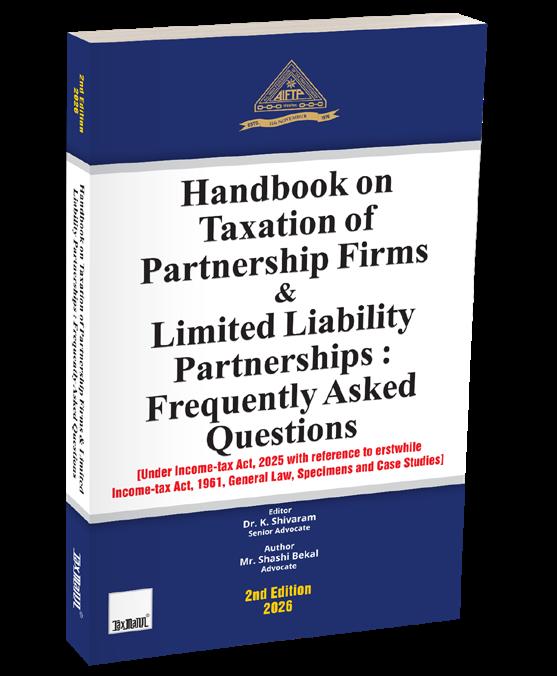
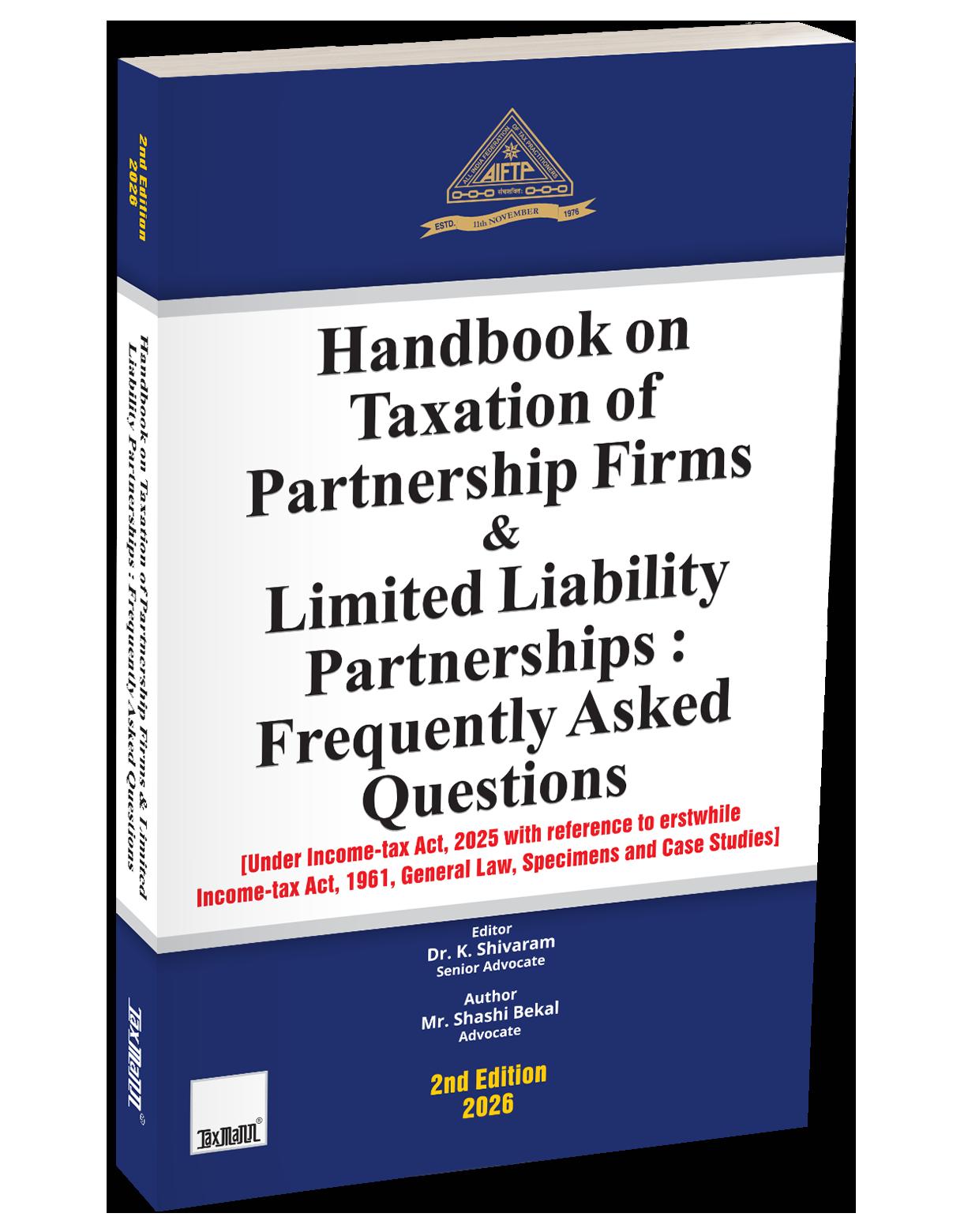
Handbook on Taxation of Partnership Firms and Limited Liability Partnerships is a question-and-answer treatise recalibrated for the Income-tax Act 2025 and continuously cross-referenced to the erstwhile Income-tax Act 1961. Commissioned by the All India Federation of Tax Practitioners (AIFTP) in its golden jubilee year, the work arrives at the moment of statutory transition: the 2025 Act renumbers and rearranges without disturbing settled interpretive jurisprudence, and Section 536(2) (j) preserves the validity of circulars, notifications and instructions issued under the 1961 Act so long as they are not in conflict with the new statute. Across 437 questions in 24 chapters, the Second Edition addresses the entire commercial and tax life of a firm—formation, partner-level economics, residency, reconstitution under Sections 8 and 67(10), conversion, set-off of losses, prosecution, stamp duty, GST, the four new Labour Codes, and assessment of AOPs and BOIs—reinforced by 13 specimen deeds, three worked case studies computing capital gains under Sections 8, 67(10) and 72(5) read with Rules 6 and 50 of the Income-tax Rules 2026, and the bare texts of allied legislation in the appendices. This book is intended for the following audience:
• Chartered Accountants and Tax Consultants
• Advocates and Senior Advocates
• In-House Tax Counsel and Finance Leadership
• Departmental Officers and Judicial Officers
• Members of the AIFTP and Other Tax Practitioner Associations
• Faculty and Post-Graduate Students
The Present Publication is the 2nd Edition, commissioned by AIFTP and published by Taxmann. It is edited by Dr K. Shivaram [Senior Advocate] and authored by Mr Shashi Ashok Bekal [Advocate], with the following noteworthy features:
• [Twin-statute Referencing on Every Provision] Each section of the Income-tax Act 2025 carries its corresponding 1961 Act section in square brackets, eliminating the need for separate renumbering lookup
• [FAQ Architecture Engineered for Retrieval] 437 numbered questions structured for direct application in assessment, advisory and litigation work, with each answer following a uniform pattern—statutory provision, judicial authority, departmental view, and the author’s analytical position
• [Judicial Substratum Carried Forward to the 2025 Regime] Supreme Court, High Court and ITAT authorities decided under the 1961 Act are integrated throughout, with express notes that such case law continues to govern the renumbered provisions in keeping with Section 536(2)(j) of the 2025 Act
• [Multi-disciplinary Treatment] Direct tax issues are read alongside the Indian Partnership Act 1932, LLP Act 2008, the Four New Labour Codes, GST, Stamp Duty, FEMA & Overseas Direct Investment Regulations, SARFAESI, IBC, Negotiable Instruments Act, Consumer Protection Act and Arbitration Framework
• [Drafting Library of 13 Specimen Deeds] Ready-to-adapt instruments covering formation, change, exit and conversion events, drafted to reflect post-2025 statutory requirements
• [Three Worked Case Studies with Computational Arithmetic] Illustrations taking the reader from book value and revaluation through to the tax effect of Sections 8, 67(10) and 72(5), and the long-term/short-term characterisation under Rules 6 and 50 of the Income-tax Rules 2026
• [Constitutional, FEMA and Overseas Dimensions] Constitutional validity of the reconstitution provisions, retrospective applicability, PE and POEM analysis for cross-border firms, overseas direct investment under the Automatic and Approval routes, and the position of foreign firms on agricultural land and legal practice in India
• [Bare Legislative Appendices] Full text of the Indian Partnership Act 1932, the LLP Act 2008, the relevant Income-tax sections and rules, and CBDT Circular No. 14 of 2021
• [Consolidated List of Cases and Subject Index] Designed for evidentiary lookup during assessment, appellate and advisory work