Sample Read
© All rights reserved
Price : ` 395
Law stated in this book is as updated till 1st February, 2026
Published by :
Taxmann Publications (P.) Ltd.
Sales & Marketing :
59/32, New Rohtak Road, New Delhi-110 005 India
Phone : +91-11-45562222
Website : www.taxmann.com
E-mail : sales@taxmann.com
Regd. Office :
21/35, West Punjabi Bagh, New Delhi-110 026 India
Printed at :
Tan Prints (India) Pvt. Ltd.
44 Km. Mile Stone, National Highway, Rohtak Road Village Rohad, Distt. Jhajjar (Haryana) India
E-mail : sales@tanprints.com
Disclaimer
Every effort has been made to avoid errors or omissions in this publication. In spite of this, errors may creep in. Any mistake, error or discrepancy noted may be brought to our notice which shall be taken care of in the next edition. It is notified that neither the publisher nor the author or seller will be responsible for any damage or loss of action to any one, of any kind, in any manner, therefrom. It is suggested that to avoid any doubt the reader should cross-check all the facts, law and contents of the publication with original Government publication or notifications.
No part of this book may be reproduced or copied in any form or by any means [graphic, electronic or mechanical, including photocopying, recording, taping, or information retrieval systems] or reproduced on any disc, tape, perforated media or other information storage device, etc., without the written permission of the publishers. Breach of this condition is liable for legal action.
For binding mistake, misprints or for missing pages, etc., the publisher’s liability is limited to replacement within seven days of purchase by similar edition. All expenses in this connection are to be borne by the purchaser. All disputes are subject to Delhi jurisdiction only.
1.1
1.1-1
1.1-3
1.1-4
1.1-5
1.1-6
BAGGAGE - INTRODUCTION
1.7
1.8
1.9
1.3-4
2.1
1.9-1
CONTROL OVER BRINGING GOODS AS BAGGAGE
2.5-1
2.5-2
2.5-3
2.5-4
2.7-2 Allowance available under transfer of residence
2.8 Import and Export of Currency
2.9 Import of Pets
2.10 Provisions regarding unaccompanied baggage
2.11 Baggage Rules apply to crew members
PROCEDURES IN RESPECT OF BAGGAGE
3.1 Declaration and clearance of baggage
3.1-1
3.1-2
3.1-3
3.1-4 Declaration in respect of unaccompanied baggage
3.1-5 Declaration in physical form if not submitted electronically
3.2 Declaration can be made electronically upto three days in advance and can be updated
3.2-1 Verification of declaration on basis of risk based evaluation
3.3 Declaration before departure if goods are to be re-imported
3.4 Application for Temporary duty free import for subsequent re-export
3.5 Examination and clearance of baggage
3.6 Transit of unaccompanied baggage to customs stations
3.7 Custody and disposal of detained baggage
3.7-1 Disposal of detained baggage if not claimed in 6 months
3.8 Filing of declaration by person other than passenger 39
3.9 Retention of records of declarations for five years 39
APPENDICES
Appendix 1 : Relevant provisions of Customs Act, 1962 43
Appendix 2 : Baggage Rules, 2026 46
Appendix 3 : Customs Baggage (Declaration and Processing) Regulations, 2026 57
Appendix 4 : Guidelines for uniform implementation of Baggage Rules, 2026 75
Appendix 5 : Effective rate of duty on baggage 87
Appendix 6 : Exemption from additional duty to baggage 89
Appendix 7 : Concessional rate of duty for specified goods imported by a passenger as baggage 90
Appendix 8 : Revised procedure for Import of Pets/Live Animals 92
Appendix 9 : Regulation of import of pet dog and pet cat under the Live-stock Importation Act, 1898 : Facilitation for final Quarantine Clearance 98
Appendix 10 : Exemption to specified goods imported for display or use at any specified event such as meetings, exhibitions, fairs or similar show or display 100
Appendix 11 : Import of gold and silver as baggage 104
Appendix 12 : Exemption to samples, price lists, commercial samples or prototypes imported as baggage or by post, air or courier service and prototypes of engineering goods imported as samples for executing or securing export orders 107
Control over bringing goods as baggage 2
2.1 CUSTOMS CONTROL OVER BAGGAGE
Provisions in respect of importing goods as baggage are summarised in Baggage Rules, 2026.
2.1-1 Goods prohibited for imports in baggage
Following articles are prohibited to import as baggage:
(A) Articles specified as prohibited in Appendix 1 to Baggage Rules, 2026 - (1) Fire arms (2) Cartridges of fire arms exceeding 50 (3) Cigarettes exceeding 100 sticks or cigars exceeding 25 or tobacco exceeding 125 gms (4) Alcoholic liquor or wines in excess of two litres (5) Gold or silver in any form other than ornaments (6) Television.
(B) Articles prohibited for import as per Form CBD-I to Customs Baggage (Declaration and Processing) Regulations, 2026 - (1) Maps and literature where Indian external boundaries have been shown incorrectly; (2) Narcotic Drugs and Psychotropic Substances (3) Goods violating any of the legally enforceable intellectual property rights (4) Wild life products (5) Indian counterfeit currency notes or coin; and (6) Specified live birds and animals.
2.2
DUTY FREE IMPORTS OF PERSONAL EFFECTS
A passenger, including an infant arriving in India, shall be allowed clearance of used personal effects required for satisfying daily
Para 2.2 CONTROL OVER BRINGING GOODS AS BAGGAGE 18
necessities of life and travel souvenirs, carried on the person or in his bona fide baggage, free of duty, other than those articles mentioned in Annexure-I – Rule 3 of Baggage Rules, 2026.
“Personal effects” means all articles (new or used) which a passenger may reasonably require for his personal use during the journey, taking into account all the circumstances of the journey, but excluding any goods imported or exported for commercial purposes – Rule 1(g) of Baggage Rules, 2026.
“Infant” means a child not more than two years of age – Rule 1(e) of Baggage Rules, 2026.
Jewellery, furniture can be ‘personal effects’ - In Jayantilal A Shah v. K N Anantharam Aiyar, CIT (1985) 156 ITR 448 = 23 Taxman 14 (Bom. HC), it was held that those need not be used daily. As long as the effects are meant for personal use, those will be ‘personal effects’. Even furniture can be ‘personal effects’.
In CIT v. Sitadevi N Poddar (1984) 148 ITR 506 = 17 Taxman 345 (Bom. HC DB), it was held that personal effects do not have to be those worn on person of assessee. Personal effects should be clearly, commonly and ordinarily intended for personal or household use.
In Pushpa Lakhumpal Tulani v. ACC (2008) 227 ELT 368 (Del. HC DB), a wealthy lady brought jewellery (some was used and some appeared to be new) of value of Rs. 25 lakhs. There was no evidence that these have been brought with view to dispose them off. It was held that these are ‘personal effects’ and these cannot be confiscated – view confirmed in DRI v. Pushpa Lekhumal Tolani (2017) 353 ELT 129 (SC), where in fact, value of gold and diamond jewellery was Rs. 1.27 crores – followed in Razia Begum v. CC (2025) 394 ELT 270 = 33 Centax 320 (Del. HC DB) * Mohammad Idres v. CC (2025) 394 ELT 280 = 32 Centax 261 (Del. HC DB).
In Rubeena Khalid v. CC 2001(137) ELT 446 (CEGAT), it was held that a college girl bringing one gold chain and six gold bangles (total weight 135 gms) cannot be considered as an attempt to smuggle those ornaments.
In H. H. Maharaja Rana Hemany Singhji v. CIT AIR 1976 SC 662 = 103 ITR 61 (SC), it was observed, ‘To constitute ‘personal effects’, an intimate connection between the effects and the person of the assessee must be shown to exist’. In this case, it was held that furniture, household utensils, wearing apparel etc. could be ‘personal effects’. However, silver coins, gold sovereigns, silver bars which were used on festivals cannot be said to be for personal use.
In CIT v. HH Maharani Usha Devi (1998) 231 ITR 793 = 98 Taxman 309 (SC), it was held that jewellery for personal use is ‘personal effects’, even if it is used on ceremonial occasions only.
In Smt Shree Kumari Mundra v. CIT (2000) 112 Taxman 253 (Cal. HC DB), it was held that household articles and utensils could be ‘personal effects’ though not very expensive decorative pieces. It was held that silver utensils in reasonable quantity can be ‘personal effects’. In Himatlal C Valia v. CIT (2001) 114 Taxman 269 (Guj. HC DB), silver dinner sets used occasionally for dinner parties were held as ‘personal effects’.
Jewellery in personal use is ‘personal effects’ and is not required to be declared - Jewellery or ornaments in bona fide personal use of tourist would not be excluded from ‘personal effects’ defined in Baggage Rules, 2016. Gold bangles tourist worn may be part of her personal effects are not required to be declared. Baggage Rules interpretation should not unnecessarily burden tourist –Anjali Pandey v. Union of India (2025) 27 Centax 32 (Del HC DB) * Saba Simran v. Union of India (2025) 27 Centax 34 = 394 ELT 403 (Del HC DB) – SLP dismissed by SC - CC v. Saba Simran (2025) 32 Centax 132 = 394 ELT 27 (SC) – followed in Razia Begum v. CC (2025) 394 ELT 270 = 33 Centax 320 (Del HC DB).
Used jewellery worn by passenger would fall within ambit of personal effects in terms of Baggage Rules and detention of the same itself would be contrary to law - Manan Karan Sharma v. Commissioner of Customs (2025) 31 Centax 380 (Del HC DB).
Personal jewellery not acquired abroad not subject to monetary limit - Jewellery’ in Rule 2(vi) of Baggage Rules, 2016 must be read (a) in conjunction with previous versions of Baggage Rules
2.2
and CBEC’s clarificatory Circular No. 72/98-Cus., dated 24-91998; and (b) as inclusive of articles newly acquired as opposed to used personal jewellery which may have been borne on person while exiting country or carried in their baggage; hence, personal jewellery, not acquired on overseas trip and used personal effect of passenger, would not be subject to monetary limit - Saba Simran v. Union of India (2025) 27 Centax 34 = 394 ELT 403 (Del HC DB) – SLP dismissed by SC - CC v. Saba Simran (2025) 32 Centax 132 (SC) – followed in Razia Begum v. CC (2025) 394 ELT 270 = 33 Centax 320 (Del HC DB).
2.2-1 CBIC instructions in respect of Jewellery
Import of jewellery is always looked with suspicion by customs department.
Views of CBIC, as given in para 2(iv) of CBIC circular No. 04/2026-Customs, dated 1-2-2026 are as follows. [It is clear that views of department and of customs are widely different]. Views of Customs are as follows:
(a) Used Personal jewellery and valuables as used personal effects.- Used personal effects, including personal jewellery and valuables required for daily necessities of life, carried on the person or in bona fide baggage, shall be allowed duty free clearance under the Baggage Rules, 2026, subject to risk-based verification.
(b) Jewellery and valuables not forming part of used personal effect:—
(
i) Jewellery and valuable, other than those required for daily necessities of life, brought by a passenger in bona fide baggage, shall not be allowed duty free, however, the same may be allowed on payment of applicable duty.
(ii) Jewellery and valuable, other than those required for daily necessities of life, brought by a resident, tourist of Indian origin, or a foreigner with a valid visa, other than tourist visa, in bona fide baggage may be allowed duty free clearance at the time of
OF ARTICLES WHICH WERE TAKEN OUT
its re-import, on the basis of an export certificate where such articles had been taken out earlier from India.
(iii) Jewellery and valuable, other than those required for daily necessities of life, bi ought by tourists in bona fide baggage for use during their stay in India, may be allowed subject to declaration at the time of arrival, issuance of temporary baggage import certificate and mandatory re-export at the time of departure.
(iv) Non- bona fide jewellery or valuables or such articles, not declared or not complying with the prescribed conditions, shall attract duty as per the Baggage Rules, 2026 and shall be dealt with strictly under the Customs Act, 1962.
(c) Special allowance or jewellery.- Eligible residents and tourists of Indian origin residing abroad for more than one year shall be allowed a special duty-free jewellery allowance as prescribed under the Baggage Rules, 2026. Jewellery within the prescribed allowance shall be cleared duty free, while jewellery in excess of such allowance shall be assessed to applicable customs duty.
2.3 RE-IMPORT OF ARTICLES WHICH WERE TAKEN OUT
Any article of personal effects other than used personal effects required for satisfying daily necessities of life, taken out earlier by the resident or tourist of Indian origin or foreigner with a valid visa, other than tourist visa, or member of his family, from India shall be allowed free of duty, on submission of declaration made at the time of his departure from India electronically or otherwise, subject to the satisfaction of the same by the Deputy Commissioner of Customs or Assistant Commissioner of Customs, as the case may be – Rule 4(1) of Baggage Rules, 2026.
“Tourist” means a person not ordinarily resident in India and who enters India for a stay of not more than six months in the course of any twelve months period for legitimate non-immigrant purposes – Rule 1(i) of Baggage Rules, 2026.
“Resident” means a person ordinarily residing in India and holding a valid passport issued under the Passports Act, 1967 – Rule 1(h) of Baggage Rules, 2026.
“Foreigner with a valid visa, other than tourist visa” means a foreigner possessing a valid visa, other than a tourist visa and staying in India for more than six months – Rule 1(d) of Baggage Rules, 2026.
Risk based verification - The passengers availing the facility under this rule, may be subject to risk based verification – Rule 4(3) of Baggage Rules, 2026.
2.4 TEMPORARY IMPORT BY TOURIST
Any article of personal effects other than used personal effects required for satisfying daily necessities of life, carried by a tourist, required for his stay in India, may be allowed to be imported temporarily free of duty, on submission of a declaration made electronically or otherwise, and subject to their re-export at the time of leaving India for a foreign destination – Rule 4(2) of Baggage Rules, 2026.
“Personal effects” means all articles (new or used) which a passenger may reasonably require for his personal use during the journey, taking into account all the circumstances of the journey, but excluding any goods imported or exported for commercial purposes – Rule 1(g) of Baggage Rules, 2026.
Risk based verification - The passengers availing the facility under this rule, may be subject to risk based verification – Rule 4(3) of Baggage Rules, 2026.
2.5 GENERAL FREE ALLOWANCE
Goods upto certain limited can be imported as baggage without payment of customs duty. This is termed as ‘General Free Allowance’.
2.5-1 General Free Allowance for resident or tourist or foreigner with valid visa
A resident or a tourist of Indian origin or foreigner with a valid visa, other than tourist visa, not being an infant, arriving in
India other than by land, shall be allowed clearance free of duty articles other than those mentioned in Annexure-I, up to the value of Rs. 75,000, if such articles are carried on the person or in the bona fide accompanied baggage of the passenger – Rule 5 of Baggage Rules, 2026.
“Foreigner with a valid visa, other than tourist visa” means a foreigner possessing a valid visa, other than a tourist visa and staying in India for more than six months – Rule 1(d) of Baggage Rules, 2026.
“Infant” means a child not more than two years of age – Rule 1(e) of Baggage Rules, 2026.
“Resident” means a person ordinarily residing in India and holding a valid passport issued under the Passports Act, 1967 – Rule 1(h) of Baggage Rules, 2026.
A passenger of the eighteen years of age or above, other than a crew member, shall be allowed clearance of one new laptop including notepad free of duty in bona fide baggage– third proviso to Rule 5 of Baggage Rules, 2026.
The free allowance of a passenger shall not be allowed to pool with the free allowance of any other passenger – Explanation to Rule 5 of Baggage Rules, 2026.
2.5-2 General Free Allowance for tourist of foreign origin
A tourist of foreign origin, not being an infant, arriving in India other than by land, shall be allowed clearance free of duty articles other than those mentioned in Annexure-I, up to the value of rupees 25,000, if these are carried on the person or in the bona fide accompanied baggage of the passenger – first proviso to Rule 5 of Baggage Rules, 2026.
“Infant” means a child not more than two years of age – Rule 1(e) of Baggage Rules, 2026.
2.5-3 General Free Allowance cannot be pooled
The free allowance of a passenger shall not be allowed to pool with the free allowance of any other passenger – Explanation to Rule 5 of Baggage Rules, 2026.
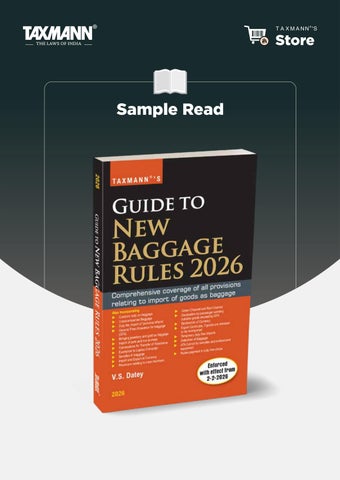
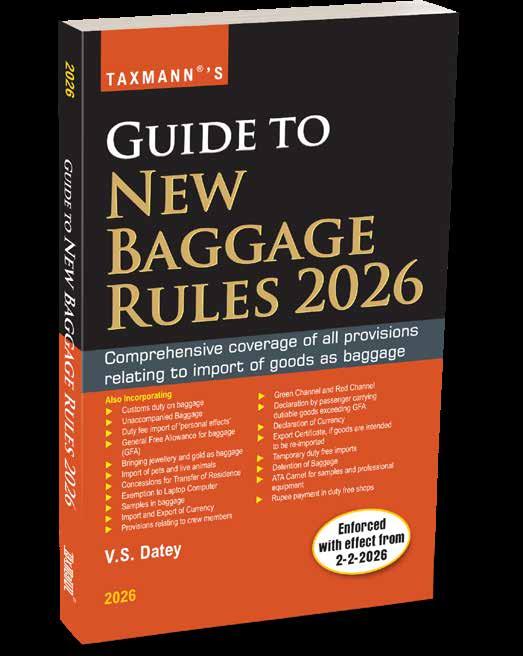
GUIDE TO NEW BAGGAGE RULES 2026
AUTHOR : V.S. Datey
PUBLISHER : Taxmann
EDITION
ISBN NO
NO. OF PAGES BINDING
DATE OF PUBLICATION : February 2026 : 2026 Edition : 9789375611486 : 120
TYPE
Rs. 395
: Paperback
DESCRIPTION
Guide to New Baggage Rules 2026 is a comprehensive, implementation-ready and statute-backed handbook that explains India's revamped passenger baggage regime introduced through the Baggage Rules 2026 and the Customs Baggage (Declaration and Processing) Regulations 2026, both enforced with effect from 2nd February 2026. The book translates the new baggage framework into a clear, operational system—covering duty-free allowances, duty computation, valuation, declaration procedures, Green/Red Channel mechanics, detention and disposal processes, and compliance consequences under the Customs Act. It explains statutory provisions under the Customs Act 1962, including declaration of baggage, determination of the relevant date for duty and valuation, bona fide baggage exemptions, temporary detention and return of goods, and CBIC's regulation-making powers. It also clarifies what constitutes baggage (including unaccompanied baggage), outlines practical boundaries of the baggage framework, and highlights general prohibitions and restrictions impacting passengers—such as currency controls, narcotics, wildlife products, endangered species articles, pets and live animals. A defining strength of this book is its integration of the complete baggage law ecosystem. It brings together:
•Rules (entitlements and exclusions)
•Regulations (declaration and processing framework, certificates and detention)
•CBIC Master Circular for uniform implementation
•Key Notifications and appendices determining effective duty incidence, exemptions, concessional schemes, and special categories such as gold/silver, samples, pets and ATA Carnet
This publication is intended for users who require clarity, procedural certainty and defensibility in baggage-related matters, including:
•Customs & Trade Practitioners
•Chartered Accountants, Company Secretaries & Cost Accountants
•Advocates
•Customs Brokers & Airport Logistics Professionals
•NRIs/OCIs/Returning Residents/Frequent Travellers
•Customs Officers & Passenger Facilitation Teams
The Present Publication is the 2026 Edition, updated till 1st February 2026. It is authored by V.S. Datey, with the following noteworthy features:
•[Complete Coverage of the New Baggage Regime] End-to-end exposition of the 2026 baggage framework—rules, regulations, forms, guidelines and key notifications in one place
•[Duty & Valuation Clarity in Practical Terms] Explains baggage-specific duty architecture and valuation principles
•[Category-wise Allowances Made Actionable] Covers General Free Allowance (GFA), jewellery, laptop and crew allowances, including land-route restrictions and non-pooling rules
•[Procedure-first Compliance Guidance] Step-by-step guide to declarations, channel selection, advance filing and risk-based verification
•[Special Situations Covered Exhaustively] Unaccompanied baggage, Transfer of Residence, temporary imports, re-imports and detention procedures
•[Operational Toolkit Included] Full reproduction of CBD forms and procedural certificates