Sample Read
© All rights reserved
Price : ` 1275
Law stated in this book is as amended by the Finance Act, 2026
Published by :
Taxmann Publications (P.) Ltd.
Sales & Marketing : 59/32, New Rohtak Road, New Delhi-110 005 India
Phone : +91-11-45562222
Website : www.taxmann.com
E-mail : sales@taxmann.com
Regd. Office : 21/35, West Punjabi Bagh, New Delhi-110 026 India
Printed at :
Tan Prints (India) Pvt. Ltd.
44 Km. Mile Stone, National Highway, Rohtak Road Village Rohad, Distt. Jhajjar (Haryana) India
E-mail : sales@tanprints.com
Disclaimer
Every effort has been made to avoid errors or omissions in this publication. In spite of this, errors may creep in. Any mistake, error or discrepancy noted may be brought to our notice which shall be taken care of in the next edition. It is notified that neither the publisher nor the author or seller will be responsible for any damage or loss of action to any one, of any kind, in any manner, therefrom. It is suggested that to avoid any doubt the reader should cross-check all the facts, law and contents of the publication with original Government publication or notifications.
No part of this book may be reproduced or copied in any form or by any means [graphic, electronic or mechanical, including photocopying, recording, taping, or information retrieval systems] or reproduced on any disc, tape, perforated media or other information storage device, etc., without the written permission of the publishers. Breach of this condition is liable for legal action.
For binding mistake, misprints or for missing pages, etc., the publisher’s liability is limited to replacement within seven days of purchase by similar edition. All expenses in this connection are to be borne by the purchaser. All disputes are subject to Delhi jurisdiction only.
3.3
3.4
Thoughts for this Segment - is ‘Works Contract’ Under GST Regime a Move Back to the Purer Concept of ‘Works Contract’
CHAPTER 3
CHAPTER 4
4.1
4.2
CHAPTER 5
CHAPTER 6
CHAPTER 7
7.7
CHAPTER 8
CHAPTER 9
CHAPTER 11 CASE STUDIES TO PRACTICALLY UNDERSTAND WHETHER A CONTRACT WOULD QUALIFY AS ‘WORKS CONTRACT’
CHAPTER 12
CHAPTER 15
‘Place of Supply’
CHAPTER 16
PLACE OF SUPPLY
CHAPTER 17
Taxability of Liquidated Damages - Judgments under European Union (‘EU’) VAT which may be Relevant from an Indian GST Perspective in the Coming Days
CHAPTER 18
RATES AS APPLICABLE ON VARIOUS TYPES OF WORKS CONTRACTS 18.1 Advance Rulings on Various Aspects of Services to ‘Government/Governmental Authority/Entity and Eligibility for Concessional GST Rate for Such Services
CHAPTER 19
Key Differences in ‘Works Contract’ in the Pre and Post GST ERA
20.1
20.2
20.3
CHAPTER 20
TRANSITION PROVISIONS UNDER GST FOR WORKS CONTRACT
Section 140(3) of the CGST Act - Transition of Credit of Goods in Stock
Section 140(6) of the State Goods and Services Tax ActTransition of Credit in Case of Tax Levied at Fixed Rate
Section 142 of the Central Goods and Services Tax ActTransition Provisions Dealing with Continuous Contracts
20.4 Issue of Transition Credit under Section 140(3) of the CGST Act in Respect of Inputs (i.e. Cement, Steel, etc.) that Were Procured under the Erstwhile Taxation Regime and Utilized in Construction of Buildings that Were Semi-Finished/under Construction as on July 1, 2017, i.e., the Date When GST GOT Implemented
CHAPTER 21
CHAPTER 22
CHAPTER 23
23.4 Sale of Immovable Property and Constructed Flats (i.e. Where Completion Certificate has been Issued by the Competent Authority)
23.5 Advance Ruling Pertaining to a Scenario Where Separate Contracts are Entered into for the Construction Activity and the Underlying Undivided Share of Land: In Re: Sanjeev Sharma [2018-VIL-10-AAR]
23.6
23.7
23.8 Appendix I to this Chapter - Excerpt of Relevant Portions of Notification No. 8/2017-IGST (Rate), dated 28-6-2017
CHAPTER 24
WORKS CONTRACT AND IMPLICATIONS FOR ROADS/HIGHWAYS
24.1
24.2 Taxability of the Annuity Payments Received by Concessionaire under the GST Regime for Construction, Operation and Maintenance of
CHAPTER 25
WORKS CONTRACTS AND IMPLICATIONS ON PORTS
CHAPTER
CHAPTER
CHAPTER
CHAPTER
30.2 Anti-Profiteering under the GST Regime
30.2A Summary of Key Orders from the National Anti-Profiteering Authority (“NAA”)
30.3 Delhi High Court Judgment Upholding Constitutional Validity of the Anti-Profiteering Provisions - Key Points
30.4 Contractual Documentation Related Aspects
CHAPTER 31
PRACTICAL STRATEGIES VIS-A-VIS STRUCTURING
OF
VARIOUS TYPES OF WORKS CONTRACT UNDER GST
31.1 Contract Structuring for Tax Optimization – Genesis
31.2 Contract Structuring for Tax Optimization - Relevant Under GST too?
31.3 Practical Strategies and Considerations for Contract Structuring under GST
31.4 ‘Substance Test’ for Upholding of Contract Structuring from a Tax Perspective
31.5 Advance Ruling in the Case of EMC Limited and other Advance Rulings on Contract Structuring (2018-VIL-31- AAR)
CHAPTER 32
WHAT HAPPENS TO ‘NO-INCOME TAX’ POSITION FOR OFFSHORE SUPPLIES UNDER A SINGLE EPC CONTRACT, POST GST?
32.1 ‘No Income Tax’ Position for Offshore Supplies under a Single EPC Contract Can Continue Post GST - Key Arguments in Favour
32.2 Concluding Thoughts
CHAPTER 33
BEST
PRACTICES FOR
TAX CONTROVERSY MANAGEMENT UNDER GST
33.1 Tax Controversy - Prevention and Cure
ANNEXURES
u ANNEXURE 1 - RELEVANT CGST RATE SCHEDULE FOR SERVICES 407
u ANNEXURE 2 - MAHARASHTRA GST ACT - NEW COMPOSITION SCHEME FOR BUILDER AND DEVELOPER
417
u ANNEXURE 3 - RELEVANT EXPLANATORY NOTES TO THE SCHEME OF CLASSIFICATION OF SERVICES 422
INTERPLAY BETWEEN COMPOSITE SUPPLY, MIXED SUPPLY AND WORKS CONTRACTS
8.1 ‘WORKS CONTRACTS’ ARE ‘COMPOSITE SUPPLIES’
Under the previous chapters we have discussed the guiding principles and methodologies for determination of whether a contract amounts to a ‘works contract’ or is a ‘composite supply’ or a ‘mixed supply’ contract. The concept of ‘composite supplies’ and/or ‘mixed supplies’ is an innovation under GST with the legislative intent to prevent splitting of singular contracts into their constituent elements and thereby application of different rate to such constituent elements. This also accords with the legislative ideal of GST which seeks to prevent the proliferation of different rate of GST on different supplies.
The Supreme Court in its decision in Union of India v. Mohit Minerals (2022) 10 SCC 700 has explained the idea behind the introduction of the concept of composite supplies under GST in the following terms:—
“165. The provisions of composite supply in the CGST Act (and the IGST Act) play a specific role in the levy of GST. The idea of introducing ‘composite supply’ was to ensure that various elements of a transaction are not dissected and the levy is imposed on the bundle of supplies altogether. This finds specific mention in the illustration provided under Section 2(30) of CGST Act, where the principal supply is that of goods. Thus, the intent of the Parliament was that a transaction which includes different aspects of supply of goods or services and which are naturally bundled together, must be taxed as a composite supply.
A works contract is necessarily a composite supply since all the ingredients as follows are satisfied:
A works contract involves taxable supply of goods and services;
The goods and services (related to the fourteen types of activities mentioned therein) are generally naturally bundled in ordinary course of business and supplied in conjunction with each other.
Once it is established that the ‘works contract’ is a contract for ‘composite supply’ of goods and services, the next questions that come to the mind of the readers is
What would be the principal supply?
Taxability of works contract - whether as goods or service?
The answer to the above lies in the Schedule II appended to the CGST Act. This schedule categorically specifies whether a particular supply is a supply of goods or service.
Two entries under this Schedule are relevant:
i. Entry 5(b) which states that - “The following shall be treated as supply of services, namely :—”
(b) “construction of a complex, building, civil structure or a part thereof, including a complex or building intended for sale to a buyer, wholly or partly, except where the entire consideration has been received after issuance of completion certificate, where required, by the competent authority or after its first occupation, whichever is earlier”
Explanation.—For the purposes of this clause—
(1) the expression “competent authority” means the Government or any authority authorized to issue completion certificate under any law for the time being in force and in case of non-requirement of such certificate from such authority, from any of the following, namely:—
(i) an architect registered with the Council of Architecture constituted under the Architects Act, 1972; or
(ii) a chartered engineer registered with the Institution of Engineers (India); or
(iii) a licensed surveyor of the respective local body of the city or town or village or development or planning authority;
(2) the expression “construction” includes additions, alterations, replacements or remodelling of any existing civil structure
ii. Entry 6 - Composite supply
The following composite supplies shall be treated as a supply of services, namely:—
(a) works contract as defined in clause (119) of section 2.
Therefore, a ‘Works Contract’ shall always be treated as a supply of service falling under entry 5(b) or entry 6, irrespective of whether the ‘principal supply’ therein is goods or services.
Now, admittedly, there is a bit of an anomaly here - entries 5 and 6 belong to Schedule II of the CGST Act which draws power from section 7(1)(d) of the CGST Act pertaining to “activities to be treated as supply of goods or supply of services” whereas it is section 8 which pertains to determination of ‘composite’ and ‘mixed’ supplies. Entry 6 in Schedule II, by starting with the words, “The following composite supplies….” is at best a drafting oversight and at worst, a vulnerability which can be used to contend that Entry 6 of Schedule II is ultra vires the CGST Act and thus ought to be struck down*.
8.2 ANALYSIS OF ENTRY 5(b) VERSUS ENTRY 6
Clause 5(b) of Schedule II to the CGST Act provides that construction of a complex, building, intended for sale to a buyer, except where the entire consideration is received after issuance of completion certificate, would be classified as a ‘supply of service’. In other words, under construction flats shall be covered by this Entry.
Under service tax laws, a separate class of services i.e. construction of complex services was defined in a similar fashion.
Similarly, Clause 6(a) of Schedule II provides that the ‘works contract service’ would also be classified as a ‘supply of service’. The term ‘works contract’ has been defined under Section 2(119) and is excerpted below once again for ease of reference:
‘(119) “works contract” means a contract for building, construction, fabrication, completion, erection, installation, fitting out, improvement, modification, repair, maintenance, renovation, alteration or commissioning of any immovable property wherein transfer of property in goods (whether as goods or in some other form) is involved in the execution of such contract’
The definition of the term ‘works contract’ specifically includes within it the activity of construction of immovable property. 71 ANALYSIS OF ENTRY 5(b) VERSUS ENTRY 6 Para 8.2
* Reference in this regard can be made again to the article by Manish Sachdeva, Supra
On the basis of the above provisions, it can be concluded that the activities of construction of immovable property can be classified as a supply of service either under entry 5(b) or under entry 6(a) of Schedule II to the CGST Act.
The larger bench of the Supreme Court interpreted the definition of the term ‘works contract’ in the case of Larsen & Toubro (2014) 1 SCC 708, to hold that even in case of real estate transactions of sale of under-construction flats, the developer is constructing the said flat(s) for the purchaser and not for himself and therefore, such contracts amount to ‘works contract’.
It is pertinent to note that the 101st Constitution Amendment Act, 2016, whereby, the Centre and State Governments are empowered to make laws for levying GST, has not made any amendments in the Article 366(29A)(b) of the Constitution which provides tax on sale or purchase of Goods and was relied upon heavily by the Supreme Court in the Larsen & Toubro (supra) case. Article 366(29A)(b) reads as:
“a tax on the transfer of property in goods (whether as goods or in some other form) invoked in the execution of a works contract”
Thus, considering the fact that the nature of real estate transaction involved in the above cited case (i.e. L&T decision) remains unchanged even post GST, the law laid down by the aforementioned decision of the Hon’ble Supreme Court will continue to hold the ground and hence, the activity on construction of immovable property should undoubtedly qualify as a ‘works contract service’.
In other words, the mere fact that ‘construction of complex’ is mentioned separately does not mean that ‘construction of complex’ would not qualify as a ‘works contract’ as defined under Goods and Service Tax.
At this juncture, it is critical to understand the reason for existence of Schedule II to the CGST Act. Schedule II is envisaged under Section 7(d) of the CGST Act. Section 7 defines ‘supply’ which is the taxable event under GST. Sub-sections (a), (b) and (c) of Section 7 outline various aspects and inclusions to the definition of ‘Supply’. In a similar manner, Schedule II also specifically enumerates certain activities as ‘supply of goods’ or ‘supply of services’ - conceptually speaking, Schedule II is a successor to the ‘Declared Service’ concept under service tax law. As per the fifth bullet to para 1.4 of the Education Guide issued under Service Tax in 2012, “To remove some ambiguities certain activities have been specifically defined by description as services and are referred as Declared Services”.
Schedule II also serves the same purpose - it puts together ‘supplies’ which could have led to ambiguities vis-a-vis levy of GST and clarifies certain ‘supplies’ to be ‘supply of services’ and certain others to be ‘supply of goods’. The entry 5(b) or entry 6(a) of Schedule II are thus not mutually exclusive, water-tight
compartments - they are to be read conjointly to understand that construction contracts will qualify as ‘supply of services’.
Classification of services, including that of ‘construction contracts’ are covered separately under GST laws and is discussed in the next chapter. It is advisable that readers classify construction services appropriately since the rates of tax and the mechanism for determining the value of service may be different as we will study in the succeeding chapters. The specific context of real estate transactions would also be elaborated upon in a subsequent segment dealing with sector specific nuances.
8.3 CASE STUDY
A company is in the process of constructing a residential complex with the intention to sell and transfer the units and car parking therein to purchaser together with rights to use and occupy the common areas and facilities. For the purposes of constructing such residential complex, the Company engages the construction services of a contractor and also procures manpower and intermediary services of real-estate brokers.
The company is the owner of the property on which the construction of the residential complex is to take place. The company has appointed the contractor for carrying out the construction of the residential complex wherein the contractor besides performing the activity of construction also supplies the goods for the same. Although the project is still under construction, the company has entered into sale and purchase agreement with individual buyers for the sale of residential units. Applying the ratio of L&T II decision of the Supreme Court (discussed supra) to the instant transaction, the sale of under construction flat units to prospective buyers will qualify as works contract service as per Section 2(119) of the CGST Act read with Clause 6(a) of Schedule II.
It is pertinent to mention here that Schedule II of the CGST Act clarifies that a construction service including a complex or building intended for sale to a buyer wholly or partly shall be treated as a supply of service. It also separately clarified that a works contract is also to be treated as a service under the GST regime. It is important to understand that Schedule II is only relevant for concluding whether a supply is a supply of service or supply of goods. It has no impact on availment of input tax credit. For determining the availability of input tax credit under Sections 16 and 17 of the CGST Act, the definition of works contract under Section 2(119) is only relevant.
The services provided by contractor for construction of residential complex are in the nature of works contract services as contractor is also supplying goods along with such services. Since the outward services of the company is also in
the nature of work contract services, the company can take input tax credit of such services (to the extent of sale of under-construction flats).
8.4 KEY ADVANCE RULING PRONOUNCED UNDER GST AS RELEVANT FOR THIS CHAPTER
(i) Vihan Enterprises - [2018] 97 taxmann.com 579 (AAR-Madhya Pradesh)
Questions Raised: What is the nature of the supply vis a vis construction of pooling sub-station along with associated transmission line and associated feeder bay work on total turnkey basis under World Bank Financing?
Held: The work involves both supply of goods and supply of services, which are naturally bundled. Accordingly, under this agreement, the applicant is providing a composite supply - The agreement involves construction of Pooling Sub-station on Turnkey Basis and falls under the definition of a “Works Contract” within the meaning of the CGST Act. The HSN Code would be 995423 under Group 99542 for the supply of composite service in the nature of works contract and is liable to GST at 18% rate.
It is pertinent to note here that the applicant’s contract was with Rewa Ultra Mega Solar Limited (“RUMS”) - RUMS had taken a position that since the work is part of evacuation infrastructure being exclusively for solar power, for a solar park and is being developed by Solar Project Park Developer, the rate of 5% should be applicable. This was rightly rejected by the AAR by highlighting that the said concessional rate of 5% is applicable only for supply of goods and not for services.
(ii) Dinesh Kumar Agrawal - [2018] 95 taxmann.com 295 (AARMaharashtra)
Questions Raised: The applicant was a prospective contractor undertaking different works for supply of goods and services. Scope of works included procurement and supply of goods, transportation of goods from vendor and assembly and erection and commissioning. The question raised was - whether transportation charges received by the applicant are liable to tax under GST, especially when the applicant is not a goods transport agency (GTA).
Held - The AAR held that the applicant’s understanding that there is a standalone contract for transportation of equipment for which separate consideration is received, is incorrect. From the conjoint reading of the clauses of the agreement it could be safely concluded by the AAR that the contract was a single contract for engineering, procurement and
construction of a solar power plant and thus constituted a composite supply in the nature of works contract. Accordingly, the transportation charges received by the applicant are also to be liable to GST as a works contract as per provisions of section 2(119) of the CGST Act.
(iii) EIFFEL Hills and Dales Developers Private Limited [2018] 100 taxmann.com 314 (AAR-Maharashtra)
Questions raised: The applicant is a construction company engaged in the business of Mechanical, Electrical and Plumbing (MEP) turnkey project contracting & engineering. The MEP activities provided by the applicant include design, engineering, supply, installation and commissioning of plumbing, firefighting and electrical infrastructure systems to a wide range of commercial projects. The applicant was venturing into an agreement with a developer/builder to provide MEP services for an affordable housing project. The said housing project satisfies the definition of affordable housing described in Notification No. 13/6/2009 - INF dated 30th March, 2017 by Ministry of Finance, Department of Economic Affairs thereby enjoying the Infra status within the meaning of Central Tax (Rate) Notification No. 1/2018, dated 25th January 2018.
In this background the following question was raised: Whether MEP activities (Mechanical, Electrical & Plumbing Works) undertaken by the Applicant falls within the definition of composite supply of works contract as defined under section 2(119) of CGST Act?
Held: The Authority for Advance Rulings, Maharashtra held as follows:
After a detailed scrutiny of the proposed contract of the applicant, the authority observed that the contract like the one of applicant which includes design, engineering, work laying of RCC Hume pipe/GI pipe etc. for storm waterline and construction of chambers involves more than two taxable supplies in the nature of resources, material and machinery.
It also observed that large number of service receivers of such bundle of services mostly expect plumbing work to be provided as a package in the ordinary course of business. Therefore, the plumbing contract constitute a composite supply as defined under section 2(30) of the CGST Act.
As a corollary to this finding it was also held that since (a) as per the scope of contract, the work order is for complete external plumbing work, laying of RCC Hume pipes/UPVC pipes for storm water lines, drainage line etc. including construction of chambers; and
(b) the plumbing system is either attached to earth or as the case may be, fastened to building which is attached to the earth. Therefore, the contract for plumbing work is a composite supply of works contract as defined in section 2(119) of the CGST Act.
(iv) Vikram Sarabhai Space Centre [2019] 105 taxmann.com 239 (AARKerala)
Questions raised: Whether the services of design, procurement, fitment, etc. rendered by a contractor to the applicant for construction of wind tunnel and ejector system would qualify as ‘works contract’? If yes, what will be the applicable rate?
Held: The services being in connection with an immovable property, would qualify as ‘works contract services’. The AAR further held that the services rendered to the applicant were eligible for the reduced rate of 12% in as much as the said services were being rendered to the ‘Government’ and were not to be used for any commercial purpose by the applicant given that the applicant was engaged in research and development activities.
(
v) M/s Purple Distributors Pvt. Ltd. – AAR West Bengal
Questions raised: The applicant, as a sub-contractor, undertakes the work for conversion of Short Welded Rails (“SWR”) to Long Welded Rails (“LWR”) by Flash Butt Welding process. The question before the AAR was whether this supply falls under the ambit of ‘works contract’.
It was contended by the applicant that only welding services are provided by them by using Flash Butt Welding Machine on railway tracks which can be easily detachable from the earth without any damage and no goods are transferred in the services involved. Accordingly, such services should not be treated as ‘works contract’ as defined in clause (119) of section 2 of the CGST Act. Further, they argued that as the treatment or process of welding has only been carried out on goods i.e., on railway tracks to convert from SWR to LWR and the said goods are the property of Indian Railways who is a registered person under the CGST Act, the services provided by them would fall under the ambit of job work in terms of definition laid down in section 2(68) of the CGST Act.
Held: The AAR disagreed with the applicant on the point of railway tracks being movable but agreed on the larger point that their supply would not qualify as ‘works contract’ since the supply didn’t involve transfer of property in goods.
The AAR held that the services of welding of railway track along with labour services are naturally bundled and supplied in conjunction in each other and therefore would fall under the ambit of ‘composite supply’ of
services falling under Tariff 995429 (“General construction services of civil engineering works”) and shall be taxable at 18% vide serial number 3(xii) of Notification No. 11/2017-Central Tax (Rate) dated 28-06-2017, as amended from time to time.
1,275
DESCRIPTION
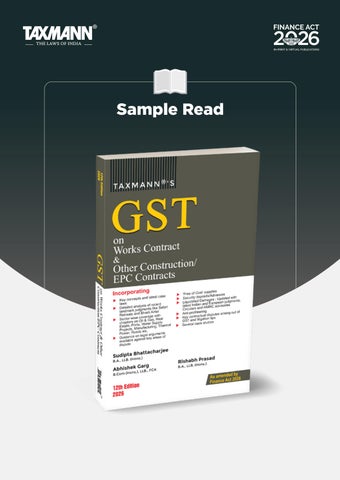
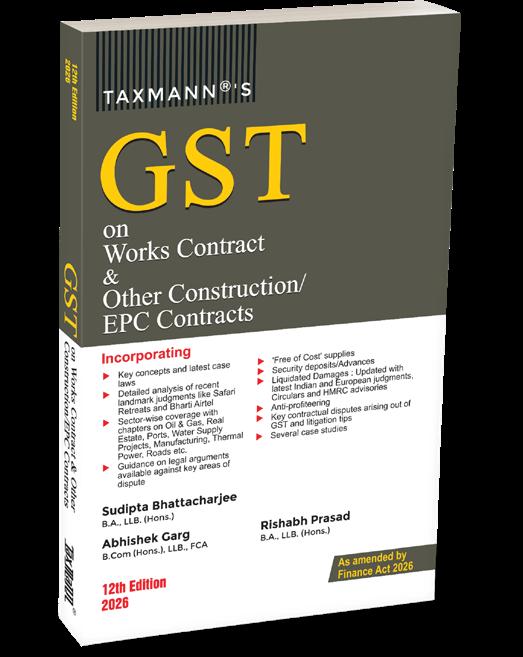
GST on Works Contract & Other Construction/EPC Contracts is a definitive practitioner's commentary on one of the most complex and persistently litigated domains under the Goods and Services Tax framework in India. Works contracts—straddling the supply of goods, services, and immovable property simultaneously—have generated a disproportionately large share of advance rulings, High Court litigation, and contractual disputes since GST's inception. This book provides an analytically rigorous treatment from first principles and constitutional underpinnings to contract structuring strategies, sector-specific implications, and litigation management techniques.
Now in its 12th Edition, within eight years of first publication, the text is comprehensively updated for the Finance Act 2026 and integrates the latest case law, including Safari Retreats and Bharti Airtel, updated guidance on liquidated damages drawing from Indian judgments, EU VAT jurisprudence, HMRC advisories and recent circulars, and current anti-profiteering precedents. The treatment spans the full contractual lifecycle, covering classification, valuation, input tax credit, place and time of supply, security deposits, free-of-cost supplies, TDS compliance, transition provisions, contract structuring, offshore supply mechanics, and GST controversy management.
The book simplifies the intricacies of GST law with sector-specific insights across oil & gas, real estate, manufacturing, thermal power, roads, ports, and water supply projects. Case studies, practical examples, and landmark judgments demystify the complexities around liquidated damages, security deposits/advances, anti-profiteering, and valuation, while dedicated litigation strategies help professionals anticipate and manage disputes. This book is designed for professionals who deal with works contracts and construction/EPC agreements in a substantive legal, commercial, or compliance capacity:
• Tax Lawyers and Litigators
• Chartered Accountants and Indirect Tax Advisors
• In-House Legal and Tax Teams
• Contract Managers, Procurement Heads, and Project Finance Professionals
• Government and Public Sector Undertakings
• Advance Ruling Applicants and Parties Appearing Before the National Anti-Profiteering Authority
The Present Publication is the 12th Edition | 2026, amended by the Finance Act 2026. It is authored by Sudipta Bhattacharjee, Rishabh Prasad & Abhishek Garg, with the following noteworthy features:
•[Finance Act 2026 Updated] All amendments introduced by the Finance Act 2026 are incorporated, making this the most current edition available
•[Landmark Judicial Pronouncements] Detailed analysis of Safari Retreats (Supreme Court), Bharti Airtel, and a wide body of High Court and advance ruling decisions
•[Sector-Specific Coverage] Dedicated chapters on Oil & Gas, Real Estate, Roads/Highways, Ports, Thermal Power, Solar Power, Large Manufacturing Plants, and Water Supply Projects—each addressing the contractual structures, rate schedules, and ITC positions specific to that sector
•[Liquidated Damages] Comprehensively updated with the latest Indian judgments, EU VAT precedents, recent circulars, and HMRC advisories—essential given the sustained controversy over GST leviability
•[Free-of-Cost Supplies] Addresses valuation complexities arising when customers supply materials, equipment, or services without separate billing—one of the most practically contested issues in works contract GST compliance
•[Security Deposits & Advances] Discrete treatment of mobilisation advances, material advances, retention money, and security deposits, clarifying when these trigger GST liability
•[Contract Structuring Strategies] Practical guidance on structuring composite EPC, offshore supply, and split-contract models, with the substance test framework required to sustain such structures
•[Anti-Profiteering] Analysis of the Section 171 framework, key NAA orders, and the Delhi High Court judgment upholding constitutional validity, with guidance on contractual documentation
•[Litigation & Controversy Management] Chapter 33 provides a dedicated framework on GST dispute prevention, documentation, and litigation conduct, including writ petition strategy
•[Case Studies] Practical worked examples distributed across chapters to test classification, ITC eligibility, composite supply analysis, and contract structuring
•[Comparative International Perspective] A dedicated chapter on construction contracts under Australian GST, EU VAT, and GCC VAT laws, providing a framework for comparative legal arguments