Store
© All rights reserved Price : ` 1725 Law stated in this book is as updated till November, 2025 Published by : Taxmann Publications (P.) Ltd. Sales & Marketing : 59/32, New Rohtak Road, New Delhi-110 005 India Phone : +91-11-45562222 Website : www.taxmann.com E-mail : sales@taxmann.com Regd. Office : 21/35, West Punjabi Bagh, New Delhi-110 026 India Printed at : Tan Prints (India) Pvt. Ltd. 44 Km. Mile Stone, National Highway, Rohtak Road Village Rohad, Distt. Jhajjar (Haryana) India E-mail : sales@tanprints.com Disclaimer Every effort has been made to avoid errors or omissions in this publication. In spite of this, errors may creep in. Any mistake, error or discrepancy noted may be brought to our notice which shall be taken care of in the next edition. It is notified that neither the publisher nor the author or seller will be responsible for any damage or loss of action to any one, of any kind, in any manner, therefrom. It is suggested that to avoid any doubt the reader should cross-check all the facts, law and contents of the publication with original Government publication or notifications. No part of this book may be reproduced or copied in any form or by any means [graphic, electronic or mechanical, including photocopying, recording, taping, or information retrieval systems] or reproduced on any disc, tape, perforated media or other information storage device, etc., without the written permission of the publishers. Breach of this condition is liable for legal action. For binding mistake, misprints or for missing pages, etc., the publisher’s liability is limited to replacement within seven days of purchase by similar edition. All expenses in this connection are to be borne by the purchaser. All disputes are subject to Delhi jurisdiction only.
Contents PAGE
About the Author Preface Gratitude Appeal provisions at a Glance Provisions of Appeal as per the CGST Act Legal Maxims and their application in GST Law Quick Referencer GSTAT (Procedure) Rules, 2025 Chapter-heads List of Cases
I-5 I-7 I-9 I-11 I-15 I-29 I-47 I-65 I-81
DIVISION 1 APPELLATE REMEDIES UNDER GST LAW
1 OVERVIEW OF NOTICES UNDER GST LAW 1.1 1.2
Background of litigation under GST law Show cause of notice is the foundation of any indirect tax disputes
1.3 1.4
2 NOTICES UNDER SECTIONS 73, 74 AND 74A 2.1 Overview of sections 73, 74 and 74A 2.2 Settled principles of extended period of limitation 2.3 General Principles of SCN 2.4 Established principles of SCN 2.5 Other aspects of SCN Appendix I-69
1.7 1.15 1.22 1.29 1.35 1.40
CONTENTS
I-70 PAGE
3 REPLY AND ADJUDICATION OF SCN 3.1 Reply to show cause notice 3.2 Adjudication & Representation 3.3 Adjudication order 3.4 Other aspects of adjudication 3.5 Qualities of good adjudication order 3.6 Way forward on the adjudication order Appendix
1.79 1.82 1.92 1.96 1.97 1.99 1.100
4 RIGHT TO APPEAL 4.1 Right to file an appeal 4.2 Appeal against decision or order 4.3 Judicial views on the right to appeal 4.4 Relevance of filing an appeal 4.5 Purpose of Appeal 4.6 Provisions and forum of appeal under GST Appendix
1.108 1.109 1.110 1.112 1.112 1.113 1.131
5 APPEALABLE ORDER 5.1 5.2 5.3 5.4 5.5 5.6 5.7
Appealable order Maintainability of appeal Meaning of “order” or “decision” Non-challenge of an appealable order and its subsequent effects Appeal against the order by the successful party Non-Appealable decisions or orders Refusal of appeal by the Tribunal in certain cases
1.146 1.147 1.152 1.153 1.155 1.158 1.159
6 PERSON ELIGIBLE TO FILE AN APPEAL 6.1
Person eligible to file an appeal
1.160
6.2
‘Person Aggrieved’ does not include Revenue
1.162
I-71
CONTENTS
PAGE
6.3
Joint Appeals
1.163
7 DEPARTMENTAL APPEAL Remedies available to the Department to review the validity of the order 7.2 Statutory provisions of appeal by the Department 7.3 The Commissioner must check the legality or propriety of the order 7.4 Authorisation of the Commissioner is mandatory 7.5 Can the officer review his own order passed in another capacity 7.6 Appeal not to be filed in certain cases Appendix
7.1
1.167 1.168 1.169 1.171 1.174 1.175 1.180
8 FORMS AND MANNER OF FILING OF AN APPEAL 8.1 8.2 8.3 8.4 8.5
Forms for filing an appeal Procedure for filing first appeal before Appellate Authority Procedure for filing appeal before Appellate Tribunal Procedure for filing an appeal by the Department before the Appellate Authority or Appellate Tribunal Other incidental aspects of filing an appeal before the Appellate Authority and Appellate Tribunal
1.184 1.185 1.197 1.206 1.209
9 WITHDRAWAL OF AN APPEAL 9.1
Withdrawal of an appeal
1.213
9.2
Statutory provision for withdrawal of an appeal
1.213
10 PREPARATION OF APPEAL MEMORANDUM 10.1
Appeal Memorandum
1.220
10.2
Key consideration before drafting an appeal memorandum
1.221
Preparation of appeal memorandum
1.223
10.3
CONTENTS
I-72 PAGE
11 ADDITIONAL GROUNDS OF APPEAL 11.1
Additional grounds of appeal
1.277
12 ADMISSION OF ADDITIONAL EVIDENCE 12.1
Admission of additional evidence
1.284
12.2
Statutory provisions for the admission of additional evidence
1.284
13 PROVISIONS OF PRE-DEPOSIT 13.1
Background of the concept of pre-deposit
1.302
13.2
Provisions of pre-deposit not taking away substantive right
1.302
13.3
Statutory Provisions of pre-deposit
1.303
13.4
Procedure and manner of making the pre-deposits
1.306
13.5
No recovery after payment of pre-deposit
1.311
13.6
Other aspects of the pre-deposit
1.313
Appendix
1.321
14 LIMITATION PERIOD FOR FILING AN APPEAL 14.1
Time limit for filing an appeal
1.333
14.2
Statutory provisions of time limit for filing an Appeal
1.334
14.3
Meaning of the word “Communicated”
1.335
14.4
Applicability of Limitation Act
1.338
14.5
Writ remedy where appeal is barred by the time limit
1.339
14.6
Limitation period would start only when the order is uploaded on the GST portal
1.342
Delay because of technical glitches on the portal should be excluded from the period of limitation
1.344
14.8
Condonation of Delay
1.344
14.9
Condonation of delay was allowed in the following Cases
1.345
14.10
Condonation of delay was refused in the following Cases
1.348
14.7
I-73
CONTENTS
PAGE
15 CROSS-OBJECTION AND CROSS-APPEAL 15.1 15.2 15.3 15.4 15.5 15.6
Right of cross-objection Provisions of cross-objection under GST law Fees for filing a memorandum of cross-objection Appeal and cross-objection/cross-appeal to be heard together Cross-objection not maintainable when impugned order entirely in favour of a party Cross-objection is an objection raised against the order impugned in the appeal and not the objection to the contents of the appeal memorandum
1.354 1.355 1.356 1.356 1.358
1.359
16 MATTER INCIDENTAL TO AN APPEAL 16.1 Opportunity of being heard 16.2 Authorised representatives 16.3 Legal representatives 16.4 Impleading of additional parties in appeal 16.5 Access to the proceedings 16.6 Copies of references 16.7 Affidavits 16.8 Application for production of documents 16.9 Return of the documents 16.10 Examination of witnesses and issue of commissions Appendix
1.360 1.365 1.367 1.368 1.368 1.369 1.369 1.369 1.370 1.370 1.372
17 RESULT OF APPEAL 17.1 17.2 17.3 17.4 17.5 17.6
Result of appeal Requirement of the order Difference of opinion amongst members Matter becomes final if not appealed subsequently Benefit of appellate order not to be denied only on the ground of further appeal being filed All the issues must be decided together
1.375 1.378 1.384 1.385 1.386 1.387
CONTENTS
I-74 PAGE
17.7 17.8 17.9
Disposal of appeal on preliminary point Enforcement of order Award of the Cost
1.388 1.389 1.389
18 LEGAL PRINCIPLES RELEVANT IN APPEAL 18.1 18.2 18.3 18.4
Principles of interpretation of taxation statutes Doctrine of Merger Binding Precedents Res Judicata
1.390 1.391 1.394 1.397
19 RECTIFICATION OF ERROR Rectification of error Statutory provision of rectification of error Meaning of apparent error Meaning of record Long-drawn process of reasoning not falling within the scope 19.6 Fresh grounds in an application for rectification of mistakes 19.7 Fresh material or additional evidence cannot be accepted 19.8 Rectification cannot be sought on the basis of a later decision favourable to the party 19.9 Judgments not cited earlier not to be considered at ROM 19.10 Second application for rectification of alleged mistake in an order rejecting an application for rectification not maintainable 19.11 Limitation period for filing an application for rectification 19.12 Principle of natural justice to be followed 19.13 Authority to rectify the error 19.14 Persons eligible to apply for rectification of errors under GST 19.15 Manner of filing application for rectification 19.16 Special procedure under section 148 of the CGST Act for rectification of demand orders issued for contravention of section 16(4) of the said Act Appendix
19.1 19.2 19.3 19.4 19.5
1.404 1.404 1.406 1.412 1.413 1.413 1.414 1.414 1.415
1.416 1.417 1.418 1.419 1.420 1.420
1.422 1.425
I-75
CONTENTS
PAGE
20 REMAND 20.1
Need for remand
1.430
20.2
Statutory provisions for remand
1.431
21 REVISION 21.1
Revision
1.432
21.2
Revisional Authority
1.433
21.3
Statutory provisions of revisions
1.433
21.4
No revision in certain cases
1.436
21.5
Procedure in case of revision of an order
1.437
21.6
Time limit for passing an order by the Revisional Authority
1.437
21.7
Binding nature of order
1.438
21.8
Appeal against the order of Revisional Authority
1.439
21.9
Admission of new grounds in revisionary proceedings
1.439
21.10
Review of own order passed in a different capacity
1.440
21.11
Jurisdiction of Revisional Authority in bail cases
1.441
22 MISCELLANEOUS ASPECTS OF THE TRIBUNAL 22.1
Registrar and powers and functions of the registrar
1.442
22.2
Delegation of powers by the president
1.443
22.3
Record of proceedings
1.443
22.4
Regulation of court work
1.443
22.5
Maintenance of registers
1.443
22.6
Organisation of case files
1.444
22.7
Preservation and destruction of records
1.444
22.8
Inspection of records
1.445
22.9
Register of appeal
1.445
22.10
Interim order of Supreme Court or High Court
1.445
22.11
Fees for filings
1.446
22.12
Dress code for members
1.446
CONTENTS
I-76 PAGE
22.13
Removal of difficulties and directions
1.446
22.14
Inspection of state benches
1.447
23 APPEAL TO THE HIGH COURT 23.1
Appeal to High Court
1.448
23.2
Appeal admitted only when the question of law is involved
1.448
23.3
Procedure for filing an appeal before the High Court
1.449
23.4
Decision on the question of law
1.450
23.5
Bench Strength of High Court to hear case under GST law
1.451
23.6
Monetary limit for filing departmental appeals before the High Court
1.451
Writ remedy before the High Court
1.451
23.7
24 APPEAL TO THE SUPREME COURT 24.1
Appeal to the Supreme Court
1.471
24.2
Form for filing an appeal before the Supreme Court
1.471
24.3
Time limit for filing an appeal before the Supreme Court
1.471
24.4
Sums due to be paid notwithstanding appeal before Supreme Court
1.472
Monetary limit for filing Departmental appeals before the Supreme Court
1.472
24.6
Judgment by the Supreme Court
1.472
24.7
Supreme Court need not give reasons in order
1.472
24.8
Special Leave Petition (SLP)
1.473
24.5
25 AMNESTY SCHEME UNDER SECTION 128A 25.1
Background to amnesty scheme
1.475
25.2
Applicability of waiver scheme
1.475
25.3
Procedure for closure of proceedings under section 128A
1.476
25.4
Processing of application and issuance of order
1.484
Appendix
1.489
I-77
CONTENTS
PAGE
DIVISION 2 ISSUES AND GROUNDS OF APPEAL ISSUE 1 : Mismatch between the liability declared in FORM GSTR-1 vs. FORM GSTR-3B
2.3
ISSUE 2 : Mismatch between the liability declared in FORM GSTR-1/GSTR-3B vs. e-way bill data
2.10
ISSUE 3 : Mismatch between the liability declared in FORM GSTR-1/GSTR-3B vs. GSTR-7
2.18
ISSUE 4 : Mismatch between the liability declared in FORM GSTR-1/GSTR-3B vs. GSTR-8
2.27
ISSUE 5 : Mismatch between the RCM liability declared and paid in FORM GSTR-3B on inward supplies vs. RCM liability auto-populated in FORM GSTR-2A/2B
2.35
ISSUE 6 : Liability determined under RCM on the basis of various expenses ledger recorded in the books of account
2.39
ISSUE 7 : Adjustment of excess payment of tax in subsequent returns
2.47
ISSUE 8 : Interest on debit note
2.53
ISSUE 9 : Cash discount received for early payment to the supplier
2.57
ISSUE 10 : Taxability in case of liquidated damages
2.61
ISSUE 11 : Taxability in the case of notice pay recovery
2.64
ISSUE 12 : Taxability in the case of other income
2.68
ISSUE 13 : Mismatch in ITC claimed in GSTR-3B and reflected in GSTR-2A
2.73
ISSUE 14 : Disallowance of Input Tax Credit due to non-payment of tax by supplier under section 16(2)(c) of the CGST Act
2.87
ISSUE 15 : Reversal of ITC on Account of Cancellation of Registration of the Supplier
2.95
ISSUE 16 : ITC on Retention Money - Non-payment of Consideration within 180 days
2.102
ISSUE 17 : Availment of ITC and depreciation on capital goods
2.106
ISSUE 18 : Reversal of ITC under rule 42 & rule 43 of the CGST Rules
2.111
CONTENTS
I-78 PAGE
ISSUE 19 : ITC on vehicles used for the transportation of employees
2.114
ISSUE 20 : ITC on Furniture
2.122
ISSUE 21 : ITC on Solar Power Plant used for captive consumption
2.129
ISSUE 22 : ITC on Repairs and Maintenance of immovable property
2.135
ISSUE 23 : ITC on Prefabricated Structure
2.138
ISSUE 24 : Reversal of ITC on account of normal loss in the production process
2.146
ISSUE 25 : Reversal of ITC on the canteen facility provided to employees
2.151
ISSUE 26 : Reversal of ITC on Written-Off Inputs and Capital Goods
2.159
DIVISION 3 SPECIMEN LETTERS AND APPLICATIONS BEFORE THE APPELLATE TRIBUNAL FORMAT NO. 1
: Vakalatnama/Authorisation
3.3
FORMAT NO. 2
: Application for condonation of delay
3.4
FORMAT NO. 3
: Application for admission of additional grounds
3.6
: Application for admission of additional evidence
3.8
: Application for extension of period in submission of documents
3.10
: Application for filing reply by the respondent to the application filed by on account of admission of additional grounds and additional evidence
3.12
: Application for condonation of delay in filing reply to application made by the appellant
3.14
: Rejoinder against the reply filed by the respondent
3.16
: Application for cross-examination
3.20
FORMAT NO. 4 FORMAT NO. 5 FORMAT NO. 6
FORMAT NO. 7 FORMAT NO. 8 FORMAT NO. 9
FORMAT NO. 10 : Application for withdrawal of the appeal
3.22
I-79
CONTENTS
PAGE
FORMAT NO. 11 : Application for urgent hearing and early hearing
3.23
FORMAT NO. 12 : Application for preponement of hearing
3.25
FORMAT NO. 13 : Application for adjournment of hearing
3.27
FORMAT NO. 14 : Application for online/offline hearing
3.29
FORMAT NO. 15 : Covering letter for filing paper book before the tribunal
3.31
FORMAT NO. 16 : Draft paper book index
3.32
FORMAT NO. 17 : Compilation of relied upon decisions
3.34
FORMAT NO. 18 : Miscellaneous application for hearing two matters together
3.36
FORMAT NO. 19 : Miscellaneous application for change of authorised representative
3.38
FORMAT NO. 20 : Request for transfer of matter to a singlemember bench
3.40
FORMAT NO. 21 : Request for transfer of matter to larger bench
3.42
FORMAT NO. 22 : Request for transfer of matter to principal bench
3.44
DIVISION 4 STATUTORY PROVISIONS CHAPTER 1 : Relevant provisions of Appeals and Revision under the Central Goods and Services Tax Act, 2017
4.3
CHAPTER 2 : Relevant rules pertaining to Appeals and Revision under the Central Goods and Services Tax Rules, 2017
4.19
CHAPTER 3 : GSTAT (Procedure) Rules, 2025
4.26
CHAPTER 4 : Provisions of Amnesty Scheme 2024
4.54
CHAPTER 5 : Forms pertaining to Appeals and Revision
4.60
CHAPTER 6 : Forms pertaining to Amnesty Scheme
4.105
Subject Index
i
8 CHAPTER
FORMS AND MANNER OF FILING OF AN APPEAL 8.1 FORMS FOR FILING AN APPEAL Exercising the option of filing an appeal is a crucial decision. The right to appeal is a valuable right and the person aggrieved is expected to exercise such option only after assessment of relevant facts of the case, legal provisions of law relevant to the case, judicial pronouncement etc. This analysis helps a person to identify the possibility of getting relief against the injustice arising from the order passed. Filing an appeal also involves the financial cost. One will also have to look into the opportunity cost involved in filing an appeal in terms of time and effort involved and the possibility of getting a favourable outcome and penal action in cases where the outcome is adverse. Therefore, the pros and cons of filing an appeal must be analysed before proceeding to file an appeal. A person is required to file an appeal in the prescribed manner and form. The form and manner of filing an appeal is prescribed in Chapter XIII of the CGST Rules. The following forms are notified for filing of appeal at different stages of appeal— Sr. No.
Stage of Appeal
Form notified
1.
Appeal to Appellate Authority by Aggrieved Person
Form GST APL - 01
2.
Appeal to Appellate Authority by Department
Form GST APL - 03
3.
Appeal to Appellate Tribunal
Form GST APL - 05
4.
Cross-objections before the Appellate Tribunal
Form GST APL - 06
5.
Application to the Appellate Tribunal by the Department Form GST APL - 07
6.
Appeal to the High Court
Form GST APL - 08
1.184
1.185
FORMS AND MANNER OF FILING OF AN APPEAL
Para 8.2
8.2 PROCEDURE FOR FILING FIRST APPEAL BEFORE APPELLATE AUTHORITY Appellate Authority is the first forum of appeal where the decisions or orders of the Adjudicating Authority are appealable under section 107 of the CGST Act. The appeal can be filed by either of the following persons: (a) Person aggrieved by such decision or order (b) Department Section 107(2) of the CGST Act categorically differentiates the Department from the aggrieved person. Therefore, the Department cannot be called as an aggrieved person. The differentiation is needed as the time limit for filing an appeal and the form for filing an appeal is different in the case of an appeal by the Department. The step-by-step process of filing an appeal in both cases is discussed as under—
8.2.1 Procedure for filing an appeal by aggrieved person Rule 108 of the CGST Rules provides the procedure for filing an appeal under section 107(1) of the CGST Act by the aggrieved person before the Appellate Authority. Rule 108(1) of the CGST Rules provides that an appeal to the Appellate Authority under sub-section (1) of Section 107 shall be filed in FORM GST APL-01, along with the relevant documents, electronically and a provisional acknowledgement shall be issued to the appellant immediately. Therefore, FORM GST APL-01 is notified as the form of appeal for filing an appeal before the Appellate Authority. The aggrieved person is required to prepare an appeal memorandum and make the written submission in FORM GST APL-01. 8.2.1.1 Contents of FORM GST APL-01: FORM GSTAPL-01 contains the following details— Sr. No. 1.
Particulars
Description
Details of aggrieved The appellant is required to provide the basic details person such as—
- GSTIN/Temporary ID/UIN; - Legal name of the appellant; - Trade name, if any; and - Address. 2.
Details of order
The appellant herein requires providing the details of the order number and date, designation and address of the officer who has passed the order and date of communication of an order.
Para 8.2
APPELLATE REMEDIES UNDER GST LAW
1.186
Sr. No.
Particulars
Description
3.
Name of the authorised representative
The appellant is required to provide the name of the authorised person who shall sign the appeal memorandum.
4.
Brief issue of the The appellant is required to brief the issue involved in case under dispute the case. The list of issues is defined in the form on the common portal.
5.
Description and The appellant is required to provide the description and classification of the tariff classification of the goods or services (i.e. HSN goods/services in or SAC) in respect of which dispute has arisen. dispute
6.
Period of dispute
The appellant needs to provide the period for which the dispute relates.
7.
Amount of Dispute
The appellant is required to provide the amount of tax along with interest, penalty, fees and other charges against each head of CGST, SGST, IGST and Cess.
8.
Market Value of The appellant is supposed to provide the market value seized goods of the seized goods, wherever applicable.
9.
Whether the appel- The appellant is required to provide if he wishes to be lant wishes to be heard in person before the Appellate Authority. heard in person
10.
Statement of Facts
The detailed facts of the case, the appellant is required to provide herein.
11.
Grounds of appeal
The appellant is required to submit the grounds on which he is filing an appeal before the Appellant Authority.
12.
Prayer
In the prayer part, the appellant requests the Appellate Authority to provide relief against the order passed by the Adjudicating Authority.
13.
Amount of demand The appellant is required to provide the details of the created, admitted demand created, admitted and the amount for which and disputed the appellant wants to contest.
14.
Details of payment The appellant is required to provide the details of payment of admitted amount of the admitted amount and pre-deposit paid. and pre-deposit
15.
Whether appeal is The appellant is required to provide whether the appeal being filed after the is filed within the stipulated time period and the reason prescribed period for delay if the appeal is filed beyond the prescribed time along with the period of delay.
Most of the fields mentioned above are auto-populated when an appeal is filed electronically on the GST common portal. However, the appellant is required to make a written submission on certain points such as the Statement of Facts and Grounds of Appeal and such written submission along
1.187
FORMS AND MANNER OF FILING OF AN APPEAL
Para 8.2
with necessary documents would be required to be uploaded on the portal in PDF format. 8.2.1.2 Manner of filing of an appeal: The Appellant is required to file an appeal before the Appellate Authority electronically in FORM GST APL01 along with the requisite documents. Therefore, the appellant must understand the functionality of filing an appeal on the GST common portal before filing an appeal. The Appellant can file an appeal on the GST common portal using the following steps— Step 1: Log in to GST common portal: Access the common portal using the URL www.gst.gov.in> login using valid credentials >On the dashboard Click the Services >User Services> My Application
Step 2: Select the Appeal to Appellate Authority option: Select “Appeal to Appellate Authority” option from the list of application types available in my application menu and click on “New Application”
Para 8.2
APPELLATE REMEDIES UNDER GST LAW
1.188
Step 3: Select the order type and insert the order number: The Portal will redirect to the FORM GST APL-01: Appeal to Appellate Authority page by clicking on the “New application button”. Select the option Yes if the order pertaining to Multiple Financial Years or No to proceed with a single Financial Year. Select the Order Type from the drop-down list.
The types of orders issued by Adjudicating Authority under GST law are categorised into different types on the Common portal. The appellant would be required to select the applicable one from the following categories:
Enforcement order
Assessment - Demand order
Assessment non-demand order
Registration order
Refund order
Assessment Non-Demand order
LUT Order
After selecting the category and filling in the order number in the “Order No” field, the appellant can search the details of the order. In case the appellant applied for the rectification of the order, the appeal cannot be filed against the original order. However, an appeal against the rectified order can be filed.
1.189
FORMS AND MANNER OF FILING OF AN APPEAL
Para 8.2
Step 4: Select the Category of the case under dispute: After searching for the details of the case, the appellant is required to select the category of the case under dispute from the drop-down. The Common portal categorizes the type of dispute in the following categories:
Misclassification of any goods or services or both
Wrong applicability of a notification issued under the provisions of
this Act
Incorrect determination of time and value of supply of goods or ser-
vices or both
Incorrect admissibility of input tax credit of tax paid or deemed to
have been paid
Incorrect determination of the liability to pay tax on any goods or
services or both
Whether applicant is required to be registered
Whether any particular thing done by the applicant results in supply
of goods or services or both
Rejection of application for registration on incorrect ground
Cancellation of registration for incorrect reasons
Transfer/Initiation of recovery/special mode of recovery
Tax wrongfully collected/Tax collected not paid to Government
Determination of tax not paid or short paid
Refund on wrong ground/refund not granted/ interest on delayed
refund
Fraud or wilful suppression of fact
Anti-profiteering related matter; and
Others
Para 8.2
APPELLATE REMEDIES UNDER GST LAW
1.190
The appellant can add more than one category, where the appeal is filed for more than one issue. Similarly, the appellant can click on the delete button to delete the category. The date of communication and period of dispute shall be auto-populated. However, the appellant can edit the same. Step 5: Preparation and uploading of Annexures to appeal: The appellant would be required to upload a PDF copy of the written submissions prepared by him as discussed. The appellant can download the templates of annexures to FORM GST APL-01 that are available on the “GST APL-01: Appeal to Appellate Authority” page. The appellant is required to upload the annexures to appeal in PDF format. The maximum size of the annexures to appeal is restricted up to 5 MB.
Step 6: Details of demand created, admitted and disputed: After uploading annexures to GST-APL-01, the appellant would be required to furnish the details of disputed amount and payment details. The appellant needs to provide the following—
The amount of total demand created by the Adjudicating Authority
The amount which the appellant has admitted out of above details;
and
The remaining amount which is in dispute
After clicking on the disputed amount/payment details tab, the appellant shall be redirected to Disputed Amount/Payment Details page. The page is divided into 5 different tables. In the first table the appellant is required to provide the details of amount under dispute
1.191
FORMS AND MANNER OF FILING OF AN APPEAL
Para 8.2
Amount of demand created and admitted is the second table which the appellant requires to confirm. The Table is further divided into following two sub-tables. (1) Amount of demand created and (2) Amount of demand admitted
The figures of Amount of demand admitted table is auto calculated by the portal after reporting figures in the table of amount of dispute. Details of payment of pre-deposit is another important table in which system calculates the pre-deposit amount. The amount is auto calculated by the common portal.
Para 8.2
APPELLATE REMEDIES UNDER GST LAW
1.192
In case of liability under IGST head, the appellant is required to provide the place of supply wise disputed amount and admitted amount as under—
Details of payment of admitted amount and pre-deposit appears in the following table—
1.193
FORMS AND MANNER OF FILING OF AN APPEAL
Para 8.2
Remaining amount of amount payable on account of admitted amount and pre-deposit will be auto populated in the last table as under—
The Appellant is required to make the payment by clicking on utilize ITC/ CASH. Total liability would be shown on the next page which is frozen, and the appellant cannot make changes in said table.
The Appellant is allowed to make the payment of admitted liability and pre-deposit from Electronic Cash Ledger and Electronic Credit Ledger. The appellant can make the payment as per the availability of balance and as per the provisions of pre-deposit from Electronic Cash Ledger and Electronic Credit Ledger. The appellant can make the payment of admitted liability and pre-deposit by clicking on the Set off button.
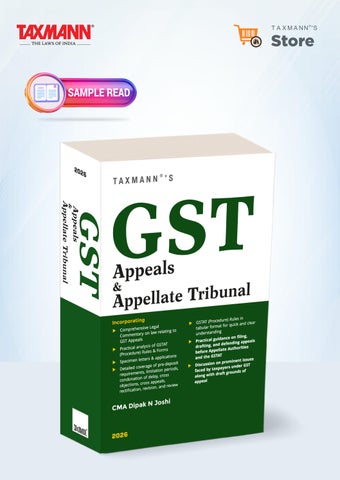
GST APPEALS & APPELLATE TRIBUNAL
Rs. 1,725/-
AUTHOR
: Dipak N Joshi
PUBLISHER
: Taxmann Publications
DATE OF PUBLICATION
: December 2025
EDITION
: 2026 Edition
ISBN NO
: 9789371263429
NO. OF PAGES
: 988
BINDING TYPE
: PAPERBACK
DESCRIPTION GST Appeals & Appellate Tribunal is a focused, practice-driven commentary that streamlines the entire appellate framework under India's GST law. This Edition offers a clear, step-by-step understanding of the appeals process—right from filing before the Appellate Authority to advancing matters before the GST Appellate Tribunal (GSTAT). It explains FORM GST APL-01 and APL-05 in a simplified manner, along with all annexures, disclosures, and procedural requirements. Key components, such as the case summary, statement of facts, grounds of appeal, classification details, valuation particulars, and pre-deposit calculations, are explained clearly. The book also decodes the GSTAT (Procedure) Rules, including filing mandates, scrutiny checks, defect rectification, and documentary compliance. Supported by specimen drafts, templates, and practical drafting strategies, this Edition bridges statutory procedure with appellate practice. This book is intended for the following audience: • GST Practitioners, Chartered Accountants, Cost Accountants & Company Secretaries • Advocates & Tax Litigators • Corporate Tax Teams & In-house Counsels • Departmental Officers & Adjudicating Authorities • Students, Academicians & Researchers The Present Publication is the Latest 2026 Edition, updated till November 2025. This book is authored by CMA Dipak N Joshi, with the following noteworthy features: • [Granular Procedural Commentary] Stepwise guidance on filing appeals, including electronic submission of APL-01, identification of auto-populated fields, and the drafting requirements for APL-05, such as cause title, party details, act coverage, annexures, and respondent particulars • [Comprehensive Explanation of GSTAT (Procedure) Rules] Coverage of filing norms under Rule 18, documentary requirements under Rule 21, and Registrar-level processes for scrutiny, rectification, and defect handling • [Specimen Letters, Applications & Draft Pleadings] Templates for condonation of delay, rectification, review, revision, adjournment, draft grounds, written submissions, and rejoinders • [Practical & Issue-wise Drafting Guidance] Instructions for preparing Annexure-based case histories, issue-wise summaries, and financial break-ups across CGST/SGST/IGST/Cess • [Tabular Presentation of Rules & Forms] GSTAT Rules presented in simplified comparative tables for instant reference • [Insight into Taxpayer Issues & Litigation Trends] Commentary on disputes involving valuation, classification (HSN/SAC), ITC denial, refunds, natural justice lapses, penalties, and prosecution • [Pre-deposit Compliance & Limitation Strategy] Guidance on admitted vs. disputed amounts, proof of pre-deposit, and drafting condonation applications
BUY NOW