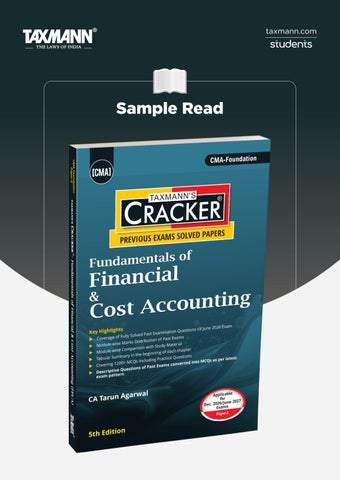

Sample Read


© All rights reserved
Price : ` 325
Fifth Edition : June 2026
Published by :
Taxmann Publications (P.) Ltd.
Sales & Marketing : 59/32, New Rohtak Road, New Delhi-110 005 India
Phone : +91-11-45562222
Website : www.taxmann.com
E-mail : sales@taxmann.com
Regd. Office : 21/35, West Punjabi Bagh, New Delhi-110 026 India
Printed at :
Tan Prints (India) Pvt. Ltd.
44 Km. Mile Stone, National Highway, Rohtak Road Village Rohad, Distt. Jhajjar (Haryana) India
E-mail : sales@tanprints.com
Disclaimer
Every effort has been made to avoid errors or omissions in this publication. In spite of this, errors may creep in. Any mistake, error or discrepancy noted may be brought to our notice which shall be taken care of in the next edition. It is notified that neither the publisher nor the author or seller will be responsible for any damage or loss of action to any one, of any kind, in any manner, therefrom.
No part of this book may be reproduced or copied in any form or by any means [graphic, electronic or mechanical, including photocopying, recording, taping, or information retrieval systems] or reproduced on any disc, tape, perforated media or other information storage device, etc., without the written permission of the publishers. Breach of this condition is liable for legal action.
For binding mistake, misprints or for missing pages, etc., the publisher’s liability is limited to replacement within seven days of purchase by similar edition. All expenses in this connection are to be borne by the purchaser. All disputes are subject to Delhi jurisdiction only.
1.14 MODULE 1 : ACCOUNTING FUNDAMENTALS

Q.8. Valuation of crops at market value is in accordance with:
(a)Matching Principle
(b)Revenue Recognition Principle
(c)Cost Principle
(d)None of the above
Ans. (b) Revenue Recognition Principle
Q.9. The principle which treats all rupees alike whether it is a rupee of 1957 or 2007:
(a)Money measurement principle
(b)Periodicity principle
(c)Consistency principle
(d)Accounting entity principle
Ans. (a) Money measurement principle
Q.10. A purchased a building on 01.04.2020 for ` 50,00,000, on 01.04.2024 it was found that it would cost ` 80,00,000 to purchase a similar building. This ` 80,00,000 is:
(a)Historical cost
(b)Realisable value
(c)Current cost
(d)Present cost
Ans. (c) Current cost
Q.11. State the case where going concern concept is applied:
(a) When an enterprise was set up for a particular purpose, which has been achieved or to be achieved shortly
(b) When a receiver or liquidator has been appointed in case of a company which is to be liquidated
(c)Fixed assets are acquired for use in the business for earning revenues and are not meant for resale.
(d)When an enterprise is declared sick
Ans. (c) Fixed assets are acquired for use in the business for earning revenues and are not meant for resale.
Q.12. If market value of the closing stock is reduced below cost than which of the following concepts will come in to play:
(a)Materiality
(b)Business entity
(c)Realisation concept
(d)Consistency concept
Ans. (c) Realisation concept
CHAPTER 1.3
CAPITAL AND REVENUE TRANSACTIONS
Quick Revision of the chapter
Important Concepts
Capital Expenditures
Capital Expenditure refers to that expenditure, benefit from which can be enjoyed by an entity over a number of accounting periods. This type of expenditure happens to be non-recurring in nature. A capital expenditure takes place when an asset or service is acquired or improvement of a fixed asset is affected. These assets resulting from such expenditure are not intended for resale in the ordinary course of business.
Example: Purchase of machinery; Construction of building; Development of website; Heavy repairs of a non-current asset etc.
Accounting Treatment: An expenditure of capital nature is not written off completely (i.e. charged) against income in the accounting period in which it is acquired. Rather, it is capitalised (i.e. recorded) as an asset and gets reflected in the balance sheet. However, over time the amount of capital expenditure sliced for being recognized as revenue expenditure i.e. it gets gradually charged against the profit.
Revenue Expenditure
Revenue Expenditure refers to that expenditure, benefit from which can be enjoyed by an entity in the current accounting period. This type of expenditure happens to be recurring in nature. Revenue expenditures are incurred to carry on the regular course of operations by an organisation.
Example: Purchase of goods for sale; payment of recurring expenses (like salaries, wages, rent, depreciation, conveyance charges, monthly internet charges etc.); Repairs and maintenance of non-current assets etc.
Accounting Treatment: An expenditure of revenue nature charged as an expense against profit of the accounting period in which it is incurred or recognised.
Rules for Identification of Capital Expenditure:
An expenditure can be recognised as capital if it is incurred for the following purposes:
An expenditure incurred for the purpose of acquiring long-term assets (useful life is at least more than one accounting period) for use in the organisation to carry on its operations (and not meant for resale) will be treated as a capital expenditure.
When an expenditure is incurred to improve the present condition of a machine or putting an old asset into working condition, it is recognised as a capital expenditure. The expenditure is capitalised and added to the cost of the asset. Likewise, any expenditure incurred to put an asset into working condition is also a capital expenditure.
An expenditure incurred for improving the earning capacity of an organisation will be considered to be of capital nature.
Preliminary expenses incurred before the commencement of business is considered capital expenditure.
Deferred Revenue Expenditures
Deferred Revenue Expenditure is the expenditure for which payment has been made or a liability has been incurred but which is carried forward on the presumption that will be of benefit over a subsequent period or periods.
As per guidance Note on Terms used in Financial Statements issued by Institute of Chartered Accountants of India:
Deferred revenue expenditures are a combination of capital and revenue expenses whose usefulness does not expire in the year of their occurrence, but generally expires in the near future. This type of expenditures are carried forward and are
written-off in future accounting periods. A portion of such expenditure is capitalised even though it is revenue in nature, and hence is also referred to as Capitalised Revenue Expenditure.
Example: Heavy advertisement expenditure incurred prior to launching a new product; Development expenses of a product etc.
Accounting Treatment: A part of such expenditure (the expense portion) is recorded in the debit-side of the Income Statement, while the unwritten-off portion appears as an asset in the Balance Sheet.
Note: After the issuance of AS-26, the expenditures which were recognised as deferred revenue expenditure has to be treated as simple revenue expense. The accounting standard has specifically mentioned that any expenditure incurred for research, training, advertising and promotional activities should be recognised as an expense of the accounting period in which it has been incurred.
Capital Receipts
Capital Receipts refer to the receipts which are obtained by an entity from operations other than the regular operations of the entity. Capital receipts do not have any effect on the operating result (i.e. profits earned or losses incurred) during the course of a year.
Example: Additional capital introduced by proprietor/partners; receipts from issue of fresh shares, by a company; proceeds from sale of long-term assets etc.
Accounting Treatment: Such receipt is credited to the respective account of capital nature, and gets reflected in the Balance Sheet.
Revenue Receipts
Revenue Receipts refer to the receipts which are obtained by an entity from its regular course of operations. Receipts of money in the revenue nature increase the profits or decrease the losses of a business and must be set against the revenue expenses in order to ascertain the profit for the period.
Example: Collection from customers for goods sold on credit; Fees received for services rendered in the ordinary course of business; Recovery from customers earlier written-off as bad etc.
Accounting Treatment: These are recognised as income and should be credited to the Income Statement.
Capital Profit refers to a profit which arises out of the non-operating activities of an entity. It is non-recurring in nature. Generally, capital profits arise out of the sale of assets other than inventory, or in connection with the raising of capital or at the time of purchasing an existing business.
Examples: Profit prior to incorporation; Premium received on issue of shares; Profit made on reissue of forfeited shares; Redemption of Debenture at a discount; Profit made on sale or revaluation of a non-current tangible asset etc.
Accounting Treatment: Capital profits are generally capitalised i.e. transferred to a Capital Reserve Account.
Revenue Profit refers to a profit which arises out of the regular operating activities of an entity. It is recurring in nature.
Example: Profit arising out of the sale of the merchandise that the business deals in; Profit made by rendering regular services to clients; Surplus earned by a non-profit organisation, etc.
Accounting Treatment: Revenue profits, which get determined in the Income Statement, are distributed to the owners of the business or transferred to any Reserve Account.
Capital Losses
Capital Loss refers to a loss which does not arise to an entity in the regular course of its operations.
Example: Capital losses may result from the sale of assets other than inventory for less than written down value; Diminution/elimination of assets other than as the result of use or sale i.e. from extra-ordinary activities (viz. loss by flood, fire etc.) or in connection with raising debt capital by a company (issue of debentures at a discount) or on the settlement of liabilities for a consideration more than its book value (debenture issued at par but redeemed at a premium).
Accounting Treatment: It is either charged against the revenue i.e. debit-side of Income Statement or reflected in the asset-side of Balance Sheet (as fictitious assets).
Revenue Loss
Revenue Loss arise to an entity from the normal course of business. Example: Discount allowed to customers for prompt payment; loss due to bad debts etc.
Accounting Treatment: Such loss is to be recorded in the debit-side of Income Statement.
PAST EXAMINATION QUESTIONS
THEORY QUESTIONS
Q.1. ` 8,000 is spent of travelling expenses of the partner to a foreign trip for purchased of an asset to be used for the business is a/an-
(a) Capital Expenditure
(b) Revenue Expenditure
(c) Revenue Loss
(d) Capital Loss [Dec.2014,June2015]
Ans. (a) Capital Expenditure
Q.2. The expenditure of ` 2000 incurred on a trial run of newly purchased machine is:
(a) Preliminary expenses
(b) Capital expenditure
(c) Revenue expenditure
(d) Deferred revenue expenditure [March2015]
Ans. (b) Capital expenditure
Q.3. If repair cost is ` 20,000, white wash expenses are ` 10,000, cost of extension of building is ` 3,50,000 and cost of improvement in Electrical wiring system is ` 19,000 the amount to be expensed i.e.:
(a) ` 3,99,000
(b) ` 39,000
(c) ` 30,000
(d) ` 49,000 [Sept.2015]
Ans. (c) ` 30,000
Q.4. Money spent ` 20,000 as travelling expenses of the directors on trips abroad for purchase of Capital assets is:
(a) Capital expenditure
(b) Revenue expenditures
(c) Deferred revenue expenditures
(d) None of the above [Dec.2015]
Ans. (a) Capital expenditure
Q.5. Which of the following is not a revenue expenditure?
(a) Petrol consumed in motor vehicles
(b) Cost of saleable goods
(c) Bad debts
(d) Premises given on lease [June2016]
Ans. (d) Premises given on lease
Q.6. Capital expenses are shown in:
(a) Balance sheet
(b) Profit and loss A/c
(c) Trading A/c
(d) None of these [June2016,June2019, Dec.2022]
Ans. (a) Balance sheet
Q.7. Life membership fees received by a club is a:
(a) Revenue Expenditure
(b) Capital Expenditure
(c) Deferred Revenue Expenditure
(d) Capital Receipt [June2017,Dec.2022]
Ans. (d) Capital Receipt
Q.8. Import duty of raw material purchased is a:
(a) Revenue Expenditure
(b) Capital Expenditure
(c) Deferred Revenue Expenditure
(d) None of the above [June2017,June2019]
Ans. (a) Revenue Expenditure
Q.9. A bad debt recovered during the year will be:
(a) Capital Expenditure
(b) Revenue Expenditure
(c) Capital Receipt
(d) Revenue Receipt [June2017,Dec.2022,June2023]
Ans. (d) Revenue Receipt
Q.10. House Building Advance of 2.00 lakh paid to employees. It is a:
(a) Asset
(b) Revenue Expenditure
(c) Capital Expenditure
(d) Deferred Revenue Expenditure [Dec.2017,June2023]
Ans. (a) Asset
Q.11. An expenditure is in capital nature when:
(a) The receiver of the amount is going to treat it for the purchase of fixed assets.
(b) It increases the quantity of fixed assets.
(c) It is paid as interests on loans for the business.
(d) It maintains a fixed asset.
[Dec.2017,June2018, Dec.2023]
Ans. (b) It increases the quantity of fixed assets.
Q.12. ` 5,000 incurred for upgradation of computer by installation of 128 MB RAM is:
(a) Revenue expenditure
(b) Deferred revenue expenditure
(c) Capital expenditure
(d) None of the above [June2018]
Ans. (c) Capital expenditure
Q.13. Cost of goods purchased for resale is an example of:
(a) Revenue expenditure
(b) Capital expenditure
(c) Deferred revenue expenditure
(d) None of the above [June2018]
Ans. (a) Revenue expenditure
Q.14. Insurance claim received on account of machinery damaged completely by fire is:
(a) Capital receipt
(b) Revenue receipt
(c) Capital expenditure
(d) Revenue expenditure [June2018]
Ans. (a) Capital receipt
Q.15. Which one is not considered as capital expenditure?
(a) Depreciation
(b) Architect’s fees
(c) Demolition cost
(d) Legal cost for buying property [Dec.2018]
Ans. (a) Depreciation
Q.16. Legal charges paid to defend a suit on firm’s factory site is:
(a) Capital expenditure
(b) Revenue expenditure
(c) Deferred revenue expenditure
(d) Prepaid expenditure [Dec.2018]
Ans. (b) Revenue expenditure
Q.17. Any revenue expense for which a separate fund is available will be:
(a) Capitalised and shown in the balance sheet.
(b) Debited to income and expenditure account.
(c) Debited to the separate fund.
(d) None of the above [Dec.2018,June2023]
Ans. (c) Debited to the separate fund.
Q.18. Which of the following is capital expenditure?
(a) Repairs of fixed asset
(b) Demolition cost
(c) Locker rent
(d) Annual subscription [Dec.2018]
Ans. (b) Demolition cost
Q.19. Advertising expenses for launching a new product of the company is ____.
(a) Revenue expenditure
(b) Capital expenditure
(c) Deferred revenue expenditure
(d) Deferred capital expenditure [Dec.2018]
Ans. (a) Revenue expenditure
Q.20. Received from Soloman & co., an invoice for ` 1500 for repairs to factory walls:
(a) Revenue expenditure
(b) Capital expenditure
(c) Deferred revenue expenditure
(d) None of these [Dec.2022]
Ans. (a) Revenue expenditure
Q.21. Which is intended to be used over long-term for earning profits there from?
(a) Revenue Expenditure
(b) Capital Expenditure
(c) Deferred Revenue Expenditure
(d) Both (b) and (c) [Dec.2023]
Ans. (b) Capital Expenditure
Q.22. Which of the following are included in the trading and profit and loss account?
(a) Revenue expenditures and incomes
(b) Revenue as well as capital expenditures and incomes
(c) Revenue expenditures
(d) Revenue incomes [Dec.2023]
Ans. ( a ) Revenue expenditures and incomes
Q.23. ` 47,000 paid for installation of new machinery in the factory should be debited to _______ Account.
(a) Machinery
(b) Installation Expenses
(c) Repairs
(d) Factory [June2024]
Ans. (a) Machinery
PRACTICE QUESTIONS
Q.1. Which of the following is a Capital Expenditure?
(a) Cost of a stand by equipment
(b) Cost of purchase of goods for resale
(c) Repair of an equipment
(d) Annual maintenance of computer system
Ans. (a) Cost of a stand by equipment
Q.2. A machine with book value of ` 10,000 has been sold for ` 13,000. The amount realised is:
(a) Capital receipt and profit involved should be transferred to capital reserve
(b) Revenue Receipt
(c) Capital receipt and profit involved should be transferred to General Reserve
(d) Capital receipt and profit involved should be transferred to Profit & Loss A/c
Ans. ( a ) Capital receipt and profit involved should be transferred to capital reserve
Q.3. Compensation paid to retrenched employee for loss of employment:
(a) Revenue Expenditure
(b) Capital Expenditure
(c) Deferred Revenue Expenditure
(d) None of the above
Ans. (a) Revenue Expenditure
Q.4. Cleaning and greasing new machine:
(a) Revenue Expenditure
(b) Capital Expenditure
(c) Deferred Revenue Expenditure
(d) None of the above
Ans. (a) Revenue Expenditure
Q.5. Cost of registration and documentation of a newly formed company:
(a) Revenue Expenditure
(b) Capital Expenditure
(c) Deferred Revenue Expenditure
(d) None of the above
Ans. (a) Revenue Expenditure
Q.6. If X sells and services typewriters than purchase of tools for servicing work:
(a) Revenue Expenditure
(b) Capital Expenditure
(c) Deferred Revenue Expenditure
(d) None of the above
Ans. (b) Capital Expenditure
Q.7. A motor car which was purchased for ` 20,000 and had a book value of ` 12,000 was sold for ` 25,000; capital profit is:
(a) ` 5,000
(b) ` 8,000
(c) ` 13,000
(d) None of these
Ans. (a) ` 5,000
Working Note: Capital Profit = ` 25,000 – 20,000 = ` 5,000.
Q.8. Festival advance of ` 25,000 was given to employees at the time of Deepawali. It is a:
(a) Revenue Expenditure
(b) Capital Expenditure
(c) Deferred Revenue Expenditure
(d) Not an Expense
Ans. (d) Not an Expense
Q.9. Money spent ` 10,000 as travelling expenses of the directors on trips abroad for purchase of capital assets is:
(a) Capital expenditures
(b) Revenue expenditures
(c) Prepaid revenue expenditures
(d) Deferred Revenue expenditures
Ans. (a) Capital expenditures
Q.10. Subsidy of ` 40,000 received from the government for working capital by a manufacturing concern is:
(a) Capital receipt
(b) Revenue receipt
(c) Capital expenditures
(d) Revenue Expenditure
Ans. (b) Revenue receipt
Q.11. Amount received from IDBI as a medium-term loan for augmenting working capital is:
(a) Capital expenditures
(b) Revenue expenditures
(c) Capital receipt
(d) Revenue Receipt
Ans. (c) Capital receipt
Fundamentals of Financial & Cost Accounting (FFCA | Accounting) | CRACKER
AUTHOR : Tarun Agarwal
PUBLISHER : Taxmann
DATE OF PUBLICATION : June 2026
EDITION : 5th Edition
ISBN NO : 9789375617419
No. of Pages : 260
BINDING TYPE : Paperback
DESCRIPTION
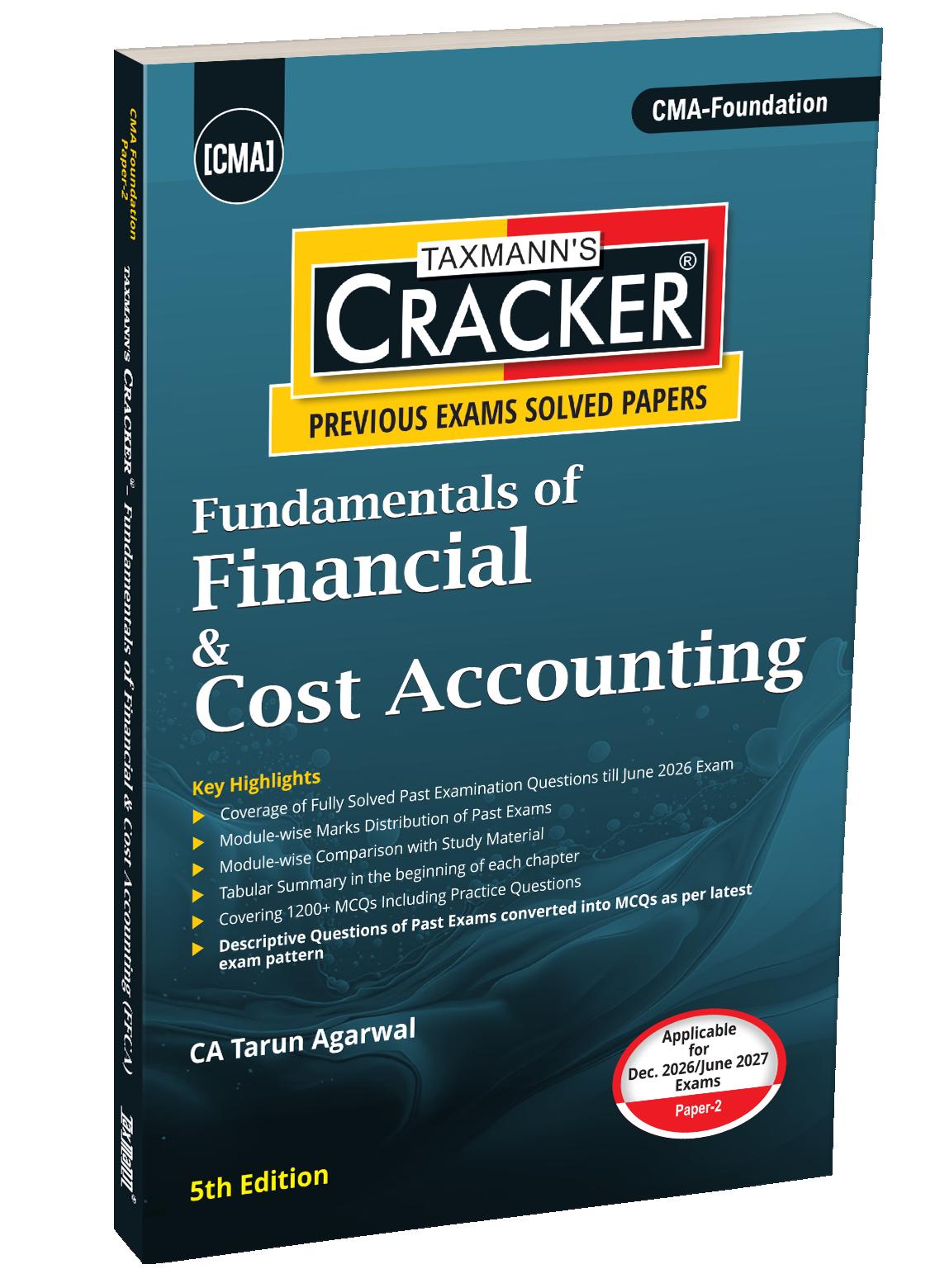
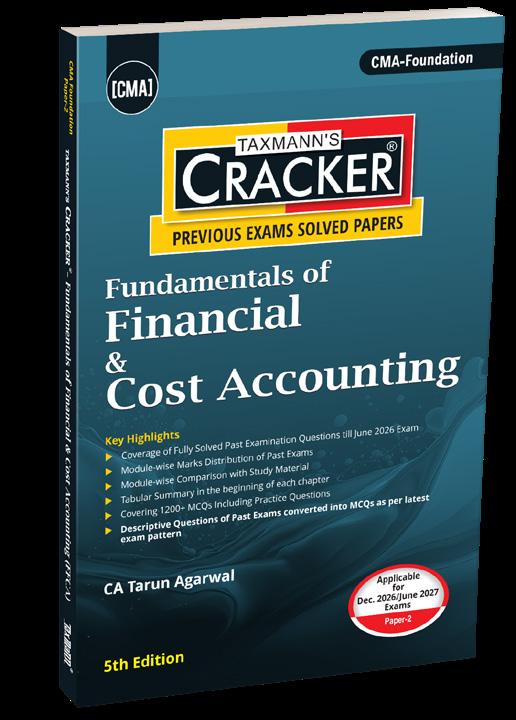
Fundamentals of Financial & Cost Accounting (FFCA | Accounting) – CRACKER is an exampreparation and revision title for Paper 2 of the CMA Foundation course conducted by the Institute of Cost Accountants of India (ICMAI). Part of Taxmann’s well-known CRACKER series, it is built for the Foundation exam’s current format—a fully objective, 100% MCQ, 100mark paper—distilling each topic into a crisp concept recap and then drilling it through a large, exam-realistic bank of multiple-choice questions.
Fully aligned with the latest pattern, it incorporates fully solved past-examination questions right up to the June 2026 exam, making it an all-in-one revise practise test companion for candidates targeting the December 2026 and June 2027 attempts—a single, affordable resource to use from first reading through to final pre-exam revision.
The Present Publication is the 5th Edition | June 2026, authored by CA. Tarun Agarwal, with the following noteworthy features:
• [Fully Solved Past Papers—Updated to June 2026] Fully solved past questions up to the June 2026 exam, so students practise on the exact topics and question styles currently being set
• [Module-wise Marks Distribution] A front-matter analysis of how marks have been spread across modules and chapters (2023–2026, with per-chapter averages), letting students prioritise by weightage
• [Comparison with the ICMAI Study Material] A mapping table aligning the book’s modules and chapters with the corresponding CMA study-material modules to confirm complete coverage
• [Tabular Chapter Summaries] A ‘Quick Revision’ of key concepts at the start of every chapter—a fast, scannable tool for last-minute recall
• [1200+ MCQs with Practice Questions] A large, chapter-wise bank combining genuine past-exam questions with practice sets, with answers provided alongside
• [Descriptive Questions Recast as MCQs] Older descriptive questions re-cast into the current objective format, preserving their learning value