
Sample Read



© All rights reserved
Price : ` 795
Twelfth Edition : February 2026
Published by :
Taxmann Publications (P.) Ltd.
Sales & Marketing : 59/32, New Rohtak Road, New Delhi-110 005 India
Phone : +91-11-45562222
Website : www.taxmann.com
E-mail : sales@taxmann.com
Regd. Office : 21/35, West Punjabi Bagh, New Delhi-110 026 India
Printed at :
Tan Prints (India) Pvt. Ltd.
44 Km. Mile Stone, National Highway, Rohtak Road Village Rohad, Distt. Jhajjar (Haryana) India
E-mail : sales@tanprints.com
Disclaimer
Every effort has been made to avoid errors or omissions in this publication. In spite of this, errors may creep in. Any mistake, error or discrepancy noted may be brought to our notice which shall be taken care of in the next edition. It is notified that neither the publisher nor the author or seller will be responsible for any damage or loss of action to any one, of any kind, in any manner, therefrom.
No part of this book may be reproduced or copied in any form or by any means [graphic, electronic or mechanical, including photocopying, recording, taping, or information retrieval systems] or reproduced on any disc, tape, perforated media or other information storage device, etc., without the written permission of the publishers. Breach of this condition is liable for legal action.
For binding mistake, misprints or for missing pages, etc., the publisher’s liability is limited to replacement within seven days of purchase by similar edition. All expenses in this connection are to be borne by the purchaser. All disputes are subject to Delhi jurisdiction only.



SUMMARY
1. Cost of Capital: Cost of capital is the return expected by the providers of capital (i.e. shareholders, lenders and the debt-holders) to the business as a compensation for their contribution to the total capital. Cost of capital is also known as ‘cut-off’ rate, ‘hurdle rate’, ‘minimum rate of return’ etc.
2. Components of Cost of Capital: COMPONENTS
3. Cost of Debt (Kd): COST OF DEBTS (Kd)
Irredeemable Redeemable
Kd = () ⎡⎤ ⎣⎦ × 11-t 100 NP
Here,
I = Amount of Interest
NP = Net Proceeds
Alternatively: When FV = NP
Kd = Rate of Interest (1 - t)
In Lump-sum In Instalments
(1) Approximation Method:
(a) Kd =
× 100 or
(b) Kd =
(2) YTM Method; Kd = L + L
(a) Cost of Irredeemable Debenture: Kd = I(1t) NP × 100
Where,
I = Amount of Interest
t = Tax rate
× 100
× (H - L)
YTM Method only : Kd = L+ L
× (H – L)
NP = Net Proceeds of Debenture or Current Market Price
Note: If Face Value of Debenture equal to Net Proceeds then Kd = Rate of Interest (1 – t)
(b) Cost of Redeemable Debenture (in Lump sum): Approximation Method:
Kd = ( ) ⎛⎞ −+ ⎜⎟ ⎝⎠ + RVNP I1t n RVNP 2 × 100 Or =
Where, I = Amount of Interest.
+ RVNP I1 t n RVNP 2 × 100
RV = Redemption value of Debenture
NP = Net Proceeds of Debenture or Current Market Price
n = Remaining Life of Debenture
Present Value Method (PV)/Yield to Maturity Method (YTM):
Kd = IRR = L + L LH NPV
× (H - L)
(c) Cost of Redeemable Debenture (in Instalments):
Kd = IRR = L + L LH
(d) Cost of Zero Coupon Bonds (ZCB):
Kd = n RV 1 IP
Where, I = Amount of Interest.
RV = Redemption value of Debenture
IP = Issue Price of Bond
n = Life of Bond
Note:
× (H - L)
In case of convertible debenture use convertible value in place of redemption value of debenture.
If nothing is specified, issue price, redemption value etc. assumed to be equal to face value.
If nothing is specified, flotation cost assumed to be linked with “face value or issue price whichever is higher”.
4. Cost of Preference Share Capital (K p):
(a) Cost of Irredeemable Preference Share:
K p = PD NP × 100
Where,
PD = Amount of Preference Dividend
NP = Net Proceeds of Preference Share or Current Market Price of Preference Share
Note: If Face Value of Preference Share equal to Net Proceeds then
K p = Rate of Preference Dividend
(b) Cost of Redeemable Preference Share (in Lump sum):
Approximation Method:
Where,
PD = Amount of Preference Dividend
RV = Redemption value of Preference Share
NP = Net Proceeds of Preference Share or Current Market Price of Preference Share
n = Remaining Life of Preference Share
Present Value Method (PV)/Yield to Maturity Method (YTM): K p = IRR = L +
× (H - L)
(c) Cost of Redeemable Preference Share (in Instalments):
= IRR = L +
Note:
In case of convertible preference share use convertible value in place of redemption value.
If nothing is specified, issue price, redemption value etc. assumed to be equal to face value.
If nothing is specified, flotation cost assumed to be linked with “face value or issue price whichever is higher”.
5. Cost of Equity Share Capital (K e):
COST OF EQUITY SHARE CAPITAL (Ke)
Dividend Price Approach
K e = 0 D P × 100 or In Case of New Issue :
K e = D NP × 100
(a) Dividend Price/Yield Approach:
K e = 0 D P × 100
Where,
D = Expected/Current Dividend
P0 = Current Market Price of Equity Share
Assumption: Constant Dividend
(b) Earning Price/Yield Approach:
K e = 0 E P × 100 Where,
E = Expected/Current EPS
P0 = Current Market Price of Equity Share
Assumption: Constant EPS
(c) Growth Approach or Gordon’s Model:
Where,
D1 = D0 (1 + g) = Expected DPS
P0 = Current Market Price of Equity Share
g = Constant Growth Rate of Dividend
Note:
In case of fresh issue of Equity shares (New Shares), Net Proceeds from equity share {(Issue price - Issue expenses/Flotation cost) or (P - F)} is used in place of current price of share.
If nothing is specified, flotation cost assumed to be linked with “face value or issue price whichever is higher”.
Estimation of Growth Rate:
(a) Average Method: Growth rate = 0 n n D D - 1
D0 = Current Dividend
D n = Dividend in n years ago
(b) Gordon’s Growth Model: g = b × r
r = Rate of return on fund invested
b = Earning retention ratio
(c) Realised Yield Approach:
K e = Average rate of return realised in past few years = IRR or Geometric mean
(d) Capital Asset Pricing Model (CAPM):
K e = Rf + ß (Rm - Rf)
Rf = Risk Free Rate of Return
R m = Rate of Return on Market Portfolio
R m - Rf = Market Risk Premium
ß = Beta coefficient
6. Cost of Retained Earnings (K r): After tax return to shareholder if he invest elsewhere.
Formulae:
K r = K e (of existing investors)
K r = K e (1 - tp) (In case of personal tax)
K r = K e (1 - tp) (1 - f) (f is rate of flotation cost)
7. Weighted Average Cost of Capital (K0): WACC is also known as the overall cost of capital of having capitals from the different sources as explained above. WACC of a company depends on the capital structure of a company. Weighted average cost of capital is the weighted average after tax costs of the individual components of firm’s capital structure. That is, the after tax cost of each debt and equity is calculated separately and added together to a single overall cost of capital. It can be calculated by using either Book Value weights or Market Value weights.
Structure (a)
Note: Market Value of equity has been apportioned in the ratio of Book Value of equity and retained earnings when Market Value weights are used.
8. Marginal Cost of Capital (MCC): The marginal cost of capital may be defined as the cost of raising an additional rupee of capital. Marginal cost of capital is derived, when the average cost of capital is calculated using the marginal weights.
FORMATS AND FORMULAS
COST OF DEBENTURE (Kd)
Perpetual
Redeemable (Approximation Method)
(1) NP (Net proceeds) :
Interest (1-t)/NP × 100
Interest (1-t) + (RV-NP/N) × 100 RV + NP/2
Issue price or selling price – flotation cost
Or Market price – Flotation cost
Or Face value – Flotation cost
Or 100 – Flotation cost
(2) RV (Redeemable value): Given Or Face value Or 100
(3) N = Maturity period. If not given means debenture is perpetual
(4) t = Tax rate
COST OF CONVERTIBLE DEBENTURE
Cost of convertible debenture
Approximation method or YTM method
In case of convertible debenture, only different calculation is of Redeemable value. Redeemable value calculation = No of shares per debenture x Market price per share at the time of conversion.
YIELD TO MATURITY METHOD (Kd)
Step 1
Step 2
Step 3
Step 4
Calculate Net proceed per share or debenture. It is cash inflow
Calculate Interest (1-t) for every year up to maturity (Debenture)
Calculate Redeemable value. It is terminal cash outflow
Calculate IRR. IRR is Kd
COST OF PREFERENCE SHARE CAPITAL (Kp)
Perpetual
Redeemable (Approximation Method)
Preference Dividend/NP × 100
Preference dividend + (RV-NP/N) × 100 RV + NP/2
(1) NP (Net proceeds): Calculate Same as in cost of debenture
(2) RV (Redeemable value): Calculate same as in cost of debenture
(3) N = Maturity period. If not given means preference share is perpetual
YIELD TO MATURITY METHOD (Kp)
Step 1
Step 2
Step 3
Step 4
Calculate Net proceed per share or debenture. It is cash inflow
Calculate Preference dividend for every year up to maturity (share) It is annual cash outflow
Calculate Redeemable value. It is terminal cash outflow
Calculate IRR. IRR is Kp
COST OF LOAN (Kl)
Cost of Loan Interest Rate (1-t)
COST OF EQUITY SHARE CAPITAL (Ke)
CAPM Rf + (Beta × Average market risk premium)
Dividend Growth Approach (D1/NP × 100) + g
Earnings Price Approach E/NP × 100
Dividend Price Approach D1/NP × 100
(1) NP (Net proceeds): Calculate same in cost of debenture
(2) D1 (Expected dividend per share):
Given
Or D0 (1 + g)
(3) g (Growth rate):
Given
Or Calculate on the basis of past years trend of dividend or earnings Or Rate of return × Retention ratio
(4) Rf = Risk free rate of return
(5) If question is silent, use dividend growth approach to calculate Ke
REALIZED YIELD APPROACH FOR Ke
Step 1 Present market price is Cash outflow
Step 2 Dividend per share is cash inflow for every year
Step 3 Market price per share given for future is terminal value
Step 4 Calculate IRR. IRR is ke
COST OF RESERVE AND SURPLUS (Kr)
Cost of reserve & surplus Ke (1 – Shareholder tax rate)
(1) For Kr calculation, Flotation cost is not to be deducted from net proceeds.
(2) Shareholder or personal tax rate if given in question, then only it is adjusted.
(2) If flotation cost and shareholder tax rate not given, Ke = Kr.
WEIGHTED AVERAGE COST OF CAPITAL
Equity share capital
Preference share capital
Debenture
Loan Reserves
(1) Book value of loan and market value of loan is same
(2) When WACC is calculated on market value weight, Market value of equity share is to be apportioned between Equity share and Reserve in their book value ratio.
(3) If question is silent, calculate WACC on the basis of book value weight.
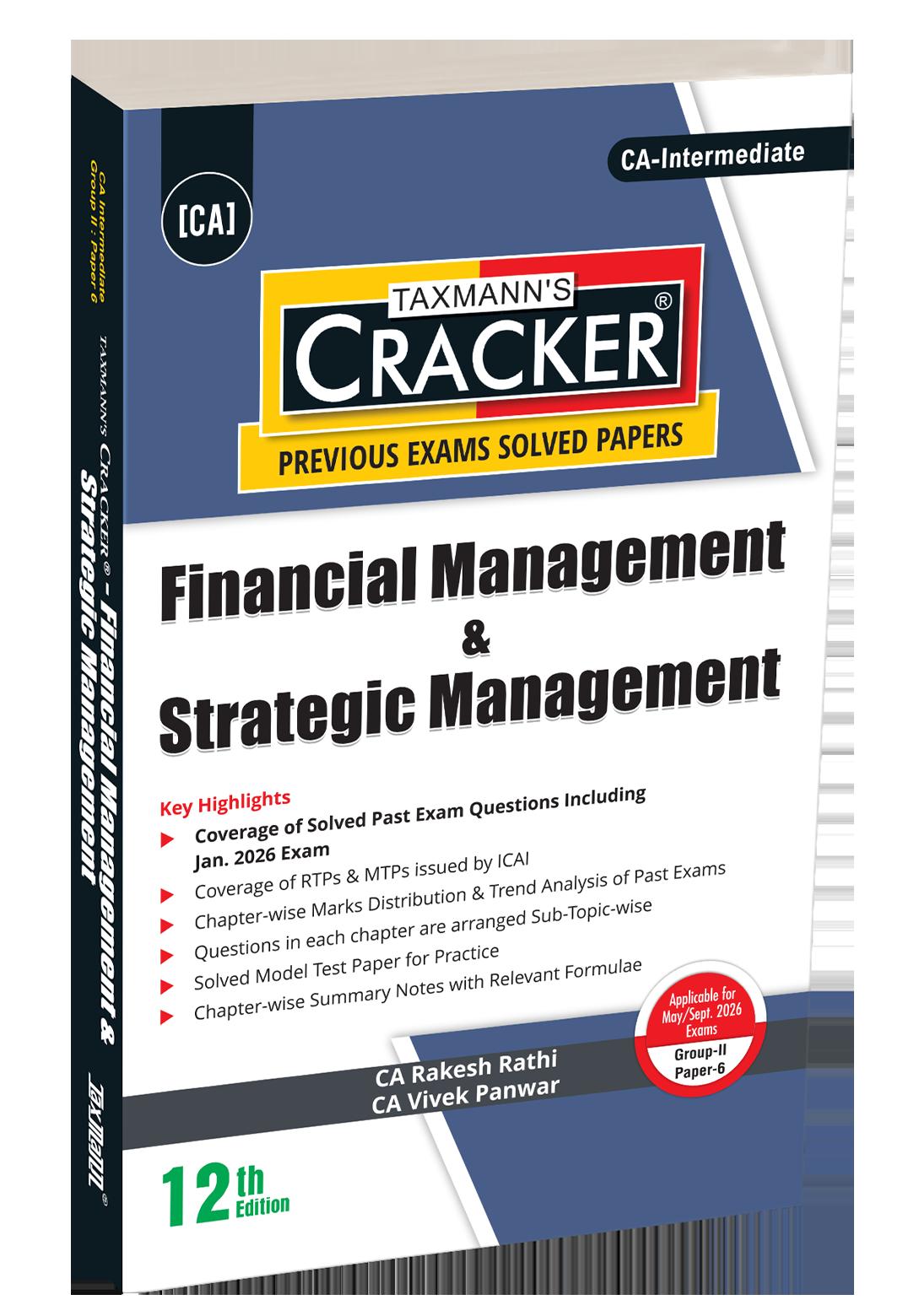
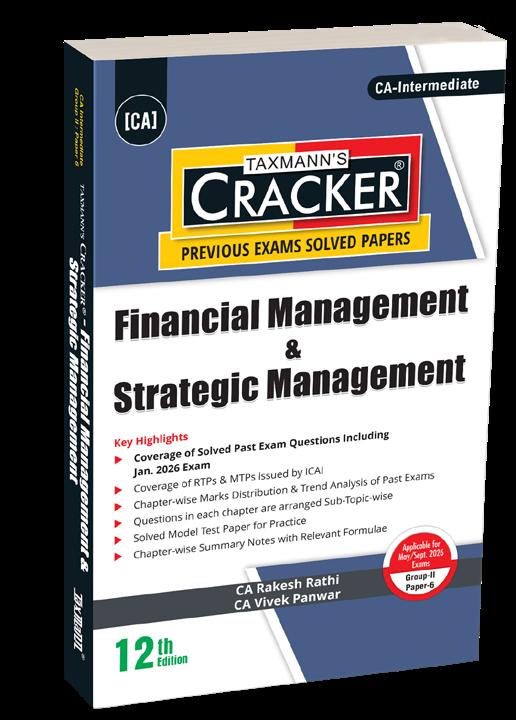
Financial Management & Strategic Management (FM and SM | FM SM) | CRACKER
AUTHOR : Rakesh Rathi, Vivek Panwar
PUBLISHER : Taxmann
DATE OF PUBLICATION : February 2026
EDITION : 12th Edition
ISBN NO : 9789375616894
No. of Pages : 740
BINDING TYPE : Paperback
Rs. 795
DESCRIPTION
Financial Management & Strategic Management – CRACKER (Previous Exams Solved Papers) is a precisionengineered, exam-intelligence manual for CA Intermediate – Group II | Paper 6, designed to translate ICAI’s past examination behaviour into a focused, marks-maximisation preparation strategy. This Edition (February 2026) is fully aligned with the May and September 2026 examinations and includes exhaustively solved past examination questions up to the January 2026 attempt, along with ICAI’s RTPs and MTPs. Rather than treating the syllabus as static theory, this CRACKER analyses it as a testing framework—decoding chapter-wise weightage, question patterns, marking logic, and answer presentation—enabling predictable, exam-ready performance.
The Present Publication is the 12th Edition, authored by CA. Rakesh Rathi and CA. Vivek Panwar, with the following noteworthy features:
• [Solved Past Examination Questions up to Jan. 2026] Comprehensive coverage of ICAI-asked questions across multiple attempts, including the January 2026 exam, solved strictly as per ICAI’s evaluation standards
• [Integrated RTPs & MTPs Coverage] Includes relevant Revision Test Papers and Mock Test Papers issued by ICAI, ensuring alignment with the latest testing approach
• [Chapter-wise Marks Distribution Analytics] Attempt-wise tables highlighting chapter-wise marks allocation to help students prioritise preparation effectively
• [Previous Exams Trend Analysis] Detailed mapping of compulsory and optional questions, theorypractical mix, and recurring test areas to reveal examiner preferences
• [Sub-topic-wise Question Classification] Questions are arranged by sub-topics within each chapter for focused and efficient concept mastery
• [Solved Model Test Paper] A full-length Model Test Paper with suggested answers to simulate real exam conditions
• [Chapter-wise Summary Notes & Formulae] Concise revision notes consolidating key concepts, frameworks, and formulae for last-phase revision