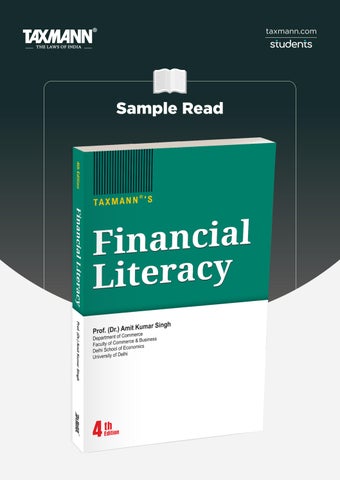

Sample Read

© All rights reserved
Price : ` 325
Fourth Edition : June 2026
Published by :
Taxmann Publications (P.) Ltd.
Sales & Marketing : 59/32, New Rohtak Road, New Delhi-110 005 India
Phone : +91-11-45562222
Website : www.taxmann.com
E-mail : sales@taxmann.com
Regd. Office : 21/35, West Punjabi Bagh, New Delhi-110 026 India
Printed at :
Tan Prints (India) Pvt. Ltd.
44 Km. Mile Stone, National Highway, Rohtak Road Village Rohad, Distt. Jhajjar (Haryana) India
E-mail : sales@tanprints.com
Disclaimer
Every effort has been made to avoid errors or omissions in this publication. In spite of this, errors may creep in. Any mistake, error or discrepancy noted may be brought to our notice which shall be taken care of in the next edition. It is notified that neither the publisher nor the author or seller will be responsible for any damage or loss of action to any one, of any kind, in any manner, therefrom.
No part of this book may be reproduced or copied in any form or by any means [graphic, electronic or mechanical, including photocopying, recording, taping, or information retrieval systems] or reproduced on any disc, tape, perforated media or other information storage device, etc., without the written permission of the publishers. Breach of this condition is liable for legal action.
For binding mistake, misprints or for missing pages, etc., the publisher’s liability is limited to replacement within seven days of purchase by similar edition. All expenses in this connection are to be borne by the purchaser. All disputes are subject to Delhi jurisdiction only.


CHAPTER
Time Value of Money


LEARNING OUTCOMES
The learning from this chapter will enable students gain an understanding of the concept of the time value of money future understand the power of compounding get familiarized with the application of the time value of money in real life
INTRODUCTION
We all have gone grocery shopping with our mother in the local markets. Right? So, we recall the same grocery like potatoes which we used to buy for ` 5/kg 15 years back is now sold for ` 30/kg. Have you thought of the reason why is it so? What happened in these 15 years? The answer is the time value of money. In any financial decision, the time value of money holds immense importance. In this chapter, we will understand this concept, how to calculate it and why?
TIME VALUE OF MONEY
Simply stating, the time value of money means that the value of a rupee today will not be equal to the value of a rupee tomorrow. The purchases you make with the specific amount of money will not be sufficient to make the same quantum of purchases in the future. If you want to derive the same utility in the future you have to spend more. Thus, with time the money loses its worth.
Relevance of Time Value of Money
As already stated, money loses its value with time. One of the key reasons is inflation. Therefore, people prefer to receive money as soon as possible and try to delay their payments as much as possible. Other reasons are given below:
Uncertainty in the future: If you are presented with two options. One is to receive money today and the other is to receive money after 2 years with a 10 per cent appreciation. What will be your choice? Along with determining whether this 10% appreciation will be able to cover the value erosion, your answer will also depend on how certain you are that you will receive this amount after 2 years.
Preference for current consumption: Anyone who is more concerned about current or immediate consumptions will mostly go for immediate will be based on how much your consumptions can be delayed and how
Opportunity for reinvestment: Another reason for preferring current income is the opportunities available for their investment. Here, you have to compare if there is any investment opportunity available which can provide better returns that the return which is offered to accept future payment. For example, you have two options. One is to receive ` 1,000 today and the other is to receive ` 1,050 after one year. There is an investment opportunity which offers an annual return of 10%. Now in light of the existing opportunity, what will be your choice? The answer will be option 1. If you accept after 1 year you only receive ` 50 appreciation. However, if you go for the current receipt and invest it you will receive ` 100 appreciation.
It is safe to say that knowledge about the time value of money is relevant to make an informed decision. It helps you understand the worth of your money thereby guiding you to derive the most out of it.
TVM GLOSSARY
Annuity
An annuity refers to the regular cash flow of a fixed amount at equal intervals for a specific time period. A lease requiring payment of ` 20,000 per month for a period of 50 years is an example of an annuity. It is a “600 months period, ` 20,000 annuity”. The identical nature of cash flows in terms of amount and time gap in frequency of payment is a necessary condition to call it an annuity. There are two types of annuities based on the time of payment:
Regular/Ordinary Annuity –the year (at period 1).
Annuity Due –0).
Compound Interest
Compound interest is a situation where the interest is calculated not only on the principal amount but also on the interest earned throughout the years. This is a concept of exponential growth of money.
Compounding Frequency
Compounding frequency means how frequently the interest is calculated and credited to the account. As the interest is credited it becomes principal in the immediate next period. The compounding frequency plays a crucial role in determining the exponential growth of money. The higher the frequency, the higher the growth of money. For example, the future value of ` 10,000 invested at the rate of 10% per annum for a period of 3 years compounded annually is ` 13,310, compounded bi-annually is ` 13,400, compounded quarterly is ` 13,449 and compounded monthly is ` 13,481.
Discount Rate
A discount rate is a rate which is used to derive present value from future value. The process is known as discounting because the present value is less than the future value in absolute terms.
Future Value
Future value refers to the value of money which is expected to occur at some future date. For example, the future value of ` 1,000 invested today for a period of 2 years at the rate of 15% per annum compounded annually is ` 1,322. This means that after 2 years this ` 1,000 is equal to ` 1,322. So, in literal translation, future value means “what will it be worth at some future point in time?”
Number of Periods
It is the time period for which the compounding and discounting are done to arrive at future value or present value respectively. For example, if compounding is done annually for 5 years then the number of periods is 5. If compounding is done quarterly for 5 years, then the number of periods is 20 (5 years * 4 quarters).
Perpetuity
Perpetuity is like an annuity for an infinite time period. It is also known as a perpetual annuity.
Present Value
future. It is the amount that an individual is willing to pay at present in order to receive certain cash flows in the future. Literally translated, present value means “what is it worth right now?” The present value of ` 10,000 to be received after 2 years having a rate of interest of 10% is ` 8,264. This means that you are willing to pay today ` 8,264 in order to receive ` 10,000 after 2 years.
COMPOUNDING
Compounding is a strategy where the return on an asset or investment is reinvested in order to generate more income. In simple words, it means “generating returns from returns in the future”. The value derived through the compound process is known as future value.
Power of Compounding
Let us understand the power of compounding with an example. Mr Sahil decided to invest ` 1,00,000 every year for a period of 5 years. The rate of return is 10% per annum. He has two options.
Option 1: Withdraw interest earned as and when they are earned.
Option 2: Reinvest the interest earned in the same investment option. Now, in option 1 Mr Sahil will be earning a return of ` 50,000 (1,00,000 * 10% * 5) during the 5 years.
Under Option the calculation is as follows:
1-1,00,00010,0001,10,000 21,10,0001,00,00021,0002,31,000 32,31,0001,00,00033,1003,64,100 43,64,1001,00,00046,4105,10,510 55,10,5101,00,00061,0516,71,561 5,00,0001,71,561
From this table, you can see that in principle he invested only ` 5,00,000 and its value appreciated to ` 6,71,561 after 5 years offering a
of ` 1,71,561
which is significantly higher than ` 50,000 (option 1). This is what ye call the power of compounding.
(A) Present Value of Single Cash flow for Annual Compounding
Future value = Present value * (1 + K)n
Where, K = compounding rate
n = number of years for which compounding is done
Alternatively,
Future value = Present value * (FVFK,n)
Where FVF = Future Value Factor for the given rate and time period. (FVF Table)
Illustration: If Seema deposited ` 5,000 at the rate of 12% compounded annually for 4 years, what will be the value at the time of maturity?
Solution: For this, we will calculate the future value
Future value = Present value * (1 + K)n
Future value = 5,000 (1 + 0.12)4
Future value = 5,000 * 1.57
Future value = ` 7,850
(B) Present value of Single Cash flow for Non-Annual Compounding
Future value = Present value * (1 + K/m)n*m
Where, K = compounding rate
n = number of years for which compounding is done
m = number of times the compounding is done in a year
Alternatively,
Future value = Present value * (FVFK/m,n*M)
Where FVF = Future Value Factor for the given rate and time period. (FVF Table)
Illustration: If Rohit deposited ` 12,000 at the rate of 15% compounded quarterly for 7 years what will be the value at the time of maturity?
Solution: For this, we will calculate the future value
Future value = Present value * (1 + K/m)n/m
Future value = 12,000 (1 + 0.15/4)7*4
Future value = 12,000 * 2.80
Future value = ` 33,600
(C) Effective Rate of Interest
The effective rate of interest is the annual interest rate received or paid in case the compounding is not done annually.
Effective Interest rate = (1 + K/m)m – 1
Where, K = compounding rate
m = number of times the compounding is done in a year
Illustration: Find the effective interest rate if the amount is invested at the rate of 20% for 10 years compounded monthly.
Solution:
Effective Interest rate = (1 + K/m)m – 1
Effective Interest rate = (1 + 0.20/12)12 – 1
Effective Interest rate = 1.2194 – 1
Effective Interest rate = 0.2194 = 21.94%
(D) Future value of Multiple and Cash flows
Illustration: Following are the cash inflows of Yash at the end of each year for 5 years. Calculate the future value at the end of 5the year if the compounding rate is 5% annually.
Solution: The present value is calculated as follows
11,00041.2161,216 22,50031.1582,895 31,50021.1031,656 475011.05788 51,200011,200 Present value7,755
Note: Future value factor can be calculated from the future value table.
(E) Future Value of Regular/Ordinary Annuity
Future value = A(1+K)n-1 + A(1+K)n-2 + A(1+K)n-3 + ……..+ A
Where, K = compounding rate
n = number of years for which compounding is done
A = Annuity amount
Alternatively,
Future value = Annuity * (FVFAK,n)
Where, K = compounding rate
n = number of years for which compounding is done
FVFAK,n = Future value factor for Annuity (future value annuity table)
Illustration: A person deposited ` 1,000 at the end of each year for 10 years. Find the total amount accumulated at the end of the 10th year if the compounding rate is 9% annually.
Solution:
Future value = Annuity * (FVFAK,n)
Future value = 1,000 (FVFA9%,10)
Future value = 1,000 * 15.193
Future value = ` 15,193
(F) Future Value of Annuity Due
Future value = Annuity * (FVFAK,n) * (1+K)
Where, K = compounding rate
n = number of years for which compounding is done
FVFAK,n = Future Value factor for Annuity (future value annuity table)
Illustration: If a person deposits ` 30,000 at the beginning of each year, find out what will be the value at the end of 10 years if compounded annually at the rate of 11%.
Solution:
Future value = Annuity * (FVFAK,n) * (1+K)
Future value = 30,000 (FVFA11%,10) * (1 + 0.11)
Future value = 30,000 * 16.722 * 1.11
Future value = ` 5,56,823
DISCOUNTING
Discounting can be defined as the process of determining the present value of the stream of cash flows to be received in the future. It is a technique of reverse compounding future cash flows.
(A) Present Value of Single Cash Flow
Present value = Future value / (1+ K)n
Where, K = discounting rate
n = number of years for which discounting is done
Alternatively,
Present value = Future value / (PVFK,n)
Where, PVF = Present Value Factor for the given rate and time period. (PVF Table)
Illustration: Calculate the present value of deposits if deposited today at the rate of 10% per annum will yield ` 10,000 after 5 years.
Solution:
Present value = Future value / (1+ K)n
Present value = 10,000 / (1+0.10)5
Present value = 10,000 / 1.61
Present value = ` 6,211.18
(B) Present Value of Multiple Cash Flow
Illustration: Find the present value of the following future cash flows if discounting rate is 10%
Solution:
Present value = 2,500 * 0.909 + 3,400 * 0.826 + 1,800 * 0.75 + 1,500 * 0.683 + 2,700 * 0.621
(C) Present Value of Regular/Ordinary Annuity
Present value = Annuity * (PVFAK,n)
Where, K = discounting rate
n = number of years for which discounting is done
PVFAK,n = Present Value factor for Annuity (present value annuity table)
Illustration: A person deposited ` 1,000 at the end of each year for the next 10 years. What is the present value if the rate of interest is 11%?
Solution:
Present value = Annuity * (PVFAK,n)
Present value = 1,000 * 5.889
Present value = ` 5,889
(D) Present Value of Annuity Due
Present value = Annuity * (PVFAK,n) * (1+K)
Where, K = discounting rate
n = number of years for which discounting is done
PVFAK,n = Present Value factor for Annuity (present value annuity table)
Illustration: A person deposited ` 1,000 at the beginning of each year for 10 years. What is the present value if the rate of interest is 9%?
Solution:
Present value = Annuity * (PVFAK,n) * (1+K)
Present value = 1,000 * 6.418 * 1.10
Present value = ` 7,059.8
(E) Present Value of Perpetuity
Present value = Annual cash flow/discounting rate
Illustration: A company promises to pay ` 10,000 for an indefinite number of years and the rate of interest is 15%. Calculate the present value.
Solution:
Present value = Annual cash flow/discounting rate
Present value = 10,000 / 0.15
Present value = ` 66,666.67
APPLICATIONS OF TIME VALUE OF MONEY
(A) Sinking Fund Problem
At the time the financial managers of a company have to set aside a certain sum of money regularly for a while in order to create a corpus of a specific amount which is to be used to replace an asset or pay off a financial obligation. To determine this regular amount to be set aside compounding technique is appropriate.
For example, if the company wants to accumulate ` 20,00,000 in a period of 5 years and the rate of interest is 10% compounded annually, what will be the annual cash outflow for such corpus?
Future value = Annuity * (FVFAK,n)
Annuity = Future value / (FVFAK,n)
Annuity = 20,00,000 / (FVFA10%,5)
Annuity = 20,00,000 / 6.105 = ` 3,27,600
(B) Capital Recovery Problem/ Loan Repayment
Corporations regularly indulge in taking loans for their operation. Whenever indulging in debt, the financial manager must be thorough about the financial position of the company and its repayment ability. In order to determine the number of equal instalments to be paid in order to honour the debt obligation within the given time period and the interest rate charges; the concept of the present value technique is applied.
For example, ABC company takes a loan of ` 25,00,000 from a bank. The interest rate charged is at the rate of 10% per annum and the repayment period is 10 years. What should be the annual instalment?
Present value = Annuity * (PVFAK,n)
Annuity = Present value / (PVFAK,n)
Annuity = 25,00,000 / (PVFA10%,10)
Annuity = 25,00,000 / 6.145 = ` 4,06,835
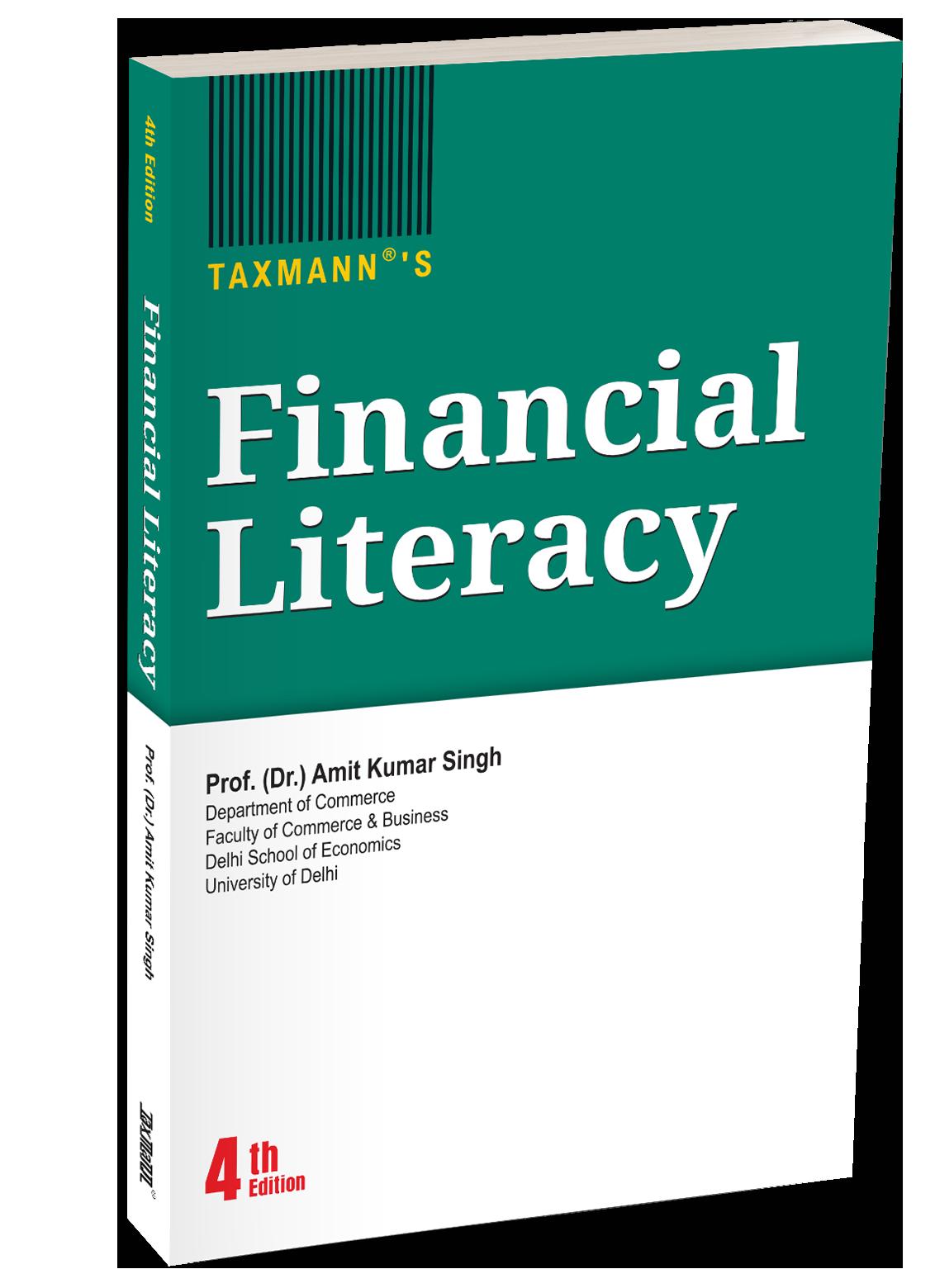
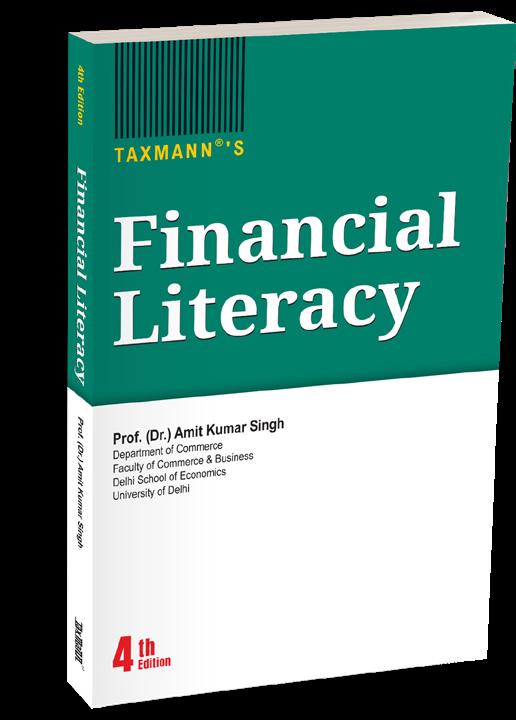
Financial Literacy
AUTHOR : Amit Kumar Singh
PUBLISHER : Taxmann
DATE OF PUBLICATION : May 2026
EDITION : 4th Edition
ISBN NO : 9789375619970
No. of Pages : 284
BINDING TYPE : Paperback
Rs.
DESCRIPTION
Financial Literacy is a syllabus-aligned textbook for the University of Delhi’s Value Addition Course (VAC) under the National Education Policy. Built on the premise that financial well-being is a learned discipline and the first step toward self-sufficiency, it takes the reader from foundational money concepts through banking, digital payments, investing, insurance, and personal taxation—treating each as a working life skill. It pairs plain-language explanation with worked numerical illustrations, contemporary Indian examples, and hands-on exercises, serving equally as a classroom text and a self-study guide for first-time learners.
This book is intended for the following audience:
• Undergraduate Students
• Beginners with No Prior Finance Background
• Young Earners and Students
• Teachers and Course Facilitators
The Present Publication is the 4th Edition, authored by Prof. (Dr) Amit Kumar Singh, with the following noteworthy features:
• [Learning Outcomes] Every chapter opens with a defined set of learning outcomes framing what the reader will achieve
• [Simple, Lucid Text] Written in plain language and broken into graded headings and sub-headings for easy navigation
• [Worked Problems] Concepts taught through fully worked illustrations and step-by-step solved problems— present- and future-value computations, real-rate and post-tax returns, coefficient-of-variation risk ranking, portfolio working, NAV and load-adjusted redemptions, and side-by-side old-versus-new-regime tax computations
• [Built-in Glossaries] Quick-reference glossaries of essential terms that build a working financial vocabulary
• [Indian Context] Practical Indian context throughout—cited survey data, named government schemes, and current fraud typologies
• [Review Questions] Review Questions at the end of each chapter for self-testing and consolidation
• [Practical Exercises] Hands-on exercises—building dummy portfolios, comparing bank and mutual-fund products, using TVM and SIP calculators, applying Excel’s PV/FV/NPER/RATE functions, filing a dummy return, and running a financial-literacy survey
• [Previous Years’ Papers] A compilation of previous years’ DU common question papers for exam practice