Sample Read
Contents FACTORIES ACT, 1948 PAGE
CHAPTER I PRELIMINARY 1. Short title, extent and commencement
1
2. Interpretation
1
3. References to time of day
8
4. Power to declare different departments to be separate factories or two or more factories to be a single factory
9
5. Power to exempt during public emergency
9
6. Approval, licensing and registration of factories
9
7. Notice by occupier
10
7A. General duties of the occupier
11
7B. General duties of manufacturers, etc., as regards articles and substances for use in factories
12
CHAPTER II THE INSPECTING STAFF 8. Inspectors
13
9. Powers of Inspectors
14
10. Certifying surgeons
15
I-5
CONTENTS
I-6 PAGE
CHAPTER III HEALTH 11. Cleanliness
16
12. Disposal of wastes and effluents
17
13. Ventilation and temperature
17
14. Dust and fume
18
15. Artificial humidification
18
16. Overcrowding
19
17. Lighting
19
18. Drinking water
19
19. Latrines and urinals
20
20. Spittoons
21 CHAPTER IV SAFETY
21. Fencing of machinery
21
22. Work on or near machinery in motion
22
23. Employment of young persons on dangerous machines
23
24. Striking gear and devices for cutting off power
23
25. Self-acting machines
24
26. Casing of new machinery
24
27. Prohibition of employment of women and children near cotton-openers
25
28. Hoists and lifts
25
29. Lifting machines, chains, ropes and lifting tackles
26
30. Revolving machinery
27
31. Pressure plant
27
32. Floors, stairs and means of access
28
33. Pits, sumps, openings in floors, etc.
28
34. Excessive weights
28
35. Protection of eyes
29
36. Precautions against dangerous fumes, gases, etc.
29
36A. Precautions regarding the use of portable electric light 37. Explosive or inflammable dust, gas, etc.
29 30
I-7
CONTENTS PAGE
38. Precautions in case of fire
31
39. Power to require specifications of defective parts or tests of stability
31
40. Safety of buildings and machinery
31
40A. Maintenance of buildings
32
40B. Safety Officers
32
41. Power to make rules to supplement this Chapter
32
CHAPTER IVA PROVISIONS RELATING TO HAZARDOUS PROCESSES 41A. Constitution of Site Appraisal Committees
32
41B. Compulsory disclosure of information by the occupier
34
41C. Specific responsibility of the occupier in relation to hazardous processes
34
41D. Power of Central Government to appoint Inquiry Committee
35
41E. Emergency standards
35
41F. Permissible limits of exposure of chemical and toxic substances
35
41G. Workers’ participation in safety management
36
41H. Right of workers to warn about imminent danger
36
CHAPTER V WELFARE 42. Washing facilities
37
43. Facilities for storing and drying clothing
37
44. Facilities for sitting
37
45. First-aid appliances
38
46. Canteens
38
47. Shelters, rest rooms and lunch rooms
39
48. Creches
40
49. Welfare Officers
40
50. Power to make rules to supplement this Chapter
41
CHAPTER VI WORKING HOURS OF ADULTS 51. Weekly hours
41
52. Weekly holidays
41
CONTENTS
I-8 PAGE
53. Compensatory holidays
42
54. Daily hours
43
55. Intervals for rest
43
56. Spreadover
44
57. Night shifts
45
58. Prohibition of overlapping shifts
45
59. Extra wages for overtime
46
60. Restriction on double employment
49
61. Notice of periods of work for adults
49
62. Register of adult workers
50
63. Hours of work to correspond with notice under section 61 and register under section 62
50
64. Power to make exempting rules
51
65. Power to make exempting orders
53
66. Further restrictions on employment of women
53
CHAPTER VII EMPLOYMENT OF YOUNG PERSONS 67. Prohibition of employment of young children
54
68. Non-adult workers to carry tokens
55
69. Certificates of fitness
55
70. Effect of certificate of fitness granted to adolescent
56
71. Working hours for children
56
72. Notice of periods of work for children
57
73. Register of child workers
57
74. Hours of work to correspond with notice under section 72 and register under section 73
57
75. Power to require medical examination
58
76. Power to make rules
58
77. Certain other provisions of law not barred
58
CHAPTER VIII ANNUAL LEAVE WITH WAGES 78. Application of Chapter
58
79. Annual leave with wages
59
80. Wages during leave period
61
I-9
CONTENTS PAGE
81. Payment in advance in certain cases
62
82. Mode of recovery of unpaid wages
62
83. Power to make rules
63
84. Power to exempt factories
63
CHAPTER IX SPECIAL PROVISIONS 85. Power to apply the Act to certain premises
63
86. Power to exempt public institutions
63
87. Dangerous operations
64
87A. Power to prohibit employment on account of serious hazard 88. Notice of certain accidents 88A. Notice of certain dangerous occurrences
64 65 65
89. Notice of certain diseases
65
90. Power to direct inquiry into cases of accident or disease
66
91. Power to take samples
67
91A. Safety and occupational health surveys
67
CHAPTER X PENALTIES AND PROCEDURE 92. General penalty for offences
68
93. Liability of owner of premises in certain circumstances
70
94. Enhanced penalty after previous conviction
73
95. Penalty for obstructing Inspector
74
96. Penalty for wrongfully disclosing results of analysis under section 91
75
96A. Penalty for contravention of the provisions of sections 41B, 41C and 41H
75
97. Offences by workers
76
98. Penalty for using false certificate of fitness
76
99. Penalty for permitting double employment of child
77
100. [Omitted by the Factories (Amendment) Act, 1987, w.e.f. 1-12-1987]
78
101. Exemption of occupier or manager from liability in certain cases
78
102. Power of Court to make orders
79
103. Presumption as to employment
79
104. Onus as to age
80
CONTENTS
I-10 PAGE
104A. Onus of proving limits of what is practicable, etc.
81
105. Cognizance of offences
81
106. Limitation of prosecutions
82
106A. Jurisdiction of a Court for entertaining proceedings, etc., for offence
82
CHAPTER XI SUPPLEMENTAL 107. Appeals
83
108. Display of notices
84
109. Service of notice
84
110. Returns
84
111. Obligations of workers
84
111A. Right of workers, etc.
85
112. General power to make rules
86
113. Powers of Centre to give directions
86
114. No charge for facilities and conveniences
86
115. Publication of rules
86
116. Application of Act to Government factories
86
117. Protection to persons acting under this Act
86
118. Restriction on disclosure of information
87
118A. Restriction on disclosure of information
87
119. Act to have effect notwithstanding anything contained in Act 37 of 1970
87
120. Repeal and savings
87
FIRST SCHEDULE:
List of Industries Involving Hazardous Processes
SECOND SCHEDULE: Permissible Levels of Certain Chemical Substances in
87 89
Work Environment THIRD SCHEDULE:
SUBJECT INDEX
List of Notifiable Diseases
95 97
Factories Act, 1948† [63 OF 1948]* An Act to consolidate and amend the law regulating labour in factories. WHEREAS it is expedient to consolidate and amend the law regulating labour in factories; It is hereby enacted as follows :— CHAPTER I PRELIMINARY Short title, extent and commencement. 1. (1) This Act may be called the Factories Act, 1948. 1
[(2) It extends to the whole of India 2[***]].
(3) It shall come into force on the 1st day of April, 1949. Interpretation. 2. In this Act, unless there is anything repugnant in the subject or context,— (a) “adult” means a person who has completed his eighteenth year of age; (b) “adolescent” means a person who has completed his fifteen year of age but has not completed his eighteenth year; 3
[(bb) “calendar year” means the period of twelve months beginning with the first day of January in any year;] (c) “child” means a person who has not completed his fifteenth year of age;
4
[(ca) “competent person”, in relation to any provision of this Act, means a person or an institution recognised as such by the Chief Inspector for the
*Dated 23-9-1948 †Shall be repealed by the Occupational Safety, Health and Working Conditions Code, 2020, with effect from a date yet to be notified. 1. Substituted by the Adaptation of Laws Order, 1950. 2. Words “except the State of Jammu and Kashmir” omitted by the Central Labour Laws (Extension to Jammu and Kashmir) Act, 1970, w.e.f. 1-9-1971. Earlier said quoted words were substituted by the Part B States (Laws) Act, 1951, w.e.f. 1-4-1951. 3. Inserted by the Factories (Amendment) Act, 1954, w.e.f. 7-5-1954. 4. Inserted by the Factories (Amendment) Act, 1987, w.e.f. 1-12-1987.
1
S. 2
FACTORIES ACT, 1948
2
purposes of carrying out tests, examinations and inspections required to be done in a factory under the provisions of this Act having regard to— (i) the qualifications and experience of the person and facilities available at his disposal; or (ii) the qualifications and experience of the persons employed in such institution and facilities available therein, with regard to the conduct of such test, examinations and inspections, and more than one person or institution can be recognised as a competent person in relation to a factory; (cb) “hazardous process” means any process or activity in relation to an industry specified in the First Schedule where, unless special care is taken, raw materials used therein or the intermediate or finished products, bye-products, wastes or effluents thereof would— (i) cause material impairment to the health of the persons engaged in or connected therewith, or (ii) result in the pollution of the general environment: Provided that the State Government may, by notification in the Official Gazette, amend the First Schedule by way of addition, omission or variation of any industry specified in the said Schedule;] (d) “young person” means a person who is either a child or an adolescent; (e) “day” means a period of twenty-four hours beginning at midnight; (f) “week” means a period of seven days beginning at midnight on Saturday night or such other night as may be approved in writing for a particular area by the Chief Inspector of factories; (g) “power” means electrical energy, or any other form of energy which is mechanically transmitted and is not generated by human or animal agency; (h) “prime mover” means any engine, motor or other appliance which generates or otherwise provides, power; (i) “transmission machinery” means any shaft, wheel drum, pulley, system of pulleys, coupling, clutch, driving belt or other appliance or device by which the motion of a prime mover is transmitted to or received by any machinery or appliance; (j) “machinery” includes prime movers, transmission machinery and all other appliances whereby power is generated, transformed, transmitted or applied; (k) “manufacturing process” means any process for— (i) making, altering, repairing, ornamenting, finishing, packing, oiling, washing, cleaning, breaking up, demolishing, or otherwise treating or adapting any article or substance with a view to its use, sale, transport, delivery or disposal; or 5
[(ii) pumping oil, water, sewage or any other substance; or]
5. Substituted by the Factories (Amendment) Act, 1976, w.e.f. 26-10-1976.
3
FACTORIES ACT, 1948
S. 2
(iii) generating, transforming or transmitting power; or 6
[(iv) composing types for printing, printing by letter press, lithography, photogravure or other similar process or book binding;] 7[or] (v) constructing, reconstructing, repairing, refitting, finishing or breaking up ships or vessels; 7[or]
7
[(vi) preserving or storing any article in cold storage;]
(l) “worker” means a person 8[employed, directly or by or through any agency (including a contractor) with or without the knowledge of the principal employer, whether for remuneration or not], in any manufacturing process, or in cleaning any part of the machinery or premises used for a manufacturing process, or in any other kind of work incidental to, or connected with, the manufacturing process, or the subject of the manufacturing process 9[but does not include any member of the armed forces of the Union;] (m) “factory” means any premises including the precincts thereof— (i) whereon ten or more workers are working, or were working on any day of the preceding twelve months, and in any part of which a manufacturing process is being carried on with the aid of power, or is ordinarily so carried on, or (ii) whereon twenty or more workers are working, or were working on any day of the preceding twelve months, and in any part of which a manufacturing process is being carried on without the aid of power, or is ordinarily so carried on, but does not include a mine subject to the operation of 10[the Mines Act, 1952 (35 of 1952)], or 11[a mobile unit belonging to the armed forces of the Union, a railway running shed or a hotel, restaurant or eating place]. 12 13
[ [Explanation I].—For computing the number of workers for the purposes of this clause all the workers in 14[different groups and relays] in a day shall be taken into account.] 15
[Explanation II.— For the purposes of this clause, the mere fact that an Electronic Data Processing Unit or a Computer Unit is installed in any premises or part thereof, shall not be construed to make it a factory if
6. 7. 8. 9. 10. 11. 12. 13. 14. 15.
Substituted by the Factories (Amendment) Act, 1954, w.e.f. 7-5-1954. Inserted by the Factories (Amendment) Act, 1976, w.e.f. 26-10-1976. Substituted for “employed, directly or through any agency, whether for wages or not”, ibid. Inserted, ibid. Substituted for “the Indian Mines Act, 1923 (4 of 1923)” by the Factories (Amendment) Act, 1954, w.e.f. 7-5-1954. Substituted for “a railway running shed” by the Factories (Amendment) Act, 1976, w.e.f. 26-10-1976. Inserted, ibid. Explanation renumbered as Explanation I by the Factories (Amendment) Act, 1987, w.e.f. 1-12-1987. Substituted for “different relays”, ibid. Inserted, ibid.
S. 2
FACTORIES ACT, 1948
4
no manufacturing process is being carried on in such premises or part thereof;] (n) “occupier” of a factory means the person who has ultimate control over the affairs of the factory 16[***]: 17
[Provided that— (i) in the case of a firm or other association of individuals, any one of the individual partners or members thereof shall be deemed to be the occupier;
(ii) in the case of a company, any one of the directors shall be deemed to be the occupier; (iii) in the case of a factory owned or controlled by the Central Government or any State Government, or any local authority, the person or persons appointed to manage the affairs of the factory by the Central Government, the State Government or the local authority, as the case may be, shall be deemed to be the occupier :] 18 19
[ [Provided further that] in the case of a ship which is being repaired, or on which maintenance work is being carried out, in a dry dock which is available for hire,— (1) the owner of the dock shall be deemed to be the occupier for the purposes of any matter provided for by or under: (a) section 6, section 7, 20[section 7A, section 7B,] section 11 or section 12; (b) section 17, insofar as it relates to the providing and maintenance of sufficient and suitable lighting in or around the dock; (c) section 18, section 19, section 42, section 46, section 47 or section 49, in relation to the workers employed on such repair or maintenance; (2) the owner of the ship or his agent or master or other officer-in-charge of the ship or any person who contracts with such owner, agent or master or other officer-in-charge to carry out the repair or maintenance work shall be deemed to be the occupier for the purposes of any matter provided for by or under section 13, section 14, section 16 or section 17 (save as otherwise provided in this proviso) or Chapter IV (except section 27) or section 43, section 44 or section 45, Chapter VI, Chapter VII, Chapter VIII or Chapter IX or section 108, section 109 or section 110, in relation to—
16. Words “, and where the said affairs are entrusted to a managing agent, such agent shall be deemed to be the occupier of the factory” omitted by the Factories (Amendment) Act, 1987, w.e.f. 1-12-1987. 17. Inserted, ibid. 18. Inserted by the Factories (Amendment) Act, 1976, w.e.f. 26-10-1976. 19. Substituted for “Provided that” by the Factories (Amendment) Act, 1987, w.e.f. 1-12-1987. 20. Inserted, ibid.
5
FACTORIES ACT, 1948
S. 2
(a) the workers employed directly by him, or by or through any agency; and (b) the machinery, plant or premises in use for the purpose of carrying out such repair or maintenance work by such owner, agent, master or other officer-in-charge or person;] (o) 21[***] (p) “prescribed” means prescribed by rules made by the 21a[State Government] under this Act; (q) 22[***] (r) where work of the same kind is carried out by two or more sets of workers working during different periods of the day, each of such sets is called a 23[“group” or “relay”] and each of such periods is called a “shift”. COMMENTS SECTION NOTES
2.1 “Competent person” [Section 2(ca)] A “competent person” refers to a person or institution recognised by the Chief Inspector
for conducting tests, examinations, and inspections in a factory. Such recognition must be in accordance with the provisions of this Act having regard
to: Individual qualifications and experience, and the availability of necessary facilities. In the case of institutions, the qualifications and experience of its personnel along
with institutional facilities. A competent person in relation to a factory can be recognised with regard to the conduct
of such test, examinations and inspections, and more than one person or institution. 2.2 “Hazardous process” [Section 2(cb)] The term refers to any process or activity in relation to an industry listed in the First
Schedule where, if special care is not taken, it can lead to: Material impairment to the health of those involved or associated with the process,
or Pollution of the general environment. State Government’s power to
alter Schedule I
The State Government is empowered to update the list of industries
via notification in the Official Gazette, and may add, omit or vary any industry in Schedule I.
21. Omitted by the Factories (Amendment) Act, 1987, w.e.f. 1-12-1987. 21a. Substituted for “Provincial Government” by the Adaptation of Laws Order, 1950. 22. Clause (q) omitted by the Adaptation of Laws Order, 1950. 23. Substituted for “relay” by the Factories (Amendment) Act, 1987, w.e.f. 1-12-1987.
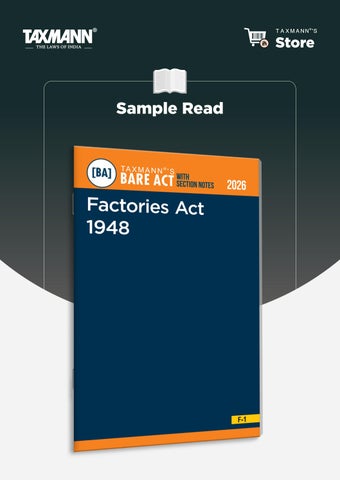
Factories Act 1948 – Bare Act with Section Notes AUTHOR : PUBLISHER : DATE OF PUBLICATION : EDITION : ISBN NO : No. of Pages : BINDING TYPE :
Taxmann’s Editorial Board Taxmann December 2025 2026 Edition 9789371269407 112 Paperback
Rs. 155 DESCRIPTION Factories Act 1948 [Bare Act with Section Notes] by Taxmann is a concise yet comprehensive publication that presents the full, amended text of the Act. It includes clear section-wise notes, references to case law, and relevant tables and schedules—ensuring that readers gain both the bare statutory provisions and interpretative insights. Updated through 2026, it highlights pre- and post-amendment provisions, enabling practitioners to grasp historical context and transitional applicability. This book is intended for the following audience: • Legal Professionals & Litigators • Corporate Legal Teams & HR Managers • Entrepreneurs & Factory Occupiers • Government Officials & Inspectors • Academics & Students The Present Publication is the 2026 Edition, covering the amended and updated text of the Factories Act [Act No. 63 of 1948] and Rules, with the following noteworthy features: • [Complete Text] The entire Act, with all amendments, plus footnotes for older provisions • [Section Notes] Brief commentaries explaining crucial aspects, compliance obligations, and case law references • [Reference Tools] Marginal headings, cross-references, and appended schedules for swift navigation • [Practical Insights] Highlights obligations of occupiers/managers in critical areas like health, safety, welfare, and working hours • [User-friendly Format] Clear layout with a detailed table of contents for easy access • [Compliance-oriented] Showcases typical penalty scenarios and stakeholder duties
Buy Now