Sample Read
© Taxmann Price : ` 120
Law stated in this book is as updated till 1st December, 2025
Published by : Taxmann Publications (P.) Ltd.
Sales & Marketing : 59/32, New Rohtak Road, New Delhi-110 005 India
Phone : +91-11-45562222
Website : www.taxmann.com
E-mail : sales@taxmann.com
Regd. Office : 21/35, West Punjabi Bagh, New Delhi-110 026 India
Printed at :
Tan Prints (India) Pvt. Ltd.
44 Km. Mile Stone, National Highway, Rohtak Road Village Rohad, Distt. Jhajjar (Haryana) India
E-mail : sales@tanprints.com
Disclaimer
Every effort has been made to avoid errors or omissions in this publication. In spite of this, errors may creep in. Any mistake, error or discrepancy noted may be brought to our notice which shall be taken care of in the next edition. It is notified that neither the publisher nor the author or seller will be responsible for any damage or loss of action to any one, of any kind, in any manner, therefrom. It is suggested that to avoid any doubt the reader should cross-check all the facts, law and contents of the publication with original Government publication or notifications.
No part of this book may be reproduced or copied in any form or by any means [graphic, electronic or mechanical, including photocopying, recording, taping, or information retrieval systems] or reproduced on any disc, tape, perforated media or other information storage device, etc., without the written permission of the publishers. Breach of this condition is liable for legal action.
For binding mistake, misprints or for missing pages, etc., the publisher’s liability is limited to replacement within seven days of purchase by similar edition. All expenses in this connection are to be borne by the purchaser. All disputes are subject to Delhi jurisdiction only.
ESSENTIAL COMMODITIES ACT, 1955
3. Powers to control production, supply, distribution, etc., of essential commodities
4. Imposition of duties on State Governments, etc.
5. Delegation of powers
6. Effect of orders inconsistent with other enactments
6A. Confiscation of essential commodity
6B. Issue of show-cause notice before confiscation of foodgrains, etc.
6C. Appeal
6D. Award of confiscation not to interfere with other punishments
6E. Bar of jurisdiction in certain cases
7. Penalties
7A. Power of Central Government to recover certain amounts as arrears of land revenue
8. Attempts and abetment
9. False statement
10. Offences by companies
10A. Offences to be cognizable
10B.
5.
6.
7.
8.
PREVENTION OF BLACKMARKETING AND MAINTENANCE OF SUPPLIES OF ESSENTIAL COMMODITIES ACT, 1980
16.
Essential Commodities Act, 1955
[10 OF 1955]*
An Act to provide, in the interest of the general public, for the control of the production, supply and distribution of, and trade and commerce, in certain commodities.
Be it enacted by Parliament in the Sixth Year of the Republic of India as follows:—
Short title and extent.
1. (1) This Act may be called the Essential Commodities Act, 1955.1 (2)It extends to the whole of India 2[***].
Definitions.
2. In this Act, unless the context otherwise requires,— (a) 3[***]
*Dated 1-4-1955.
1. This Act has been extended to Goa, Daman and Diu by Regulation 12 of 1962, Dadra and Nagar Haveli by Regulation 6 of 1963, to Lakshadweep and Aminidivi Islands by Regulation 8 of 1965 and to the State of Sikkim by S.O. 28(E), dated 7-1-1976, w.e.f. 7-1-1976.
2. Words “except the State of Jammu and Kashmir” omitted by the Central Laws (Extension to Jammu and Kashmir) Act, 1968, w.e.f. 15-8-1968.
3. Omitted by the Essential Commodities (Amendment) Act, 2006, w.e.f. 12-2-2007. Prior to its omission, clause (a), as amended by the Essential Commodities (Amendment) Act, 1974, w.r.e.f. 22-6-1974, read as under:
‘(a) “essential commodity” means any of the following classes of commodities—
(i) cattle fodder, including oil-cakes and other concentrates;
(ii) coal including coke and other derivatives;
(iii) component parts and accessories of automobiles;
(iv) cotton and woollen textiles.
(iva) drugs;
Explanation.— In this sub-clause, “drug” has the meaning assigned to it in clause (b) of section 3 of the Drugs and Cosmetics Act, 1940 (23 of 1940);
(v) foodstuffs, including edible oil seeds and oils;
(vi) iron and steel, including manufactured products of iron and steel;
(vii) paper, including newsprint, paperboard and straw board;
(viii) petroleum and petroleum products;
(ix) raw cotton, whether ginned or unginned, and cotton seed;
(x) raw jute;
(xi) any other class of commodity which the Central Government may, by notified order, declare to be an essential commodity for the purposes of this Act, being a commodity with respect to which Parliament has power to make laws by virtue of Entry 33 in List III in the Seventh Schedule to the Constitution.’
4[(ia)] “Collector” includes an Additional Collector and such other officer, not below the rank of Sub-Divisional Officer, as may be authorised by the Collector to perform the functions and exercise the powers of the Collector under this Act;]
(b) “food-crops” include crops of sugarcane;
(c) “notified order” means an order notified in the Official Gazette;
5[(cc) “order” includes a direction issued thereunder;]
6[(d) “State Government,” in relation to a Union territory, means the administrator thereof;]
5[(e) “sugar” means—
(i) any form of sugar containing more than ninety per cent, of sucrose, including sugar candy;
(ii) khandsari sugar or bura sugar or crushed sugar or any sugar in crystalline or powdered form; or
(iii) sugar in process in vacuum pan sugar factory or raw sugar produced therein;]
COMMENTS
SECTION NOTES
u Section 2 defines various terms but does not define “essential commodity” which is the most important term in the Act.
u Section 2A defines “essential commodity” to mean a commodity specified in the Schedule.
CASE LAWS
The Supreme Court upheld the Allahabad High Court’s decision invalidating the requirement for brick manufacturers to obtain licenses to use coal under the U.P. Coal Control Order, 1977. The Court determined that “bricks” are not classified as an “essential commodity” under Section 2(a)(xi) of the Essential Commodities Act, 1955. As the State Government’s regulatory authority under section 3, read with Section 5, extends only to listed essential commodities, it lacks jurisdiction to mandate licensing for coal usage specific to brick manufacturing. Consequently, the prosecution attempts against brick manufacturers for non-compliance with the Coal Control Order were quashed. All appeals and writ petitions were dismissed. - State of U.P. v. Janta Industrial Udyog AIR 1991 SC 477
The Supreme Court ruled that rice bran qualifies as “foodstuff” under Section 2(a)(v) of the Essential Commodities Act, 1955, thus making it an essential commodity subject to regulatory control under Section 3. The appellants challenged the Haryana Rice Bran (Distribution and Price) Control Order, 1967, asserting rice bran was neither “foodstuff” nor “cattle fodder.” The Court held that rice bran, commonly used as poultry and cattle feed, fits the dictionary definition of “food,” which includes any substance taken for life and growth, whether by
4. Inserted by the Essential Commodities (Amendment) Act, 1976, w.e.f. 2-9-1976.
5. Inserted by the Essential Commodities (Second Amendment) Act, 1967, w.e.f. 30-12-1967.
6. Substituted by the Adaptation of Laws (No. 3) Order, 1956. Prior to its substitution, clause (d) read as under:
“(d) ‘State Government’ in relation to a Part C State means the Lieutenant Governor or the Chief Commissioner, as the ease may be.”
3
ESSENTIAL COMMODITIES ACT, 1955 S. 2
humans or animals. The Court emphasized that “foodstuff” is not limited to human consumption, affirming the State’s authority to regulate rice bran production and sale to ensure availability for animal nutrition. The appeal was dismissed. - Sat Pal Gupta v. State of Haryana AIR 1982 SC 798
STATE AMENDMENTS
HIMACHAL PRADESH
n Section 2
After sub-clause (vi) of clause (a) of section 2 insert, “( vi - a ) cases made wholly or partially of wood, card-board or straw;” - [ Vide Essential Commodities (Himachal Pradesh Amendment) Act, 1986, w.e.f. 29-2-1992]
MAHARASHTRA
n Section 2
In Section 2—
(a) after the words “the context otherwise requires”,- and before clause (a) insert—
“(ai) ‘Collector’ in Greater Bombay means in Controller of Rationing and includes any Deputy or Assistant Controller of Rationing and elsewhere means the Collector of the District and includes any Assistant or Deputy Collector or District Supply Officer within his respective jurisdiction”;
(b) after clause (b), insert—
“(ba) ‘holder’, in relation to any agricultural land, means the person in actual possession of such land, and includes a company or other body corporate, firm association, joint family or body of individuals in joint possession of such land;
(bb) ‘holding’ means the aggregate of all lands in possession of a holder;”— [Vide Essential Commodities (Maharashtra Amendment) Act, 1975, w.r.e.f. 12-11-1975.]
In section 2,—
(a) for clause (ia), the following clause shall be substituted, namely: —
‘(ia) “Collector” in any Rationing Area means the Controller of Rationing designated for that area and includes the Deputy or Assistant Controller or Rationing; and elsewhere, the Collector of the District and includes Additional, Deputy or Assistant Collector, Sub-Divisional Officer and District Supply Officer within his respective jurisdiction;’;
(b) clause (ai) shall be deleted.- [Vide Essential Commodities (Maharashtra Amendment) Act, 2002, w.e.f. 19-3-2003.]
UTTAR PRADESH
In section 2 before clause (a), the following clause shall be inserted namely:—
“(aa) ‘Collector’ includes such officer not below the rank of an Assistant Collector of the first class as may be authorized by the Collector to exercise the powers conferred on him by or under the provisions of this Act;” - [Vide Essential Commodities (Uttar Pradesh Amendment) Act, 1975, w.e.f. 31-3-1975.]
7[Essential commodities declaration, etc.
2A. (1) For the purposes of this Act, “essential commodity” means a commodity specified in the Schedule.
(2) Subject to the provisions of sub-section (4), the Central Government may, if it is satisfied that it is necessary so to do in the public interest and for reasons to be specified in the notification published in the Official Gazette, amend the Schedule so as to—
(
a) add a commodity to the said Schedule;
(
b) remove any commodity from the said Schedule, in consultation with the State Governments.
(3) Any notification issued under sub-section (2) may also direct that an entry shall be made against such commodity in the said Schedule declaring that such commodity shall be deemed to be an essential commodity for such period not exceeding six months to be specified in the notification:
Provided that the Central Government may, in the public interest and for reasons to be specified, by notification in the Official Gazette, extend such period beyond the said six months.
(4) The Central Government may exercise its powers under sub-section (2) in respect of the commodity to which Parliament has power to make laws by virtue of Entry 33 in List III in the Seventh Schedule to the Constitution.
(5) Every notification issued under sub-section (2) shall be laid, as soon as may be after it is issued, before both Houses of Parliament.]
COMMENTS
SECTION NOTES
2.1 Definition of Essential Commodity [Sub-section (1)]
7. Inserted by the Essential Commodities (Amendment) Act, 2006, w.e.f. 12-2-2007. S. 2A
u An “essential commodity” is any commodity listed in the Schedule of the Act.
u In terms of the Schedule, the following are the essential commodities:
(1) drugs [as defined in clause (b) of section 3 of the Drugs and Cosmetics Act, 1940]
(2) fertilizer, whether inorganic, organic or mixed;
(3) foodstuffs, including edible oilseeds and oils;
(4) hank yarn made wholly from cotton;
(5) petroleum and petroleum products;
(6) raw jute and jute textiles;
(7) (i) seeds of food-crops and seeds of fruits and vegetables; (ii) seeds of cattle fodder; and
(iii) jute seeds;
(iv) cotton seeds.
(8) masks (2ply and 3ply surgical masks, N95 masks) and hand sanitizers.
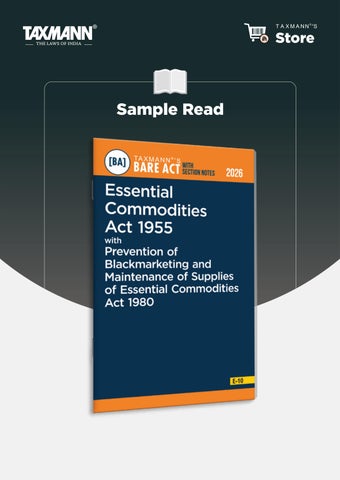
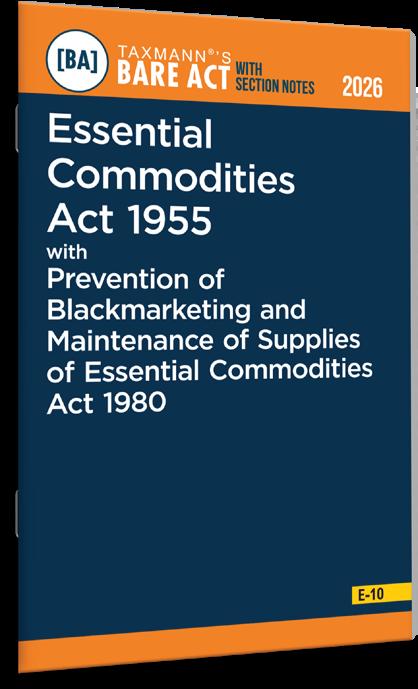
ESSENTIAL COMMODITIES ACT 1955 WITH PREVENTION OF BLACKMARKETING AND MAINTENANCE OF SUPPLIES OF ESSENTIAL COMMODITIES ACT 1980 – BARE ACT WITH SECTION NOTES
AUTHOR : Taxmann's Editorial Board
PUBLISHER : Taxmann
DATE OF PUBLICATION : December 2025
EDITION : 2026 Edition
ISBN NO : 9789371268769
NO. OF PAGES : 68
BINDING TYPE : Paperback
Rs. 120
DESCRIPTION
Essential Commodities Act 1955 with Prevention of Blackmarketing and Maintenance of Supplies of Essential Commodities Act 1980 [Bare Act with Section Notes] by Taxmann is an authoritative statutory reference covering two key legislations that regulate the production, supply, distribution, and control of essential commodities in India. Together, these Acts provide the legal framework for ensuring availability, equitable distribution, price regulation, and prevention of hoarding and blackmarketing. The publication presents the complete text of both Acts in a clear Bare Act format, supported by section-wise notes that explain legislative intent, clarify provisions, and refer to relevant judicial interpretations, making it a practical and reliable legal resource. This book is intended for the following audience:
•Legal Practitioners & Judges
•Compliance Officers & Legal Departments
•Government Officials & Policy Makers
•Law Students & Academicians
The Present Publication is the 2026 Edition, covering the amended and updated text of the Essential Commodities Act [Act No. 10 of 1955] and Prevention of Blackmarketing and Maintenance of Supplies of Essential Commodities Act [Act No. 7 of 1980], with the following noteworthy features:
•[Authoritative Text] Complete and updated statutory text of both Acts, incorporating all relevant amendments
•[Pre-amendment Provisions] Earlier versions of amended provisions are reproduced in amendment footnotes for historical and transitional clarity
•[Section Notes] Concise notes explaining objectives, definitions, and operative provisions with case-law references
•[Judicial References] Select Supreme Court and High Court decisions for practical interpretation
•[State Amendments] References to applicable State Amendments for jurisdiction-specific understanding
•[Easy Navigation] Clear layout, marginal headings, and detailed subject indices for quick reference