Sample Read
© Taxmann Price : ` 95
Law stated in this book is as updated till 15th November, 2025
Published by : Taxmann Publications (P.) Ltd.
Sales & Marketing : 59/32, New Rohtak Road, New Delhi-110 005 India
Phone : +91-11-45562222
Website : www.taxmann.com
E-mail : sales@taxmann.com
Regd. Office : 21/35, West Punjabi Bagh, New Delhi-110 026 India
Printed at :
Tan Prints (India) Pvt. Ltd.
44 Km. Mile Stone, National Highway, Rohtak Road Village Rohad, Distt. Jhajjar (Haryana) India
E-mail : sales@tanprints.com
Disclaimer
Every effort has been made to avoid errors or omissions in this publication. In spite of this, errors may creep in. Any mistake, error or discrepancy noted may be brought to our notice which shall be taken care of in the next edition. It is notified that neither the publisher nor the author or seller will be responsible for any damage or loss of action to any one, of any kind, in any manner, therefrom. It is suggested that to avoid any doubt the reader should cross-check all the facts, law and contents of the publication with original Government publication or notifications.
No part of this book may be reproduced or copied in any form or by any means [graphic, electronic or mechanical, including photocopying, recording, taping, or information retrieval systems] or reproduced on any disc, tape, perforated media or other information storage device, etc., without the written permission of the publishers. Breach of this condition is liable for legal action.
For binding mistake, misprints or for missing pages, etc., the publisher’s liability is limited to replacement within seven days of purchase by similar edition. All expenses in this connection are to be borne by the purchaser. All disputes are subject to Delhi jurisdiction only.
EQUAL REMUNERATION ACT, 1976
1.
4.
5.
7.
EQUAL REMUNERATION RULES, 1976
AND CLAIMS UNDER THE
3. Complaints regarding contravention of the Act 19 4. Claim regarding non-payment of wages, etc. 20 5. Authorisation 20
CHAPTER III
REGISTERS TO BE MAINTAINED
6. Registers to be maintained by the employer 20
FORM A : Complaint under clause (a) of sub-section (7) of the Equal Remuneration Act, 1976 (25 of 1976) 20
FORM B : Claim under clause (b) of sub-section (1) of section 7 of the Equal Remuneration Act, 1976 (25 of 1976) 21
FORM C : Form of authority in favour of legal practitioner or any official of a registered trade union 22
FORM D : [Omitted by the Case of Compliance to Maintain Registers under Various Labour Laws Rules, 2017, w.e.f. 21-2-2017] 23
1.
2.
3.
4.
5.
6.
7.
CENTRAL ADVISORY COMMITTEE ON
REMUNERATION RULES, 1991
1.
2.
EASE OF COMPLIANCE TO MAINTAIN REGISTERS UNDER VARIOUS LABOUR LAWS RULES, 2017
FORM E : Format of register of rest/leave/leave wages under the Mines Act, 1952, the Sales Promotion Employees (Conditions of Service) Act, 1976 and the Working Journalists (Conditions of Service) and Miscellaneous Provisions Act, 1957
Equal Remuneration Act, 1976
[Shall be repealed by Code on Wages, 2019, with effect from a date yet to be notified] [25 OF 1976]*
An Act to provide for the payment of equal remuneration to men and women workers and for the prevention of discrimination, on the ground of sex, against women in the matter of employment and for matters connected therewith or incidental thereto.
Be it enacted by Parliament in the Twenty-seventh Year of the Republic of India as follow.—
CHAPTER I PRELIMINARY
Short title, extent and commencement.
1. (1) This Act may be called the Equal Remuneration Act, 1976.
(2)It extends to the whole of India.
(3)It shall come into force on such date†, not being later than three years from the passing of this Act, as the Central Government may, by notification, appoint and different dates may be appointed for different establishments or employments.
COMMENTS
SECTION NOTES
Title and Scope
1.1 Short title [Section 1(1)]
u The Act is formally named the “Equal Remuneration Act, 1976.”
1.2 Extent [Section 1(2)]
u The Act applies across all of India.
1.3 Commencement [Section 1(3)]
1.3-1 Discretionary implementation
u The Central Government holds the authority to determine the commencement date of the Act, providing flexibility for its implementation.
*Dated 11-2-1976.
†Came into force on 8-3-1976, vide Notification S.O. 175(E) dated 6-3-1976.
u This commencement is restricted to a timeline not exceeding three years from the passing of the Act.
u The Central Government may appoint different dates for different establishments or types of employment.
Definitions.
2. In this Act, unless the context otherwise requires,—
(a) “appropriate Government” means,—
(i) in relation to any employment carried on by or under the authority of the Central Government or a railway administration, or in relation to a banking company, a mine, oilfield or major port or any corporation established by or under a Central Act, the Central Government; and
(ii) in relation to any other employment, the State Government;
(b) “commencement of this Act” means, in relation to an establishment or employment, the date on which this Act comes into force in respect of that establishment or employment;
(
c) “employer” has the meaning assigned to it in clause (f) of section 2 of the Payment of Gratuity Act, 1972 (39 of 1972);
(d) “man” and “woman” mean male and female human beings, respectively, of any age;
(
e) “notification” means a notification published in the Official Gazette;
(f) “prescribed” means prescribed by rules made under this Act;
(g) “remuneration” means the basic wage or salary, and any additional emoluments whatsoever payable, either in cash or in kind, to a person employed in respect of employment or work done in such employment, if the terms of the contract of employment, express or implied, were fulfilled;
(
h) “same work or work of a similar nature” means work in respect of which the skill, effort and responsibility required are the same, when performed under similar working conditions, by a man or a woman and the differences, if any, between the skill, effort and responsibility required of a man and those required of woman are not of practical importance in relation to the terms and conditions of employment;
(i) “worker” means a worker in any establishment or employment in respect of which this Act has come into force;
(
j) words and expressions used in this Act and not defined but defined in the Industrial Disputes Act, 1947 (14 of 1947), shall have the meanings respectively assigned to them in that Act.
COMMENTS
SECTION NOTES
Definitions
2.1 Remuneration [Section 2(g)]
u Comprises:
n Basic wage or salary.
n Additional emoluments payable in cash or kind, provided they stem from the fulfilment of employment terms (express or implied).
2.2 Same work or work of a similar nature [Section 2(h)]
u Encompasses work where:
n The skill, effort, and responsibility required are the same.
n Working conditions are similar.
n Minor differences in skill, effort, or responsibility are considered insignificant for determining equal treatment in terms and conditions of employment.
CASE LAWS
u Similarity in work requirements – Burden of proof - The Supreme Court emphasized that the principle of “equal pay for equal work” under the Equal Remuneration Act necessitates proof of similarity in the skill, effort, and responsibility required for the work. It ruled that the burden of establishing this similarity lies with the individual alleging discrimination. In this case, lecturers from Madhya Pradesh Higher Secondary Schools, despite having equivalent qualifications and service conditions to non-technical lecturers in technical schools, failed to demonstrate similarity in job responsibilities. Consequently, their claim for equal pay under the Act was rejected. – State of Madhya Pradesh v. Pramod Bhartiya AIR 1993 SC 286.
u Appropriate Government for Independent Contractors - The Karnataka High Court ruled on the definition of “appropriate government” under section 2(a) of the Equal Remuneration Act, 1976, in cases involving independent contractors. The petitioners, partners of a firm executing construction contracts for a Central Government entity, argued that their employment fell under the purview of the State Government as per section 2(a)(ii). The Court held that the firm acted as independent contractors, not under the authority or control of the Central Government. Thus, the State Government, and not the Central Government, was deemed the appropriate government. Complaints filed with the sanction of the Central Government were invalid, leading to the quashing of proceedings against the contractors. – K.E. Koshy v. The State 1988 LAB. I. C. 879.
Act to have overriding effect.
3. The provisions of this Act shall have effect notwithstanding anything inconsistent therewith contained in any other law or in the terms of any award, agreement or contract of service, whether made before or after the commencement of this Act, or in any instrument having effect under any law for the time being in force.
EQUAL REMUNERATION ACT 1976 WITH RULES – BARE ACT WITH SECTION NOTES
AUTHOR : Taxmann's Editorial Board
PUBLISHER : Taxmann
DATE OF PUBLICATION : December 2025
EDITION : 2026 Edition
ISBN NO : 9789371263177
NO. OF PAGES : 44
BINDING TYPE : Paperback
Rs. 95
DESCRIPTION
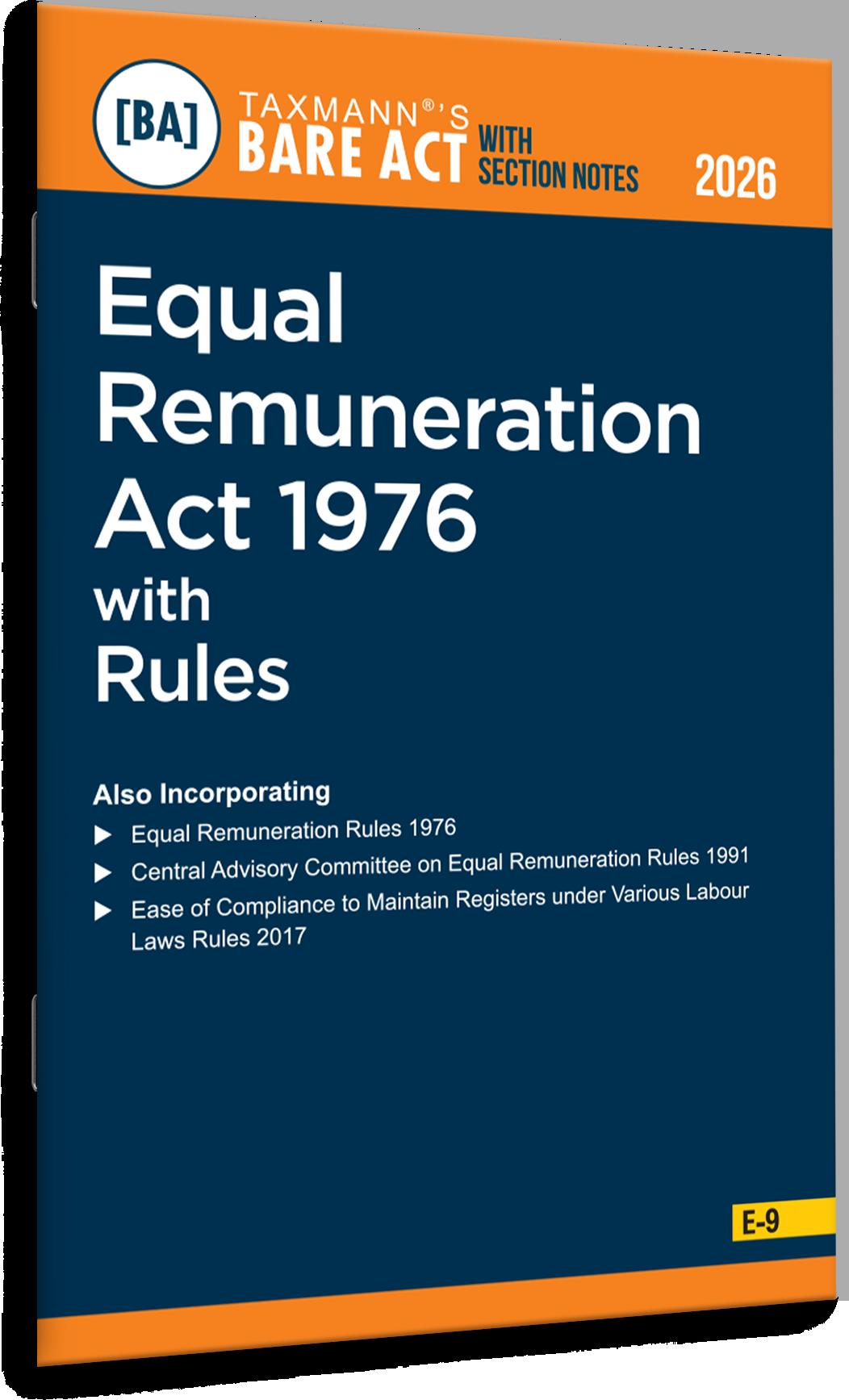
Equal Remuneration Act 1976 with Rules [Bare Act with Section Notes] by Taxmann is a concise and authoritative statutory reference presenting the complete and updated legal framework on equal remuneration and gender equality in employment in India. The publication reproduces the verbatim text of the Equal Remuneration Act 1976, along with all allied rules, notifications, and compliance-related instruments. Supported by brief section-wise notes, contextual explanations, and key judicial references, the book clearly explains the principle of 'equal pay for equal work', the prohibition of gender-based discrimination in wages and recruitment, and the statutory duties of employers. It serves as a dependable, single-point reference for both substantive provisions and procedural compliance under the Act. This book is intended for the following audience:
• Legal Practitioners & Litigators
• Corporate Entities & HR Professionals
• Judicial Officers & Government Authorities
• Academicians & Law Students
• NGOs & Women's Rights Organisations
The Present Publication is the 2026 Edition, covering the amended and updated text of the Equal Remuneration Act [Act No. 25 of 1976] and Rules, with the following noteworthy features:
• [Bare Act with Section Notes] Full statutory text supplemented with concise section-wise notes on scope, intent, and application
• [Updated Incorporations] Includes the Equal Remuneration Rules 1976; Central Advisory Committee on Equal Remuneration Rules 1991; and the Ease of Compliance to Maintain Registers under Various Labour Laws Rules 2017
• [Pre-amendment Footnotes] Earlier versions of provisions included in amendment footnotes for transitional understanding
• [Judicial References] Select references explaining concepts such as 'same work or work of a similar nature' and non-discrimination
• [Practical Compliance Guidance] Overview of authorities' powers, inspectors' roles, complaint mechanisms, and penalties
• [User-friendly Presentation] Clear headings, structured chapters, cross-references, and a detailed subject index
• [Repeal & Transition Context] Notes the proposed repeal under the Code on Wages 2019, for contextual clarity