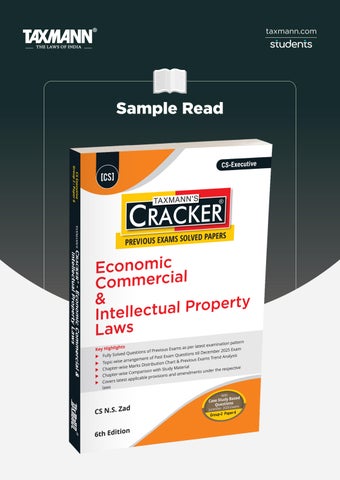

Sample Read

© All rights reserved
Price : ` 465
Sixth Edition : January 2026
Published by :
Taxmann Publications (P.) Ltd.
Sales & Marketing : 59/32, New Rohtak Road, New Delhi-110 005 India
Phone : +91-11-45562222
Website : www.taxmann.com
E-mail : sales@taxmann.com
Regd. Office : 21/35, West Punjabi Bagh, New Delhi-110 026 India
Printed at :
Tan Prints (India) Pvt. Ltd. 44 Km. Mile Stone, National Highway, Rohtak Road Village Rohad, Distt. Jhajjar (Haryana) India
E-mail : sales@tanprints.com
Disclaimer
Every effort has been made to avoid errors or omissions in this publication. In spite of this, errors may creep in. Any mistake, error or discrepancy noted may be brought to our notice which shall be taken care of in the next edition. It is notified that neither the publisher nor the author or seller will be responsible for any damage or loss of action to any one, of any kind, in any manner, therefrom. It is suggested that to avoid any doubt the reader should cross-check all the facts, law and contents of the publication with original Government publication or notifications.
No part of this book may be reproduced or copied in any form or by any means [graphic, electronic or mechanical, including photocopying, recording, taping, or information retrieval systems] or reproduced on any disc, tape, perforated media or other information storage device, etc., without the written permission of the publishers. Breach of this condition is liable for legal action. For binding mistake, misprints or for missing pages, etc., the publisher’s liability is limited to replacement within seven days of purchase by similar edition. All expenses in this connection are to be borne by the purchaser. All disputes are subject to Delhi jurisdiction only.


CHAPTER
Q1. What is meant by intellectual property? Mention various kinds of intellectual property and the laws governing intellectual property rights in India?
Ans.: As the term intellectual property relates to the creations of human mind and human intellect, this property is called Intellectual property. Creators can be given the right to prevent others from using their inventions, designs or other creations and to use that right to negotiate payment in return for others using them.
Types of intellectual properties:
Copyright and related rights
Trademarks, Service marks, Certification marks, Collective marks
Geographical indications
Industrial designs
Patents
Layout-designs (topographies) of integrated circuits
Undisclosed information, including trade secret.
Laws governing intellectual property rights in India:
-Copyright Act, 1957
-Patents Act, 1970
-Trade Marks Act, 1999
-Geographical Indications of Goods (Registration & Protection) Act, 1999
-Design Act, 2000
Q2. Distinguish between: Intellectual Property & Industrial Property [June 2007 (5 Marks)], [June 2010 (5 Marks)]
What is meant by an Industrial property under the Intellectual Property Rights? [Dec. 2023 (5 Marks)]
Ans.: Legal scholars often make a distinction between intellectual and industrial property. Intellectual property covers copyright and related rights, whereas industrial property means patents, trademarks, trade secrets and so on.
Traditionally this distinction was made because industrial property rights were mostly used by industry, whereas intellectual property right was “only” for artists, writers and other creative people.
Today the distinction between the two has almost disappeared. Most people use “intellectual property” as a catch-all term, including patents and other items that traditionally were considered “industrial property”.
The Paris Convention recognized industrial property to cover patent, trademark, service mark, trade names, utility models, industrial designs, indication of source and appellations of origin and the repression of unfair competition. Hence, intellectual property right is a collective name for rights referring to the commercial or industrial activities of a person. There activities may include the activities of industrial or commercial interests. They may be called inventions, creations, new products, processes of manufacture, new designs or model and a distinctive mark for goods etc.
Q3. State the basic principle of GATS. [June 2014 (3 Marks)] Or
What are the basic principles of General Agreement on Trade in Services (GATS)? [June 2015 (5 Marks)], [June 2019 (3 Marks)]
Ans.: General Agreement on Trade in Services (GATS) is the first ever set of multilateral, legally enforceable rules covering international trade in services. It was negotiated in the Uruguay Round of World Trade Organization.
The GATS’ contribution to world services trade rests on two main pillars:
(a) Ensuring increased transparency and predictability of relevant rules and regulations, and
(b) Promoting progressive liberalization through successive rounds of negotiations.
Basic principles of GATS are as follows:
- All services are covered by GATS.
- Most-favoured-nation treatment applies to all services.
- National treatment applies in the areas where commitments are made.
- Transparency in regulations, inquiry points.
- Regulations have to be objective and reasonable.
- International payments – normally unrestricted.
- Individual countries commitments – negotiated and bound.
- Progressive liberalization – through further negotiations.
Q4. Discuss the mission and the ways through which WIPO promotes the development and use of international intellectual property system. [June 2017 (5 Marks)]
Ans.: World Intellectual Property Organization (WIPO): The United Nations Organization devoted to using intellectual property as a tool to foster innovation and creativity is known as the World Intellectual Property Organization.
WIPO was founded in 1970 with a mission from its Member States to advance the protection of intellectual property all over the globe through intergovernmental cooperation and cooperation with other international organizations. Its goal is to foster innovation and creativity through the creation of a fair and efficient international intellectual property system for the benefit of all nations’ economic, social, and cultural development.
The Organization was designated as a specialized agency of the UN. The WIPO’s main office is in Geneva. It is committed to creating a fair and open worldwide Intellectual Property (IP) system that encourages innovation, rewards creativity, and advances economic growth while protecting the general welfare.
By signing a cooperative agreement with the World Trade Organization in 1996, WIPO enlarged its mandate and further illustrated the significance of intellectual property rights in the administration of globalised trade.
In order to establish and unify laws and procedures for the protection of intellectual property rights, WIPO serves as a platform for its Member States. Additionally, WIPO provides global patent filing services as well as global registration services for trademarks, industrial designs, and appellations of origin. Systems for protecting intellectual property have existed in the majority of developed countries for decades. However, many emerging and developing nations are still constructing their legal frameworks and systems for copyright, patents, and trademarks. Through treaty negotiation, registration, enforcement, legal and technical assistance, and training in various forms, WIPO plays a critical role in assisting these new systems in evolving in light of the increasing globalization of trade and the rapid changes in technological innovation.
The World Intellectual Property Organization works to advance the growth and application of the global intellectual property system by:
Services: Run systems which make it easier to obtain protection internationally for patents, trademarks, designs and appellations of origin; and to resolve IP disputes.
Law: Develop the international legal IP framework in line with society’s evolving needs.
Infrastructure: Build collaborative networks and technical platforms to share knowledge and simplify IP transactions, including free databases and tools for exchanging information.
Development: Build capacity in the use of IP to support economic development.
Q5. What are the types of Intellectual property covered by Trade Related Aspects of Intellectual Property Rights (TRIPs)? Explain. [June 2019 (5 Marks)]
Ans.: Types of intellectual property covered by the Trade Related Aspects of Intellectual Property Rights (TRIPs) Agreement are:
(1) Patents: Patent is a monopoly grant and it enables the inventor to control the output and within the limits set by demand, the price of the patented products. It acts as a stimulus to investment in the Industrial innovation.
(2) Trademark: A Trademark distinguishes the goods or services of one manufacturer or service provider from similar goods or services of others and therefore, it seeks to protect the interest of the consumer as well as the manufacturer or service provider.
(3) Copyright and related rights: Copyright as the name suggests arose as an exclusive right of the author to copy the literature produced by him and stop others from doing so. Copyright law has extended protection not only to literary, dramatic, musical and artistic works but also sound recordings, films, broadcasts, cable programmes and typographical arrangements of publications. Computer programs have also been brought within the purview of copyright law.
(4) Geographical Indications: Geographical Indications of Goods refers to a country or to a place situated therein as being the country or place of origin of that product. Typically, such a name conveys an assurance of quality and distinctiveness which is essentially attributable to the fact of its origin in that defined geographical locality, region or country.
(5) Industrial Designs: An industrial design is the ornamental or aesthetic aspect of a useful article, which must appeal to the sense of sight and may consist of the shape and/or pattern and/or colour of article. An industrial design to be protectable, must be new and origin.
(6) Layout designs of integrated circuits: Layout designs (topographies) of integrated circuits sometimes called topographies of integrated circuits are the three-dimensional placement of some or all of the elements and interconnections that make up an integrated circuit.
(7) Trade Secrets: Undisclosed information including trade secrets is confidential business information.
Q6. State the genesis of the Trade Related Aspects of Intellectual Property Rights (TRIPS). [Dec. 2020 (5 Marks)]
Ans.: The TRIPS Agreement plays a critical role in facilitating trade in knowledge and creativity, in resolving trade disputes over intellectual property, and in assuring WTO members the latitude to achieve their domestic objectives.
Ideas and knowledge are an increasingly important part of trade. Creators can be given the right to prevent others from using their inventions, designs or other creations and to use that right to negotiate payment in return for others using them. These are “intellectual property rights”. They take a number of forms. For example books, paintings and films come under copyright; inventions can be patented; brand names and product logos can be registered as trademarks; and so on.
Governments and Parliaments have given creators these rights as incentive to produce ideas that will benefit society as a whole.
The extent of protection and enforcement of these rights varied widely around the world and as intellectual property became more important in trade, these differences became a source of tension in international economic relations. New internationally agreed trade rules for intellectual property rights were seen as a way to introduce more order and predictability, and for disputes to be settled more systematically.
The World Trade Organization’s TRIPS Agreement is an attempt to narrow the gaps in the way these rights are protected around the world, and to bring them under common international rules. It establishes minimum levels of protection that each government has to give to the intellectual property of fellow WTO members.
Q7. A food and beverage company wants to protect its unique recipe under Trade Secrets law. Can they do so? Explain the concept of ‘Trade Secrets’ with examples. State the duration and conditions for preservation of the trade secrets. [Dec. 2024 (5 Marks)]
Ans.: Trade Secret: A trade secret is a method, practice, procedure, design, instrument, pattern, or collection of information that is not widely known or easily discoverable and through which a company might gain a competitive edge over rivals or clients. An enterprise may gain a competitive edge from secret business information.
Examples of trade secret: Sales techniques, distribution strategies, consumer profiles, marketing plans, client and supplier lists, production procedures, and advertising strategies are all examples of trade secrets.
Duration and condition for preservation of trade secrets: A trade secret can be preserved indefinitely, but there must be a significant amount of secrecy, making it difficult to obtain the information unless inappropriate means are used.
Q8. What are main topics addressed by Trade Related Aspects of Intellectual Property Rights (TRIPS) Agreements? [Dec. 2024 (5 Marks)]
Ans.:
TRIPS Agreement addresses five main topics:
1. How general rules and fundamental ideas of the global trading system apply to international intellectual property?
2. What are the minimum protection criteria for intellectual property rights that members should offer?
3. What mechanisms should members offer to defend those rights in their home countries?
4. Specific interim framework for resolving intellectual property disputes between WTO members in order to implement TRIPS requirements.
5. Special transitional arrangements for the implementation of TRIPS provisions.
Q9. The main goals on which National Intellectual Property Right Policy has focused are mainly to encourage innovation, enhance the business climate and commercially utilize intellectual property. Comment. [June 2025 (5 Marks)]
Ans.: The National Intellectual Property Policy outlines seven goals that are further defined with actions that must be taken by the designated nodal Ministry or Department. The goals are briefly discussed below:
1. IPR Awareness – Outreach and Promotion: To create public awareness about the economic, social and cultural benefits of IPRs among all sections of society.
2. Generation of IPRs: To stimulate the generation of IPR.
3. Legal and Legislative Framework: To have strong and effective IPR laws, which balance the interests of rights owners with larger public interest.
4. Administration and Management: To modernize and strengthen service oriented IPR administration.
5. Commercialization of IPR: Get value for IPRs through commercialization.
6. Enforcement and Adjudication: To strengthen the enforcement and adjudicatory mechanisms for combating IPR infringements.
7. Human Capital Development: To strengthen and expand human resources, institutions and capacities for teaching, training, research and skill building in IPRs.
Q10. Examine the key focus areas of the National Intellectual Property Rights Policy and explain how its seven goals aim to promote innovation, entrepreneurship and socio-economic development.
[Dec. 2025 (5 Marks)]
Ans.:
The National Intellectual Property Rights Policy was put into place to encourage innovation, enhance the business climate, and make it easier to commercially utilize intellectual property. The Policy is in accordance with India’s proclamation that this decade is the “Decade of Innovation”.
On 12th May, 2016, the Union Cabinet approved the IPR Policy. It acknowledges India’s well-established, TRIPS compliant legal structure to protect IPRs and strives to balance her development objectives by making use of the flexibilities offered by the global regime. The Policy places a special emphasis on spreading knowledge about IPRs and emphasizing their value as a marketable financial asset and a tool for the economy.
IPR Policy focuses on:
Improving access to healthcare, food security, and environmental protection, among other areas of critical social, economic, and technological importance.
Fostering creativity and innovation and thereby promote entrepreneurship and enhance socio-economic and cultural development.
The Policy outlines seven goals that are further defined with actions that must be taken by the designated nodal Ministry or Department. The goals are briefly discussed below:
1. IPR Awareness – Outreach and Promotion: To create public awareness about the economic, social and cultural benefits of IPRs among all sections of society.
2. Generation of IPRs: To stimulate the generation of IPR.
3. Legal and Legislative Framework: To have strong and effective IPR laws, which balance the interests of rights owners with larger public interest.
4. Administration and Management: To modernize and strengthen service oriented IPR administration.
5. Commercialization of IPR: Get value for IPRs through commercialization.
6. Enforcement and Adjudication: To strengthen the enforcement and adjudicatory mechanisms for combating IPR infringements.
7. Human Capital Development: To strengthen and expand human resources, institutions and capacities for teaching, training, research and skill building in IPRs.
Q11. Discuss the scope of Intellectual Property as per Intellectual Property Rights. [Dec. 2025 (5 Marks)]
Ans.: Scope of Intellectual Property: The range of IP rights is wide, and there are two methods for classifying IP as either copyright or industrial property.
Patents or inventions, trademarks, trade names, biodiversity, plant breeding rights, and other commercial interests are all examples of industrial properties. In order to profit from the invention, a patent gives its holder the sole right to exploit the Intellectual Property.
A novel creation, procedure, tool, or product is considered to be an invention. Copyright protects the expression of ideas that are distinct from patents but does not grant you the sole right to an idea. In addition to technological and scientific works, copyright also applies to the arts and literature. Copyright rules apply to everything, including music and audiovisual works. 60 years after the creator’s passing, copyright protection continues to be in effect. In other words, a writer’s book has copyright protection both during his lifetime and for 60 years following his passing. In contrast to patent laws, copyright laws do not mandate an administrative procedure.
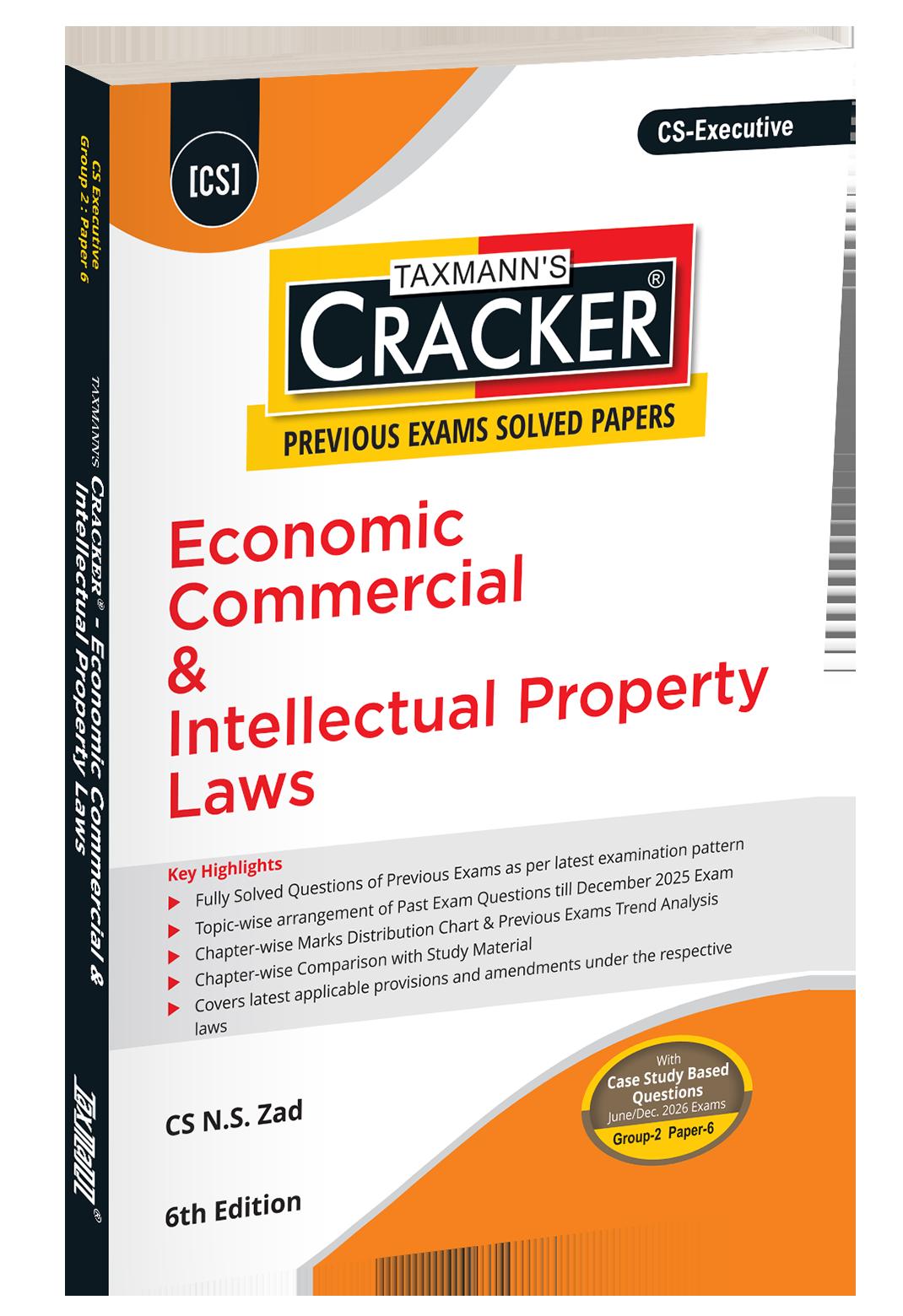
Economic
Commercial & Intellectual Property
Laws
(ECIPL | EC & IPL) | CRACKER
AUTHOR : N.S. Zad
PUBLISHER : Taxmann
DATE OF PUBLICATION : January 2026
EDITION : 6th Edition
ISBN NO : 9789375617853
No. of Pages : 388
BINDING TYPE : Paperback
Rs. 465

DESCRIPTION
Economic, Commercial & Intellectual Property Laws – CRACKER is a focused, exam-oriented preparation manual for CS Executive – Group 2 | Paper 6, designed to address the growing emphasis on casestudy questions, practical application, and inter-law integration under the ICSI examination framework. Applicable for the June/December 2026 examinations, the book is developed through a systematic analysis of CS Executive question papers up to December 2025, transforming past exam trends into a targeted, high-scoring preparation strategy. Going beyond a conventional solved-papers book, this CRACKER decodes the examiner’s focus, identifies scoring chapters, and aligns tested areas directly with the ICSI Study Material, enabling precise, result-oriented preparation.
The Present Publication is the 6th Edition, authored by CS N.S. Zad, with the following noteworthy features:
• [Fully Solved Previous Examination Questions] Comprehensive coverage of CS Executive Paper 6 questions up to December 2025, solved in a structured manner as per ICSI’s evaluation standards
• [Dedicated Case Study–Based Question Framework] A separately analysed, high-weightage segment focusing on case-study questions, which constitute a significant portion of marks in recent examinations
• [Chapter-wise Marks Distribution Charts] Analytical tables presenting marks allocation across multiple exam cycles (2021–2025) to identify consistently scoring chapters
• [Previous Exams Trend Analysis] Attempt-wise and year-wise analysis highlighting recurring chapters, question patterns, and shifts in examiner emphasis
• [Chapter-wise Comparison with ICSI Study Material] Direct mapping of each chapter with the corresponding Study Material chapter to ensure complete syllabus alignment
• [Updated Legal Position] Solutions incorporating the latest applicable statutory provisions, rules, and amendments relevant for the 2026 exams