Sample Read
© Taxmann Price : ` 235
Law stated in this book is as updated till 15th November, 2025
Published by : Taxmann Publications (P.) Ltd.
Sales & Marketing : 59/32, New Rohtak Road, New Delhi-110 005 India
Phone : +91-11-45562222
Website : www.taxmann.com
E-mail : sales@taxmann.com
Regd. Office : 21/35, West Punjabi Bagh, New Delhi-110 026 India
Printed at :
Tan Prints (India) Pvt. Ltd.
44 Km. Mile Stone, National Highway, Rohtak Road Village Rohad, Distt. Jhajjar (Haryana) India
E-mail : sales@tanprints.com
Disclaimer
Every effort has been made to avoid errors or omissions in this publication. In spite of this, errors may creep in. Any mistake, error or discrepancy noted may be brought to our notice which shall be taken care of in the next edition. It is notified that neither the publisher nor the author or seller will be responsible for any damage or loss of action to any one, of any kind, in any manner, therefrom. It is suggested that to avoid any doubt the reader should cross-check all the facts, law and contents of the publication with original Government publication or notifications.
No part of this book may be reproduced or copied in any form or by any means [graphic, electronic or mechanical, including photocopying, recording, taping, or information retrieval systems] or reproduced on any disc, tape, perforated media or other information storage device, etc., without the written permission of the publishers. Breach of this condition is liable for legal action.
For binding mistake, misprints or for missing pages, etc., the publisher’s liability is limited to replacement within seven days of purchase by similar edition. All expenses in this connection are to be borne by the purchaser. All disputes are subject to Delhi jurisdiction only.
DOCK WORKERS (REGULATION OF EMPLOYMENT) ACT, 1948
1.
3.
4.
5.
6.
7.
8.
9.
10.
11.
12.
DOCK WORKERS (SAFETY, HEALTH AND WELFARE) ACT, 1986
DOCK WORKERS (REGULATION OF
(INAPPLICABILITY TO MAJOR PORTS) ACT, 1997
DOCK WORKERS (REGULATION OF EMPLOYMENT) RULES, 1962
DOCK WORKERS (ADVISORY
DOCK WORKERS (SAFETY, HEALTH AND WELFARE) RULES, 1990
DOCK WORKERS (SAFETY, HEALTH AND WELFARE) REGULATIONS, 1990
21.
23.
24.
25.
26.
27.
28.
29.
30.
33.
43.
CONTENTS
51. Register of periodical test and examination and certificates thereof
52. Marking of safe working load
53. Loading of lifting appliances and loose gears
54. Pulley blocks
55. Vacuum and magnetic lifting device
56. Knotting of chains and wire ropes
Equipment and Operations
57. Power trucks and hand trucks
58. Use of internal combustion engines in the holds
59.
60.
61.
62.
63.
64.
67.
69.
70.
71.
72.
73.
74.
75.
79.
80.
81.
83.
86.
87.
110. Statement of accidents, etc.
PART VI
111. Training of dock workers, responsible persons, etc.
112. Emergency action plans
113. Display of abstracts
114.
115.
116. The employer’s
117.
SCHEDULE I: Manner of test and examination before taking lifting appliance, loose gear and wire rope into use for the first time
SCHEDULE II: Classification of dangerous goods
SCHEDULE III: Rules relating to the appointment of safety officers
SCHEDULE IV: List of notifiable diseases
SCHEDULE V: Articles required for an ambulance room
SCHEDULE VI: Equipment required for a First-Aid Box or Cupboard
SCHEDULE VII: Permissible exposure in cases of Continuous Noise 110
SCHEDULE VIII: Scale for providing Latrines, Urinals, Washing and Bathing Facilities at Dock 111
SCHEDULE IX: Requirements for Canteen 111
SCHEDULE X: Rules relating to the appointment of welfare officer Prescribed under regulation 109 of the Dock Workers (Safety, Health and Welfare) Regulations, 1989
SCHEDULE XI: Schedule for medical examination of Dock Workers 114
Dock Workers (Regulation of Employment) Act, 1948
[9 OF 1948]1
An Act to provide for regulating the employment of dock workers.
Whereas it is expedient to provide for regulating the employment of dock workers; It is hereby enacted as follows:—
Short title and extent.
1. (1) This Act may be called the Dock Workers (Regulation of Employment) Act, 1948.
(2)It extends to the whole of India 2[except the State of Jammu and Kashmir*].
Definitions.
2. In this Act, unless there is anything repugnant in the subject or context,—
3[(a) “Board” means a Dock Labour Board established under section 5A;]
4[(aa)] “cargo” includes anything carried or to be carried in a ship or other vessel;
(b) “dock worker” means a person employed or to be employed in, or in the vicinity of, any port on work in connection with the loading, unloading, movement or storage of cargoes, or work in connection with the preparation of ships or other vessels for the receipt or discharge of cargoes or leaving port;
(c) “employer”, in relation to a dock worker, means the person by whom he is employed or to be employed as aforesaid;
(d) “Government” means, in relation to any major port, the Central Government and, in relation to any other port, the State Government;
(e) “scheme” means a scheme made under this Act.
1. Dated 4-3-1948.
2. Substituted for “except Part B States” by the Part B States (Laws) Act, 1951, w.e.f. 1-4-1951.
3. Inserted by the Dock Workers (Regulation of Employment) Amendment Act, 1962, w.e.f. 1-61962.
4. Clause (a) re-lettered as clause (aa), ibid.
*This Act made applicable to the Union Territory of Jammu and Kashmir and Union Territory of Ladakh vide Notification No. S.O. 3912(E) dated 30-10-2019.
S. 2 DOCK WORKERS (REGULATION OF EMPLOYMENT) ACT, 1948 2
COMMENTS
SECTION NOTES
2.1 Dock Worker [Section 2(b)]
u A dock worker refers to a person who is:
n Currently employed or to be employed (i.e., includes prospective employment),
n Location: Either:
l Within a port, or
l In the vicinity of a port.
u The work must relate to one or more of the following categories:
n Cargo Handling:
l Loading of cargoes;
l Unloading of cargoes;
l Movement of cargoes;
l Storage of cargoes.
n Ship Operations:
l Activities concerning the preparation of ships or other vessels for:
1. Receiving cargoes;
2. Discharging cargoes;
3. Departing from port.
CASE LAWS
u Definition of Stevedore and Employer - Registration Rights - The Calcutta Dock Workers (Regulation of Employment) Scheme, 1951 and 1956, framed under the Dock Workers (Regulation of Employment) Act, 1948, differentiate between stevedores and other employers. The petitioners, engaged in the business of supplying tally clerks for cargo handling, contended that they were denied registration under the scheme despite employing dock workers. The Court clarified that the term “stevedore” refers to those directly involved in the stowing and discharging of cargo, while the petitioners acted merely as contractors providing tally clerks and did not meet this definition. The Court further held that the scheme does not limit registration exclusively to stevedores; employers who hire dock workers for related activities must also be eligible. The refusal to register the petitioners was found to be improper, and they were entitled to be registered as employers. - Kesab Lal Banerjee v. Calcutta Dock Labour Board AIR 1960 Calcutta 166.
u Definition of Dock Workers - Applicability of Wage Board Recommendations - The Supreme Court considered whether bargemen, i.e., Majhis and Dandees, at Calcutta Port fell within the definition of “dock workers” under section 2(b) of the Dock Workers (Regulation of Employment) Act, 1948, and whether they were entitled to the benefits of the Wage Board’s recommendations for port and dock workers. The National Tribunal had held that bargemen, who were involved in cargo handling, were included within the definition of “dock workers” despite the Wage Board’s failure to make specific recommendations for them. The Supreme Court affirmed this decision, rejecting the view of the Calcutta High Court that the tribunal exceeded its jurisdiction. It held that the Wage Board’s recommendations were applicable to the bargemen and alternatively supported the tribunal’s independent wage determination based on fair wage principles.
DOCK WORKERS (REGULATION OF EMPLOYMENT) ACT, 1948 S. 3
The appeal was allowed, and the tribunal’s award was restored. Calcutta Port Shramik Union v. The Calcutta River Transport Association AIR 1988 SC 2168.
u Definition of Dock Worker - The term “dock worker” under section 2(b) of the Dock Workers (Regulation of Employment) Act, 1948, includes not only those involved directly in loading, unloading, movement, or storage of cargo but also encompasses individuals engaged in preparatory work related to the arrival, handling, or departure of vessels. This definition was expanded to include sampling workers who are involved in taking samples as part of the cargo preparation process before export, as such activities are integral to the process of handling and preparing cargo for shipment. This broader interpretation affirms that sampling workers fall within the scope of “dock workers.”
- Dr. Raman C. Amin v. Dock Labour Board, Visakhapatnam 1990 LAB. I. C. 110.
Scheme for ensuring regular employment of workers.
3. (1) Provision may be made by a scheme for the registration of dock workers 5[and employers] with a view to ensuring greater regularity of employment and for regulating the employment of dock workers, whether registered or not, in a port.
(2) In particular, a scheme may provide—
(a) for the application of the scheme to such classes of dock workers and employers as may be specified therein;
(b) for defining the obligations of dock workers and employers subject to the fulfilment of which the scheme may apply to them and the circumstances in which the scheme shall cease to apply to any dock workers or employers;
(
c) for regulating the recruitment and entry into the scheme of dock workers, 6[and the registration of dock workers and employers], including the maintenance of registers, the removal either temporarily or permanently, of names from the registers and the imposition of fees for registration;
(
d) for regulating the employment of dock workers, whether registered or not, and the terms and conditions of such employment, including rates of remuneration, hours of work and conditions as to holidays and pay in respect thereof;
(
e) for securing that, in respect of periods during which employment, or full employment, is not available for dock workers to whom the scheme applies and who are available for work, such workers will, subject to the conditions of the scheme, receive a minimum pay;
(f) for prohibiting, restricting or otherwise controlling the employment of dock workers to whom the scheme does not apply and the employment of dock workers by employers to whom the scheme does not apply;
7[(ff) for creating such fund or funds as may be necessary or expedient for the purposes of the scheme and for the administration of such fund or funds;]
5. Inserted by the Dock Workers (Regulation of Employment) Amendment Act, 1962, w.e.f. 1-6-1962.
6. Substituted for “and their registration”, ibid.
7. Inserted by the Dock Workers (Regulation of Employment) Amendment Act, 1980, w.e.f. 29-11-1980.
S. 3 DOCK WORKERS (REGULATION OF EMPLOYMENT) ACT, 1948 4
(g) for the training 8[***] of dock workers, insofar as satisfactory provision therefor does not exist apart from the scheme;
9[(gg) for the welfare of the officers and other staff of the Board;]
(h) 10[***]
(i) for the manner in which, and the persons by whom, the cost of operating the scheme is to be defrayed;
11[(j) for constituting 12[***] the authority to be responsible for the administration of the scheme;]
(k) for such incidental and supplementary matters as may be necessary or expedient for the purposes of the scheme.
(3) A scheme may further provide that a contravention of any provision thereof shall be punishable with imprisonment for such term as may be specified but in no case exceeding three months in respect of a first contravention or six months in respect of any subsequent contravention, or with fine which may extend to such amount as may be specified but in no case exceeding five hundred rupees in respect of a first contravention or one thousand rupees in respect of any subsequent contravention, or with both imprisonment and fine as aforesaid.
COMMENTS
CASE LAWS
u Framing of Scheme - Legislative Power of Central Government - Section 3 of the Dock Workers (Regulation of Employment) Act, 1948, grants the Central Government the power to frame schemes for regulating the employment of dock workers. This power is legislative in nature, and any scheme framed under this section is considered a form of subordinate legislation. The Courts cannot compel the Government through a writ of mandamus to frame or amend such schemes, as this would interfere with the legislative discretion vested in the Government. The High Court also held that any challenge to this exercise of power on grounds of violation of Article 14 of the Constitution is not maintainable, as the power under section 3 is legislative rather than administrative.Union of India v. Cochin Port Labour Union 1994 LAB. I. C. 626.
u Fundamental Right to Stevedoring Business - Licensing Requirement by Port Authority - Under the Dock Workers (Regulation of Employment) Act, 1948, and the 1956 Scheme, clause 15(1)(c) requires stevedores to obtain a license from the Port Authority as a precondition for registration. The petitioner challenged this provision, arguing that it violated their fundamental right to carry on business under Article 19(1)(g) of the Constitution. The court held that there is no inherent or fundamental right to carry on a specific business like stevedoring within a particular area owned and controlled
8. Words “and welfare” omitted by the Dock Workers (Safety, Health and Welfare) Act, 1986, w.e.f. 15-4-1987.
9. Inserted by the Dock Workers (Regulation of Employment) Amendment Act, 1970, w.e.f. 28-8-1970.
10. Clause (h) omitted by the Dock Workers (Safety, Health and Welfare) Act, 1986, w.e.f. 15-4-1987.
11. Substituted by the Dock Workers (Regulation of Employment) Amendment Act, 1949.
12. Words “whether as a body corporate or otherwise” omitted by the Dock Workers (Regulation of Employment) Amendment Act, 1962, w.e.f. 1-6-1962.
5 DOCK WORKERS (REGULATION OF EMPLOYMENT) ACT, 1948 S. 4
by the Port Commissioners. The licensing requirement under the scheme is valid as it regulates the entry of businesses to maintain safety and efficient operations. The judgment emphasized that while the general right to carry on business is protected, specific rights to operate within a restricted area like a port do not constitute a fundamental right. The appeal was allowed, and the petition for mandamus was dismissed. - Commissioners for the Port of Calcutta v. Asit Ranjan Majumder AIR 1962 Calcutta 530.
u Decasualisation of Workers - Formation of High Power Committee - The Supreme Court dealt with the issue of decasualisation of unlisted dock workers at Paradeep Port. The High Court had previously constituted a committee chaired by the Chairman of Paradeep Port Trust to determine the listing of unlisted workers. However, the Supreme Court found this committee inadequate due to the lack of technical expertise. Referring to the Abraham Committee’s recommendations, which emphasized the need for an expert assessment of optimal worker strength, the Court directed the formation of a new High Power Committee headed by a retired Supreme Court judge, with members nominated by the Government of India, including a representative from the Ministry of Surface Transport and an expert in port management. The new committee was tasked with implementing the decasualisation process in accordance with the Abraham Committee’s recommendations and the Paradeep Cargo Handling (Regulation of Employment) Scheme, 1979. The appeal was disposed of with directions for the implementation of the committee’s decision within two months. - Paradeep Port Trust v. Paradeep Port and Dock Mazdoor Union AIR 1990 SC 1125.
u Power to Frame Employment Schemes - Legitimacy of Workforce Reorganization - The Calcutta High Court upheld the Dock Labour Board’s authority under Section 3 to implement schemes for regulating the employment of dock workers, including measures for compulsory retirement to maintain operational efficiency. The Court held that the Scheme’s provisions allowing for the reduction of surplus workers were valid, and such reorganization did not require compliance with the Industrial Disputes Act, as the Board does not constitute an “industry.” The appeal challenging the Board’s actions was dismissed, affirming the power of the Dock Labour Board to adjust the workforce based on operational needs - Promode Ranjan Datta v. Union of India 1982 LAB. I. C. 1768.
Making, variation and revocation of schemes.
4. (1) The Government may, by notification in the Official Gazette and subject to the condition of previous publication, make one or more schemes for a port or group of ports, and may in the like manner and subject to the like condition add to, amend, vary or revoke any scheme made by it.
(2) The provisions of section 23 of the General Clauses Act, 1897 (10 of 1897), shall apply to the exercise of a power given by sub-section (1) as they apply to the exercise of a power given by a Central Act to make rules subject to the condition of previous publication.
(3) The Government may direct the port authority of any port to prepare, in accordance with such instructions as may from time to time be given to it, one or more draft schemes for the port, and the port authority shall comply with such direction.
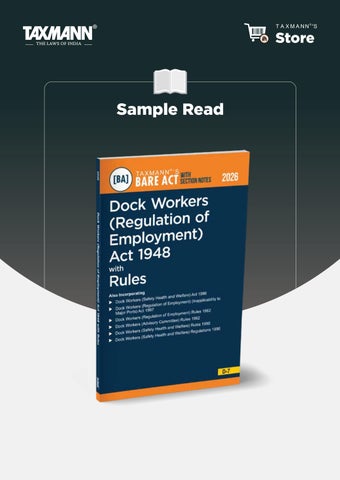
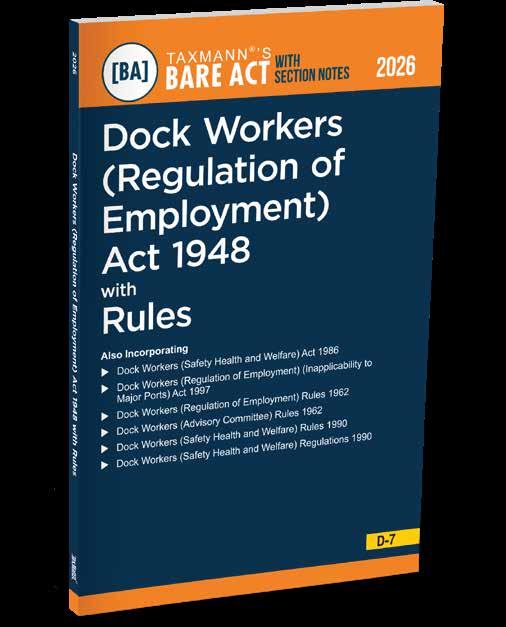
DOCK WORKERS (REGULATION OF EMPLOYMENT) ACT 1948 WITH RULES –BARE ACT WITH SECTION NOTES
AUTHOR : Taxmann's Editorial Board
PUBLISHER : Taxmann
DATE OF PUBLICATION : January 2026
EDITION : 2026 Edition
ISBN NO : 9789371266284
NO. OF PAGES : 168
BINDING TYPE : Paperback
DESCRIPTION
Dock Workers (Regulation of Employment) Act 1948 with Rules [Bare Act with Section Notes] by Taxmann is an authoritative statutory reference on the regulation of employment, welfare, safety, and administrative control of dock workers in India. The publication presents the bare and unabridged text of the principal Act, along with all relevant rules, amendments, and allied legislations governing dock labour and port operations. Supported by section-wise explanatory notes, judicial interpretations, and cross-references, the book enables a clear understanding of both the substantive law and its practical application in port and dock employment contexts. The 2026 Edition reflects the law as amended and in force up to date, ensuring complete statutory accuracy and reliability. This book is intended for the following audience:
• Legal Professionals, Judges & Law Firms
• Port Authorities, Employers & HR Departments
• Government Officials, Labour Departments & Inspectors
• Trade Unions & Worker Representatives
• Academicians & Law Students
• Consultants, Safety Officers & Regulatory Advisors
The Present Publication is the 2026 Edition, covering the amended and updated text of the Dock Workers (Regulation of Employment) Act [Act No. 9 of 1948] and Rules, with the following noteworthy features:
• [Authentic & Unabridged Text] Full and amended text of the Dock Workers (Regulation of Employment) Act 1948
• [Updated to Latest Amendments] Incorporates all statutory amendments, notifications, and applicability updates as of date
• [Pre-amendment Provisions] Includes pre-amendment text through amendment footnotes for understanding earlier legal positions and transitional applicability
• [Comprehensive Allied Material] Complete and updated text of:
o Dock Workers (Regulation of Employment) Rules 1962
o Dock Workers (Advisory Committee) Rules 1962
o Dock Workers (Safety, Health and Welfare) Act 1986
o Dock Workers (Safety, Health and Welfare) Rules 1990
o Dock Workers (Safety, Health and Welfare) Regulations 1990
o Dock Workers (Regulation of Employment) (Inapplicability to Major Ports) Act 1997
• [Detailed Section Notes & Case Law] Concise explanatory notes with summaries of landmark judgments and key interpretative rulings
• [Practical Forms & Schedules] Statutory forms and compliance formats relating to inspection, safety, medical examination, and accident reporting
• [User-friendly Structure] Clear headings, logical flow, and a detailed subject index for quick reference
• [Legislative History & Amendments] Coverage of statutory evolution, amendments, savings, and repeal provisions
• [Practical Focus] Designed for operational use as both a legal reference and a compliance manual for inspections, audits, and port management
• [Legal Reliability] Supported by up-to-date judicial guidance to aid accurate interpretation and implementation