Sample Read
© All copyright with The Chamber of Tax Consultants, Mumbai Price : ` 485 Edition : 2026 Published by : Taxmann Publications (P.) Ltd. Sales & Marketing : 59/32, New Rohtak Road, New Delhi-110 005 India Phone : +91-11-45562222 Website : www.taxmann.com E-mail : sales@taxmann.com Mumbai : 35, Bodke Building, M.G. Road, Opp. Railway Station, Mulund (W), Mumbai - 400 080 Mob. +91-9322247686, 9619668669, 7045453844/45/51 E-mail : sales.mumbai@taxmann.com Regd. Office : 21/35, West Punjabi Bagh, New Delhi-110 026 India Printed at : Tan Prints (India) Pvt. Ltd. 44 Km. Mile Stone, National Highway, Rohtak Road Village Rohad, Distt. Jhajjar (Haryana) India E-mail : sales@tanprints.com Disclaimer Every effort has been made to avoid errors or omissions in this publication. In spite of this, errors may creep in. Any mistake, error or discrepancy noted may be brought to our notice which shall be taken care of in the next edition. It is notified that neither the publisher nor the Chamber of Tax Consultants or seller will be responsible for any damage or loss of action to any one, of any kind, in any manner, therefrom. It is suggested that to avoid any doubt the reader should cross-check all the facts, law and contents of the publication with original Government publication or notifications. No part of this book may be reproduced or copied in any form or by any means [graphic, electronic or mechanical, including photocopying, recording, taping, or information retrieval systems] or reproduced on any disc, tape, perforated media or other information storage device, etc., without the written permission of the Chamber of Tax Consultants. Breach of this condition is liable for legal action. For binding mistake, misprints or for missing pages, etc., the publisher’s liability is limited to replacement within seven days of purchase by similar edition. All expenses in this connection are to be borne by the purchaser. All disputes are subject to Mumbai jurisdiction only.
CONTENTS Serial 'HVFULSWLRQ Number 1 2 3 4 5 6 7 8 9 10 11 12 13 14 15 16 17 18 19 20
Page Number From To Vision Statement I-3 I-3 The Chamber of Tax Consultants I-5 I-5 President & Chairman Message I-7 I-8 Managing Council 2025-26 I-9 I-10 Research & Publications Committee 2025-26 I-11 I-12 About the Author I-13 I-14 Testimonials I-15 I-17 Preface I-19 I-20 Synopsis 1 2 Conceptual Framework Introduction 3 6 Corporate Law – Basic Provisions 7 11 Comparative sections of ITA 1961/IT Rules 12 15 1962 vis-a-vis ITA 2025/IT Rules 2026 Residential Status 16 25 Definition of Dividend and Deemed Divi- 26 59 dend Controversies Taxability and Issues 60 63 Dividend Income Characterisation 64 64 Expenses Deductible 65 66 Dividend Stripping 67 69 Buy-Back of Shares 70 77 Deduction in respect of Inter-Corporate 78 80 Dividends
I-21
Contents
Serial 'HVFULSWLRQ Number 21 22 23 24 25 26 27 28 29
I-22
Page Number From To Taxation of International Dividend Pay- 81 96 outs Withholding Taxes and Tax deducted at 97 104 Source provisions on Dividend Tax Jurisprudence 105 106 Corporate Dividend Audit Checklists 107 119 documentation Index of Judicial Citations, Circulars and 120 126 Notifications Alphabetical Judgment Index 127 132 Subject-wise Index 133 136 Income-tax Section-wise Index 137 140 Conclusion 141 142
C
6
H
A
P
T
E
R
Definition of Dividend and Deemed Dividend Controversies
Section 2(22) of ITA 1961 (analogues to section 2(40) of ITA 2025) defines the “dividend”. The definition provided under the Act is inclusive definition but the same is not exhaustive as such. Thus, it can be concluded that if a particular distribution can’t be regarded as dividend as per section of the Act, then, it may be considered as dividend as held in Kantilal Manilal v. CIT (1961) 41 ITR 275 (SC). Section 2(22) of ITA 1961 vis-à-vis section 2(40) of ITA 2025 defines the dividend as under: “dividend” includes
26
Subclause
2(22)- ITA 1961
2(40) ITA 2025
(a)
any distribution by a company of accumulated profits, whether capitalised or not, if such distribution entails the release by the company to its shareholders of all or any part of the assets of the company
any distribution by a company of accumulated profits, whether capitalised or not, if such distribution entails the release by the company to its shareholders of all or any part of the assets of the company
(b)
any distribution to its shareholders by a company of debentures, debenture-stock, or deposit certificates in any form, whether with or without interest, and any distribution to its preference shareholders of shares by way of bonus, to the extent to which the company possesses accumulated profits, whether capitalised or not;
any distribution to its shareholders by a company of debentures, debenture-stock, or deposit certificates in any form, with or without interest, and any distribution to its preference shareholders of shares by way of bonus, to the extent to which the company possesses accumulated profits, whether capitalised or not
(c)
any distribution made to the shareholders of a company on its liquidation, to the extent to which the distribution is attributable to the accumulated profits of the company immediately before its liquidation, whether capitalised or not;
any distribution made to the shareholders of a company on its liquidation, to the extent to which the distribution is attributable to the accumulated profits of the company immediately before its liquidation, whether capitalised or not;
Definition of Dividend and Deemed Dividend Controversies Subclause
2(22)- ITA 1961
2(40) ITA 2025
(d)
any distribution to its shareholders by a company on the reduction of its capital, to the extent to which the company possesses accumulated profits which arose after the end of the previous year ending next before the 1st day of April, 1933, whether such accumulated profits have been capitalised or not;
any distribution to its shareholders by a company on the reduction of its capital, to the extent to which the company possesses accumulated profits, whether capitalised or not;
(e)
any payment by a company, not being a company in which the public are substantially interested, of any sum (whether as representing a part of the assets of the company or otherwise) made after the 31st day of May, 1987, by way of advance or loan to a shareholder being a person who is the beneficial owner of shares (not being shares entitled to a fixed rate of dividend whether with or without a right to participate in profits) holding not less than ten per cent of the voting power, or to any concern in which such shareholder is a member or a partner and in which he has a substantial interest (hereafter in this clause referred to as the said concern)] or any payment by any such company on behalf, or for the individual benefit, of any such shareholder, to the extent to which the company in either case possesses accumulated profits;
any payment by a company, not being a company in which the public are substantially interested, of any sum (whether as representing a part of the assets of the company or otherwise),— i. as an advance or loan to a shareholder, being a person who is the beneficial owner of shares (not being shares entitled to a fixed rate of dividend, with or without a right to participate in profits) holding not less than 10% of the voting power; or ii. as an advance or loan to any concern in which such shareholder is a member or a partner and in which he has a substantial interest (herein referred to as the said concern) or; iii. made on behalf, or for the individual benefit, of any such shareholder, to the extent to which the company in either case possesses accumulated profits
(f)
any payment by a company on purchase of its own shares from a shareholder in accordance with the provisions of section 68 of the Companies Act, 2013 (18 of 2013) w.e.f. October 1, 2024.
any payment by a company on purchase of its own shares from a shareholder as per section 68 of the Companies Act, 2013 (18 of 2013). The Finance Act, 2026 has omitted clause (f) from definition of “dividend” in Section 2(40) of ITA 2025
27
Definition of Dividend and Deemed Dividend Controversies Subclause
2(22)- ITA 1961
2(40) ITA 2025 and has substituted sub-sections (2) and (3) of Section 69 of ITA 2025. With effect from tax year 2026-27, any payment made by company for buyback of its own shares is taxable as capital gains in the hands of shareholder and not as “deemed dividend”. If buyback activities are completed on or before 31.03.2026 but payment for buyback is made to shareholder on or after 01.04.2026, the payment will be taxable as capital gains under Section 69 of ITA 2025 and not as deemed dividend. If buyback activities are completed and payment is made on or before, 31.03.2026, same is taxable as deemed dividend under Section 2(22)(f) of ITA 1961.
but “dividend” does not include- but does not include-
28
(i)
(i) a distribution made in accordance with sub-clause (c) or sub-clause (d) in respect of any share issued for full cash consideration, where the holder of the share is not entitled in the event of liquidation to participate in the surplus assets;
a distribution made under sub-clause (c) or (d) in respect of any share issued for full cash consideration, where the holder of the share is not entitled in the event of liquidation to participate in the surplus assets
(ia)
a distribution made in accordance with sub-clause (c) or sub-clause (d) in so far as such distribution is attributable to the capitalised profits of the company representing bonus shares allotted to its equity shareholders after the 31st day of March, 1964, and before the 1st day of April, 1965]
NA
(ii)
(ii) any advance or loan made to a shareholder or the said concern] by a company in the ordinary course of its business, where the lending of money is a substantial part of the business of the company;
any advance or loan made to a shareholder or the said concern by a company in the ordinary course of its business, where the lending of money is a substantial part of the business of the company
Definition of Dividend and Deemed Dividend Controversies Subclause (iia)
2(22)- ITA 1961
2(40) ITA 2025
any advance or loan between two v. any advance or loan between two group entities, where, group entities, where, — (A) one of the group entity is a “Finance company” or a “Finance unit”; and
A. one of the group entity is a “Finance Company” or a “Finance Unit”; and
(B) the parent entity or principal entity of such group is listed on stock exchange in a country or territory outside India other than the country or territory outside India as may be specified by the Board in this behalf
B. the parent entity or principal entity of such group is listed on stock exchange in a country or territory outside India other than the country or territory outside India as specified by the Board in this behalf, where, — (A) “accumulated profits” for the purposes of— (I) sub-clauses (a), (b), (d) and (e), shall include all profits of the company up to the date of distribution or payment referred to in those sub-clauses; (analogous to Explanation 1 of ITA 1961) (II) sub-clause (c), shall include all profits of the company up to the date of liquidation, but shall not, where the liquidation is consequent on the compulsory acquisition of its undertaking by the Government or a corporation owned or controlled by the Government under any law in force, include any profits of the company before three successive Tax Year 2026-27 immediately preceding the Tax Year 2026-27 in which such acquisition took place; (analogous to Explanation 2 of ITA 1961) (B) in respect of an amalgamated company, the accumulated profits, whether capitalised or
29
Definition of Dividend and Deemed Dividend Controversies Subclause
2(22)- ITA 1961
2(40) ITA 2025 not, or loss, as the case may be, shall be increased by the accumulated profits, whether capitalised or not, of the amalgamating company on the date of amalgamation (analogous Explanation 2A of ITA 1961) (C) “concern” means a Hindu undivided family or a firm or an association of persons or a body of individuals or a company; (analogous Explanation 3(a) of ITA 1961) (D) a person shall be deemed to have a substantial interest in a concern, other than a company, if he is, at any time during the Tax Year 2026-27, beneficially entitled to not less than 20% of the income of such concern; (analogous Explanation 3(b) of ITA 1961) (E) for the purposes of sub-clause (v),— (I) “Finance Company” and “Finance Unit” shall have the same meaning as respectively assigned to them in regulation 2(1)(e) and (f) of the International Financial Services Centres Authority (Finance Company) Regulations, 2021 made under the International Financial Services Centres Authority Act, 2019 (50 of 2019), and is set up as a global or regional corporate treasury centre for undertaking treasury activities or treasury services as per the relevant regulations made by the International Financial Services Centres Authority established under
30
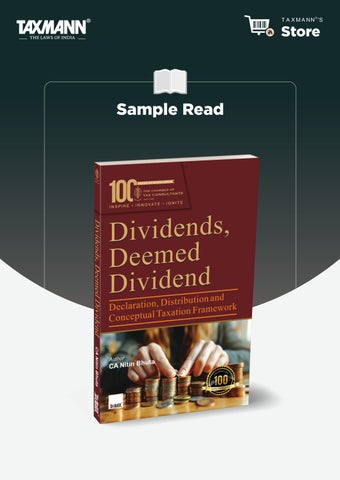
DIVIDENDS, DEEMED DIVIDEND—DECLARATION, DISTRIBUTION AND CONCEPTUAL TAXATION FRAMEWORK AUTHOR : PUBLISHER : DATE OF PUBLICATION : EDITION : ISBN NO : NO. OF PAGES : BINDING TYPE :
Nitin Bhuta Taxmann July 2026 2026 Edition 9789375619956 164 Paperback
Rs. 485 DESCRIPTION A dividend looks like the simplest transaction in corporate finance: a company earns a profit and hands some of it back to its owners. That simplicity is an illusion. Before a single rupee reaches a shareholder, it must survive Section 123 of the Companies Act 2013; the inclusive, and famously elastic, definition in Section 2(22) of the Income-tax Act 1961; the newly enacted Section 2(40) of the Income-tax Act 2025; a withholding obligation whose trigger point may have just moved; FEMA's Non-Debt Instruments Rules; an applicable DTAA read alongside the Multilateral Instrument; and some seventy years of judicial precedent, much of it decided on facts that no longer exist. Dividends, Deemed Dividend—Declaration, Distribution and Conceptual Taxation Framework holds all of that in a single hand. Drawing on thirty-three years of practice, CA. Nitin Bhuta compresses a subject that ordinarily sprawls across three or four volumes into 142 pages across 21 chapters, without hollowing it out. What makes it distinctive is its refusal to read tax law in a vacuum. A defective declaration under company law is the seed of a tax dispute, so the two must be read together—the book moves between the Board resolution and the assessment order, the Register of Members and Form 27Q, Section 52 of the Companies Act and Section 2(22)(e) of the Income-tax Act. It is also written from inside a transition, mapping the Income-tax Act 2025 against the 1961 Act section by section and rule by rule, then asking what practitioners actually need answered: do the old judgments still work? Above all, the book takes positions. Contested questions are framed as Posers and answered with the author's own reasoned view—on Section 56(2)(x) and capital reduction, PMS fee deductibility, TDS on a year-end provision for proposed dividend, when a dividend held up by RBI approval becomes taxable, and whether Section 94(7) reaches shares acquired by gift or inheritance. The author flags where a position 'is likely to be subject to scrutiny and litigation.' A practitioner may disagree. But they are usable—which is more than can be said of a hedge. The book is pitched at anyone who has to make, defend, verify, or advise on a dividend decision: • Chartered Accountants and Tax Consultants • Advocates and Litigators • Statutory Auditors • Tax Auditors • Company Directors and Boards • Company Secretaries and Compliance Officers • CFOs and Corporate Tax Teams • International Tax and FEMA Practitioners • Investors, NRIs and their Advisors • Students and Academics The Present Publication is the Latest Edition, commissioned by The Chambers of Tax Consultants, authored by CA. Nitin Bhuta and published exclusively by Taxmann, with the following noteworthy features: • [Multi-disciplinary Text] Company law, tax law, FEMA and audit read as one system: the Articles authorise, the Board recommends, the AGM approves, the bank account segregates, the TDS crystallises, the auditor verifies, the assessee reconciles. Break the chain anywhere, and the consequences travel in every direction • [Mapping Tables] Two comparative tables—ITA 1961/IT Rules 1962 vis-à-vis ITA 2025/IT Rules 2026—covering roughly forty provisions and the full form migration (10F→41, 15CA→145, 15CB→146, 26Q→140, 27Q→144, 16A→131, 3CEB→48, 3CD→26, 67→44) • [The Core, Dissected] A 34-page treatment of Section 2(22)/Section 2(40). Sub-clauses (a) to (e) analysed for their cumulative conditions, then stress-tested scenario by scenario with precedent attached; (f) is taken up in the buy-back chapter • [The Select Committee Record] Verbatim Parliamentary proceedings on Clause 2(40)—the rejected safe-harbour for bona fide intra-group loans, the Revenue's refusal to align 'company in which the public are substantially interested' with company law, and the deletion of limb (f). The book's most distinctive research contribution • [Positions, Not Hedges] Eleven Posers across five chapters, each with the author's view, the reasoning, and where warranted a candid risk flag • [A Working Paper for Rule 11(f)] A 44-point Corporate Dividend Audit Checklist, segmented into Corporate Law, Income Tax Law and Other Documentation, with Yes/No/NA columns, tagged document references and a Prepared/Reviewed/Approved/Verified sign-off block • [Four Ways In] A 70-entry Index of Judicial Citations, Circulars and Notifications; an Alphabetical Judgment Index (61 judgments); a Subject-wise Index; and an Income-tax Section-wise Index • [Thirty Treaties at a Glance] A 30-country DTAA withholding rate table, with holding-threshold conditions and allocation of taxing rights • [Knows Its Own Limits] The author declines to litigate buy-back capital gains controversies; the book 'deals exclusively with the taxation of dividends'; and concedes cross-border dividend taxation 'could, in itself, warrant a dedicated treatise'
Buy Now