Direct Tax Vivad se Vishwas Act, 2020
[3 OF 2020]
[AS AMENDED BY FINANCE ACT, 2021]
An Act to provide for resolution of disputed tax and for matters connected therewith or incidental thereto.
BE it enacted by Parliament in the Seventy-first Year of the Republic of India as follows:—
Short title.
1. This Act may be called the Direct Tax Vivad se Vishwas Act, 2020. Definitions.
2. (1) In this Act, unless the context otherwise requires,—
(a) “appellant” means—
(
i) a person in whose case an appeal or a writ petition or special leave petition has been filed either by him or by the income-tax authority or by both, before an appellate forum and such appeal or petition is pending as on the specified date;
(ii) a person in whose case an order has been passed by the Assessing Officer, or an order has been passed by the Commissioner (Appeals) or the Income Tax Appellate Tribunal in an appeal, or by the High Court in a writ petition, on or before the specified date, and the time for filing any appeal or special leave petition against such order by that person has not expired as on that date;
(iii) a person who has filed his objections before the Dispute Resolution Panel under section 144C of the Income-tax Act, 1961 (43 of 1961) and the Dispute Resolution Panel has not issued any direction on or before the specified date;
(iv) a person in whose case the Dispute Resolution Panel has issued direction under sub-section (5) of section 144C of the Income-tax Act and the Assessing Officer has not passed any order under sub-section (13) of that section on or before the specified date;
(
v) a person who has filed an application for revision under section 264 of the Income-tax Act and such application is pending as on the specified date.
(
(
(
(
1[Explanation.—For the removal of doubts, it is hereby clarified that the expression “appellant” shall not include and shall be deemed never to have been included a person in whose case a writ petition or special leave petition or any other proceeding has been filed either by him or by the income-tax authority or by both before an appellate forum, arising out of an order of the Settlement Commission under Chapter XIX-A of the Income-tax Act, and such petition or appeal is either pending or is disposed of;]
b) “appellate forum” means the Supreme Court or the High Court or the Income Tax Appellate Tribunal or the Commissioner (Appeals);
c) “declarant” means a person who files declaration under section 4;
d) “declaration” means the declaration filed under section 4;
e) “designated authority” means an officer not below the rank of a Commissioner of Income-tax notified by the Principal Chief Commissioner for the purposes of this Act;
(
f) “disputed fee” means the fee determined under the provisions of the Income-tax Act, 1961 (43 of 1961) in respect of which appeal has been filed by the appellant;
(
g) “disputed income”, in relation to an assessment year, means the whole or so much of the total income as is relatable to the disputed tax;
(
h) “disputed interest” means the interest determined in any case under the provisions of the Income-tax Act, 1961 (43 of 1961), where—
(i) such interest is not charged or chargeable on disputed tax;
(ii) an appeal has been filed by the appellant in respect of such interest;
(i) “disputed penalty” means the penalty determined in any case under the provisions of the Income-tax Act, 1961 (43 of 1961), where—
(i) such penalty is not levied or leviable in respect of disputed income or disputed tax, as the case may be;
(ii) an appeal has been filed by the appellant in respect of such penalty;
(j) “disputed tax”, in relation to an assessment year or financial year, as the case may be, means the income-tax, including surcharge and cess (hereafter in this clause referred to as the amount of tax) payable by the appellant under the provisions of the Income-tax Act, 1961 (43 of 1961), as computed hereunder:—
(A) in a case where any appeal, writ petition or special leave petition is pending before the appellate forum as on the specified date, the amount of tax that is payable by the appellant if such appeal or writ petition or special leave petition was to be decided against him;
(B) in a case where an order in an appeal or in writ petition has been passed by the appellate forum on or before the specified date, and the time for filing appeal or special leave petition against such order
(
(
has not expired as on that date, the amount of tax payable by the appellant after giving effect to the order so passed;
C) in a case where the order has been passed by the Assessing Officer on or before the specified date, and the time for filing appeal against such order has not expired as on that date, the amount of tax payable by the appellant in accordance with such order;
(
D) in a case where objection filed by the appellant is pending before the Dispute Resolution Panel under section 144C of the Income-tax Act as on the specified date, the amount of tax payable by the appellant if the Dispute Resolution Panel was to confirm the variation proposed in the draft order;
(
E) in a case where Dispute Resolution Panel has issued any direction under sub-section (5) of section 144C of the Income-tax Act and the Assessing Officer has not passed the order under sub-section (13) of that section on or before the specified date, the amount of tax payable by the appellant as per the assessment order to be passed by the Assessing Officer under sub-section (13) thereof;
(
F) in a case where an application for revision under section 264 of the Income-tax Act is pending as on the specified date, the amount of tax payable by the appellant if such application for revision was not to be accepted:
Provided that in a case where Commissioner (Appeals) has issued notice of enhancement under section 251 of the Income-tax Act on or before the specified date, the disputed tax shall be increased by the amount of tax pertaining to issues for which notice of enhancement has been issued:
Provided further that in a case where the dispute in relation to an assessment year relates to reduction of tax credit under section 115JAA or section 115D of the Income-tax Act or any loss or depreciation computed thereunder, the appellant shall have an option either to include the amount of tax related to such tax credit or loss or depreciation in the amount of disputed tax, or to carry forward the reduced tax credit or loss or depreciation, in such manner as may be prescribed.
2[Explanation.—For the removal of doubts, it is hereby clarified that the expression “disputed tax”, in relation to an assessment year or financial year, as the case may be, shall not include and shall be deemed never to have been included any sum payable either by way of tax, penalty or interest pursuant to an order passed by the Settlement Commission under Chapter XIX-A of the Income-tax Act;]
(k) “Income-tax Act” means the Income-tax Act, 1961 (43 of 1961);
(
l) “last date” means such date as may be notified by the Central Government in the Official Gazette;
m) “prescribed” means prescribed by rules made under this Act;
17-3-2020.
(n) “specified date” means the 31st day of January, 2020;
(o) “tax arrear” means,—
(i) the aggregate amount of disputed tax, interest chargeable or charged on such disputed tax, and penalty leviable or levied on such disputed tax; or
(ii) disputed interest; or
(iii) disputed penalty; or
(iv) disputed fee, as determined under the provisions of the Income-tax Act.
3[Explanation.—For the removal of doubts, it is hereby clarified that the expression “tax arrear” shall not include and shall be deemed never to have been included any sum payable either by way of tax, penalty or interest pursuant to an order passed by the Settlement Commission under Chapter XIX-A of the Income-tax Act.]
(2) The words and expressions used herein and not defined but defined in the Income-tax Act shall have the meanings respectively assigned to them in that Act. Amount payable by declarant.
3. Subject to the provisions of this Act, where a declarant files 4[under the provisions of this Act on or before such date as may be notified], a declaration to the designated authority in accordance with the provisions of section 4 in respect of tax arrear, then, notwithstanding anything contained in the Income-tax Act or any other law for the time being in force, the amount payable by the declarant under this Act shall be as under, namely:—
Sl. No. Nature of tax arrear
(a) Where the tax arrear is the aggregate amount of disputed tax, interest chargeable or charged on such disputed tax and penalty leviable or levied on such disputed tax.
Amount payable under this Act on or before the 5[31st day of December, 2020 or such later date as may be notified]
Amount of the disputed tax.
Amount payable under this Act on or after the 6[1st day of January, 2021 or such later date as may be notified] but on or before the last date
The aggregate of the amount of disputed tax and ten per cent of disputed tax:
Provided that where the ten per cent of disputed tax exceeds the aggregate amount of interest
3. Inserted by the Finance Act, 2021, w.r.e.f. 17-3-2020.
4. Substituted for “under the provisions of this Act on or before the last date” by the Taxation and Other Laws (Relaxation and Amendment of Certain Provisions) Act, 2020, w.r.e.f. 31-3-2020.
5. Substituted for “31st day of March, 2020”, ibid.
6. Substituted for “1st day of April, 2020”, ibid.
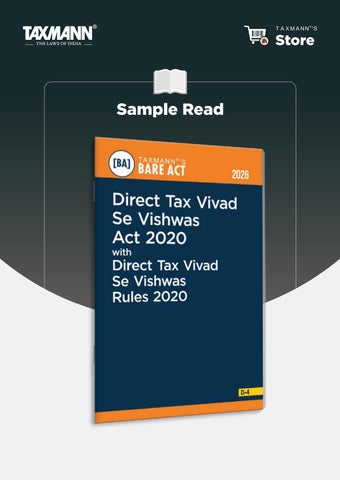
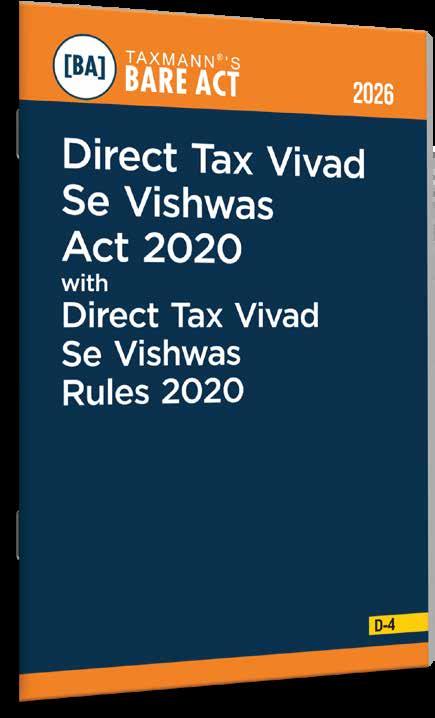
DIRECT TAX VIVAD SE VISHWAS ACT 2020 WITH DIRECT TAX VIVAD SE VISHWAS RULES 2020 –BARE ACT
AUTHOR : Taxmann's Editorial Board
PUBLISHER : Taxmann
DATE OF PUBLICATION : January 2026
EDITION : 2026 Edition
ISBN NO : 9789371260275
NO. OF PAGES : 84
BINDING TYPE : Paperback
DESCRIPTION
Direct Tax Vivad Se Vishwas Act 2020 with Direct Tax Vivad Se Vishwas Rules 2020 [Bare Act] by Taxmann is a concise and authoritative statutory compilation that captures India's legislatively structured framework for resolving pending direct tax disputes. The publication presents the Vivad Se Vishwas scheme as a comprehensive dispute-closure mechanism—covering appeals before the Commissioner (Appeals), the ITAT, High Courts, and the Supreme Court; objections before the Dispute Resolution Panel; revision proceedings under section 264; and tax disputes linked to arbitration, conciliation, or mediation. The 2026 Edition consolidates the principal Act, amendments, Rules, computation provisions, CBDT notifications, administrative orders, and all prescribed statutory forms, making it a reliable reference for handling legacy disputes and understanding the finality of settlements under the scheme. This publication is indispensable for stakeholders dealing with direct tax disputes, settlement, and post-settlement compliance, including:
• Chartered Accountants and Tax Consultants
• Direct Tax Litigators and Advocates
• Corporate Tax Heads and In-house Litigation Teams
• Income-tax Authorities and Designated Authorities
• Appellate and Quasi-Judicial Authorities
• Banks, Financial Institutions, and Large Corporates
• Academicians and Researchers
• Professionals
The Present Publication is the 2026 Edition, covering the amended and updated text of the Direct Tax Vivad Se Vishwas Act [Act No. 3 of 2020] and Rules, with the following noteworthy features:
• [Authoritative Statutory Text] Complete and unaltered text of the Act
• [Finance Act Integration] Incorporates amendments introduced by the Finance Act 2021
• [Rules with Procedural & Computational Coverage] Exhaustive Rules governing filing, payment, and computation of disputed tax
• [All Prescribed Forms] Includes Forms 1 to 5 for declaration, undertaking, certification, payment, and final settlement
• [CBDT Notifications & Orders] Covers notified dates, extensions, and administrative directions
• [Complex Computation Provisions] Addresses MAT credit, carried-forward losses, unabsorbed depreciation, search cases, and favourable appellate issues
• [Subject Index] Detailed index for quick and accurate reference