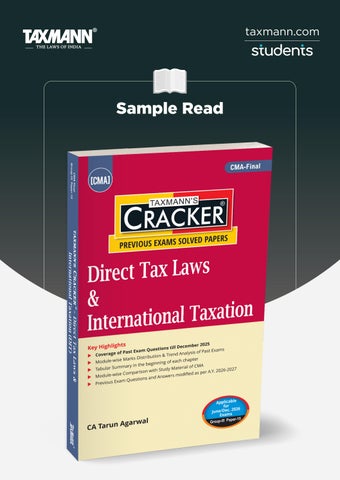

Sample Read


Chapter-wise Marks Distribution I-5
Previous Exams Trend Analysis I-7
Module-wise Comparison with Study Material I-11
SECTION B
INTERNATIONAL TAXATION

A QUICK REVIEW
AMALGAMATION
Definition [Sec. 2(1B)]:
Amalgamation (in relation to companies) means:
(i)the merger of one or more companies with another company; or
(ii)the merger of two or more companies to form one company; in such a manner that—
(a)all assets and liabilities of the amalgamating company or companies immediately before the amalgamation become the assets and liabilities of the amalgamated company;
(b)shareholders (both equity or preference) holding not less than 75% in value of the shares in the amalgamating company or companies (other than shares already held therein immediately before the amalgamation by, or by a nominee for, the amalgamated company or its subsidiary) become shareholders (equity or preference) of the amalgamated company.
Exceptions:
Following mergers shall not be treated as amalgamation -
(i)Merger as a result of acquisition of the property of one company by another company pursuant to the purchase of such property by the other company; or
(ii)Merger as a result of distribution of such property to the other company after the winding up of the first-mentioned company.
Amalgamation & Shareholder of amalgamating company:
Effect of amalgamation on a shareholder are as under:
Transfer of shares of amalgamating company
As per sec. 47(vii), any transfer by a shareholder, in a scheme of amalgamation, of share(s) held by him in the amalgamating company is not treated as transfer and hence not liable to capital gain tax, if following conditions are satisfied:
(i)The transfer is made in consideration of the allotment to him of any share or shares in the amalgamated company; and
(ii)The amalgamated company is an Indian company.
5.2
Cost of shares in amalgamated company
Determination of nature of assets
SECTION A: DIRECT TAX LAWS
The cost of shares in amalgamating company shall be deemed to be the cost of shares in amalgamated company. [Sec. 49(2)]
To find whether shares in amalgamated company are longterm or short-term capital asset, the period of holding shall be calculated from the date when shares in the amalgamating company were acquired. [Sec. 2(42A)]
Amalgamation & amalgamating company:
(
i) As per sec. 47(vi), any transfer, in a scheme of amalgamation, of a capital asset by the amalgamating company to the amalgamated company is not treated as transfer (hence not liable to capital gain) provided the amalgamated company is an Indian company.
(ii) If amalgamation does not satisfy condition of sec. 2(1B) and of sec. 47(vi), then exemption is not available.
(iii) As per sec. 47(viab), any transfer, in a scheme of amalgamation, of a capital asset, being a share of a foreign company, (referred to in the Explanation 5 of sec. 9(1)(i)), which derives, directly or indirectly, its value substantially from the share or shares of an Indian company, held by the amalgamating foreign company to the amalgamated foreign company, if:
(a) at least 25% of the shareholders of the amalgamating foreign company continue to remain shareholders of the amalgamated foreign company; and
(
b) such transfer does not attract tax on capital gains in the country in which the amalgamating company is incorporated.
(
iv) As per sec. 47(via), any transfer, in a scheme of amalgamation, of a capital asset being a share or shares held in an Indian company, by the amalgamating foreign company to the amalgamated foreign company is not treated as transfer (hence not liable to capital gain) provided:
(
a) at least 25% of the shareholders of the amalgamating foreign company continue to remain shareholders of the amalgamated foreign company; and
(
b) such transfer does not attract tax on capital gains in the country, in which the amalgamating company is incorporated.
DEMERGER
Demerger (in relation to companies) means the transfer, pursuant to a scheme of arrangement u/ss 230 to 232 of the Companies Act, 2013, by a demerged company of its one or more undertakings to any resulting company in such a manner that:
(i) All assets and liabilities are transferred: All assets and liabilities of the undertaking, being transferred by the demerged company, immediately before the demerger, become the assets and liabilities of the resulting company.
(ii) Transfer at Book value: Assets and liabilities of the undertaking or undertakings being transferred by the demerged company are transferred at its book-value (without considering revaluation) immediately before the demerger.
(
Note: Any change in the value of assets consequent to their revaluation shall be ignored.
Exception: The provisions is not applicable where the resulting company records the value of the property and the liabilities of the undertaking or undertakings at a value different from the value appearing in the books of account of the demerged company, immediately before the demerger, in compliance to the Indian Accounting Standards specified in Annexure to the Companies (Indian Accounting Standards) Rules, 2015.
iii) Consideration in shares: Resulting company issues, in consideration of the demerger, its shares to the shareholders of the demerged company on a proportionate basis except where the resulting company itself is a shareholder of the demerged company.
(
iv) Common shareholders: Shareholders holding not less than 75% in value of the shares in the demerged company (other than shares already held therein immediately before the demerger, or by a nominee for, the resulting company or, its subsidiary) become shareholders of the resulting company or companies by virtue of the demerger, otherwise than as a result of the acquisition of the property or assets of the demerged company or any undertaking thereof by the resulting company.
(
v) Going concern: Transfer of the undertaking is on a going concern basis.
(vi) Other specified condition: The demerger is in accordance with the conditions, if any, notified u/s 72A(5) by the Central Government in this behalf.
Demerger and Shareholder of demerged company:
As per sec. 47(vid), any transfer or issue of shares by the resulting company, in a scheme of demerger to the shareholders of the demerged company shall not be treated as transfer if the transfer or issue is made in consideration of demerger of the undertaking.
Cost of acquisition of the shares in the resulting company [Sec. 49(2C)]:
The cost of acquisition of the shares in the resulting company shall be the amount which bears to the cost of acquisition of shares held by the assessee in the demerged company the same proportion as the net book value of the assets transferred in a demerger bears to the net worth of the demerged company immediately before such demerger.
Net worth shall mean the aggregate of the paid-up share capital and general reserves as appearing in the books of account of the demerged company immediately before the demerger.
Cost of acquisition of the shares in demerged company [Sec. 49(2D)]:
The cost of acquisition of the original shares held by the shareholder in the demerged company shall be deemed to have been reduced by the amount as so arrived at u/s 49(2C).
5.4
SECTION A: DIRECT TAX LAWS
Demerger and Demerged company:
(i) As per sec. 47(vib), any transfer, in a demerger, of a capital asset by the demerged company to the resulting company is not treated as transfer (hence not liable to capital gain) provided the resulting company is an Indian company.
(ii) As per sec. 47(vic), any transfer in a demerger, of a capital asset, being a share or shares held in an Indian company, by the demerged foreign company to the resulting foreign company is not treated as transfer provided:
(
a) the shareholders holding not less than ¾th in value of the shares of the demerged foreign company continue to remain shareholders of the resulting foreign company; and
(
b) such transfer does not attract tax on capital gains in the country, in which the demerged foreign company is incorporated.
The provisions of the Companies Act shall not apply in case of demergers referred to in this clause.
(iii) As per sec. 47(vicc), any transfer in a demerger, of a capital asset, being a share of a foreign company (referred to in the Explanation 5 of sec. 9(1)(i)), which derives, directly or indirectly, its value substantially from the share or shares of an Indian company, held by the demerged foreign company to the resulting foreign company, if:
(
a) the shareholders, holding not less than 3/4th in value of the shares of the demerged foreign company, continue to remain shareholders of the resulting foreign company; and
(
b) such transfer does not attract tax on capital gains in the country in which the demerged foreign company is incorporated.
SLUMP SALE
Definition [Sec. 2(42C)]: It means transfer, by any means, of undertaking(s) for a lump sum consideration without assigning values to the individual assets of such undertaking(s).
Undertaking shall include any part of an undertaking or a unit or division of an undertaking or a business activity taken as a whole but does not include individual assets or liabilities or any combination thereof not constituting a business activity.
Computation of capital gain:
Sale consideration: Fair market value of the capital assets as on the date of transfer, calculated in the prescribed manner, shall be deemed to be the full value of the consideration received or accruing as a result of the transfer of such capital asset Accordingly, the CBDT has prescribed that the fair market value (FMV) of capital assets would be the higher of:
(a) FMV 1, being the fair market value of capital assets transferred by way of slump sale (determined on the date of slump sale); and
(b) FMV 2, being the fair market value of the consideration (monetary and non-monetary) received or accruing as a result of transfer by way of slump sale.
Cost of Acquisition or Improvement: Net worth of the undertaking
Nature of gain whether short term or long term: If undertaking is owned and held by the assessee for not more than 36 months, then capital gain shall be deemed to be short-term capital gain otherwise long-term capital gain.
Note: Where an undertaking is owned and held by an assessee for more than 36 months immediately preceding the date of its transfer, then it shall be treated as a long-term capital asset. It makes no difference that few of the assets of the undertaking are newly acquired (i.e. for less than 36 months).
Report of an accountant:
The assessee is required to upload one month prior to the due date of filing of the return of income, a report of a chartered accountant in Form 3CEA indicating the computation of the net worth of the undertaking or division and certifying that the net worth of the undertaking or division has been correctly arrived at in accordance with the provisions of this section.
CONVERSION OF SOLE PROPRIETARY BUSINESS TO COMPANY
Transaction not regarded as transfer for the purpose of capital gain [Sec. 47(xiv)]
Where a sole proprietary concern is succeeded by a company in the business carried on by it as a result of which the sole proprietary concern sells or otherwise transfers any capital asset to the company, the transaction is not regarded as transfer provided following conditions are satisfied:
(
a) All assets and liabilities of the sole proprietary concern relating to the business immediately before the succession become the assets and liabilities of the company;
(
b) Proprietor holds not less than 50% of the total voting power in the company and his shareholding continues to remain as such for a period of 5 years from the date of succession; and
(c) The sole proprietor does not receive any consideration or benefit, directly or indirectly, in any form or manner, other than by way of allotment of shares in the company.
CONVERSION OF FIRM INTO COMPANY
Transaction not regarded as transfer for the purpose of capital gain [Sec. 47(xiii)]
Any transfer of a capital asset, by a firm to a company as a result of succession of the firm by a company in the business carried on by the firm, shall not be regarded as transfer provided following conditions are satisfied:
(
a) All assets and liabilities of the firm relating to the business immediately before the succession become the assets and liabilities of the company.
(b) All the partners of the firm immediately before the succession become the shareholders of the company in the same proportion in which their capital accounts stood in the books of the firm on the date of succession.
5.6
SECTION A: DIRECT TAX LAWS
(c) The partners of the firm do not receive any consideration or benefit, directly or indirectly, in any form or manner, other than by way of allotment of shares in the company; and
(d) The aggregate of the shareholding in the company of the partners of the firm is not less than 50% of the total voting power in the company and their shareholding continues to be as such for a period of 5 years from the date of succession.
Withdrawal of exemption u/s 47(xiii)/47(xiv) [Sec. 47A(3)]:
On violation of conditions, exemption earlier allowed shall be withdrawn and the amount of profits or gains arising from the transfer of such capital asset not charged earlier shall be deemed to be the profits and gains chargeable to tax of the successor company for the previous year in which the requirements of sec. 47(xiii)/ (xiv) are violated
CONVERSION OF PRIVATE LIMITED COMPANY/UNLISTED PUBLIC COMPANY INTO LLP
Transaction not regarded as transfer for the purpose of capital gain [Sec. 47(xiiib)]:
Any transfer of -
(a) a capital asset or intangible asset by a private company or unlisted public company (hereafter referred to as the company) to a limited liability partnership (LLP); or
(b) a share(s) held in the company by a shareholder as a result of conversion of the company into a limited liability partnership (LLP) shall not regarded as a transfer, if following conditions are satisfied:
(i) All the assets and liabilities of the company immediately before the conversion become the assets and liabilities of the LLP;
(ii) All the shareholders of the company immediately before the conversion become the partners of the LLP and their capital contribution and profit sharing ratio in the LLP are in the same proportion as their shareholding in the company on the date of conversion;
(iii) The shareholders of the company do not receive any consideration or benefit other than by way of share in profit and capital contribution in the LLP;
(iv) The aggregate of the profit sharing ratio of the shareholders of the company in the LLP shall not be less than 50% at any time during the period of 5 years from the date of conversion;
(v) The total sales, turnover or gross receipts in business of the company in any of the 3 previous years preceding the previous year in which the conversion takes place does not exceed ` 60 lakhs;
(vi) The total value of the assets as appearing in the books of account of the company in any of the 3 previous years preceding the previous year in which the conversion takes place does not exceed ` 5 crores; and
(vii) No amount is paid (directly or indirectly) to any partner out of balance of accumulated profit standing in the accounts of the company on the date of conversion for a period of 3 years from the date of conversion.
Withdrawal of exemption u/s 47(xiiib) [Sec. 47A(4)]:
On violation of aforesaid conditions, exemption earlier allowed to the company or shareholder shall be withdrawn and amount of profits or gains arising from the transfer of such capital asset or intangible asset or share(s) not charged earlier shall be deemed to be the profits and gains chargeable to tax of the successor LLP or the shareholder (of predecessor company) for the previous year in which the requirements of sec. 47(xiiib) are violated.
PAST EXAMINATION QUESTIONS
OBJECTIVE QUESTIONS
Q.1 A block of buildings, all acquired on 01-01-2023 by ABC Ltd., was transferred in a scheme of demerger to R Ltd., effective from 01-04-2025, vide order of High Court pronounced on 12-06-2025. These buildings were sold by R Ltd., on 12-03-2026. For reckoning the period of holding of the asset, the starting date to be taken is
(a) 01-01-2023
(b) 01-04-2025
(c) 12-06-2025
(d) None of the above [Dec. 2016, 1 Mark, Modified]
Ans. (a) 01-01-2023
Q.2 XYZ (P) Ltd. decided to buy-back shares from the shareholders. It bought 30,000 shares of ` 10 each by paying ` 40 per share. The accumulated profits of the company on the date of buy-back was ` 30 lakhs. The buy-back was 30% of the total paid up capital.
The tax liability on the company for buy-back of shares would be
(a) Nil
(b) ` 12,48,000
(c) ` 4,36,800
(d) ` 1,87,200 [June 2017, 1 Mark, Modified]
Ans. (a) Nil
Q.3 In December, 2025 Excel Ltd. and Exceed Ltd. got amalgamated to form Excellence Ltd. The expenditure for the purpose of amalgamation was ` 10 lakhs. The amount of amalgamation expenditure deductible for the assessment year 2026-27 would be
(a) ` 10 lakhs
(b) ` 2 lakhs (one-fifth)
(c) ` 1 lakh (one-tenth)
(d) ` 5 lakhs (one-half)
[Dec. 2017, 1 Mark, Modified]
Ans. (b) ` 2 lakhs (one-fifth)
NUMERICAL PROBLEMS
Q.1 The following is the balance sheet of VV Ltd. as on 31.03.2026, on which date the Fertilizer Division was transferred by way of slump sale for a consideration of ` 300 lakhs:
Liabilities
Additional information:
(i) Fixed Assets of Fertilizer Division include land, which was acquired for ` 40 lakhs in 2018 and re-valued at ` 100 lakhs on 31.03.2026, just before slump sale.
(ii) Other Fixed Assets of Fertilizer Division represent their Written Down Values as per books. The written down value under Section 43(6) of the Income-tax Act is ` 320 lakhs.
(iii) Other Assets of Fertilizer Division reflected at ` 400 lakhs represent book value of non-depreciable assets.
(iv) The Fertilizer Division is operational from 1st January, 2023.
Compute the Capital Gain chargeable to income tax on the slump sale of Fertilizer Division, for the Assessment Year 2026-27. Also suggest a possible reinvestment for availing exemption from the resultant Capital Gains. [Dec. 2015, 7 Marks, Modified, Similar Question in June 2019, 8 Marks, Modified, Similar Question in Dec. 2019, 8 Marks, Modified, Similar Question in June 2023, 8 Marks, Modified] Ans.
Computation of net worth of Fertilizer Division
Particulars ` in lakhs
Book value of non-depreciable assets
Written down value of depreciable assets u/s. 43(6)
Particulars ` in lakhs
Aggregate value of assets 760
Less: Value of liabilities of Fertilizer Division 500
Net worth of Fertilizer Division 260
Computation of capital gain on slump sale of Fertilizer Division
Particulars
Sale consideration from slump sale of Fertilizer Division 300
Less: Net worth of the Fertilizer Division (260)
Long-term capital gain on slump sale of Fertilizer Division 40
Note: Since the fertilizer division is operational from January, 2023 and is transferred in March, 2026, by way of slump sale, the capital gain is chargeable to tax as long-term capital gain.
The assessee can invest the long-term capital gain (upto ` 50 lakhs) in Units of Specified Funds to avail tax exemption [Section 54EE], within six months from the date of transfer.
Q.2 AB Private Limited, an Indian company (having 5,000 shares of 100 per share) is engaged in producing edible oil and processing foods. It is decided that AB Private Limited will be amalgamated with CD Private Limited with effect from 1st March, 2026. The total consideration for transfer of assets is ` 9.75 lakhs, the break-up of which is as follows:
Capital assets ` 6 lakhs.
Net current assets ` 3.75 lakhs.
Consideration is to be satisfied by issue of 3 equity shares of CD Private Limited at ` 130 per share for every 2 equity shares of AB Private Limited.
One Mr. Ganesh held 700 equity shares in AB Private Limited which were acquired in the financial year 2019-20 for ` 2,00,000. Mr. Ganesh received 1,050 equity shares from CD Private Limited consequent to amalgamation in March, 2026.
Against the above backdrop, you are required to answer the following questions:
(i) Does the transaction of amalgamation attract any income-tax liability in the hands of AB Private Ltd.?
(ii) Compute capital gain in the hands of Mr. Ganesh on receipt of shares of CD Private Limited.
(iii) Compute capital gain in the hands of Mr. Ganesh if he sells the shares of CD Private Limited at ` 600 per share on 31st March, 2026.
(iv) Will sale of shares of CD Private Limited by Mr. Ganesh affect the tax benefit, if any availed by AB Private Limited?
(v) Suggest any investment plan for Mr. Ganesh to mitigate his tax liability.
Note: Cost inflation index: FY 2019-20: 289; FY 2025-26:376. [June 2016, 8 Marks, Modified]
SECTION A: DIRECT TAX LAWS
Ans.
(i) As per section 47(vi), transfer, in a scheme of amalgamation, of a capital asset by the amalgamating company to the amalgamated company is exempted from levy of tax on capital gain, provided the amalgamated company is an Indian company.
Therefore, transaction of amalgamation does not attract any tax liability in the hands of AB Private Ltd.
(ii) As per section 47(vii), any transfer by a shareholder in a scheme of amalgamation, of shares of amalgamating company held as capital asset is not liable to capital gain tax, if the transfer is made in consideration of the allotment to him of any shares in the amalgamated company and the amalgamated company is an Indian company. Thus, there is no capital gain in the hands of Ganesh on receipt of shares of CD Private Ltd.
(iii) Computation of Capital Gain in hands of Mr. Ganesh on sale of share of CD Private Ltd.
Particulars `
Sale Consideration [1,050 × 600]6,30,000
Less: Cost of Acquisition(2,00,000)
Long-Term Capital gain4,30,000
Notes:
(a) Cost of shares of amalgamating company is to be taken as cost of shares of the amalgamated Company.
(b) Period of holding of shares in the amalgamating company is included for computing period of holding of shares in the amalgamated company.
(c) For Assets transferred on or after 23.07.2024 no indexation benefit is allowed for Long-term Assets.
(iv) There is no provision in the Income-tax Act which affects the tax benefits availed by the amalgamating company (i.e. exemption under section 47(vi) in the event of sale of shares of the amalgamated company).
(v) In order to mitigate tax liability on long-term capital gain, Mr. Ganesh should be advised to invest within 6 months from the date of transfer/sale (i.e. 31st March, 2026) the whole amount of long-term capital gain i.e. ` 4,30,000 in Specified Funds approved u/s 54EE of the Income-tax Act, 1961. Alternatively, it may be assumed that the assessee fulfills the eligibility conditions for section 54F and hence can invest the net sale proceeds within the stipulated time in a residential house.
Q.3 ABC Ltd. was amalgamated with XYZ Ltd. on 01.04.2025. All the conditions of Section 2(1B) were satisfied and amalgamation is within the meaning of Section 72A of Income-tax Act. ABC Ltd. has the following carried forward losses as assessed till the Assessment Year 2025-26
Particulars ` (in lakhs)
Speculative loss4
Unabsorbed depreciation18
Unabsorbed expenditure of capital nature on scientific research2
Business loss (Non-speculative)120
XYZ Ltd. has computed a profit of ` 140 lakhs for the financial year 2025-26 before setting off eligible losses of ABC Ltd. but after providing depreciation at 15% per annum on ` 150 lakhs, being the consideration at which plant and machinery were transferred to XYZ Ltd. The written down value as per income tax record of ABC Ltd. as on 31st March, 2024 was ` 100 lakhs. Above profit of XYZ Ltd. includes speculative profit of ` 10 lakhs. Compute the total income of XYZ Ltd. for Assessment Year 2026-27.
[Dec. 2017, 7 Marks, Modified]
Ans.
Computation of total income of XYZ Ltd. For the Assessment Year 2026-27
Particulars ` in lakhs
Profits and gains of business or profession140.00
Value at which assets were transferred by ABC Ltd.150.00 WDV in the books of accounts of ABC Ltd. as on 1-4-2025 (100 - 15 for the year ended 31-3-2025). (85.00)
Excess amount accounted65.00
Add: Excess depreciation claimed in the scheme of amalgamation of ABC Ltd. with XYZ Ltd. 9.75
Excess depreciation claimed in computing taxable income of XYZ Ltd. (` 65 lakhs 15%) - Ref: Explanation 2 to section 43(6) - Note-1
Less: Set-off of brought forward business losses of ABC Ltd.120.00
Less: Set-off of unabsorbed depreciation 18.00 (140.00)
Less: Set-off of unabsorbed capital expenditure under section 352.00
Total income9.75
Notes:
(1) In case of amalgamation of Companies, the unabsorbed losses and unabsorbed depreciation of amalgamating company shall be deemed to be loss or unabsorbed depreciation of amalgamated company for the previous year in which the amalgamation was affected. Such business loss shall be carried forward and set off by the amalgamated Company for a period of 8 years and unabsorbed depreciation shall be carried forward and set off by the amalgamated company over indefinite period.
(2) As per section 72A(7), the accumulated loss for carry forwards, does not include speculative loss. So, in view of above speculative loss of ` 4 lakhs of ABC Ltd. cannot be carried forward by XYZ Ltd.
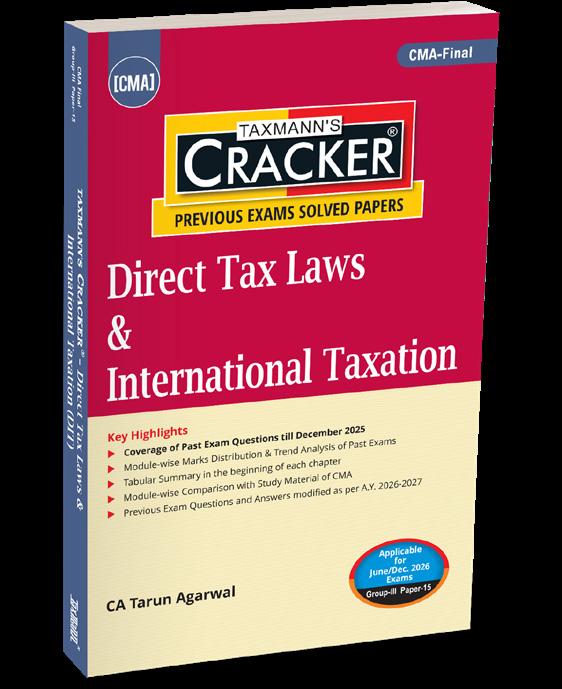
Direct Tax Laws and International Taxation (DIT) | CRACKER
AUTHOR : Tarun Agarwal
PUBLISHER : Taxmann
DATE OF PUBLICATION : January 2026
EDITION : 2026 Edition
ISBN NO : 9789371262187
No. of Pages : 452
BINDING TYPE : Paperback
Rs. 495
DESCRIPTION
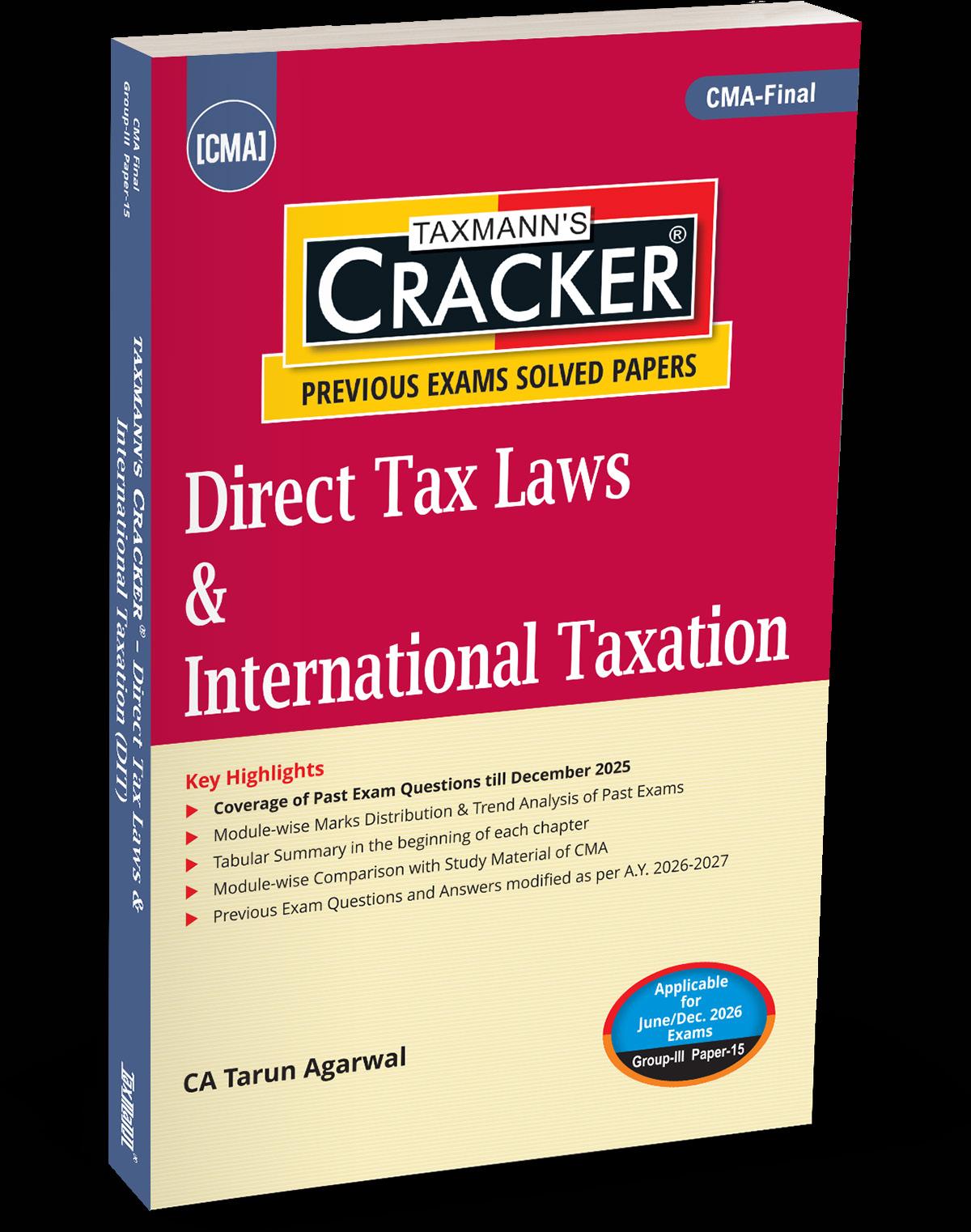
Direct Tax Laws and International Taxation | CRACKER is a focused, exam-oriented practice and revision resource specifically designed for CMA Final – Group III | Paper 15. It is a strategic preparation tool for the June/December 2026 examinations, offering comprehensive coverage of fully solved past examination questions up to December 2025, updated in accordance with Assessment Year 2026–27. This CRACKER edition is structured to translate syllabus knowledge into scoring performance through solved papers, trend analysis, and close alignment with the CMA Institute’s Study Material, enabling efficient and result-driven preparation.
The Present Publication is the January 2026 Edition, authored by CA. Tarun Agarwal, with the following noteworthy features:
• [Exhaustive Coverage of Past Examination Questions] Fully solved CMA Final questions up to December 2025, presented with exam-oriented, step-by-step solutions
• [Module-wise Marks Distribution & Trend Analysis] Analytical tables highlighting historical weightage, frequently tested areas, and examination trends
• [Tabular Chapter Snapshots] Concise summary tables at the beginning of each chapter for quick orientation and revision
• [Module-wise Comparison with CMA Study Material] Direct mapping with official CMA Study Material to ensure syllabus completeness and conceptual alignment
• [Updated as per A.Y. 2026–27] All questions and answers revised to reflect the latest provisions, rates, amendments, and interpretations