
Sample Read

© Taxmann
Price : ` 130
Law stated in this book is as updated till 15th December, 2025
Published by : Taxmann Publications (P.) Ltd.
Sales & Marketing :
59/32, New Rohtak Road, New Delhi-110 005 India
Phone : +91-11-45562222
Website : www.taxmann.com
E-mail : sales@taxmann.com
Regd. Office :
21/35, West Punjabi Bagh, New Delhi-110 026 India
Printed at :
Tan Prints (India) Pvt. Ltd.
44 Km. Mile Stone, National Highway, Rohtak Road Village Rohad, Distt. Jhajjar (Haryana) India
E-mail : sales@tanprints.com
Disclaimer
Every effort has been made to avoid errors or omissions in this publication. In spite of this, errors may creep in. Any mistake, error or discrepancy noted may be brought to our notice which shall be taken care of in the next edition. It is notified that neither the publisher nor the author or seller will be responsible for any damage or loss of action to any one, of any kind, in any manner, therefrom. It is suggested that to avoid any doubt the reader should cross-check all the facts, law and contents of the publication with original Government publication or notifications.
No part of this book may be reproduced or copied in any form or by any means [graphic, electronic or mechanical, including photocopying, recording, taping, or information retrieval systems] or reproduced on any disc, tape, perforated media or other information storage device, etc., without the written permission of the publishers. Breach of this condition is liable for legal action.
For binding mistake, misprints or for missing pages, etc., the publisher’s liability is limited to replacement within seven days of purchase by similar edition. All expenses in this connection are to be borne by the purchaser. All disputes are subject to Delhi jurisdiction only.
COURT-FEES


Short title.

Court-Fees Act, 1870
[7 OF 1870]*
CHAPTER I
PRELIMINARY
1. This Act may be called the Court-fees Act, 1870. Extent of Act.
It extends to the whole of India except 1[the territories which, immediately before the 1st November, 1956, were comprised in Part B States]. Commencement of Act.
And it shall come into force on the first day of April, 1870.
COMMENTS
SECTION NOTES
1.1 Short Title
The short title is used to refer to this specific legislation for clarity and ease of identification.
The Act is officially titled as the “Court-fees Act, 1870”.
1.2 Extent of Act
This Act extends across the entirety of India with one exception:
1.2-1 Exception
It does not apply to the territories that were classified as Part B States before November 1, 1956.
2[1A. Definition of “Appropriate Government”.
In this Act “the Appropriate Government” means, in relation to fees or stamps relating to documents presented or to be presented before any officer serving under the Central Government, that Government, and in relation to any other fees or stamps, the State Government.]
*Date 11-3-1870
1.Substituted for “Part B States” by the Adaptation of Laws (No. 2) Order, 1956.
2.Inserted by the Government of India (Adaptation of Indian Laws) Order, 1937.
2. “Chief Controlling Revenue-authority” defined. 3[***]
CHAPTER II
FEES IN THE HIGH COURTS AND IN THE COURTS OF SMALL CAUSES AT THE PRESIDENCY-TOWNS
Levy of fees in High Courts on their original sides.
3. The fees payable for the time being to the clerks and officers (other than the sheriffs and attorneys) of 4[the 5[High Courts other than those of Kerala, Mysore and Rajasthan]],
or chargeable in each of such Courts under No. 11 of the First, and Nos. 7, 12, 14, 6[***] 20 and 21 of the Second Schedule to this Act annexed; Levy of fees in Presidency Small Cause Courts.
And the fees for the time being chargeable in the Courts of Small Causes at the presidency-towns, and their several offices; shall be collected in manner hereinafter appearing.
COMMENTS
SECTION NOTES
3.1 Fees Payable to Officers of High Courts:
The fees are payable to clerks and officers of the High Courts
3.1-1 Exception
Sheriffs and attorneys.
Clerks and officers of the High Courts of Kerala, Mysore (now Karnataka) and Rajasthan.
3.2 Entries under which Fees is Chargeable
The section refers to specific entries in the First and Second Schedules of the Act, under which the fees are chargeable.
Fees chargeable in the High Courts under entries hereinafter mentioned:First Schedule (No. 11); and Second Schedule (Nos. 7, 12, 14, 20 and 21)
3.3 Levy of Fees in Presidency Small Cause Courts
The fees levy in the Small Cause Courts and their offices, which are located in the presidency towns, i.e., Mumbai, Chennai and Kolkata.
3. Omitted by the Government of India (Adaptation of Indian Laws) Order, 1937.
4. Substituted for “the Courts which are High Courts for the purpose of the Government of India Act, 1935” by the Adaptation of Laws Order, 1950.
5. Substituted for “High Courts for Part A States” by the Adaptation of Laws (No. 2) Order, 1956.
6. Number “16”, omitted by the Amending Act, 1891.
3.4 Collection of Fees
The fees chargeable in the Presidency Small Cause Courts and their offices are to be collected as per the methods specified later in the Act. [See Sections 25 and 26].
3.5 List of documents on which court fees not payable
See Section 19.
Fees on documents filed, etc., in High Courts in their Extraordinary Jurisdiction.
4. No document of any of the kinds specified in the First or Second Schedule to this Act annexed, as chargeable with fees, shall be filed, exhibited or recorded in, or shall be received or furnished by, any of the said High Courts in any case coming before such Court in the exercise of its extraordinary original civil jurisdiction; or in the exercise of its extraordinary original criminal jurisdiction; In their appellate jurisdiction. or in the exercise of its jurisdiction as regards appeals from the 7[judgments (other than judgments passed in the exercise of the ordinary original civil jurisdiction of the Court) or one] or more Judges of the said Court, or of a Division Court; or in the exercise of its jurisdiction as regards appeals from the Courts subject to its superintendence;
As Courts of reference and revision. or in the exercise of its jurisdiction as a Court of reference or revision; unless in respect of such document there be paid a fee of an amount not less than that indicated by either of the said Schedules as the proper fee for such document.
COMMENTS
SECTION NOTES
4.1 Requirement of Payment of Fees
No document listed in the First or Second Schedule, as chargeable with fees, shall be accepted, filed, exhibited, or recorded in the High Courts unless the prescribed fee has been paid.
This includes any document filed, exhibited, recorded, received or furnished by the High Court during the exercise of its:
Extraordinary Original Civil Jurisdiction
Extraordinary Original Criminal Jurisdiction
Appellate Jurisdiction and Fees
Section 4 covers documents filed in appeals from judgments not arising out of the ordinary original jurisdiction of the High Court.
It includes appeals from:
Judgments by Single or Multiple Judges of the High Court
7. Substituted for “judgment of two” by the Court Fees (Amendment) Act, 1922.
Decisions from Lower Courts Subject to the Superintendence of the High Court
Reference and Revision Jurisdiction
CASE LAWS
Deficiency in Court Fees and Retrospective Effect - The Supreme Court examined the interaction between Section 4 of the Court-fees Act, 1870, and Section 149 of the Civil Procedure Code, 1908, in a case involving an appeal filed with insufficient court fees. The Court held that while Section 4 bars the reception of insufficiently stamped documents, Section 149 operates as a proviso, allowing the deficiency to be rectified within a time frame fixed by the court. Once the deficiency is made good, the document is treated as valid retrospectively from the date of its initial filing. The Court emphasized the harmonious interpretation of these provisions, ensuring that making up the deficiency cures the defect for both limitation and sufficiency of court fees. – Mannan Lal v. Mst. Chhotka Bibi AIR 1971 SC 1374.
Court Fees on Copies of Criminal Court Orders - The Supreme Court addressed whether copies of orders or judgments from criminal proceedings must bear court fees under Article 9 of Schedule I of the Court-fees Act, 1870. The appellant argued that imposing fees contradicted the policy of the Code of Criminal Procedure, which allows for free provision of certain documents to the accused. The Court rejected this contention, holding that under section 4 of the Act, every document specified in the schedules must bear the prescribed fees. It ruled that orders from criminal courts constitute judicial proceedings and clearly fall within the scope of Article 9. The words in Article 9 were deemed unambiguous, leaving no room for alternative interpretations. The Court noted potential hardships on accused persons but maintained that legislative intervention, not judicial construction, was necessary to address the issue. – Bibhuti Bhusan Chatterjee v. State of Bihar AIR 1960 SC 128.
Procedure in case of difference as to necessity or amount of fee.
5. When any difference arises between the officer whose duty it is to see that any fee is paid under this Chapter and any suitor or attorney, as to the necessity of paying a fee or the amount thereof, the question shall, when the difference arises in any of said High Courts, be referred to the taxing-officer, whose decision thereon shall be final, except when the question is, in his opinion, one of general importance, in which case he shall refer it to the final decision of the Chief Justice of such High Court, or of such Judge of the High Court as the Chief Justice shall appoint either generally or specially in this behalf.
When any such difference arises in any of the said Courts of Small Causes, the question shall be referred to the Clerk of the Court, whose decision thereon shall be final, except when the question is, in his opinion, one of general importance, in which case he shall refer it to the final decision of the first Judge of such Court.
The Chief Justice shall declare who shall be taxing-officer within the meaning of the first paragraph of this section.
COMMENTS
SECTION NOTES
5.1 Dispute Arises Between Officer and Suitor or Attorney
Section 5 deals with dispute arises between the court officer responsible for fee collection and a suitor (litigant) or an attorney (legal representative)
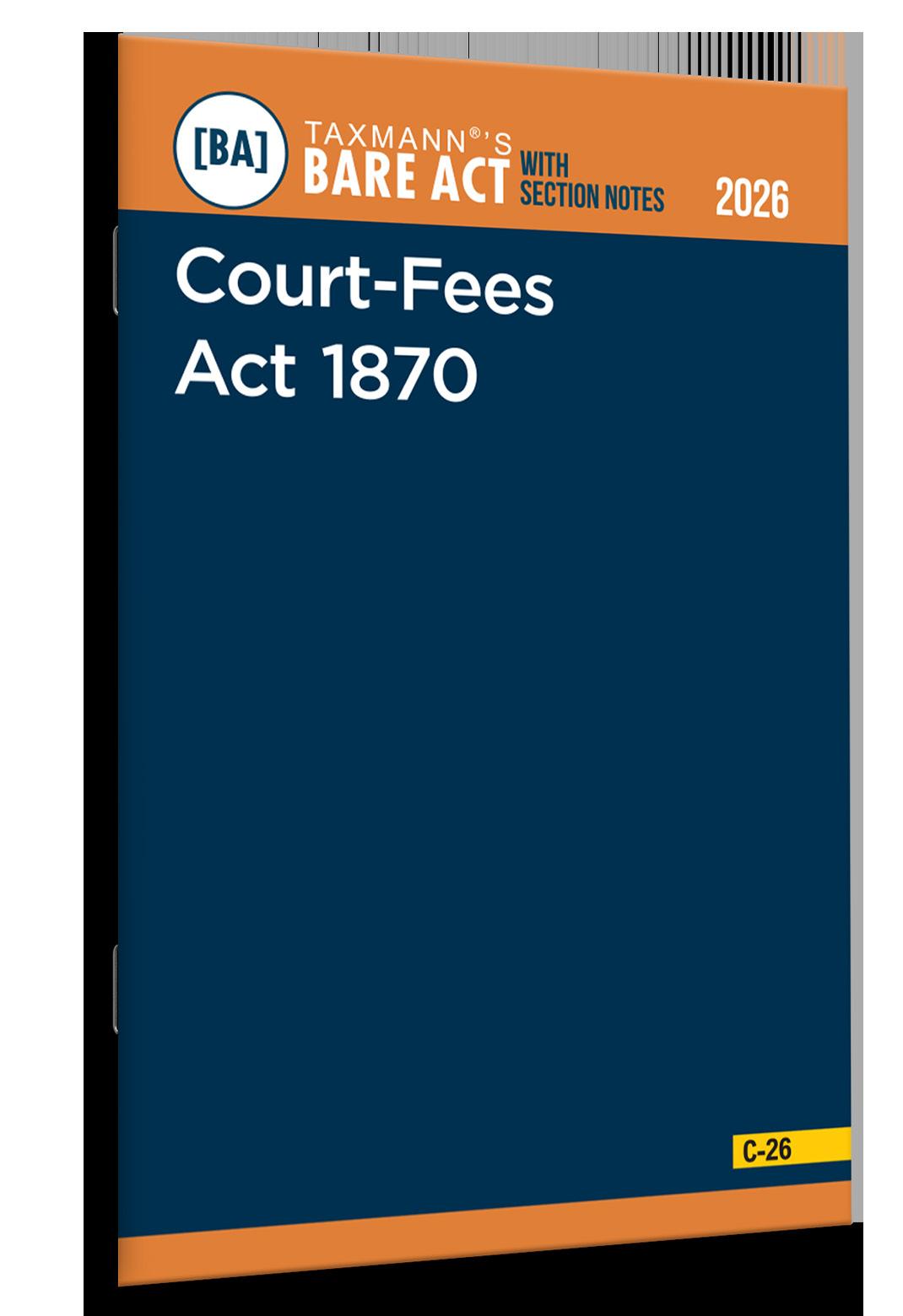
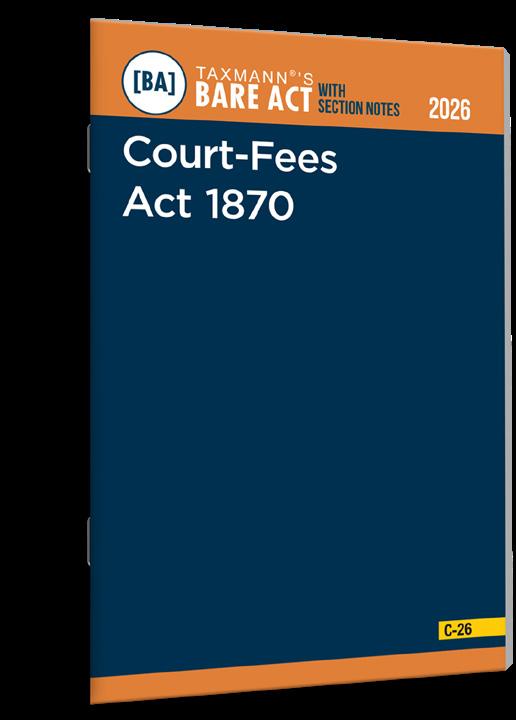
Court-Fees Act 1870 – Bare Act
with Section Notes
AUTHOR : Taxmann’s Editorial Board
PUBLISHER : Taxmann
DATE OF PUBLICATION : December 2025
EDITION : 2026 Edition
ISBN NO : 9789371261517
No. of Pages : 68
BINDING TYPE : Paperback
Rs. 130
DESCRIPTION
Court-Fees Act 1870 [Bare Act with Section Notes] by Taxmann is a carefully updated statutory publication that presents the complete and authoritative text of the Act governing the levy, computation, remission, and refund of court fees in India. The 2026 Edition is editorially enriched with succinct section-wise notes, explanatory comments, and selective judicial references, making it a dependable statutory and procedural guide for understanding the practical operation of court fee law, including valuation of suits, jurisdictional determinations, deficit fee rectification, exemptions, and refund mechanisms. This book is intended for the following audience:
• Advocates & Legal Practitioners
• Judges & Judicial Officers
• Court Registry & Administrative Staff
• Law Students & Academicians
• Government & Revenue Authorities
The Present Publication is the 2026 Edition, covering the amended and updated text of the Court-Fees Act [Act No. 7 of 1870], with the following noteworthy features:
• [Authentic Bare Act Text] Complete and unaltered statutory text ensuring accuracy and reliability
• [Section Notes & Comments] Concise section-wise notes explaining legislative intent, scope, and procedural relevance
• [Pre-amendment Provisions] Earlier versions of provisions included through footnotes to aid understanding of the pre-amendment legal position
• [Latest Amendments & Updates] Incorporates all amendments and adaptations up to the 2026 Edition
• [Tables & Schedules] Full and updated Schedules on ad valorem fees, fixed fees, and valuation forms for ready reference
• [Practical Insights] Covers valuation methods, deficit and excess fee adjustment, penalties, exemptions, and refund provisions
• [Case Law References] Select judicial decisions referenced to clarify statutory interpretation
• [User-friendly Layout] Clear structure and an exhaustive Subject Index for easy navigation