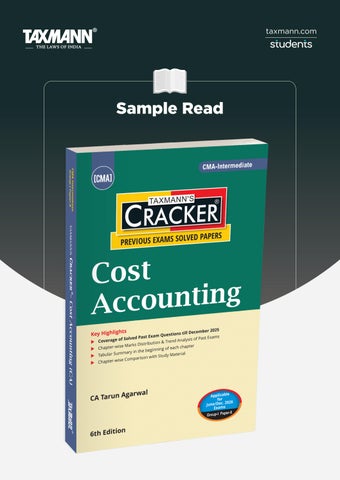

Sample Read




A Quick Review CHAPTER
IMPORTANT DEFINITIONS
Classification:
Classification is defined by CIMA as, ‘arrangement of items in logical groups having regard to their nature (subjective classification) or the purpose to be fulfilled (objective classification). In other words, classification is the process of arranging items into groups according to their degree of similarity. Accurate classification of all items is actually a prerequisite to any form of cost analysis and control system.
Types of Classification
1.Elementwise classification:
a. Indirect Material
b.Indirect Labour
c.Indirect Expenses
2.Functional Classification:
a Factory (or Manufacturing or Production) Overhead
b.Office and Administration Overhead
c.Selling and Distribution Overhead
3.Classification based on behaviour:
a. Fixed Overheads/Period Costs
b.Variable Overheads
c.Semi – Variable Overheads
Allocation and Apportionment (Primary Distribution of Overheads)
Allocation of overhead means charging of overhead to a particular cost centre when such overhead has been incurred directly for that cost centre. If the overhead is directly related to a particular cost centre or department, it is charged to that.
Apportionment of overhead means those overheads which are not directly identifiable with any particular production or cost centre, are distributed over the departments/cost centres on some equitable basis. These are joint costs whose
benefits are commonly shared. For example, the benefits of rent or electricity cannot be identified with any particular department. So, these overheads have to be apportioned.
Secondary Distribution of Production Overheads
After the primary distribution the next step is to reapportion the service department costs over the production departments. This also needs to be done on some suitable basis, as there may not be a direct linkage between services and production activity.
Methods of Secondary Distribution:
a. Direct Distribution Method
This method is based on the assumption that one service department does not give service to other service department/s. Thus, between service departments there is no reciprocal service exchange. Hence, under this method, service costs are directly loaded on to the production departments.
b. Step Distribution Method or Non-reciprocal Method
This method is based on the assumption that one service department gives service to the other but does not receive service from other service department.
In such situation, cost of that service department will be distributed first which render services to maximum number of other service departments. After this, the cost of service department serving the next large number of departments is distributed. This process is continued till all service departments are over, because it is done in steps, it is called as Step Distribution Method.
c. Reciprocal Service Method
This method takes cognizance of the fact that service departments may actually give as well as receive services from and to the other service departments on reciprocal basis.
i. Repeated Distribution Method
This is a continuous distribution of overhead costs over all departments. The decided ratios are used to distribute the costs of service departments to the production and other service departments. This is continued till the figures of service departments become ‘nil’ or ‘negligible’.
ii. Simultaneous Equations Method
Under this method, simultaneous equations are formed using the service departments’ share with each other. Solving the two equations will give the total cost of service departments after loading the interdepartmental exchange of services. These costs are then distributed among production departments in the given ratio.
iii. Trial and Error Method
This method is to be followed when the question of distribution of costs of service cost centres which are interlocked among them arises. In the
first stage, gross costs of services of service cost centres are determined. In the second stage cost of service centres are apportioned to production cost centres.
Capacity
a. Theoretical or Maximum Plant Capacity
Maximum Capacity or the Ideal Capacity is the capacity for which plant is designed to operate. It is only Theoretical Capacity. It does not give allowance for waiting, delays and shut down.
b. Practical Capacity
When this capacity is determined, allowance is given for unavoidable interruptions like time lost for repairs, inefficiencies, breakdown, delay in delivery of raw material and supplies, labour shortages and absence, sunday, holidays, vacation, inventory taking etc. Thus, practical capacity is the maximum theoretical capacity with minor unavoidable interruptions.
c. Normal Capacity
Idle capacity due to long term sales trend only is reduced from practical capacity to get normal capacity. Calculation of normal capacity of a plant presents considerable problems. Normal capacity is determined for the business as a whole. Then, it is broken down by plants and departments.
d. Capacity based on Sales Expectancy
Capacity may be based on sales expectancy for the year. The distinction between normal capacity and capacity based on sales expectancy should be properly understood. While normal capacity considers the long-term trend analysis of sales, which is based on sales of a cycle of years, the capacity based on sales expectancy is based on sales for the year only.
e. Idle Capacity and Excess Capacity
The difference between practical capacity and normal capacity, i.e., the capacity based on long term sales expectancy is the idle capacity. However, if actual capacity happens to be different from capacity based on sales expectancy, the idle capacity will represent difference between practical capacity and actual capacity.
Excess capacity results either from managerial decision to retain larger production capacity or from unbalanced equipment or machinery within departments. Excess capacity refers to that portion of practical capacity which is available, but no attempt is made for its utilization for strategic or other reasons.
Absorption of Overheads
The absorption of overhead enables a Cost Accountant to recover the overhead cost spent on each unit of the product. Overhead absorption is also known as levy or recovery of overheads.
Absorption means ‘recording of overheads in Cost Accounts on an estimated basis with the help of a predetermined overhead rate, which is computed at normal or average or maximum capacity’
Overhead Absorption Rates:
A. Actual Overhead Rate
Actual overhead rate is obtained by dividing the overhead expenses incurred during the accounting period by actual quantum on the base selected.
B. Pre-determined Overhead Rate
Predetermined rate is computed by dividing the budgeted overhead expenses for the accounting period by the budgeted base (quantity, hours etc.)
C. Blanket (single) Overhead Rate
A single overhead rate for the entire factory may be computed for the entire factory. So, this is known as factory wide or blanket overhead rate method.
D. Multiple Rates
This method is most commonly used to determine the multiple overhead rates i.e., separate rate:
i. For each production department;
ii. For each service department;
iii. For each cost centre; and
iv. For each product line.
Methods of Overhead Absorption:
A. Production Unit Method
The concept here is to average out the total overheads on total units produced.
B. Percentage of Direct Wages
Under this method, overhead for a job is recovered on the basis of a pre-determined percentage of direct wages.
C. Percentage of Direct Material Cost
Here the absorption rate is expressed as a percentage of direct material cost.
D. Percentage of Prime Cost
This method combines the benefits of direct wages and direct material cost methods as we know prime cost means the sum total of direct material cost, direct labour cost and direct expenses.
E. Direct Labour Hour Rate
Under this method, the absorption rate is calculated by dividing the overhead amount by the actual or predetermined direct labour hours. The labour hour rate may be calculated as a single rate or different for different group of workers.
F. Machine Hour Rate
This is the rate calculated by dividing the actual or budgeted overhead cost related to a machine or a group of machines by the appropriate number of machine hours. These hours could be actual hours or budgeted hours.
Under-absorption and Over-absorption of Overhead
The amount of overhead absorbed in costs is the sum total of the overhead costs allotted to individual cost units by application of the overhead rate.
If the amount absorbed is less than the amount incurred, which may due to actual expenses exceeding the estimate and/or the output or the hours worked being less than the estimate, the difference denotes under absorption.
On the other hand, if the amount absorbed is more than the expenditure incurred, which may be due to the expense being less than estimate and/or the output or hours worked being more than the estimates, this would indicate over-absorption.
How does one deal with the situation of over or under absorption?
There are three ways to handle over or under absorption:
(i) Write off (in case of under-absorption) or write back (in case of over-absorption) to the Profit and Loss Account. This treatment is valid if most of the overhead items are related to time.
(ii) Carry forward to the next period through a reserve account – this method is not recommended on the logic that it is inconsistent with Accounting Standard.
(iii) Use of supplementary rates - to adjust the effect to the cost of sales, finished stocks and work in progress stocks. This sound logical as it does not carry forward the unabsorbed or over-absorbed overheads to the next accounting period entirely. It aims at splitting the total effect between the cost of sale (which is charged to current year’s profits) and stocks (which is carried forward to the next year).
PAST EXAMINATION QUESTIONS
OBJECTIVE QUESTIONS
Q.1. T Ltd. uses pre-determined overhead rate of ` 15 per labour hour. The actual labour hours are 5750 and the actual overhead cost is ` 85,000. There is:
(A) ` 1,250 over absorption
(B) ` 1,250 under absorption (C) ` 1,000 over absorption
(D) ` 1,000 under absorption [June 2013, 1 Mark]
Ans. (A) ` 1,250 over absorption
5.6
Working Note:
Absorbed OH = 15 × 5750 = 86,250
Actual OH = 85,000
Over Absorption = ` 1,250
5 : OVERHEADS
Q.2. For a department, the standard Overhead rate is ` 2.50 per hour and the overhead allowances are as follows:
Activity Levels (hours)
Budgeted overhead allowances (` )
6,000 20,000
Calculate the fixed cost. [Dec. 2013, 2 Marks]
Ans.
Difference in activity levels = 8,000 hours.
Difference in overhead amounts = ` 16,000
Variable overhead = 16,000/8,000 = ` 2 per Hour.
Fixed overheads = 20,000 – 6,000 × 2 = ` 8,000
Q.3. The following data relating to a machine is available:
Cost of the machine is ` 20,000; Estimated scrap value is ` 2,000. Working life = 6 years. The machine had to be discarded at the end of 4 years due to obsolescence and was sold for ` 4,000. What is the resultant loss? (Use straight line depreciation on net value). [Dec. 2013, 2 Marks]
Ans.
Depreciation per annum = (20,000 – 2,000)/6 = ` 3,000
WDV at the end of 4 years = 20,000 – (3,000 × 4) = ` 8,000
Sale value = ` 4,000
Loss = 8,000 – 4,000 = ` 4,000
Q.4. A concern producing a single product estimates the following expenses for a production period.
`
What will be the overhead recovery rate based on prime cost? [Dec. 2013, 2 Marks]
Ans.
Prime cost = Direct material + Direct Labour + Direct Expenses = 1,05,000.
Overhead expenses = 2,10,000.
Overhead recovery rate based on prime cost = 2,10,000/1,05,000 = 2 times or 200% of prime cost.
Q.5. The following information is given: The total number of operators working in a Department = 300. The number of working days per year = 300 and the number of hours per day = 8. The total Departmental overhead is ` 3,42,000. 5% of the total number of days is normal idle time. Find the overhead rate per direct labour hour. [June 2014, 2 Marks]
Ans.
No. of working hours per annum = 300 × 8 × 0.95 × 300 = 6,84,000 hours.
Overhead Cost = ` 3,42,000.
Direct labour hour rate = 3,42,000/6,84,000 = ` 0.5/hr.
Q.6. A, B, C and D are products produced by a company. Power is supplied to these production units from the in-house power generator. Cost of power generated for a certain period was ` 1,00,000. Additionally, the committed cost of standby power shop utilities was ` 25,000. The sales value of A, B, C and D were equal and the units produced were in the ratio 1:2:2:3. What amount of power cost will be part of cost of production for each of A, B, C and D? One unit of power is consumed per unit of production of A, B, C & D [Dec. 2014, 2 Marks]
Ans.
Cost of power is a utility and hence a direct expense. Direct expense includes the cost of standby utilities. Hence 1,25,000 should be charged to the products in the ratio of units of power per unit of product x no. of products produced. Since units per product are not given, if we assume same rate of power consumption, ` 1,25,000 in the ratio 1:2:2:3 i.e. ` 1,5625, ` 31,250, ` 31,250, ` 46,875 for A, B, C, D.
Q.7. The actual machine hours worked in June ` 2014, is for 35,000 units and the predetermined overhead recovery is @ ` 3 per unit, when actual overhead is ` 1,57,500, the outcome will be:
(A) ` 52,500 under absorbed (B) ` 53,500 over absorbed (C) ` 1,57,500 over absorbed (D) ` 1,05,000 under absorbed. [June 2015, 1 Mark]
Ans. (A) ` 52,500 under absorbed
Working Note:
Overheads absorbed = 35,000 × 3 = ` 1,05,000
Actual Overheads = ` 1,57,500
Under absorbed overheads = ` 52,500
Q.8. Calculate the variable overhead per hour and the amount of fixed overheads from the following information:
Activity level (Hours)
Total Budgeted overhead (` )
21,000 1,25,000
28,000 1,53,000 [June 2015, 2 Marks]
Ans.
Difference in activity levels = 7000 hours.
Difference in overhead amounts = ` 28,000
Variable overhead = 28,000/7000 = ` 4 per Hour.
Fixed overheads = 1,25,000 – 21,000 × 4 = ` 41,000
Q.9. The following particulars are furnished to you by M/S Limelight & Co. Ltd in respect of a current machine:
Cost of Machine ` 30,000
Estimated scrap value ` 3,000
Working life of the machine is 5 years
The machine is treated as obsolete after three years of service and sold for ` 6,000. How would you treat the loss of the transaction in cost Account? [Dec. 2015, 2 Marks]
Ans.
Depreciation per annum = (30,000 – 3,000)/5 = ` 5,400
WDV at the end of 4 years = 30,000 – (5,400 × 3) = ` 13,800
Sale value = ` 6,000
Loss = 13,800 – 6,000 = ` 7,800
Entire loss may be charged to costing profit and loss a/c in the year of sale or may be spread over the balance period of life of the machine.
Q.10. A Ltd. uses pre-determined overhead absorption rates. In a certain period, actual overheads incurred were ` 5 lacs and not mostly related to time. Overheads absorbed were ` 1.5 lacs, 50% of unabsorbed overheads was due to faulty planning. How will such under absorption due to defective planning be treated in Cost Accounts? [June 2016, 2 Marks]
Ans.
Overheads under absorbed, whether due to faulty planning or otherwise, if considerable, have to be adjusted to cost of sale, WIP and Finished Goods by using a supplementary rate.
Q.11. In a certain factory, normal capacity was 50000 units. Actual capacity utilization was 52000 units. Fixed production overheads should be absorbed based on ___________ capacity. [June 2016, 1 Mark]
Ans. Actual Capacity (Whichever is higher should be the base).
Q.12. At the level of 60,000 units of output, factory overheads were ` 3,75,000 out of which 40% was fixed. Find the amount of factory overheads at 78,000 units of output. [Dec. 2016, 2 Marks]
Ans.
3,75,000 × 60% = 2,25,000 is variable for 60,000 units.
Unit Variable cost = ` 3.75;
Fixed Cost = 1,50,000.
At 78,000 units, OH cost = {(3.75 × 78,000) + 1,50,000} = ` 4,42,500.
Q.13. Variable overheads are absorbed by products based on _______level of capacity utilization. [Dec. 2016, 1 Mark]
Ans. Actual
Q.14. Find the actual overhead for the month of October 2016, when actual machine hours worked is 10000 and there is under-recovery of overhead of ` 30,000 by using machine hour rate of ` 30. [Dec. 2016, 2 Marks]
Ans.
Overheads absorbed = 10,000 × 30 = ` 3,00,000
Overheads under absorbed = ` 30,000
Actual Overheads = ` 3,30,000
Q.15. When you attempt a reconciliation of profits as per Financial Accounts and Cost Accounts, the following is done:
(A) Add the under absorption of overheads in Cost Accounts if you start from the profits as per Financial Accounts.
(B) Add the under absorption of overheads in Cost Accounts if you start from the profits as per Cost Accounts.
(C) Add the over absorption of overheads in Cost Accounts if you start from the profits as per Financial Accounts.
(D) Add the over absorption of overheads in Cost Accounts if you start from the profits as per Cost Accounts. [June 2017, 1 Mark]
Ans. (A) Add the under absorption of overheads in Cost Accounts if you start from the profits as per Financial Accounts.
Q.16. Selling and distribution overheads are absorbed on the basis of:
(A) rate per unit.
(B) percentage on works cost.
(C) percentage on selling price of each unit.
(D) Any of the above. [Dec. 2017, Dec. 2021, 1 Mark]
Ans. (D) Any of the above
Q.17. Warehouse expense is an example of:
(A) Production overhead (B) Administration overhead (C) Selling overhead (D) Distribution overhead [June 2018, 1 Mark]
Ans. (D) Distribution overhead
Q.18. Charging to a cost center those overheads that result solely for the existence of that cost center is known as:
(A) Allotment (B) Allocation (C) Absorption (D) Apportionment [Dec. 2018, Dec. 2021, 1 Mark]
Ans. (B) Allocation
Q.19. Which of the following is a service department?
(A) Refining department (B) Machining department (C) Receiving department (D) Finishing department [June 2019, Dec. 2021, 1 Mark]
Ans. (C) Receiving department
Q.20. Which method of absorption of factory overheads do you suggest in a concern which Produces only one uniform time of product?
(A) Direct labour rate
(B) Percentage of direct wages basis
(C) Machine hour rate
(D) A rate per units of output [Dec. 2021, 1 Mark]
Ans. (D) A rate per units of output
Q.21. Which of the following is usually classed as Discretionary Fixed Costs?
(A) Supervisors’ wages
(B) Depreciation (C) Rent
(D) Research and Development Cost [Dec. 2022, 1 Mark]
Ans. (D) Research and Development Cost
Q.22. Under absorption of overheads means that actual overheads are ______ than absorbed overheads. [July 2023, 1 Mark]
Ans. More
Q.23. _______ is that part of practical capacity which is not utilised due to factors like temporary lack of orders, bottlenecks and machine breakdown etc. [July 2023, 1 Mark]
Ans. Idle Capacity
Cost Accounting (CA) | CRACKER
AUTHOR : Tarun Agarwal
PUBLISHER : Taxmann
DATE OF PUBLICATION : December 2025
EDITION : 6th Edition
ISBN NO : 9789375611851
No. of Pages : 556
BINDING TYPE : Paperback
Rs. 495
DESCRIPTION
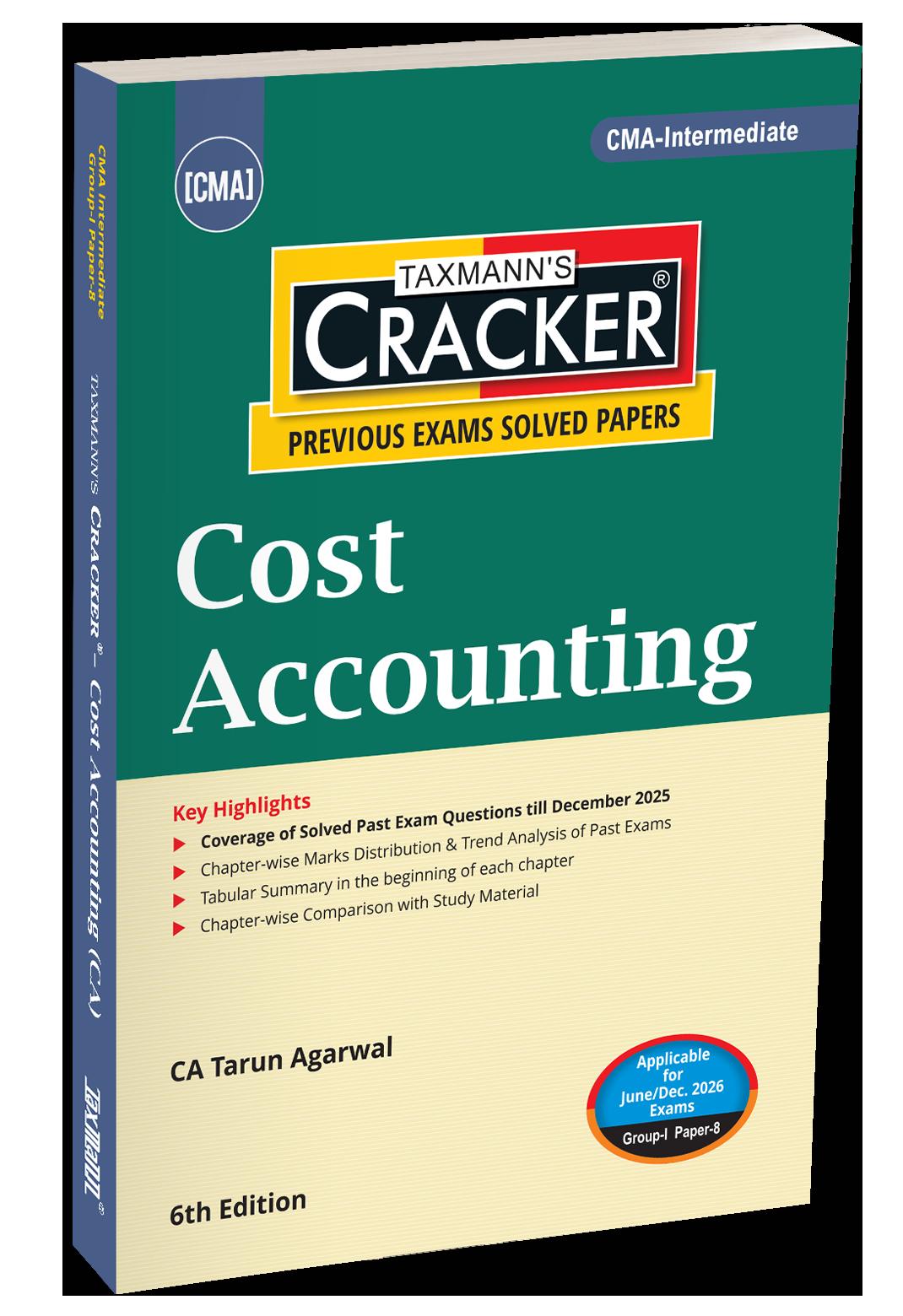
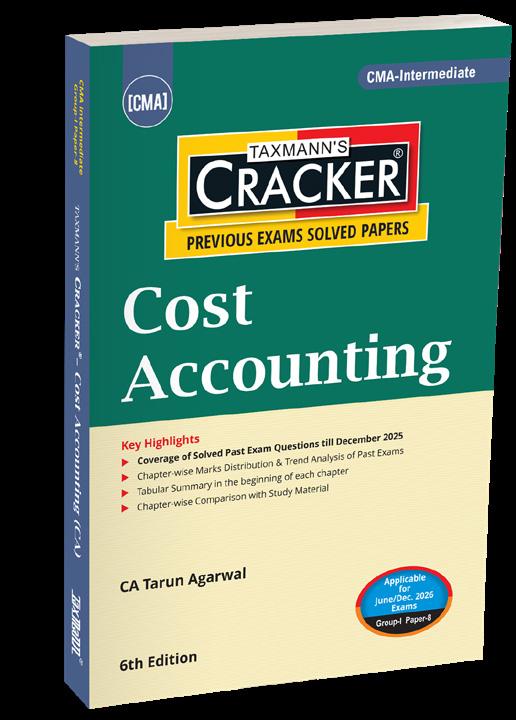
Cost Accounting | CRACKER is a focused, exam-oriented practice and revision resource designed for CMA Intermediate students (Group I | Paper 8 – Cost Accounting). It serves as a strategic preparation companion by integrating solved past examination questions up to December 2025 with chapter-wise marks distribution, trend analysis, and direct alignment with the CMA Study Material, helping students build numerical accuracy, conceptual clarity, and exam-oriented application skills.
The Present Publication is the 6th Edition for the June/Dec. 2026 Exams. This book is authored by CA. Tarun Agarwal, with the following noteworthy features:
• [Solved Past Exam Questions] Systematically solved CMA Intermediate questions up to December 2025, reflecting recent exam patterns and marking expectations
• [Chapter-wise Marks Distribution & Trend Analysis] Clear analysis of weightage across multiple exam cycles to identify high-scoring and frequently tested areas
• [Tabular Summaries] Concise tabular snapshots at the beginning of each chapter for quick revision of key concepts and formulae
• [Study Material Mapping] Chapter-wise comparison with CMA Study Material modules to ensure complete syllabus alignment
• [Strong Numerical Orientation] Step-wise, exam-friendly solutions with emphasis on presentation and working notes
• [Strategic Revision Tool] Weightage and trend data to support prioritised study planning and efficient revision
• [Ideal for Final Revision] Solved questions, summaries, and recent papers make it suitable for last-stage practice and self-evaluation
• [Updated & Exam-ready] Accurate, syllabus-aligned content authored by an experienced faculty member