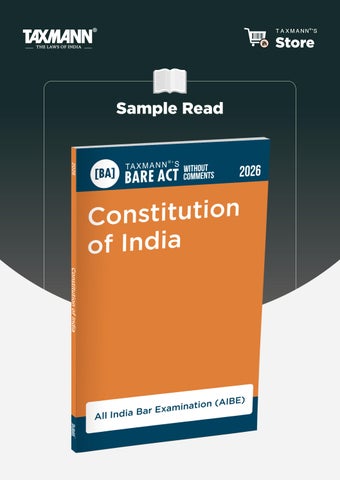

Sample Read

© Taxmann
Price : ` 245
Published by :
Taxmann Publications (P.) Ltd.
Sales & Marketing :
59/32, New Rohtak Road, New Delhi-110 005 India
Phone : +91-11-45562222
Website : www.taxmann.com
E-mail : sales@taxmann.com
Regd. Office :
21/35, West Punjabi Bagh, New Delhi-110 026 India
Printed at :
Tan Prints (India) Pvt. Ltd.
44 Km. Mile Stone, National Highway, Rohtak Road Village Rohad, Distt. Jhajjar (Haryana) India
E-mail : sales@tanprints.com
Disclaimer
Every effort has been made to avoid errors or omissions in this publication. In spite of this, errors may creep in. Any mistake, error or discrepancy noted may be brought to our notice which shall be taken care of in the next edition. It is notified that neither the publisher nor the author or seller will be responsible for any damage or loss of action to any one, of any kind, in any manner, therefrom. It is suggested that to avoid any doubt the reader should cross-check all the facts, law and contents of the publication with original Government publication or notifications.
No part of this book may be reproduced or copied in any form or by any means [graphic, electronic or mechanical, including photocopying, recording, taping, or information retrieval systems] or reproduced on any disc, tape, perforated media or other information storage device, etc., without the written permission of the publishers. Breach of this condition is liable for legal action.
For binding mistake, misprints or for missing pages, etc., the publisher’s liability is limited to replacement within seven days of purchase by similar edition. All expenses in this connection are to be borne by the purchaser. All disputes are subject to Delhi jurisdiction only.



CONSTITUTION OF INDIA
4.
92.
95.
96.
Conduct of Business
CHAPTER III
179.
181.
183.
184.
224A.
227.
228.
228A.
CHAPTER VI
SUBORDINATE COURTS
PART VII
PART VIII
PART IX
243ZC. Part not to apply to certain areas
243ZD.
Bar to interference by courts in
PART IXB
SOCIETIES
243ZJ. Number and term of members of board and its office bearers
243ZK. Election of members of board
243ZL. Supersession and suspension of board and interim management
Convening of general
PART X THE SCHEDULED AND TRIBAL AREAS
Formation of an autonomous State comprising certain tribal areas in Assam and creation of local Legislature or Council of Ministers or both therefor
PART XI RELATIONS BETWEEN THE UNION AND THE STATES
CHAPTER I
245. Extent of laws made by Parliament and by the Legislatures of States
246. Subject-matter of laws made by Parliament and by the Legislatures of States
247. Power of Parliament to provide for the establishment of certain additional
248. Residuary powers of
249. Power of Parliament to legislate with respect to a matter in the State List in the national interest
250. Power of Parliament to legislate with respect to any matter in the State List if a Proclamation of Emergency is in operation
251. Inconsistency between laws made by Parliament under articles 249 and 250 and laws made by the Legislatures of States
252. Power of Parliament to legislate for two or more States by consent and adoption of such legislation by any other State
253. Legislation for giving effect to international agreements
254. Inconsistency between laws made by Parliament and laws made by the Legislatures of States
255. Requirements as to recommendations and previous sanctions to be regarded as matters of procedure only
CHAPTER II
ADMINISTRATIVE RELATIONS
257A. [Omitted by the Constitution (Forty-fourth Amendment) Act, 1978, w.e.f. 20-6-1979
258. Power of the Union to confer powers, etc., on States in certain cases
258A. Power of the States to entrust functions to the Union
259. [Omitted by the Constitution (Seventh Amendment) Act, 1956, w.e.f. 1-11-1956]
PART XII
FINANCE, PROPERTY, CONTRACTS AND SUITS
Distribution of Revenues between the Union and the States
268. Duties levied by the Union but collected and appropriated by the States
268A. [Omitted by the Constitution (One Hundred and First Amendment) Act, 2016, w.e.f. 16-9-2016]
269. Taxes levied and collected by the Union but assigned to the States
269A. Levy and collection of goods and services tax in course of inter-State trade or commerce
270. Taxes levied and distributed between the Union and the states
271. Surcharge on certain duties and taxes for purposes of the Union
272. [Omitted by the Constitution (Eightieth Amendment) Act, 2000, w.e.f. 9-6-2000]
273. Grants in lieu of export duty on jute and jute products
274. Prior recommendation of President required to Bills affecting taxation in which States are interested
275. Grants from the Union to certain States
276. Taxes on professions, trades, callings and employments
278. [Omitted by the Constitution (Seventh Amendment) Act, 1956, w.e.f. 1-11-1956]
282. Expenditure defrayable by the Union or a State out of its revenues
283. Custody, etc., of Consolidated Funds, Contingency Funds and moneys credited to the public accounts
284. Custody of suitors’ deposits and other moneys received by public servants and
288. Exemption from taxation by States in respect of water or electricity in certain cases
289. Exemption of property and income of a State from Union taxation
290. Adjustment in respect of certain expenses and pensions
290A. Annual payment to certain Devaswom Funds
291. [Omitted by the Constitution (Twenty-sixth Amendment) Act, 1971, w.e.f. 28-12-1971]
CHAPTER II BORROWING
CHAPTER III
294. Succession to property, assets, rights, liabilities and obligations in
295.
296. Property accruing by escheat or lapse or as bona vacantia
297. Things of value within territorial waters or continental shelf and resources of the exclusive economic zone to vest in
[Omitted by the Constitution (Seventh Amendment) Act, 1956, w.e.f. 1-11-1956
307. Appointment of authority for carrying out the purposes of articles 301 to 304
310.
in
in
314. [Omitted by the Constitution (Twenty-eighth Amendment) Act, 1972, w.e.f. 29-8-1972]
CHAPTER II
PUBLIC SERVICE COMMISSIONS
319. Prohibition as to the holding of offices by members of Commission on ceasing to be
PART XV ELECTIONS
329A. [Omitted by the Constitution (Forty-fourth Amendment) Act, 1978, w.e.f. 20-6-1979] 154
PART XVI
SPECIAL PROVISIONS RELATING TO CERTAIN CLASSES
330. Reservation of seats for Scheduled Castes and Scheduled Tribes in the House of the People 154
330A. Reservation of seats for women in the House of the people
331. Representation of the Anglo-Indian community in the House of the People
332. Reservation of seats for Scheduled Castes and Scheduled Tribes in the Legislative Assemblies of the States
Reservation of seats for women in the Legislative Assemblies of the States
333. Representation of the Anglo-Indian community in the Legislative Assemblies of the States
334. Reservation of seats and special representation to cease after certain period
335. Claims of Scheduled Castes and Scheduled Tribes to services and posts
Control of the Union over the Administration of Scheduled Areas and the welfare of Scheduled
of
PART XVII
OFFICIAL LANGUAGE CHAPTER
CHAPTER II
REGIONAL LANGUAGES
345. Official language or languages of a State 168
346. Official language for communication between one State and another or between a State and the Union 168
347. Special provision relating to language spoken by a section of the population of a State 168
CHAPTER III
LANGUAGE OF THE SUPREME COURT, HIGH COURTS, ETC.
348. Language to be used in the Supreme Court and in the High Courts and for Acts, Bills, etc. 168
349. Special procedure for enactment of certain laws relating to language 169
CHAPTER IV
SPECIAL
DIRECTIVES
350. Language to be used in representations for redress of grievances 170
350A. Facilities for instruction in mother-tongue at primary stage 170
350B. Special Officer for linguistic minorities 170
351. Directive for development of the Hindi language 170
PART XVIII
EMERGENCY PROVISIONS
352. Proclamation of Emergency 170
353. Effect of Proclamation of Emergency 172
354. Application of provisions relating to distribution of revenues while a Proclamation of Emergency is in operation 173
355. Duty of the Union to protect States against external aggression and internal disturbance 173
356. Provisions in case of failure of constitutional machinery in States 173
357. Exercise of legislative powers under Proclamation issued under article 356 175
358. Suspension of provisions of article 19 during emergencies 176
359. Suspension of the enforcement of the rights conferred by Part III during emergencies 176
359A. [Omitted by the Constitution (Sixty-third Amendment) Act, 1989, w.e.f. 6-1-1990] 177
360. Provisions as to financial emergency 177
PART XIX
MISCELLANEOUS
361. Protection of President and Governors and Rajpramukhs 178
361A. Protection of publication of proceedings of Parliament and State Legislatures 179
361B. Disqualification for appointment on remunerative political post 179
362. [Omitted by the Constitution (Twenty-sixth Amendment) Act, 1971 w.e.f. 28-12-1971] 180
363. Bar to interference by courts in disputes arising out of certain treaties, agreements, etc. 180
363A. Recognition granted to Rulers of Indian States to cease and privy purses to be abolished 181
364. Special provisions as to major ports and aerodromes 181
365. Effect of failure to comply with, or to give effect to, directions given by the Union 181
366. Definitions 181
367. Interpretation 185
PART XX
AMENDMENT OF THE CONSTITUTION
368. Power of Parliament to amend the Constitution and procedure therefor 186
PART XXI
TEMPORARY, TRANSITIONAL AND SPECIAL PROVISIONS
369. Temporary power to Parliament to make laws with respect to certain matters in the State List as if they were matters in the Concurrent List 187
370. Temporary provisions with respect to the State of Jammu and Kashmir 188
371. Special provision with respect to the States of Maharashtra and Gujarat 189
371A. Special provision with respect to the State of Nagaland 189
371B. Special provision with respect to the State of Assam 192
371C. Special provision with respect to the State of Manipur 192
371D. Special provisions with respect to the State of Andhra Pradesh or the State of Telangana 193
371E. Establishment of Central University in Andhra Pradesh 195
371F. Special provisions with respect to the State of Sikkim 195
371G. Special provision with respect to the State of Mizoram 198
371H. Special provision with respect to the State of Arunachal Pradesh 198
371-I. Special provision with respect to the State of Goa 199
371J. Special provisions with respect to State of Karnataka 199
372. Continuance in force of existing laws and their adaptation 199
372A. Power of the President to adapt laws 200
373. Power of President to make order in respect of persons under preventive detention in certain cases 200
374. Provisions as to Judges of the Federal Court and proceedings pending in the Federal Court or before His Majesty in Council 201
375. Courts, authorities and officers to continue to function subject to the provisions of the Constitution 201
376. Provisions as to Judges of High Courts 201
377. Provisions as to Comptroller and Auditor-General of India 202
378. Provisions as to Public Service Commissions 202
378A. Special provision as to duration of Andhra Pradesh Legislative Assembly 202 379-391. [Omitted by the Constitution (Seventh Amendment) Act, 1956, w.e.f. 1-11-1956] 203
392. Power of the President to remove difficulties 203
PART XXII
SHORT TITLE, COMMENCEMENT, AUTHORITATIVE TEXT IN HINDI AND REPEALS

Constitution of India
PREAMBLE
WE, THE PEOPLE OF INDIA, having solemnly resolved to constitute India into a 1[SOVEREIGN SOCIALIST SECULAR DEMOCRATIC REPUBLIC] and to secure to all its citizens:
JUSTICE, social, economic and political;
LIBERTY of thought, expression, belief, faith and worship;
EQUALITY of status and of opportunity; and to promote among them all
FRATERNITY assuring the dignity of the individual and the 2[unity and integrity of the Nation];
IN OUR CONSTITUENT ASSEMBLY this twenty-sixth day of November, 1949, do HEREBY ADOPT, ENACT AND GIVE TO OURSELVES THIS CONSTITUTION.
PART I
THE UNION AND ITS TERRITORY
Name and territory of the Union.
1. (1) India, that is Bharat, shall be a Union of States.
3[(2) The States and the territories thereof shall be as specified in the First Schedule.]
(3)The territory of India shall comprise—
(a)the territories of the States;
4[(b) the Union territories specified in the First Schedule; and]
(c) such other territories as may be acquired.
Admission or establishment of new States.
2. Parliament may by law admit into the Union, or establish, new States on such terms and conditions as it thinks fit.
1.Substituted for “SOVEREIGN DEMOCRATIC REPUBLIC” by the Constitution (Forty-second Amendment) Act, 1976, w.e.f. 3-1-1977.
2.Substituted for “unity of the Nation”, ibid.
3.Substituted by the Constitution (Seventh Amendment) Act, 1956, w.e.f. 1-11-1956.
4.Substituted, ibid.
Sikkim to be associated with the Union.
2A. [ Omitted by the Constitution (Thirty-sixth Amendment) Act, 1975, w.e.f. 26-4-1975. Earlier, it was inserted by the Constitution (Thirty-fifth Amendment) Act, 1974, w.e.f. 1-3-1975.]
Formation of new States and alteration of areas, boundaries or names of existing States.
3. Parliament may by law—
(a) form a new State by separation of territory from any State or by uniting two or more States or parts of States or by uniting any territory to a part of any State;
(b) increase the area of any State;
(
c) diminish the area of any State;
(d) alter the boundaries of any State;
(
e) alter the name of any State:
5[Provided that no Bill for the purpose shall be introduced in either House of Parliament except on the recommendation of the President and unless, where the proposal contained in the Bill affects the area, boundaries or name of any of the States 6[***], the Bill has been referred by the President to the Legislature of that State for expressing its views thereon within such period as may be specified in the reference or within such further period as the President may allow and the period so specified or allowed has expired.]
7[Explanation I.—In this article, in clauses (a) to (e), “State” includes a Union territory, but in the proviso, “State” does not include a Union territory.
Explanation II.—The power conferred on Parliament by clause (a) includes the power to form a new State or Union territory by uniting a part of any State or Union territory to any other State or Union territory.]
Laws made under articles 2 and 3 to provide for the amendment of the First and the Fourth Schedules and supplemental, incidental and consequential matters.
4. (1) Any law referred to in article 2 or article 3 shall contain such provisions for the amendment of the First Schedule and the Fourth Schedule as may be necessary to give effect to the provisions of the law and may also contain such supplemental, incidental and consequential provisions (including provisions as to representation in Parliament and in the Legislature or Legislatures of the State or States affected by such law) as Parliament may deem necessary.
(2) No such law as aforesaid shall be deemed to be an amendment of this Constitution for the purposes of article 368.
5. Substituted by the Constitution (Fifth Amendment) Act, 1955, w.e.f. 24-12-1955.
6. Words “specified in Part A or Part B of the First Schedule” omitted by the Constitution (Seventh Amendment) Act, 1956, w.e.f. 1-11-1956.
7. Inserted by the Constitution (Eighteenth Amendment) Act, 1966, w.e.f. 27-8-1966.
PART II
CITIZENSHIP
Citizenship at the commencement of the Constitution.
5. At the commencement of this Constitution every person who has his domicile in the territory of India and—
(a) who was born in the territory of India; or
(b) either of whose parents was born in the territory of India; or
(c) who has been ordinarily resident in the territory of India for not less than five years immediately preceding such commencement, shall be a citizen of India.
Rights of citizenship of certain persons who have migrated to India from Pakistan.
6. Notwithstanding anything in article 5, a person who has migrated to the territory of India from the territory now included in Pakistan shall be deemed to be a citizen of India at the commencement of this Constitution if—
(a) he or either of his parents or any of his grandparents was born in India as defined in the Government of India Act, 1935 (as originally enacted); and
(b) (i) in the case where such person has so migrated before the nineteenth day of July, 1948, he has been ordinarily resident in the territory of India since the date of his migration, or
(ii) in the case where such person has so migrated on or after the nineteenth day of July, 1948, he has been registered as a citizen of India by an officer appointed in that behalf by the Government of the Dominion of India on an application made by him therefor to such officer before the commencement of this Constitution in the form and manner prescribed by that Government:
Provided that no person shall be so registered unless he has been resident in the territory of India for at least six months immediately preceding the date of his application.
Rights of citizenship of certain migrants to Pakistan.
7. Notwithstanding anything in articles 5 and 6, a person who has after the first day of March, 1947, migrated from the territory of India to the territory now included in Pakistan shall not be deemed to be a citizen of India:
Provided that nothing in this article shall apply to a person who, after having so migrated to the territory now included in Pakistan, has returned to the territory of India under a permit for resettlement or permanent return issued by or under the authority of any law and every such person shall for the purposes of clause (b) of article 6 be deemed to have migrated to the territory of India after the nineteenth day of July, 1948.
Rights of citizenship of certain persons of Indian origin residing outside India.
8. Notwithstanding anything in article 5, any person who or either of whose parents or any of whose grandparents was born in India as defined in the Government of India Act, 1935 (as originally enacted), and who is ordinarily residing in any country outside India as so defined shall be deemed to be a citizen of India if he has been registered as a citizen of India by the diplomatic or consular representative of India in the country where he is for the time being residing on an application made by him therefor to such diplomatic or consular representative, whether before or after the commencement of this Constitution, in the form and manner prescribed by the Government of the Dominion of India or the Government of India.
Persons voluntarily acquiring citizenship of a foreign State not to be citizens.
9. No person shall be a citizen of India by virtue of article 5, or be deemed to be a citizen of India by virtue of article 6 or article 8, if he has voluntarily acquired the citizenship of any foreign State.
Continuance of the rights of citizenship.
10. Every person who is or is deemed to be a citizen of India under any of the foregoing provisions of this Part shall, subject to the provisions of any law that may be made by Parliament, continue to be such citizen.
Parliament to regulate the right of citizenship by law.
11. Nothing in the foregoing provisions of this Part shall derogate from the power of Parliament to make any provision with respect to the acquisition and termination of citizenship and all other matters relating to citizenship.
PART III
FUNDAMENTAL RIGHTS
General
Definition.
12. In this Part, unless the context otherwise requires, “the State” includes the Government and Parliament of India and the Government and the Legislature of each of the States and all local or other authorities within the territory of India or under the control of the Government of India.
Laws inconsistent with or in derogation of the fundamental rights.
13. (1) All laws in force in the territory of India immediately before the commencement of this Constitution, in so far as they are inconsistent with the provisions of this Part, shall, to the extent of such inconsistency, be void.
(2) The State shall not make any law which takes away or abridges the rights conferred by this Part and any law made in contravention of this clause shall, to the extent of the contravention, be void.
(3) In this article, unless the context otherwise requires,—
(a) “law” includes any Ordinance, order, bye-law, rule, regulation, notification, custom or usage having in the territory of India the force of law;
(b) “laws in force” includes laws passed or made by a Legislature or other competent authority in the territory of India before the commencement of this Constitution and not previously repealed, notwithstanding that any such law or any part thereof may not be then in operation either at all or in particular areas.
8[(4) Nothing in this article shall apply to any amendment of this Constitution made under article 368.]
Right to Equality
Equality before law.
14. The State shall not deny to any person equality before the law or the equal protection of the laws within the territory of India.
Prohibition of discrimination on grounds of religion, race, caste, sex or place of birth.
15. (1) The State shall not discriminate against any citizen on grounds only of religion, race, caste, sex, place of birth or any of them.
(2) No citizen shall, on grounds only of religion, race, caste, sex, place of birth or any of them, be subject to any disability, liability, restriction or condition with regard to—
(a) access to shops, public restaurants, hotels and places of public entertainment; or
(b) the use of wells, tanks, bathing ghats, roads and places of public resort maintained wholly or partly out of State funds or dedicated to the use of the general public.
(3) Nothing in this article shall prevent the State from making any special provision for women and children.
9[(4) Nothing in this article are in clause (2) of article 29 shall prevent the State from making any special provision for the advancement of any socially and educationally backward classes of citizens or for the Scheduled Castes and the Scheduled Tribes.]
10[(5) Nothing in this article or in sub-clause (g) of clause (1) of article 19 shall prevent the State from making any special provision, by law, for the advancement of any socially and educationally backward classes of citizens or for the Scheduled Castes or the Scheduled Tribes in so far as such special provisions relate to their admission to educational institutions including private educational institutions, whether aided or unaided by the State, other than the minority educational institutions referred to in clause (1) of article 30.]
10a[(6) Nothing in this article or sub-clause (g) of clause (1) of article 19 or clause (2) of article 29 shall prevent the State from making,—
8. Inserted by the Constitution (Twenty-fourth Amendment) Act, 1971, w.e.f. 5-11-1971.
9. Inserted by the Constitution (First Amendment) Act, 1951, w.e.f. 18-6-1951.
10. Inserted by the Constitution (Ninety-third Amendment) Act, 2005, w.e.f. 20-1-2006.
10a. Inserted by the Constitution (One Hundred and Third Amendment) Act, 2019, w.e.f. 14-1-2019.
(
a) any special provision for the advancement of any economically weaker sections of citizens other than the classes mentioned in clauses (4) and (5); and
(
b) any special provision for the advancement of any economically weaker sections of citizens other than the classes mentioned in clauses (4) and (5) in so far as such special provisions relate to their admission to educational institutions including private educational institutions, whether aided or unaided by the State, other than the minority educational institutions referred to in clause (1) of article 30, which in the case of reservation would be in addition to the existing reservations and subject to a maximum of ten per cent of the total seats in each category.
Explanation.—For the purposes of this article and article 16, “economically weaker sections” shall be such as may be notified by the State from time to time on the basis of family income and other indicators of economic disadvantage.]
Equality of opportunity in matters of public employment.
16. (1) There shall be equality of opportunity for all citizens in matters relating to employment or appointment to any office under the State.
(2) No citizen shall, on grounds only of religion, race, caste, sex, descent, place of birth, residence or any of them, be ineligible for, or discriminated against in respect of, any employment or office under the State.
(3) Nothing in this article shall prevent Parliament from making any law prescribing, in regard to a class or classes of employment or appointment to an office 11[under the Government of, or any local or other authority within, a State or Union territory, any requirement as to residence within that State or Union territory] prior to such employment or appointment.
(4) Nothing in this article shall prevent the State from making any provision for the reservation of appointments or posts in favour of any backward class of citizens which, in the opinion of the State, is not adequately represented in the services under the State.
12[(4A) Nothing in this article shall prevent the State from making any provision for reservation 13[in matters of promotion, with consequential seniority, to any class] or classes of posts in the services under the State in favour of the Scheduled Castes and the Scheduled Tribes which, in the opinion of the State, are not adequately represented in the services under the State.]
14[(4B) Nothing in this article shall prevent the State from considering any unfilled vacancies of a year which are reserved for being filled up in that year in accordance with any provision for reservation made under clause (4) or clause (4A) as a separate class of vacancies to be filled up in any succeeding year or years and such class of
11. Substituted for “under any State specified in the First Schedule or any local or other authority within its territory, any requirement as to residence within that State” by the Constitution (Seventh Amendment) Act, 1956, w.e.f. 1-11-1956.
12. Inserted by the Constitution (Seventy-seventh Amendment) Act, 1995, w.e.f. 17-6-1995.
13. Substituted for “in matters of promotion to any class” by the Constitution (Eighty-fifth Amendment) Act, 2001, w.r.e.f. 17-6-1995.
14. Inserted by the Constitution (Eighty-first Amendment) Act, 2000, w.e.f. 9-6-2000.
vacancies shall not be considered together with the vacancies of the year in which they are being filled up for determining the ceiling of fifty per cent reservation on total number of vacancies of that year.]
(5) Nothing in this article shall affect the operation of any law which provides that the incumbent of an office in connection with the affairs of any religious or denominational institution or any member of the governing body thereof shall be a person professing a particular religion or belonging to a particular denomination.
14a[(6) Nothing in this article shall prevent the State from making any provision for the reservation of appointments or posts in favour of any economically weaker sections of citizens other than the classes mentioned in clause (4), in addition to the existing reservation and subject to a maximum of ten per cent of the posts in each category.]
Abolition of Untouchability.
17. “Untouchability” is abolished and its practice in any form is forbidden. The enforcement of any disability arising out of “Untouchability” shall be an offence punishable in accordance with law.
Abolition of titles.
18. (1) No title, not being a military or academic distinction, shall be conferred by the State.
(2) No citizen of India shall accept any title from any foreign State.
(3) No person who is not a citizen of India shall, while he holds any office of profit or trust under the State, accept without the consent of the President any title from any foreign State.
(4) No person holding any office of profit or trust under the State shall, without the consent of the President, accept any present, emolument, or office of any kind from or under any foreign State.
Right to Freedom
Protection of certain rights regarding freedom of speech, etc.
19. (1) All citizens shall have the right—
(a) to freedom of speech and expression;
(b) to assemble peaceably and without arms;
(c) to form associations or unions 15[or co-operative societies];
(d) to move freely throughout the territory of India;
(e) to reside and settle in any part of the territory of India; 16[and]
(f) 17[***]
(g) to practise any profession, or to carry on any occupation, trade or business.
14a. Inserted by the Constitution (One Hundred and Third Amendment) Act, 2019, w.e.f. 14-1-2019.
15. Inserted by the Constitution (Ninety-seventh Amendment) Act, 2011, w.e.f. 15-2-2012.
16. Inserted by the Constitution (Forty-fourth Amendment) Act, 1978, w.e.f. 20-6-1979.
17. Omitted, ibid
18[(2) Nothing in sub-clause (a) of clause (1) shall affect the operation of any existing law, or prevent the State from making any law, in so far as such law imposes reasonable restrictions on the exercise of the right conferred by the said sub-clause in the interests of 19[the sovereignty and integrity of India,] the security of the State, friendly relations with Foreign States, public order, decency or morality or in relation to contempt of court, defamation or incitement to an offence.]
(3) Nothing in sub-clause (b) of the said clause shall affect the operation of any existing law in so far as it imposes, or prevent the State from making any law imposing, in the interests of 19[the sovereignty and integrity of India or] public order, reasonable restrictions on the exercise of the right conferred by the said sub-clause.
(4) Nothing in sub-clause (c) of the said clause shall affect the operation of any existing law in so far as it imposes, or prevent the State from making any law imposing, in the interests of 19[the sovereignty and integrity of India or] public order or morality, reasonable restrictions on the exercise of the right conferred by the said sub-clause.
(5) Nothing in 20[sub-clauses (d) and (e)] of the said clause shall affect the operation of any existing law in so far as it imposes, or prevent the State from making any law imposing, reasonable restrictions on the exercise of any of the rights conferred by the said sub-clauses either in the interests of the general public or for the protection of the interests of any Scheduled Tribe.
(6) Nothing in sub-clause (g) of the said clause shall affect the operation of any existing law in so far as it imposes, or prevent the State from making any law imposing, in the interests of the general public, reasonable restrictions on the exercise of the right conferred by the said sub-clause, and, in particular, 21[nothing in the said sub-clause shall affect the operation of any existing law in so far as it relates to, or prevent the State from making any law relating to,—
(i) the professional or technical qualifications necessary for practising any profession or carrying on any occupation, trade or business, or (ii) the carrying on by the State, or by a corporation owned or controlled by the State, of any trade, business, industry or service, whether to the exclusion, complete or partial, of citizens or otherwise].
Protection in respect of conviction for offences.
20. (1) No person shall be convicted of any offence except for violation of a law in force at the time of the commission of the act charged as an offence, nor be subjected to a penalty greater than that which might have been inflicted under the law in force at the time of the commission of the offence.
(2) No person shall be prosecuted and punished for the same offence more than once.
(3) No person accused of any offence shall be compelled to be a witness against himself.
18. Substituted by the Constitution (First Amendment) Act, 1951, w.e.f. 18-6-1951.
19. Inserted by the Constitution (Sixteenth Amendment) Act, 1963, w.e.f. 5-10-1963.
20. Substituted for “sub-clauses (d), (e) and (f)” by the Constitution (Forty-fourth Amendment) Act, 1978, w.e.f. 20-6-1979.
21. Substituted for the portion beginning with the words “nothing in the said sub-clause” and ending with the words “occupation, trade and business” by the Constitution (First Amendment) Act, 1951, w.e.f. 18-6-1951.
Protection of life and personal liberty.
21. No person shall be deprived of his life or personal liberty except according to procedure established by law.
22[Right to education.
21A. The State shall provide free and compulsory education to all children of the age of six to fourteen years in such manner as the State may, by law, determine.]
Protection against arrest and detention in certain cases.
22. (1) No person who is arrested shall be detained in custody without being informed, as soon as may be, of the grounds for such arrest nor shall he be denied the right to consult, and to be defended by, a legal practitioner of his choice.
(2) Every person who is arrested and detained in custody shall be produced before the nearest magistrate within a period of twenty-four hours of such arrest excluding the time necessary for the journey from the place of arrest to the court of the magistrate and no such person shall be detained in custody beyond the said period without the authority of a magistrate.
(3) Nothing in clauses (1) and (2) shall apply—
(a) to any person who for the time being is an enemy alien; or (b) to any person who is arrested or detained under any law providing for preventive detention.
23[(4) No law providing for preventive detention shall authorise the detention of a person for a longer period than three months unless—
22. Inserted by the Constitution (Eighty-Sixth Amendment) Act, 2002, w.e.f. 1-4-2010.
23. Substituted by the Constitution (Forty-fourth Amendment) Act, 1978, with effect from a date yet to be notified. Prior to substitution, clause (4) read as under:
‘(4) No law providing for preventive detention shall authorise the detention of a person for a longer period than two months unless an Advisory Board constituted in accordance with the recommendations of the Chief Justice of the appropriate High Court has reported before the expiration of the said period of two months that there is in its opinion sufficient cause for such detention:
Provided that an Advisory Board shall consist of a Chairman and not less than two other members, and the Chairman shall be a serving Judge of the appropriate High Court and the other members shall be serving or retired Judges of any High Court:
Provided further that nothing in this clause shall authorise the detention of any person beyond the maximum period prescribed by any law made by Parliament under sub-clause (a) of clause (7).
Explanation.—In this clause, “appropriate High Court” means,—
(i) in the case of the detention of a person in pursuance of an order of detention made by the Government of India or an officer or authority subordinate to that Government, the High Court for the Union territory of Delhi;
(ii) in the case of the detention of a person in pursuance of an order of detention made by the Government of any State (other than a Union territory), the High Court for that State; and
(iii) in the case of the detention of a person in pursuance of an order of detention made by the administrator of a Union territory or an officer or authority subordinate to such administrator, such High Court as may be specified by or under any law made by Parliament in this behalf.’
(
a) an Advisory Board consisting of persons who are, or have been, or are qualified to be appointed as, Judges of a High Court has reported before the expiration of the said period of three months that there is in its opinion sufficient cause for such detention:
Provided that nothing in this sub-clause shall authorise the detention of any person beyond the maximum period prescribed by any law made by Parliament under sub-clause (b) of clause (7); or
(b) such person is detained in accordance with the provisions of any law made by Parliament under sub-clauses (a) and (b) of clause (7).]
(5) When any person is detained in pursuance of an order made under any law providing for preventive detention, the authority making the order shall, as soon as may be, communicate to such person the grounds on which the order has been made and shall afford him the earliest opportunity of making a representation against the order.
(6) Nothing in clause (5) shall require the authority making any such order as is referred to in that clause to disclose facts which such authority considers to be against the public interest to disclose.
24(7) Parliament may by law prescribe—
(a) the circumstances under which, and the class or classes of cases in which, a person may be detained for a period longer than three months under any law providing for preventive detention without obtaining the opinion of an Advisory Board in accordance with the provisions of sub-clause (a) of clause (4);
(b) the maximum period for which any person may in any class or classes of cases be detained under any law providing for preventive detention; and
(c) the procedure to be followed by an Advisory Board in an inquiry under sub-clause (a) of clause (4).
Right against Exploitation
Prohibition of traffic in human beings and forced labour.
23. (1) Traffic in human beings and begar and other similar forms of forced labour are prohibited and any contravention of this provision shall be an offence punishable in accordance with law.
(2) Nothing in this article shall prevent the State from imposing compulsory service for public purposes, and in imposing such service the State shall not make any discrimination on grounds only of religion, race, caste or class or any of them.
24. On the enforcement of section 3 of the Constitution (Forty-fourth Amendment) Act, 1978, clause (7) shall stand amended as follows:
‘(b) in clause (7),—
(i) sub-clause (a) shall be omitted; (ii) sub-clause (b) shall be re-lettered as sub-clause (a); and (iii) sub-clause (c) shall be re-lettered as sub-clause (b) and in the sub-clause as so re-lettered, for the words, brackets, letter and figure “sub-clause (a) of clause (4)”, the word, brackets and figure “clause (4)” shall be substituted.’
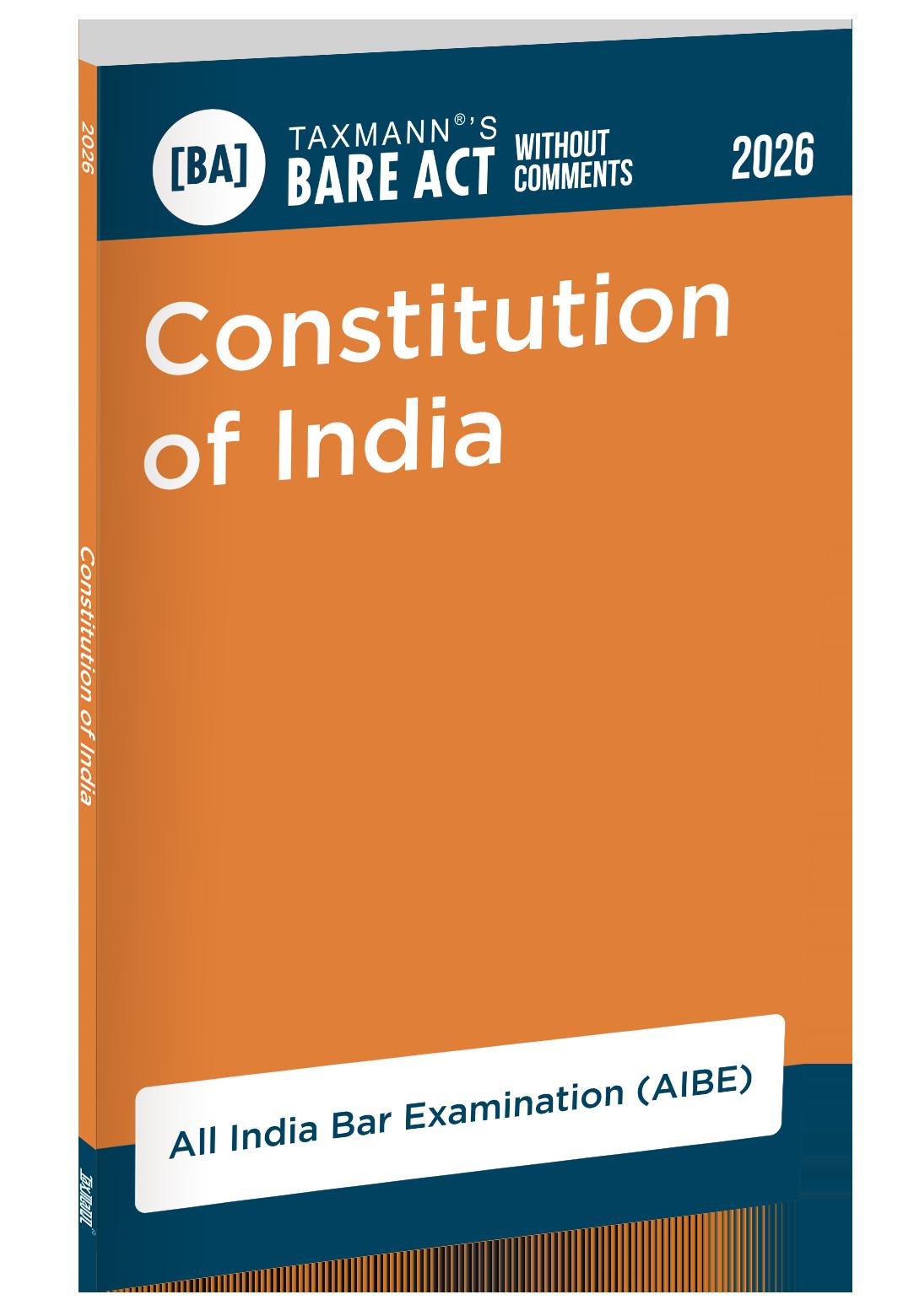
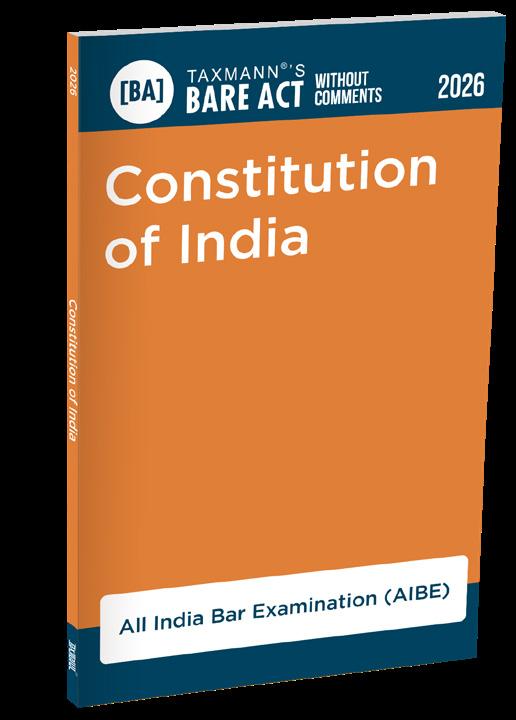
Constitution of India – Bare Act without Comments | AIBE
AUTHOR : Taxmann’s Editorial Board
PUBLISHER : Taxmann
DATE OF PUBLICATION : February 2026
EDITION : 2026 Edition
ISBN NO : 9789364556392
No. of Pages : 304
BINDING TYPE : Paperback
Rs. 245
DESCRIPTION
Constitution of India [Bare Act without Comments] by Taxmann for All India Bar Examination (AIBE) is an authentic, AIBE exam-compliant statutory reference containing the complete and unaltered text of the Constitution of India. Updated with all amendments in force as of 2026, it is an essential resource for AIBE aspirants, providing direct access to the supreme law without commentary or annotations.
The Present Publication is the 2026 Edition, covering the amended and updated text of the Constitution of India, with the following noteworthy features:
• [Complete & Authentic Text] Incorporates all constitutional amendments to date
• [Bare Act Format] Pure statutory language without commentary or editorial inputs
• [Exam Compliant] Fully aligned with AIBE’s permissible reference material requirements
• [Logical Arrangement] Article-wise presentation as per the official constitutional structure
• [Includes Schedules & Preamble] Covers all parts, articles, and twelve schedules
• [Portable & Durable] Compact binding for easy handling and repeated use