
Sample Read

© All rights reserved
Price : ` 345
Fifth Edition : January 2026
Published by :
Taxmann Publications (P.) Ltd.
Sales & Marketing :
59/32, New Rohtak Road, New Delhi-110 005 India
Phone : +91-11-45562222
Website : www.taxmann.com
E-mail : sales@taxmann.com
Regd. Office :
21/35, West Punjabi Bagh, New Delhi-110 026 India
Printed at :
Tan Prints (India) Pvt. Ltd.
44 Km. Mile Stone, National Highway, Rohtak Road Village Rohad, Distt. Jhajjar (Haryana) India
E-mail : sales@tanprints.com
Disclaimer
Every effort has been made to avoid errors or omissions in this publication. In spite of this, errors may creep in. Any mistake, error or discrepancy noted may be brought to our notice which shall be taken care of in the next edition. It is notified that neither the publisher nor the author or seller will be responsible for any damage or loss of action to any one, of any kind, in any manner, therefrom. No part of this book may be reproduced or copied in any form or by any means [graphic, electronic or mechanical, including photocopying, recording, taping, or information retrieval systems] or reproduced on any disc, tape, perforated media or other information storage device, etc., without the written permission of the publishers. Breach of this condition is liable for legal action.
For binding mistake, misprints or for missing pages, etc., the publisher’s liability is limited to replacement within seven days of purchase by similar edition. All expenses in this connection are to be borne by the purchaser. All disputes are subject to Delhi jurisdiction only.

SAMPLE CHAPTER
CHAPTER 2
DOCUMENTATION & MAINTENANCE OF RECORDS
Purpose of Documentation
Q1. Dr. Ltd. is a listed entity incorporated on 11th January 2018 under the Companies Act, 2013 having its registered office at a State X in the country. The company has a paid up capital of ` 100 crore and turnover of other ` 500 crore during last three proceeding financial years. The company at present has 13 lakh shareholders B, one of its shareholders inspected the companies records at the registered office and found that register of members is not properly maintained and accordingly complained to the Registrar of Companies (RoC). During the course of inquiry, it was noticed that the register of member was found to be incomplete. Based on the above fact and citing a leading case you are required to explain as to who is responsible for maintaining a register of its member and related provisions as per the Companies Act, 2013. [June 2024 (5 Marks)]
Ans. The Company Secretary is responsible for maintaining, storing, retrieving, certifying and explaining corporate documents. Proper document management includes safe storage, backup of records, timely access and compliance with statutory retention requirements.
As per section 88 of the Companies Act, 2013, every company limited by shares must maintain a Register of Members in Form MGT-1 from the date of its registration.
Penalty for Non-Compliance
If a company fails to comply with section 88:
The company and every of cer in default are liable to a ne not less than `50,000 and up to `3,00,000
In case of a continuing default, an additional ne of `1,000 per day may be imposed.
Case Law – M/s SDU Holdings Private Limited
During an inquiry under section 206, the Registrar of Companies, Bangalore found that the Register of Members (Form MGT-1) maintained by the company was incomplete. After giving a reasonable opportunity of being heard, the Adjudicating Officer imposed penalties on the company and its directors for violation of Section 88
2.2
Conclusion
PART I: COMPLIANCE MANAGEMENT
The case highlights the importance of proper maintenance of statutory registers. Failure to maintain complete records attracts monetary penalties on the company and its officers. Therefore, the Company Secretary must ensure accurate and timely compliance with statutory record-keeping requirements.
Q2. The Board of Directors (BoD) of CTZ Ltd. thinks that the documents, register, index, agreement, memorandum & minutes maintained by the company in electronic form, after getting it dated and signed digitally are capable of being edited or altered subsequently under their powers. Is the contention of BoD of CTZ Ltd. correct? Explaining the meaning of document and records, elucidate the manner in which the records in electronic form should be maintained as per the provisions contained in the Companies Act, 2013. [Dec. 2023 (5 Marks)]
Ans. Section 120 of the Companies Act, 2013 read with Rule 27 & 28 of the Companies (Management and Administration) Rule, 2014 provides for maintenance of documents in electronic form.
The Rule 27 provides that every listed company or a company having not less than 1000 shareholders, debenture holders and other security holders, may maintain its records in electronic form.
Section 2(36) of the said Act relates to the definition of “document” which includes summons, notice, requisition, order, declaration, form and register, whether issued, sent or kept in pursuance of Companies Act or under any other law for the time being in force or otherwise, maintained on paper or in electronic form. The term “records” means any register, index, agreement, memorandum, minutes or any other document required by the Act or the Rules made thereunder to be kept by a company. Therefore, such documents and records can also be maintained in electronic form.
However, the records in electronic form shall be maintained in such manner as the Board of directors of the company may think fit, provided that:
(
(
a) the records are maintained in the same formats and in accordance with all other requirements as provided in the Act or the rules made there under;
b) the information as required under the provisions of the Act or the rules made there under should be adequately recorded for future reference;
(
(
c) the records must be capable of being readable, retrievable and reproducible in printed form;
d) the records are capable of being dated and signed digitally wherever it is required under the provisions of the Act or the rules made there under;
(
e) the records, once dated and signed digitally, shall not be capable of being edited or altered;
(
f) the records shall be capable of being updated, according to the provisions of the Act or the rules made there under, and the date of updating shall be capable of being recorded on every updating.
CHAPTER 2: DOCUMENTATION & MAINTENANCE OF RECORDS 2.3
Q3. What do you mean by Good Documentation? Give some examples of Good Documentation Practices as well as Poor Documentation Practices.
[Dec. 2020 (5 Marks)]
Ans. The term documentation includes any and all forms of documentation recorded by a person in professional capacity in relation to his professional duties and includes written and electronic records, audio and video tapes, emails, facsimiles, images, charts, check lists, communication books, management reports, incident reports and working notes or any other type or form of documentation.
The good documentation promotes good corporate governance practices and compliance level of the company and also improves communication and dissemination of information between and across various stakeholders.
These guiding principles support professionals, employers, policy makers and managers in assessment, planning, execution and evaluation.
Examples of Poor Documentation Practices:
Document with errors, correction, not signed/dated, and didn’t include a reason for the correction;
Write-overs, multiple line-through & use of “White-out” or other masking device;
Recording of events is not in sequence & tabled; The delegation of work is not recorded/documented; Standards operating procedures as adopted by the professional is not authorised.
Examples of Good Documentation Practices:
Records should be completed at time of activity or when any action is taken; Superseded documents should be retained for a speci c period of time; Concise, legible, accurate and traceable;
Picture is worth a thousand words; Clear examples; Don’t assume knowledge/information.
Q4. Management of XYZ Ltd. was worried because it was observed that in the organization, good documentation was neglected and poorly executed. There was no system to update its Documents, Statutory registers and training records. You have recently joined the Secretarial department of XYZ Limited. Management of XYZ Ltd wanted to know what is Good Documentation Practice. Clarify them what is Good Documentation Practice, along with the Do’s and Don’ts of Good Documentation. [Dec. 2025 (5 Marks)]
Ans. Good documentation practices is a set of best practices for documentation and record keeping. It aims to preserve the data integrity of important documents and records and can also serve as guidelines for how to record information and store data appropriately.
The good documentation promotes good corporate governance practices and compliance level of the company and also improves communication and dissemination of information between and across various stakeholders.
2.4
PART I: COMPLIANCE MANAGEMENT
These guiding principles support professionals, employers, policy makers and managers in assessment, planning, execution and evaluation.
Good Documentation Do’s and Don’t
Do’s Don’ts
Do record the data/document as soon as it is generated
Do add the reference notes (if possible) to provide the context
Do validate your computerised system or document software
Do limit document access to authorised personnel
Do specify when the data/document was recorded, reviewed and approved
Do keep data back-up, either automatically or by storing the true copy in separate location
Don’t delay in data/document recording
Don’t make the data confusing, vague and unreadable
Don’t encourage handwritten documentation
Don’t intentionally falsify the record/document
Don’t pre-date or back-date the data/document
Don’t archive data/documents unless explicitly authorised to do so
Q5. What does the term documentation connote? Name the 10 C’s which form the guiding principles of good documentation.
[Dec. 2022 (5 Marks)]
Ans. The term documentation includes any and all forms of documentation recorded by a person in professional capacity in relation to his professional duties and includes written and electronic records, audio and video tapes, emails, facsimiles, images, charts, check lists, communication books, management reports, incident reports and working notes or any other type or form of documentation.
The good documentation promotes good corporate governance practices and compliance level of the company and also improves communication and dissemination of information between and across various stakeholders. Also, the good documentation practices and policies demonstrate the professional obligation, accountability and legal requirement to communicate and record client information and good secretarial practice.
The guiding principles for good documentation are as follows:
1. Clear
2. Correct
3. Concise
4. Comprehensive
5. Complete
6. Collaborative
7. Contemporary
8. Client Centric
9. Consecutive
10. Con dential
CHAPTER 2: DOCUMENTATION & MAINTENANCE OF RECORDS 2.5
Q6. Discuss the purpose of Documentation. [Scoring Question] Ans.
Client Service Documentation is a tool for professionals to serve better to their clients in a timely and effective manner.
Communication Documentation is the base for better communication between professionals. Clear, complete, accurate and factual documentation provides a reliable permanent record of client.
Accountability Documentation demonstrates professional accountability and records the work of the professional. It may be used in relation to performance management, internal inquiries, regulatory proceedings and/or legal proceedings.
Professional Responsibility Documentation is an integral part of professional practice and forms the basis for evidence of professional conduct.
Legal Requirement Professionals are required to make and keep records of their professional work in accordance with practice standards followed and organisational policy. However, the laws mandate specific information to be recorded and maintained.
Quality Documentation may be used to evaluate professional practice in terms of Peer reviews, Quality reviews, audits and accreditation processes, Regulatory inspections or critical incident reviews.
Research Documentation is a valuable source of data for researchers. It provides information to professional, evaluates client outcomes and is a concise record, essential for accurate research data and evidence-based practice.
Electronic Repository of Documents
Q7. What are the disadvantages of electronic records? [June 2019 (5 Marks)] Ans.
Advantages of the Electronic Records:
Cost Effective: Storing and maintaining records in digital form is much cheaper than in any other format. With the increase in the technology advancement, the Digital media costs drop every day.
Ease of use: It’s very easy to locate and share electronic documents through Computer’s aid searching now a days the process of ling doesn’t exist anymore. The Document management system take care for nding and maintaining Records consistent locations.
Labor savings: The labour required to locate, manage and dispose of electronic documents is almost nil and minimum. With electronic documents, all the steps like ling collating, stapling etc. can be automated and that labour completely disappears.
Search ability: Electronic documents can be made searchable by doing OCR of a document and make the whole text keyword searchable. That is not possible with paper documents.
2.6
PART I: COMPLIANCE MANAGEMENT
Portability: It’s very easy to transport electronic documents. No more boxes of records and trucks and semi-trucks to haul records archives. They can easily be stored on a removable hard drive or thumb drive and taken to the courthouse or to the eld of ce.
Version Tracking: In case of the version tracking, it is very easy with electronic documents, making it easy to see who has made changes to a document, when they made those and what the document looked like before the change. Version tracking and document management in the hard copy world is much more complex and much more costly.
Q8. The Board of directors of Bee & Bee Ltd. was of the view that as the company was diversifying its operations, it should evaluate digitizing the books of accounts and other records. The Board sought views from the Company Secretary about the same and asked him to appraise them about the Document Management System including good documentation practices. Advise the Board as the CS. [June 2021 (5 Marks)] OR
Q9. DE Ltd. recently transitioned from physical document storage to a CloudBased Document Management System (DMS) to streamline record-keeping and improve its compliance system. While the new system provided secure access, audit trails and keyword search functionality, some employees raised concerns about data security, restricted access policies, and longterm reliability of cloud storage. The Company Secretary of the Company had confirmed to the Board of Directors that the new DMS would be compliant with the provisions of the Companies Act, 20l3.
In this context, explain DMS and its benefits. Also explain the relevant provisions of the Companies Act, 2013. [June 20205 (3+2=5 Marks)]
Ans. Document management refer the process of managing and tracking of the documents and records through an electronic or physical source of documents. In an electronic repository, Document Management Systems (DMS) works by using a computer system and software to store, manage and track electronic documents and electronic images of paper-based information captured through the use of a scanner.
The term document management system can be defined as the software that controls and organizes documents of an organization. It incorporates document and content capture, workflow, document repositories and output systems, and information retrieval systems. Also, the processes used to track, store and control documents. Advantages of DMS are as follows:
Tracking on check-in/check-out by various of cers
Locking and unlocking of Document
Simultaneous editing
Document Version Control
Roll-back options/Retrieve option
Ease in Audit trail
Annotation and Stamps
CHAPTER 2: DOCUMENTATION & MAINTENANCE OF RECORDS 2.7
Section 120 of the Companies Act, 2013 (the Act) read with Rules 27 & 28 of the Companies (Management and Administration) Rule, 2014, provides for maintenance of documents in electronic form. The provisions also provide for inspection of documents maintained in electronic form. It states that any document, record, register, minutes, etc. that are required to be kept by a company or allowed to be inspected or copies to be given to any person by a company under the Act, may be kept or inspected or copies given, as the case may be, in electronic form. Rule 27 provides that every listed company or a company having not less than one thousand shareholders, debenture holders and other security holders, may maintain its records in electronic form.
In view of above the contention of the Company Secretary is valid.
Physical Repository
Q10. Differentiate Physical Data Room and Virtual Data Room. [June 2022 (5 Marks)]
Ans.
No. Basis Physical Data Room Virtual Data Room
1. Form of documents Papers, files, boxes or other tangible thing
2. Security of documents
Lies with the integrity of person who is in-charge of the data room
3. Time required for creation of data room Longer time required
4. Cost
5. Convenience
Cost is high because of reasons like-Requirement of one person to take care of data room. Requires bidders to travel from their place to the place of location of data room, etc.
Searching the documents is time consuming
Electronic/Digital/soft copies of documents including video/ audio documents
More secured through specific log-in id and pass word. In addition, facilities like internet fire walls are there
Can be created within 48 hours once demands of prospective bidders are identified
Cost is Low as the documents can be viewed from any location with internet security
More convenient as it enables multiple bidders to review documents at the same time with search facility also
6. Accessibility to data room Timings to access data may be restricted Data may be accessed nearly any time
7. Facility to restrict access of specific document
8. Ability to copy documents
Difficult to implement any Restriction
Possible
Access can be restricted
Not possible always
PART I: COMPLIANCE MANAGEMENT
Coding and Nomenclature
Q11. In naming of a document, briefly explain the concept of Descriptive file and non-Descriptive file.
[Dec. 2021 (5 Marks)]
Ans. For naming of any documents adopting good file naming conventions can help ensure that files will work with different operating systems. Further, the file names can be either self-descriptive or non-descriptive.
The Descriptive le names are useful for small, well-de ned projects with existing identi cation schemes that link the digital object to the source material. However, inconsistent application of terms or typos will increase to indexing and sorting errors.
Non-descriptive le names are usually system-generated sequential numerical string or the system based, such as a digital ID number, combination of Date and time, name of original le and are often linked to meta data stored elsewhere. Non-descriptive le names are often created for large scale digitization projects and may employ a digital ID number and numerical sequences to indicate batch or parent-child relationships. The advantage of non-descriptive names is that there is less chance of repeated or non-unique le names within a data structure.
Some applications and computer scripts could not recognize spaces or process files differently when using spaces. A best practice is to replace spaces in file names with an underline (_) or hyphen (-). However, the punctuation, symbols, or special characters (periods, commas, parentheses, ampersands, asterisks, etc.) should be avoided.
Q12. ‘R’ was appointed as Managing Director of P mart Limited recently. During the meeting of the Board, he desires that all agenda files should be sent by email encrypted by password. He also desires that to protect the file from hacking, there should be some special name to the file. As a company secretary, kindly highlight any eight best practices for file naming. [Dec. 2021 (5 Marks)] OR
Q13. “The strength of a folder and file naming convention under documents in electronic form is dependent on the proposed naming structure and the quality and quantity of the data elements chosen to build it.” With reference to this, correct each of the following statements, specifying the basic rules that could serve as a basic guideline in structuring folder and file naming, along with the reason associated with it:
(a) C:/Crescent Milky Way/Financial Year 2022-23/Annual Return Form MGT 7.doc
(b) Rose Merry TPS 8312 9 POLICY 2022 12 22. pdf II White Paper Structured le naming strategy.doc [Dec. 2023 (5 Marks)]
CHAPTER 2: DOCUMENTATION & MAINTENANCE OF RECORDS 2.9
Ans. The following are best practices for file naming. The File names should:
Be unique and consistently structured;
Be persistent and not tied to anything that changes over time or location; Limit the character length to no more than 25-35 characters;
Use leading 0s to facilitate sorting in numerical order if following a numeric scheme “001, 002, 010, 011 … 100, 101, etc.” instead of “1, 2, …10, 11 … 100, 101, etc.”;
Contain a le format extension; Use a period followed by a le extension (for example, .tif, .jpg, .gif, .pdf, .wav, .mpg);
Use lowercase letters. However, when a name has more than one word, start each word with an uppercase letter for example, “File_Name_Convention_001. doc”;
Use numbers and/or letters but not characters such as symbols or spaces that could cause complications across operating platforms;
Use hyphens or underscores instead of spaces;
Use standard date notation (YYYY-MM-DD or YYYYMMDD);
Avoid blank spaces anywhere within the character string; and Not use an overly complex or lengthy naming scheme that is susceptible to human error during manual input, such as “ lenameconventionjoes nal versionedited nal.doc”.
The strength of a folder and file naming convention is dependent on the proposed naming structure and the quality and quantity of the data elements chosen to build it. It should be of no surprise that for any business activity there is always an ideal naming structure. However, any structured naming convention that attempts to be all encompassing may result in overkill and unwieldiness.
Q14. You are a partner of ZKB & Associates (Practising Company Secretaries) and you are responsible for arranging and indexing the records in a way that permits easy location, access and retrieval of documents. Citing the basic rules that could serve as a general guideline in structuring folder and file naming. Give nomenclature of the file in following cases:
(a) Annual Return MGT-7, Financial Year 2022-23 of TZ Pharma.
(b) Search Report of PTK RESORTS, Invoice dated 30 July, 2023, PDF document.
(c) Mohit Nair Max Life 8561 3 POLICY date 19/October/2022, white paper structured le naming Strategy document. [Dec. 2024 (1×3=3 Marks)]
Ans.
(a) D:\TZP\FY\22-23\AR\MGT-7.doc
Rule: Avoid extra-long folder names and complex hierarchical structures but use information rich file names instead.
2.10
PART I: COMPLIANCE MANAGEMENT
(b) PTKRESORTS_SearchReport_Invoice30.07.2023.pdf
Rule: Put sufficient elements in the structure for easy retrieval and identification but do not overdo it.
(c) Mohit-Nair_Maxlife_8561_3_POLICY_2020-10-19.pdf| |WhitePaper_Structured File Naming Strategy.doc
Rule: Use the hyphen (-) to define it words within an element or capitalize the first letter of each word within an element.
Safety and Retrieval of Records
Q15. Records Management provides a professional approach to caring for the records and archives which is governed by certain key concepts. Explain the concepts that govern the care of records and archives.
[Dec. 2022 (5 Marks)]
OR
Q16. OS Pvt. Ltd. implemented a document control system to ensure its quality and compliance. However, during an internal audit, gaps were identified, including lack of operating logs, incomplete review records, and inadequate tracking of document access and inspections. The management faced challenges in monitoring work performance and analysing information flow. Enumerate the key measures which should be adopted for effective document control and key concepts required to be considered to take care of records and archives.
[June 2025 (5 Marks)]
Ans. To assure the best quality of documents, it is to be assured that sufficient records are maintained to furnish evidence of the activities affecting quality. The records should incorporate the following:
(
(
a) Operating logs: the names of the individuals who all have worked on the same documents;
b) Results of reviews: the recording of the changes suggested by each reviewer and basis of the rejection on Non agreement;
(
(
c) Inspections: list of individuals who have access of the records and have inspection rights of the same;
d) Monitoring of work performance: will ease in the monitoring of work performed by the person to whom the le is shared;
(
e) Information analyses: Provide ease in the Information system of the organization and tracking of les.
Records should be identifiable and retrievable and should consistent with applicable regulatory requirements. The company should comply with requirements concerning record retention, such as duration, location, and assigned responsibility. Every record must be well managed in order to ensure that they are protected for both administrative purposes and to serve as evidence of the organization’s work. Records management provides a professional approach to caring for records. The care of records and archives is governed by three key concepts.
COMPLIANCE MANAGEMENT AUDIT & DUE DILIGENCE (CMADD/DUE DILIGENCE) | CRACKER
AUTHOR : Ankush Bansal
PUBLISHER : Taxmann
DATE OF PUBLICATION : January 2026
EDITION : 5th Edition
ISBN NO : 9789375611554
NO. OF PAGES : 288
BINDING TYPE : Paperback
Rs. 345
DESCRIPTION
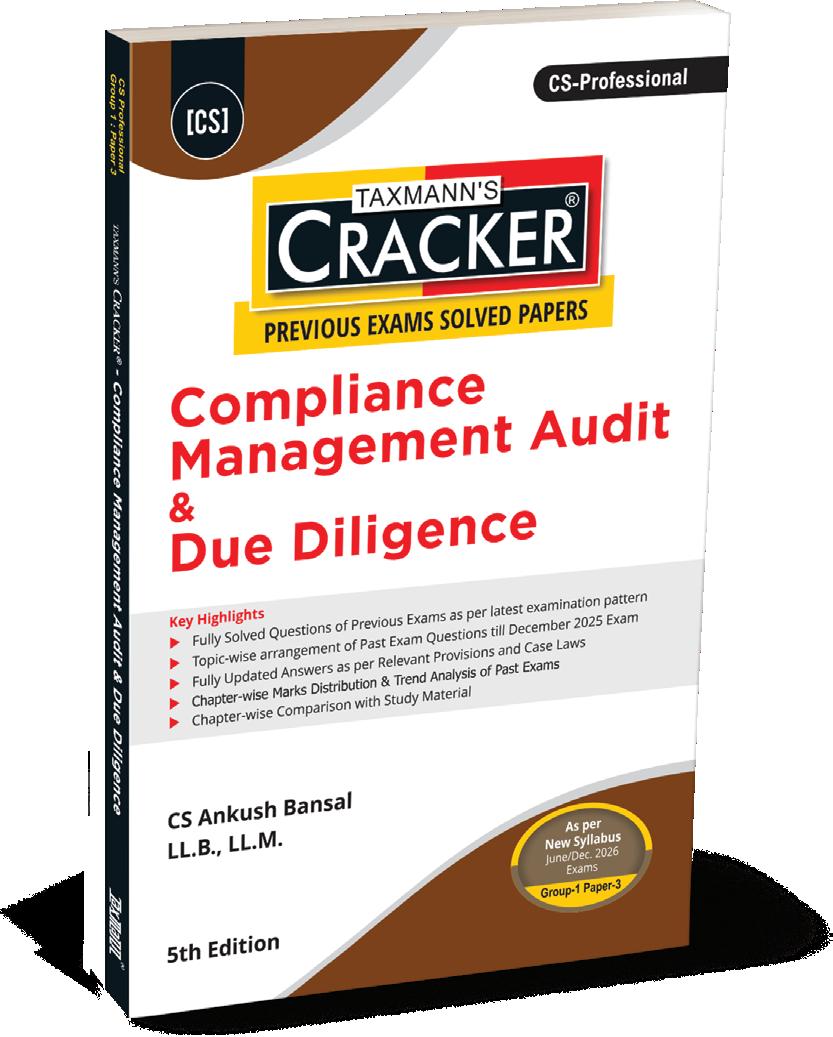
Compliance Management, Audit & Due Diligence – CRACKER is an examination-focused, previous-years-based preparation manual for CS Professional – Group 1 | Paper 3, fully aligned with the new ICSI syllabus and applicable for the June & December 2026 examinations. Designed as an exam-response system rather than a theory textbook, the book is structured around how ICSI actually frames questions, allocates marks, and evaluates descriptive and practical answers. It consolidates more than a decade of CS Professional examination coverage, including complete questions up to December 2025, into a topic-wise, marks-mapped, answer-ready preparation framework. Recognising that Paper 3 is tested as a professional application paper—not as a theoretical compliance subject—the book trains students to demonstrate structured compliance reasoning, audit judgement, due diligence orientation, and regulatory clarity within examination constraints. All solutions are drafted in ICSI-compliant language, format, and depth, reflecting current examiner expectations.
The Present Publication is the 5th Edition, authored by CS Ankush Bansal, with the following noteworthy features:
• [Fully Solved Previous Examination Questions] Provides complete, model-quality solutions to past CS Professional Paper 3 questions, drafted strictly as per the latest examination pattern and presentation standards
• [Topic-wise & Chapter-wise Question Classification] Past questions are systematically arranged chapter-wise, enabling focused preparation and end-to-end mastery of each topic from an exam perspective
• [Statutorily Updated, Case-Law-Backed Answers] All answers are updated in line with applicable statutory provisions, rules, regulatory practices, and relevant judicial precedents for the 2026 examination cycle
• [Chapter-wise Marks Distribution & Trend Analysis] Analytical tables highlight chapter-wise question frequency, marks allocation, and question nature (descriptive/practical), enabling data-driven preparation
• [Chapter-wise Comparison with ICSI Study Material] A structured correlation matrix maps each chapter of the book with the corresponding ICSI Study Material chapter, ensuring clarity and syllabus alignment