




© All copyright with The Chamber of Tax Consultants, Mumbai
Price : ` 495
Edition : 2026
Published by :
Taxmann Publications (P.) Ltd.
Sales & Marketing :
59/32, New Rohtak Road, New Delhi-110 005 India
Phone : +91-11-45562222
Website : www.taxmann.com
E-mail : sales@taxmann.com

Mumbai : 35, Bodke Building, M.G. Road, Opp. Railway Station, Mulund (W), Mumbai - 400 080 Mob. +91-9322247686, 9619668669, 7045453844/45/51
E-mail : sales.mumbai@taxmann.com
Regd. Office :
21/35, West Punjabi Bagh, New Delhi-110 026 India
Printed at :
Tan Prints (India) Pvt. Ltd.
44 Km. Mile Stone, National Highway, Rohtak Road Village Rohad, Distt. Jhajjar (Haryana) India
E-mail : sales@tanprints.com
Disclaimer
Every effort has been made to avoid errors or omissions in this publication. In spite of this, errors may creep in. Any mistake, error or discrepancy noted may be brought to our notice which shall be taken care of in the next edition. It is notified that neither the publisher nor the Chamber of Tax Consultants or seller will be responsible for any damage or loss of action to any one, of any kind, in any manner, therefrom. It is suggested that to avoid any doubt the reader should cross-check all the facts, law and contents of the publication with original Government publication or notifications.
No part of this book may be reproduced or copied in any form or by any means [graphic, electronic or mechanical, including photocopying, recording, taping, or information retrieval systems] or reproduced on any disc, tape, perforated media or other information storage device, etc., without the written permission of the Chamber of Tax Consultants. Breach of this condition is liable for legal action.


For binding mistake, misprints or for missing pages, etc., the publisher’s liability is limited to replacement within seven days of purchase by similar edition. All expenses in this connection are to be borne by the purchaser. All disputes are subject to Mumbai jurisdiction only.





For too long, the intricacies of the Companies Act, 2013, have remained concealed in complex legal jargons, creating an unnecessary barrier between the entrepreneurs and the legal framework governing the very existence of their business. As a legal professional, I have witnessed countless business owners, who feel overwhelmed not itself. This complexity defeats the very purpose of the law, which is to encourage robust and compliant business growth.
This book was born from the conviction that company law should not be a secret guarded by professionals, but a clear, navigable roadmap for growth. To achieve this, I discarded the traditional textbook format. Instead, you will join Ayush, a sole proprietor of a growing tea business, on his journey towards breaking down the complexities of law. Every concept, from incorporation to winding up, is explained not through academic text, but through engaging, easy to follow dialogues.
It is important to note that while this narrative focuses on the Sections of the Companies Act, 2013, these provisions must always be read in conjunction with the relevant statutory rules for procedural compliance. These rules form an integral part of the subject and dictate the ‘how-to’ of the legal mandates discussed.
This journey is structured to follow the full corporate lifecycle, ensuring you grasp the legal realities of every stage. While the language is kept intentionally simple, the legal foundation remains meticulously accurate and based strictly on the current statute. My sincere hope is that by the time you close this book, you will feel




governing your business are no longer a source of anxiety, but a powerful framework for your ambition.
B.Sc. (H) Mathematics, LLB, LLM (Investment and Securities Law), Actuarial Sciences

The conversation at the coffee house with Siddharth left Ayush with both clarity in mind and fresh questions. He realized that the Companies Act, 2013, isn’t just dry legal document; rather, it is a living and breathing blueprint for business.
The very next day, a sense of purpose firm in his step, Ayush took the decisive step towards incorporation. He approached his lawyer, Mr Amogh, a man whose office exuded quiet authority, filled with scent of old paper and ambitions with bulky leather-bound books. With a calm and analytical look, Mr Amogh was involved in the process of drafting the Memorandum of Association, the MoA, denoting it as the “Constitution of the Company”.
“Ayush”, Mr. Amogh began in a low steady voice, “firstly, we need a name for your company. This name will be featured in the ‘name clause’ of the MoA of your company.
If we register your company as a public company, the word ‘Limited’ will be added as the last word, but if we register your company as a private company, the word ‘Private Limited ‘ will be added as the last word.”14
Then, he leaned back comfortably in his large rotating chair, with a thoughtful expression on his face.
“We need to consider a few crucial points before we finalise the name, as the name isn’t just a label, it is the identity of your company in the legal world. And that legal world is full of rules. The name must not be identical with, or even resemble the name of any existing company.15 The name shouldn’t constitute an offence16 and should not be
14.Section 4(1)(a) of the Companies Act, 2013.
15.Section 4(2)(a) of the Companies Act, 2013.
16.Section 4(2)(b)(i) of the Companies Act, 2013.
undesirable in the opinion of the Central Government17. And most importantly, it shouldn’t represent Government patronage18 unless you have obtained approval from the Central Government19.”
Ayush, who had been writing down names for his company for weeks now, felt a new layer of complexity emerge in his mind. All the names he had thought of were creative and catchy, but now he has understood that the name has to pass through a strict legal gate. “If I suggest a name like ‘Fresh Brew’, and it is available, can we reserve it for the time being and start the registration process in a few days”?
“Of Course”, affirmed Amogh with a smile. “We can reserve the name for 20 days20 by simply filing an ‘application for the reservation of name’21 with the Registrar of Companies and paying the relevant fees. And if you have an existing company whose name you wanted to change, then you would have got 60 days22 to reserve the new name.”
Ayush, after his discussion with Siddharth was aware that potential problems may arise, so he raised his concern. “What will happen, if we file a name, that turns out to be wrong or problematic?”
Mr Amogh removed his hands from his desk and his expressions turned serious. “That is a very important question. If the company hasn’t been incorporated yet, then the name which was reserved for 20 days will be cancelled and a penalty will be imposed on you, the Applicant.23 However, if the company is already incorporated, then you will be given an opportunity of being heard by the Registrar of Companies.24 If the name turns out to be wrong or problematic, even after that, then the company will be directed to either change the name within three months25, or the name of the
17.Section 4(2)(b)(ii) of the Companies Act, 2013.
18.Section 4(3)(a) of the Companies Act, 2013.
19.Section 4(3)(b) of the Companies Act, 2013.
20.Section 4(5)(i) of the Companies Act, 2013.
21. Section 4(4) of the Companies Act, 2013.
22. Supra at 20.
23.Section 4(5)(ii)(a) of the Companies Act, 2013.
24.Section 4(5)(ii)(b) of the Companies Act, 2013.
25.Section 4(5)(ii)(b)(i) of the Companies Act, 2013.
company will be struck off the register26, or a petition for winding up the company might be filed by the Registrar himself27
Ayush realising the gravity of even such small details, sipped water.
Then, Mr. Amogh guided him through other essential clauses that will be a part of the MoA. “ The MoA will include the ‘registered office clause’ wherein the name of the state in which the company is incorporated will be specified.28 Furthermore, the MoA will include the ‘object clause’, in which the purpose for which the company has been incorporated is stated.29 Ayush this is crucial, as your company can undertake only those activities which fall within these stated objects. Next, we will detail the ‘liability clause’. This clause will define the extent of liability that the members have undertaken to contribute if the company faces winding up.30”
Mr. Amogh paused for a moment, allowing Ayush to breathe. “For a company limited by shares, the liability of the members is limited to the amount unpaid on shares.31
But for a company limited by guarantee, the liability is limited to the specific assets the person undertakes to contribute in the event of winding up of the company.32 Notably, in case of a company limited by guarantee, the liability extends not only to the current members of the company but also to those, who have ceased to be members up to one year before the winding up.33”
Mr. Amogh finally arrived at the ‘Capital Clause’.34 “Ayush, this clause will specify the ownership structure, essentially, the number and types of shares in your company. The number of shares that each member intends to take, will be indicated opposite to their names. This is known as the ‘subscription clause’ and the members whose names are entered are known as the ‘subscribers
26.Section 4(5)(ii)(b)(ii) of the Companies Act, 2013.
27.Section 4(5)(ii)(b)(iii) of the Companies Act, 2013.
28 Section 4(1)(b) of the Companies Act, 2013.
29 Section 4(1)(c) of the Companies Act, 2013.
30 Section 4(1)(d) of the Companies Act, 2013.
31 Section 4(1)(d)(i) of the Companies Act, 2013.
32.Section 4(1)(d)(ii) of the Companies Act, 2013.
33.Section 4(1)(d)(ii)(A) of the Companies Act, 2013.
34.Section 4(1)(e) of the Companies Act, 2013.
to the MoA’.35 This is where we will formalize your company’s potential to issue shares. Remember that, if your company is limited by guarantee and does not have a share capital, then the total number of shares that the company is authorized to issue can even be zero. But, if your company is limited by shares, then it is a must for your company to have shares and the number of shares that the company is authorized to issue can never be less than one.”36
Ayush then leaned back in his chair with a fresh wave of understanding washing over, and a thought crossed his mind. “So, if I register my company as limited by guarantee and not shares, can I make an agreement to give the profit to others, i.e., nonmembers of the company?”
To his surprise, Mr. Amogh shook his head, “No, you can’t, as any such agreement will be considered void (unacceptable).”37 However, if your company is limited by shares, then you can make an agreement to give the profit to others, i.e., non-members of the company.
The conversation about the contents of the MoA with Mr. Amogh, made Ayush realise that MoA is not just a simple document; rather, it was truly the constitutional backbone, the very DNA, of his Company. But then another question came across his mind, “What about the company’s management? Is there a separate document that outlines how company’s day-to-day task will be managed?”
Mr. Amogh’s eyes lit up. “Ah! an excellent question.” He explained, “For that very purpose, the Article of Association (AoA) of the company must be meticulously prepared. These are the internal rulebook, which contains the specific regulations for the management of the company38. Besides outlining the management regulations, the AoA will also include entrenchment provision.39”
Intrigued by the word ‘entrenchment’, Ayush excused himself and headed back home. He needed to get away from the formal setting of Mr. Amogh’s office and understand about the
35.Section 4(1)(e)(ii) of the Companies Act, 2013.
36.Section 4(1)(e)(i) of the Companies Act, 2013.
37. Section 4(7) of the Companies Act, 2013.
38. Section 5(1) of the Companies Act, 2013.
39. Section 5(3) of the Companies Act, 2013.
‘entrenchment provision’ in depth. With a cup of freshly brewed green tea, Ayush settled into his armchair and researched. Soon, he discovered that ‘entrenchment provision’ acts like a powerful safeguard for the AoA, by deliberately making its amendment process more difficult than usual. It ensures that the specified provisions of the AoA can only be amended if conditions or procedure more restrictive than a special resolution are met. But what exactly was a ‘special resolution’?
Poring over the digital pages, Ayush finally gained clarity. He got introduced to two distinct concepts: the Ordinary Resolution and the Special Resolution. He learned that, “an ordinary resolution is passed when the votes cast in favour, including any casting vote, simply exceed the total votes cast against it. It’s a simple majority. In stark contrast, a Special Resolution requires a much higher threshold: the total number of votes casted in favour must be not less than three times the votes cast against it. It is a tool for deciding significant matters of the company.”40
While this clarified how the entrenchment provision worked, Ayush’s next question was about its introduction: “When exactly can the ‘entrenchment provisions’ be incorporated in the AoA?”
The Companies Act, 2013, he read, clearly states that, “An entrenchment provision can be introduced either right at the company’s formation, i.e., when the AoA is initially drafted, or even subsequently. If introduced later on, it requires the agreement of all members in the case of a private company and the passing of a special resolution in the case of a public company.41 Furthermore, once entrenchment provisions are included in the AoA, a formal notice must be filed with the Registrar of Companies, in order to update the records of the Company.”42
Ayush also discovered that the AoA refers to ‘model articles’43 (basically the Act provides a standard template for the AoA), that
40. Section 114(1) of the Companies Act, 2013.
41. Section 5(4) of the Companies Act, 2013.
42. Section 5(5) of the Companies Act, 2013.
43. Section 5(7) of the Companies Act, 2013.
DNA: The MoA and AoA
will automatically apply to the company, unless it has been explicitly excluded or modified, by the AoA drafted for the company.44
Learning about all these important details, Ayush leaned back, a mix of exhaustion and satisfaction settling over him. He had now understood that the MoA and AoA are the most powerful documents of the company. He consulted the digital pages of the Act as a final check and learned that while both MoA and AoA are crucial for the existence and operation of the company, the Companies Act, 2013, holds supreme authority over everything.45 It has an overriding effect over both MoA and AoA.
Anything in the MoA or the AoA of the company, that contradicts or overrides, the provisions of the Companies Act, 2013, will simply be considered ‘void’.46 The act, he realized that, was the ultimate guardian of the company.
44. Section 5(8) of the Companies Act, 2013.
45.Section 6(a) of the Companies Act, 2013.
46.Section 6(b) of the Companies Act, 2013.
With the intricate blueprint of the MoA and AoA finally understood, Ayush felt a surge of readiness within himself. He had now completed the theoretical groundwork, and the time had come to take steps towards bringing his company to life. In an eager voice, Ayush asked, “What next?”.
Mr. Amogh’s office gave the feel of a ‘sanctuary of legal orders’. He gestured Ayush towards a brown leather chair. “What’s next, is bringing your company to life. I will guide you through the process of ‘incorporation of the company’.” He continued, “To initiate the incorporation process, a set of documents have to be filed with that Registrar of Companies, within whose jurisdiction the registered office of your company will be situated.47 Since, your company’s registered office is proposed to be situated in Guwahati, you will have to file your documents with the RoC, Guwahati. These filed documents aren’t just for a quick check. The copies of these documents have to be preserved at your registered office till the dissolution of the company, i.e., its official ending.”48
He continued, detailing the formalities. “The MoA and the AoA are to be duly signed by all the subscribers to the memorandum.49 Alongside these fundamental documents, certain declarations have to be signed and filed with the Registrar. One key declaration, affirming full compliance with the provisions of the Act with respect to registration, must be signed by a professional - an Advocate, a Chartered Accountant, a Cost Accountant or a Company Secretary in practice, as well as by Director, Manager or Secretary of the proposed Company.50
47.Section 7(1) of the Companies Act, 2013.
48.Section 7(4) of the Companies Act, 2013.
49.Section 7(1)(a) of the Companies Act, 2013.
50.Section 7(1)(b) of the Companies Act, 2013.
Then, there are certain declarations which are to be made by the subscribers to the MoA and if you have mentioned any person as the ‘first director’ in the AoA, then the declarations have to be made by them also. ‘Directors’ are basically the head of the company, who are responsible for managing the affairs of the company. The first directors hold the office till the regular directors are appointed and if you have not mentioned the name of the first director in the AoA, then the subscribers to the MoA, will be deemed first directors. The aforementioned individuals must file the following declarations:
He/she has not been convicted of any offence in connection with formation, promotion or management of any company.
He/she has not been found guilty of, fraud or misfeasance or any breach of duty to any company, in the in the preceding five years.
All the documents filed with the Registrar are correct and contain complete information.”51
If the permanent registered office is not yet established, then a temporary address must also be filed with the Registrar.52 All the official communication will be sent there.”
The weight of documents to be filed made Ayush pause. Processing the knowledge, Ayush raised another concern, “But, what all specific details of the subscribers to the MoA and the first directors named in the AoA need to be filed with the Registrar? Do we need to file just the name and address?”
Mr. Amogh opened a folder on his MacBook and turned the screen towards Ayush. “More than just that. For both subscribers and the first director, we will require the following details and documents:53
1. Full name including Surname or Family Name,
2. Residential Address
51. Section 7(1)(c) of the Companies Act, 2013.
52. Section 7(1)(d) of the Companies Act, 2013.
53. Section 7(1)(e) of the Companies Act, 2013.
AUTHOR : Sristi Nimodia, The Chamber of Tax Consultants
PUBLISHER : Taxmann
DATE OF PUBLICATION : April 2026
EDITION : 2026 Edition
ISBN NO : 9789375617778
No. of Pages : 176
BINDING TYPE : Paperback
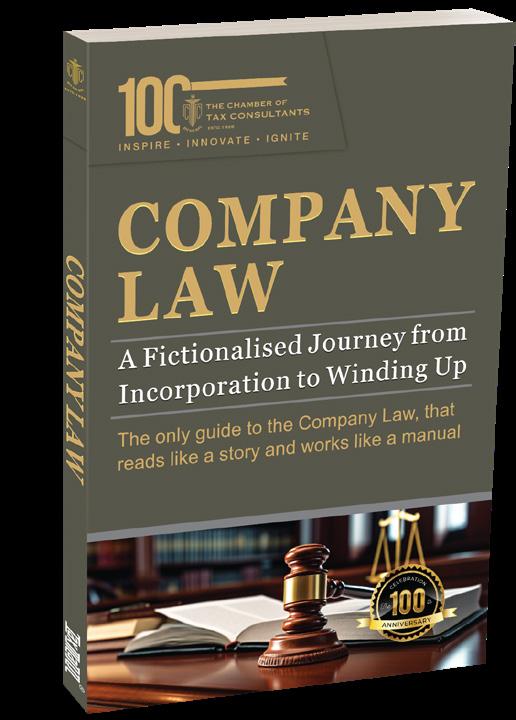
Company Law — A Fictionalised Journey from Incorporation to Winding Up follows Ayush—a sole proprietor of a growing tea business in Guwahati—who decides it is time to incorporate. From that initial act of ambition, the reader journeys with him through the full corporate lifecycle under the Companies Act 2013: selecting a structure, incorporating, raising capital, governing a board, managing directors, handling accounts and audits, navigating fraud and mismanagement, and ultimately winding up. Every legal concept emerges through Ayush’s conversations—with a friend who set up an OPC, a lawyer drafting his MoA, a classmate fresh from an IPO, an SFIO officer, a managing director cousin, and a legal executive facing an NCLT plea. Law appears through dialogue—over coffee, in cars, on Zoom, at dinner. It never comes across as a lecture. Despite this, the book is not a loose narrative. Each concept is anchored to a specific section of the Companies Act, 2013, footnoted throughout. Procedural steps are laid out in sequence. Part Three—covering Offences and Penalties, E-Forms, and a Comparative Schedule—serves as a standalone compliance reference. The result is a book you read and a manual you revisit.
This book is designed for a wide but well-defined audience:
• Entrepreneurs and Business Founders
• Advocates, Company Secretaries, Chartered Accountants, and Compliance Officers
• Law and Commerce Students
• Independent Directors and Board Members
• Anyone Transitioning from a Sole Proprietorship, Partnership, or LLP into a Corporate Structure
The Present Publication is the Latest Edition, commissioned by The Chambers of Tax Consultants and published exclusively by Taxmann. It is authored by Advocate Sristi Nimodia and reviewed by CS Latesh Shah. The key points of this book are as follows:
• [Narrative-led Legal Education] Legal concepts emerge through Ayush’s real conversations with friends, lawyers, and professionals—making statutory provisions concrete, memorable, and immediately applicable. Storytelling here is pedagogy, not decoration
• [Complete Corporate Lifecycle Coverage] Every major stage of a company’s legal existence—from formation to dissolution—is addressed in sequence, in a single coherent narrative
• [Strict Statutory Accuracy] Every concept is anchored to a specific section of the Companies Act 2013, cited in footnotes. The language is simple; the legal foundation is meticulous
• [Exhaustive Penalty and Offence Tables] A comprehensive, tabulated compilation of offences and penalties—from prospectus violations to board governance failures—that functions as a standalone compliance risk reference
• [Complete E-Forms Directory] All prescribed e-forms under the Companies Act 2013, mapped to the compliance obligations discussed in the narrative, giving the book its ‘works like a manual’ quality
• [Company vs. LLP Comparative Schedule] A structured comparison of the two primary business vehicles across structural, governance, liability, and compliance dimensions—directly relevant to the foundational decision every entrepreneur faces before incorporation
• [Author’s Interdisciplinary Grounding] Advocate Sristi Nimodia holds a B.Sc. (H) in Mathematics, an LLM in Investment and Securities Law from NISM, and actuarial sciences certification from the Institute and Faculty of Actuaries, UK—producing a treatment of corporate law that is analytically sharp, financially literate, and practically oriented