It gives me immense pleasure in presenting the TwentyEighth Edition of the Book. I express my gratitude to the readers for the encouraging response to the earlier editions. Since the last edition of the book, the MCA has taken various initiatives towards ease of doing business in India. Various steps have been taken to simplify the processes by making suitable amendments to the Rules. The limit of paid-up capital and turnover for small companies was substantially increased, leading to many more companies to be classified as small companies and therefore enabling them to enjoy the relaxation given to small companies. The facility of fast-track merger was extended to certain other classes of companies. The jurisdiction of various Registrar of Companies and Regional Directors was reorganized during the year. SEBI introduced corporate governance norms for high value debt listed entities to further enhance corporate governance. All these have been suitably covered in the current edition.
Changes in the Companies Act and the notified new/amended rules up to 31st December, 2025 have been duly incorporated at appropriate places in the text. Case laws reported up to 31st December, 2025 have been discussed at the relevant places in the book. In addition, I have taken care to add as well as change discussion in certain areas based on feedback received from the readers and colleagues in various colleges.
I am sure that the readers will appreciate this edition like the earlier ones and continue to give me an opportunity to serve them. I request you continue to send your feedback/suggestions. These certainly will help improve the text.
With Best Wishes,
DR. SANJAY DHAMIJA
HISTORY
KINDS OF COMPANIES
FORMATION AND INCORPORATION OF A COMPANY
4.1 Promotion
4.2 Registration/Incorporation of a company
4.3 Simplified Proforma for Incorporating Company Electronically (SPICe) + (Pronounced as SPICe Plus)
4.3A Certificate of incorporation
4.3AA Online Registration of a company99
4.3B Effect of certificate of incorporation
4.3C Conclusiveness of certificate of incorporation
4.4 Commencement of business
MEMORANDUM OF ASSOCIATION
5.1 Meaning and importance
5.2 Memorandum of Association - Whether an unalterable charter
5.3 Form and contents
5.4 Alteration of memorandum
6.1 Introduction
ARTICLES OF ASSOCIATION
6.2 Memorandum and Articles - Their Relationship
6.3 Distinction between memorandum of association and articles of association
6.4 Contents
6.5 Model form of articles
6.6 Signing of Articles
6.7 Alteration of articles
6.8 Binding effect of memorandum and articles
6.9 Doctrine of constructive notice
6.10
PROSPECTUS
7.1 Meaning and definition of a prospectus
7.2 Contents of a prospectus
7.3 Draft Prospectus to be made public 160
7.3A Abridged Prospectus 160
7.4 Is issue of prospectus compulsory/When prospectus is not required to be issued? 161
7.5 Statutory requirements in relation to a prospectus 161
7.6 Prospectus by implication/Deemed prospectus [Section 25] 163
7.7 Shelf Prospectus and Information Memorandum [Section 31] 164
7.8 Red herring prospectus [Section 32] 165
7.9 Misstatements in a prospectus and their consequences 165
7.10 Golden Rule for framing of Prospectus 169
7.11 Allotment of shares in fictitious names prohibited [Section 38] 170
7.12 Announcement regarding proposed issue of capital [Section 30] 171
ACCEPTANCE OF PUBLIC DEPOSITS
8.1
SHARE AND SHARE CAPITAL
9.1 Meaning and nature
9.2
9.3
9.4 Kinds of
9.5 Par
9.6 Raising of capital/Issue of
9.7 Public issue of
9.10
9.11
9.12
REGISTERS AND RETURNS
13.1/2
DIVISIBLE PROFITS AND DIVIDEND
COMPANY MANAGEMENT
16
COMPANY MEETINGS-I - GENERAL
16.1
16.3
16.4
16.5
16.6
COMPANY MEETINGS-II -
COMPANY MEETINGS-III - BOARD MEETINGS
18.3 Participation of directors through video conferencing or other audio visual means [Section 173(2)]
18.4 Board meeting
18.5 Contents and Agenda of Board Meeting
18.6 Time and place of Board meeting
18.7 Quorum
18.8 Adjournment for want of quorum
18.9 Passing of Resolutions by Circulation [Section 175] 491
18.10 Minutes of the Board meeting
ACCOUNTS AND AUDIT
ACCOUNTS
19.1 Books of account required to be kept
19.2 Inspection of books of account
19.3 Persons responsible for keeping proper books of account [vide sub-section (6) of section 128]
19.4 Financial Statements
19.5 Authentication of Accounts
19.6 Board’s Report
19.7 Circulation of Financial Statements
19.8 Adoption and filing of Financial Statements
19.9 Accounting Standards
19.10 Internal Audit
AUDIT
19.11 Who can be appointed as an Auditor (Qualifications)? 511
19.12 Who cannot be appointed as an Auditor (Disqualifications)?
19.13 Auditor not to render certain services
19.14 Appointment of First Auditors 514
19.15 Appointment of subsequent Auditors 515
19.16 Tenure of appointment 515
19.17 Compulsory rotation of auditors 515
19.18 Reappointment of retiring auditor 517
19.19 Rights of retiring auditor [Section 140(4)]
19.21 Removal and resignation of an auditor
19.22 Remuneration of auditors
19.23 Rights of the company auditor
19.24 Duties of Company Auditor 522
19.25 Special provisions relating to audit of Government Companies 524
19.26 Punishment for Contravention 526
19.27 Audit Committee 526
19.28
INSPECTION, INQUIRY AND INVESTIGATION
INSPECTION
20.1 Power to call for information, inspect books and conduct inquiries 533
20.2 What books and papers can be inspected? 535
20.3 Place and time of inspection 535
20.4 Duties of directors, officers, employees of the company to assist in inspection 536
20.5 Powers of the inspector 536
20.6 Supply of report 537
INVESTIGATION
20.7 Investigation 537
20.8 Who can apply and the scope of investigation? 537
20.9 Investigation into affairs of a company by Serious Fraud Investigation Office 538
20.10 Investigation into company’s affairs in other cases
20.11 Firm, body corporate or association not to be appointed as inspector 542
20.12 Investigation of ownership of a company [Section 216] 542
20.13 Powers of inspectors 542
20.14 Report of the Inspector 544
20.15 Follow up action by the Central Government on the investigation report of the inspector 545
20.16 Investigations etc. of foreign companies [Section 228] 545
20.17 Penalty for furnishing false statements, mutilation or destruction of documents 545
20.18 Difference between Inspection and Investigation 545
YOUR KNOWLEDGE 547
21
MAJORITY RULE AND MINORITY PROTECTION
21.1 Rule of majority 548
21.2 Personal rights of members 550
21.3 Representative and Derivative Action 551
21.4 Exceptions to ‘the rule in Foss v. Harbottle’ 552
YOUR KNOWLEDGE 555
22
PREVENTION
OF OPPRESSION AND MISMANAGEMENT
22.1 Meaning of oppression 556
22.2 Application to Tribunal for relief in cases of oppression etc. 567
22.3 Power of Tribunal 571
22.4 Oppression of majority 571
22.5 Appeals against the orders of the Tribunal and variation of the order of Tribunal 573
22.6 Composite/simultaneous petition under sections 241 and 271Whether maintainable 573
22.7 Powers of the Tribunal [Section 242] 573
22.8 Class Action 577
23
COMPROMISES,
ARRANGEMENTS, RECONSTRUCTION AND AMALGAMATION
23.1 Meaning of compromise 581
23.2 Meaning of arrangement 581
23.3 Statutory provisions regarding compromise or arrangement 582
23.4 Exercise of the Tribunal’s discretion 584
23.5 Powers of the Tribunal 588
23.6 Information as to compromise or arrangement [Section 230] 589
23.7 Reconstruction and amalgamation 591
23.8 Meaning of reconstruction 591
23.9 Meaning of amalgamation and merger 592
23.10 Difference between amalgamation and reconstruction 592
23.11 Take-over v. Merger 592
23.12 Legal provisions regarding reconstruction and amalgamation 593
23.13 Reconstruction/Amalgamation by sale of undertaking [Section 232] 593
23.14 Merger and Amalgamation of certain companies [Section 233] 599
23.14A Application of section 233 to Start-up Companies 601
23.14B Application of Section 233 to unlisted companies and holding and subsidiary companies 602
23.15 Merger or Amalgamation with foreign company [Section 234] 602
23.16 Power to acquire shares of shareholders dissenting from scheme or contract approved by majority [Section 235] 603
23.17 Amalgamation of companies in public interest [Section 237] 606
23.18 Preservation of Books and Papers of Amalgamated Company [Section 239] 608
23.19 Offences committed prior to merger, amalgamation [Section 240] 608
23.20 Valuation by registered valuers 608 TEST YOUR KNOWLEDGE 609
24
WINDING UP
24.1 Meaning 611
24.2 Modes of winding up [Section 270] 611
24.3 Winding up by the Tribunal 611
24.4 Who can make petition [Section 272] 619
24.5 Commencement of winding up [Section 357] 622
24.6 Procedure for winding up order 622
24.7 Consequences of winding up order 625
24.8 Submission of report by Company Liquidator [Section 281] 627
24.9 Promoters, directors etc. to cooperate with the Company Liquidator [Section 284] 629
24.10 Advisory Committee [Section 287] 629
24.11 General Powers of Tribunal in case of winding up by Tribunal 631
24.12 Dissolution of company [Section 302] 631
24.13 Enforcement of and appeal from orders 632
24.14 Summary procedure for Liquidation [Section 361] 633
24.15 Liquidators 634
24.16 Liquidators in winding up by the Tribunal 634
24.17 Liquidator in Summary Procedure 637
24.18 Official Liquidators 637
24.19 Provisions applicable to every mode of winding up 637
24.20 Debts of all descriptions to be admitted to proof [Section 324] 637
24.21 Preferential Payments 638
24.22 Antecedent and other transactions 641
24.23 Avoidance of voluntary transfer [Section 329] 642
24.24 Transfer for benefit of all creditors [Section 330] 642
24.25 Liabilities and rights of certain fraudulently preferred person [Section 331] 643
24.26 Effect of floating charge [Section 332] 643
24.27 Disclaimer of onerous property [Section 333] 643
24.28 Avoidance of transfers, etc. after commencement of winding-up [Section 334] 645
24.29 Avoidance of certain attachments [Section 335] 645
24.30 Offences by officers of companies in liquidation [Section 336] 646
24.31 Penalty for fraud by officers [Section 337] 647
24.32 Liability for not keeping proper books [Section 338] 648
24.33 Liability for fraudulent conduct of business [Section 339] 648
24.34 Damages for misfeasance etc. [Section 340] 649
24.35 Prosecution of Delinquent Officer and Members of the Company [Section 342] 652
24.36 Miscellaneous provisions 652
24.37 Distribution of property 655
24.38 Default by the Company Liquidator to make returns [Section 353] 656
24.39 Meetings to ascertain wishes of creditor and contributories [Section 354] 656
24.40 Contributory 656
24.41 Unregistered Companies 660
24.42 Winding-up of a Foreign Company 662
24.43 Removal of name of company from Register of Companies 662
24.44 Transfer of winding-up proceedings to Tribunal 669 TEST YOUR KNOWLEDGE 669
25
AUTHORITIES UNDER THE COMPANIES ACT, 2013
25.1 Registrar of Companies (ROC) 672
25.2 Regional Director 675
25.3 National Financial Reporting Authority [Section 132] 677
26.3 Service of documents on members by company [Section 20] 686
26.4 Electronic communication 687 TEST YOUR KNOWLEDGE 687
27
CORPORATE GOVERNANCE
27.1 Meaning of Corporate Governance 688
27.2 Need for Corporate Governance 688
27.3 Corporate Governance in India 690
27.4 Kotak Committee on Corporate Governance 694
27.5 Certain Provisions of the Companies Act, 2013 vis-a-vis Corporate Governance 695 TEST YOUR KNOWLEDGE 697
THE DEPOSITORIES ACT, 1996 : AN ANALYSIS
28.1 Objectives 698
28.2 Salient features of Depositories Act, 1996 698
28.3 Meaning of Depository 699
28.4 Benefits of depository system 699
28.5 Services to be rendered by a Depository 699
28.6 Dematerialisation of securities 702
28.7 How does an investor avail services of a depository? 702
28.8 Free transferability of services 703
28.9 Rematerialisation 704
28.10 Powers of SEBI under the Depositories Act, 1996 704
28.11 Bye-laws of a depository 704
28.12 Stamp duty on security certificates 705
28.13 Distinctive number of shares 706
28.14 Exercise of membership rights in respect of securities held by a Depository 706
28.15 The evidential value of the records of the depository 706
28.16 Cognizance of offence by Courts 706
28.17 Penalty for offences under the Depositories Act 706
COMPANY LAW IN A COMPUTERISED ENVIRONMENT - E-GOVERNANCE AND E-FILING
29.1 What is e-Governance 708
29.2 Filing of applications, documents, inspection etc. in electronic form 708
29.3 Advantages of e-Filing 710
29.4 MCA-21 Programme 710
29.5 MCA-21 Version 3 712
29.6 Five Step e-Filing Process 713
19
Accounts and Audit
Section 128 of the Companies Act, 2013 requires every company to maintain at its registered office books of account and other relevant books and papers and financial statements for every financial year which give a true and fair view of the state of affair of the company including that of its branch office or offices. As per Section 2(13) the books of account includes records maintained with respect to:
(a)all sums of money received and expended by the company and the matters in respect of which receipts and expenditure take place;
(b)all sales and purchases of goods by the company;
(c)the assets and liabilities of the company; and
(d)the items of cost as may be prescribed under section 148 in the case of a company which belongs to any class of companies specified under that section;
As noted in the preceding paragraph, Section 128 requires books of account to be kept at the registered office of the company. However, the proviso to Section 128(1) allows the company to keep its books of account or any of them at any other place in India as the Board of directors may decide. In such a case, the company is required to file with the Registrar a notice in writing giving the full address of that other place within seven days. In respect of a branch office in India or outside India, Section 128 (2) allows the books of account relating to the transactions effected at the branch office to be kept at that office. However proper summarized returns periodically are required to be sent by the branch office to the company at its registered office or the other place referred to in Section 128(1).
The proviso to Section 128(1) also permits the company to maintain the books of account and other relevant papers in an electronic mode. If the books of account are maintained in the electronic mode, the Rule 3 of the Companies (Accounts) Rules, 2014 requires that such books of account and records to remain accessible
1.For details see under ‘Register and Returns’.
494
in India, at all times for being usable subsequently. Such books and records must be maintained in the format in which they were originally generated, sent or received. Likewise the information received from the branch office need to be kept without alternation and must depict information originally received from the branches. The company needs to have proper system of storage, retrieval, display or printout as considered appropriate by the Audit Committee or the Board. In respect of books and records maintained in the electronic form including at a place outside India, daily back up shall be kept in servers physically located in India. If the company is using the services of a third party service provider for maintaining the books and records in the electronic format, company shall intimate to the Registrar the name of the service provider, internet protocol address and location of the service provider. If the service provider is located outside India, the name and address of the person in control of the books of account and other books and papers in India also needs to be intimated. This information needs to be furnished annually at the time of filing of the financial statements.
With effect from the financial year commencing on or after April 2021, the accounting software used by the company to maintain the books of account must have the features of recording audit trail of each transaction and creating an edit log of each change made in the books of account alongwith the dates when such changes were made. Moreover, the software must not permit disabling of the audit trail.* The accounting software need to keep audit trail, log of all changes made and not permit disabling of the audit trail.
Section 338(2) provides (taken in positive terms) that proper books of account constitute such books of account as are necessary to exhibit and explain the transactions and financial position of the business of the company, including books containing sufficiently detailed entries of daily cash receipts and payments. Also, where the business of the company has involved dealings in goods, statements of the annual stock takings (except in the case of goods sold by way of ordinary retail trade) and of all goods sold and purchased, showing the goods and the buyers and sellers thereof in sufficient detail to enable these goods and these buyers and sellers to be identified should also be maintained. Though section 338 relates to a situation involving winding up of a company, it has the special effect of further amplifying the requirements as regards maintenance of books of account and should be taken as a general requirement from the standpoint of the company. In other words, its application should not be taken as confined to winding-up process only.
Proper books of account - Section 2 (13) and Section 128(1) read with section 338(2) of the Act provides for the maintenance of proper books of account and they obviously include the cost accounting records [section 2(13)(d)] and stock records [section 338(2)], apart from normal books of account. As per Section 148(1) of the Act the Central Government may order that companies engaged in production of such goods or providing such services as may be prescribed to maintain detailed cost records including utilization of material or labour or other items of cost in the manner specified by the Central Government. The Central Government had ordered maintenance of Cost Records for different types of Industries. Proper maintenance of stock records is also a necessity as in the absence of proper stock record the true and fairness of the annual statements of account cannot be properly understood. The Institute of Chartered Accountants of India (ICAI) had in the 495
*Inserted vide Notification No. G.S.R. 205(E) dated 24th March, 2021.
Compendium of Guidance Notes2 , casts the duty on the statutory auditor to examine the cost records maintained, as the cost records form a part of the “proper books of account” within the meaning the Act.
Section 128(3) provides that books of account and other books and papers shall be open to inspection by any director during business hours. However inspection in respect of the subsidiary company is permitted only by a person duly authorized by the Board of Directors by passing a resolution in this regard.
Further, section 206(1) provides that the Registrar by a written notice may call on the company to produce the books of account, books, papers and explanations as may be required. Before serving any notice under Section 206, the Registrar shall record his reasons in writing for issuing such notice. Likewise, if the circumstances so warrant, the Central Government under section 206(5) of the Act may appoint an inspector for carrying out an inspection of books and papers of a company. If the Registrar or inspector so appointed by the Central Government calls for the books of account and other books and papers as aforesaid, the directors, officers and employees of the company are duty bound to produce all such documents and other statements, information and explanations as may be needed for the purpose of such inspection. The Registrar or inspector making the inspection under section 206, may make or cause to be made copies of books and account and other books and papers or place or cause to be placed any marks of identification on the books of account or other books and papers as token of inspection having been made.
Penalty under section 207(4) - Sub-section (1) of section 207 casts a duty on every director or other officer or employee of the company to produce to the person making inspection all such books of account and other books and papers of the company in his custody/control and to furnish him with any statement, information or explanation as may be required by that person, within such time and at such place as he may specify. Also, it is the duty of every director, other officer or employee of the company to assist the person in the inspection as it may be reasonable to expect from the company. Where default has been made in the above matter, every officer of the company, including a director who is in default, shall be punishable with fine which shall not be less than rupees twenty five thousand but which may extend to rupees one lakh and also with imprisonment for a term which may extend to one year. Further, the director or the officer, if convicted, shall, on and from the date of conviction, be deemed to have vacated his office as such and also shall be disqualified for holding such office in any company. In respect of directors, this vacation of office is in addition to the grounds mentioned in section 167 of the Act. This disqualification extends to private companies as well.
The managing director, the whole-time director in charge of finance, the Chief Financial Officer or any other person of a company who has been given the
2.Refer Compendium of Guidance Note, Vol. 1, 2nd Edition, Page 18-1, Issued by the ICAI. 3.For details see under ‘Register and Returns’. Para 19.3
497
responsibility of keeping proper books of account and other matters enumerated under section 128 shall be held responsible for keeping proper books of account.
Punishment for default - In case of contravention, the person so responsible shall be punishable with fine which shall not be less than rupees fifty thousand and may extend to rupees five lakhs.* There is no provision in the Act to prosecute the company concerned. Only the functionaries identified in these sections who alone can be charged and prosecuted - Sanjay Suri v. State [2010] 102 SCL 1 (Delhi).
Proper books of account in relation to the branch of a company - Section 128(2) states that where a company has a branch office, whether in or outside India, the company shall be deemed to have complied with the provisions of section 128(1), if proper books of account relating to the transactions effected at the branch office are kept at that office and proper summarised returns, made up to date, at intervals of not more than three months, are sent by the branch office to the registered office of the company or at such other address where the books of account are kept by fulfilling the requirements mentioned earlier. This requirement is specific that a foreign branch has also to maintain proper books of account as required by section 128(1) of the Act, irrespective of the requirement, if any, in the country where the branch is located.
Period for which books of account to be retained - Section 128(5) specifies that the books of account of every company relating to the period of not less than eight years immediately preceding the current year shall be preserved in good order along with the relevant vouchers. Where a company has not been in existence for eight years, the books of account and related vouchers should be preserved in good order right from the first accounting year of the company. As the obligation under section 128(5) is to maintain the books of account for eight years, the obligation is fulfilled if the books are so maintained. In Ankit TNG Retail (India) (P.) Ltd. v. Central Bureau of Investigation [2023] 150 taxmann.com 133 (Delhi) it was held that in the absence of any direction given by Central Government to petitioner-company to keep books of account for a longer period, plea of respondent-CBI that they have power to ask for books of account prior to period of eight financial years, as per proviso to section 128(5), could not be accepted.
The Section 129 (1) of the Act requires every company to prepare its financial statements at the end of ‘financial year’ so as to give a true and fair view of the state of affairs of the company. Such statements shall comply with the accounting standards notified under section 133 of the Act in the format prescribed in Schedule III.Section 2(40) of the Act has given an inclusive definition of the expression ‘financial statements’. The financial statements accordingly include —
(i) a balance sheet as at the end of the financial year;
(ii)a profit and loss account,
(iii)cash flow statement for the financial year;
(iv)a statement of changes in equity, if applicable; and
(v)any explanatory note annexed to, or forming part of, any document referred to in sub-clause (i) to sub-clause (iv):
*Amended vide the Companies (Amendment) Act, 2020, Notification dated 28 September 2020.
The expression financial statements include explanatory statements and wherever there is a requirement to submit financial statements it includes explanatory notes. The explanatory notes of account form integral part of the balance sheet and are essential for understanding the balance sheet. [State of Bihar v. Ziqitza Health Care Ltd. [2024] 161 taxmann.com 723 (SC)]
In case of company not carrying on business for profit, it will prepare ‘Income & Expenditure Account’ instead of Profit and Loss account. With respect to One Person Company, small company and dormant company, the cash flow statement need not be prepared.
The financial statement for the financial year are required to be presented by the Board of Directors before the Annual General Meeting (AGM) of members [Section 129(2)]. As the AGM is required to take place within six months of close of the financial year under Section 96(1), it means that the financial statements must be ready within six months of the close of the financial year.
The financial statements are required to be prepared for each financial year.
Section 2(41) of the Act defines the ‘financial year’ in relation to a company as the period ending on the 31st day of March every year. In case of a new company incorporated on or after 1st day of January of a year, the financial year will end on the 31st day of March of the following year. The Act provides for a uniform financial year ending on 31st day of March. The first financial year of a company may be shorter or longer than 12 months. The first financial year for a company incorporated between 1st January and 31st March would be longer than 12 months whereas for other companies it would be shorter than 12 months.
A company which is either a holding or a subsidiary of a company incorporated outside India and which is required to follow a different financial year for consolidation of its accounts may follow a different period as financial year. For this purpose the application needs to be made to the Central Government. Prior to the Companies (Amendment) Act, 2019, the application was to be made to the Tribunal. Prior to the commencement of the Act, many companies were following accounting period different than that ending on 31st March. Such companies have been permitted a period of two years from the commencement of the Act to align their financial year as prescribed by the Act [proviso to Section 2(41)]. During this period of alignment such companies would have at least one financial year which is either longer or shorter than twelve months.
The Income-tax Act, 1961 already requires that all companies must submit their income-tax returns on the basis of ‘Uniform Financial Year’ closing on 31st March every year. A uniform financial year under the companies act would obviate the need for maintaining separate accounts for income-tax purposes.
Section 129 along with Schedule III* to the Act deals with the preparation and presentation of balance-sheet and the statement of profit and loss of a company. This section requires that the financial statements shall give a true and fair view of the state of affairs of the company. The balance sheet should be in the form set out in Part I of Schedule III and the statement of profit and loss should be in form set out in Part II of Schedule III. Any reference to the financial statement under this Para 19.4
section shall include any notes annexed to or forming part of such financial statement, giving information required to be given and allowed to be given in the form of such notes under this Act (Explanation to Section 129).
Schedule III* of the Act prescribes the form in which the balance sheet, the statement of profit and loss and consolidated financial statements should be prepared. Schedule III have been divided into two parts. Division-I contains the formats of financial statements and general instructions for preparation of financial statements for companies which are required to comply with the existing accounting standards. Division II prescribes the formats and general instructions for preparation of financial statements for companies which are required to comply with the revised Indian Accounting Standards (Ind AS) compliant with the International Financial Reporting Standards (see para 19.9-1).
The balance sheet and the statement of profit and loss of a company shall not be treated as not disclosing a true and fair view of the state of affairs of the company, merely by reason of the fact that they do not disclose—(i) in the case of an insurance company, any matters which are not required to be disclosed by the Insurance Act, 1938 or the Insurance Regulatory and Development Authority Act, 1999; (ii) in the case of a banking company, any matters which are not required to be disclosed by the Banking Companies Act, 1949; (iii) in the case of a company engaged in the generation or supply of electricity, any matters which are not required to be disclosed under the Electricity Act, 2003; (iv) in the case of a company governed by any other law for the time being in force, any matters which are not required to be disclosed by that special law. [Proviso to Section 129(1)].
The above provisions are not applicable to an insurance or banking company or any company engaged in the generation or supply of electricity or any other class of companies for which a form of financial statements has been specified in or under the special law concurrently governing such company.
Exemption from requirements of Schedule III - The Central Government may, by notification exempt in public interest, any class or classes of companies from compliance with any of the requirements of Section 129. Any such exemption may be granted either unconditionally or subject to such conditions as may be specified in the notification [Section 129(6)]. Such an exemption may be given the Central Government on its own or on an application made by a class or classes of companies.
Compliance with Accounting Standards: As per section 129(1) of the Act, items contained in the financial statements shall comply with the accounting standards notified under section 133. In respect of a government company engaged in defence production, Accounting Standard 17 (Segment Reporting) will not apply.** Where the financial statements of a company do not comply with the accounting standards, such company shall disclose in its financial statements the following :—(a) the deviation from the accounting standards; (b) the reasons for such deviation; and (c)the financial effect, if any, arising due to such deviation [Section 129(5)].
Additionally the Directors’ Responsibility Statement prepared under Section 134 of the Act shall state that the applicable accounting standards had been followed in the preparation of the financial statements giving proper explanation in case of material departures.
*The Schedule III has been further amended vide Notification No. G.S.R. 207 (E) dated 24 March, 2021.
**Amended vide Notification No. F. No. 1/2/2014-CL.V, dated 5 June 2015.
Until the accounting standards are notified by the Central Government under section 133 as aforesaid, the standards specified under the Companies Act, 1956 shall apply as the accounting standards.
Responsibility for compliance: The managing director, the whole-time director in charge of finance, the Chief Financial Officer or any other person charged by the Board with the duty of complying with the requirements of this section and in the absence of any of the officers mentioned above, all the directors are deemed to be responsible for the compliance with the provisions of Section 129. As per Section 129(7) in case of contravention, those responsible shall be punishable with imprisonment for a term which may extend to one year or with fine which shall not be less than rupees fifty thousand but which may extend to rupees five lakh, or with both.
Preparation of consolidated financial statements by the holding company* - Section 129(3) of the Act requires that where there is one or more subsidiary or associate companies of a company (i.e., the holding company), at the end of the financial year of the (holding) company, it shall prepare a consolidated financial statement of the company and of all the subsidiaries and associate companies. The consolidated financial statements shall be presented in the same form and manner as that of its own. The consolidated financial statements are also required to be laid before the annual general meeting of the company. In addition, a separate statement containing the salient features of the financial statement of the subsidiary or subsidiaries and associate companies shall also be presented.
It may be noted that the listed companies are required to prepare and disseminate quarterly results in terms of the listing agreement with the stock exchange. There was no such requirement for unlisted companies. Section 129A, inserted vide the Companies (Amendment) Act, 2020, the Central Government is empowered to require such class or classes of unlisted companies to prepare the financial results periodically. The form and periodicity for preparing the periodic financial results as may be prescribed. The periodical results may also be subject to complete audit or limited review and would be approved by the Board of Directors. A copy of the periodical results needs to be filed with the Registrar within thirty days of completion of the relevant period.†
According to section 134(1), the financial statements of a company, including the consolidated financial statements, shall be approved by the Board of Directors. They are required to be signed on behalf of the Board of directors by the chairperson of the company where he is authorized by the Board or by two directors out of which one shall be the managing director and the Chief Executive Officer, if he is a director of the company. They are also required to be signed by the Chief Financial Officer and the company secretary of the company if appointed. In case of a banking company, the balance sheet and the profit and loss account shall be signed by the persons mentioned in clause (a) or clause (b) of section 29(2) of the
* Amended vide the Companies (Amendment) Act, 2017.
†Inserted vide the Companies (Amendment) Act, 2020, Notification dated 28 September 2020.
Banking Regulation Act, 1949. In the case of One Person Company, they are required to be signed by only one director.
The financial statements of all companies shall be approved by the Board of directors before they are signed on behalf of the Board in accordance with the provisions of this section and before they are submitted to the auditors for their report thereon. Section 134 (2) further provides that auditors’ report shall be attached to every financial statement.
Section 134(3) requires that there shall be attached to financial statements laid before a company in general meeting, a report by its Board of directors, with respect to the following:
(a)the web address, if any, where annual return referred to in sub-section (3) of section 92 has been placed;*
(b)number of meetings of the Board;
(c)Directors’ Responsibility Statement;
(ca)details in respect of frauds reported by auditors under sub-section (12) of section 143 other than those which are reportable to the Central Government.4
(d)a statement on declaration given by independent directors under subsection (6) of section 149;
(e)in case of a company covered under sub-section (1) of section 178, company’s policy on directors’ appointment and remuneration including criteria for determining qualifications, positive attributes, independence of a director and other matters provided under sub-section (3) of section 178**;
(f)explanations or comments by the Board on every qualification, reservation or adverse remark or disclaimer made—
(i)by the auditor in his report; and
(ii)by the company secretary in practice in his secretarial audit report;
(g)particulars of loans, guarantees or investments under section 186;
(h)particulars of contracts or arrangements with related parties referred to in sub-section (1) of section 188 in the prescribed form;
(i)the state of the company’s affairs;
(j)the amounts, if any, which it proposes to carry to any reserves;
(k)the amount, if any, which it recommends should be paid by way of dividend;
(l)material changes and commitments, if any, affecting the financial position of the company which have occurred between the end of the financial year of the company to which the financial statements relate and the date of the report;
(m)the conservation of energy, technology absorption, foreign exchange earnings and outgo, in such manner as may be prescribed;
* Amended vide the Companies (Amendment) Act, 2017.
4.Inserted vide the Companies (Amendment) Act, 2015. Also see Para 19.24-4.
**Sub-clause (e) above shall not apply to the government companies. (Amended vide Notification No. F. No. 1/2/2014-CL.V dated 5 June 2015).
(n)a statement indicating development and implementation of a risk management policy for the company including identification therein of elements of risk, if any, which in the opinion of the Board may threaten the existence of the company;
(o)the details about the policy developed and implemented by the company on corporate social responsibility initiatives taken during the year;
(p)in case of a listed company and every other public company having such paid-up share capital as may be prescribed, a statement indicating the manner in which formal #annual evaluation of the performance of the Board, its Committees and of individual directors has been made*;
(q)such other matters as may be prescribed.
If the disclosure as required under section 134(3) has been made elsewhere in the financial statements, it would be sufficient to refer to such disclosure rather than repeating the same in the Board’s report. In case, the policies referred to in subclause (e) or (o) are available on the company’s website, only salient features and changes in the policy need to be mentioned in the Board’s report indicating the webaddress where such policies are available. In case of One Person Company or small company, the Central Government may prescribe an abridged Boards’ report†
The Board’s Report shall be prepared using the financial statements of the company on a standalone basis. The performance and financial position of each of the subsidiaries, joint ventures companies and associates included in the consolidated financial statement shall be reported separately in the Board’s Report.
Clause (c) of Section 134(3) requires a Directors’ Responsibility Statement to be furnished as a part of the Directors’ Report. It reinforces the responsibility of the Board in laying down the internal controls, maintenance of accounting records and preparation of financial statements. The Directors’ Responsibility Statement accordingly states:
(a)Applicable accounting standards have been followed in the preparation of financial statements. In case of a deviation, proper explanation has been provided.
(b)Accounting policies have been selected by the Board and judgments and estimates have been made that are reasonable and prudent. The policies chosen have been applied consistently. The financial statements give a true and fair view of the state of affair of the company at the end of the financial year and the profit and loss of the company for that period.
(c)Proper and sufficient care has been taken for the maintenance of adequate accounting records to meet the requirements of the Act. The directors also take responsibility for safeguarding the assets of the company and for preventing and detecting frauds and other irregularities.
(d)The accounts have been prepared on a going concern basis.
#Amended vide the Companies (Amendment) Act, 2017.
*Sub-clause (p) shall also not apply to a government company if the directors are evaluated by the Ministry or Department of the Central Government or State Government as per its own evaluation methodology. (Amended vide Notification No. F. No. 1/2/2014-CL.V dated 5 June 2015).
† Inserted vide the Companies (Amendment) Act, 2017.
(e)In the case of a listed company, adequate internal financial controls have been laid down and such controls are operating effectively.
(f)Proper systems have been laid down to ensure compliance with the provisions of all the applicable laws.
Rule 8(5) requires some additional information to be reported in the Board’ report as detailed below:
(i)the financial summary or highlights;
(ii)the change in the nature of business, if any;
(iii)the details of directors or key managerial personnel who were appointed or have resigned during the year;
(iiia)a statement regarding opinion of the Board with regard to integrity, expertise and experience (including the proficiency) of the independent directors appointed during the year. For this purpose, the expression “proficiency” is ascertained from the online proficiency self-assessment test conducted by the institute notified under sub-section (1) of section 150*.
(iv)the names of companies which have become or ceased to be its Subsidiaries, joint ventures or associate companies during the year;
(v)the details relating to deposits accepted during the year, remained unpaid or unclaimed as at the end of the year. If there has been any default in repayment of deposits or payment of interest thereon during the year and if so, number of such cases and the total amount involved;
(vi)Deposits which are not in compliance with the requirements of the Act need to be reported separately;
(vii)Any significant and material orders passed by the regulators or courts or tribunals impacting the going concern status and company’s operations in future;
(viii)Adequacy of internal financial controls with reference to the Financial Statements;
(ix)a disclosure, as to whether maintenance of cost records as specified by the Central Government under sub-section (1) of section 148 of the Companies Act, 2013, is required by the Company and accordingly such accounts and records are made and maintained;
(x)a statement that the company has complied with provisions relating to the constitution of Internal Complaints Committee under the Sexual Harassment of Women at Workplace (Prevention, Prohibition and Redressal) Act, 2013 [14 of 2013]**.
***(xi)the details of applications made or any proceedings pending under the Insolvency and Bankruptcy Code, 2016 during the year alogwith their status at the end of the financial year;
*Inserted vide Notification G.S.R. 803(E) dated 22 October 2019.
**Amended vide Notification G.S.R 725(E) dated 31st July 2018.
***(xi) and (xii) Inserted vide Notification No. G.S.R. 205(E) dated 24th March, 2021.
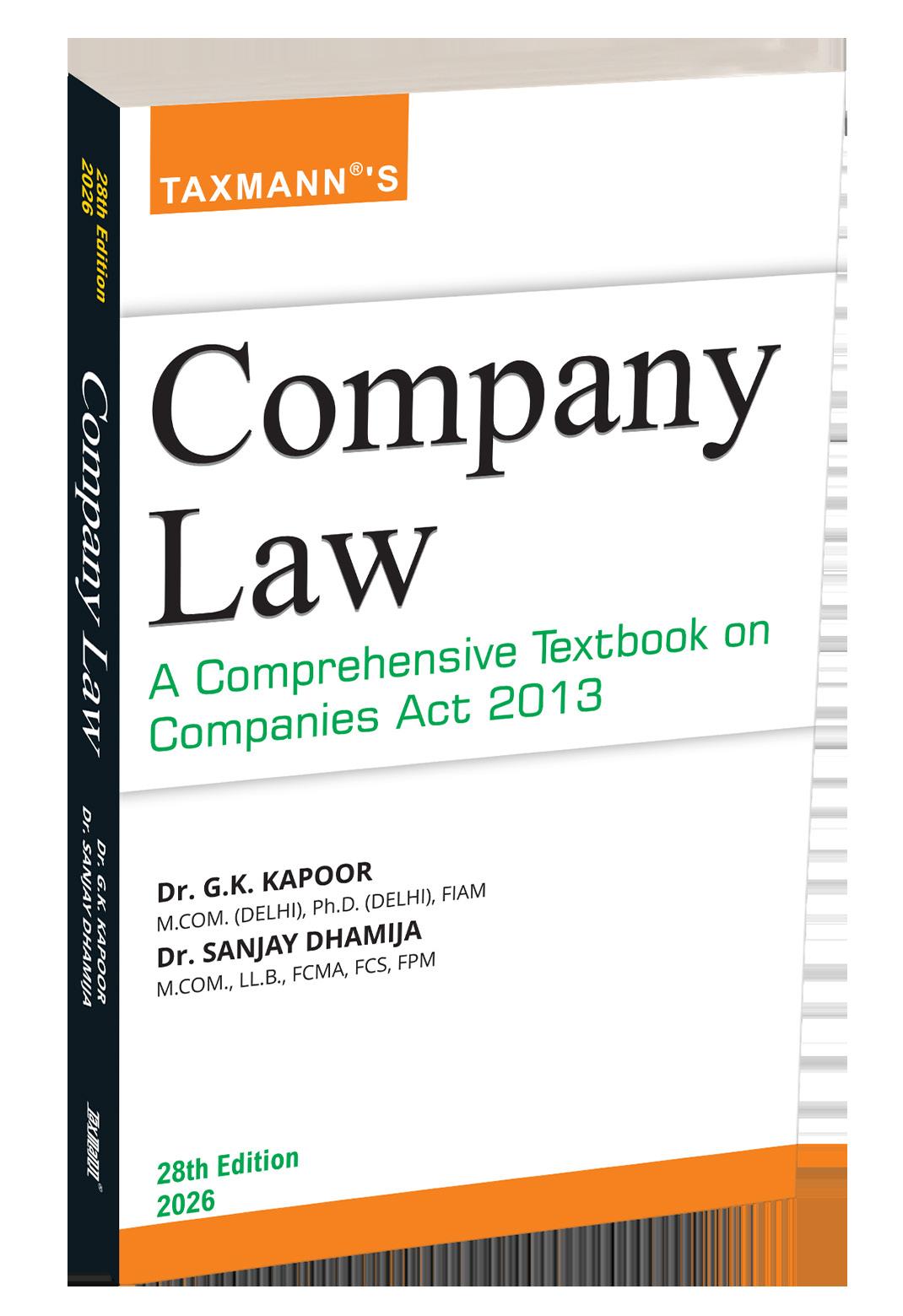
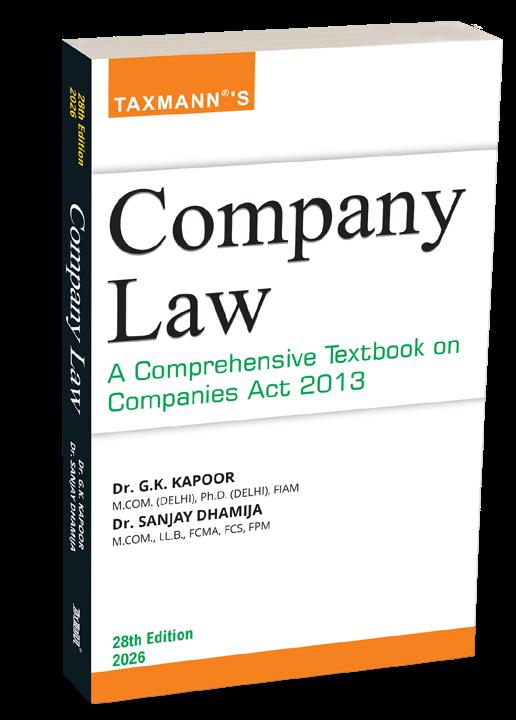
Company Law
AUTHOR : G.K. Kapoor, Sanjay Dhamija
PUBLISHER : Taxmann
DATE OF PUBLICATION : January 2026
EDITION : 28th Edition | 2026
ISBN NO : 9789375610700
No. of Pages : 752
BINDING TYPE : Paperback
Rs. 795
DESCRIPTION
Company Law – A Comprehensive Textbook on the Companies Act 2013 is a full-course academic textbook that presents Indian company law as an integrated legal framework governing corporate formation, functioning, governance, regulation, restructuring, and dissolution. Designed as a concept-driven and statute-anchored work, the book focuses on building strong doctrinal foundations while enabling statutory application, examination readiness, and practical understanding. It explains the rationale, operation, and lifecycle application of company law provisions in a clear and structured manner. This Edition is comprehensively revised and updated with the law as amended up to date, reflecting the contemporary corporate regulatory environment marked by enhanced governance standards, increased disclosure and accountability, digitised compliance systems, tribunal-based enforcement, and investor protection. Statutory amendments, regulatory developments, and relevant case law up to the cut-off date are integrated at appropriate places.
The book is helpful for the following:
• Undergraduate & Postgraduate Students
• Candidates Pursuing Professional Qualifications
• Law Students
• Academicians & Faculty Members
• Early-stage Corporate Law Learners
The Present Publication is the 28th Edition | 2026, and is updated till 31st December 2025. This book is authored by Dr G.K. Kapoor & Dr Sanjay Dhamija, with the following noteworthy features:
• [Concept-first, Statute-integrated Approach] Legal principles are explained first, followed by their statutory embodiment under the Companies Act 2013
• [End-to-End Corporate Lifecycle Coverage] Covers formation, constitution, capital, management, governance, regulation, restructuring, and winding up of companies
• [Updated Regulatory and Governance Framework] Incorporates recent amendments and regulatory initiatives relating to small companies, fast-track mergers, ROC/RD jurisdictional changes, governance norms for debt-listed entities, CSR relaxations, and ease-of-doing-business measures
• [Judicial Interpretation Embedded in the Text] Important case law up to 31st December 2025 is discussed contextually to explain statutory meaning and application
• [Strong Pedagogical Design] Each chapter includes:
o Chapter-end summaries of substantive provisions
o ‘Test Your Knowledge’ questions
o Hints for examination-oriented questions and practical problems
• [Specimen Drafting Support] Includes specimen notices, resolutions, and minutes at relevant places to support applied learning and drafting-based examination questions.
• [Coverage Beyond the Core Act] Dedicated analytical chapters on Corporate Governance, the Depositories Act 1996, and Company Law in a computerised environment (e-governance and e-filing)