Sample Read
© Taxmann Price : ` 115
Law stated in this book is as updated till 1st December, 2025
Published by : Taxmann Publications (P.) Ltd.
Sales & Marketing : 59/32, New Rohtak Road, New Delhi-110 005 India
Phone : +91-11-45562222
Website : www.taxmann.com
E-mail : sales@taxmann.com
Regd. Office : 21/35, West Punjabi Bagh, New Delhi-110 026 India
Printed at :
Tan Prints (India) Pvt. Ltd.
44 Km. Mile Stone, National Highway, Rohtak Road Village Rohad, Distt. Jhajjar (Haryana) India
E-mail : sales@tanprints.com
Disclaimer
Every effort has been made to avoid errors or omissions in this publication. In spite of this, errors may creep in. Any mistake, error or discrepancy noted may be brought to our notice which shall be taken care of in the next edition. It is notified that neither the publisher nor the author or seller will be responsible for any damage or loss of action to any one, of any kind, in any manner, therefrom. It is suggested that to avoid any doubt the reader should cross-check all the facts, law and contents of the publication with original Government publication or notifications.
No part of this book may be reproduced or copied in any form or by any means [graphic, electronic or mechanical, including photocopying, recording, taping, or information retrieval systems] or reproduced on any disc, tape, perforated media or other information storage device, etc., without the written permission of the publishers. Breach of this condition is liable for legal action.
For binding mistake, misprints or for missing pages, etc., the publisher’s liability is limited to replacement within seven days of purchase by similar edition. All expenses in this connection are to be borne by the purchaser. All disputes are subject to Delhi jurisdiction only.
CONSERVATION OF FOREIGN EXCHANGE AND PREVENTION OF SMUGGLING ACTIVITIES ACT, 1974
6.
4.
6.
SMUGGLERS AND FOREIGN EXCHANGE MANIPULATORS (FORFEITURE OF PROPERTY) ACT, 1976
25.
8.
11.
13.
14.
SMUGGLERS AND FOREIGN EXCHANGE MANIPULATORS (RECEIPT, MANAGEMENT AND DISPOSAL OF FORFEITED PROPERTY) RULES, 2006
CHAPTER IV
DISPOSAL OF PROPERTY
15. Disposal of live stocks, perishable, etc.
16. Disposal of valuables
17. Deposit of currency
18. Disposal of conveyance
19. Disposal of land or building
20. Disposal of other property
CHAPTER V
MISCELLANEOUS
21.
22.
23.
Conservation of Foreign Exchange and Prevention of Smuggling Activities Act, 1974
[52 OF 1974]*
An Act to provide for preventive detention in certain cases for the purposes of conservation and augmentation of Foreign Exchange and prevention of smuggling activities and for matters connected therewith.
Whereas violations of foreign exchange regulations and smuggling activities are having an increasingly deleterious effect on the national economy and thereby a serious adverse effect on the security of the State;
And whereas having regard to the persons by whom and the manner in which such activities or violations are organised and carried on, and having regard to the fact that in certain areas which are highly vulnerable to smuggling, smuggling activities of a considerable magnitude are clandestinely organised and carried on, it is necessary for the effective prevention of such activities and violations to provide for detention of persons concerned in any manner therewith;
Be it enacted by Parliament in the Twenty-fifth Year of the Republic of India as follows:—
Short title, extent and commencement
1. (1) This Act may be called the Conservation of Foreign Exchange and Prevention of Smuggling Activities Act, 1974.
(2)It extends to the whole of India.
(3)It shall come into force on such date1 (being a date not later than the twentieth day of December, 1974), as the Central Government may, by notification in the Official Gazette, appoint.
Definitions.
*13-12-1974.
1. Enforced with effect from 19-12-1974.
2. In this Act, unless the context otherwise requires,— (a) “appropriate Government” means, as respects a detention order made by the Central Government or by an officer of the Central Government 1
S. 3 FOREIGN EXCHANGE & PREVENTION ACTIVITIES ACT, 1974 2
or a person detained under such order, the Central Government, and as respects a detention order made by a State Government or by an officer of a State Government or a person detained under such order, the State Government;
(
b) “detention order” means an order made under section 3;
(
(
c) “foreigner” has the same meaning as in the Foreigners Act, 1946 (31 of 1946);
d) “Indian customs waters” has the same meaning as in clause (28) of section 2 of the Customs Act, 1962 (52 of 1962);
(
e) “smuggling” has the same meaning as in clause (39) of section 2 of the Customs Act, 1962 (52 of 1962), and all its grammatical variations and cognate expressions shall be construed accordingly;
(
(
f) “State Government” in relation to a Union territory, means the administrator thereof;
g) any reference in this Act to a law which is not in force in the State of Jammu and Kashmir shall, in relation to that State, be construed as a reference to the corresponding law, if any, in force in that State.
Power to make orders detaining certain persons.
3. (1) The Central Government or the State Government or any officer of the Central Government, not below the rank of a Joint Secretary to that Government, specially empowered for the purposes of this section by that Government, or any officer of a State Government, not below the rank of a Secretary to that Government, specially empowered for the purposes of this section by that Government, may, if satisfied, with respect to any person (including a foreigner), that, with a view to preventing him from acting in any manner prejudicial to the conservation or augmentation of foreign exchange or with a view to preventing him from—
(i) smuggling goods, or
(ii) abetting the smuggling of goods, or
(iii) engaging in transporting or concealing or keeping smuggled goods, or
(iv) dealing in smuggled goods otherwise than by engaging in transporting or concealing or keeping smuggled goods, or
(v) harbouring persons engaged in smuggling goods or in abetting the smuggling of goods,
it is necessary so to do, make an order directing that such person be detained:
2[Provided that no order of detention shall be made on any of the grounds specified in this sub-section on which an order of detention may be made under section 3 of the Prevention of Illicit Traffic in Narcotic Drugs and Psychotropic Substances Act, 1988 or under section 3 of the Jammu and Kashmir Prevention of Illicit Traffic in Narcotic Drugs and Psychotropic Substances Ordinance, 1988 (J.&K. Ordinance 1 of 1988).]
2. Inserted by the Prevention of Illicit Traffic in Narcotic Drugs and Psychotropic Substances (Amendment) Act, 1988, w.r.e.f. 4-7-1988.
(2) When any order of detention is made by a State Government or by an officer empowered by a State Government, the State Government shall, within ten days, forward to the Central Government a report in respect of the order.
(3) For the purposes of clause (5) of article 22 of the Constitution, the communication to a person detained in pursuance of a detention order of the grounds on which the order has been made shall be made as soon as may be after the detention, but ordinarily not later than five days, and in exceptional circumstances and for reasons to be recorded in writing, not later than fifteen days, from the date of detention.
COMMENTS
CASE LAWS
u Single incident and detention—Sufficiency of satisfaction and representation - The petitioner, a French national and Air India’s Geneva airport manager, was detained under section 3(1) of COFEPOSA after arriving at Bombay Airport carrying undeclared high-value watch parts valued at over ` 3.9 lakhs. The detention was challenged on the grounds that it was based on a single incident, that his retracted confession was not considered, and that the detaining authority did not personally consider his representation. The Supreme Court rejected all contentions. It held that even a solitary smuggling incident could justify preventive detention if the detaining authority was reasonably satisfied that the person was likely to repeat such acts. The Court further ruled that under the Maharashtra Government’s business rules, both the Home Secretary and the Home Minister could act on behalf of the State, and the rejection of representation by the Home Minister was valid. As the retraction letter was dated after the detention order and had not reached the detaining authority in time, its non-consideration did not vitiate the detention. The petitioner had also appeared before the Advisory Board and could have raised the issue there. The detention was therefore upheld – Raverdy Marc Germain Jules v. State of Maharashtra AIR 1983 SUPREME COURT 311.
u Each authority not bound to consider representations made to others - The detenu, accused of evading customs duty by undervaluing imported floppy disk drives, was detained under section 3(1) of COFEPOSA. He made three separate representations to different authorities—the Joint Secretary (detaining authority), the Central Government, and the Finance Minister—each of which was considered and rejected individually. However, the Calcutta High Court quashed the detention, holding that every representation made to any authority must be placed before and independently considered by all other competent authorities. Reversing this view, the Supreme Court held that Article 22(5) requires each authority to consider only those representations specifically addressed to it. There is no constitutional or statutory mandate that a copy of every representation made to one authority be automatically forwarded to and acted upon by all others. Doing so would create unnecessary delay, defeating the purpose of prompt consideration. The detenu may approach different authorities, and each such authority must apply its mind only to the representation made directly to it. The contrary view taken by the High Court was overruled – Union of India v. Sneha Khemka AIR 2004 SUPREME COURT 2938.
u Validity of detention and subsequent SAFEMA proceedings - Roshan Lal was detained on 19-12-1974 under section 3(1) of COFEPOSA based on his involvement in smuggling gold received from across the border, with substantial sums paid for large consignments. His representation against the detention dated 17-1-1975 was duly considered and rejected by the State on 11-02-1975. Although the Emergency was lifted on 21-03-1977, no judicial challenge was pursued thereafter, and proceedings under 3 FOREIGN EXCHANGE & PREVENTION ACTIVITIES
SAFEMA were initiated to forfeit his and his wife’s properties. The appellant, his son, challenged the original detention order and the subsequent forfeiture proceedings after a gap of over two decades. The Supreme Court held that the order of detention was validly passed upon subjective satisfaction, and the rejection of representation was properly communicated. It emphasized that no grievance had been raised at any time regarding language of communication, and all statutory safeguards were complied with. The failure to challenge the detention order during its subsistence barred its later use as a ground to invalidate SAFEMA proceedings. Therefore, the detention order stood affirmed, and the appeal was dismissed – Narender Kumar v. Union of India AIRONLINE 2019 SC 2626.
u Representation not required to detaining officer personally - The detenu, a young man caught transporting gold biscuits of foreign origin, was detained under section 3(1) of COFEPOSA by an officer specially empowered by the State Government. The detenu was informed of his right to make a representation to the State Government and Central Government but not specifically to the officer who issued the detention order. The Bombay High Court quashed the detention, holding that failure to inform the detenu of his right to represent to the detaining officer violated Article 22(5). Reversing the High Court, the Supreme Court held that under COFEPOSA, even when an order is issued by an officer specially empowered under section 3(1), the appropriate government—State or Central—remains the detaining authority for the purposes of representation. The officer is merely a functionary, and the Act does not require that the detenu be given a separate opportunity to make a representation to such officer in addition to the appropriate government. Therefore, no breach of constitutional safeguards under Article 22(5) occurred, and the detention was upheld in law, though the Court, on equitable grounds, declined to order the re-arrest of the detenu – State of Maharashtra v. Sushila Mafatlal Shah AIR 1988 SUPREME COURT 2090.
u Detention order by administrator—Not bound by Ministerial Advice - The petitioners were detained under COFEPOSA for engaging in smuggling activities after seizure of contraband goods worth over ` 5 lakhs from a house in Daman, based on confessional statements of labourers linking them to the smuggling operation. The detention order under section 3(1) was issued by the Administrator of Goa, Daman and Diu. The detenus challenged the validity of the order on the ground that the Administrator could not act independently of the Council of Ministers, arguing that only the Chief Minister or a minister acting in the name of the Administrator could pass such an order. The Supreme Court rejected this contention, holding that under section 2(f) of COFEPOSA and section 44 of the Government of Union Territories Act, 1963, the Administrator is specifically empowered to act independently in preventive detention matters. The Court clarified that unlike the President or a Governor, the Administrator of a Union Territory is not constitutionally bound to act on ministerial advice, especially in judicial or quasi judicial functions like preventive detention. Accordingly, the detention was held to be valid – Devji Vallabhbhai Tandel v. The Administrator of Goa, Daman and Diu AIR 1982 SUPREME COURT 1029.
u Preventive detention under COFEPOSA despite repeal of FERA - The detenu was apprehended for engaging in hawala transactions, involving over ` 1.6 crores, by receiving Indian rupees in India on behalf of a person residing in Riyadh and distributing them locally without authorization. A detention order under section 3(1) of COFEPOSA was passed to prevent further acts prejudicial to the augmentation of foreign exchange. The High Court quashed the order on the ground that such acts were no longer offences under the Foreign Exchange Management Act (FEMA), which replaced the repealed Foreign Exchange Regulation Act (FERA). The Supreme Court reversed this view, holding that the legality of preventive detention under COFEPOSA
5 FOREIGN EXCHANGE & PREVENTION ACTIVITIES ACT, 1974 S. 5
is not contingent on whether the acts are criminal offences under FEMA. Preventive detention, being anticipatory, does not require a pending or concluded prosecution. It was further held that COFEPOSA and FEMA occupy different legal fields—COFEPOSA operates to prevent acts prejudicial to foreign exchange, while FEMA regulates foreign exchange with civil penalties. The Court ruled that mere repeal of FERA does not render section 3 of COFEPOSA inoperative, reaffirming that violation of foreign exchange regulations—even if no longer criminal—is sufficient ground for detention under COFEPOSA – Union of India v. Venkateshan S. 2002 CRI. L. J. 2790.
Execution of detention orders.
4. A detention order may be executed at any place in India in the manner provided for the execution of warrants of arrest under the Code of Criminal Procedure, 1973 (2 of 1974)*.
Power to regulate place and conditions of detention.
5. Every person in respect of whom a detention order has been made shall be liable—
(a) to be detained in such place and under such conditions including conditions as to maintenance, interviews or communication with others, discipline and punishment for breaches of discipline, as the appropriate Government may, by general or special order, specify; and (b) to be removed from one place of detention to another place of detention, whether within the same State or in another State by order of the appropriate Government:
Provided that no order shall be made by a State Government under clause (b) for the removal of a person from one State to another State except with the consent of the Government of that other State.
COMMENTS
CASE LAWS
u Unreasonable restrictions on interview rights of detenu - The petitioner, a British national detained under section 3 of COFEPOSA for smuggling offences, challenged the restrictions imposed under Clause 3(b)(i) and (ii) of a 1975 Detention Order issued by the Delhi Administration under section 5 of the Act. These provisions permitted only one family interview per month and required prior permission from the District Magistrate and the presence of Customs or Enforcement officers for legal interviews. The Supreme Court held these restrictions violative of Articles 14 and 21 of the Constitution. It ruled that preventive detention is not punitive and detainees retain their fundamental rights, subject to reasonable limits. The right to consult legal counsel and to have meaningful contact with family is a part of the right to life and personal liberty. The conditions were held arbitrary and unreasonable, especially when undertrials were allowed two weekly family interviews and legal access without such burdensome procedures. The Court struck down the restrictions and directed that detenus be allowed two family interviews a week and legal consultations at reasonable times with only minimal procedural oversight – Francis Coralie Mullin v. The Administrator, Union Territory of Delhi AIR 1981 SUPREME COURT 746.
*Now see the Bharatiya Nagarik Suraksha Sanhita, 2023 (46 of 2023) [Vide Notification No. S.O. 2790(E), dated 16-7-2024].
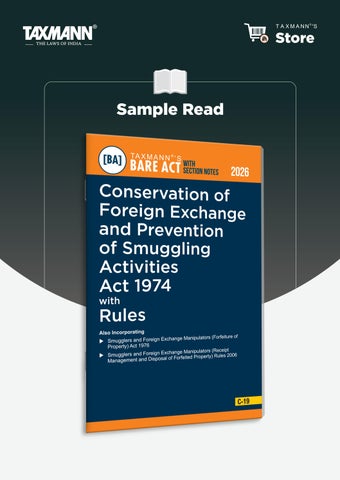
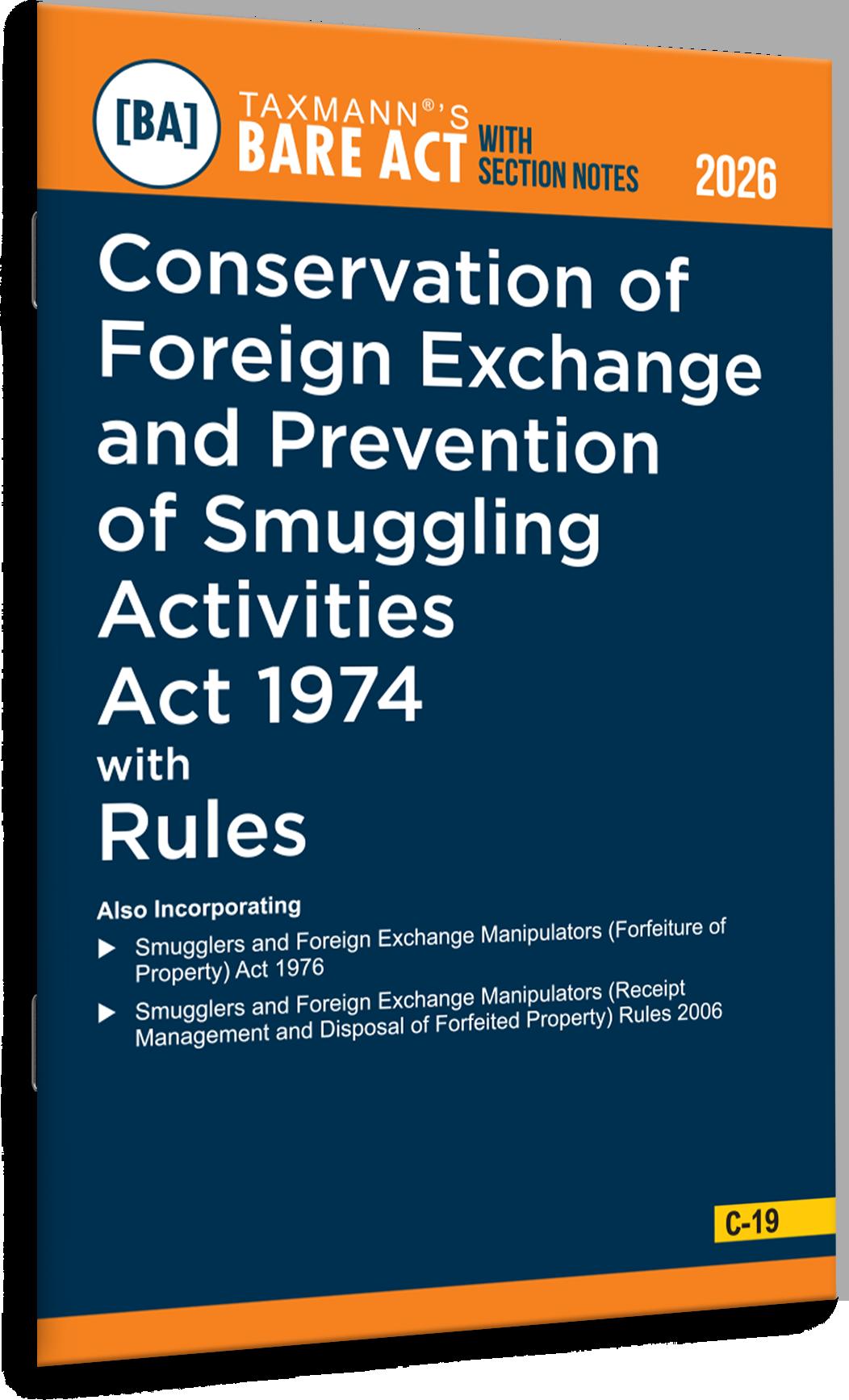
CONSERVATION OF FOREIGN EXCHANGEAND PREVENTION OF SMUGGLING ACTIVITIES ACT 1974 WITH RULES – BARE ACT WITH SECTION NOTES
AUTHOR : Taxmann's Editorial Board
PUBLISHER : Taxmann
DATE OF PUBLICATION : January 2026
EDITION : 2026 Edition
ISBN NO : 9789371266642
NO. OF PAGES : 60
BINDING TYPE : Paperback
DESCRIPTION
Conservation of Foreign Exchange and Prevention of Smuggling Activities Act 1974 (COFEPOSA) with Rules [Bare Act with Section Notes] by Taxmann is an authoritative statutory reference governing India's preventive detention and property forfeiture framework for economic offences such as smuggling and foreign exchange violations. This publication presents COFEPOSA as an integrated economic security legislation that balances national interests with constitutional safeguards. The book consolidates the fully amended and operative text of the Conservation of Foreign Exchange and Prevention of Smuggling Activities Act 1974, along with all relevant Rules. It also incorporates the complete text of the Smugglers and Foreign Exchange Manipulators (Forfeiture of Property) Act 1976 (SAFEMA) and the SAFEMA (Receipt, Management and Disposal of Forfeited Property) Rules 2006. Each provision is supported by concise section-wise notes, explanatory commentary, and selected judicial precedents, enabling a clear understanding of statutory intent, procedural safeguards, and practical application. The publication serves as a reliable reference for enforcement, litigation, compliance, and policy analysis in the domain of economic offences and national security law.
This book is intended for the following audience:
• Legal Practitioners, Judges & Judicial Officers
• Law Enforcement Agencies & Customs Officials
• Compliance, Risk & Regulatory Professionals
• Academicians, Researchers & Law Students
• Government Departments, Policymakers & Regulatory Authorities
The Present Publication is the 2026 Edition, covering the amended and updated text of the Conservation of Foreign Exchange and Prevention of Smuggling Activities Act (COFEPOSA) [Act No. 52 of 1974] and Rules, with the following noteworthy features:
• [Comprehensive Statutory Text] Complete and updated text of the COFEPOSA Act 1974 with all amendments in force
• [Allied Legislation in Full] Includes:
- Smugglers and Foreign Exchange Manipulators (Forfeiture of Property) Act 1976
- SAFEMA (Receipt, Management and Disposal of Forfeited Property) Rules 2006
• [Section-wise Notes & Commentary] Explanatory notes covering scope, legislative intent, and procedural requirements
• [Judicial Precedents] Selected Supreme Court and High Court decisions on detention standards, representation rights, advisory boards, and constitutional safeguards
• [Practical Compliance Guidance] Clarifies detention, execution, revocation, extensions, forfeiture procedures, burden of proof, and remedies
• [Subject Index & Easy Navigation] Detailed indices for quick reference across Acts and Rules
• [Updated for the 2026 Edition] Incorporates all relevant amendments and judicial developments up to the date of publication
• [Litigation & Compliance Utility] Useful for drafting petitions, representations, compliance documents, and defence briefs
• [Authoritative Reference] A long-standing and trusted resource on preventive detention and forfeiture in economic offence matters