Sample Read
© Taxmann
Price : ` 165
Law stated in this book is as updated till 5th January, 2026
Published by : Taxmann Publications (P.) Ltd.
Sales & Marketing :
59/32, New Rohtak Road, New Delhi-110 005 India
Phone : +91-11-45562222
Website : www.taxmann.com
E-mail : sales@taxmann.com
Regd. Office :
21/35, West Punjabi Bagh, New Delhi-110 026 India
Printed at :
Tan Prints (India) Pvt. Ltd.
44 Km. Mile Stone, National Highway, Rohtak Road Village Rohad, Distt. Jhajjar (Haryana) India
E-mail : sales@tanprints.com
Disclaimer
Every effort has been made to avoid errors or omissions in this publication. In spite of this, errors may creep in. Any mistake, error or discrepancy noted may be brought to our notice which shall be taken care of in the next edition. It is notified that neither the publisher nor the author or seller will be responsible for any damage or loss of action to any one, of any kind, in any manner, therefrom. It is suggested that to avoid any doubt the reader should cross-check all the facts, law and contents of the publication with original Government publication or notifications.
No part of this book may be reproduced or copied in any form or by any means [graphic, electronic or mechanical, including photocopying, recording, taping, or information retrieval systems] or reproduced on any disc, tape, perforated media or other information storage device, etc., without the written permission of the publishers. Breach of this condition is liable for legal action.
For binding mistake, misprints or for missing pages, etc., the publisher’s liability is limited to replacement within seven days of purchase by similar edition. All expenses in this connection are to be borne by the purchaser. All disputes are subject to Delhi jurisdiction only.
CHAPTER IV PENALTIES
[Omitted by the Jan Vishwas (Amendment of Provisions) Act, 2023, w.e.f. 3-10-2023
4. [Omitted by the Radio, Television and Video Cassette Recorder Sets (Exemption from Licensing Requirements) Amendment Rules, 2001 w.e.f. 9-1-2001]
CHAPTER V
ADDITIONAL STANDARDS OF QUALITY OF SERVICE RELATING TO DIGITAL DECODER AND SET TOP BOX FOR DIGITAL CABLE SERVICE (WITH OR WITHOUT CONDITIONAL ACCESS) IN NON-CAS AREAS
15. Additional standards of quality of service relating to digital cable service (with or without conditional access) in non-CAS areas 83
16. Arrangements for repairs or replacement of decoder or set top box supplied by the cable operator or multi-system operator 83
CHAPTER VI
DISCONTINUANCE OF CHANNELS FROM THE CABLE TELEVISION NETWORK 17. Notice to subscribers before taking off channels from Cable Television Network
CHAPTER VII
STANDARDS AS TO QUALITY OF SIGNALS
CHAPTER VIII
OF PERFORMANCE OF QUALITY OF SERVICE
CHAPTER IX
Cable Television Networks (Regulation) Act, 1995
[7 OF 1995]1
An Act to regulate the operation of cable television networks in the country and for matters connected therewith or incidental thereto.
Be it enacted by Parliament in the Forty-sixth year of the Republic of India as follows:—
CHAPTER I
PRELIMINARY
Short title, extent and commencement.
1. (1) This Act may be called the Cable Television Networks (Regulation) Act, 1995. (2)It extends to the whole of India.
(3)It shall be deemed to have come into force on the 29th day of September, 1994.
COMMENTS
CASE LAWS
u Legislative Competence on Cable Regulation and Entertainment Tax -The Supreme Court ruled that the regulatory scope of the Cable Television Networks (Regulation) Act, 1995 does not interfere with the legislative competence of state governments to levy taxes on entertainments, such as the West Bengal Entertainment-cum-Amusement Tax Act, 1982. The Court emphasized that while the central act regulates cable operations, state laws imposing entertainment taxes fall within the state’s exclusive power under Entry 62, List II, Seventh Schedule of the Constitution. — State of W.B v. Purvi Communication Pvt. Ltd. AIR 2005 SC 1849.
Definitions.
2. In this Act, unless the context otherwise requires,—
2[(a) “authorised officer” means, within his local limits of jurisdiction,— (i) a District Magistrate, or
1. Dated 25-3-1995.
2. Inserted by the Cable Television Networks (Regulation) Amendment Act, 2000, w.e.f. 1-9-2000.
(ii) a Sub-divisional Magistrate, or (iii) a Commissioner of Police, and includes any other officer notified in the Official Gazette, by the Central Government or the State Government, to be an authorised officer for such local limits of jurisdiction as may be determined by that Government;]
3[(ai) “Authority” means the Telecom Regulatory Authority of India established under sub-section (1) of section 3 of the Telecom Regulatory Authority of India Act, 1997 (24 of 1997);
(aii) “Broadcaster” means a person or a group of persons, or body corporate, or any organisation or body providing programming services and includes his or its authorised distribution agencies;
(aiii) “cable operator” means any person who provides cable service through a cable television network or otherwise controls or is responsible for the management and operation of a cable television network and fulfils the prescribed eligibility criteria and conditions;]
(b) “cable service” means the transmission by cables of programmes including re-transmission by cables of any broadcast television signals;
(
c) “cable television network” means any system consisting of a set of closed transmission paths and associated signal generation, control and distribution equipment, designed to provide cable service for reception by multiple subscribers;
(d) “company” means a company as defined in section 3 of the Companies Act, 1956 (1 of 1956);
(e) “person” means—
(i) an individual who is a citizen of India;
(ii) an association of individuals or body of individuals, whether incorporated or not, whose members are citizens of India;
4[(iii) a company as defined in section 3 of the Companies Act, 1956 (1 of 1956)4a;]
5[(ei) “post” means a post and includes a pole, tower, standard, stay, strut, cabinet, pillar or any above ground contrivance for carrying, suspending or supporting any network infrastructure facility;]
3. Clauses (ai) to (aiii) substituted for clause (aa) by the Cable Television Networks (Regulation) Amendment Act, 2011, w.r.e.f. 25-10-2011. Prior to its substitution, clause (aa), as amended by the Cable Television Networks (Regulation) Amendment Act, 2000, w.e.f. 1-9-2000 read as under:
‘(aa) “cable operator” means any person who provides cable service through a cable television network or otherwise controls or is responsible for the management and operation of a cable television network;’
4. Substituted, ibid. Prior to its substitution, sub-clause (iii) read as under:
“(iii) a company in which not less than fifty-one per cent of the paid-up share capital is held by the citizens of India;”
4a. Now see section 2(20), 2(67), 2(68) and 2(71) of the Companies Act, 2013 (18 of 2013).
5. Inserted by the Cable Television Networks (Regulation) Amendment Act, 2011, w.r.e.f. 25-10-2011.
(f) “prescribed” means prescribed by rules made under this Act;
(g) “programme” means any television broadcast and includes—
(i) exhibition of films, features, dramas, advertisements and serials 6[***];
(ii) any audio or visual or audio-visual live performance or presentation, and the expression “programming service” shall be construed accordingly;
6a[(gi) “public authority” means any authority, body or institution of local self-government constituted or established by or under—
(i) the Constitution of India;
(ii) any law made by Parliament;
(iii) any law made by a State Legislature;
(iv) any notification issued or order made by the appropriate Government, and includes any—
(v) body owned, controlled or substantially financed; or
(vi) non-governmental organisation substantially financed, directly or indirectly by funds provided by the appropriate Government;]
(h) “registering authority” means such authority as the Central Government may, by notification in the Official Gazette, specify to perform the functions of the registering authority under this Act 6a[within such local limits of jurisdiction as may be determined by that Government];
(i) “subscriber” means 7[any individual, or association of individuals, or a company, or any other organisation or body] who receives the signals of cable television network at a place 8[indicated by him or it] to the cable operator, without further transmitting it to any other person.
COMMENTS
CASE LAWS
u Role of section 2(17) in regulating business practices and safeguarding consumer rights - The Kerala High Court emphasized the role of section 2(17) in addressing unregulated business practices and safeguarding consumer rights within the framework of the Cable Television Networks (Regulation) Act, 1995. It highlighted that clear definitions and regulatory oversight are vital to ensuring lawful conduct and preventing exploitation through misleading schemes. The Court reinforced the applicability
6. Words “through video cassette recorders or video cassette players” omitted by the Cable Television Networks (Regulation) Amendment Act, 2011, w.r.e.f. 25-10-2011.
6a. Inserted, ibid
7. Substituted for “a person”, ibid
8. Substituted for “indicated by him”, ibid
of this provision to combat non-compliant broadcasting practices effectively. — P. Raveendran Pillai v. State of Kerala AIR ONLINE 2020 Ker. 1175.
u Definition of consumer and inclusion of commercial cable subscribers under TRAI Regulations - The Supreme Court examined the definition of “consumer” in the context of broadcasting services under the Cable Television Networks (Regulation) Act, 1995 and related laws. It ruled that hotel owners, who provide television services as an amenity to their guests, qualify as consumers under the Act and cannot be excluded from the regulatory jurisdiction of the Telecom Regulatory Authority of India (TRAI). The Court rejected the argument that commercial cable subscribers are beyond the scope of TRAI regulations, affirming that such consumers remain within its purview.
— Hotel and Restaurant Association v. Star India Pvt. Ltd. AIR 2007 SC 1168.
CHAPTER II
REGULATION OF CABLE TELEVISION NETWORK
Cable Television Network not to be operated except after registration.
3. No person shall operate a cable television network unless he is registered as a cable operator under this Act.
9[***]
COMMENTS
SECTION
NOTES
u No person shall operate a cable television network without obtaining registration as a cable operator under this Act [Section 3]
u If a cable operator operates a cable television network without registration, the authorised officer may seize the equipment being used by such cable operator for operating the cable television network [Section 11]
u The equipment seized shall be liable to confiscation unless the cable operator from whom the equipment has been seized registers himself as a cable operator under section 4 within thirty days from the date of seizure of the said equipment [Section 12]
u Procedure for registration as cable operator [See Section 4]
u For the definition of “Cable television network” [See Section 2(c)]
u For the definition of “cable operator”, [See Section 2(aiii)]
u Penalty for contravention of provisions of section 4 [See Section 16]
9. Omitted by the Cable Television Networks (Regulation) Amendment Act, 2011, w.r.e.f. 25-102011. Prior to its omission, proviso read as under:
“Provided that a person operating a cable television network, immediately before the commencement of this Act, may continue to do so for a period of ninety days from such commencement; and if he has made an application for registration as a cable operator under section 4 within the said period, till he is registered under that section or the registering authority refuses to grant registration to him under that section.”
CABLE TELEVISION NETWORKS (REGULATION)
ACT 1995 & RULES – BARE ACT WITH SECTION NOTES
AUTHOR : Taxmann's Editorial Board
PUBLISHER : Taxmann
DATE OF PUBLICATION : January 2026
EDITION : 2026 Edition
ISBN NO : 9789371267472
NO. OF PAGES : 108
BINDING TYPE : Paperback
DESCRIPTION
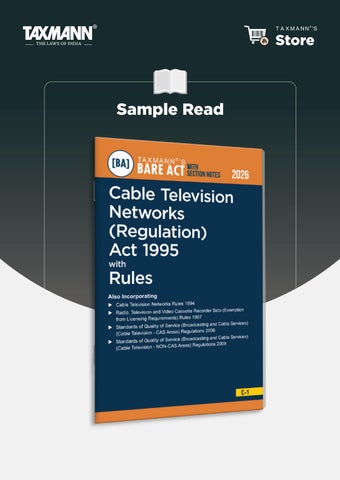
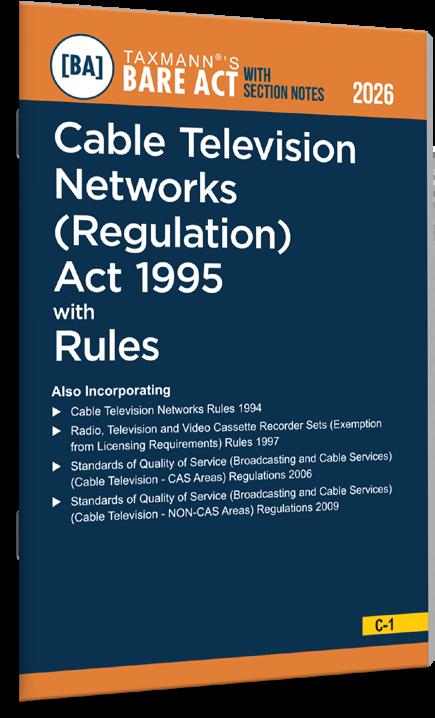
Cable Television Networks (Regulation) Act 1995 with Rules [Bare Act with Section Notes] by Taxmann is a comprehensive statutory and compliance reference that presents India's cable television law as a fully operational, enforcement-ready regulatory framework. The publication reflects the evolution of cable regulation from an analogue, operator-driven model to a digitised, consumer-centric regime, integrating registration control, content regulation, tariff transparency, quality-of-service standards, grievance redressal, and a rationalised civil-penalty structure. Editorially, the book is designed to explain how the law functions in practice, through section-wise explanatory notes that map statutory provisions to applicable rules, enforcement powers, seizure and confiscation consequences, penalty triggers, appellate remedies, and consumer safeguards. The inclusion of updated Rules, TRAI-linked Quality-of-Service Regulations, digitisation notifications, mandatory channel carriage schedules, and statutory forms makes this publication a complete operational manual for the cable television ecosystem. This book is intended for the following audience:
• Local Cable Operators (LCOs) & Multi-System Operators (MSOs)
• Broadcasters & Platform Service Providers
• Media, Telecom & Regulatory Lawyers
• Government Authorities & Enforcement Officers
• Compliance Teams, Policy Analysts & Media-Law Students
The Present Publication is the 2026 Edition, covering the amended and updated text of the Cable Television Networks (Regulation) Act [Act No. 7 of 1995] and Rules, with the following noteworthy features:
• [Section-wise Explanatory Notes – Core Editorial USP] Concise notes under each section explaining compliance duties, enforcement powers, timelines, consequences of non-compliance, and cross-references to rules and penalties
• [Pre-amendment Provisions] Presents original text in amendment footnotes for reference to the pre-amendment legal position
• [Digitisation & DAS Framework Fully Integrated] Focused coverage of Section 4A and allied rules governing mandatory encryption, addressable systems, subscriber management, tariff disclosure, and phased digitisation
• [Registration & Eligibility Architecture] Complete treatment of eligibility criteria, online registration and renewal, deemed and provisional registration, suspension, revocation, and appellate remedies
• [Programme & Advertisement Code – Operationalised] Consolidated presentation of content standards, prohibitions, restrictions, and enforcement pathways
• [Inspection, Seizure & Confiscation Regime] Clear statutory framework for inspection without prior notice, seizure of equipment, confiscation safeguards, show-cause procedures, and appeals
• [Post-Jan Vishwas Penalty Structure] Updated civil-penalty regime replacing criminal prosecution with graded monetary penalties, warnings, suspension, and revocation, aligned with the 2023 amendments
• [Consumer-Centric Quality of Service Regulations] Full text of CAS (2006) and Non-CAS (2009) Quality-of-Service Regulations covering billing, refunds, complaint timelines, service benchmarks, and technical standards
• [Forms, Registers & Compliance Templates] Statutory forms for registration, renewal, declarations, MSO permissions, registers, and certificates for direct compliance use