Sales & Marketing : 59/32, New Rohtak Road, New Delhi-110 005 India
Phone : +91-11-45562222
Website : www.taxmann.com
E-mail : sales@taxmann.com
Regd. Office : 21/35, West Punjabi Bagh, New Delhi-110 026 India
Printed at :
Tan Prints (India) Pvt. Ltd.
44 Km. Mile Stone, National Highway, Rohtak Road Village Rohad, Distt. Jhajjar (Haryana) India
E-mail : sales@tanprints.com
Disclaimer
Every effort has been made to avoid errors or omissions in this publication. In spite of this, errors may creep in. Any mistake, error or discrepancy noted may be brought to our notice which shall be taken care of in the next edition. It is notified that neither the publisher nor the author or seller will be responsible for any damage or loss of action to any one, of any kind, in any manner, therefrom.
This book should not be considered as professional advice on the HR policies/ Taxation/Accounting/any such matters as it is purely for easier understanding. Authors are not technical experts but rather consultants and the solution depends upon situations which may be unique to each person.
The authors, contributors and publishers in this book shall bear no responsibility for the actions and inactions made based upon the information contained in this book. No part of this book may be reproduced or copied in any form or by any means [graphic, electronic or mechanical, including photocopying, recording, taping, or information retrieval systems] or reproduced on any disc, tape, perforated media or other information storage device, etc., without the written permission of the publishers. Breach of this condition is liable for legal action. For binding mistake, misprints or for missing pages, etc., the publisher’s liability is limited to replacement within seven days of purchase by similar edition. All expenses in this connection are to be borne by the purchaser. All disputes are subject to Delhi jurisdiction only.
PART VI
SUCCESSOR IDENTIFICATION & GROOMING
CHAPTER 14 Strategies and Approach to Succession Planning
Typically, business owners consult with a variety of professionals in developing their succession plans — lawyers, accountants, bankers, financial planners, insurance advisors, merger and acquisition consultants and management consultants. Furthermore, quite often, these professionals find it difficult to proceed because the business has yet to make a number of personal decisions that will drive the planning process.
On that note, the diverse strategies involved in achieving efficient succession planning at the individual, family and business levels include:
u Strategic Planning,
u Continuity Planning,
u Human Resources Planning,
u Financial Planning,
u Estate Planning,
u Exit Planning.
The process comprises five and three steps for family and business succession planning respectively. Each step involves an exploration of several key questions. They might be better visualised as points on a circle, each one connected to all of the others.
Figure-2
FIVE-STEP APPROACH TOWARDS FAMILY SUCCESSION PLANNING
1. Vision
u Do you have clarity over your passion, purpose and why?
u Do you want to keep the business in the family?
u Can you make the shift from “me” to “we”?
u How do you want to spend your “golden” years?
u Do you have the Retirement strategy in place?
2. Family Constitution
u Do members of your family have a vision for their own lives?
u Does the next generation wish to own and/or operate the business?
u Do you have a written document describing the responsibilities & roles of family members?
u How will you frame bodies like family board or family council?
u How would these bodies function?
3. Aligning the business & family strategies
u Does the company’s strategic plan support the family’s vision and values?
u Have you placed the Alignment of the Ownership with Family and management?
u Is the business positioned for long-term viability and succession?
u Could the business survive your untimely death or disability?
4. Identifying & Preparing successors and Leadership transition
u Who will run the business?
u Which family members will enter the business?
u Who will you prepare for succession?
u How will you prepare them?
u How to Groom the successor?
5. Estate Planning
u How will you ease the transition?
u When will the change in ownership take place?
u Who will own the business?
u How can you leave your family and the business in the best possible financial shape?
u What will be the Taxation on the transition ?
u What will be the best suitable structure for carrying out your business?
Figure-3
THREE-STEP APPROACH TOWARDS BUSINESS SUCCESSION PLANNING
1. Vision
u Do you have clarity over your passion, purpose and why?
u Are you clear about the direction you want internally within the organisation and where you want to head externally?
u Can you make the shift from “me” to “we”?
u How do you want to spend your “golden” years?
u Do you have the Retirement strategy in place?
2. Identifying & Preparing Successors for Leadership
u Who will run the business?
u Do you want to hand over your business to someone known or sell your business to an outsider?
u Who will you prepare for succession?
u How will you prepare them?
u How to Groom the successor?
3. Estate Planning
u How will you ease the transition?
u When will the change in ownership take place?
u Who will own the business?
u What will be the Taxation on the transition ?
u What will be the best suitable structure for carrying out your business?
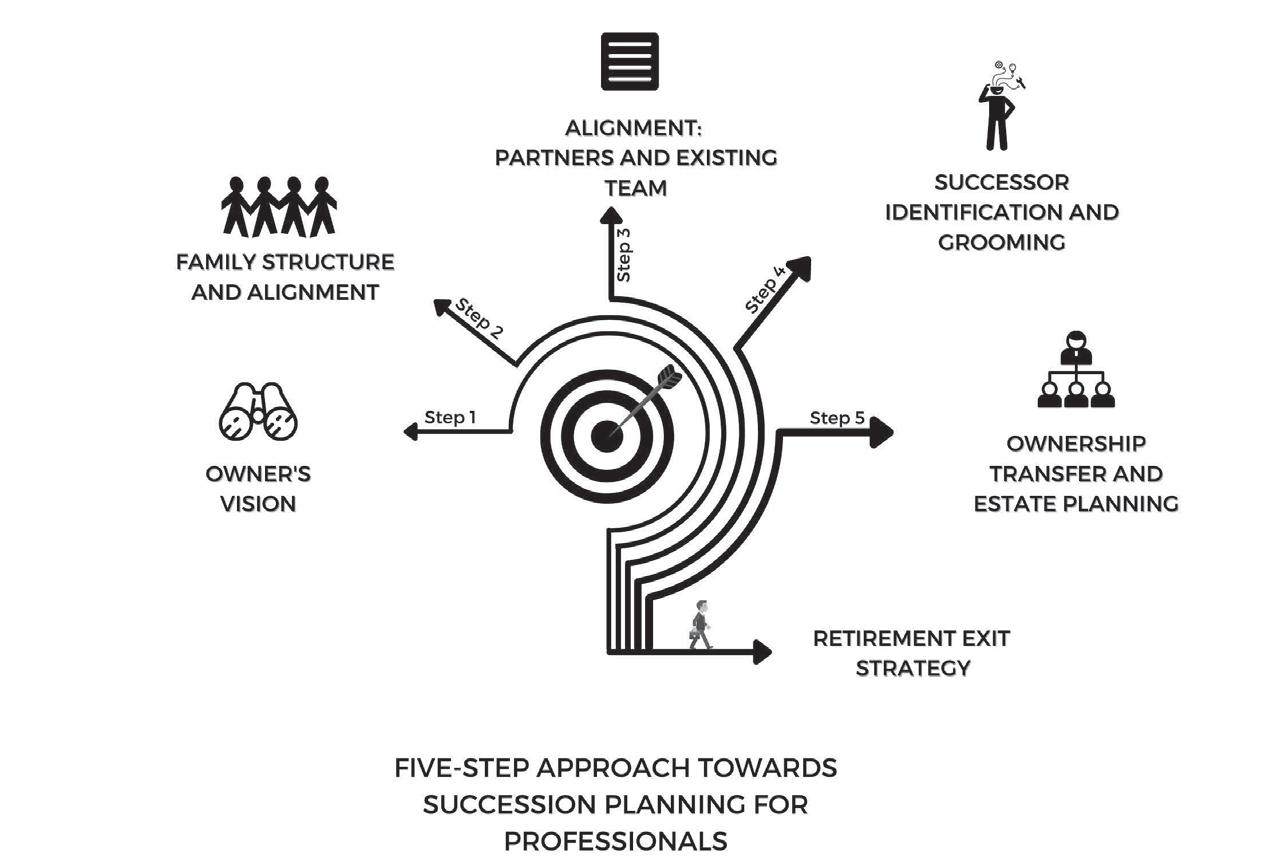
FIVE-STEP APPROACH TOWARDS SUCCESSION PLANNING FOR PROFESSIONALS
1. Vision
u Do you have clarity over your passion, purpose and why?
u Are you clear about the direction you want internally within the organisation and where you want to head externally?
Figure-3A
u Can you make the shift from “me” to “we”?
u How do you want to spend your “golden” years?
u Do you have the Retirement strategy in place?
2. Family Structure and Alignment
u When do you want your child or the candidate to take over your professional practice?
u How will the succession affect other family members?
u What happens in case the chosen person gets incapacitated?
u How does your succession plan affect individual goals?
3.
Alignment with the Partners and the Existing Team
u Do you have the processes in place to openly discuss the organisation’s vision, values, and mission with your team?
u Have you planned ways to support your employees’ progress, career development, and well-being?
u Are your team members aware of the significance of their positions in the company?
u Have you specified that the current succession plan is not a permanent resolution but subject to change over time?
4. Successor Identification and Grooming
u Who will run the business?
u Do you want to hand over your business to someone known or sell your business to an outsider?
u Who will you prepare for succession?
u How will you prepare them?
5. Estate Planning and Exit Strategy
u How will you ease the transition?
u When will the change in ownership take place?
u Who will own the business?
u What will be the taxation on the transition?
u What will be the best suitable structure for carrying out your business?
These questions are like your checklist of things to consider before the transition begins. But, how do you know when you have succeeded in the succession process? The next chapter talks about the wheel of succession, and how you can measure your succession progress.
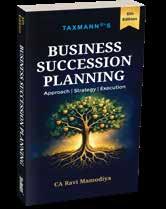
BUSINESS SUCCESSION PLANNING
AUTHOR : Ravi
Mamodiya
PUBLISHER : Taxmann Publications
DATE OF PUBLICATION : April 2026
EDITION : 5th Edition
ISBN NO : 9789371261081
NO. OF PAGES : 404
BINDING TYPE : Paperback
DESCRIPTION
Business Succession Planning: Approach | Strategy | Execution is a practitioner-authored guide addressing one of the most underserved yet consequential aspects of Indian enterprise management—the structured, conscious transfer of business ownership, leadership, and legacy across generations.
The book's central thesis is captured in its subtitle: succession planning is not merely an event or a document—it is a continuous approach, a deliberate strategy, and a disciplined execution spanning years, if not a decade.
The book is designed for a broad but purposeful readership:
• Primary Audience
o Promoter-Led and Family-Owned Business Owners at any Stage
o SME and MSME Owners
o First-Generation Entrepreneurs
• Professional Audience
o Chartered Accountants, Company Secretaries, and Advocates
o Corporate Governance Professionals and HR Heads at Listed Entities
o Management Consultants and Family Business Advisors
• Successor and Academic Audience
o Next-Generation Successors
o Startup Founders
o Students of Business Management, Law, and CA Programmes
The Present Publication is the 5th Edition, authored by CA. Ravi Mamodiya, with the following noteworthy features:
• [Three Proprietary Frameworks] The 5-Step Succession Approach (Owner's Vision → Family Constitution → Business & Family Alignment → Successor Identification and Grooming → Ownership Transfer and Estate Planning); the AMG Model (Assessment → Management → Grooming); and the 3-P Framework (People, Property, Proportion) for Will drafting
• [The Wheel of Succession] A self-diagnostic tool mapping readiness across all five succession dimensions on a 0–100% scale—with separate templates for family, business, and professional succession
• [Three Differentiated Succession Frameworks] Distinct frameworks for family businesses (5 steps), non-family business succession (3 steps), and professional/service firms (5 steps with partner alignment)
• [India-Specific Legal Architecture] SEBI LODR Regulation 17(4); Companies Act 2013 Section 178; Hindu Succession Act 1956; Muslim Personal Law (Shariat); Indian Succession Act 1925; Indian Trusts Act 1882; HUF law; income tax on inheritance and capital gains; succession certificates and probate
• [Owner's Vision—Internal and External] Vision decomposed into internal (vision, mission, goals, purpose, passion, GPS framework) and external dimensions (output metrics, system quality, stakeholder assessments, competitive positioning), including an organisational chart vulnerability exercise
• [Family Constitution—Full Governance Architecture] Six constitutional bodies (Family Council, Family Assembly, Family Association, Owner's Council, Family Fund, Family Office); a five-step constitution-building process; miscommunication risks illustrated through Ranbaxy, Raymond, and Ponty Chadha. Complete draft included as Annexure 4
• [Quantified Successor Evaluation Tools] A 20-dimension leadership assessment scoresheet (five domains, five-point scale, four leadership bands) and the 9-Box Succession Planning Grid Matrix mapping potential against performance
• [Multi-Dimension Grooming Framework] Five formal development practices—Education, Assessment (360-degree feedback), Coaching (ICE Model), Mentoring, and Experiential Learning—with an initiative-to-practice mapping table and five-step selection sequence (Forecast Analysis → Resource Development → Selection → Trial Run → Transition)
• [Exit Strategies and Liquidity Management] Insurance instruments as liquidity tools (key person, buy-sell, deferred compensation, disability, collateral); IPO as an exit mechanism; and the Family Office (SFO vs. MFO)—each illustrated through embedded case studies
• [Gender and Generational Dimensions] Gender bias in succession; the female entrepreneur's succession journey; and a generational taxonomy mapping Founders, Gen X, Millennials, and Gen Z with distinct transition challenges
• [Four Deployment-Ready Legal Templates] Complete draft formats for a Private Trust Deed, HUF Creation Deed, Will, and Family Constitution
• [Structured Checklists at Every Stage] Yes/Partially/No checklists at the close of every part—covering readiness, parallel planning, transition management, and successor selection—with interpretive guidance for each response
• [16 Myths Systematically Debunked] Common misconceptions dismantled—from 'only for the ultra-rich' and 'equal distribution is fair' to 'nominees inherit assets' and 'succession belongs to the son'