Preface
In an era where data-driven insights and evidence-based decision-making are pivotal to success in business and management, the ability to conduct systematic and methodical research is an indispensable skill for students and professionals alike. This textbook, Business Research Methodology, has been meticulously crafted to cater to the academic requirements of the DSE 6.6/7.1 course under the B. Com. (Hons.) and B. Com. of the University of Delhi. It seeks to provide a comprehensive, structured, and application-oriented understanding of the research process, encompassing both theoretical foundations and practical execution. With its student-friendly layout, rigorous conceptual clarity, and integration of contemporary tools such as SPSS and spreadsheet applications, the book is designed not only to aid academic learning but also to foster analytical thinking, ethical awareness, and research competence. Each unit has been thoughtfully developed to progressively build the reader’s ability to undertake independent research projects with academic integrity and professional precision.
Unit 1: Introduction This unit lays the theoretical foundation for business research. It introduces the meaning, scope, and application of research in the business world, along with essential terminologies such as hypothesis, model, and theory. It further explains various types of research—quantitative vs. qualitative, longitudinal vs. cross-sectional, fundamental vs. applied—helping students differentiate between research approaches. Additionally, the unit delves into philosophical paradigms like positivism and interpretivism, and outlines methodological frameworks such as deductive and inductive approaches. It also guides learners through the research process, emphasizing the importance of literature reviews and the formulation of meaningful research questions.
vii
viii
Business Research Methodology
Unit 2: Research Design This unit focuses on the blueprint of any research study—its design. It helps students understand the purpose, characteristics, and types of research design including exploratory, descriptive, and experimental research. The unit equips learners to select and structure the most appropriate design for their study based on the research problem and objectives. It serves as a crucial bridge between theoretical understanding and the planning of real research work.
Unit 3: Data Collection Unit 3 forms the operational core of the research process. It begins with the concepts of measurement and scaling, discussing different levels of measurement and their relevance. Students then explore various scaling techniques and learn how to evaluate the reliability and validity of their instruments. The unit covers primary and secondary data collection methods, offers guidelines for designing effective questionnaires, and introduces online tools like Google Forms. It also includes detailed discussions on survey methods, sampling techniques, and the preparation and cleaning of raw data. The unit concludes with data classification and various methods for presenting data graphically and tabularly.
Unit 4: Data Analysis Using Spreadsheet This unit emphasizes the importance of data preparation, cleaning, and structured presentation. It explains how to organize and classify data, and how to present it effectively using tables, charts, pie diagrams, histograms, and box plots. It introduces students to descriptive statistics—measures of central tendency, dispersion, and shape (skewness and kurtosis)—with hands-on practice using both SPSS and spreadsheet tools. The unit also covers probability measures essential for statistical inference. The final chapter in this unit is dedicated to hypothesis testing, covering parametric tests (Z-test, t-test) and non-parametric tests (Chi-square tests, etc.). Each statistical method is explained with step-bystep SPSS and spreadsheet procedures, interpretation, and practical exercises.
Unit 5: Report Writing and Ethics The final unit brings the research process to a close by focusing on the effective communication and ethical conduct of research. It begins with a comprehensive guide to report writing, explaining how to draft various types of reports—contractual, project, academic, and evaluation reports—with emphasis on structure, referencing, and presentation techniques. The final chapter addresses ethical issues in business research, highlighting potential dilemmas at every
Preface
ix
stage—from problem identification to data reporting. It discusses the rights and responsibilities of researchers, sponsors, and respondents, encouraging students to approach research with a strong ethical mindset and professional responsibility. Prof. Pushpender Kumar Dr. Anupreet Kaur Mokha
Contents
Page About the Author
v
Preface
vii
UNIT 1 INTRODUCTION Chapter 1: Foundations of Research
3
1.1 1.2 1.3
3 4 5
What is Research? Scope of Research Application of Research in Business
1.4
Terminologies of Research 1.4.1 Concept 1.4.2 Construct 1.4.3 Variable 1.4.4 Proposition 1.4.5 Hypothesis 1.4.6 Theory 1.4.7 Model 1.5 Characteristics of Good Research Summary Multiple Choice Questions Short Answer Questions Long Answer Questions
6 6 8 9 14 15 20 23 25 26 28 30 30
Case Study
31
xi
xii
Business Research Methodology
Page Chapter 2: Types of Research
33
2.1
Quantitative & Qualitative Research
34
2.1.1
Quantitative Research
34
2.1.2
Qualitative Research
34
2.1.3
Difference between Quantitative and Qualitative Research
35
2.2
2.3
2.4
Longitudinal & Cross-Sectional Research 2.2.1 Longitudinal Research 2.2.2 Cross-Sectional Research Conceptual & Empirical Research 2.3.1 Conceptual Research 2.3.2 Empirical Research Fundamental & Applied Research 2.4.1 Fundamental Research 2.4.2 Applied Research
36 36 37 38 38 38 39 39 40
2.4.3 Difference between Fundamental and Applied Research Summary Multiple Choice Questions Short Answer Questions Long Answer Questions
40 40 41 43 43
Case Study
44
Chapter 3: Philosophical and Methodological Approaches to Research
47
3.1
3.2
Philosophies of Research 3.1.1 Positivism 3.1.2 Interpretivism 3.1.3 Pragmatism Methodological Approaches to Research 3.2.1 Deductive Approach 3.2.1.1 Concept of Deductive Approach 3.2.1.2 Conceptual Framework of Deduction 3.2.1.3 Features of the Deductive Approach 3.2.1.4 Process of Deductive Approach 3.2.2 Inductive Approach 3.2.2.1 Concept of Inductive Approach 3.2.2.2 Features of the Inductive Approach 3.2.2.3 Process of Inductive Approach
48 48 49 50 51 52 52 52 53 54 55 55 56 56
xiii
Contents
Page Summary
58
Multiple Choice Questions
59
Short Answer Questions
61
Long Answer Questions Case Study
61 62
Chapter 4: Research Process, Literature Review, and Research Question Formulation
65
4.1 4.2
4.3
Research Process Literature Review 4.2.1 Meaning of a Literature Review 4.2.2 Importance of a Literature Review 4.2.3 How Does a Literature Review Help Formulate a Research Question? 4.2.4 Steps to Conduct a Literature Review Formulation of Research Questions 4.3.1 Importance of Formulating Research Questions
4.3.2 4.3.3 4.3.4 Summary
Characteristics of a Good Research Questions Steps in Formulating Research Questions Common Mistakes in Formulating Research Questions
66 68 68 68 69 70 73 73 74 74 76 76 77 78 79 79
Multiple Choice Questions Short Answer Questions Long Answer Questions Case Study
UNIT 2 RESEARCH DESIGN Chapter 5: Research Design
83
5.1 5.2 5.3
83 84 85 85 90 92 94 95
Meaning of Research Design Characteristics of Research Design Types of Research Design 5.3.1 Exploratory Research 5.3.2 Descriptive Research 5.3.3 Experimental Research Summary Multiple Choice Questions
xiv
Business Research Methodology
Page Short Answer Questions Long Answer Questions
97 97
Case Study
98
UNIT 3 DATA COLLECTION Chapter 6: Measurements and Scaling
101
6.1 6.2 6.3
Measurement: Meaning and Need Measurement Process Meaning of Scaling 6.3.1 Functions of Scaling 6.3.2 Dimensions of Scales 6.4 Levels of Measurement 6.4.1 Nominal-Level Measurement 6.4.2 Ordinal-Level Measurement 6.4.3 Interval-Level Measurement 6.4.4 Ratio-Level Measurement 6.5 Properties of Four Scales Summary Multiple Choice Questions Short Answer Questions Long Answer Questions Case Study
102 102 104 105 105 105 106 106 107 107 108 109 110 111 112 112
Chapter 7: Scaling Methods
115
7.1 7.2
Scales Scale Methods 7.2.1 Comparative or Ranking Methods 7.2.2 Non-Comparative (Rating Scale) Some Extra Scale Methods Goodness of Measures (Criteria in Measurement)
115 116 116 119 121 122
7.4.1
122 123 123
7.3 7.4
Reliability 7.4.1.1 Importance of Reliability 7.4.1.2 Types of Reliability
xv
Contents
Page 7.4.2
7.5
Validity 7.4.2.1 Importance of Validity 7.4.2.2 Types of Validity 7.4.2.3 Difference between Reliability and Validity
125 125 125 128
Precautions in Scale or Measure Development
129
7.6 Scaling Development Methods in Social Sciences Summary Multiple Choice Questions Short Answer Questions Long Answer Questions Case Study
130 132 133 135 135 136
Chapter 8: Data Collection Methods and Questionnaire Design
139
8.1
139 140 140
8.2
8.3 8.4
8.5 8.6
Data 8.1.1 8.1.2
Primary Data Secondary Data
8.1.3 Difference between Primary and Secondary Data Sources of Data Collection 8.2.1 Primary Data Sources 8.2.2 Secondary Data Sources
140 141 141 142
Discrete Variable and Continuous Variable Questionnaire Design 8.4.1 Objectives of a Good Questionnaire 8.4.2 Characteristics of a Good Questionnaire 8.4.3 How to Design a Good Questionnaire?
143 143 144 144 144
Different Types of Questions How to Design a Questionnaire Using Online Tools? 8.6.1 Create a Google Form for a Questionnaire 8.6.2 Tips and Tricks when Creating and Sending a Google Forms Survey Summary Multiple Choice Questions Short Answer Questions Long Answer Questions Practical Exercises Case Study
147 149 150 169 170 171 173 173 174 175
xvi
Business Research Methodology
Page Chapter 9: Sample and Census Survey
179
9.1
179
9.2
Survey 9.1.1
Sample Survey
180
9.1.2
Census Survey
180
Various Surveys in the Context of Commerce and Management
181
9.3
Survey v/s Census Operations 9.3.1 Survey Operations 9.3.2 Census Operations 9.4 Designing Sample Survey 9.4.1 Characteristics of a Good Survey 9.4.2 Different Types of Survey Methods Summary Multiple Choice Questions Short Answer Questions
182 182 183 185 186 186 187 188 190
Long Answer Questions Case Study
190 191
Chapter 10: Sampling Techniques
193
10.1 Sampling
193
10.2 Population 10.3 Few Terminologies 10.4 Sampling Process 10.5 Sampling Techniques 10.5.1 Probability Sampling 10.5.2 Probability Sampling Techniques 10.5.3 Non-Probability Sampling 10.5.4 Non-probability Sampling Techniques 10.6 Sample Size Determination Summary Multiple Choice Questions Short Answer Questions Long Answer Questions Case Study
194 195 195 196 197 197 201 202 204 206 206 208 209 209
xvii
Contents
Page
UNIT 4 DATA ANALYSIS USING SPREADSHEET Chapter 11: Data Preparation, Cleaning and Presentation of Data
213
11.1 Data Preparation 11.2 Data Cleaning
213 216
11.3 Importance of Data Preparation and Data Cleaning
219
11.4 Software Tools for Data Preparation and Cleaning 11.5 Best Practices and Ethical Considerations 11.6 Classification of Data 11.6.1 Types of Classification of Data 11.7 Presentation of Data 11.7.1 Tabular Forms 11.7.2 Line Graphs 11.7.3 Pie Charts 11.7.4 Bar Charts 11.7.5 Histograms 11.7.6 Box Plots Summary Multiple Choice Questions Short Answer Questions Long Answer Questions Case Study
220 220 220 221 222 223 224 225 226 229 231 234 234 236 236 237
Chapter 12: Descriptive Analysis
239
12.1 Measures of Central Tendency 12.1.1 Mean 12.1.2 Median
240 240 240
12.1.3 Mode 12.2 Measures of Variability 12.2.1 Range 12.2.2 Inter-Quartile Range 12.2.3 Variance 12.2.4 Standard Deviation 12.2.5 Coefficient of Variation
240 240 241 241 241 241 241
xviii
Business Research Methodology
Page 12.3 The Measure of Divergence from Normality 12.3.1 Skewness 12.3.2 Kurtosis 12.4 Measures of Probability Practical SPSS Procedure for Frequency
242 242 243 244 244 244
SPSS Procedure for Descriptive Statistics SPSS Procedure for Explore Function SPSS Procedure for Graphical Presentation of Data Spreadsheet Procedure for Frequency Spreadsheet Procedure for Descriptive Statistics Spreadsheet Procedure for Graphical Presentation of Data Summary Multiple Choice Questions Short Answer Questions Practical Exercises Case Study
248 251 255 257 260 262 264 264 266 266 267
Chapter 13: Hypothesis Testing
269
13.1 Proposition and Hypothesis 13.2 Hypothesis Testing 13.2.1 Significance of Hypothesis Testing
269 270 271
13.2.2 Important Terminologies Used in Hypothesis Testing 13.2.2.1 Parameters and Statistics 13.2.2.2 Standard Error 13.2.2.3 Test of Significance 13.2.2.4 Null and Alternative Hypothesis 13.2.2.5 Errors in Sampling 13.2.2.6 Critical Region and Level of Significance 13.2.3 Key Steps in Hypothesis Testing 13.3 Parametric Tests 13.3.1 Z-Test 13.3.1.1 One-Sample Z-Test Practical SPSS Procedure for One-Sample Z-Test Spreadsheet Procedure for One-Sample Z-Test
271 271 271 272 272 273 274 274 274 275 275 278 278 279
xix
Contents
Page 13.3.1.2 Two-Sample Z-Test for Means Practical
280 282
SPSS Procedure for Two-Sample Z-Test
282
Spreadsheet Procedure for Two-Sample Z-Test
282 285
13.3.2 t-Test 13.3.2.1 One-Sample t-Test
286
Practical SPSS Procedure for One-Sample t-Test Spreadsheet Procedure for One Sample t-Test 13.3.2.2 Paired-Samples t-Test Practical SPSS Procedure for Paired-Samples t-Test Spreadsheet Procedure for Paired-Samples t-Test 13.3.2.3 Independent Samples t-Test Practical SPSS Procedure for Independent Samples t-Test
288 288 290 293 295 295 297 300 302 302
Spreadsheet Procedure for Independent Samples t-Test 13.4 Non-Parametric Tests 13.4.1 Chi-Square (F2) Test
305 308
13.4.2 13.4.3 13.4.4 13.4.5
13.4.1.1 Chi-Square Goodness of Fit Test Practical SPSS Procedure for Chi-Square Goodness of Fit Test Spreadsheet Procedure for Chi-Square Goodness of Fit Test 13.4.1.2 Chi-Square Goodness of Fit Test Practical SPSS Procedure for Chi-Square Goodness of Fit Test Spreadsheet Procedure for Chi-Square Goodness of Fit Test Kolmogorov-Smirnov Test Mann-Whitney U Test Kruskal-Wallis Test Median Test
308 309 310 310 312 315 316 316 319 320 321 321 321
xx
Business Research Methodology
Page 13.4.6 Sign Test 13.4.7 McNemar Test Summary
322 322 322
Multiple Choice Questions
324
Short Answer Questions Long Answer Questions
325 326
Numerical Questions Practical Exercises
327 329
UNIT 5 REPORT WRITING AND ETHICS Chapter 14: Report Writing
333
14.1 Effective Report Writing
333
14.2 Steps in Report Writing 14.3 Types of Report Writing 14.3.1 Contractual Reports 14.3.2 Project Reports 14.3.3 Research Report 14.3.4 Evaluation Reports 14.3.5 Annual Reports 14.4 Referencing 14.5 Bibliography 14.6 Format and Presentation of Report Summary Multiple Choice Questions Short Answer Questions Long Answer Questions Practical Exercises
334 338 338 339 339 341 341 342 345 346 350 351 353 353 354
Chapter 15: Ethical Issues in Business Research
357
15.1 Ethics 15.2 Emerging Ethical Issues in Research 15.3 Ethical Principles in Research 15.4 Ethical Issues in Different Stages of the Research Process 15.4.1 Ethical Issues in the Research Problem 15.4.2 Ethical Issues in the Research Purpose or Questions
357 358 360 361 361 361
xxi
Contents
Page 15.4.3 Ethical Issues in Data Collection 15.4.4 Ethical Issues in Data Analysis and Interpretation 15.4.5 Ethical Issues in Writing and Disseminating the Research Report 15.5 Rights and Responsibilities of Concerned Parties 15.5.1 Rights and Responsibilities of Researchers or Doers 15.5.2 Rights and Responsibilities of Sponsors or Users
361 362 362 363 363 364
15.5.3 Rights and Responsibilities of Respondents Summary Multiple Choice Questions Short Answer Questions Long Answer Questions Case Study
364 364 365 366 367 368
Appendix
369
Spreadsheet Datasets Z Table t Table Chi-Square Test
369 376 377 379
Question Paper (May/June 2025) B. Com. (Hons.) - Sem. VI (DSE) 381 Question Paper (May/June 2025) B. Com. - Sem. VI (DSE)
383
5
Research Design
CHAPTER
LEARNING OBJECTIVES By the end of this chapter, students will be able to: Understand the concept and purpose of research design in the research process. Differentiate between various types of research designs: exploratory, descriptive, and experimental. Identify the appropriate research design based on the nature and objectives of the study. Learn about different methods used under each research design with real-world examples.
After identifying and defining the research problem in the previous chapter, it becomes essential to plan how the research will be carried out—this is where research design comes into play. This chapter introduces students to the structure and blueprint that guides the entire research process. Learners will explore the different types of research designs—exploratory, descriptive, and experimental—along with their characteristics, methods, and applications. By understanding these designs, students will gain the skills to choose the most suitable approach for their own research projects. This chapter also equips them to ensure their studies are methodical, valid, and reliable, ultimately helping them produce meaningful and impactful results.
5.1 Meaning of Research Design Research design outlines the process and techniques for gathering, measuring, and analyzing the data. A research design is a plan, blueprint, and framework for conducting research to obtain the answer to research questions. 83
84
Business Research Methodology
According to Anol Bhattacherjee, “Research design is a comprehensive plan for data collection in an empirical research project. It is a “blueprint” for empirical research aimed at answering specific research questions or testing specific hypotheses, and must specify at least three processes: (1) the data collection process, (2) the instrument development process, and (3) the sampling process”. According to C.R. Kothari, “Research design stands for advance planning of the methods to be adopted for collecting the relevant data and the techniques to be used in their analysis, keeping in view the objective of the research and the availability of staff, time and money”.
5.2 Characteristics of Research Design Objectivity: A good research design must maintain objectivity throughout
the study. This means that the research should be free from the researcher’s personal biases or subjective influence. All decisions, from formulating the problem to interpreting the results, should be based on factual evidence and logical reasoning, ensuring that the conclusions drawn are valid and trustworthy. Reliability: Reliability refers to the consistency and dependability of the
research results. A research design is considered reliable if the same methods applied under similar conditions yield the same results over time. This consistency strengthens the credibility of the findings and allows others to replicate the study with similar outcomes. Validity: Validity is a critical characteristic of research design, ensuring that
the study measures what it is supposed to measure. Internal validity confirms that the research is accurately studying the intended variables without interference from external factors, while external validity refers to how well the results can be generalized to other settings, populations, or times. Flexibility: An effective research design should be flexible enough to ac-
commodate necessary changes during the course of the study. Especially in exploratory or qualitative research, new insights might require slight adjustments in the approach. However, any changes must be carefully considered to avoid compromising the overall integrity of the research. Generalizability: A strong research design allows for the findings to be ap-
plicable beyond the specific sample studied. This is known as generalizability, where the results can be extended to a larger population or different contexts. This is particularly important in quantitative research, and it depends heavily on the sampling method and the representativeness of the sample. Economy: A well-structured research design ensures the efficient use of
available resources. It should be cost-effective, saving time, money, and
85
Research Design
effort while still achieving the desired objectives. A good design maximizes output while minimizing the input required, without sacrificing the quality of the research. Thoroughness: Thoroughness means the research design addresses all nec-
essary components of the study in detail. From defining the research problem and formulating hypotheses to data collection and analysis methods, every aspect should be carefully planned and clearly laid out to avoid confusion or gaps during the research process. Appropriateness: The design must be appropriate for the type of research
being conducted. Whether it’s qualitative, quantitative, or mixed-methods, the research design should align with the research objectives, questions, and the nature of the data. An appropriate design enhances the relevance and clarity of the findings.
5.3 Types of Research Design The types of research design are depicted in Figure 5.1:
Figure 5.1: Types of Research Design
5.3.1 Exploratory Research Exploratory research seeks to learn about what is going on and to gather information on a subject of interest by asking open-ended questions. It starts with “what” and “how” to define a situation, issue, or phenomenon. Exploratory research is the initial research into a hypothetical or theoretical idea and the development of a theory from scratch. There are numerous approaches to carrying out this study, such as a literature review, expert interviews, in-depth interviews, and focus interviews. According to Neuman, “Exploratory research is a research whose primary purpose is to examine a little understood issue or phenomenon and to develop preliminary ideas about it and move toward refined research questions”.
Characteristics of Exploratory Research The main characteristics of exploratory research are:
86
Business Research Methodology
Exploratory research is unstructured and flexible, allowing for open-ended
investigation. It is typically low-cost, interactive, and qualitative in nature. The purpose is to explore basic questions such as: What is the problem? What is the purpose of the study? What areas or topics require further research? It is used when: There is no prior research on the subject. Existing research does not fully address the problem. The process is often time-consuming and requires patience and adaptability. There is a level of uncertainty and risk, as the research direction may
change during the study. The researcher must review all available information to identify gaps and
opportunities for further study. There are no strict rules for conducting exploratory research; it is broad
and flexible in approach. The research topic should have practical value or relevance to ensure the
study’s usefulness. Having theoretical support can help guide the study and assist in inter-
preting results. While the data collected is mostly qualitative, quantitative data (via sur-
veys or small experiments) may also be used to gain preliminary insights or inform further research.
Research Methods in Exploratory Research Exploratory research involves both primary and secondary methods to gather initial insights into a problem or area of interest. The methods are typically flexible, qualitative in nature, and are used to uncover patterns, generate ideas, and identify research directions.
Primary Sources Methods These involve collecting first-hand data directly from original sources. They are especially useful when existing information is insufficient or unavailable. Let us discuss the primary sources methods of exploratory research designs (Table 5.1).
87
Research Design
Table 5.1: Methods of Primary Sources Exploratory Research Design Method
Description
Example
In-depth Interviews
These are open-ended, face-to-face or virtual interviews conducted with individuals who have experience or knowledge about the research topic. The goal is to gather deep, personal insights. The interviewer can explore feelings, perceptions, and motivations in depth.
Interviewing small business owners to understand how they adapted to digital platforms during COVID-19.
Focus Group Discussions
This method involves bringing together a group (typically 6–10 participants) to discuss a specific topic, guided by a moderator. It helps to collect a range of ideas, perceptions, and reactions, often revealing unexpected insights through group dynamics.
Organizing a focus group of parents to explore their concerns about online education.
Observational In observational research, the researchStudies er watches subjects in their natural environment without interfering. This is helpful for understanding behavior that people might not express verbally or might not even be aware of themselves.
Observing customers in a retail store to study how they interact with product displays and signage.
Case Studies
A case study involves an intensive, holistic investigation of a single individual, organization, event, or situation. It uses multiple sources of data to understand complex issues in depth.
Studying the launch strategy of a successful eco-friendly brand to learn how it attracted its audience.
Pilot Surveys
These are small-scale surveys conducted before a full research study. They help test survey design, identify flaws in questions, and assess the clarity of instructions. Results help in refining the final questionnaire.
Distributing a pilot survey to 20 students to test questions for a study on mental health awareness.
Expert This method involves engaging with Consultations field experts to gather informed opinions or interpretations. It is especially useful when exploring new or highly technical areas. Expert views can provide direction and depth to the study.
Interviewing a legal advisor to understand the challenges of enforcing intellectual property rights online.
88
Business Research Methodology
Method Projective Methods
Description
Example
Indirect techniques that encourage respondents to project their true feelings or beliefs onto ambiguous stimuli. Useful when people are unwilling or unable to articulate their thoughts. (Types are explained in Table 5.2)
Asking respondents to complete the sentence “My college is like ______” or to create a collage about a brand.
Projective methods are indirect research techniques that encourage participants to project their underlying feelings, thoughts, desires, or attitudes onto a given ambiguous stimulus. These methods are valuable when the subject matter is sensitive, subconscious, or difficult to verbalize. Common Projective Methods in Exploratory Research are (Table 5.2): Table 5.2: Common Projective Methods in Exploratory Research Method Word Association
Description
Example
Respondents are given a A participant hears “Luxword and asked to respond ury” and responds with with the first word that “Mercedes” or “Status.” comes to mind.
Sentence Completion Respondents complete in- “When I think of online complete sentences. shopping, I feel…” o “... excited but cautious.” Story Completion
Participants are given part A story starts: “A man of a story and asked to finds a wallet on the complete it. street...”
Picture Interpreta- Respondents are shown am- Viewing a picture of two tion (Thematic Ap- biguous pictures and asked people in a room and experception Test - TAT) to tell a story about them. plaining their interaction. Third-Person Tech- Participants describe how “Why do people buy nique others might think or be- eco-friendly products?” o have in a given situation. Projects personal beliefs. Cartoon Completion Respondents are shown a Filling in what one charcartoon with empty dia- acter says to another in a logue bubbles to complete. shopping scenario. Brand Mapping
Participants place brands Mapping brands based on on a map based on perceived “affordable” vs “luxury” traits. and “trendy” vs “classic.”
Role Playing
Participants are asked to act Acting as a dissatisfied out a scenario or role. customer returning a product.
89
Research Design
Secondary Sources Methods These involve using existing data or information collected by others. They are helpful when preliminary understanding is needed without direct data collection. Let us discuss the secondary sources methods of exploratory research designs (Table 5.3). Table 5.3: Secondary Research Methods in Exploratory Research Design Method
Detailed Description
Example
Literature Review Involves reviewing existing academic sources such as books, peer-reviewed journal articles, theses, and scholarly publications. It helps to identify research gaps, build theoretical foundations, and understand what has already been studied.
Reviewing articles on employee motivation to identify gaps in the literature on remote work culture.
Document/ This method analyzes written, Content Analysis visual, or audio content (e.g., reports, policy papers, speeches, advertisements) to identify themes, meanings, and trends related to the research topic.
Studying election campaign speeches to examine how leaders frame national development narratives.
Industry Reports These are publications from professional or commercial research firms that provide data, trends, forecasts, and insights about specific industries or markets.
Using a McKinsey report to understand trends in the global logistics industry post-COVID.
Government Publications
Official documents such as census data, national health surveys, economic reports, and policy briefs. They provide credible, large-scale data for demographic or socio-economic research.
Using Ministry of Education reports to analyze student enrollment patterns over a decade.
Online & Digital Sources
Includes data gathered from the internet—such as blogs, news articles, forums, and social media. These sources are useful for understanding public opinions and emerging issues.
Analyzing trending hashtags on Twitter to study youth responses to environmental policies.
90
Business Research Methodology
Steps in Exploratory Research Design 1. Identifying the Problem: The first step is to clearly define and understand the research problem or area of interest. This stage often involves recognizing gaps in knowledge, ambiguous issues, or unexplored areas that need further inquiry. 2. Formulating Research Objectives or Questions: Set preliminary objectives or research questions to guide the inquiry. These are usually broad and open-ended, such as “What factors influence consumer trust in online shopping?” 3. Review of Existing Literature: Conduct a literature review to understand what previous research has been done and where the knowledge gaps lie. This helps in refining the problem and determining the relevance of your study. 4. Choosing the Appropriate Method: Select suitable exploratory research methods such as interviews, focus groups, case studies, or content analysis. The choice depends on the nature of the problem and the available resources. 5. Collecting Data: Begin data collection using the chosen method(s). Since exploratory research is often qualitative, techniques like open-ended interviews and observations are commonly used. 6. Analyzing and Interpreting Data: Analyze the gathered data to identify patterns, insights, and emerging themes. This analysis is typically non-statistical and relies on interpretation of qualitative input. 7. Developing Hypotheses or Further Research Questions: Based on the findings, researchers often develop hypotheses or more structured research questions that can be tested in later studies using descriptive or causal designs. 8. Reporting Findings: The final step is to report the insights gained. These findings are typically presented in a narrative format, highlighting possible explanations and new areas for further investigation.
5.3.2 Descriptive Research The goal of descriptive research is to accurately profile people, events, and circumstances. It provides answers to research-related questions such as “How,” “When,” “Where,” and “Who”. For example, surveys like censuses, which are conducted after every ten years, can provide descriptive information about the demographic characteristics of Indians. According to Ranjit Kumar, “Descriptive study attempts to describe systematically a situation, problem, phenomenon, service or programme, or provides information about, say the living conditions of a community. The main purpose of such studies is to describe what is prevalent with respect to the issue /problem under study”.
91
Research Design
According to Uma Shekran, “A descriptive study is undertaken in order to ascertain and describe the characteristics of the variables of interest in a situation. Quite frequently, descriptive studies are undertaken in organizations to learn about and describe the characteristics of a group of employees, as for example, the age, educational level, job status, and length of service of Hispanics or Asians, working in the system”. The fundamental goal of descriptive research is to “paint a picture” using words or numbers and to provide a profile, a classification of types, or an outline of procedures to address issues like who, when, where, and how.
Characteristics of Descriptive Research Describes phenomena as they exist without manipulating variables. Focuses on the “what” rather than the “why” or “how”. Uses quantitative or qualitative data, or both, depending on the study. Structured and pre-planned in terms of research process and tools. Often uses tools like surveys, observations, and case studies. Objective and fact-based; aims for accuracy and reliability. Data is usually collected from large samples for generalization. Helps in identifying patterns, trends, and relationships among variables. Often used for market studies, demographic analysis, and social research. Results are typically represented through statistical tools like graphs, charts,
and tables.
Research Methods in Descriptive Research The research methods used in descriptive research are survey, observation method, and case study. Let us discuss these (Table 5.4): Table 5.4: Research Methods in Descriptive Research Design Method
Description
Example
Surveys & Questionnaires
This is the most commonly used method in descriptive research. It involves preparing a structured set of questions (open-ended or closed-ended) to collect information from a large population. It helps in quantifying opinions, behaviors, and preferences. The data can be analyzed statistically to draw general conclusions.
Conducting an online questionnaire among 1,000 consumers to measure satisfaction with a new digital banking app’s usability, features, and service quality.
92
Business Research Methodology
Method
Description
Example
Observational Method
In this method, the researcher observes subjects in their natural setting without interfering. Observations can be participant (researcher is involved) or non-participant. It is useful for studying behavioral patterns and environmental interactions.
Observing customer movement in a shopping mall to understand the effect of store layout on foot traffic and time spent in each section.
Case Studies
A case study provides an in-depth, contextual analysis of a specific subject (an individual, organization, group, or event). It is valuable when detailed, comprehensive understanding is required. Often used for complex issues that can’t be separated from their real-life context.
Studying a rural school that implemented a technology-integrated teaching model to assess the impact on student engagement and performance.
5.3.3 Experimental Research Experimental research design is a scientific approach used to investigate causal relationships between variables. It involves the deliberate manipulation of an independent variable to determine its effect on a dependent variable, while controlling extraneous factors that may influence the outcome. This type of research is widely used in psychology, medicine, education, and social sciences because it allows researchers to test hypotheses in a controlled environment, enhancing the validity and reliability of the findings.
Characteristics of Experimental Research Design Controlled Setting: Experiments are typically conducted in a laboratory
or controlled environment to limit external influences. Manipulation of Variables: The researcher actively changes or manipulates
the independent variable to study its impact on the dependent variable. Random Assignment: Subjects are randomly assigned to different groups
(e.g., control and experimental) to eliminate selection bias and ensure comparability. Use of Control Group: A control group is maintained without any experi-
mental treatment to serve as a baseline for comparison. Causal Inference: The main goal is to establish a cause-and-effect relation-
ship between variables.
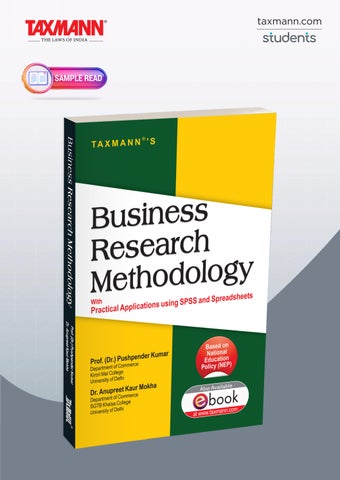
Business Research Methodology with Practical Applications using SPSS and Spreadsheets AUTHOR
:
PUSHPENDER KUMAR,
ANUPREET KAUR MOKHA
PUBLISHER
:
TAXMANN
DATE OF PUBLICATION
:
NOVEMBER 2025
EDITION
:
2025 EDITION
ISBN NO
:
9789371267694
NO. OF PAGES
:
408
BINDING TYPE
:
PAPERBACK
Rs. 550
DESCRIPTION Business Research Methodology is a concise, student-friendly, and visually enriched textbook that simplifies the study of research methods. Aligned with the NEP syllabus for DSE 6.6/7.1 of B.Com. (Hons.) and B.Com., the book presents research as a clear, step-by-step process supported by real datasets, SPSS screenshots, spreadsheet techniques, case studies, solved examples, numericals, and practical exercises. It covers the entire research journey across five structured units—from research foundations and philosophical approaches to data collection, statistical analysis, report writing, and ethics. By combining conceptual clarity with practical exposure, the book prepares students not only for university examinations but also for dissertations, internships, and early-stage research roles. This book is intended for the following audience: • B.Com. (Hons.) and B.Com. Students • Postgraduate Commerce & Management Students • Research Beginners, Interns & Early-Stage Scholars • UPSC/State PSC Aspirants • Faculty Members • Students The Present Publication is the Latest Edition, authored by Prof. (Dr) Pushpender Kumar and Dr Anupreet Kaur Mokha, with the following noteworthy features: • [Complete Coverage of the Research Cycle] From research concepts and philosophies to design, sampling, data collection, analysis, and professional report writing • [Highly Practice-driven] Hands-on SPSS & spreadsheet exercises with real datasets and actual software outputs • [Detailed Visuals] Clear charts, diagrams, flowcharts, models, and classification tables to simplify complex topics • [Strong Conceptual Clarity] Well-organised definitions, comparisons, and structured frameworks for easy learning • [Case Study Integration] Case studies in every chapter to connect concepts with business scenarios • [Ethics-focused] Dedicated coverage of ethical issues across the research process. • [Student-friendly Design] Summaries, MCQs, short & long questions, numericals, and practical tasks for revision and assessment • [Aligned with NEP Outcomes] Emphasises applied learning, problem-solving, and skill development using modern analytical tools • [Exam-ready Content] Includes solved examples, thorough assessments, and actual university question papers
BUY NOW