Sample Read
© All rights reserved
Price : ` 750
Sixteenth Edition : July 2026
Published by :
Taxmann Publications (P.) Ltd.
Sales & Marketing : 59/32, New Rohtak Road, New Delhi-110 005 India
Phone : +91-11-45562222
Website : www.taxmann.com
E-mail : sales@taxmann.com
Regd. Office : 21/35, West Punjabi Bagh, New Delhi-110 026 India
Printed at :
Tan Prints (India) Pvt. Ltd.
44 Km. Mile Stone, National Highway, Rohtak Road Village Rohad, Distt. Jhajjar (Haryana) India
E-mail : sales@tanprints.com
Disclaimer
Every effort has been made to avoid errors or omissions in this publication. In spite of this, errors may creep in. Any mistake, error or discrepancy noted may be brought to our notice which shall be taken care of in the next edition. It is notified that neither the publisher nor the author or seller will be responsible for any damage or loss of action to any one, of any kind, in any manner, therefrom.
No part of this book may be reproduced or copied in any form or by any means [graphic, electronic or mechanical, including photocopying, recording, taping, or information retrieval systems] or reproduced on any disc, tape, perforated media or other information storage device, etc., without the written permission of the publishers. Breach of this condition is liable for legal action.
For binding mistake, misprints or for missing pages, etc., the publisher’s liability is limited to replacement within seven days of purchase by similar edition. All expenses in this connection are to be borne by the purchaser. All disputes are subject to Delhi jurisdiction only.
CHAPTER 4
CHAPTER 5
CHAPTER 8
CHAPTER 12
CHAPTER 14
BAILMENT AND PLEDGE
CHAPTER 15 AGENCY
LIABILITY PARTNERSHIP ACT, 2008 CHAPTER 22
23
24
3 Offer and Acceptance
An agreement enforceable by law is a contract. An agreement is a promise or set of promises forming consideration for each other. A promise is an accepted proposal. Thus an agreement is a two-sided bargain. It requires two concluding an agreement between the parties.
Example : A says to B, “I am willing to sell my car to you for ` 2,00,000.” Here A has made an offer to sell his car to B. A is offeror and B is offeree.
A says willing to sell my car for ` 2,00,000 to you accepts becomes accepter.
Section 2(a) : (i) doing something. (ii) (iii) person to such act or abstinence.
3.1.1 How an offer is made
3.1.2 To whom can an offer be made
3.2
LEGAL RULES FOR A VALID OFFER
3.2.1 An offer may be express or implied otherwise than in words inferred from the conduct of the party, it is called
Examples :
(i) A says to B, “I am willing to sell my Parker pen to you for ` 100.” This is an express offer by A.
(ii) A writes to B in a letter, “I am willing to sell my scooty to you for ` 2,000.” This is an express offer.
(iii) A transport company runs buses on different routes in a metropolitan city company. The acceptance of the offer is complete as soon as a passenger boards the bus.
(iv) A weighing machine kept at a cinema hall is an implied offer to use the machine by inserting the necessary coin.
3.2.2 An offer must be made with an intention to create legal relations therefore cannot constitute a legally binding agreement.
Case : In the leading case Mr. Balfour, who was serving the Government of Ceylon, went to England Balfour had to go back to Ceylon, but his wife could not accompany him for medical reasons. Consequently, he promised orally to pay an for or in satisfaction of the obligation of the husband towards his wife to maintain her. On his failure to make the payment, the wife sued him for the recovery of the promised amount. Her suit was dismissed by the Court of Appeal on the ground that the agreement was only an arrangement between husband and wife, and parties never intended to make a bargain.
3.2.3 The terms of the offer must be definite and certain an agreement to agree in future is not a contract as Examples :
(i) An agreement to take a lease of a house for three years at ` 60,000 per annum, if the house is “put into thorough repair, and the drawing room handsomely
decorated. According to the present style”, can not be enforced as the terms are vague and uncertain.
(ii) A proposes to sell his car for ` 2,00,000 or ` 2,50,000. Here the offer made by A is not certain because it is not clear which of the two prices is intended.
3.2.4 An invitation to offer or a mere statement of intention is not an offer
3.2.4. (a) Advertisement for sale of goods by auction sale. It does not bind the auctioneer to sell the goods since the announcement falls on the highest bid, there is acceptance and the contract is concluded.
Case : The leading case on this point is alone from London to advertised place and found that auction sale was acceptance by traveling to the place, constituted a contract. The Court held that the advertisement was only a declaration of intention which cannot be considered as a binding contract.
3.2.4. (b) Display of goods in a shop with price tags shop, tenders the prices and demands the article, the shop-keeper is not bound
Case : In the leading case Pharmaceutical Society of Great Britain a customer selected a drug from the shelves in a self-service shop and brought the same to the cash desk where a registered pharmacist supervised the purchase of all drugs. The question was whether the taking of the goods to buy, the learned judge observed that “It would be wrong to say that any person who might come in and that, the person can insist on buying
3.2.4. (c) Catalogues and price lists
A catalogue or a price list, which contains description of goods meant for sale, with prices stated against them, although appears to contain a number of
3.2.4. (d) Advertisement inviting tenders and quotations
An advertisement inviting tenders and quotations of the lowest price, is
Case : In A (the
in a tender which turned out to be the highest, but it was not accepted. In a suit by him, it was held that the advertisement did not amount to a contract or promise to sell to the person who made the highest (i) (ii) a certain quantity, deliveries to be made if and when demanded or (i) quantity of certain goods, the acceptance of the tender is an acceptance in legal sense and creates a legal obligation.
(ii) If tender is invited for the supply during the coming
3.2.4.
(e) Mere statement of lowest price
A mere statement of the lowest price at which the vendor would sell contains no contract to sell at that price to the person making the enquiry. The
Case (i) : In the leading case
sell the Bumper Hall Penn (a plot of land) A sued B. It was held that of B to sell the plot of land and (ii) its lowest price. B replied the second
Case (ii) : In the leading case defendant) for `
less than ` performance. It was held by the Supreme Court that B did not make
` 10,000 and, therefore, no concluded contract. In this case the Supreme Court relied on the principle
3.2.4. (f) Announcement of voluntary retirement scheme
In it was held that announcement of a voluntary retirement scheme by a nationalized bank is not
3.2.4A Distinction between offer and Invitation to offer Basis
willingness to obtain assent of another for an agreement. negotiate for an agreement.
The person making the invitation invites the other to public at large.
It is in the form of displayed goods in a shop, catalogues, price lists, share issue by a company.
A gives an advertisement to sell certain goods by auction.
3.2.5 An offer may be specific or general made to an unascertained body of individuals or to the public at large, it is said such promises are made in return for an act, thus leading to the formation of unilateral contract. Section 8 of the Act recognizes acceptance by performing conditions of the proposal.
Case (i) :
In this case, a company (the defendants), who were the proprietors and vendors of a medical according to the printed directions. It was also stated that £ 1,000 had been deposited with the Alliance Bank, Regent Street, to show their for the promised reward. It was held that the company was liable to pay party at the request of the other is enough to create a consideration.
Case (ii) : In the leading case ` 500 to anybody who would trace his missing son. B, who knew about the reward traced the boy and sent a telegram to A that he had found his
in Carlill . Carbolic Smoke Ball Co., Basis
public at large It can be accepted by any It can be accepted only by that
Here as many number of contracts may be formed as Only one contract is formed same channel through which is bound by the contracts made prior to revocation. made prior to acceptance.
Cartill vs. Carbolic smoke Ball Co. ` 50,000.
3.2.6 The offer must be communicated
person to whom the same is addressed. This is obviously because of the reason
According to Section 4 of the Act,
Case : In the leading case ` 501 to anyone who might trace the boy. B traced the boy and sent a telegram to A who went to Haridwar and brought the boy back to Kanpur. He gave B, inter alia, ` 20. B, without asking for anything more, continued
held that since there can be no acceptance unless there is knowledge this case that “there was already a subsisting obligation and therefore, the performance of the act cannot be regarded as consideration for
In an it was held that even
Case : In if the information was given by an accomplice, not being himself the the hope of pardon, that he gave the information to save himself, the reward.
3.2.7 An offer should not contain any term the non-compliance of which amounts to acceptance instance, say that if the acceptor does not communicate his acceptance within
Case : In the leading case
term was held to be void.
BUSINESS LAWS
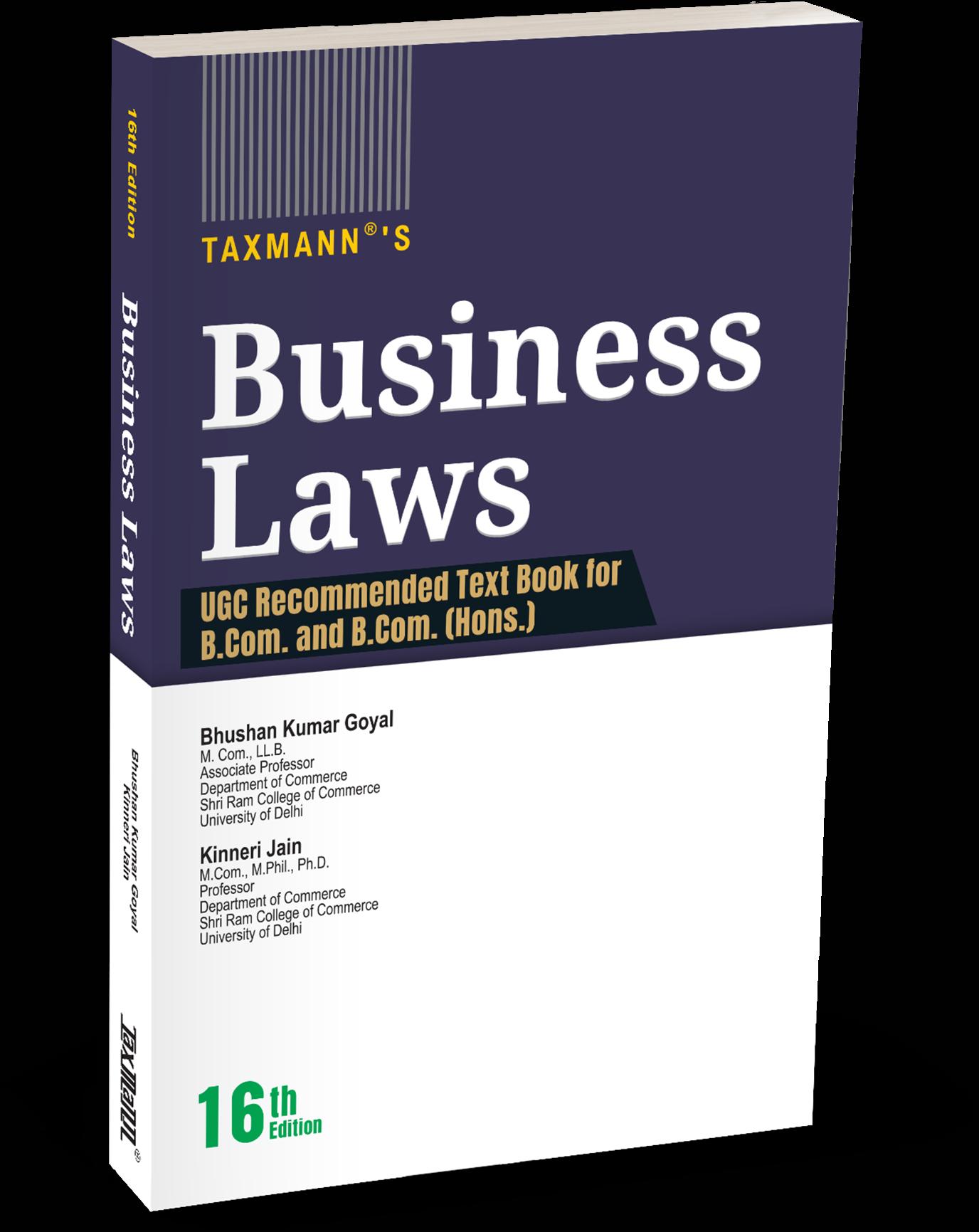
AUTHOR : Bhushan Kumar Goyal, Kinneri Jain
PUBLISHER : Taxmann
DATE OF PUBLICATION : July 2026
EDITION : 16th Edition
ISBN NO : 9789375614098
NO. OF PAGES : 572
BINDING TYPE : Paperback
DESCRIPTION
Business Laws is a comprehensive, time-tested textbook and a standard reference for undergraduate commerce students across India. It presents the core areas of Indian business and commercial law—the law of contract, the sale of goods, and limited liability partnership—in a clear, structured, examination-oriented manner, aligned with the National Education Policy (NEP) framework and the latest University of Delhi syllabus, as well as those of other universities across the country.
What sets the book apart is its teaching-led method, refined over 16 editions by authors with long experience teaching Business Laws at Shri Ram College of Commerce (SRCC). Rather than reproduce bare statutory provisions, it explains every rule and principle lucidly and reinforces it with worked illustrations and decided court cases—a deliberate blend of classic English authorities and Indian judgments—so that students learn not just what the law says but how it works in real disputes. Over 110 leading cases are summarised chapter-wise at the very front of the book, allowing the entire body of case law to be revised in one sweep, and every chapter closes with theoretical questions, true/false questions, and practical problems, most drawn from past university and professional examinations.
The book is written primarily for undergraduate commerce students, but its clarity and depth extend its usefulness well beyond that core:
•B.Com. and B.Com. (Hons.) Students
•BBA and MBA Students
•Professional-course Aspirants
•Teachers and Lecturers
•Self-learners and General Readers
No prior legal background is assumed; concepts are built up from the ground, making the book suitable for students meeting law for the first time
The Present Publication is the 16th Edition, authored by Bhushan Kumar Goyal and Dr Kinneri Jain, with the following noteworthy features:
•[NEP & Syllabus-aligned] Structured to match the latest University of Delhi B.Com./B.Com. (Hons.) syllabus and the NEP framework, with coverage suited to universities across India
•[Concept-plus-case Method] Every rule is lucidly explained, illustrated with examples, and supported by leading English and Indian court cases explained in detail
•[110+ Leading Cases, Briefed Chapter-wise] Landmark judgments—English authorities such as Balfour v. Balfour, Carlill v. Carbolic Smoke Ball Co., Hyde v. Wrench, Felthouse v. Bindley, Derry v. Peek, Dunlop Pneumatic Tyre Co. v. Selfridge and Krell v. Henry, alongside Indian decisions such as Durga Prasad v. Baldeo and Chinnaya v. Ramayya—summarised up front for quick revision
•[Distinctions in Tabular Form] Key distinctions between related concepts are set out in tables for quick comparison and recall
•[Exhaustive End-of-chapter Practice] Theoretical questions, true/false questions, and practical problems, most of which have appeared in university and professional examinations
•[Updated with the Latest Law] Incorporates the latest provisions of the Insolvency and Bankruptcy Code 2016, keeping the LLP discussion current
•[Problem-solving Orientation] Practical problems require students to identify and apply the relevant legal issue, building genuine analytical skill rather than rote memory
•[Authoritative, Refined Authorship] Written by experienced SRCC faculty and improved edition after edition through feedback from Delhi University colleges