
Sample Read


© All rights reserved
Price : ` 225
First Published : March 2026
Published by :
Taxmann Publications (P.) Ltd.
Sales & Marketing :
59/32, New Rohtak Road, New Delhi-110 005 India
Phone : +91-11-45562222
Website : www.taxmann.com
E-mail : sales@taxmann.com
Regd. Office :
21/35, West Punjabi Bagh, New Delhi-110 026 India
Printed at :
Tan Prints (India) Pvt. Ltd.
44 Km. Mile Stone, National Highway, Rohtak Road Village Rohad, Distt. Jhajjar (Haryana) India
E-mail : sales@tanprints.com
Disclaimer
Every effort has been made to avoid errors or omissions in this publication. In spite of this, errors may creep in. Any mistake, error or discrepancy noted may be brought to our notice which shall be taken care of in the next edition. It is notified that neither the publisher nor the author or seller will be responsible for any damage or loss of action to any one, of any kind, in any manner, therefrom.
No part of this book may be reproduced or copied in any form or by any means [graphic, electronic or mechanical, including photocopying, recording, taping, or information retrieval systems] or reproduced on any disc, tape, perforated media or other information storage device, etc., without the written permission of the publishers. Breach of this condition is liable for legal action.
For binding mistake, misprints or for missing pages, etc., the publisher’s liability is limited to replacement within seven days of purchase by similar edition. All expenses in this connection are to be borne by the purchaser. All disputes are subject to Delhi jurisdiction only.


CHAPTER 1
THEORETICAL QUESTIONS
ENGLISH GRAMMAR & ITS USAGE
Q1. What are the various kinds of Nouns? Explain with examples.
Ans. A noun is a “naming word”. It names somebody or something.
Rahul took the dog to the park. The car makes a lot of noise.
A noun is a name of a person (Rahul), animal (dog), place (park), thing (car) or idea (noise).
Kinds of Nouns: Nouns may be divided into (a) Common Nouns and (b) Proper Nouns.
Common nouns: Common nouns are the names given in common to all persons, places or things of the same class. For example, bank, shop, market, etc.
Common nouns include another class known as collective nouns.
Collective noun: A collective noun names a group of people, animals or things regarded as a whole, e.g. batch, company, university, crowd, flock, etc.
Proper nouns: Proper nouns are the names of particular persons, places or things.
For example, India, Larsen & Toubro, Delhi, January, etc.
Q2. Explain the rules for using articles ‘a’, ‘an’, and ‘the’ with examples.
Ans. The words ‘a’ or ‘an’ and ‘the’ are called articles. They come before nouns.
‘A’ or ‘an’ is called the Indefinite article, because it usually leaves indefinite the person or thing spoken of; as, A doctor; that is, any doctor.
‘The’ is called the definite article because it normally points out some particular person or thing; as, He saw the doctor; meaning some particular doctor.
The indefinite article is used before singular countable nouns, e.g., A car, an apple, a table.
The definite article is used before singular countable nouns, plural countable nouns and uncountable nouns, e.g. the pen, the milk, the idea.
The article ‘an’ is used when the noun to which it is attached begins with a vowel sound (a, e, i, o and u). It is the vowel sound and not the vowels that determines the use of ‘a’ or ‘an’.
Vowels with consonant sound take ‘a’ and not ‘an’.
For example,
- Bring me an apple.
- He walks like an Egyptian.
- She has planted a eucalyptus tree.
- He is an honest man.
- He has joined a union.
- I have lost a one-rupee note.
Q3. Read the following sentences.
1. I shall write another letter tomorrow.
2. I write this letter to my mother.
3. I wrote the letter yesterday.
How you will classify above three sentences as – present tense; past tense or future tense.
Ans.
1. In Sentence 1, helping the verb ‘shall’ write refers to a future time. Therefore, it is said to be in the Future Tense.
2. In Sentence 2, the verb ‘write’ refers to the present time. Hence, a verb that refers to the present time is said to be in the Present Tense.
3. In Sentence 3, the verb wrote refers to the past time. Hence, it is said to be in Past Tense.
Q4. What are the two commonly used ‘Conjunctions’? Give example. Ans.
Conjunctions join words or even sentences conveying related ideas. Two commonly used conjunctions are: and but
We received your letter and telegram but regret our inability to attend the meeting Conjunctions may also be used in pairs, e.g. neither-nor, either-or, not only-but also, both-and, whether-or etc. Such conjunctions are known as Correlative Conjunctions.
Q5. Give example of words used as ‘Interjection’
Ans. Interjections are words which are used in a sentence to express strong emotion or feeling. They may not form a part of its grammatical structure. Some of the common interjections are: Hi !, Alas !, Oh!, etc.
Q6. Go through the sentences given below and identify the voice used.
1. Shreya Ghoshal sings beautiful songs.
2. The Sun sets in the West.
3. The boy was being beaten by his teacher.
4. Bucky is helped by Steve.
5. The carpenter is building the desk.
6. The woodcutter cut down the tree.
7. The man dropped his axe into the river.
8. The bird was shot by the naughty boy.
Ans.
1. Active voice
2. Active voice
3. Passive voice
4. Passive Voice
5. Active voice
6. Active voice
7. Active voice
8. Passive voice
Q7. Go through the sentences given below and identify the voice used.
1. The bag was found by me.
2. Natasha lost the money.
3. The farmer will plough the field.
4. The work will be finished by the workers in a day.
5. The enemy has entered the war zone.
6. Who sang the song?
7. The children teased the animals.
Ans.
1. Passive voice
2. Active voice
3. Active voice
4. Passive voice
5. Active voice
6. Active voice
7. Active voice
Q8. Change the following sentences from Active Voice to Passive Voice.
1. The dog chased the cat.
2. The dog bit the boy.
3. The peon rang the bell.
4. Ram played hockey.
5. Miss Mary teaches us English.
Ans.
1. The cat was chased by the dog.
2. The boy was bitten by the dog.
3. The bell was rung by the peon.
4. Hockey was played by Ram.
5. English is taught to us by Miss Mary.
Q9. Change the following sentences from active voice to passive voice.
(i) Raj caught the ball.
(ii) Children like sweets.
(iii) Rita will take a photograph.
(iv) Who taught you this poem?
(v) The police arrested the smuggler.
(vi) Shiva was flying a kite.
(vii) The hunter shot the deer.
(viii) The lion attacked the zebra.
Ans.
(i) The ball was caught by Raj.
(ii) Sweets are liked by children.
(iii) A photograph will be taken by Rita.
(iv) By whom were you taught this poem?
(v) The smuggler was arrested by the police.
(vi) A kite was being flown by Shiva.
(vii) The deer was shot by the hunter.
(viii) The zebra was attacked by the lion.
Q10. Change the following sentences from active voice to passive voice.
A. Virat threw the ball.
B. Everyone loves Zara.
C. My sister has drawn this portrait.
D. The people were helping the wounded woman.
E. Sam had taken the medicines.
F. The player is taking extra time.
G. The cat ate the fish.
Ans.
A. The ball was thrown by Virat.
B. Zara is loved by everyone.
C. This portrait has been drawn by my sister.
D. The wounded woman was being helped by the people.
E. The medicines had been taken by Sam.
F. Extra time is being taken by the player.
G. The fish was eaten by the cat.
Q11. Attempt the following as per the given instructions.
(i) Rearrange the following parts to make a meaningful sentence: “1. I/ 2. immediately/ 3. salary/ 4. my/ 5. Want
(ii) Which is the correct affirmative form of “I did not see anyone entering his office”?
(iii) What is the grammatical function of “fast” in “Kamal talks so fast”?
(iv) Combine these sentences into one complex sentence: “He is poor. He is honest.”
Ans.
(i) I want my salary immediately.
(ii) I saw someone entering his office.
(iii) Adverb, as it describes the verb “talks”.
(iv) Though he is poor, he is honest.
Q12. What is “Supportive Prefixes”? Give examples.
Ans. Supportive Prefixes are prefixes that support or are for the root word.
“Pro” is used with the meaning favouring/supporting as the prefix.
Pro, as a prefix has other meanings too, such as “in substitute of” or “before in time, pace or order”.
Examples of Pro as a supportive prefix are – Pro-choice, Pro-market, Pro-life.
Q13. Explain: Opposing Prefixes
Ans. Opposing Prefixes are prefixes that are opposed to the action denoted by the root word.
Anti (against) — antibody, antibacterial, antibiotic, anticlockwise, antidote, anti-inflammatory, antioxidant, etc.
Counter (opposition/retaliation) — counteract, counter-example, counter- attack, counterblast, counterbalance, counterclaim, counterculture, counter-in-surgency, countermeasure, counterproductive, etc.
Q14. What is denoted by Size Prefixes? Give examples.
Ans. Size Prefixes denote size.
They are:
Mega (very large) — megaphone, megastar, megalith, megawatt
Midi (medium) — midi-computer, midibus
Mini (small) — minibus, miniseries, minicab, minimarket
Q15. Write the correct sentence underneath by adding — Capital Letters, Full Stops, Question Marks & Inverted Commas.
1. one warm sunny day jessica and lilly went to the zoo when they arrived they visited the monkeys
2. i like the zoo said jessica lilly looked up and saw a monkey had stolen her lunchbox
3. do we have any money to buy more food asked jessica
4. lilly replied no now we dont have anything for lunch
5. dont worry girls a voice called from behind them it was the zookeeper who was holding their lunchbox with a big smile on his face
Ans.
1. One warm, sunny day Jessica and Lilly went to the zoo. When they arrived, they visited the monkeys.
2. ‘I like the zoo,’ said Jessica. Lilly looked up and saw a monkey had stolen her lunchbox!
3. ‘Do we have any money to buy more food?’ asked Jessica.
4. Lilly replied ‘No! Now we don’t have anything for lunch!’
5. ‘Don’t worry girls,’ a voice called from behind them. It was the zookeeper, who was holding their lunchbox, with a big smile on his face.
Q16. Choose the correct for the following:
(i) I, we, you, she, he, it, him, us, them, etc. are (Personal Pronouns/Relative Pronouns)
(ii) A word used to describe or point out, a person, animal, place or thing which the noun names, or to tell the number and quantity is called an (Adjective/ Possessive Pronouns)
(iii) Identify the adjective: “The homeless beggar hasn’t eaten in days.”
(iv) Identify the adjective and type: “She bought some French pastries.”
(v) Identify the adjective in “The selfish giant didn’t allow the children to enter.”
Ans.
(i) Personal Pronouns
(ii) Adjective
(iii) Homeless (describes the noun).
(iv) Some (adjective of quantity), French (proper adjective).
(v) Selfish.
Q17. Correct the Sentence Punctuation:
(i) its a beautiful day outside said Sarah
(ii) Can you believe it she won the contest
(iii) my brothers dog is called tess
(iv) Rahul said I will complete my project today
(v) Wow this is amazing Ans.
(i) “It’s a beautiful day outside,” said Sarah.
(ii) Can you believe it? She won the contest.
(iii) My brother’s dog is called Tess.
(iv) Rahul said, “I will complete my project today.”
(v) Wow! This is amazing.
Q18. Attempt the following questions on “Full Stop”.
1. What is the main purpose of a full stop?
2. Can full stop be used after a question mark?
3. When is a full stop used in email addresses or web URLs?
4. Is a full stop needed at the end of a bulleted list?
5. How does a full stop differ from a comma? Ans.
1. To mark the end of a sentence that makes a statement or expresses a complete thought.
2. No, a full stop should never be used at the end of a question (use ?), an exclamation (use !), or a command that is an exclamation.
3. Multiple full stops are used in web addresses (e.g., www.google.com) or within email addresses.
4. If the bullet points are complete sentences, use a full stop. If they are just phrases, a full stop is often omitted.
5. A full stop indicates a long pause and ends a sentence, while a comma indicates a short, brief pause within a sentence.
Q19. Select the answer choice that identifies which comma should be removed from the sentence.
1. To prepare for the interview, David researched the company, practiced his answers, and, chose a professional outfit. (a) company, practiced
(b) answers, and (c) and, chose
(d) No error
2. The main character, a clever and resourceful detective, solved the case, because she noticed a tiny, overlooked clue.
(a) detective, solved
(b) case, because
(c) tiny, overlooked
(d) No error
3. On Friday, March 15, 2024, the company announced its new line of eco-friendly products.
(
a) Friday, March
(b) 15, 2024
(c) 2024, the
(d) No error
4. The old oak tree, which had stood in the town square for a century, finally fell during the storm, and damaged the historic gazebo.
(a) tree, which (b) century, finally
(c) storm, and
(d) No error
5. My cousin, who wrote the award-winning essay, attributed her success to her English teacher, and her parents.
(a) cousin, who
(b) essay, attributed
(c) teacher, and
(d) No error
Ans.
1. (c) There is an unnecessary comma placed after the coordinating conjunction and
2. (b) A comma isn’t needed before a conjunction like because when the dependent clause follows the main clause and is essential to its meaning.
3. (d) No error
4. (c) A comma isn’t needed before and because the phrase “damaged the historic gazebo” is not a full sentence; it’s the second part of a compound predicate.
5. (c) A comma should not be used before and when it connects two items in a compound object (attributing success to the teacher and the parents). The first two commas are correct because they properly set off the non-essential clause.
Note: Students are required to select correct answer of MCQ. Explanation is not required, same is given for understanding as to which is the correct answer.
Q20. What is Colon (:)? What are the functions of Colon (:) in communication?
Ans.
Colon (:) is a punctuation mark that has three major functions:
To introduce some kind of explanation.
They did not sleep last night: they must be tired.
To introduce examples.
Today they face another threat to their survival: starvation.
To introduce quotations or direct speech.
Functions of Colon: Some of the other functions of the colon are:
To point the reader’s attention forward.
This function can be best explained through the words of the grammarian, Henry Fowler. He says that the function of a colon is “that of delivering the goods that have been invoiced in the preceding words”.
What he meant by goods here might be a conclusion, summary, a list or a contracting statement.
To introduce a number of items listed separately.
The conference hall facility has everything: furniture, mikes, amplifier, projector, screen, generator backup, catering, dining hall and even a huge parking lot.
To present a conclusion.
After sixty years in the business, Mr. Rajan realized that there was only one certainty in life: the inevitability of change.
To introduce a question.
They all agreed that the essential issue was simply this: Will making an investment in Sweatland Limited be a mistake or not?
To link contrasting statements.
Man proposes: God disposes.
To substitute a conjunction. Another Monday morning: and it is pouring.
After headings in correspondence.
Subject:
Reference:
To introduce subtitles.
Credit cards: Power of Plastic; Past Promises: Failure to deliver.
In bibliographical references, colon can be used after the place of publication.
(Delhi: 2010).
VOCABULARY
Q21. Give some tips for choosing the right words in communication. Ans.
Some general points to remember in communication are:
1. Simplicity: Simple language produces the best and the quickest response from everyone. But one must try not to sacrifice precision or dignity. However, there are occasions when easy comprehension must take a back seat. At times, long and unusual words have to be used because they are more precise.
For example, legal language is far from simple. Hence the legal draftsman has to keep the complexity of the situation in mind. He may end up using complex language.
2. Use familiar words: Use familiar words i.e., the words with sharp and clear meanings in the mind. As words which are familiar to some people may be unfamiliar to others, so you will need to select familiar words with care.
3. Jargon: Jargon is a language that is unique to a particular field of knowledge, e.g., science, technology, art, trade or a profession. There is for instance legal jargon, military jargon, and political jargon.
For example, the word ‘operation’ takes on different meanings depending on the context in which it is used.
4. Avoid using superfluous words/Verbosity: Verbosity (an expressive style that uses excessive or superfluous words) or using more words than necessary is a common weakness. The speaker/ writer uses more words than needed in the hope of diverting/retaining audiences. This tendency is seen in writing too. It has been well defined as an extension of Parkinson’s Law-words increase in number to fill the quantity of paper available. More words do not necessarily lead to greater clarity. Nor do difficult and high sounding words lend weight to the argument. They obscure meaning and tire the reader out.
5. Choose short words: According to studies of readability, short words generally communicate better than long words. Of course, part of the explanation is that short words tend to be familiar words. But there is another explanation i.e. heavy use of long words, even long words that are understood, leaves an impression of difficulty and hinders communication.
6. Select words for precise meaning: Writing requires considerable knowledge of the language being used. But beyond basic familiarity with vocabulary, good writers possess a sensitivity to words’ shades of meaning. Knowledge of language enables you to use words that carry the meaning you want to communicate.
For example, fewer and less means the same to some people. But careful users select fewer to mean “smaller numbers of items” and less to mean “reduced value, degree or quantity”. Similarly, careful writers use continual to mean “repeated but broken succession” and continuous to mean “unbroken succession”.
Business Communication (Paper 1) | CRACKER
AUTHOR : N.S.
Zad
PUBLISHER : Taxmann
DATE OF PUBLICATION : March 2026
EDITION : 2026 Edition
ISBN NO : 9789375613220
No. of Pages : 156
BINDING TYPE : Paperback
Rs. 225
DESCRIPTION
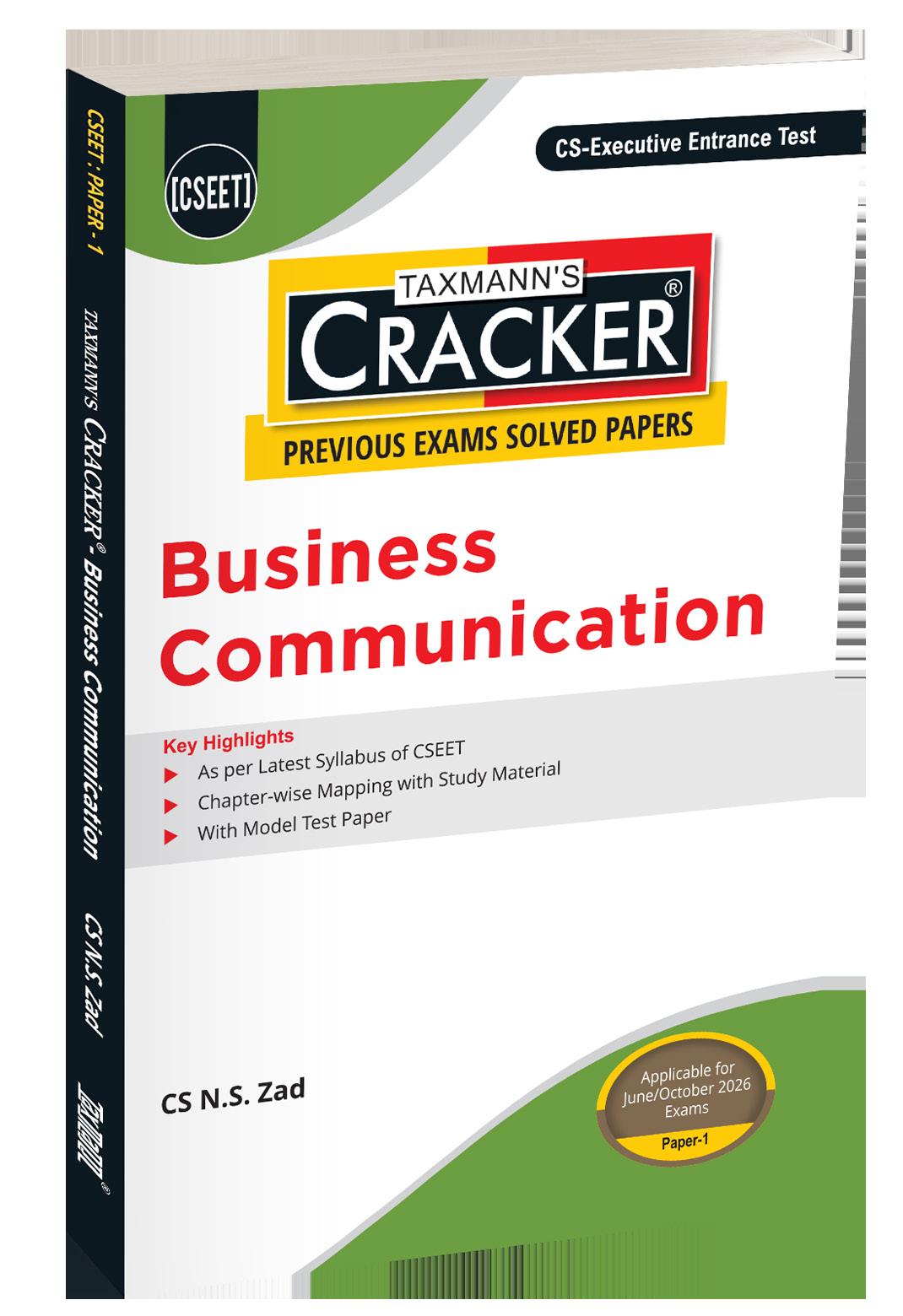
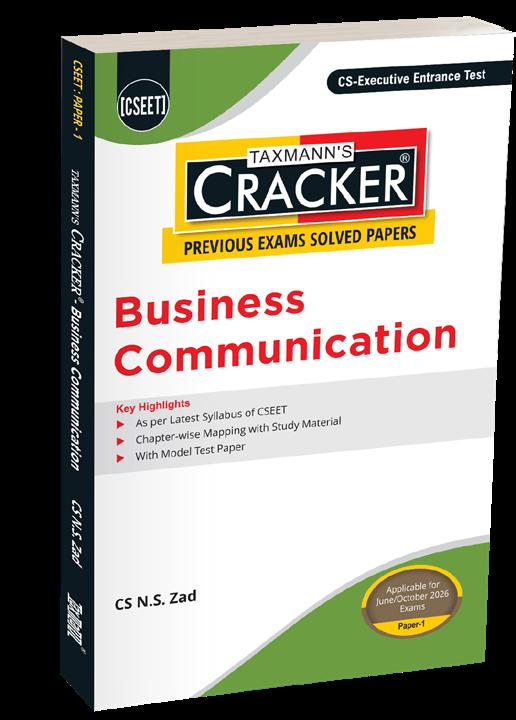
Business Communication – CRACKER is a focused exam preparation book for candidates taking Paper 1 of the CS Executive Entrance Test (CSEET). Carefully aligned with the latest ICSI CSEET syllabus, this book covers the entire scope of Business Communication, from fundamental English grammar and usage to corporate correspondence, organisational communication theory, and business terminology. It serves as a comprehensive self-study resource, including theoretical questions with model answers, practice exercises, and a complete Model Test Paper with suggested answers, all in a compact format.
The Present Publication is the March 2026 Edition, authored by CS N.S. Zad, with the following noteworthy features:
• [Syllabus-Aligned Coverage] Strictly based on the latest CSEET syllabus issued by ICSI, with no unnecessary content
• [Chapter-wise Mapping with ICSI Study Material] A dedicated comparison table at the front crossreferences each chapter with the corresponding chapter in the official ICSI study material, helping candidates use both resources together without duplication or gaps
• [Question-Answer Format Throughout] The entire book follows a standard Q&A format, with questions modelled on actual examination patterns, including descriptive, MCQ-type, and application-based drafting questions
• [Model Test Paper with Suggested Answers] A full-length model test paper replicating the actual CSEET Paper 1 format is included at the end, with suggested answers covering all four chapters
• [Applied Drafting Practice] Beyond theory, the book offers extensive practical exercises on business correspondence—drafting complaint letters, office orders, circulars, memoranda, AGM notices, interview calls, and rejection letters, each with model answers
• [Compact and Exam-Focused] Designed for efficient last-stage revision rather than primary study, making it suitable as a quick or supplementary practice resource