Sample Read
© Taxmann Price : ` 90
Law stated in this book is as updated till 15th November, 2025
Published by : Taxmann Publications (P.) Ltd.
Sales & Marketing : 59/32, New Rohtak Road, New Delhi-110 005 India
Phone : +91-11-45562222
Website : www.taxmann.com
E-mail : sales@taxmann.com
Regd. Office : 21/35, West Punjabi Bagh, New Delhi-110 026 India
Printed at :
Tan Prints (India) Pvt. Ltd.
44 Km. Mile Stone, National Highway, Rohtak Road Village Rohad, Distt. Jhajjar (Haryana) India
E-mail : sales@tanprints.com
Disclaimer
Every effort has been made to avoid errors or omissions in this publication. In spite of this, errors may creep in. Any mistake, error or discrepancy noted may be brought to our notice which shall be taken care of in the next edition. It is notified that neither the publisher nor the author or seller will be responsible for any damage or loss of action to any one, of any kind, in any manner, therefrom. It is suggested that to avoid any doubt the reader should cross-check all the facts, law and contents of the publication with original Government publication or notifications.
No part of this book may be reproduced or copied in any form or by any means [graphic, electronic or mechanical, including photocopying, recording, taping, or information retrieval systems] or reproduced on any disc, tape, perforated media or other information storage device, etc., without the written permission of the publishers. Breach of this condition is liable for legal action.
For binding mistake, misprints or for missing pages, etc., the publisher’s liability is limited to replacement within seven days of purchase by similar edition. All expenses in this connection are to be borne by the purchaser. All disputes are subject to Delhi jurisdiction only.
BONDED LABOUR SYSTEM (ABOLITION) ACT, 1976
CHAPTER I PRELIMINARY
1. Short title, extent and commencement 1
2. De nitions 1
3. Act to have overriding effect 4
CHAPTER II ABOLITION OF BONDED LABOUR SYSTEM
4. Abolition of bonded labour system 5
5. Agreement, custom, etc., to be void 8
CHAPTER III
EXTINGUISHMENT OF LIABILITY TO REPAY BONDED DEBT
6. Liability to repay bonded debt to stand extinguished 9
7. Property of bonded labourer to be freed from mortgage, etc. 10
8. Freed bonded labourer not to be evicted from homestead, etc. 10
9. Creditor not to accept payment against extinguished debt 10
BONDED LABOUR SYSTEM (ABOLITION) RULES, 1976
1. Short title and commencement 25
2. De nitions 25
3. Term of Of ce, and vacation of seat, of members of District Vigilance Committee 25
4. Term of of ce, and vacation of seat, of members of Sub-Divisional Vigilance Committee 26
5. Prescribed authority under sub-section (6) of section 6 27
6. Time within which an application under sub-section (6) is to be made 27
7. Records to be maintained by District Vigilance Committees to ensure the implementation of the provisions of the Act and Rules 27
Bonded Labour System (Abolition) Act, 1976
[19 OF 1976]*
An Act to provide for the abolition of bonded labour system with a view to preventing the economic and physical exploitation of the weaker sections of the people and for matters connected therewith or incidental thereto.
BE it enacted by Parliament in the Twenty-seventh year of the Republic of India as follows:
CHAPTER I PRELIMINARY
Short title, extent and commencement.
1. (1) This Act may be called the Bonded Labour System (Abolition) Act, 1976.
(2) It extends to the whole of India.
(3) It shall be deemed to have come into force on the 25th day of October, 1975.
COMMENTS
SECTION NOTES
1.1 Extent [Section 1(2)]
The Act applies to the entire territory of India. Definitions.
2. In this Act, unless the context otherwise requires—
(a) “advance” means an advance, whether in cash or in kind, or partly in cash or partly in kind, made by one person (hereinafter referred to as the creditor) to another person (hereinafter referred to as the debtor);
(b) “agreement” means an agreement (whether written or oral, or partly written and partly oral) between a debtor and creditor, and includes an agreement providing for forced labour, the existence of which is presumed under any social custom prevailing in the concerned locality.
* Dated 9-2-1976.
S. 2 BONDED LABOUR SYSTEM (ABOLITION) ACT, 1976 2
Explanation.— The existence of an agreement between the debtor and creditor is ordinarily presumed, under the social custom, in relation to the following forms of forced labour, namely:—
Adiyamar, Baramasia, Basahya, Bethu, Bhagela, Cherumar, Garru-Galu, Hali, Hari, Harwai, Holya, Jana, Jeetha, Kamiya, Khundit-Mundit, Kuthia, Lakhari, Munjhi, Mat, Munish system, Nit-Majoor, Paleru, Padiyal, Pannayilal, Sagri, Sanji, Sanjawat, Sewak, Sewakia, Seri, Vetti;
(c) “ascendant” or “descendant”, in relation to a person belonging to a matriarchal society, means the person who corresponds to such expression in accordance with the law of succession in force in such society;
(d) “bonded debt” means an advance obtained, or presumed to have been obtained, by a bonded labourer under, or in pursuance of, the bonded labour system;
(e) “bonded labour” means any labour or service rendered under the bonded labour system;
(f) “bonded labourer” means a labourer who incurs, or has, or is presumed to have incurred, a bonded debt;
(g) “bonded labour system” means the system of forced, or partly forced, labour under which a debtor enters, or has, or is presumed to have entered into an agreement with the creditor to the effect that—
(i) in consideration of an advance obtained by him or by any of his lineal ascendants or descendants (whether or not such advance is evidenced by the document) and in consideration of the interest, if any, due on such advance, or
(ii) in pursuance of any customary or social obligation, or
(iii) in pursuance of any obligation devolving on him by succession, or
(iv) for any economic consideration received by him or by any of his lineal ascendants or descendants, or
(v) by reason of his birth in any particular caste or community,—
he would—
(1) render, by himself or through any member of his family, or any person dependent on him, labour or service, to the creditor, or for the benefit of the creditor, for a specified period or for an unspecified period, either without wages or for nominal wages, or
(2) for the freedom of employment or other means of livelihood for a specified period or for an unspecified period, or
(3) forfeit the right to move freely throughout the territory of India, or
(4) forfeit the right to appropriate or sell at market-value any of his property or product of his labour or the labour of a member of his family or any person dependent on him,
3 BONDED LABOUR SYSTEM (ABOLITION) ACT, 1976 S. 2
and includes the system of forced, or partly forced, labour under which a surety for a debtor enters, or has, or is presumed to have entered into an agreement with the creditor to the effect that in the event of the failure of the debtor to repay the debt, he would render the bonded labour on behalf of the debtor;
1[Explanation.— For the removal of doubts, it is hereby declared that any system of force, or partly forced labour under which any workman being contract labour as defined in clause (b) of sub-section (1) of section 2 of the Contract Labour (Regulation and Abolition) Act, 1970 (37 of 1970), or an inter-State migrant workman as defined in clause (e) of subsection (1) of section 2 of the Inter-State Migrant Workmen (Regulation of Employment and Conditions of Service) Act, 1979 (30 of 1979), is required to render labour or service in circumstances of the nature mentioned in sub-clause (1) of this clause or is subjected to all or any of the disabilities referred to in sub-clauses (2) to (4), is ‘bonded labour system’, within the meaning of this clause.]
(h) “family”, in relation to a person, includes the ascendant and descendant of such person;
(i) “nominal wages”, in relation to any labour, means a wage which is less than—
(a) the minimum wages fixed by the Government, in relation to the same or similar labour, under any law for the time being in force; and
(b) where no such minimum wage has been fixed in relation to any form of labour, the wages that are normally paid, for the same or similar labour, to the labourers working in the same locality;
(j) “prescribed” means prescribed by rules made under this Act.
COMMENTS
SECTION NOTES
2.1 Advance [Section 2(a)]
Refers to any sum of money or goods given as a loan by a creditor to a debtor.
The advance can be either in cash, kind, or a combination of both.
2.1-1 Creditor and debtor
The person giving the loan is termed as the “creditor,” and the one receiving it is the “debtor.”
2.2 Agreement [Section 2(b)]
It includes any oral or written contract, or a mix of both, between a debtor and creditor.
It also covers forced labour arrangements that are recognized under local customs.
The existence of such agreements is often presumed under traditional customs in specific forms of forced labour systems, such as Adiyamar, Bhagela, Kamiya, Sanji, Vetti, among others.
1. Inserted by the Bonded Labour System (Abolition) Amendment Act, 1985, w.e.f. 24-12-1985.
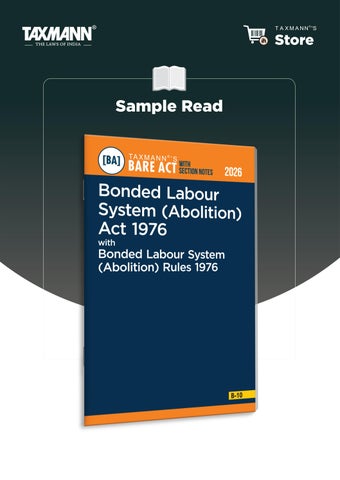
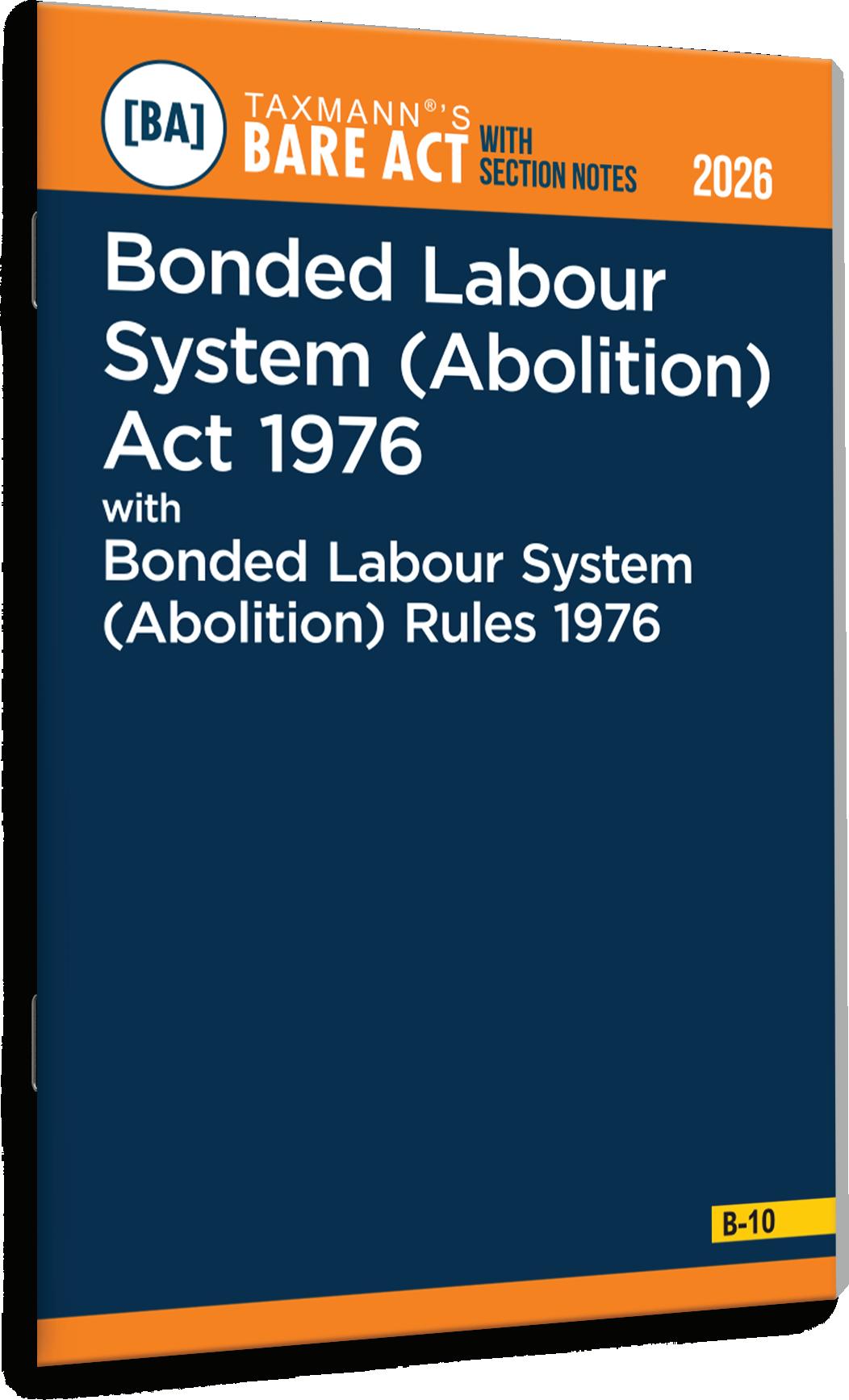
BONDED LABOUR SYSTEM (ABOLITION) ACT 1976 WITH BONDED LABOUR SYSTEM (ABOLITION)
RULES 1976 – BARE ACT WITH SECTION NOTES
AUTHOR : Taxmann's Editorial Board
PUBLISHER : Taxmann
DATE OF PUBLICATION : January 2026
EDITION : 2026 Edition
ISBN NO : 9789371267564
NO. OF PAGES : 36
BINDING TYPE : Paperback
Rs. 90
DESCRIPTION
Bonded Labour System (Abolition) Act 1976 with Bonded Labour System (Abolition) Rules 1976 [Bare Act with Section Notes] by Taxmann is an authoritative statutory publication presenting India's core legal framework for the abolition of bonded labour and the prohibition of forced labour arising from debt, custom, caste, or economic exploitation. Enacted to operationalise the constitutional mandate under Articles 21 and 23, the Act provides for the abolition of the bonded labour system, extinguishment of bonded debts, restoration of property, and penal action against enforcement or abetment of bonded labour. This Edition reproduces the complete text of the Act and Rules, supplemented by concise section-wise notes that clarify legislative intent, scope, enforcement mechanisms, and judicial interpretation, making it a dependable statutory reference. This book is intended for the following audience:
• Advocates & Legal Practitioners
• Judicial Officers & Legal Researchers
• Labour Commissioners, District Magistrates & Government Officials
• NGOs, Social Workers & Human Rights Organisations
• Law Students & Academicians
The Present Publication is the 2026 Edition, covering the amended and updated text of the Bonded Labour System (Abolition) Act [Act No. 19 of 1976] and Rules, with the following noteworthy features:
• [Bare Act with Section Notes] Complete and authentic text of the Act and Rules with concise section-wise explanatory notes
• [Updated & Consolidated Text] Incorporates all amendments, notifications, and statutory developments
• [Pre-amendment Provisions] Includes pre-amendment text through amendment footnotes for historical and transitional understanding
• [Commentary on Definitions & Core Provisions] Explanatory notes on key terms such as advance, bonded debt, bonded labour, nominal wages, and burden of proof
• [Implementation & Enforcement Framework] Clear exposition of the roles and duties of District Magistrates, authorised officers, and Vigilance Committees
• [Offences, Penalties & Procedure] Structured coverage of offences, punishments, cognisance, trial procedure, offences by companies, and abetment
• [Subject Index & Easy Navigation] Well-organised contents and subject index for quick reference