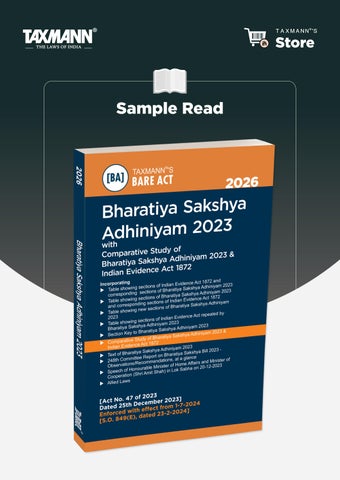

Sample Read

© Taxmann
Price : ` 195
Law stated in this book is as updated till 1st December, 2025
Published by :
Taxmann Publications (P.) Ltd.
Sales & Marketing :
59/32, New Rohtak Road, New Delhi-110 005 India
Phone : +91-11-45562222
Website : www.taxmann.com
E-mail : sales@taxmann.com
Regd. Office :
21/35, West Punjabi Bagh, New Delhi-110 026 India
Printed at :
Tan Prints (India) Pvt. Ltd.
44 Km. Mile Stone, National Highway, Rohtak Road Village Rohad, Distt. Jhajjar (Haryana) India
E-mail : sales@tanprints.com
Disclaimer
Every effort has been made to avoid errors or omissions in this publication. In spite of this, errors may creep in. Any mistake, error or discrepancy noted may be brought to our notice which shall be taken care of in the next edition. It is notified that neither the publisher nor the author or seller will be responsible for any damage or loss of action to any one, of any kind, in any manner, therefrom. It is suggested that to avoid any doubt the reader should cross-check all the facts, law and contents of the publication with original Government publication or notifications.
No part of this book may be reproduced or copied in any form or by any means [graphic, electronic or mechanical, including photocopying, recording, taping, or information retrieval systems] or reproduced on any disc, tape, perforated media or other information storage device, etc., without the written permission of the publishers. Breach of this condition is liable for legal action. For binding mistake, misprints or for missing pages, etc., the publisher’s liability is limited to replacement within seven days of purchase by similar edition. All expenses in this connection are to be borne by the purchaser. All disputes are subject to Delhi jurisdiction only.
CONTENTS
Table showing sections of Indian Evidence Act, 1872 and corresponding sections of Bharatiya Sakshya Adhiniyam, 2023 I-7
Table showing sections of Bharatiya Sakshya Adhiniyam, 2023 and corresponding sections of Indian Evidence Act, 1872 I-19
Table showing new sections of Bharatiya Sakshya Adhiniyam, 2023 I-31
Table showing sections of Indian Evidence Act repealed by Bharatiya Sakshya Adhiniyam, 2023 I-33
Section key to Bharatiya Sakshya Adhiniyam, 2023 I-35
Comparative Study of Bharatiya Sakshya Adhiniyam, 2023 and Indian Evidence Act, 1872 I-49
Arrangement of sections 1 Text of Bharatiya Sakshya Adhiniyam, 2023 11
248th Report on Bharatiya Sakshya Bill, 2023 - Parliamentary Standing Committee on Home Affairs - Observations/ Recommendations - At a glance 135
Speech of Honourable Minister of Home Affairs and Minister of Cooperation (Shri Amit Shah) in Lok Sabha on 20-12-2023 139
Appendix : Provisions of other Acts Referred to in Bharatiya Sakshya Adhiniyam, 2023 141

BHARATIYA SAKSHYA ADHINIYAM, 2023
[47 OF 2023]
An Act to consolidate and to provide for general rules and principles of evidence for fair trial.
BE it enacted by Parliament in the Seventy-fourth Year of the Republic of India as follows:—
PART I
CHAPTER I
PRELIMINARY
Short title, application and commencement.
1. (1) This Act may be called the Bharatiya Sakshya Adhiniyam, 2023.
(2)It applies to all judicial proceedings in or before any Court, including Courtsmartial, but not to affidavits presented to any Court or officer, nor to proceedings before an arbitrator.
(3)It shall come into force on such date as the Central Government may, by notification in the Official Gazette†, appoint.
Corresponding Provision : Section 1 of Indian Evidence Act, 1872 Definitions.
2. (1) In this Adhiniyam, unless the context otherwise requires,—
(a)“Court” includes all Judges and Magistrates, and all persons, except arbitrators, legally authorised to take evidence;
Corresponding Provision : Section 3, para 1 of Indian Evidence Act, 1872
(b) “conclusive proof” means when one fact is declared by this Adhiniyam to be conclusive proof of another, the Court shall, on proof of the one fact, regard the other as proved, and shall not allow evidence to be given for the purpose of disproving it;
Corresponding Provision : Section 4, para 3 of Indian Evidence Act, 1872
(c)“disproved” in relation to a fact, means when, after considering the matters before it, the Court either believes that it does not exist, or considers its non-existence so probable that a prudent man ought, under
† Notification No. S.O. 849(E), dated 23-2-2024 - In exercise of the powers conferred by sub-section (3) of section 1 of the Bharatiya Sakshya Adhiniyam, 2023 (47 of 2023), the Central Government hereby appoints the 1st day of July, 2024 as the date on which the provisions of the said Adhiniyam, shall come into force.
the circumstances of the particular case, to act upon the supposition that it does not exist;
Corresponding Provision : Section 3, para 8 of Indian Evidence Act, 1872
(d) “document” means any matter expressed or described or otherwise recorded upon any substance by means of letters, figures or marks or any other means or by more than one of those means, intended to be used, or which may be used, for the purpose of recording that matter and includes electronic and digital records.
Illustrations
(i) A writing is a document.
(ii) Words printed, lithographed or photographed are documents.
(iii) A map or plan is a document.
(iv) An inscription on a metal plate or stone is a document.
(v) A caricature is a document.
(vi) An electronic record on emails, server logs, documents on computers, laptop or smartphone, messages, websites, locational evidence and voice mail messages stored on digital devices are documents;
Corresponding Provision : Section 3, para 5 of Indian Evidence Act, 1872
(e) “evidence” means and includes—
(i) all statements including statements given electronically which the Court permits or requires to be made before it by witnesses in relation to matters of fact under inquiry and such statements are called oral evidence;
(ii) all documents including electronic or digital records produced for the inspection of the Court and such documents are called documentary evidence;
Corresponding Provision : Section 3, para 6 of Indian Evidence Act, 1872
(f) “fact” means and includes—
(i) any thing, state of things, or relation of things, capable of being perceived by the senses;
(ii) any mental condition of which any person is conscious.
Illustrations
(i) That there are certain objects arranged in a certain order in a certain place, is a fact.
(ii) That a person heard or saw something, is a fact.
(iii) That a person said certain words, is a fact.
(iv) That a person holds a certain opinion, has a certain intention, acts in good faith, or fraudulently, or uses a particular word in a particular sense, or is or was at a specified time conscious of a particular sensation, is a fact;
Corresponding Provision : Section 3, para 2 of Indian Evidence Act, 1872
(g) “facts in issue” means and includes any fact from which, either by itself or in connection with other facts, the existence, non-existence, nature or extent of any right, liability or disability, asserted or denied in any suit or proceeding, necessarily follows.
Explanation.—Whenever, under the provisions of the law for the time being in force relating to Civil Procedure, any Court records an issue of fact, the fact to be asserted or denied in the answer to such issue is a fact in issue.
Illustrations
A is accused of the murder of B. At his trial, the following facts may be in issue:—
(i) That A caused B’s death.
(ii) That A intended to cause B’s death.
(iii) That A had received grave and sudden provocation from B.
(iv) That A, at the time of doing the act which caused B’s death, was, by reason of unsoundness of mind, incapable of knowing its nature;
Corresponding Provision : Section 3, para 4 of Indian Evidence Act, 1872
(h) “may presume”.—Whenever it is provided by this Adhiniyam that the Court may presume a fact, it may either regard such fact as proved, unless and until it is disproved or may call for proof of it;
Corresponding Provision : Section 4, para 1 of Indian Evidence Act, 1872
(i) “not proved”.—A fact is said to be not proved when it is neither proved nor disproved;
Corresponding Provision : Section 3, para 9 of Indian Evidence Act, 1872
(j) “proved”.—A fact is said to be proved when, after considering the matters before it, the Court either believes it to exist, or considers its existence so probable that a prudent man ought, under the circumstances of the particular case, to act upon the supposition that it exists;
Corresponding Provision : Section 3, para 7 of Indian Evidence Act, 1872
(k) “relevant”.—A fact is said to be relevant to another when it is connected with the other in any of the ways referred to in the provisions of this Adhiniyam relating to the relevancy of facts;
Corresponding Provision : Section 3, para 3 of Indian Evidence Act, 1872
(l) “shall presume”.—Whenever it is directed by this Adhiniyam that the Court shall presume a fact, it shall regard such fact as proved, unless and until it is disproved.
Corresponding Provision : Section 4, para 2 of Indian Evidence Act, 1872
(2) Words and expressions used herein and not defined but defined in the Information Technology Act, 2000 (21 of 2000), the Bharatiya Nagarik Suraksha Sanhita, 2023 and the Bharatiya Nyaya Sanhita, 2023 shall have the same meanings as assigned to them in the said Act and Sanhitas.
COMMENTS
Circumstantial evidence must prove guilt unerringly beyond reasonable doubt - It is trite law that to convict an accused on the basis of circumstantial evidence, the prosecution
must prove beyond reasonable doubt each of the incriminating circumstances on which it proposes to rely; the circumstance(s) relied upon must be of a definite tendency unerringly pointing towards accused's guilt and must form a chain so far complete that there is no escape from the conclusion that within all human probability it is the accused and no one else who had committed the crime and they (it) must exclude all other hypothesis inconsistent with his guilt and consistent with his innocence. [Para 17] - State of Punjab v. Kewal Krishan AIR 2023 Supreme Court 3226.
Circumstantial evidence should not only be consistent with guilt of accused but should be inconsistent with his innocence - A basic principle of criminal jurisprudence is that in circumstantial evidence cases, the prosecution is obliged to prove each circumstance, beyond reasonable doubt, as well the as the links between all circumstances; such circumstances, taken cumulatively, should form a chain so complete that there is no escape from the conclusion that within all human probability, the crime was committed by the accused and none else; further, the facts so proved should unerringly point towards the guilt of the accused. The circumstantial evidence, in order to sustain conviction, must be complete and incapable of explanation of any other hypothesis than that of the guilt of the accused, and such evidence should not only be consistent with the guilt of the accused but should be inconsistent with his innocence. [Para 21] - Jabir v. State of Uttarakhand AIR 2023 Supreme Court 488.
To establish guilt on accused, chain of evidence must point out to crime and none else - In a criminal trial, the prosecution has to prove its case beyond reasonable doubt. This heavy burden has to be discharged by the prosecution. It becomes even more difficult in a case of circumstantial evidence.
In order to establish a charge of guilt on the accused, the chain of evidence must be completed and the chain must point out to one and only one conclusion, which is that it is only the accused who have committed the crime and none else. [Para 14] - Dinesh Kumar v. State of Haryana AIR 2023 Supreme Court 2795.
In a case of circumstantial evidence, judgment remains essentially inferential and circumstances must be conclusive - In a case of circumstantial evidence, the judgment remains essentially inferential. The inference is drawn from the established facts as the circumstances lead to particular inferences. The Court has to draw an inference with respect to whether the chain of circumstances is complete, and when the circumstances therein are collectively considered, the same must lead only to the irresistible conclusion that the accused alone is the perpetrator of the crime in question. All the circumstances so established must be of a conclusive nature, and consistent only with the hypothesis of the guilt of the accused. [Para 49] - Subramanya v. State of Karnataka AIR 2022 Supreme Court 5110.
In case of circumstantial evidences which is “indirect evidence”, a complete chain without a snap must point to hypothesis that except accused, no one had committed offence - All evidence let in before the court of law are classified either as direct or circumstantial evidence. “Direct evidence” means when the principal fact is attested directly by witnesses, things or documents. For all other forms, the term “circumstantial evidence” which is “indirect evidence” is referred, whether by witnesses, things or documents, which can be received as evidence. This is also of two kinds namely, conclusive and presumptive. Conclusive is when the connection between the principal and evidentiary facts - the factum probandum and factum probans - is a necessary consequence of the laws of nature; “presumptive” is when the inference of the principal fact from the evidence is only probable, whatever be the degree of the persuasion which it may generate. Thus, circumstantial evidence is evidence of circumstances as opposed to what is called direct evidence. The prosecution must take place and prove all necessary circumstances constituting a complete chain without a snap and pointing to the hypothesis that except the accused, no one had committed the offence.
The principal fact can be proved indirectly by means of certain inferences drawn from its existence or its connection with other circumstantial evidence. It is often said that witnesses
may lie but not the circumstances. However, the court must adopt a cautious approach while basing its conviction purely on circumstantial evidence. Inference of guilt can be drawn only when all incriminating facts and circumstances are found to be incompatible with the innocence of an accused. In other words, circumstantial evidence is not direct to the point in issue but consists of evidence of various other facts which are so closely associated with the fact in issue that, taken together they form a chain of circumstances from which the existence of the principal fact can be legally inferred or presumed.
It is trite law that in cases dependent on circumstantial evidence, the inference of guilt can be made if all the incriminating facts and circumstances are incompatible with the innocence of the accused or any other reasonable hypotheses than that of his guilt, and provide a cogent and complete chain of events which leave no reasonable doubt in the judicial mind. When an incriminating circumstance is put to the accused and the said accused either offers no explanation or offers an explanation which is found to be untrue, then the same becomes an additional link in the chain of circumstances to make it complete. If the combined effect of all the proven facts taken together is conclusive in establishing the guilt of the accused, a conviction would be justified even though any one or more of those facts by itself is not decisive. [Paras 53, 54, 55] - Neeraj Dutta v. State (Govt. of N.C.T. of Delhi) AIR 2023 Supreme Court 330.
Circumstantial evidence means facts from which another fact is inferred; hence, it is also to be proved by direct evidence - Congruent to the principle of res gestae, a fact includes a state of things or events as well as the mental state i.e. intention or animus. A fact in law of evidence includes the factum probandum i.e., the principal fact to be proved and the factum probans, i.e., the evidentiary fact from which the principal fact follows immediately or by inference. On the other hand, the expression “fact in issue” means the matters which are in dispute or which form the subject of investigation, (vide Section 3 of Evidence Act).
It is well settled that evidence is upon facts pleaded in a case and hence, the principal facts are sometimes the facts in issue. Facts relevant to the issue are evidentiary facts which render probable the existence or non-existence of a fact in issue or some relevant fact.
In criminal cases, the facts in issue are constituted in the charge, or acquisition, in cases of warrant or summon cases. The proof of facts in issue could be oral and documentary evidence. Evidence is the medium through which the court is convinced of the truth or otherwise of the matter under enquiry, i.e., the actual words of witnesses, or documents produced and not the facts which have to be proved by oral and documentary evidence. Of course, the term evidence is not restricted to only oral and documentary evidence but also to other things like material objects, the demeanour of the witnesses, facts of which judicial notice could be taken, admissions of parties, local inspection made and answers given by the accused to questions put forth by the Magistrate or Judge under section 313 of the Criminal Procedure Code (Cr.PC).
Further, according to Sarkar on Law of Evidence, 20 Edition, Volume 1, “direct” or “original” evidence means that evidence which establishes the existence of a thing or fact either by actual production or by testimony or demonstrable declaration of someone who has himself perceived it, and believed that it established a fact in issue. Direct evidence proves the existence of a fact in issue without any inference of presumption.
On the other hand, “indirect evidence” or “substantial evidence” gives rise to the logical inference that such a fact exists, either conclusively or presumptively. The effect of substantial evidence under consideration must be such as not to admit more than one solution and must be inconsistent with any explanation that the fact is not proved. By direct or presumptive evidence (circumstantial evidence), one may say that other facts are proved from which, existence of a given fact may be logically inferred.
Bharatiya Sakshya Adhiniyam 2023
– Bare Act
AUTHOR : Taxmann’s Editorial Board
PUBLISHER : Taxmann
DATE OF PUBLICATION : December 2025
EDITION : 2026 Edition
ISBN NO : 9789371266376
No. of Pages : 228
BINDING TYPE : Paperback
Rs. 195
DESCRIPTION
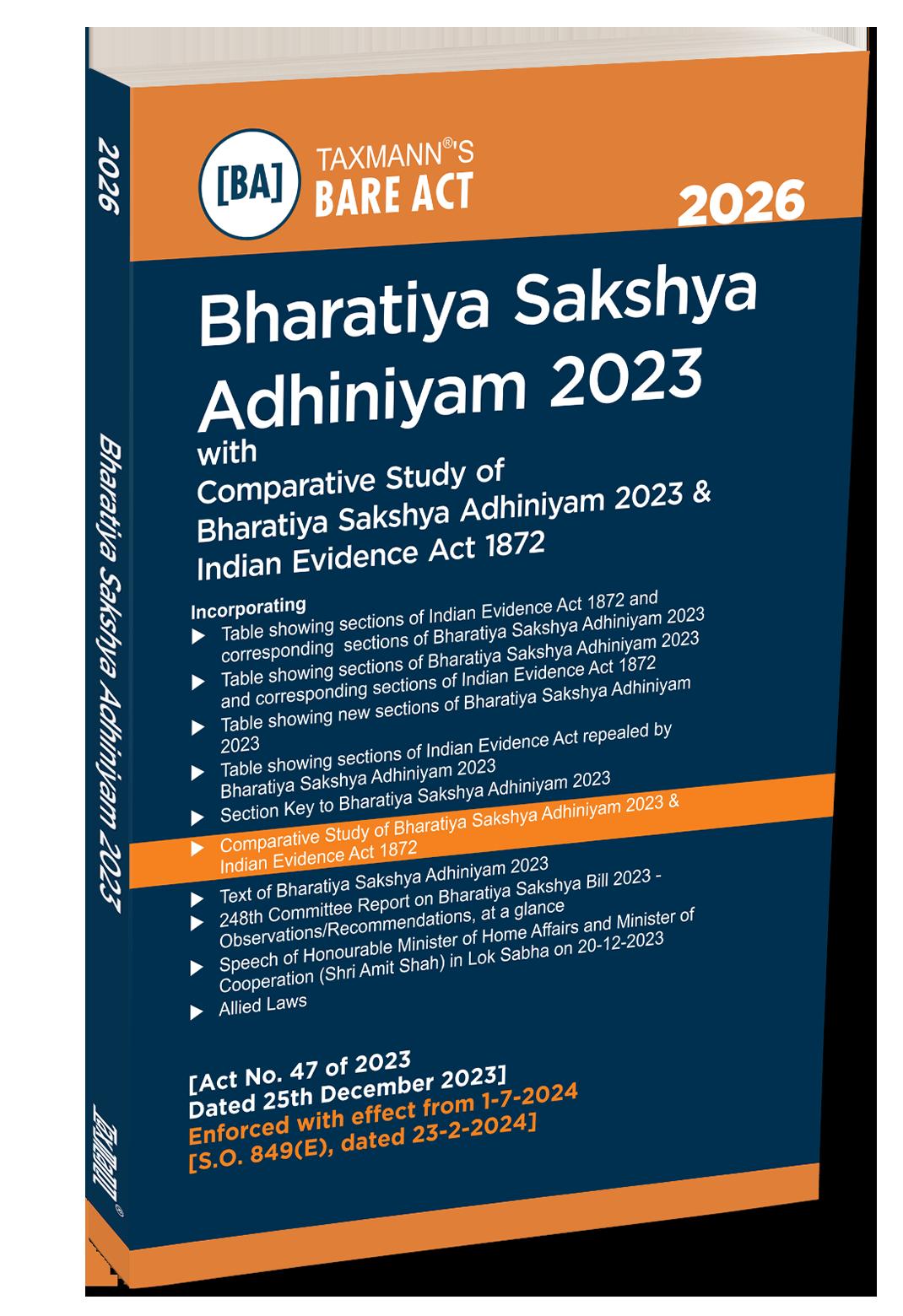
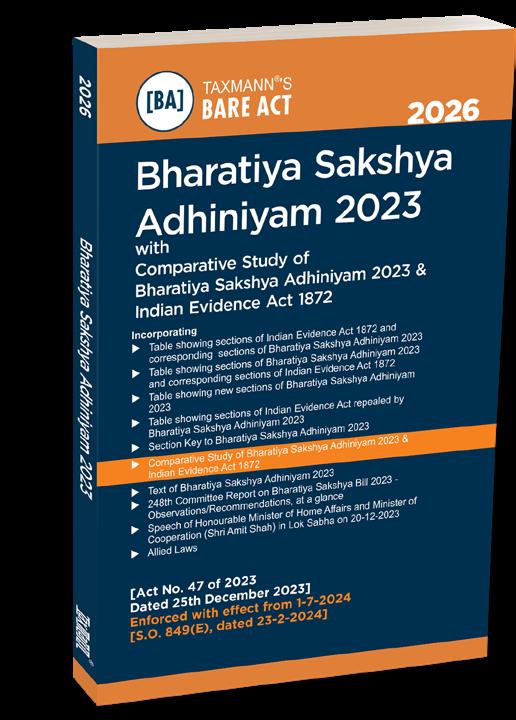
Bharatiya Sakshya Adhiniyam 2023 [Bare Act] by Taxmann is a compact, highly affordable Bare Act edition that presents the complete statutory text of India’s new law of evidence. This legislation replaces the Indian Evidence Act 1872 and introduces a modern evidentiary framework aligned with contemporary criminal justice requirements, including explicit recognition of electronic and digital records. The 2026 Edition is designed to ensure maximum accessibility at a low price point, while retaining all essential statutory reference tools, making it an ideal and economical reference to the new evidence law.
This book is intended for the following audience:
• Law Students & Judicial Aspirants
• Advocates & Trial Lawyers
• Judges & Judicial Officers
• Police Officers & Investigating Agencies
• Libraries & Institutions
The Present Publication is the 2026 Edition, covering the amended and updated text of the Bharatiya Sakshya Adhiniyam [Act No. 47 of 2023], with the following noteworthy features:
• [Complete Bare Act] Full and authentic text of the Bharatiya Sakshya Adhiniyam, 2023
• [Comparative Study Included] Comparative Study of the Bharatiya Sakshya Adhiniyam 2023 and the Indian Evidence Act 1872
• [Extensive Comparative Tables]
o Table showing sections of the Indian Evidence Act 1872 and corresponding sections of the Bharatiya Sakshya Adhiniyam 2023
o Table showing sections of the Bharatiya Sakshya Adhiniyam 2023 and corresponding sections of the Indian Evidence Act 1872
o Table showing new sections introduced under the Bharatiya Sakshya Adhiniyam 2023
o Table showing sections of the Indian Evidence Act 1872 repealed by the Bharatiya Sakshya Adhiniyam 2023
• [Section Key] Dedicated Section Key for quick location and cross-reference of provisions
• [Updated Law] Reflects the law as enacted and notified, including the commencement notification
• [Affordable Edition] Section notes intentionally excluded to keep the publication economical and widely accessible