Sample Read
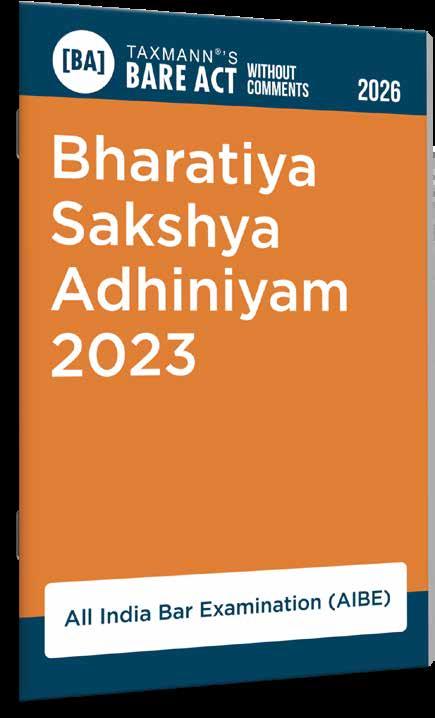

© Taxmann Price : ` 95
Published by :
Taxmann Publications (P.) Ltd.
Sales & Marketing : 59/32, New Rohtak Road, New Delhi-110 005 India
Phone : +91-11-45562222
Website : www.taxmann.com
E-mail : sales@taxmann.com
Regd. Office : 21/35, West Punjabi Bagh, New Delhi-110 026 India
Printed at :
Tan Prints (India) Pvt. Ltd.
44 Km. Mile Stone, National Highway, Rohtak Road Village Rohad, Distt. Jhajjar (Haryana) India
E-mail : sales@tanprints.com
Disclaimer
Every effort has been made to avoid errors or omissions in this publication. In spite of this, errors may creep in. Any mistake, error or discrepancy noted may be brought to our notice which shall be taken care of in the next edition. It is notified that neither the publisher nor the author or seller will be responsible for any damage or loss of action to any one, of any kind, in any manner, therefrom. It is suggested that to avoid any doubt the reader should cross-check all the facts, law and contents of the publication with original Government publication or notifications.
No part of this book may be reproduced or copied in any form or by any means [graphic, electronic or mechanical, including photocopying, recording, taping, or information retrieval systems] or reproduced on any disc, tape, perforated media or other information storage device, etc., without the written permission of the publishers. Breach of this condition is liable for legal action.
For binding mistake, misprints or for missing pages, etc., the publisher’s liability is limited to replacement within seven days of purchase by similar edition. All expenses in this connection are to be borne by the purchaser. All disputes are subject to Delhi jurisdiction only.
BHARATIYA SAKSHYA ADHINIYAM, 2023
SECTION PAGE
PART I CHAPTER I PRELIMINARY
1. Short title, application and commencement 1 2. Definitions 1
PART II CHAPTER II
RELEVANCY OF FACTS
3. Evidence may be given of facts in issue and relevant facts 4 Closely connected facts
4. Relevancy of facts forming part of same transaction 4
5. Facts which are occasion, cause or effect of facts in issue or relevant facts 5
6. Motive, preparation and previous or subsequent conduct 5
7. Facts necessary to explain or introduce fact in issue or relevant facts 6
8. Things said or done by conspirator in reference to common design 7 9. When facts not otherwise relevant become relevant 8 10. Facts tending to enable Court to determine amount are relevant in suits for damages 8
Facts relevant when right or custom is in question 8 12. Facts showing existence of state of mind, or of body or bodily feeling 8 13. Facts bearing on question whether act was accidental or intentional 10
by persons whose position must be proved as against party to suit
18. Admissions by persons expressly referred to by party to suit 12 19. Proof of admissions against persons making them, and by or on their behalf 12
20. When oral admissions as to contents of documents are relevant 13 21. Admissions in civil cases when relevant 13 22. Confession caused by inducement, threat, coercion or promise, when irrelevant in criminal proceeding 13 23. Confession to police officer 14 24. Consideration of proved confession affecting person making it and others jointly under trial for same offence 14 25. Admissions not conclusive proof, but may estop 14
by persons who cannot be called as witnesses 26. Cases in which statement of relevant fact by person who is dead or cannot be found, etc., is relevant 15 27. Relevancy of certain evidence for proving, in subsequent proceeding, truth of facts therein stated 17
Statements made under special circumstances
28. Entries in books of account when relevant 17
29. Relevancy of entry in public record or an electronic record made in performance of duty 17
30. Relevancy of statements in maps, charts and plans 18
31. Relevancy of statement as to fact of public nature contained in certain Acts or notifications 18
32. Relevancy of statements as to any law contained in law books including electronic or digital form 18
How much of a statement is to be proved
33. What evidence to be given when statement forms part of a conversation, document, electronic record, book or series of letters or papers 18
Judgments of courts when relevant
34. Previous judgments relevant to bar a second suit or trial 18
35. Relevancy of certain judgments in probate, etc., jurisdiction 19
36. Relevancy and effect of judgments, orders or decrees, other than those mentioned in section 35 19
37. Judgments, etc., other than those mentioned in sections 34, 35 and 36 when relevant 19
38. Fraud or collusion in obtaining judgment, or incompetency of Court, may be proved 20
Opinions of third persons when relevant
39. Opinions of experts 20
40. Facts bearing upon opinions of experts 21
41. Opinion as to handwriting and signature, when relevant 21
42. Opinion as to existence of general custom or right, when relevant 22
43. Opinion as to usages, tenets, etc., when relevant 22
44. Opinion on relationship, when relevant 22
45. Grounds of opinion, when relevant 23
46. In civil cases character to prove conduct imputed, irrelevant
47. In criminal cases previous good character relevant 23
48. Evidence of character or previous sexual experience not relevant in certain cases 23
49. Previous bad character not relevant, except in reply 23
50. Character as affecting damages
PART III ON PROOF
54.
64. Rules as to notice to
65. Proof of signature and handwriting of person alleged to have signed or written document produced
66. Proof as to electronic signature
67. Proof of execution of document required by law to be attested
68. Proof where no attesting witness found
69. Admission of execution by party to attested document
70. Proof when attesting witness denies execution
71. Proof of document not required by law to be attested
72. Comparison of signature, writing or seal with others admitted or proved
78. Presumption as to genuineness of certified copies
79. Presumption as to documents produced as record of evidence, etc.
80. Presumption as to Gazettes, newspapers, and other documents
81. Presumption as to Gazettes in electronic or digital record
82. Presumption as to maps or plans made by authority of Government
83. Presumption as to collections of laws and reports of decisions
84. Presumption as to powers-of-attorney
85. Presumption as to electronic agreements
86. Presumption as to electronic records and electronic signatures
87. Presumption as to Electronic Signature Certificates
SECTION
88. Presumption as to certified copies of foreign judicial records
89. Presumption as to books, maps and charts
90. Presumption as to electronic messages 37
91. Presumption as to due execution, etc., of documents not produced 37
92. Presumption as to documents thirty years old 37
93. Presumption as to electronic records five years old 38
CHAPTER VI OF THE EXCLUSION OF ORAL EVIDENCE BY DOCUMENTARY EVIDENCE
94. Evidence of terms of contracts, grants and other dispositions of property reduced to form of document 38
95. Exclusion of evidence of oral agreement
96. Exclusion of evidence to explain or amend ambiguous document
97. Exclusion of evidence against application of document to existing facts
98. Evidence as to document unmeaning in reference to existing facts 41
99. Evidence as to application of language which can apply to one only of several persons 41
100. Evidence as to application of language to one of two sets of facts, to neither of which the whole correctly applies 41 101. Evidence as to meaning of illegible characters, etc.
102. Who may give evidence of agreement varying terms of document
103. Saving of provisions of Indian Succession Act relating to wills
PART
111. Burden of proving that person is alive who has not been heard of for seven years
112. Burden of proof as to relationship in the cases of partners, landlord and tenant, principal and agent
127.
134.
135. Production of title-deeds of witness not a party
136. Production of documents or electronic records which another person, having possession, could refuse to produce
137. Witness not excused from answering on ground that answer will criminate
CHAPTER X
EXAMINATION
Procedure of Court in case of question being asked without reasonable grounds
SECTION
154. Indecent and scandalous questions 57
155. Questions intended to insult or annoy 57
156. Exclusion of evidence to contradict answers to questions testing veracity 57
157. Question by party to his own witness 58
158. Impeaching credit of witness 58
159. Questions tending to corroborate evidence of relevant fact, admissible 59
160. Former statements of witness may be proved to corroborate later testimony as to same fact 59
161. What matters may be proved in connection with proved statement relevant under section 26 or 27 59
162. Refreshing memory 59
163. Testimony to facts stated in document mentioned in section 162 60
164. Right of adverse party as to writing used to refresh memory 60
165. Production of documents 60
166. Giving, as evidence, of document called for and produced on notice 60
167. Using, as evidence, of document production of which was refused on notice 60
168. Judge’s power to put questions or order production 61
CHAPTER XI OF IMPROPER ADMISSION AND REJECTION OF EVIDENCE
169. No new trial for improper admission or rejection of evidence 61
CHAPTER XII REPEAL AND SAVINGS
170. Repeal and savings 61 SCHEDULE 63

Bharatiya Sakshya Adhiniyam, 2023
[47 OF 2023]
An Act to consolidate and to provide for general rules and principles of evidence for fair trial.
BE it enacted by Parliament in the Seventy-fourth Year of the Republic of India as follows:—
PART I CHAPTER I PRELIMINARY
Short title, application and commencement.
1. (1) This Act may be called the Bharatiya Sakshya Adhiniyam, 2023.
(2) It applies to all judicial proceedings in or before any Court, including Courtsmartial, but not to affidavits presented to any Court or officer, nor to proceedings before an arbitrator.
(3)It shall come into force on such date as the Central Government may, by notification in the Official Gazette†, appoint.
Corresponding Provision : Section 1 of Indian Evidence Act, 1872 Definitions.
2. (1) In this Adhiniyam, unless the context otherwise requires,—
(a) “Court” includes all Judges and Magistrates, and all persons, except arbitrators, legally authorised to take evidence;
Corresponding Provision : Section 3, para 1 of Indian Evidence Act, 1872
(b) “conclusive proof” means when one fact is declared by this Adhiniyam to be conclusive proof of another, the Court shall, on proof of the one fact, regard the other as proved, and shall not allow evidence to be given for the purpose of disproving it;
Corresponding Provision : Section 4, para 3 of Indian Evidence Act, 1872 1
† Notification No. S.O. 849(E), dated 23-2-2024 - In exercise of the powers conferred by sub-section (3) of section 1 of the Bharatiya Sakshya Adhiniyam, 2023 (47 of 2023), the Central Government hereby appoints the 1st day of July, 2024 as the date on which the provisions of the said Adhiniyam, shall come into force.
S. 2
(
BHARATIYA SAKSHYA ADHINIYAM, 2023
c) “disproved” in relation to a fact, means when, after considering the matters before it, the Court either believes that it does not exist, or considers its non-existence so probable that a prudent man ought, under the circumstances of the particular case, to act upon the supposition that it does not exist;
Corresponding Provision : Section 3, para 8 of Indian Evidence Act, 1872
(d) “document” means any matter expressed or described or otherwise recorded upon any substance by means of letters, figures or marks or any other means or by more than one of those means, intended to be used, or which may be used, for the purpose of recording that matter and includes electronic and digital records.
Illustrations
(i) A writing is a document.
(ii) Words printed, lithographed or photographed are documents.
(iii) A map or plan is a document.
(iv) An inscription on a metal plate or stone is a document.
(v) A caricature is a document.
(vi) An electronic record on emails, server logs, documents on computers, laptop or smartphone, messages, websites, locational evidence and voice mail messages stored on digital devices are documents;
Corresponding Provision : Section 3, para 5 of Indian Evidence Act, 1872
(e) “evidence” means and includes—
(i) all statements including statements given electronically which the Court permits or requires to be made before it by witnesses in relation to matters of fact under inquiry and such statements are called oral evidence;
(ii) all documents including electronic or digital records produced for the inspection of the Court and such documents are called documentary evidence;
Corresponding Provision : Section 3, para 6 of Indian Evidence Act, 1872
(f) “fact” means and includes—
(i) any thing, state of things, or relation of things, capable of being perceived by the senses;
(ii) any mental condition of which any person is conscious.
Illustrations
(i) That there are certain objects arranged in a certain order in a certain place, is a fact.
(ii) That a person heard or saw something, is a fact.
(iii) That a person said certain words, is a fact.
(iv) That a person holds a certain opinion, has a certain intention, acts in good faith, or fraudulently, or uses a particular word in a particular sense, or is or was at a specified time conscious of a particular sensation, is a fact;
Corresponding Provision : Section 3, para 2 of Indian Evidence Act, 1872
CH. I : PRELIMINARY
(g) “facts in issue” means and includes any fact from which, either by itself or in connection with other facts, the existence, non-existence, nature or extent of any right, liability or disability, asserted or denied in any suit or proceeding, necessarily follows.
Explanation.—Whenever, under the provisions of the law for the time being in force relating to Civil Procedure, any Court records an issue of fact, the fact to be asserted or denied in the answer to such issue is a fact in issue.
Illustrations
A is accused of the murder of B. At his trial, the following facts may be in issue:—
(i) That A caused B’s death.
(ii) That A intended to cause B’s death.
(iii) That A had received grave and sudden provocation from B.
(iv) That A, at the time of doing the act which caused B’s death, was, by reason of unsoundness of mind, incapable of knowing its nature;
Corresponding Provision : Section 3, para 4 of Indian Evidence Act, 1872
(h) “may presume”.—Whenever it is provided by this Adhiniyam that the Court may presume a fact, it may either regard such fact as proved, unless and until it is disproved or may call for proof of it;
Corresponding Provision : Section 4, para 1 of Indian Evidence Act, 1872
(i) “not proved”.—A fact is said to be not proved when it is neither proved nor disproved;
Corresponding Provision : Section 3, para 9 of Indian Evidence Act, 1872
(j) “proved”.—A fact is said to be proved when, after considering the matters before it, the Court either believes it to exist, or considers its existence so probable that a prudent man ought, under the circumstances of the particular case, to act upon the supposition that it exists;
Corresponding Provision : Section 3, para 7 of Indian Evidence Act, 1872
(k) “relevant”.—A fact is said to be relevant to another when it is connected with the other in any of the ways referred to in the provisions of this Adhiniyam relating to the relevancy of facts;
Corresponding Provision : Section 3, para 3 of Indian Evidence Act, 1872
(l) “shall presume”.—Whenever it is directed by this Adhiniyam that the Court shall presume a fact, it shall regard such fact as proved, unless and until it is disproved.
Corresponding Provision : Section 4, para 2 of Indian Evidence Act, 1872
(2) Words and expressions used herein and not defined but defined in the Information Technology Act, 2000 (21 of 2000), the Bharatiya Nagarik Suraksha Sanhita, 2023 and the Bharatiya Nyaya Sanhita, 2023 shall have the same meanings as assigned to them in the said Act and Sanhitas.
BHARATIYA
SAKSHYA ADHINIYAM 2023 –BARE ACT WITHOUT COMMENTS | AIBE
AUTHOR : Taxmann's Editorial Board
PUBLISHER : Taxmann Publications
DATE OF PUBLICATION : February 2026
EDITION : 2026 Edition
ISBN NO : 9789371264075
NO. OF PAGES : 80
BINDING TYPE : Paperback
Rs. 95
DESCRIPTION
Bharatiya Sakshya Adhiniyam 2023 [Bare Act without Comments] by Taxmann for the All India Bar Examination (AIBE) provides the complete, unaltered text. It ensures readers access the law exactly as enacted by Parliament, without commentary or interpretation. The Present Publication is the 2026 Edition, covering the amended and updated text of the Bharatiya Sakshya Adhiniyam 2023 [Act No. 47 of 2023], with the following noteworthy features:
• [Authentic Text] Exact reproduction of statutory provisions
• [Updated to 2026] Includes amendments and the commencement notification dated 1st July 2024
• [Digital Coverage] Recognises electronic records, signatures, and digital evidence
• [Exam Ready] Free from case law or notes, ideal for AIBE & other exams
• [Affordable Format] Compact, student-friendly, and reasonably priced