

Sample Read

DIVISION
ONE
PROHIBITION OF BENAMI PROPERTY TRANSACTIONS ACT, 1988 WITH RULES
DIVISION TWO
BLACK MONEY (UNDISCLOSED FOREIGN INCOME AND ASSETS) AND IMPOSITION OF TAX ACT, 2015 WITH RULES
Black Money (Undisclosed Foreign Income and Assets) and Imposition of Tax Act, 2015 as amended by Finance Act, 2026
DIVISION THREE
FUGITIVE ECONOMIC OFFENDERS ACT, 2018 WITH RULES
Declaration of Fugitive Economic Offenders (Forms and Manner of Filing Application) Rules, 2018
Fugitive Economic Offenders (Manner of Attachment of Property) Rules, 2018
Fugitive Economic Offenders (Issuance of Provisional Attachment Order) Rules, 2018 3.29
Fugitive Economic Offenders (Procedure for Conducting Search and Seizure) Rules, 2018 3.35
Fugitive Economic Offenders (Manner and Conditions for Receipt and Management of Confiscated Properties) Rules, 2018 3.43
Economic Offenders (Procedure for Sending Letter of Request to Contracting State) Rules, 2018
DIVISION FOUR
PREVENTION OF MONEY-LAUNDERING ACT, 2002 WITH RULES
Prevention of Money-laundering Act, 2002 as amended upto date 4.3
Prevention of Money-laundering (the Manner of Forwarding a Copy of the Order of Provisional Attachment of Property along with the Material, and Copy of the Reasons along with the Material in respect of Survey, to the Adjudicating Authority and its Period of Retention) Rules, 2005
Prevention of Money-laundering (Receipt and Management of Confiscated Properties) Rules, 2005 4.81
Prevention of Money-laundering (Maintenance of Records) Rules, 2005 4.87
Prevention of Money-laundering (Forms, Search and Seizure or Freezing and the Manner of Forwarding the Reasons and Material to the Adjudicating Authority, Impounding and
Custody of Records and the Period of Retention) Rules, 2005
Prevention of Money-laundering (the Forms and the Manner of Forwarding a Copy of Order of Arrest of a Person along with the Material to the Adjudicating Authority and its Period of Retention) Rules, 2005
Prevention of Money-laundering (the Manner of Forwarding a Copy of the Order of Retention of Seized Property along with the Material to the Adjudicating Authority and the Period of its Retention) Rules, 2005
Prevention of Money-laundering (Manner of Receiving the Records authenticated Outside India) Rules, 2005
of Money-laundering (Appeal) Rules, 2005
of Money-laundering (Issuance of Provisional Attachment Order) Rules, 2013
Prevention of Money-laundering (Taking Possession of Attached or Frozen Properties Confirmed by the Adjudicating Authority) Rules, 2013 4.193
DIVISION FIVE FOREIGN ASSETS OF SMALL TAXPAYERS DISCLOSURE SCHEME, 2026

1[PROHIBITION OF BENAMI PROPERTY TRANSACTIONS ACT, 1988]
[45 OF 1988]*
[AS AMENDED UPTO DATE]
An Act to prohibit benami transactions and the right to recover property held benami and for matters connected therewith or incidental thereto.
BE it enacted by Parliament in the Thirty-ninth Year of the Republic of India as follows :—
2[CHAPTER I
PRELIMINARY]
Short title, extent and commencement.
1. (1) This Act may be called the 1[Prohibition of Benami Property Transactions Act, 1988] (45 of 1988).
(2)It extends to the whole of India 2a[***].
(3)The provisions of sections 3, 5 and 8 shall come into force at once, and the remaining provisions of this Act shall be deemed to have come into force on the 19th day of May, 1988.
3[Definitions.
2. In this Act, unless the context otherwise requires,— (1)“Adjudicating Authority" means the Adjudicating Authority 3a[referred to in] section 7;
*Dated 5-9-1988.
1.Substituted for “Benami Transactions (Prohibition) Act, 1988” by the Benami Transactions (Prohibition) Amendment Act, 2016, w.e.f. 1-11-2016.
2.Inserted, ibid.
2a.Words “except the State of Jammu and Kashmir” omitted by the Jammu and Kashmir Reorganisation Act, 2019, w.e.f. 9-8-2019.
3.Substituted by the Benami Transactions (Prohibition) Amendment Act, 2016, w.e.f. 1-112016. Prior to its substitution, section 2 read as under : ‘2. Definitions.—In this Act, unless the context otherwise, requires,—
(a)“benami transaction” means any transaction in which property is transferred to one person for a consideration paid or provided by another person;
(b)“prescribed” means prescribed by rules made under this Act;
(c)“property” means property of any kind, whether movable or immovable, tangible or intangible, and includes any right or interest in such property.’
3a.Substituted for “appointed under” by the Finance Act, 2021, w.e.f. 1-7-2021. 1.7
(2)“Administrator" means an Income-tax Officer as defined in clause (25) of section 2 of the Income-tax Act, 1961 (43 of 1961);
(3)“Appellate Tribunal" means the Appellate Tribunal established under section 30;
(4)“Approving Authority" means an Additional Commissioner or a Joint Commissioner as defined in clauses (1C) and (28C) respectively of section 2 of the Income-tax Act, 1961 (43 of 1961);
(5)“attachment" means the prohibition of transfer, conversion, disposition or movement of property, by an order issued under this Act;
(6)“authority" means an authority referred to in sub-section (1) of section 18;
(7)“banking company" means a company to which the provisions of the Banking Regulation Act, 1949 (10 of 1949), applies and includes any bank or banking institution referred to in section 51 of that Act;
(8) “benami property" means any property which is the subject matter of a benami transaction and also includes the proceeds from such property;
(9) “benami transaction" means,—
(A)a transaction or an arrangement—
(
(
(a)where a property is transferred to, or is held by, a person, and the consideration for such property has been provided, or paid by, another person; and
(b)the property is held for the immediate or future benefit, direct or indirect, of the person who has provided the consideration,
except when the property is held by—
(i)a Karta, or a member of a Hindu undivided family, as the case may be, and the property is held for his benefit or benefit of other members in the family and the consideration for such property has been provided or paid out of the known sources of the Hindu undivided family;
(ii)a person standing in a fiduciary capacity for the benefit of another person towards whom he stands in such capacity and includes a trustee, executor, partner, director of a company, a depository or a participant as an agent of a depository under the Depositories Act, 1996 (22 of 1996) and any other person as may be notified by the Central Government for this purpose;
iii)any person being an individual in the name of his spouse or in the name of any child of such individual and the consideration for such property has been provided or paid out of the known sources of the individual;
iv)any person in the name of his brother or sister or lineal ascendant or descendant, where the names of brother or sister or lineal ascendant or descendent and the individual S. 2
(
(
CH. I : PRELIMINARY
appear as joint-owners in any document, and the consideration for such property has been provided or paid out of the known sources of the individual; or
B)a transaction or an arrangement in respect of a property carried out or made in a fictitious name; or
(C)a transaction or an arrangement in respect of a property where the owner of the property is not aware of, or, denies knowledge of, such ownership;
D)a transaction or an arrangement in respect of a property where the person providing the consideration is not traceable or is fictitious.
Explanation.—For the removal of doubts, it is hereby declared that benami transaction shall not include any transaction involving the allowing of possession of any property to be taken or retained in part performance of a contract referred to in section 53A of the Transfer of Property Act, 1882 (4 of 1882), if, under any law for the time being in force,—
(i)consideration for such property has been provided by the person to whom possession of property has been allowed but the person who has granted possession thereof continues to hold ownership of such property;
(ii)stamp duty on such transaction or arrangement has been paid; and
(iii)the contract has been registered;
(10) “benamidar” means a person or a fictitious person, as the case may be, in whose name the benami property is transferred or held and includes a person who lends his name;
(11)“Bench” means a Bench of the Adjudicating Authority or the Appellate Tribunal, as the case may be;
(12)“beneficial owner” means a person, whether his identity is known or not, for whose benefit the benami property is held by a benamidar;
(13)“Board” means the Central Board of Direct Taxes constituted under the Central Boards of Revenue Act, 1963 (54 of 1963);
(14)“director” shall have the same meaning as assigned to it in clause (34) of section 2 of the Companies Act, 2013 (18 of 2013);
(15)“executor” shall have the same meaning as assigned to it in clause (c) of section 2 of the Indian Succession Act, 1925 (39 of 1925);
(16)“fair market value”, in relation to a property, means—
(i)the price that the property would ordinarily fetch on sale in the open market on the date of the transaction; and
(ii)where the price referred to in sub-clause (i) is not ascertainable, such price as may be determined in accordance with such manner as may be prescribed;
(17)“firm” shall have the same meaning as assigned to it in section 4 of the Indian Partnership Act, 1932 (9 of 1932) and shall include a limited 1.9
S. 2 PROHIBITION OF BENAMI PROPERTY TRANSACTIONS ACT, 1988 1.10
liability partnership as defined in the Limited Liability Partnership Act, 2008 (6 of 2009);
(18)“High Court” means—
(i)the High Court within the jurisdiction of which the aggrieved party ordinarily resides or carries on business or personally works for gain; 3b[***]
(ii)where the Government is the aggrieved party, the High Court within the jurisdiction of which the respondent, or in a case where there are more than one respondent, any of the respondents, ordinarily resides or carries on business or personally works for gain; 3c[and]
3c[(iii)the High Court within the jurisdiction of which the office of the Initiating Officer is located,––
(a)where the aggrieved party does not ordinarily reside or carry on business or personally work for gain in the jurisdiction of any High Court;
(b)where the Government is the aggrieved party and any of the respondents do not ordinarily reside or carry on business or personally work for gain in the jurisdiction of any High Court;]
(19)“Initiating Officer” means an Assistant Commissioner or a Deputy Commissioner as defined in clauses (9A) and (19A) respectively of section 2 of the Income-tax Act, 1961 (43 of 1961);
(20)“Member” means the Chairperson or the Member of the Adjudicating Authority or the Appellate Tribunal, as the case may be;
(21)“notification” means a notification published in the Official Gazette and the expression "notified" shall be construed accordingly;
(22)“partner” shall have the same meaning as assigned to it in section 4 of the Indian Partnership Act, 1932 (9 of 1932), and shall include,—
(a)any person who, being a minor, has been admitted to the benefits of partnership; and
(b)a partner of a limited liability partnership formed and registered under the Limited Liability Partnership Act, 2008 (6 of 2009);
(23)“partnership” shall have the same meaning as assigned to it in section 4 of the Indian Partnership Act, 1932 (9 of 1932), and shall include a limited liability partnership formed and registered under the Limited Liability Partnership Act, 2008 (6 of 2009);
(24)“person” shall include—
(i)an individual;
(ii)a Hindu undivided family;
(iii)a company;
(iv)a firm;
3b.Word “and” omitted by the Finance Act, 2023, w.e.f. 1-4-2023. 3c.Inserted, ibid.
(v)an association of persons or a body of individuals, whether incorporated or not;
(vi)every artificial juridical person, not falling under sub-clauses (i) to (v);
(25)“prescribed” means prescribed by rules made under this Act;
(26)“property” means assets of any kind, whether movable or immovable, tangible or intangible, corporeal or incorporeal and includes any right or interest or legal documents or instruments evidencing title to or interest in the property and where the property is capable of conversion into some other form, then the property in the converted form and also includes the proceeds from the property;
(27)“public financial institution” shall have the same meaning as assigned to it in clause (72) of section 2 of the Companies Act, 2013 (18 of 2013);
(28)“Special Court” means a Court of Session designated as Special Court under sub-section (1) of section 50;
(29)“transfer” includes sale, purchase or any other form of transfer of right, title, possession or lien;
(30)“trustee” means the trustee as defined in the section 3 of the Indian Trusts Act, 1882 (2 of 1882);
(31)words and expressions used herein and not defined in this Act but defined in the Indian Trusts Act, 1882 (2 of 1882), the Indian Succession Act, 1925 (39 of 1925), the Indian Partnership Act, 1932 (9 of 1932), the Income-tax Act, 1961 (43 of 1961), the Depositories Act, 1996 (22 of 1996), the Prevention of Money-laundering Act, 2002 (15 of 2003), the Limited Liability Partnership Act, 2008 (6 of 2009) and the Companies Act, 2013 (18 of 2013), shall have the same meanings respectively assigned to them in those Acts.]
CASE LAWS
Section 2(9)
Criminal prosecution could not be initiated for transaction entered into prior to coming into force of Benami Transactions (Prohibition) Amendment Act, 2016 as sections 3 and 5 of unamended Act which dealt with criminal prosecution were unconstitutional from their inception; 2016 Act could only be applied prospectively; since section 2(9)(A) and section 2(9)(C) brought in statute vide Benami Transactions (Prohibition) Amendment Act, 2016, are substantive provisions creating offence of benami transaction and are substantially wider than definition of benami transaction under section 2(a) of unamended 1988 Act, section 2(9)(A) and section 2(9)(C) can only have effect prospectively from 1-11-2016 [Union of India v. Genpati Dealcom (P.) Ltd. [2022] 141 taxmann.com 389 (SC)/Asstt. CIT v. Nexus Feeds Ltd. [2023] 147 taxmann.com 176 (SC)
Section 2(19)
The notification issued by the Central Government in exercise of power under section 59 of the Act has specifically mentioned an Officer in the rank of Assistant Commissioner of Income Tax (Benami Prohibition)/Deputy Commissioner of Income Tax (Benami Prohibition) as Initiating Officer, to state that a Deputy
S. 3
PROHIBITION OF BENAMI PROPERTY TRANSACTIONS ACT, 1988 1.12
Commissioner of Income Tax other than the Deputy Commissioner of Income Tax (Benami Prohibition) could exercise jurisdiction, would be in direct conflict with the mandate contained in section 59(1) of the Act. - Cascade Energy (Pte.) Ltd. v. Union of India [2018] 90 taxmann.com 28 (Madras).
The Initiating Officer being not a Deputy Commissioner of Income-tax (Benami Prohibition), Deputy Commissioner of Income-tax, Corporate Circle could not have initiated proceedings under the Benami Act against the petitioner. - Cascade Energy (Pte.) Ltd. v. Union of India [2018] 90 taxmann.com 28 (Madras).
Since a statutory notification is issued specifying the authority who will be entitled to exercise power as an Initiating Officer, no other authority would be entitled to exercise such power and if done so, it would be without jurisdiction. Thus, as the Notification specifies the Deputy Commissioner of Income Tax (Benami Prohibition) as Initiating Officer, a Deputy Commissioner of Income Tax other than the Deputy Commissioner of Income Tax (Benami Prohibition) could not exercise jurisdiction to initiate proceedings under the Benami Act. - Cascade Energy (Pte.) Ltd. v. Union of India [2018] 90 taxmann.com 28 (Madras).
Section 2(21)
E-publication of the Gazette is the only mode of publication as on date as physical printing and publication of Government Gazette has been done away with. Therefore, the Notification No. SO 1620 dated 18-5-2017, having been e-published on 18-5-2017, it takes effect from the said date. Merely because same was uploaded online by the Government of India Press, New Delhi on the website of E-Gazette only on 22-5-2017, it could not be said that the said notification would come into effect on and after 22-5-2017. - Cascade Energy (Pte.) Ltd. v. Union of India [2018] 90 taxmann.com 28 (Madras).
4[CHAPTER II
PROHIBITION OF BENAMI TRANSACTIONS]
Prohibition of benami transactions.
3. (1) No person shall enter into any benami transaction.
(2) 5[***]
6[(2)] Whoever enters into any benami transaction shall be punishable with imprisonment for a term which may extend to three years or with fine or with both.
4.Inserted by the Benami Transactions (Prohibition) Amendment Act, 2016, w.e.f. 1-11-2016.
5.Omitted, ibid. Prior to its omission, sub-section (2), as substituted by the Depositories Act, 1996, w.r.e.f. 20-9-1995, read as under :
‘(2) Nothing in sub-section (1) shall apply to—
(a)the purchase of property by any person in the name of his wife or unmarried daughter and it shall be presumed, unless the contrary is proved, that the said property had been purchased for the benefit of the wife or the unmarried daughter; (b)the securities held by a—
(i)depository as a registered owner under sub-section (1) of section 10 of the Depositories Act, 1996;
(ii)participant as an agent of a depository.
Explanation.—The expressions “depository” and “participant” shall have the meanings respectively assigned to them in clauses (e) and (g) of sub-section (1) of section 2 of the Depositories Act, 1996.’
6.Sub-section (3) renumbered as sub-section (2), ibid.
7[(3) Whoever enters into any benami transaction on and after the date of commencement of the Benami Transactions (Prohibition) Amendment Act, 2016, shall, notwithstanding anything contained in sub-section (2), be punishable in accordance with the provisions contained in Chapter VII.]
(4) 8[***]
Prohibition of the right to recover property held benami.
4. (1) No suit, claim or action to enforce any right in respect of any property held benami against the person in whose name the property is held or against any other person shall lie by or on behalf of a person claiming to be the real owner of such property.
(2) No defence based on any right in respect of any property held benami, whether against the person in whose name the property is held or against any other person, shall be allowed in any suit, claim or action by or on behalf of a person claiming to be the real owner of such property.
(3) 9[***]
10[Property held benami liable to confiscation.
5. Any property, which is subject matter of benami transaction, shall be liable to be confiscated by the Central Government.
Prohibition on re-transfer of property by benamidar
6. (1) No person, being a benamidar shall re-transfer the benami property held by him to the beneficial owner or any other person acting on his behalf.
(2) Where any property is re-transferred in contravention of the provisions of sub-section (1), the transaction of such property shall be deemed to be null and void.
7.Inserted by the Benami Transactions (Prohibition) Amendment Act, 2016, w.e.f. 1-11-2016.
8.Omitted, ibid. Prior to its omission, sub-section (4) read as under : “(4) Notwithstanding anything contained in the Code of Criminal Procedure, 1973 (2 of 1974), an offence under this section shall be non-cognizable and bailable.”
9.Omitted by the Benami Transactions (Prohibition) Amendment Act, 2016, w.e.f. 1-11-2016.
Prior to its omission, sub-section (3) read as under :
“(3) Nothing in this section shall apply,—
(a)where the person in whose name the property is held is a coparcener in a Hindu undivided family and the property is held for the benefit of the coparceners in the family; or
(b)where the person in whose name the property is held is a trustee or other person standing in a fiduciary capacity, and the property is held for the benefit of another person for whom he is a trustee or towards whom he stands in such capacity.”
10.Substituted, ibid. Prior to their substitution, sections 5 and 6 read as under :
“5. Property held benami liable to acquisition.—(1) All properties held benami shall be subject to acquisition by such authority, in such manner and after following such procedure as may be prescribed.
(2) For the removal of doubts, it is hereby declared that no amount shall be payable for the acquisition of any property under sub-section (1).
6. Act not to apply in certain cases.—Nothing in this Act shall affect the provisions of section 53 of the Transfer of Property Act, 1882 (4 of 1882) or any law relating to transfer for an illegal purpose.”
1.13 CH. II : PROHIBITION OF BENAMI TRANSACTIONS S. 6
S. 10 PROHIBITION OF BENAMI PROPERTY TRANSACTIONS ACT, 1988 1.14
(3) The provisions of sub-sections (1) and (2) shall not apply to a transfer made in accordance with the provisions of section 190 of the Finance Act, 2016 (28 of 2016).]
11[CHAPTER III AUTHORITIES
11a[Adjudicating Authority.
7. The competent authority authorised under sub-section (1) of section 5 of the Smugglers and Foreign Exchange Manipulators (Forfeiture of Property) Act, 1976 (13 of 1976) shall be the Adjudicating Authority to exercise jurisdiction, powers and authority conferred by or under this Act.]
Composition of Authority.
8. 11b[***]
Qualifications for appointment of Chairperson and Members.
9. 11b[***]
Constitution of Benches of Adjudicating Authority.
10. 11b[***]
11.Chapter III, consisting of sections 7 to 23, inserted by the Benami Transactions (Prohibition) Amendment Act, 2016, w.e.f. 1-11-2016.
11a.Substituted by the Finance Act, 2021, w.e.f. 1-7-2021. Prior to its substitution, section 7 read as under :
“7. Adjudicating Authority.—The Central Government shall, by notification, appoint one or more Adjudicating Authorities to exercise jurisdiction, powers and authority conferred by or under this Act.”
11b.Omitted by the Finance Act, 2021, w.e.f. 1-7-2021. Prior to their omission, sections 8 to 10 read as under :
“8. Composition of Authority.—An Adjudicating Authority shall consist of a Chairperson and at least two other Members.
*9. Qualifications for appointment of Chairperson and Members.—(1) A person shall not be qualified for appointment as the Chairperson or a Member of the Adjudicating Authority unless he,—
(a)has been a member of the Indian Revenue Service and has held the post of Commissioner of Income-tax or equivalent post in that Service; or
(b)(i) has been a member of the Indian Legal Service and has held the post of Joint Secretary or equivalent post in that Service; or (ii) is qualified for appointment as District Judge.
(2) The Chairperson and other Members of the Adjudicating Authority shall be appointed by the Central Government in such manner as may be prescribed.
(3) The Central Government shall appoint the seniormost Member to be the Chairperson of the Adjudicating Authority.
10. Constitution of Benches of Adjudicating Authority.—(1) Subject to the provisions of this Act,—
(a)the jurisdiction of the Adjudicating Authority may be exercised by Benches thereof;
(b)a Bench may be constituted by the Chairperson of the Adjudicating Authority with two Members, as the Chairperson may deem fit;
(Contd. on page 1.15)
Benami Black Money & Money Laundering Laws
AUTHOR : Taxmann’s Editorial Board
PUBLISHER :
Taxmann
DATE OF PUBLICATION : April 2026
EDITION : 2026 Edition
ISBN NO : 9789375617167
No. of Pages : 588
BINDING TYPE : Paperback
Rs. 1,450
DESCRIPTION
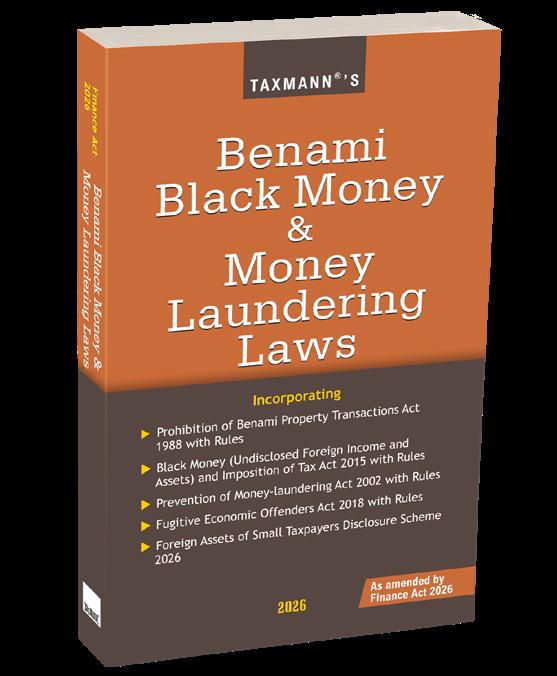
India’s enforcement architecture against illicit wealth, concealed assets, and cross-border financial offences rests on a cluster of interlocking statutes—each with its own procedural framework, adjudicatory hierarchy, and penal consequence. Taxmann’s Benami Black Money & Money Laundering Laws is the authoritative single-volume reference that consolidates all five of these foundational laws in their current, fully amended form. The 2026 Edition incorporates every amendment effected by the Finance Act 2026—including the newly enacted Foreign Assets of Small Taxpayers Disclosure Scheme 2026 (Sections 130–144), which makes its debut as a standalone Division.
The volume presents the complete text of the Prohibition of Benami Property Transactions Act 1988, the Black Money (Undisclosed Foreign Income and Assets) and Imposition of Tax Act 2015, the Fugitive Economic Offenders Act 2018, and the Prevention of Money-Laundering Act 2002—each with its subsidiary rules, regulations, circulars, notifications, and governing case law. At 588 pages, it serves as the practitioner’s complete reference for India’s anti-black money statutory regime.
This title is designed for a wide but specialised readership:
• Advocates and Litigators
• Chartered Accountants, Company Secretaries, and Tax Professionals
• Enforcement Directorate and Income Tax Officers
• Corporate Counsel and Compliance Teams
• Academicians and Researchers
• High-net-worth Individuals and NRIs
• Banks, NBFCs, and Other Reporting Entities
The Present Publication is the 2026 Edition and amended by the Finance Act 2026. This book is edited by Taxmann’s Editorial Board with the following coverage.
• [Comprehensive Statutory Coverage] Five major statutes—with their full complement of subsidiary rules, scheme regulations, and adjudicatory regulations—are consolidated in a single, coherently organised volume
• [Updated to Finance Act 2026] The Black Money Act 2015, PMLA 2002, and the Benami Act 1988 are reproduced with all amendments incorporated up to and including the Finance Act 2026, with precise amendment footnotes indicating the amending act, date of effect, and superseded text
• [Foreign Assets of Small Taxpayers Disclosure Scheme 2026] Division Five reproduces, in full, Sections 130 to 144 of the Finance Act 2026—a limited-window amnesty for small taxpayers with undisclosed foreign assets not exceeding ₹1 crore, with a structured tax-plus-penalty regime and immunity from prosecution
• [Embedded Case Law] Annotated Supreme Court and High Court decisions are integrated under individual sections of the Benami Act and Black Money Act divisions, providing immediate judicial context
• [Official Notifications and Circulars] Each Division carries relevant gazette notifications, CBDT circulars, and ministerial instructions—including PMLA notifications on Aadhaar authentication, appointment of Special Public Prosecutors, and SEBI-intermediary KYC obligations
• [Complete Rules and Scheme Texts] All subsidiary rules—including the seven sets of Fugitive Economic Offenders Rules 2018, the full suite of Prevention of Money-Laundering Rules 2005, and the Adjudicating Authority (Procedure) Regulations 2013—are reproduced in complete and current form
• [Amendment Trail Transparency] Every substituted, inserted, or omitted provision is footnoted with the amending instrument, effective date, and verbatim prior text—enabling practitioners to establish the state of the law at any point in the amendment history, which is critical in enforcement proceedings where liability turns on the date of the alleged transaction
• [Benami Transactions Informants Reward Scheme 2018] The complete Reward Scheme is included, enabling compliance officers to advise on enforcement risk and informant mechanics