Sample Read
© Taxmann Price : ` 85 Law stated in this book is as updated till 10th September, 2026 Published by : Taxmann Publications (P.) Ltd. Sales & Marketing : 59/32, New Rohtak Road, New Delhi-110 005 India Phone : +91-11-45562222 Website : www.taxmann.com E-mail : sales@taxmann.com Regd. Office : 21/35, West Punjabi Bagh, New Delhi-110 026 India Printed at : Tan Prints (India) Pvt. Ltd. 44 Km. Mile Stone, National Highway, Rohtak Road Village Rohad, Distt. Jhajjar (Haryana) India E-mail : sales@tanprints.com Disclaimer Every effort has been made to avoid errors or omissions in this publication. In spite of this, errors may creep in. Any mistake, error or discrepancy noted may be brought to our notice which shall be taken care of in the next edition. It is notified that neither the publisher nor the author or seller will be responsible for any damage or loss of action to any one, of any kind, in any manner, therefrom. It is suggested that to avoid any doubt the reader should cross-check all the facts, law and contents of the publication with original Government publication or notifications. No part of this book may be reproduced or copied in any form or by any means [graphic, electronic or mechanical, including photocopying, recording, taping, or information retrieval systems] or reproduced on any disc, tape, perforated media or other information storage device, etc., without the written permission of the publishers. Breach of this condition is liable for legal action. For binding mistake, misprints or for missing pages, etc., the publisher’s liability is limited to replacement within seven days of purchase by similar edition. All expenses in this connection are to be borne by the purchaser. All disputes are subject to Delhi jurisdiction only.
Contents Table showing sections of Bankers’ Books Evidence Act, 1891 and corresponding sections of Bankers’ Books Evidence Act, 2026
I-7
Table showing sections of Bankers’ Books Evidence Act, 2026 and corresponding sections of Bankers’ Books Evidence Act, 1891
I-9
Comparative study of Bankers’ Books Evidence Act, 2026 visà-vis Bankers’ Books Evidence Act, 1891
I-11
BANKERS’ BOOKS EVIDENCE ACT, 2026 PAGE
1. Short title and commencement
1
2. Definitions
2
3. Conditions for a certified copy
4
4. Power to extend provisions of Act
6
5. Mode of proof of entries in bankers’ books
7
6. Admissibility of electronic or digital records
7
7. Conditions for admissibility of records maintained in electronic or digital form
8
8. Case in which officer of bank not compellable to produce books
9
9. Inspection of books by order of Court
11
10. Costs
12
11. Order of Court to be construed as order made by specified officer
12
12. Power of Central Government to amend Schedules
13
13. Protection of action taken in good faith
13
14. Power to remove difficulties
13
I-5
CONTENTS
I-6 PAGE
15. Laying before Parliament
14
16. Repeal and savings
14
FIRST SCHEDULE
15
SECOND SCHEDULE
15
STATEMENT OF OBJECTS AND REASONS
17
SUBJECT INDEX
19
APPENDIX: Provisions of other Acts referred to in Bankers’ Books Evidence Act
21
Bankers’ Books Evidence Act, 2026* [15 OF 2026]
An Act to provide for law relating to evidence with respect to bankers’ books and to align it with contemporary digital banking practices and for matters connected therewith or incidental thereto. BE it enacted by Parliament in the Seventy-seventh Year of the Republic of India as follows:— COMMENTS
The Bankers’ Books Evidence Act, 1891 was enacted to facilitate the use of certified copies of bank records as evidence in legal proceedings without requiring production of the original records. The Act was enacted at a time when banking records were predominantly maintained in physical form. With the advancement of technology and growth of digital banking, bank records are increasingly created, stored and maintained using contemporary technology. It has, therefore, become necessary to modernise and strengthen the existing legal framework to meet the requirements of the present banking system by repealing the 1891 Act and by replacing it with a new Act - the Bankers’ Books Evidence Act, 2026.
Short title and commencement. 1. (1) This Act may be called the Bankers’ Books Evidence Act, 2026. (2) It shall come into force on such date1 as the Central Government may, by notification in the Official Gazette, appoint. COMMENTS SECTION NOTES
The Bankers’ Books Evidence Act, 2026 (‘this Act’ or ‘the 2026 Act’) received the assent of the President on 13th August, 2026.
*Dated 13-8-2026. 1. NOTIFICATION NO. S.O. 5041(E), DATED 10-9-2026.—In exercise of the powers conferred by sub-section (2) of section 1 of the Bankers’ Books Evidence Act, 2026 (15 of 2026), the Central Government hereby appoints the 1st day of October, 2026 as the date on which the provisions of the said Act Act shall come into force.
1
S. 2
BANKERS’ BOOKS EVIDENCE ACT, 2026
2
The Central Government has, vide Notification No. S.O. 5041(E), dated 10-9-2026, notified the 1st day of October, 2026 as the date on which the provisions of this Act shall come into force. Therefore, with effect from 1-10-2026, this Act shall come into force and the 1891 Act stands repealed. This Act aims to provide for law relating to evidence with respect to bankers’ books and to align it with contemporary digital banking practices.
Definitions. 2. (1) In this Act, unless the context otherwise requires,–– (a) “bank” and “banker” mean— (i) any company or corporation carrying on the business of banking; (ii) any entity or class of entities operating in financial sector, to whose books the provisions of this Act shall have been extended as hereinafter provided; (iii) any post office savings bank or money order office; (b) “bankers’ books” include ledgers, day-books, cash-books, account books and all other records used in the ordinary course of business of the bank, whether kept in written or physical form or stored in any form of data storage mechanisms such as electronic or digital form, or otherwise, either onsite or at any offsite or virtual or cloud location, including a back-up or disaster recovery site, or both; (c) “certified copy”, in relation to any entry or information contained in the bankers’ book, shall mean the following, namely:— (i) where the bankers’ book is maintained in written or physical form, a copy of any entry or information in such books together with a certificate referred to in sub-section (1) of section 3; and (ii) where the bankers’ book is maintained in any other mode of data storage mechanisms, such as, electronic or digital form or otherwise, a copy of any entry or information in such bankers’ book, which is printed on paper, stored, recorded or copied in optical or magnetic media or semi-conductor memory, or otherwise stored, recorded or copied in any electronic or digital form, together with the certificate in accordance with the provisions of sub-section (2) of section 3; (d) “company” means any company as defined in clause (20) of section 2 of the Companies Act, 2013* (18 of 2013) and includes a foreign company within the meaning of clause (42) of the said section; (e) “corporation” means any body corporate established by or under any law for the time being in force in India and includes the Reserve Bank of India, the State Bank of India or any corresponding new bank constituted under the Banking Companies (Acquisition and Transfer * For text of Section 2(20), see Appendix.
3
BANKERS’ BOOKS EVIDENCE ACT, 2026
S. 2
of Undertakings) Act, 1970 (5 of 1970) and the Banking Companies (Acquisition and Transfer of Undertakings) Act, 1980 (40 of 1980); (f) “legal proceeding” means— (i) any proceeding or inquiry in which evidence is or may be taken; (ii) an arbitration; and (iii) any investigation or inquiry under the Bharatiya Nagarik Suraksha Sanhita, 2023 (46 of 2023), or under any other law for the time being in force for the collection of evidence, conducted by a police officer, or by any other person (not being a Magistrate) authorised in this behalf by a Magistrate or by any law for the time being in force; (g) “notification” means a notification published in the Gazette of India and the expression “notify” with its grammatical variation and cognate expressions shall be construed accordingly; and (h) “trial” means any hearing before the Court at which evidence is taken. (2) Words and expressions used herein and not defined but defined in the Arbitration and Conciliation Act, 1996 (26 of 1996), the Information Technology Act, 2000 (21 of 2000), the Bharatiya Nagarik Suraksha Sanhita, 2023 (46 of 2023) and the Bharatiya Sakshya Adhiniyam, 2023 (47 of 2023), shall have the same meanings as assigned to them in the said Acts. COMMENTS SECTION NOTES
2.1 Definition of “bankers’ books” [Clause (b) of sub-section (1) of section 2]
Clause (b) of sub-section (1) of section 2 defines “bankers’ books” widely to include all forms of records maintained by banks, whether in physical, electronic, digital, virtual, cloud-based or in any other form, thereby providing a comprehensive, technologyneutral and future-ready legal framework.
2.2 Definition of “certified copy” [Clause (c) of sub-section (1) of section 2]
A “certified copy” means a copy of any entry or information contained in the bankers’ book which is accompanied by a certificate referred to in section 3 is the applicable format (First Schedule format or Second Schedule format).
Clause (c) of sub-section (1) of section 2 read with section 3 provides for standardised certificate formats for both bankers’ books maintained in written or physical form [First Schedule] and bankers’ books in electronic or digital form [Second Schedule]. Further, Section 3(3) provides for the authentication of the certificate by manual, digital or electronic signature.
2.3 Definition of “bank” and “banker” [Clause (a) of sub-section (1) of section 2]
The definition of “bank” and “banker” is widened to include any entity or class of entities operating in the financial sector, to whose books the provisions of this Act shall have been extended by the Central Government by Notification under section 4.
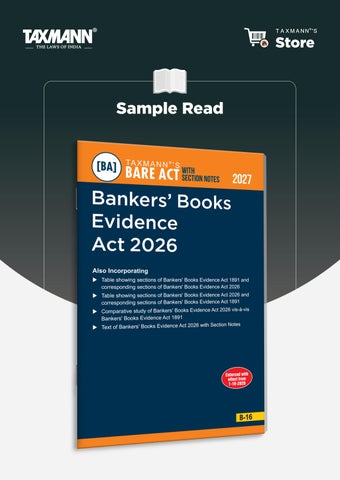
Bankers’ Books Evidence Act 2026 – Bare Act with Section Notes AUTHOR : PUBLISHER : DATE OF PUBLICATION : EDITION : ISBN NO : No. of Pages : BINDING TYPE :
Taxmann’s Editorial Board Taxmann September 2026 2026 Edition 9788167011008 36 Paperback
Rs. 85 DESCRIPTION Bankers’ Books Evidence Act 2026 [Bare Act with Section Notes] by Taxmann is a single-volume working Edition of the new Act, prepared for its commencement on 1st October 2026 and the move away from the Bankers’ Books Evidence Act 1891. The statutory text is freely available; this book supplies the apparatus around it—Section Notes under every section, two-way tables between the 2026 and 1891 Acts, a front-placed Comparative Study, the commencement notification, both certificate forms, a Subject Index and an Appendix. The book solves a practical problem. Anyone working with the new Act must consult five sources: • The 2026 text • The 1891 Act it replaces • The commencement notification • The case law on how it is read • The other Acts it refers to This volume carries the first in full, maps the second section by section, reproduces the third, cites the fourth where the notes take a position, and prints two of the fifth in an Appendix. This book is intended for the following audience: • Bank Branch Heads, Office Heads and Authorised Officers • Legal, Compliance and Litigation Teams in Banks • Technology and Information-Security Teams • Advocates and Counsel • Judges, Magistrates and Arbitrators • Police and Investigating Agencies • Chartered Accountants, Forensic Auditors and Insolvency Professionals • Law Students, Academicians and Researchers • Law Libraries and Institutional Subscribers The Present Publication is the 2027 Edition, covering the text of the Bankers’ Books Evidence Act [Act No. 15 of 2026], with the law stated as updated till 10th September 2026. It has the following noteworthy features: • [Section Notes – The Core Editorial Feature] Notes appear under all sixteen sections. Fourteen of them state whether the section descends from an 1891 section or is new, so old and new provisions can be matched while reading • [Correspondence to Sub-section Level] Sections that are part old and part new are split. Section 8(1) is traced to the 1891 Act and 8(2) is marked new. Section 3(1) is traced, and 3(2) and 3(3) are marked new • [Definitions Mapped, Gaps Marked] The tables map all eight definitions in Section 2(1): seven to an 1891 provision and one (‘notification’) to none. Two 1891 definitions (‘the Court’ and ‘Judge’) are marked as having no successor • [Borrowed Meanings Traced] The notes to Section 2(2) trace four undefined terms to the defining clause of another Act: ‘evidence’ (Bharatiya Sakshya Adhiniyam 2023), ‘inquiry’ (Bharatiya Nagarik Suraksha Sanhita 2023), ‘arbitration’ (Arbitration and Conciliation Act 1996) and ‘electronic record’ (Information Technology Act 2000) • [Enforcement Settled on the Opening Page] Footnotes carry the date of the Act and the full commencement notification, S.O. 5041(E) dated 10th September 2026. The note under Section 1 records the assent date and the date from which the 1891 Act stands repealed • [Two-Way Cross-Reference Tables] An 1891-to-2026 table (eighteen entries) and a 2026-to-1891 table (thirty-one). Both show headings on both sides and map definitions clause by clause, and Sections 3 and 8 are split by sub-section. A dash marks provisions with no counterpart: three on the 1891 side and fourteen on the 2026 side • [Front-Placed Comparative Study] Compares the two Acts under five heads, matching the five objectives in the Statement of Objects and Reasons: ‘bankers’ books’, certificates, ‘bank’ and ‘banker’, electronic records and ‘special cause’. Four heads state the 1891 position or record that there was none, and all five give the date from which the change applies • [The Judicial Anchor for ‘Special Cause’] The Comparative Study and the notes to Section 8 read ‘special cause’ as a closed list. They rely on the Supreme Court’s decision in Mumbai Port Authority v. National Commission for Scheduled Castes [2026 INSC 755] and on P. Ramanatha Aiyar’s Advanced Law Lexicon. The notes to Section 3 apply the same reading • [Transition Guidance] The notes to Section 8 explain how ‘special cause’ is read in applications filed before 1st October 2026 and in those filed on or after it. They rely on Hemant Kumar v. State of Haryana [2026 INSC 878], the Advanced Law Lexicon (6th Edition) and the Concise Oxford Dictionary • [The Government’s Clarification, Reproduced] Para 8.2 reproduces the PIB Fact Check clarification of 6th August 2026 on police access to bank records. The notes to Sections 9 and 11 point to it • [Certificate Checklists] The notes to Section 3 turn each certificate requirement into a labelled list. Para 3.1 lists five matters, four of which match the First Schedule form one for one. Para 3.2 lists two more, and para 3.3 sets out four dating and signing rules • [Research Tools] The book includes: o A Subject Index of twenty-three entries, covering fifteen section headings and all eight defined terms o Both Schedule certificates as forms (four and ten statements) o The Statement of Objects and Reasons o An Appendix printing Section 2(20) of the Companies Act 2013 and Section 6 of the General Clauses Act 1897 • [Authoritative Bare Act Presentation] The statutory text is reproduced as enacted. A boxed COMMENTS device separates it from the editorial matter, so Parliament’s words are never confused with the publisher’s explanation
Buy Now