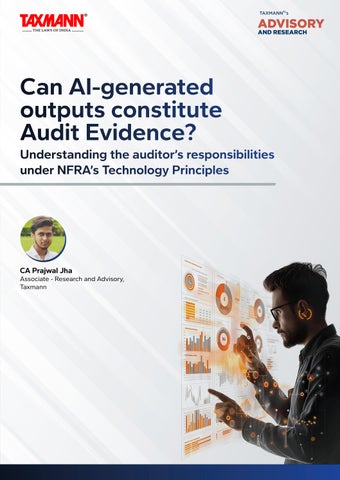

Can AI-generated outputs constitute Audit Evidence?
Understanding the auditor’s responsibilities under NFRA’s Technology Principles

CA Prajwal Jha Associate - Research and Advisory, Taxmann


Can AI-generated outputs constitute Audit Evidence?
Understanding the auditor’s responsibilities under NFRA’s Technology Principles
CA Prajwal Jha Associate - Research and Advisory, Taxmann
1. Introduction
The auditing profession is undergoing a fundamental transformation as technology increasingly becomes an integral part of the audit process. What began with the use of Computer Assisted Audit Techniques (CAATs) has evolved into sophisticated data analytics, Automated Tools and Techniques (ATTs), machine learning, and more recently, Generative Artificial Intelligence (GenAI) and Agentic AI. These technologies are no longer confined to improving operational efficiency, they are now influencing how auditors identify risks, analyse entire populations of transactions, obtain audit evidence and ultimately arrive at audit conclusions. Recognising this transformation, the National Financial Reporting Authority (NFRA) has issued its Staff Series on Technology in Audit: “General Principles for Technology Adoption in Audit”, providing a principles-based framework for the responsible adoption of technology in statutory audits.
2. Technology brings Opportunities along with New Risks
The increasing use of technology undoubtedly enhances audit quality by enabling auditors to analyse complete datasets, identify anomalies more efficiently and devote greater attention to areas requiring professional judgment. However, NFRA also cautions that these technological advancements introduce new challenges. Automation bias, opaque AI-generated outputs, model drift, data privacy concerns and the possibility that excessive reliance on technology may weaken professional scepticism are some of the key risks highlighted in the Staff Series. These risks require auditors to exercise greater care when technology forms an integral part of audit procedures.
3. Technology does not alter the Auditor’s Responsibilities
One of the most significant clarifications made by NFRA is that the adoption of advanced technology does not alter the fundamental responsibilities imposed by the Standards on Auditing. The Standards are technology-neutral, they prescribe the objective to be achieved rather than the method by which audit procedures are performed. Accordingly, whether evidence is obtained manually or through artificial intelligence, the auditor must continue to obtain sufficient appropriate audit evidence while exercising professional judgment and professional scepticism. Technology may change how an audit is performed, but it does not change the standard of evidence or the auditor’s responsibility for the audit opinion.
4. The Practical Challenge
The emergence of Generative AI has made this distinction particularly significant. AI tools can review thousands of contracts, analyse journal entries, identify unusual transactions and generate detailed summaries within seconds. While these capabilities improve efficiency, they also create a natural tendency to accept machine-generated conclusions without sufficient questioning, a phenomenon that NFRA describes as automation bias. Consequently, an increasingly important question confronting auditors today is whether AI-generated outputs can themselves be regarded as audit evidence or whether the auditor must independently evaluate their reliability before placing reliance upon them.
Let us analyse the aforesaid question in light of the principles laid down by NFRA and the relevant Standards on Auditing by examining whether an auditor can rely solely on AIgenerated outputs while forming an audit opinion.
5. Principles discussed under NFRA staff series
The NFRA Staff Series makes it abundantly clear that the increasing use of technology does not create a separate framework for auditing. Instead, it reiterates that the obligations already imposed by the Standards on Auditing, Standards on Quality Management and the applicable ethical principles continue to apply irrespective of the technology used during the audit. Accordingly, the principles articulated by NFRA should not be viewed as new requirements but as an explanation of how existing auditing principles operate when technology forms part of the audit process.
The first and perhaps most fundamental principle is technology neutrality. NFRA explains that the Standards on Auditing focus on the quality of audit evidence, the robustness of risk assessment and the integrity of the audit opinion rather than on the specific technology employed to achieve those outcomes. For example, SA 500, Audit Evidence, requires the auditor to obtain sufficient appropriate audit evidence but does not prescribe whether that evidence should be obtained manually or through technological tools. Consequently, the use of artificial intelligence neither lowers nor enhances the evidentiary threshold prescribed under the Standards. The auditor continues to be responsible for determining whether the evidence obtained is both relevant and reliable.
Closely connected with this principle is NFRA’s emphasis on the non-delegable responsibility of the auditor. Under this it states that although technology may inform and accelerate professional judgment, it can never replace that judgment. The audit report is signed by the auditor, and the opinion expressed belongs solely to the auditor. Accordingly, if an inappropriate audit opinion is issued because an AI tool failed to identify a material exception or generated an incorrect conclusion, the auditor cannot seek to attribute responsibility to the technology or its developer. The legal and professional responsibility for the audit opinion remains entirely with the engagement partner and the audit firm. This principle is fully consistent with the fundamental objectives of SA 200, which place responsibility for obtaining reasonable assurance squarely upon the auditor.
NFRA further clarifies that technology-generated outputs are not automatically audit evidence merely because they have been produced by a sophisticated tool. Before such outputs can be relied upon, the auditor must evaluate their relevance and reliability in the same manner as any other source of audit evidence. This requires the auditor to understand the source of the information, assess the possibility of error or manipulation, and perform appropriate validation procedures where necessary. Importantly, NFRA rejects the notion that technology-generated information should be subject to a lower evidentiary threshold. The same standards of reliability that apply to manually obtained evidence continue to govern outputs generated through data analytics, AI models or other automated tools. These observations reinforce the principles contained in SA 500, which require the auditor to evaluate the sufficiency and appropriateness of audit evidence irrespective of its source.
Recognising the increasing sophistication of AI systems, the Staff Series also places considerable emphasis on professional scepticism. NFRA observes that machine-generated outputs are often presented in a coherent and convincing manner, making users more susceptible to accepting them without adequate challenge. This phenomenon, commonly referred to as automation bias, may impair the auditor’s ability to critically evaluate audit evidence. The Staff Series therefore stresses that technology cannot exercise professional scepticism on behalf of the auditor. Regardless of how persuasive or technically advanced an AI-generated output may appear, the responsibility for questioning its validity, corroborating significant conclusions and challenging unexpected results always rests with the auditor.
The document also introduces the concepts of explainability and technology governance, both of which assume considerable importance where technology significantly influences audit procedures. NFRA expects audit firms to ensure that technology tools are appropriately validated before deployment, monitored throughout their lifecycle and revalidated whenever significant changes occur. Equally, where technology-generated outputs are material to the audit opinion, the auditor should possess a sufficient understanding of how those outputs were generated and should maintain documentation that enables an experienced auditor, having no previous connection with the engagement, to understand the nature of the work performed and the extent of reliance placed upon the technology. These expectations are aligned with the documentation requirements contained in SA 230 and the quality management responsibilities envisaged under SA 220.
Viewed collectively, these principles establish a consistent regulatory message. Technology is intended to enhance the quality and efficiency of audit procedures, not to replace the auditor’s professional judgment. Consequently, while artificial intelligence may assist in identifying anomalies, analysing data or generating preliminary conclusions, the auditor must ultimately determine whether those outputs constitute sufficient appropriate audit evidence capable of supporting the audit opinion.
Let us understand the aforesaid provisions with the help of case scenario:
6. Case Scenario
6.1. Facts
Omega & Co., Chartered Accountants, is appointed as the statutory auditor of Zenith Technologies Limited, a listed company engaged in developing enterprise software solutions. During the audit of the financial statements for the year ended 31st March 2026, the engagement team decides to use a Generative AI-enabled contract analysis tool to review more than 8,000 customer contracts executed during the year. The objective of using the tool is to identify unusual contractual terms that could affect revenue recognition, including clauses relating to variable consideration, rights of return, customer acceptance and significant financing components.
Before commencing the review, the engagement team uploads the contract database into the AI platform. Within a few hours, the system generates a comprehensive report categorising all contracts based on risk and concludes that none of the agreements contain unusual terms warranting further investigation. Encouraged by the apparent efficiency and comprehensiveness of the analysis, the engagement team decides to substantially reduce its planned manual review procedures and places significant reliance on the AIgenerated report while concluding that revenue has been appropriately recognised.
Several months after the audit report is issued, a regulatory inspection reveals that a number of high-value contracts contained side agreements granting customers extended acceptance rights and additional performance obligations that had not been identified by the AI tool. These clauses materially affected the timing of revenue recognition and resulted in a material misstatement of revenue in the financial statements. During the inspection, the engagement partner explains that the AI tool had analysed the entire population of contracts, classified all agreements as low risk and generated no exceptions. According to the engagement partner, the audit team had relied on the sophisticated capabilities of the technology and therefore had no reason to question its conclusions.
Can the auditor defend the audit on the ground that the AI tool failed to identify the unusual contractual terms, or do the principles laid down by NFRA require the auditor to independently evaluate the reliability and appropriateness of AI-generated outputs before relying upon them as audit evidence?
6.2. Analysis
The engagement partner’s reliance on the AI-generated report merely because it analysed the entire population of contracts is inconsistent with the principles laid down by NFRA. While technology can significantly enhance the efficiency of audit procedures, it does not reduce the auditor’s responsibility for obtaining sufficient appropriate audit evidence or exercising professional judgment. An AI-generated output does not automatically become reliable audit evidence simply because it has been produced by a sophisticated tool. Before placing reliance on such output, the auditor must evaluate whether it is relevant, reliable and appropriate for the audit objective.
In the present case, the engagement team substantially reduced its manual review procedures solely because the AI tool reported that no unusual contractual terms existed. This reflects automation bias, the tendency to accept technology-generated conclusions without adequate challenge. NFRA specifically cautions auditors against such overreliance and emphasises that professional scepticism must be maintained irrespective of the technology used. Accordingly, the auditor should have critically assessed the AIgenerated conclusions and performed additional procedures where necessary, particularly in a high-risk area such as revenue recognition.
The auditor should also have satisfied himself that the AI tool was appropriate for the intended purpose, understood its limitations, and documented the procedures performed to evaluate the reliability of its outputs. Where technology plays a significant role in the audit, the auditor cannot treat it as a “black box” whose conclusions are accepted without understanding the basis on which they have been generated.
Accordingly, before relying on AI-generated outputs, the auditor should ensure that:
a) the technology is suitable for the audit objective and its outputs have been appropriately evaluated;
b) significant AI-generated conclusions are corroborated through additional audit procedures where necessary;
c) professional scepticism is maintained throughout the engagement, notwithstanding the sophistication of the technology; and
d) the extent of reliance placed on the technology and the evaluation performed are adequately documented.
The fact that the AI tool failed to identify the side agreements does not relieve the auditor of responsibility. The audit opinion remains the auditor’s professional conclusion, and the responsibility for determining whether sufficient appropriate audit evidence has been obtained cannot be transferred to technology.
7. Conclusion
The increasing adoption of artificial intelligence and other advanced technologies is transforming the manner in which audits are planned and performed. However, as emphasised by NFRA, these technological developments do not modify the fundamental principles governing statutory audits. Regardless of the sophistication of the technology employed, the auditor remains responsible for obtaining sufficient appropriate audit evidence, exercising professional judgment and maintaining professional scepticism throughout the engagement.
AI-generated outputs should therefore be regarded as an input to the auditor’s decisionmaking process rather than as a substitute for audit evidence or professional evaluation. Before placing reliance on such outputs, the auditor must assess their reliability, understand the limitations of the technology and determine whether additional audit procedures are necessary to support the conclusions reached.
Ultimately, the NFRA Staff Series reinforces a simple but significant principle: technology may assist the auditor in performing the audit, but it can never assume responsibility for the audit opinion. The responsibility for that opinion begins and ends with the auditor.
Click here to access the NFRA staff series on Technology in Audit

About Us

Founded 1972


Evolution From a small family business to a leading technology-oriented Publishing/Product company

Expansion

Launch of Taxmann Advisory for personalized consulting solutions
Our Vision

Aim
Achieve perfection, skill, and accuracy in all endeavour
Growth
Evolution into a company with strong independent divisions: Research & Editorial, Production, Sales & Marketing, and Technology

Future
Continuously providing practical solutions through Taxmann Advisory
Our Strength
Core
Editorial and Research Division
Team
Over 200 motivated legal professionals (Lawyers, Chartered Accountants, Company Secretaries)
Expertise
Monitoring and processing developments in judicial, administrative, and legislative fields with unparalleled skill and accuracy
Impact
Helping businesses navigate complex tax and regulatory requirements with ease

Taxmann Today
Legacy Innovation Commitment
Over 60 years of domain knowledge and trust
Technology-driven solutions for modern challenges
Ensuring perfection, skill, and accuracy in every solution provided
Our Core Domain Areas
Income Tax
Corporate Tax Advisory
Trusts & NGO Consultancy
TDS Advisory
Global Mobility Services
Personal Taxation
Training
Due Diligence
Foreign Exchange Management Laws
Due Dilligence
Advisory Services
Assistance in compounding of offences
Transactions Services
Investment outside India
Your Partners for Frictionless Advice
Goods
Transaction Advisory
Business Restructuring
Classification
Due Diligence
Training
Advisory
Trade Facilitation Measures
Corporate
Corporate Structuring
VAT Advisory
Residential Status
A Glimpse of the People Behind Taxmann

Naveen Wadhwa Research and Advisory [Corporate and Personal Tax]
Chartered Accountant (All India 24th Rank)
14+ years of experience in Income tax and International Tax
Expertise across real estate, technology, publication, education, hospitality, and manufacturing sectors
Contributor to renowned media outlets on tax issues

Vinod K. Singhania
Expert on Panel | Research and Advisory (Direct Tax)
Over 35 years of experience in tax laws
PhD in Corporate Economics and Legislation
Author and resource person in 800+ seminars

V.S. Datey
Expert on Panel | Research and Advisory [Indirect Tax]
Holds 30+ years of experience
Engaged in consulting and training professionals on Indirect Taxation
A regular speaker at various industry forums, associations and industry workshops
Author of various books on Indirect Taxation used by professionals and Department officials

S.S. Gupta
Expert on Panel | Research and Advisory [Indirect Tax]
Chartered Accountant and Cost & Works Accountant
34+ Years of Experience in Indirect Taxation
Bestowed with numerous prestigious scholarships and prizes
Author of the book GST – How to Meet Your Obligations', which is widely referred to by Trade and Industry

Manoj Fogla
Expert on Panel | Research and Advisory [Charitable Trusts and NGOs]
Over three decades of practising experience on tax, legal and regulatory aspects of NPOs and Charitable Institutions
Law practitioner, a fellow member of the Institute of Chartered Accountants of India and also holds a Master's degree in Philosophy
PhD from Utkal University, Doctoral Research on Social Accountability Standards for NPOs
Author of several best-selling books for professionals, including the recent one titled 'Trust and NGO's Ready Reckoner' by Taxmann
Drafted publications for The Institute of Chartered Accountants of India, New Delhi, such as FAQs on GST for NPOs & FAQs on FCRA for NPOs.
Has been a faculty and resource person at various national and international forums

the UAE
Chartered Accountant (All India 36th Rank)
Has previously worked with the KPMG

Contact Us

Taxmann Delhi
59/32, New Rohtak Road
New Delhi – 110005 | India
Phone | 011 45562222
Email | sales@taxmann.com
Taxmann Mumbai
35, Bodke Building, Ground Floor, M.G. Road, Mulund (West), Opp. Mulund Railway Station Mumbai – 400080 | Maharashtra | India
Phone | +91 93222 47686
Email | sales.mumbai@taxmann.com
Taxmann Pune
Office No. 14, First Floor, Prestige Point, 283 Shukrwar Peth, Bajirao Road, Opp. Chinchechi Talim, Pune – 411002 | Maharashtra | India
Phone | +91 98224 11811
Email | sales.pune@taxmann.com
Taxmann Ahmedabad
7, Abhinav Arcade, Ground Floor, Pritam Nagar Paldi
Ahmedabad – 380007 | Gujarat | India
Phone: +91 99099 84900
Email: sales.ahmedabad@taxmann.com
Taxmann Hyderabad
4-1-369 Indralok Commercial Complex Shop No. 15/1 – Ground Floor, Reddy Hostel Lane Abids Hyderabad – 500001 | Telangana | India
Phone | +91 93910 41461
Email | sales.hyderabad@taxmann.com
Taxmann Chennai No. 26, 2, Rajan St, Rama Kamath Puram, T. Nagar
Chennai – 600017 | Tamil Nadu | India
Phone | +91 89390 09948
Email | sales.chennai@taxmann.com
www.taxmann.com
Taxmann Bengaluru
12/1, Nirmal Nivas, Ground Floor, 4th Cross, Gandhi Nagar
Bengaluru – 560009 | Karnataka | India
Phone | +91 99869 50066
Email | sales.bengaluru@taxmann.com
Taxmann Kolkata Nigam Centre, 155-Lenin Sarani, Wellington, 2nd Floor, Room No. 213
Kolkata – 700013 | West Bengal | India
Phone | +91 98300 71313
Email | sales.kolkata@taxmann.com
Taxmann Lucknow
House No. LIG – 4/40, Sector – H, Jankipuram Lucknow – 226021 | Uttar Pradesh | India
Phone | +91 97924 23987
Email | sales.lucknow@taxmann.com
Taxmann Bhubaneswar
Plot No. 591, Nayapalli, Near Damayanti Apartments
Bhubaneswar – 751012 | Odisha | India
Phone | +91 99370 71353
Email | sales.bhubaneswar@taxmann.com
Taxmann Guwahati
House No. 2, Samnaay Path, Sawauchi Dakshin Gaon Road
Guwahati – 781040 | Assam | India
Phone | +91 70866 24504
Email | sales.guwahati@taxmann.com