DIVISION THREE
DIVISION FOUR



3.1 Understanding the Nature of AIBE Questions
The AIBE consists of Multiple-Choice Questions (MCQs) that test both theoretical and practical knowledge. These questions assess a candidate’s understanding of legal concepts, application of laws, and ability to analyse case scenarios. Since the exam is open-book, many aspirants assume that they can simply refer to their materials and answer questions quickly. However, time management and strategic answering play a crucial role in ensuring success.
The key to effectively attempt any exam is to understand the syllabus and art of specifying the subject from which any particular question is been asked. Let’s understand the syllabus prima facie so as to get assistance in order to specify the subject from which the question is asked. It is one of the prominent tricks to attempt AIBE questions more effectively and quickly. Given below is the syllabus and brief overview as to what any particular subject deal with; the brief description of each subject to help you differentiate their scope:
Constitutional Law
Deals with the fundamental framework of governance, including the distribution of powers between the legislature, executive, and judiciary. Covers fundamental rights, directive principles, and the structure of the Constitution.
Indian Penal Code, 1860 (IPC)/Bharatiya Nyaya Sanhita, 2023
Defines criminal offences, their classification, and prescribed punishments. The Bharatiya Nyaya Sanhita, 2023, replaces IPC with some modifications.
Criminal Procedure Code, 1973 (CrPC)/Bharatiya Nagarik Suraksha Sanhita, 2023
CrPC provides the procedure for investigation, trial, and punishment of criminal offences. The Bharatiya Nagarik Suraksha Sanhita, 2023, replaces CrPC with updated provisions.
Code of Civil Procedure, 1908 (CPC)
Lays down the procedures for filing, conducting, and adjudicating civil suits, including jurisdiction, pleadings, evidence, and execution of decrees. It is to be kept in mind that this Code is divided into two parts, i.e., Part I, that provides substantive law and provisions are provided in Sections, and Part-II, that provides procedural law and provisions are provided in Orders and Rules.
Indian Evidence Act, 1872/Bharatiya Sakshya Adhiniyam, 2023
Defines rules regarding admissibility, relevancy, and burden of proof in legal proceedings. The Bharatiya Sakshya Adhiniyam, 2023, replaces the Indian Evidence Act with modernized provisions. Alternative Dispute Redressal (ADR) including Arbitration Act
Covers methods like arbitration, mediation, conciliation, and negotiation for resolving disputes outside traditional courts. Arbitration Act governs arbitration proceedings.
Family Law
Regulates personal matters like marriage, divorce, maintenance, inheritance, and adoption under Hindu, Muslim, Christian, and Parsi laws.
Public Interest Litigation (PIL)
Allows any citizen to approach the courts for legal remedies in matters of public interest, especially in cases of constitutional and legal rights violations.
Administrative Law
Regulates the functioning of government authorities, administrative discretion, and judicial review of administrative actions to ensure fairness.
Professional Ethics & Cases of Professional Misconduct under BCI Rules
Covers ethical responsibilities of advocates, rules of professional conduct, and cases of professional misconduct under the Bar Council of India (BCI) regulations.
Company Law
Regulates the formation, management, and dissolution of companies, including provisions under the Companies Act, 2013, covering corporate governance and compliance.
Environmental Law
Deals with laws related to environmental protection, pollution control, conservation of natural resources, and liabilities for environmental damage.
Cyber Law
Regulates offences related to digital transactions, cybercrime, data protection, and internet security under the Information Technology Act, 2000.
Labour and Industrial Laws
Covers rights and duties of employers and employees, wages, working conditions, industrial disputes, and trade unions under various labour legislations.
Law of Tort including Motor Vehicle Act & Consumer Protection Law
Tort law covers civil wrongs and liabilities, including negligence and defamation. The Motor Vehicle Act deals with road accidents and liabilities, while Consumer Protection Law safeguards consumer rights.
Law Related to Taxation
Covers direct and indirect tax laws, including Income Tax, Goods and Services Tax (GST), and legal procedures for tax assessments and disputes.
Law of Contract, Specific Relief, Property Law & Negotiable Instruments Act
- Law of Contract: Covers formation, performance, and breach of contracts.
- Specific Relief Act: Deals with remedies like specific performance of contracts.
- Property Law: Covers ownership, transfer, and lease of immovable property.
- Negotiable Instruments Act: Governs instruments like cheques, promissory notes, and their legal enforcement.
Land Acquisition Act
Regulates the process of acquisition of private land by the government for public purposes and provides for compensation to affected landowners.
Intellectual Property Laws
Covers legal protection of creations such as patents, trademarks, copyrights, and trade secrets, ensuring exclusive rights to inventors and creators.
3.1-1 Types of Questions in AIBE
There are various types of questions asked in the AIBE, like, provision based, chapter based, assertion and reasoning based, case laws based, maxims and doctrine based, etc. However, we have categorised the paper into three categories, i.e., easy, medium and hard.
3.1.1-1 Easy - The questions fall under the easy category are those that may be easily attempted by any aspirant with just the help of Bare Act, such questions may easily be attempted by weak students or below average students who have not gone through the law even at the course time [See Para 3.3-1];
3.1.1-2 Medium - The second category, i.e., medium, is a category under which such questions are considered which may be attempted by average students with simple reasoning and understanding by thoroughly analysing the question and by various tricks [See Para 3.3-2]; and
3.1.1-3 Hard - The third category is hard, attempting which will require knowledge of leading cases, legal maxims and doctrines and much more, which are not provided in the Bare Acts. It requires learning of law in little depth. As the syllabus of AIBE is very vast and not thoroughly specified, therefore, it would
1.20
DIV. ONE : INTRODUCTION TO AIBE
be a difficult task to achieve. However, based on previous papers, we tried to provide limited and relevant matter for the ease of learning burden. [See Para 4.4]
3.2 Tackling Objective Questions Effectively
Since AIBE questions are multiple-choice, candidates need to adopt smart answering techniques. As the syllabus of the AIBE is vast, therefore, finding the answers from Bare Act may be feels like finding an iron needle in a haystack. But do not worry, a magnet will make your work easy. Apart from understanding the syllabus, you need to understand some tricks and strategies in order to attempt such questions. Here are some strategies and tricks provided hereinafter to assist you in the exam.
3.3 Techniques for Quick Reference During the Exam
The AIBE is an open-book exam, but merely having Bare Acts won’t help unless you know how to navigate them efficiently. For this, you are required to analyse the question and extract some specific information and arrange them in order to navigate Bare Acts for answer to the question. To implement this, you need to analyse the question and extract the following information in the following mentioned order:
CHAPTER
SECTION/ARTICLE
SUB-SECTION/CLAUSE
PROVIDED
EXPLANATION
Try to extract as much information you can get from the question and apply such information in descending order in order to find the exact location in the Bare Act where you may have the answer. Keep in mind, such information may not be given directly but you have to figure it out. Let understand it with the following questions from AIBE XIX paper.
3.3-1 Easy
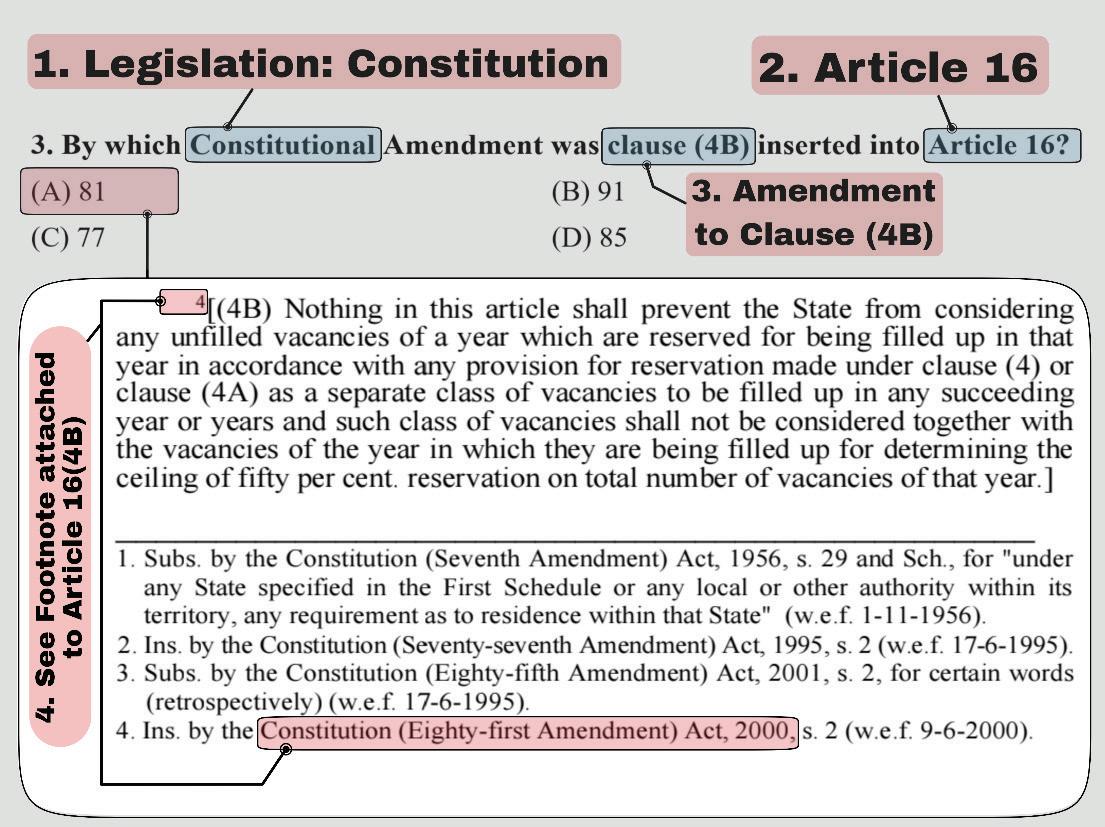
FIGURE 3.1 : ATTEMPTING QUESTIONS WITH THE HELP OF FOOTNOTES
The above question is an example of easy category questions, in which various information are provided in order to locate the required information to attempt the answer. In the above example, they asked for the Constitutional amendment through which clause (4B) of Article 16 of the Constitution was inserted. Now, in order to attempt the question, first we have to gather as much information in sequence mentioned in Para 3.3. Thereafter analysing all the information given and information required, the answer to the question may be located by following the below steps:
1. First extract out the information given. Here, the information we have from the question are –Constitution, Amendment, Article 16, clause (4B) and various range of Amendments, i.e., 81, 91, 77 and 85.
Therefore, we can clearly observe that the question is from the Constitution. Thus, take the Bare Act of the Constitution of India.
2. The information required is by which Constitutional Amendment Article 16(4B) was inserted, therefore, the answer to question lies under Article 16(4B). Open Bare Act of the Constitution and locate Article 16(4B).
3. As we have learned from the previous chapter that the information related to enforcement, amendment through which any provision is inserted, substituted or omitted, or any other information which is not a part of provision but associated to the provision are provided through the footnotes, therefore; search for the footnote(s) associated with the said provision.
4. After analysing we can easily observe that the answer is (A) 81 [See Figure 3.1]
*Note: While attempting such question, kindly verify the information carefully as there may be multiple amendments in a provision. Understand the question whether it is asking for the amendment by which a provision is inserted or amendment substituting words therein or omitting as the case may be [See Article 16(4A)].
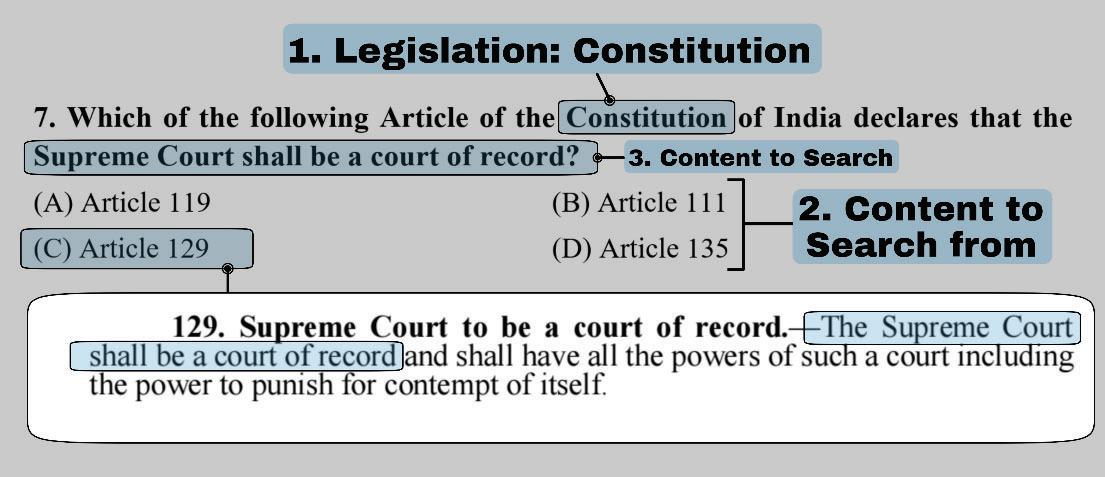
FIGURE 3.2 : ATTEMPTING QUESTIONS WITH THE HELP OF OPTIONS GIVEN
Similarly to the previous example, in this question, the information given are – Constitution, statement - Supreme Court shall be a court of record and range of Articles, i.e., Article 119, Article 111, Article 129 and Article 135. Now, to find out the answer to the above question, we may follow the following steps:
1. As we can clearly observe from the information extracted from the question that the question is asked from the Constitution of India, therefore, take the Bare Act of the Constitution of India.
2. Now searching the statement from whole of the Bare Act will be so time consuming, therefore, we have to limit our search by going through the provisions mentioned in the options.
3. Thus, going through just 4 provisions of the Constitution, we got the answer to the question [See Figure 3.2]
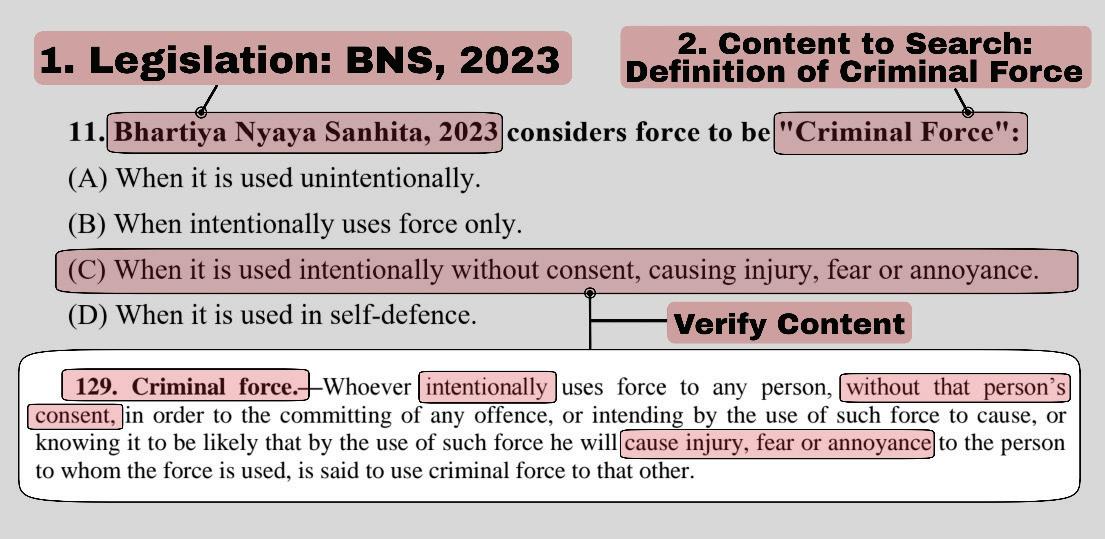
Here in the above question, it seems to be a difficult task to find the answer, however, it is just a tricky question to attempt. In the above question the information we extract is the Act name and other information given is “Criminal Force”. Therefore, we can clearly see that the question is from the definition of Criminal Force; now, we just have to locate the definition of Criminal Force in the Bharatiya Nyaya Sanhita, 2023. As we know that section 2 of the Sanhita provides for the definition, therefore, we will look for the definition in the section; after a look we could not find the definition, therefore, the definition could possibly be found under different section or Explanation to a section [See Para 2.3-1 Point 4, Figures 2.8 and 2.9].
Now, focus on term Criminal Force and go through the Index of BNS analysing the possible chapter in which this definition may fall. By going through the Chapter’s name with general understanding, we can easily conclude that this definition may falls under Chapter VI – “Of Offences Affecting the Human Body”, and further in sub-Chapter – “Of Criminal Force and Assault”.
Now, we can easily find section 129 that provides for Criminal Force. Then comparing the options of the above question with the definition, we can easily figure out the correct answer [as shown in Figure 3.3]. Similarly, in the next example:
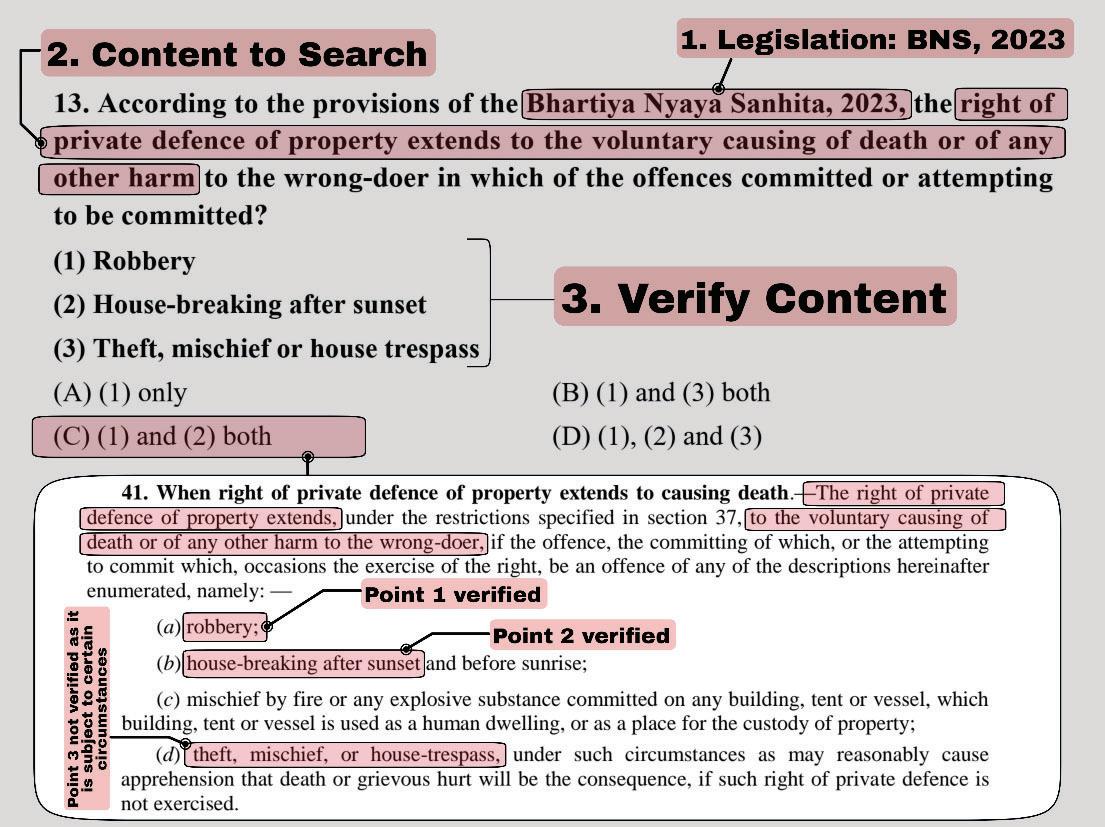
Here in the above example, the information we extract is the Act name and other information given is the sentence “the right to private defence of property extends to the voluntary causing of death or of any other harm”. So here also, there is nothing to worry. In such question the sentence or word given (like in previous example, i.e., Figure 3.3) is almost the heading of the Section. Therefore, understanding of Act and Bare Act make it easy, as in this case we can easily locate the answer by following the below steps:
1. Take Bare Act of the Bharatiya Nyaya Sanhita, 2023;
2. Search Index for relevant Chapter under which the given statement may possibly falls. We can easily conclude that this definition may falls under Chapter III – “General Exceptions”, and further in sub-Chapter – “Of Right of Private Defence”.
3. Look sections under that chapter in which the given statement may fall; Analysing statement with the section’s title, we can observe that section 41 is the most relevant provision to the above question.
4. Now verify the option given in the question and thus we can easily figure out the Correct answer [as shown in Figure 3.4].
3.3-2 Medium
3.3.2-1 Understanding Keywords - Questions often contain keywords that indicates the provision though not directly but indirectly. Figuring out such terms may help in quick referencing to the Bare Act. This is often helpful when the data relating to Legislation’s name and provision’s number is absent. Identifying such terms may make the work done to a great extent. Pay close attention to such words.
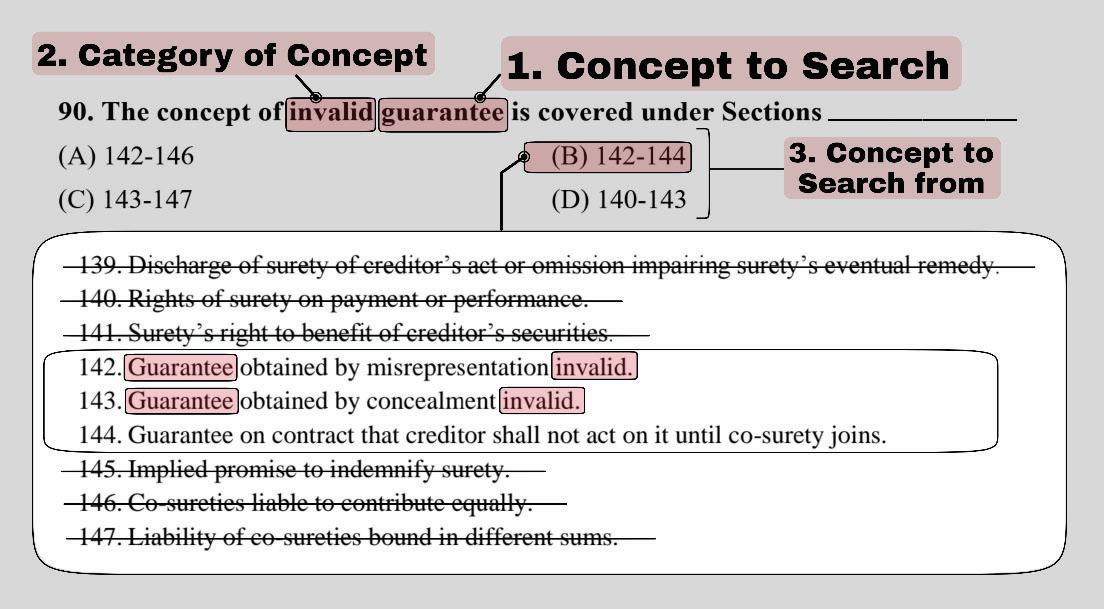
In the above example, the information given is very limited, i.e., “invalid, “guarantee” and ranges in the option, which make this question look difficult. However, it is so easy to solve such questions. The answer of this question may be achieved by following the below steps:
1. First analyse the word with subjects under which the concept may possibly fall. Here, knowledge and understanding of subject plays an important role. If we go through this skill, we may have easily identified that the concept is related to the Indian Contract Act, 1872;
2. Now, go through the Chapter’s name in order to find out relevant Chapter to the concept of guarantee. We can clearly figure out that Chapter VIII - “Of Indemnity and Guarantee” deals with the concept of Guarantee. In more simple way, search range of Sections mentioned in the options to the question, i.e., section 140 to section 147;
3. Now, we can clear see that section 142 and section 143 talks about the invalid guarantee; however, these Sections lies under options (A), (B) and (D);
4. Now we will use elimination method to figure out the answer to the question. As section 141 provides for the Surety’s right, therefore, we will eliminate option (D). Now we left with options (A) and (B). In both the options, sections 142 to 144 are common, therefore we will testify section 145. If section
145 qualify the criteria, then option (A) will be the correct answer, and if not, option (B) will be the correct answer. As section 145 provides provision related to the indemnity, therefore, option (B) is the correct answer to the given question.
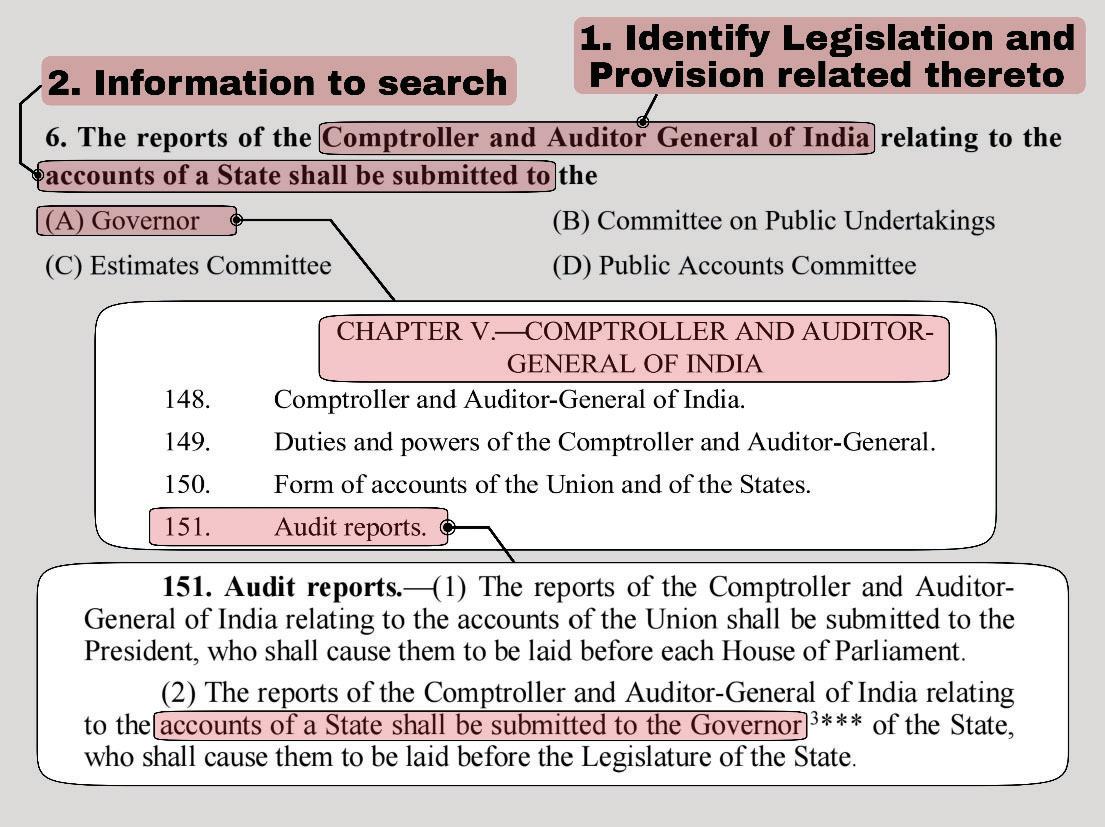
FIGURE 3.6 : ATTEMPT QUESTION BY UNDERSTANDING KEYWORDS
In the above example, neither there is any reference to any legislation nor any reference is made to the provision number. But still there are lot of information given through which we can locate the provision and attempt the question effectively. The answer of this question may be achieved by following the below steps:
1. The first information we got is “The Comptroller and Auditor General of India”, which is a Constitutional Post. Therefore, the question asked is from the Constitution;
2. Now, go through the Chapter’s name in order to find out relevant Chapter to the Comptroller and Auditor General of India. We can clearly figure out that Chapter V - “Comptroller and Auditor General of India” deals with the required information;
3. Further information given in the question is that the provision is related to the reports relating to accounts of a State. Now, quick analysing the index we can clearly conclude that Article 151 under the said Chapter deals with the reports, therefore, in the provision, we can find answer to the question;
4. In the given provision, there are two sub-Articles, one provides for the submission of accounts of Union and other provides for the submission of accounts of State. The second sub-Article is relevant to the given question and thus, the answer shall be (A), Governor.
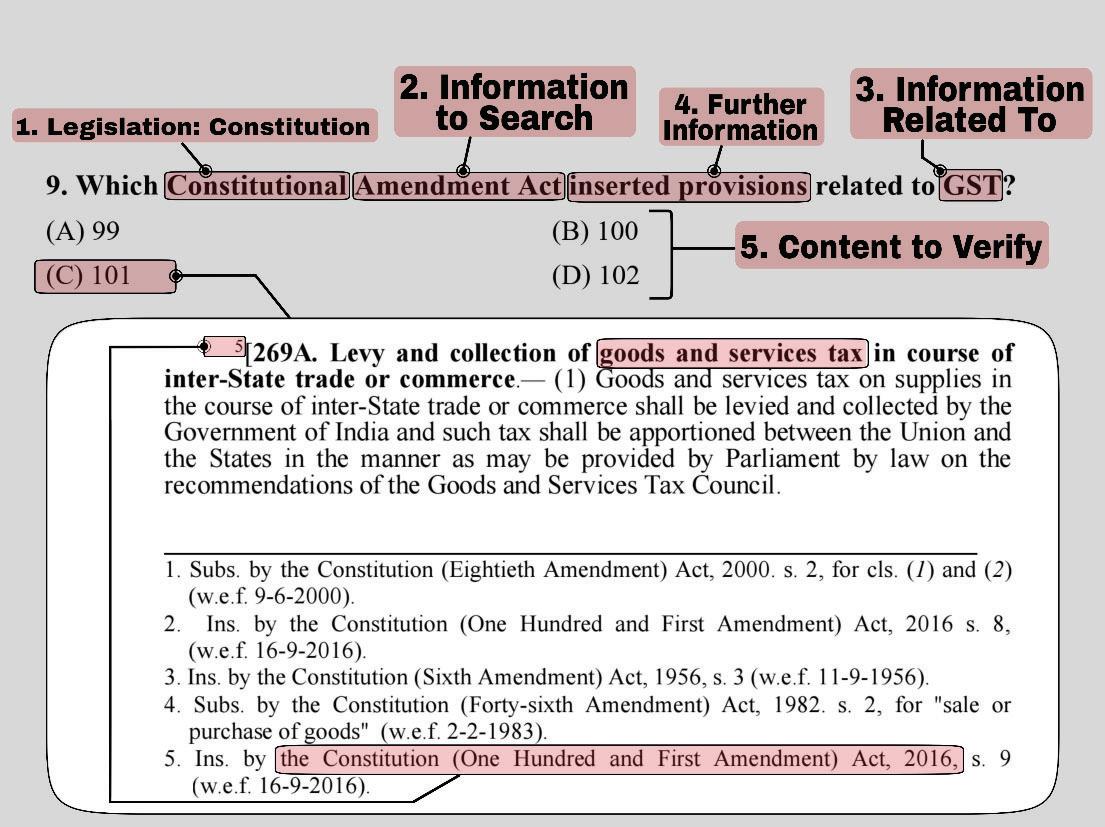
FIGURE 3.7 : UTILISING EACH INFORMATION GIVEN
Here in the above example, we have several information in order to locate the answer. The answer may be obtained by following below steps:
1. The very information is given is Constitutional Amendment Act, which indicates that the given question is related to the Constitution;
2. Secondly, the information we required the number of Amendment Act. There are so many amendments under the Constitution, but for the given question required specifically for the Goods and Services Tax (GST). Thus, go through the Chapter’s name in the index of the Constitution and figure out the possible relevant Chapter under which the related provision may fall. We may assume that the said provision may falls under Part XII, Chapter I, “Finance”;
3. Now, in the given question, we can see words “Inserted provision”. This means that the required provision is not amended one but an inserted one. Therefore, search for the provisions which ends with capitalised alphabets. This is so because, whenever any provision is amended, only content of the provision changed, but when any provision is inserted, except replacing any provision or inserted in place of omitted provision, the provision number include capital letter.
4. In this case we have Article 268A (omitted), Article 269A, Article 279A and Article 290A in the said Chapter from which we have Article 269A and Article 279A which are related to GST.
5. Now look for the footnote attached to the filtered provisions. This is so because, information related to amendment, enforcement date, substitutions, insertion, etc., are often provided in the footnotes.
6. As shown in the above figure, we finally have the answer to the said question.
FIGURE
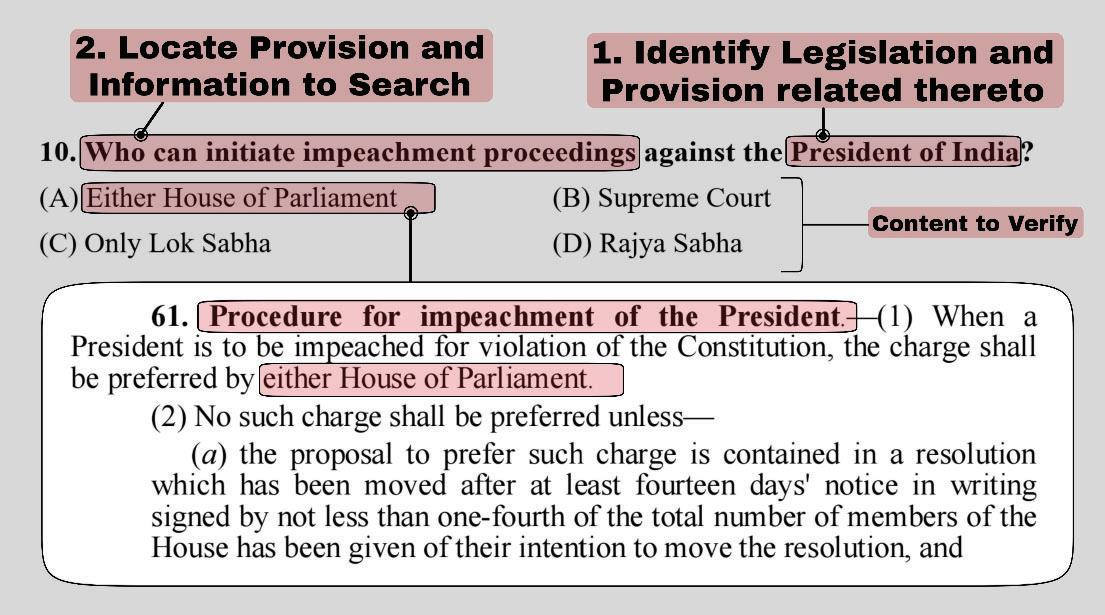
3.8 : LOCATE PROVISION FROM INFORMATION GIVEN
In the above example, the information we have is “the President of India”, “Impeachment Proceedings” and a question “Who can initiate such proceedings”. The answer of this question may be achieved by following the below steps:
1. The first information we got is “The President of India”, which is a Constitutional Post. Therefore, the question asked is from the Constitution;
2. Now, go through the Chapter’s name in order to find out relevant Chapter to the President of India. We know that the post of President is for the Union whereas, the post of Governor is for the State. Therefore, provisions related to President would falls under Part V - “The Union”, Chapter I - “The Executive” and Sub-Chapter “The President and Vice-President”;
3. Now we are required to locate impeachment proceedings and observing the index we can clearly identify that Article 61 provides for the “Procedure for impeachment of the President”;
4. Finally, going through the language of the Article, we may conclude that impeachment proceedings against President may be preferred by either House of Parliament, and thus, option (A) would be the correct answer to the given question.
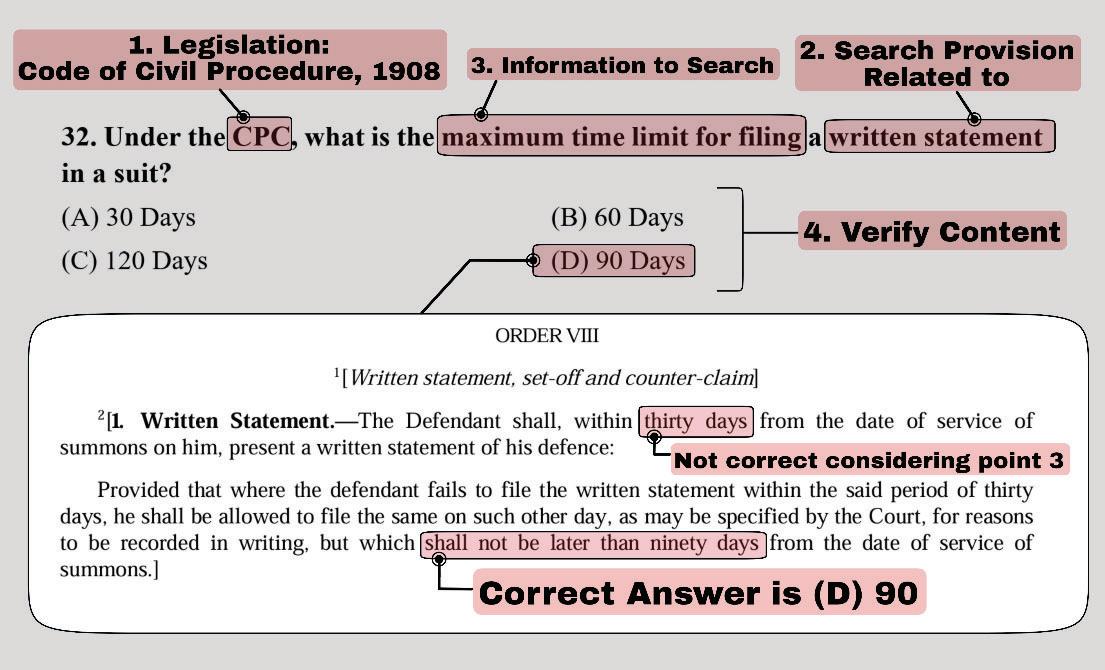
FIGURE 3.9
: ATTEMPTING QUESTION BY ANALYSING COMPLETE PROVISION
The above question is a bit interesting, as it will open up your mind to some more key areas which requires a bit more attention and carefulness. Let lead to the answer step by step: