Sales & Marketing : 59/32, New Rohtak Road, New Delhi-110 005 India
Phone : +91-11-45562222
Website : www.taxmann.com
E-mail : sales@taxmann.com
Regd. Office : 21/35, West Punjabi Bagh, New Delhi-110 026 India
Printed at :
Tan Prints (India) Pvt. Ltd.
44 Km. Mile Stone, National Highway, Rohtak Road Village Rohad, Distt. Jhajjar (Haryana) India
E-mail : sales@tanprints.com
Disclaimer
Every effort has been made to avoid errors or omissions in this publication. In spite of this, errors may creep in. Any mistake, error or discrepancy noted may be brought to our notice which shall be taken care of in the next edition. It is notified that neither the publisher nor the author or seller will be responsible for any damage or loss of action to any one, of any kind, in any manner, therefrom.
No part of this book may be reproduced or copied in any form or by any means [graphic, electronic or mechanical, including photocopying, recording, taping, or information retrieval systems] or reproduced on any disc, tape, perforated media or other information storage device, etc., without the written permission of the publishers. Breach of this condition is liable for legal action.
For binding mistake, misprints or for missing pages, etc., the publisher’s liability is limited to replacement within seven days of purchase by similar edition. All expenses in this connection are to be borne by the purchaser. All disputes are subject to Delhi jurisdiction only.
SECURITY VALUATION
Q.1 M/s. Earth Limited has 11% bond worth of ` 2 crores outstanding with 10 years remaining to maturity. The company is contemplating the issue of a ` 2 crores 10 years bond carrying the coupon rate of 9% and use the proceeds to liquidate the old bonds.
The unamortized portion of issue cost on the old bonds is ` 3 lakhs which can be written off no sooner the old bonds are called. The company is paying 30% tax and it’s after tax cost of debt is 7%. Should Earth Limited liquidate the old bonds?
You may assume that the issue cost of the new bonds with be ` 2.5 lakhs and the call premium is 5%. [May 2013] [6 Marks]
2. Computation of net present value of refunding the bond: (` lakhs)
Present value of net annual cash saving ` 19.56 lakhs
Less: - Initial outlay ` 8.60 lakhs
Net present value of refunding the bond ` 10.96 lakhs
Decision, Since the NPV of refunding the bond is favourable, the bonds should be refunded.
Q.2 Sonic Ltd. issued 8% 5 year bonds of ` 1,000 each having a maturity of 3 year. The present rate of interest is 12% for one year tenure. It is expected that forward rate of interest for one year tenure is going to fall by 75 basis points and further by 50 basis points for next year. This bond has a beta value of 1.02 and is more popular in the market due to less credit risk.
Calculate:
(i) Intrinsic value of bond.
(ii) Expected price of bond in the market. [Nov. 2013] [Nov. 2018] (Old Syllabus) [5 Marks]
Ans.:
The following information is available
rate after 2 years
(i) Intrinsic Value of the Bond:
(12- 0.75)
(11.25 - 0.50)
The intrinsic value of the Bond is ` 918.27
(ii) Expected Price of the Bond: = Intrinsic value × Beta = 918.27 × 1.02 = ` 936.64
Q.3 X Limited, just declared a dividend of ` 14.00 per share. Mr. B is planning to purchase the share of X Limited, anticipating increase in growth rate from 8% to 9%, which will continue for three years. He also expects the market price of this share to be ` 360.00 after three years.
You are required to determine:
(i) The maximum amount Mr. B should pay for shares, if he requires a rate of return of 13% per annum. [May 2013] [4 Marks]
(ii) The maximum price Mr. B will be willing to pay for share, if he is of the opinion that the 9% growth rate can be maintained indefinitely and require 13% rate of return per annum. [May 2013] [2 Marks]
(iii) The price of share at the end of three years, if 9% growth rate is achieved and assuming other conditions remaining same as in (ii) above.
Calculate rupee amount up to two decimal points.
[May 2013] [2 Marks]
Ans.:
(i) Expected dividend for next 3 years.
Year 1 (D1) ` 14.00 (1.09) = ` 15.26
Year 2 (D2) ` 14.00 (1.09)2 = ` 16.63
Year 3 (D3) ` 14.00 (1.09)3 = ` 18.13
Required rate of return = 13% (Ke)
Market price of share after 3 years = (P3) = ` 360
(ii) When the growth rate 9% is achieved for indefinite period, then maximum price of share should Mr. A willing be to pay is
(iii) Assuming that conditions mentioned above remain same, the price expected after 3 years will be:
Q.4 A share of Tension - free Economy Ltd. is currently quoted at a price earnings ratio of 7.5 times. The retained earning being 37.5% is ` 3 per share.
Calculate:
(i) The company’s cost of equity, if investors’ expected rate of return is 12%.
(ii) Market price of share, if anticipated growth rate is 13% per annum with same cost of capital.
(iii) Market price per share, if the company’s cost of capital is 18% and anticipated growth rate is 15% per annum, assuming other conditions remaining the same. [Nov. 2013] [8 Marks]
Ans.:
(i) Calculation of Cost of Capital : In the question investor’s expected rate of return can be assumed as rate of return on retained earnings and thus cost of equity shall be computed as follows:
g = b × r
g = 0.375 × 12% = 4.5%
Retained earnings 37.5% ` 3 per share
Dividend* 62.5% ` 5 per share
EPS 100.0% ` 8 per share
P/E Ratio 7.5 times
Market price is ` 7.5 × 8 = ` 60 per share
Cost of equity capital = (Dividend/Price × 100) + growth % = (5/60 × 100) + 4.5% = 12.83%
(ii) With the growth rate given (13%) the Market price of share shall become negative, which is not possible.
(iii) Market price = Dividend/(cost of equity capital % - growth rate %) = 5/(18% - 15%) = 5/3% = ` 166.66 per share.
Q.5 Write a short note on Traditional & Walter Approach to Dividend Policy [May 2014] [4 Marks]
Ans.:
Traditional approach:
It is also known as the “The Graham and Dodd model” as it was expounded by him. According to the model, the stock market places considerably more weight on dividends than on retained earnings. This is expressed quantitatively in the following valuation model:
P = m(D + E/3)
Where, P = Market price of the share
D = Dividend per share
E = Earnings per share
m = a multiplier.
This model is based on the following assumptions:
(a) Investors are rational
(b) Under conditions of uncertainty, they turn risk averse.
Under this model, the weight attached to dividends is equal to four times the weight attached to retained earnings. The weights provided by Graham and Dodd are based on their subjective judgment and not derived from any empirical analysis.
Investors discount distant dividends at a higher rate than they discount nearby dividend. This is because nearby dividends are more certain than distant dividends.
Walter approach:
The Walter’s Model propounded in 1963 by John E Walter supports the doctrine that dividends are relevant. The investment policy of the firm cannot be separated from its dividend policy and both are interlinked. The choice of an appropriate dividend policy affects the value of any firm. It is based on the following assumptions:
(a) The firm is an all equity firm.
(b) The firm will use only retained earnings to finance its investments.
(c) The rate of return on investment is constant and so is the cost of equity. This means that with every additional investment, business risk remains unaltered.
(d) All earnings are either distributed or retained internally.
(e) The firm has a perpetual or very long life.
(f) Earnings and dividends don’t change over the life of the firm.
Walter argued that the market price of a share is the sum of the present value of the following two cash flow streams:
5.6 SECURITY VALUATION
i. Infinite stream of constant future dividends.
ii. Infinite stream of capital gains.
Walter model is based on the premise that there is a relationship between the return on a firm’s investment or its internal rate of return (r) and its cost of capital (ke). The firm would have an optimum dividend policy which will be determined by the relation between (r) and (ke). If r is greater than ke, the firm should retain the earnings and if r is less than ke, it must distribute the earnings.
Q.6 GHI Ltd., AAA rated company has issued fully convertible bonds on the following terms, a year ago:
Face value of bond : ` 1,000
Coupon (interest rate) : 8.5%
Time to Maturity (remaining) : 3 years
Interest Payment : Annual, at the end of year
Principal Repayment : At the end of bond maturity
Conversion ratio (No. of shares per bond) : 25
Current market price per share : ` 45
Market price of convertible bond : ` 1,175
AAA rated company can issue plain vanilla bonds without conversion option at an interest rate of 9.5%.
Required:
Calculate as of today:
(i) Straight Value of bond.
(ii) Conversion Value of the bond.
(iii) Conversion Premium.
(iv) Percentage of downside risk.
(v) Conversion Parity Price.
Ans.: The following information is given in the question:
Face Value of the Bond : ` 1,000
Coupon Rate : 8.5%
Conversion Ratio : 25 Equity Shares for 1 Bond
Market Price of the Convertible Bond : ` 1,175
Market Price of Equity Share : ` 45
Remaining life of Bond i.e. Maturity : 3 yrs.
Interest payments : Annual
Redemption at maturity : At Par
This question is different from previous as the straight value of Bond is required to be calculated and therefore maturity period and redemption price is also given in the question.
(i) Calculation of Straight Value of Bond
The present value of future inflows (comprising both interest as well as redemption value) discounted at 9.5% is the straight value of the Bond.
Annual Interest (I) = ` 1000 × 8.5 100 = ` 85
Redemption Value (RV) = ` 1000
Maturity Period (n) = 3 Years
Accordingly, Present value of future inflows can be calculated as
= ` 85 × PVIFA (9.5%,3) + ` 1000 × PVIF (9.5%,3)
= ` 85 × 2.5089 + ` 1000 × 0.7617
= ` 213.26 + 761.7 = ` 974.96
(ii) Calculation of Stock Value or Conversion Value of Bond:
Conversion Value of Bond = Value of Shares received per Bond = Market Price per share × Conversion Ratio = 25× 45 =` 1125
Q.7 MNP Ltd. has declared and paid annual dividend of ` 4 per share. It is expected to grow @ 20% for the next two years and 10% thereafter. The required rate of return of equity investors is 15%. Compute the current price at which equity shares should sell.
Note: Present Value Interest Factor (PVIF) @ 15%: For year 1 = 0.8696; For year 2 = 0.7561 [May 2014] [5 Marks]
Ans.:
Dividend = ` 4 per share growth rate = 20% for 2 years 10% thereafter
MV [Market Price] = 1 e D Kbr
= ` 126.8 Price per share
Q.8 Goldilocks Ltd. was started a year back with equity capital of ` 40 lakhs. The other details are as under:
Earnings of the company ` 4,00,000 Price Earnings ratio 12.5 Dividend paid ` 3,20,000
Number of Shares 40,000
Find the current market price of the share. Use Walter’s Model. Find whether the company’s D/P ratio is optimal, use Walter’s formula. [Nov. 2014] [5 Marks]
Ans. As per Walter’s Model :
= () e e r DED K K +− = ` 0.10(108) 8 0.08 0.080.08 + = 100 + 31.25 = ` 131.25
Working Note: K e = 1 / PEratio = 1 12.5 = 8% EPS = 4,00,000 40,000 shares = ` 10 per share DPS = 3,20,000 40,000 shares ` = ` 8 per share r = 4,00,000() 40,00,000( ) Earnings Equitycapital ` = 10%
D/P ratio = ` ` 8 10 × 100 = 80%
As per Walter’s Model if ‘r’ is more than ‘ke’ optimal payout ratio for the firm is ‘NIL’. The company’s D/P ratio is not optimal.
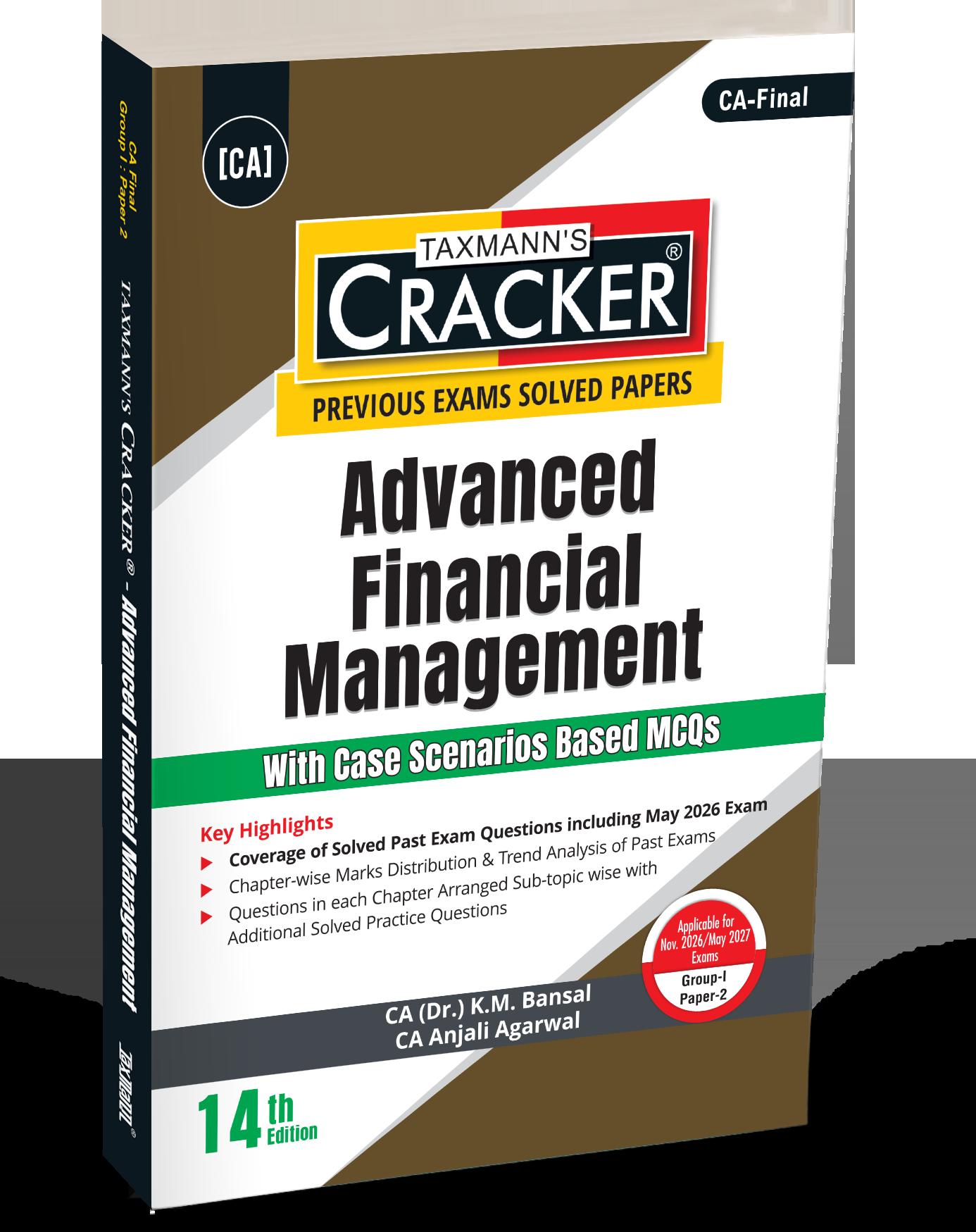
ADVANCED FINANCIAL MANAGEMENT (AFM) | CRACKER
AUTHOR : K.M. Bansal, Anjali
PUBLISHER : Taxmann
DATE OF PUBLICATION : May 2026
EDITION : 14th Edition
ISBN NO : 9789375611042
NO. OF PAGES : 624
BINDING TYPE : Paperback
Rs. 775
Agarwal
DESCRIPTION
Advanced Financial Management | CRACKER is a question-driven companion for CA-Final Group I – Paper 2, taking students from concept recall to exam execution. It does not reteach theory; it assembles the full practice set—past exam questions arranged sub-topic-wise, additional solved questions, a chapter-wise bank of Case Scenario MCQs, and five fully solved recent papers. Its distinction is answer depth: theory questions in structured, tabulated form and practicals worked end-to-end with every computation shown, so students see not just the answer but the presentation an examiner expects. The book is organised around the paper's real behaviour—practical and theory side by side, weighted toward recurring high-mark topics, and mapped to the ICAI study material. The Present Publication is the 14th Edition, authored by CA. (Dr) K.M. Bansal & CA. Anjali Agarwal, with the following noteworthy features:
•[Solved Past Exams, including May 2026] Solved past exam questions up to and including May 2026, each tagged with its exam date(s) and marks
•[Marks Distribution & Trend Analysis] Chapter-wise marks distribution (averaged across six recent attempts) and a question-by-question trend analysis that classifies each past question as theory or practical—showing where marks come from for sharper revision planning
•[Sub-topic-wise Arrangement] Questions arranged sub-topic-wise within each chapter, reinforced with additional solved practice questions
•[Answer-writing Depth] Practicals shown with full computation tables (margin accounts, NAV and real-return workings, Value at Risk, beta and futures-hedge calculations, option payoffs, forex forward-cover comparisons); theory in the structured, step-and-explanation format examiners reward
•[Dedicated Case Scenario MCQ Chapter] A chapter-wise Case Scenario MCQ chapter with multi-question scenarios replicating the 30-mark MCQ block of the current paper
•[Mapped to ICAI Study Material] A chapter-wise comparison mapping each chapter to its corresponding ICAI study-material chapter
•[Five Fully-solved Recent Papers] November 2024, May 2025, September 2025, January 2026 and May 2026 papers with full suggested answers for timed practice