Quality Control (QC)
1.1 – Audit Quality
Standards dealing with framework of audit quality
• SQC 1 and SA 220 deal with issue of establishing QC systems and responsibilities of auditors. SQC 1 applies to all engagements and deals with quality at firm level, whereas, SA220dealswithauditqualityatindividualauditengagementlevel.
• Besides SQC 1 & SA 220, other SAs, code of ethics issued by ICAI & certain provisions of CompaniesAct,2013alsofacilitateQCprocess.
• Therealsoexists mechanismforreviewof QC throughPeerReviewBoard(PRB),Quality ReviewBoard(QRB)andNationalFinancialReportingAuthority(NFRA).
1.2 - SQC 1 “Quality Control for Firms that Perform Audits & Reviews of Historical Financial Information, and Other Assurance & Related Services Engagements”
Purpose of SQC
Elements of a System of Quality Control
• ThefirmshouldestablishasystemofQCdesignedtoprovideitwithreasonableassurance that:
(a) the firm and its personnel comply with professional standards and regulatory and legalrequirements,and
(b) reports issued by the firm or engagement partner(s) are appropriate in the circumstances.
• Firm’ssystemofQCshouldconsistofpoliciesdesignedtoachievetheseobjectives.SQC1 appliestoallfirmsirrespectiveoftheirconstitution.
• The firm’s system of QC should include policies and procedures addressing each of the followingelements:
(a) Leadershipresponsibilitiesforqualitywithinthefirm.
(b) Ethicalrequirements.
(c) Acceptanceandcontinuanceofclientrelationshipsandspecificengagements.
(d) Humanresources.
(e) Engagementperformance.
(f) Monitoring.
• The QC policies and procedures should be documented and communicated to the firm’s personnel.
REQUIREMENTS OF SQC
Leadership Responsibilities
• Thefirmshouldestablishpoliciesandproceduresdesignedtopromoteaninternalculture basedontherecognitionthatqualityisessentialinperformingengagements.
Ethical requirements
• Such policies and procedures should require the firm’s CEO (or equivalent) or, if appropriate, the firm’s managing partners (or equivalent), to assume ultimate responsibilityforthefirm’ssystemofQC
• Anypersonorpersonsassignedoperationalresponsibilityforthefirm’s QCsystembythe firm’s CEO or managing board of partners should have sufficient and appropriate experienceandability,andthenecessaryauthority,toassumethatresponsibility.
Considerations to be taken into account while upholding quality of firm
(i) The firmassigns itsmanagement responsibilitiesso thatcommercial considerationsdo notoverridequalityofworkperformed
(ii) The firm’s policies and procedures in relation to its personnel are designed to demonstrateitsoverridingcommitmenttoquality.
(iii) The firm devotes sufficient resources for development and documentation of its QC policiesandprocedures.
(iv) Afirmbeforeacceptinganengagementshouldacquirevitalinformationabouttheclient. SuchaninformationshouldhelpfirmtodecideaboutintegrityofClient,promotersand key managerial personnel, competence (including capabilities, time and resources) to performengagementandcompliancewithethicalrequirements.
• Thefirmshouldestablishpoliciesandproceduresdesignedtoprovideitwithreasonable assurancethatthefirmanditspersonnelcomplywithrelevantethicalrequirements.
• TheCodeestablishesthefundamentalprinciplesofprofessionalethics,whichinclude:
(a) Integrity;
(b) Objectivity;
(c) Professionalcompetenceandduecare;
(d) Confidentiality;and
(e) Professionalbehaviour.
• Fundamentalprinciplesshouldbeemphasizedby:
(a) Actionsoftheleadershipofthefirm
(b) Spreadingawarenessandtraining
(c) Monitoring
(d) Aprocessfordealingwithnon-compliance.
Independence
• Thefirmshouldestablishpoliciesandproceduresdesignedtoprovideitwithreasonable assurance that the firm, its personnel and, where applicable, others subject to independence requirements (including experts contracted by the firm and network firm personnel),maintainindependencewhererequiredbytheCode.
• Suchpoliciesandproceduresshouldenablethefirmto:
(a) Communicateitsindependencerequirementstoitspersonnel
(b) Identify and evaluate circumstances and relationships that create threats to independence, and to take appropriate action to eliminate those threats or reduce themtoanacceptablelevelbyapplyingsafeguards,or,ifconsideredappropriate,to withdrawfromtheengagement.
Acceptance and Continuance of Client Relationships & Specific Engagements
• There shouldexista mechanisminthe firm by which EPs providethe firm with relevant information about client engagements and personnel of firm promptly notify firm of circumstances and relationships that create a threat to independence. All breaches of independence should be promptly notified to firm for appropriate action. Its objective is toensurethatindependencerequirementsaresatisfied.
• At least annually, the firm should obtain written confirmation of compliance with its policies and procedures on independence from all firm personnel required to be independentintermsoftherequirementsoftheCode.
Policies to reduce Familiarity threat
Firm should establish criteria for determining the need for safeguards to address the familiaritythreat.Indeterminingappropriatecriteria,thefirmconsiderssuchmattersas:
(a) thenatureoftheengagement,includingtheextenttowhichitinvolvesamatterofpublic interestand
(b) thelengthofserviceoftheseniorpersonnelontheengagement.
Examples of safeguards:Rotating the seniorpersonnel or requiringan engagementquality controlreview(EQCR)
Other Points
• Thefamiliaritythreatisparticularlyrelevantinthecontextoffinancial statementauditsoflistedentities.
• For these audits, EP should be rotated after a pre - defined period, normallynotmore than7years(exceptincaseswhere auditoflisted entitiesisconductedbyasolepractitioner).
• However, to ensure QC exists in such firms and appropriate reports areissued,thereisaprocessformandatorypeerreviewofsuchfirms.
• Afirmbefore acceptinganengagementshouldacquirevitalinformationabouttheclient. Suchaninformationshouldhelpfirmtodecideabout:
(a) IntegrityofClient,promotersandkeymanagerialpersonnel.
(b) Competence(includingcapabilities,timeandresources)toperformengagement.
(c) Compliancewithethicalrequirements.
• The firm should obtain such information as it considers necessary in the circumstances beforeacceptinganengagementwithanewclient,whendecidingwhethertocontinuean existing engagement, and when considering acceptance of a new engagement with an existing client. Where issues have been identified, and the firm decides to accept or continue the client relationship or a specific engagement, it should document how the issueswereresolved.
• If there is any conflict of interest between the firm and client, it should be properly resolved before accepting the engagement. Where the firm obtains information that would have caused it to decline an engagement if that information had been obtainable earlier, policies and procedures on the continuance of the engagement and the client relationshipshouldincludeconsiderationof:
(a) professional and legal responsibilities that apply to the circumstances, including whether there is a requirement for the firm to report to the person or persons who madetheappointmentor,insomecases,toregulatoryauthorities;and
(b) possibility of withdrawing from the engagement or from both the engagement and theclientrelationship.
• EstablishPoliciesw.r.t.withdrawalfromengagementandcommunicationrequirements,if circumstances warrant. Policies and procedures on withdrawal from an engagement or from both the engagement and the client relationship address issues that include the following:
(a) Discussingwithappropriatelevelofmngt.&TCWGregardingtheappropriateaction thatthefirmmighttakebasedontherelevantfactsandcircumstances.
(b) If the firm determines that it is appropriate to withdraw, discussing with the appropriate level of the client’s management and TCWG withdrawal from the engagement or from both the engagement and the client relationship, and the reasonsforthewithdrawal.
(c) Considering whetherthere isa professional,regulatory orlegal requirementfor the firm to remain in place, or for the firm to report the withdrawal from the engagement,orfromboththeengagementandtheclientrelationship,togetherwith thereasonsforthewithdrawal,toregulatoryauthorities.
(d) Documenting significant issues, consultations, conclusions and the basis for the conclusions.
Considerations as to integrity of clients
Withregardtotheintegrityofaclient,mattersthatthefirmconsidersinclude,forexample:
1. The identity and business reputation of the client’s principal owners, key management, relatedpartiesandthosechargedwithitsgovernance.
2. Thenatureoftheclient’soperations,includingitsbusinesspractices.
3. Informationconcerningtheattitudeoftheclient’sprincipalowners,keymanagementand those charged with its governance towards such matters as aggressive interpretation of accountingstandardsandtheinternalcontrolenvironment.
4. Whether the client is aggressively concerned with maintaining the firm’s fees as low as possible.
5. Indicationsofaninappropriatelimitationinthescopeofwork.
6. Indications that the client might be involved in money laundering or other criminal activities.
7. The reasons for the proposed appointment of the firm and non-reappointment of the previousfirm.
The extent of knowledge a firm will have regarding the integrity of a client will generally growwithinthecontextofanongoingrelationshipwiththatclient.
Matters to be considered to determine whether firm has the capabilities, competence, time and resources to undertake an engagement
1. Firmpersonnelhaveknowledgeofrelevantindustriesorsubjectmatters;
2. Firm personnel have experience with relevant regulatory or reporting requirements, or theabilitytogainthenecessaryskillsandknowledgeeffectively;
3. Thefirmhassufficientpersonnelwiththenecessarycapabilitiesandcompetence;
Human Resources
4. Expertsareavailable,ifneeded;
5. Individuals meeting the criteria and eligibility requirements to perform engagement qualitycontrolreviewareavailable,whereapplicable;and
6. Thefirmwouldbeabletocompletetheengagementwithinthereportingdeadline.
Firm should establish policies and procedures designed to provide it with reasonable assurancethatithassufficientpersonnelwiththecapabilities,competence,andcommitment to ethical principles necessary to perform its engagements in accordance with professional standards and regulatory and legal requirements, and to enable the firm or engagement partnerstoissuereportsthatareappropriateinthecircumstances.
Assignment of Engagement Teams
Firm should assign responsibility for each engagement to an engagement partner. The firm shouldestablishpoliciesandproceduresrequiringthat:
(a) The identityand role of the engagement partnerare communicated to keymembersof theclient’smanagementandthosechargedwithgovernance;
(b) TheEPhastheappropriate capabilities,competence,authorityandtimetoperformthe role;and
(c) TheresponsibilitiesoftheEPareclearlydefinedandcommunicatedtothatpartner.
Engagement Performance
Consistency in quality of engagement performance is achieved through briefing of engagement teams of their objectives, processes for complying with engagement standards, processes of engagement supervision and training, methods of reviewing performance of work,appropriatedocumentationofworkperformed.
Consultation
Engagement Quality Control Review (EQCR)
• Consultation should take place in difficult matters pertaining to an engagementandincludesdiscussion,atappropriateprofessionallevel, with individuals within or outside the firm who have specialized expertise,toresolveadifficultmatter.
• Consultation procedures require consultation with those having appropriate knowledge, seniority and experience within the firm (or outside the firm) on significant technical, ethical and other matters and appropriate documentation and implementation of conclusions resultingfromconsultations.
• A firm needing to consult externally, for example, a firm without appropriate internal resources, may take advantage of advisory servicesprovidedbyotherfirmsorprofessional®ulatorybodies.
• Complete and proper documentation should be maintained on issues involvedandresultsofconsultation.
• Significant judgments made in an engagement should be reviewed by EQCreviewerfortakinganobjectiveviewbeforethereportisissued.
• Theextentofthereviewdependsonthecomplexityoftheengagement and the risk that the report might not be appropriate in the circumstances. The review does not reduce the responsibilities of the EP.
Differences of opinion
• EQCRismandatoryforallauditsofF.S.oflistedentities.In respectof other engagements, firm should devise criteria to determine cases requiringperformanceofEQCR.
Matters to be considered in an EQCR for audits of F.S. of listed entities
(1) The engagement team’s evaluation of the firm’s independence in relationtothespecificengagement.
(2) Significantrisksidentifiedduringtheengagementandtheresponses tothoserisks.
(3) Judgments made, particularly with respect to materiality and significantrisks.
(4) Whether appropriate consultation has taken place on matters involving differences of opinion or other difficult matters, and the conclusionsarisingfromthoseconsultations.
(5) The significance and disposition of corrected and uncorrected misstatementsidentifiedduringtheengagement.
(6) The matters to be communicated to management and TCWG and, whereapplicable,otherpartiessuchasregulatorybodies.
(7) Whether working papers selected for review reflect the work performed in relation to the significant judgments and support the conclusionsreached.
(8) Theappropriatenessofthereporttobeissued.
Engagement Quality Control Reviewer (EQC Reviewer)
• EQCreviewershouldbeasuitablyqualifiedexternal personsuchasa partner oremployee (whoshouldbe memberofICAI) orcanbe from anotherfirmwithsimilarbackground.
• It is necessary to maintain objectivity of such reviewer. Therefore, participation in engagement or making decisions for ET is to be avoidedatallcosts.However,EPmayconsultEQCreviewerduringthe engagement so as not to compromise his objectivity and eligibility to perform the role. Where the nature and extent of the consultations become significant, care is taken by both the ET and the reviewer to maintainthereviewer’sobjectivity.Wherethisisnotpossible,another individual within the firm or a suitably qualified external person is appointedtotakeontheroleofeithertheEQCreviewerortheperson tobeconsultedontheengagement.
• The firm’s policies should provide for the replacement of the EQC reviewer where the ability to perform an objective review may be impaired.
• There might be difference of opinion within ET, with those consulted and between EP and EQC reviewer. The report should only be issued afterresolutionofsuchdifferences.
Engagement documentation
• Incase,recommendationsofEQCreviewerarenotacceptedbyEPand matterisnotresolvedtoreviewer’ssatisfaction,the mattershouldbe resolvedbyfollowingestablishedproceduresoffirmlikebyconsulting withanotherpractitionerorfirm,oraprofessionalorregulatorybody.
• Firm should establish policies and procedures for ETs assembly of final engagement files on a timely basis after the engagement reports have been finalized. Engagement files should be completed in not morethan60daysafterdateofauditor’sreport.
• Wheretwoormoredifferentreportsareissuedinrespectofthesame subjectmatterinformationofanentity,firm’spoliciesandprocedures relatingtotimelimitsforassemblyoffinalengagementfilesshouldbe considered separately. This may be the case when the firm issues an auditor’s report on a component’s financial information for group consolidation purposes and, at a subsequent date, an auditor’s report onthesamefinancialinformationforstatutorypurposes.
• Firm should establish policies and procedures designed to maintain the confidentiality, safe custody, integrity, accessibility and retrievabilityofengagementdocumentation.
• Unless otherwise specified by law or regulation, engagement documentation is the property of the firm. The firm may, at its discretion, make portions of, or extracts from, engagement documentationavailable to clients,providedsuchdisclosuredoesnot undermine the validity of the work performed, or, in the case of assuranceengagements,theindependenceofthefirmoritspersonnel.
• Engagement documentation has to be retained for a period of time sufficient to permit those performing monitoring procedures to evaluate the firm’s compliance with its system of QC, or for a longer periodifrequiredbylaworregulation.
• In specific case of audit engagements, the retention period ordinarily is no shorter than 7 years from the date of the auditor’s report, or, if later,thedateofthegroupauditor’sreport.
Policies and procedures on documentation of the EQCR
Policies & procedures on documentation of the EQCR should require documentationthat:
(a) Procedures required by firm’s policies on EQCR have been performed.
(b) EQCRhasbeencompletedbeforethereportisissuedand
(c) Reviewer is not aware of any unresolved matters that would cause the reviewer to believe that the significant judgments the ET made andtheconclusionstheyreachedwerenotappropriate.
Monitoring The firm should establish policies and procedures designed to provide it with reasonable assurance that the policies and procedures relating to the system of QC are relevant, adequate,operatingeffectivelyandcompliedwithinpractice.
Suchpoliciesand proceduresshouldinclude an ongoing consideration and evaluationofthe firm’ssystemofQC,includingaperiodicinspectionofaselectionofcompletedengagements.
Factors to be considered in monitoring of QC of engagements
(i) DecidingwhetherQCsystemofthefirmhasbeenappropriatelydesignedandeffectively implemented.
(ii) Examining whether new developments in the professional standards, legal and regulatoryrequirementshavebeenreflectedintheQCpolicies.
(iii) Conducting monitoring by entrusting responsibility of monitoring process to a partner orotherpersonswithsufficientandappropriateexperienceandauthorityinthefirm.
(iv) Dealingwithcomplaintsandallegationsagainstthe firmoranyemployeesofitof noncompliance with professional standards or appropriate regulatory requirements by a personwithinoroutsidethefirm.
(v) Taking appropriate remedial actions against the personnel who did not conform to QC policies.
(vi) Takingactionwhendeficienciesinthedesignoroperationofthefirm’s QC policiesand procedures,ornon-compliancewiththefirm’ssystemofQCareidentified.
1.3 - SA 220 “Quality Control for an Audit of F.S.”
Objectives of the auditor To implement QC procedures at engagement level that provide the auditor with reasonable assurancethat:
(a) Auditcomplieswithprofessionalstandardsandregulatoryandlegalrequirements;&
(b) Auditor’sreportissuedisappropriateinthecircumstances.
Points to remember
SA-220 is premised on the basis that the firm is subject to SQC 1. Within the context of the firm’s system of QC, ETs have a responsibility to implement QC procedures that are applicable to the audit engagement. Based upon QC system of firm, QC policies pertaining to audit engagements are decided by ETs. EP of a team is responsible for QC procedures of a particular audit engagement in accordance with SA-220.
Requirements to implement QC Procedures
Leadership
Responsibilities for Quality in Audits
Relevant Ethical requirements
EP is to take responsibility for overall quality on each audit engagement As a part of this responsibility,EPshouldemphasizethefollowingtotheengagementteam(ET):
• CompliancewithprofessionalStandardsandregulatoryandlegalrequirements.
• Compliancewithfirm’sQualityControlPoliciesandproceduresasapplicable.
• Issuanceofappropriateauditreport.
• Abilitytoraiseconcernswithoutfear.
• Qualityisessential&indispensableinengagementperformance.
Inrelationtoethicalrequirementsinanauditengagement,EPisresponsiblefor:
• Identifyingathreattoindependenceregardingtheauditengagementthatsafeguardsmay notbeabletoeliminateorreducetoanacceptablelevel.
• ReportingbyEPtotherelevantpersonswithinthefirmtodetermineappropriateaction, which may include eliminating the activity or interest that creates the threat, or withdrawingfromtheauditengagement,wherewithdrawalislegallypermitted.
Independence EP shall form a conclusion on compliance with independence requirements that apply to auditengagement.Indoingso,EPshall:
(a) Obtain relevant information from firm & where applicable, network firms, to identify & evaluatecircumstancesandrelationshipsthatcreatethreatstoindependence;
(b)Evaluate information on identified breaches, if any, of firm’s independence policies & procedurestodeterminewhethertheycreateathreattoindependence;and
(c) Take appropriate action to eliminate such threats or reduce them to acceptable level by applying safeguards, or, if considered appropriate, to withdraw from audit engagement, where withdrawal is permittedby L&R EPshall promptlyreportto firmany inabilityto resolvethematterforappropriateaction.
Acceptance & Continuance of Client
Relationship & audit Engagement
• Firm should obtain such information as it considers necessary before accepting an engagement with a new client, when deciding whether to continue an existing engagement,&whenconsideringacceptanceofanewengagementwithanexistingclient.
• EP shall be satisfied that appropriate procedures regarding the acceptance and continuanceofclientrelationshipsandauditengagementshavebeenfollowed,andshall determinethatconclusionsreachedinthisregardareappropriate.
• If EP obtains information that would have caused firm to decline the audit engagement had that information been available earlier, the EP shall communicate that information promptlytothefirm,sothatthefirmandtheEPcantakethenecessaryaction.
Examples of information which may cause the firm to withdraw
• Theintegrityoftheprincipalowners,keymanagementandTCWGoftheentity;
• Competency of engagement team to perform the audit engagement and availability of necessarycapabilities,includingtimeandresources;
• CompliancewithrelevantethicalrequirementsbyfirmandtheET;and
• Significant matters that have arisen during the current or previous audit engagement, and theirimplicationsforcontinuingtherelationship.
Assignment of Engagement team
Engagement Performance
EPshouldensurethattheETandanyauditor’sexpertswhoarenotpartoftheET,collectively have the appropriate competence and capabilities to perform the engagement in accordance withprofessionalstandardsandregulatoryandlegalrequirements.
EPhastheresponsibilityforthefollowing:
(a) Direction, supervision and performance of audit engagement in accordance with professionalstandardsandregulatoryandlegalrequirements;
(b) Auditor’sreportbeingappropriateincircumstances.
(c) Reviewofauditdocumentationbeforeissueofauditreport.
(d) Ensuring that SAAE has been obtained to support the conclusions reached and for issuanceofauditor’sreport.
(e) Undertaking appropriate consultation on difficult matters not only within the team but alsowithothersatappropriatelevelwithinoroutsidethefirm.
Monitoring
Engagement Quality Control Review (EQCR)
ForauditsofF.S.oflistedentities,andthoseotherauditengagements,if any,forwhichfirmhasdeterminedthatanEQCRisrequired,EPshall:
(a) DeterminethatanEQCreviewerhasbeenappointed.
(b) Discuss significant matters arising during the audit engagement, includingthoseidentifiedduringtheEQCR,withtheEQCreviewer.
(c) Notdatetheauditor’sreportuntilthecompletionoftheEQCR
Matters to be evaluated by EQC Reviewer
EQC reviewer shall perform an objective evaluation of the significant judgmentsmadebytheengagementteam,andtheconclusionsreached informulatingtheauditor’sreport.Thisevaluationshallinvolve:
(a) DiscussionofsignificantmatterswiththeEP.
(b) ReviewoftheF.S.andtheproposedauditor’sreport
(c) Reviewofselectedauditdocumentationrelatingtothe significant judgmentstheETmadeandtheconclusionsitreachedand
(d) Evaluationoftheconclusionsreachedinformulatingtheauditor’s reportandconsiderationofwhethertheproposedauditor’sreport isappropriate.
Additional Considerations in audit of F.S. of Listed Entities:
• ET’s evaluation of firm’s independence in relation to audit engagement.
• Whether appropriate consultation has taken place on matters involving differences of opinion/difficult matters & conclusions arisingfromconsultations.
• Whetherauditdocumentationselectedforreviewreflectsthework performed w.r.t. significant judgments made & supports the conclusionsreached.
Points to remember
PerformanceofEQCRdoesnotreducetheresponsibilitiesofthe EPfor theauditengagementanditsperformance.
Differences of opinion
If differences of opinion arise within the ET, with those consulted or, where applicable, between the EP and the EQC reviewer, the ET shall followthefirm’spoliciesandproceduresfordealingwithandresolving differencesofopinion.
• AneffectivesystemofQCincludesamonitoringprocessdesignedtoprovidethefirmwith reasonable assurance that its policies and procedures relating to the system of QC are relevant,adequate,andoperatingeffectively.
• EP shall consider the results of the firm’s monitoring process as evidenced in the latest information circulated by the firm and, if applicable, other network firms and whether deficienciesnotedinthatinformationmayaffecttheauditengagement.
Documentation By Auditor
• Issues identified w.r.t. compliance with relevant ethical requirementsandhowtheywereresolved.
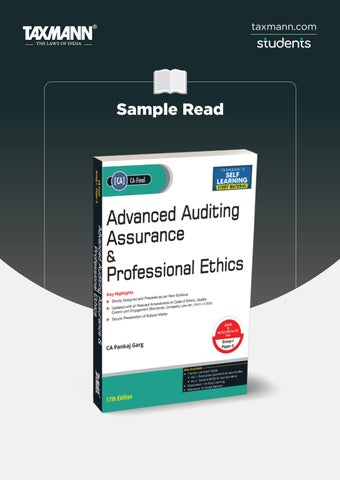
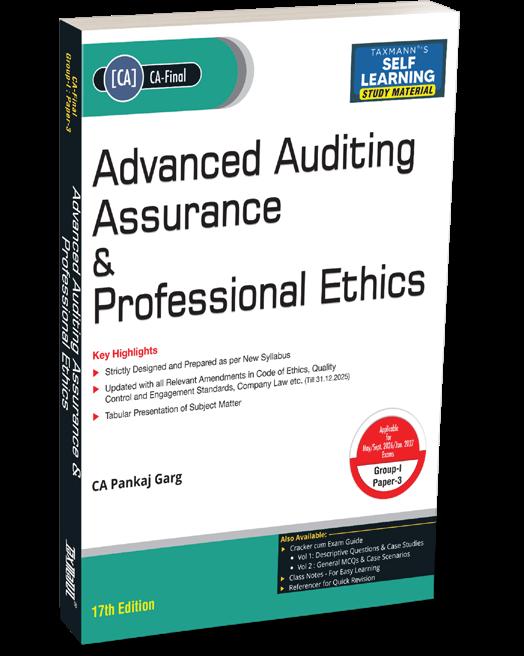
ADVANCED AUDITING ASSURANCE & PROFESSIONAL ETHICS (AUDIT) | STUDY MATERIAL
AUTHOR : Pankaj Garg
PUBLISHER : Taxmann
DATE OF PUBLICATION : January 2026
EDITION : 17th Edition
ISBN NO : 9789375619734
NO. OF PAGES : 416
BINDING TYPE : Paperback
Rs. 895
DESCRIPTION
Advanced Auditing, Assurance & Professional Ethics – Study Material is a student-centric, exam-oriented resource developed exclusively for CA Final – Group I | Paper 3 under the new ICAI syllabus. The book is designed to help CA Final students clearly understand, retain, and present auditing concepts in the precise manner expected by ICAI examiners. It simplifies complex auditing standards, assurance concepts, and professional ethics into structured, readable, and answer-ready content, enabling students to convert syllabus provisions into high-scoring examination answers. This Edition, applicable for the May/September 2026 and January 2027 examinations, is updated with all relevant amendments up to 31st December 2025, ensuring complete syllabus and law alignment. The Present Publication is the 17th Edition, authored by CA. Pankaj Garg, with the following noteworthy features:
• [Strictly as per ICAI New Syllabus] Content is fully aligned with the latest CA Final Paper 3 syllabus
• [Student-friendly Presentation] Concepts are explained for effective first-time learning without assuming prior professional exposure
• [Exam-oriented Coverage] Focus on definitions, classifications, procedures, comparisons, and structured explanations relevant for CA Final answers
• [Updated Law & Standards] Incorporates amendments in Standards on Auditing, Quality Control/Quality Management Standards, Code of Ethics, Engagement Standards, and Company Law (updated till 31-12-2025)
• [Extensive Tabular Format] Use of tables to simplify complex concepts for easy understanding, quick revision, and better retention