

Sample Read

© All rights reserved
Price : ` 945
Fifteenth Edition : May 2026
Published by :
Taxmann Publications (P.) Ltd.
Sales & Marketing : 59/32, New Rohtak Road, New Delhi-110 005 India
Phone : +91-11-45562222
Website : www.taxmann.com
E-mail : sales@taxmann.com
Regd. Office : 21/35, West Punjabi Bagh, New Delhi-110 026 India
Printed at :
Tan Prints (India) Pvt. Ltd.
44 Km. Mile Stone, National Highway, Rohtak Road Village Rohad, Distt. Jhajjar (Haryana) India
E-mail : sales@tanprints.com
Disclaimer
Every effort has been made to avoid errors or omissions in this publication. In spite of this, errors may creep in. Any mistake, error or discrepancy noted may be brought to our notice which shall be taken care of in the next edition. It is notified that neither the publisher nor the author or seller will be responsible for any damage or loss of action to any one, of any kind, in any manner, therefrom.
No part of this book may be reproduced or copied in any form or by any means [graphic, electronic or mechanical, including photocopying, recording, taping, or information retrieval systems] or reproduced on any disc, tape, perforated media or other information storage device, etc., without the written permission of the publishers. Breach of this condition is liable for legal action.
For binding mistake, misprints or for missing pages, etc., the publisher’s liability is limited to replacement within seven days of purchase by similar edition. All expenses in this connection are to be borne by the purchaser. All disputes are subject to Delhi jurisdiction only.
CHAPTER

Q.1 Alpha Ltd. sells beer to customers; some of the customers consume the beer in the bars run by Alpha Ltd. While leaving the bars, the consumers leave the empty bottles in the bars and the company takes possession of these empty bottles. The company has laid down a detailed internal record procedure for accounting for these empty bottles which are sold by the company by calling for tenders.
Keeping this in view:
(i)Decide whether the inventory of empty bottles is an asset of the company;
(ii)If so, whether the inventory of empty bottles existing as on the date of Balance Sheet is to be considered as inventories of the company and valued as per AS-2 or to be treated as scrap and shown at realizable value with corresponding credit to ‘Other Income’?
[RTP May 2014]
Ans.
(i)What ‘Framework on Presentation and Preparation of Financial Statements’ states: Tangible objects or intangible rights carrying probable future benefits, owned by an enterprise are called assets.
Analysis and conclusion: Alpha Ltd. sells these empty bottles by calling tenders. It means further benefits are accrued on its sale.
Therefore, empty bottles are assets for the company.
(ii)What AS-2 states: As per AS-2, inventories are assets held for sale in the ordinary course of business.
Analysis and conclusion: Inventory of empty bottles existing on the Balance Sheet date is the inventory and Alpha Ltd. has detailed controlled recording and accounting procedure which duly signify its materiality.
Thus, inventory of empty bottles cannot be considered as scrap and should be valued as inventory in accordance with AS-2.
Q.2 A private limited company manufacturing fancy terry towels had valued its closing inventory of inventories of finished goods at the realisable value, inclusive of profit and the export cash incentives. Firm contracts had been received and goods were packed for export, but the ownership in these goods had not been transferred to the foreign buyers. Comment on the valuation of the inventories by the company.
[RTP May 2018; RTP Jan. 2026]
Ans.
What AS-2 states: Accounting Standard 2 states that inventories should be valued at lower of historical cost and net realizable value. The standard states, “at certain stages in specific industries, such as when agricultural crops have been harvested or mineral ores have been extracted, performance may be substantially complete prior to the execution of the transaction generating revenue. In such cases, when sale is assured under forward contract or a government guarantee or when market exists and there is a negligible risk of failure to sell, the goods are often valued at net realisable value at certain stages of production. ”
Analysis and conclusion: Terry Towels do not fall in the category of agricultural crops or mineral ores. Accordingly, taking into account the facts stated, the closing inventory of finished goods (Fancy terry towel) should have been valued at lower of cost and net realisable value and not at net realisable value. Further, export incentives are recorded only in the year the export sale takes place. Therefore, the policy adopted by the company for valuing its closing inventory of inventories of finished goods is not correct.
Q.3 “In determining the cost of inventories, it is appropriate to exclude certain costs and recognize them as expenses in the period in which they are incurred”.
Provide examples of such costs as per AS-2 ‘Valuation of Inventories’.
[Nov. 2012, 5 Marks; MTP Jan. 2026; Sept. 2024, 4 Marks, Similar]
Ans.
What AS-2 states: As per AS-2, certain costs are excluded from the cost of the inventories and are recognised as expenses in the period in which incurred.
Examples of such costs are:
(a) abnormal amount of wasted materials, labour, or other production costs;
(
b) storage costs, unless those costs are necessary in the production process prior to a further production stage;
(c) administrative overheads that do not contribute to bringing the inventories to their present location and condition; and
(d) selling and distribution costs.
Q.4 X Ltd., has a normal wastage of 4% in the production process. During the year 2016-17 the Company used 12,000 MT of raw material costing ` 150 per MT. At the end of the year 630 MT of wastage was in stock. The accountant wants to know how this wastage is to be treated in the books.
Explain in the context of AS-2 the treatment of normal loss and abnormal loss and also find out the amount of abnormal loss if any.
[Nov. 2014, 5 Marks; MTP Apr. 2018; MTP Oct. 2018; MTP Apr. 2019; MTP May 2020]
Ans.
What AS-2 states: As per AS-2, abnormal amounts of wasted materials, labour and other production costs are excluded from cost of inventories and such costs are recognised as expenses in the period in which they are incurred.
Analysis and conclusion: The normal loss will be included in determining the cost of inventories (finished goods) at the year-end.
Amount of Abnormal Loss:
Material used = 12,000 MT @ ` 150 = ` 18,00,000
Normal Loss = (4% of 12,000 MT) = 480 MT
Net quantity of material = 11,520 MT
Abnormal Loss in quantity = 150 MT
Abnormal Loss = ` 23,437.50 [150 units @ ` 156.25 (` 18,00,000/11,520)]
Thus,
Amount ` 23,437.50 will be charged to the Profit and Loss statement.
Q.5 In the following cases, find the value of closing stock as per AS-2:
(i) Sonu is a retailer dealing in toys. During the year, he purchased items worth for ` 1,47,000 and made a total sale ` 1,54,000. The average percentage of gross margin is 10% on cost. Opening stock of toys at cost was ` 20,000.
(ii) On 21st March 2023, Mohan purchased 250 chairs at ` 300 each. The selling price of the chair is ` 400 each. Owing to a manufacturing defect, net realisable value of the whole lot of chair was determined at 70% of their normal selling price. No chairs were sold during the year. [Nov. 2023, 5 Marks; MTP May 2026]
Ans.
Valuation of Inventory – as per AS-2
– 1,47,000 NRV – 1,54,000 – 1/11 of 1,54,000 = 1,40,000
Cost – 250 × 300
NRV – 250 × 280
Q.6 From the following information, ascertain the value of stock as on 31st March, 2012
`
At the time of valuing stock as on 31st March, 2011, a sum of ` 3,500 was written off on a particular item, which was originally purchased for ` 10,000 and was sold during the year for ` 9,000. Barring the transaction relating to this item, the gross profit earned during the year was 20% on sales. [Nov. 2012, 5 Marks]
Ans.
Statement showing valuation of stock as on 31-3-2012:
`` Stock as on 01-04-2011 28,500 Less: Book value of abnormal stock (` 10,000 – ` 3,500) 6,500 22,000 Add: Purchases 1,52,500
Expenses 30,000 2,04,500
Less: Cost of Sales Sales as per Books 2,49,000 Less: Sales of Abnormal item (9,000) 2,40,000
Less: Gross Profit @ 20% (48,000) (1,92,000)
Value of Stock as on 31st March, 2012 12,500
Q.7 Z Ltd. ordered 13,000 kg. of chemicals at ` 90 per kg. The purchase price includes excise duty of ` 5 per kg, in respect of which full CENVAT credit is admissible. Further, State VAT is leviable at ` 2.5 per kg on purchase price. Freight incurred amounted to ` 30,000.
Normal transit loss is 4%. The company actually received 12,400 kg and consumed 10,000 kg. The company has received trade discount in the form of cash amounting to ` 1 per kg. The chemicals were delivered in containers. The containers were not reusable, hence sold for ` 500. The administrative expenses incurred to bring the chemicals were ` 10,000. Compute the value of inventory and allocate the material cost as per AS-2. [May 2016, 5 Marks]
Ans.
Computation of Cost of inventory:
Particulars `
Purchase price (13,000 Kg. × ` 89 i.e. after Trade discount of ` 1)11,57,000
Less: CENVAT Credit # (13,000 Kg. × ` 5)(65,000) 10,92,000
Add: Freight30,000
Allocated Administrative expenses10,000
Total material cost [X]11,32,000
Number of units to be normally received = 96% of 13,000 Kg. [Y]12,480
Normal cost per Kg. [X/Y]90.705
# Now, called GST Input credit.
Note: State VAT has been ignored considering it is recoverable later.
Allocation of Material Cost
ParticularsKg. `/Kg. ` Materials consumed10,0009,07,050
Cost of inventory (12,400 – 10,000) 2,40090.7052,17,692
Abnormal loss807,258 (Balancing Figure)
Total material cost12,48011,32,000
Note: Containers are used for delivery of the chemicals and are not reusable. Cost of these containers is treated as selling and distribution expense. The sale value of these containers will be credited to Profit and Loss Account and shall not be considered for the purpose of valuation of inventory.
Alternatively, the sales value of container amount of ` 500 may be deducted, while computing material cost. In that case the material cost will be computed as ` 11,31,500 (11,32,000 – 500) instead of ` 11,32,000. Accordingly, the allocation of material cost will get changed.
Q.8 A company had 5,000 units of stock “A”, costing @ ` 50 each on 313-2014. Out of this stock, 3,000 units are to be supplied under a firm contract at ` 45 each.
Show how the valuation will be done of such stock when:
(i) The general selling price is ` 49 each.
(ii) The general selling price is ` 52 each. [RTP Nov. 2014]
Ans.
(i) Valuation of stock as on 31-3-2014 when general selling price is ` 49 each:
UnitsCostNRVLower of Cost and NRV Valuation (Units × Cost/NRV)
Valuation of stock should be ` 2,33,000.
(ii) Valuation of stock as on 31-3-2014 when general selling price is ` 52 each:
UnitsCostNRVLower of cost and NRV Valuation (Units × Cost/NRV)
Valuation of stock should be ` 2,35,000.
2,35,000
Q.9 On 31st March 2017, a business firm finds that cost of a partly finished unit on that date is ` 530. The unit can be finished in 2017-18 by an additional expenditure of ` 310. The finished unit can be sold for ` 750 (subject to payment of 4% brokerage on selling price).
The firm seeks your advice regarding the amount at which the unfinished unit should be valued as at 31st March, 2017 for preparation of final accounts.
Assume that the partly finished unit cannot be sold in semi-finished form and its NRV is zero without processing it further.
Ans.
[May 2013, 5 Marks; RTP May 2019]
Valuation of Work in Process
Particulars ` Net selling price 750 Less: Estimated cost of completion(310)
Particulars
Less: Brokerage (4% of 750)(30)
Net Realisable Value410
Cost of inventory530
Value of inventory (Lower of cost and net realisable value)410
Q.10 Mr. Mehul gives the following information relating to items forming part of inventory as on 31-3-2017. His factory produces Product X using Raw material A.
(i) 600 units of Raw material A (purchased @ ` 120). Replacement cost of raw material A as on 31-3-2017 is ` 90 per unit.
(ii) 500 units of partly finished goods in the process of producing X and cost incurred till date ` 260 per unit. These units can be finished next year by incurring additional cost of ` 60 per unit.
(iii) 1500 units of finished Product X and total cost incurred ` 320 per unit. Expected selling price of Product X is ` 300 per unit.
Determine how each item of inventory will be valued as on 31-3-2017. Also calculate the value of total inventory as on 31-3-2017.
[May 2015, 5 Marks; Jan. 2021, 5 Marks, Similar]
Ans.
What AS-2 states: As per AS-2, materials and other supplies held for use in the production of inventories are not written down below cost if the finished products in which they will be incorporated are expected to be sold at cost or above cost. However, when there has been a decline in the price of materials and it is estimated that the cost of the finished products will exceed net realisable value, the materials are written down to net realisable value. In such circumstances, the replacement cost of the materials may be the best available measure of their net realisable value.
Analysis and conclusion: In the above case, selling price of product X is ` 300 and total cost per unit for production is ` 320.
Valuation will be done as under:
(i) 600 units of raw material will be written down to replacement cost as market value of finished product is less than its cost, hence valued at ` 90 per unit.
(ii) 500 units of partly finished goods will be valued at 240 per unit i.e. lower of cost (` 260) or Net realisable value ` 240 (Estimated selling price ` 300 per unit less additional cost of ` 60).
(iii) 1,500 units of finished product X will be valued at NRV of ` 300 per unit since it is lower than cost ` 320 of product X.
Valuation of Total Inventory as on 31-3-2017:
ParticularsUnitsCostNRV/ Replacement Cost Value [Units × Cost or NRV whichever is less]
Q.11 Joy Ltd. purchased 20,000 kilograms of Raw Material @ ` 20 per kilogram during the year 2020-21. They have furnished you with the following further information for the year ended 31st March, 2021:
ParticularsUnitsAmount (`)
The plant has a capacity to produce 30,000 Units of finished product per annum. However, the actual production of finished products during the year 2020-21 was 20,400 Units. Due to a fall in the market demand, the price of the finished goods in which the raw material has been utilize is expected to be sold @ ` 40 per unit. The replacement cost of the raw material was ` 19 per kilogram.
You are required to ascertain the value of closing inventory as at 31st March, 2021 as per AS-2. [July 2021, 5 Marks]
Ans. Statement Showing the Computation of Value of Closing Inventory:
Value of Closing Finished Goods
ParticularsAmount (`)
Cost of Raw Material consumed (20,400 units × ` 20 per kg) [2,200 units (Opening) + 20,000 units (Purchases) – 1,800 units (Closing) = 20,400 units]
4,08,000
Direct Labour3,06,000
Fixed Overheads (3,00,000/30,000 × 20,400)2,04,000
Cost of Production9,18,000
Cost of Closing Inventory of Finished Goods per unit (` 9,18,000/20,400)45
Net Realizable Value (NRV) per unit40
Since net realizable value is less than cost, closing inventory of Finished Goods will be valued at ` 40 per unit.
Value of Closing Raw Materials: As NRV of finished goods is less than its cost, the relevant raw material will be valued at its replacement cost, which is the best available measure of its NRV i.e. @ ` 19 per kg.
Therefore,
Value of closing inventory would be as under:
Q.12 Best Ltd. deals in five products P, Q, R, S and T which are neither similar nor interchangeable. At the time of closing of its accounts for the year ending 31st March 2011, the historical cost and net realizable value of the items of the closing stock are determined as follows:
What will be the value of closing stock for the year ending 31st March, 2011 as per AS-2 “Valuation of Inventories”? [May 2011, 5 Marks]
Ans.
What AS-2 states: As per para 5 of AS-2 on ‘Valuation of Inventories’, inventories should be valued at the lower of cost and net realizable value. Inventories should be written down to net realizable value on an item-by-item basis.
Analysis and conclusion:
Valuation of inventory (Item wise): [for the year ending 31st March 2011]
ItemHistorical CostNet Realizable Value Valuation of Closing Stock
P5,70,0004,75,0004,75,000 Q 9,80,00010,32,0009,80,000 R 3,16,0002,89,0002,89,000 S 4,25,0004,25,0004,25,000 T1,60,0002,15,0001,60,000 23,29,000
The value of inventory for the year ending 31st March 2011 = ` 23,29,000.
Q.13 Raw materials inventory of a company includes certain material purchased at ` 100 per kg. The price of the material is on decline and replacement cost of the inventory at the year-end is ` 75 per kg. It is possible to convert the material into finished product at conversion cost of ` 125.
Decide whether to make the product or not to make the product, if selling price is (i) ` 175 and (ii) ` 225. Also find out the value of inventory in each case. [May 2010, 5 Marks]
Ans.
What AS-2 states: As per Para 24 of AS-2, materials and other supplies held for use in the production of inventories are not written down below cost if the finished products in which they will be incorporated are expected to be sold at or above cost. However, when there has been a decline in the price of materials and it is estimated that the cost of the finished products will exceed net realizable value, the materials are written down to net realizable value. In such circumstances, the replacement cost of the materials may be the best available measure of their net realizable value.
Analysis and conclusion:
(i) When selling price is `175:
Current price of the material = ` 75
Therefore,
Raw material inventory would be valued at net realisable value i.e. ` 75 because the selling price of the finished product is less than ` 225 (100 + 125) per kg.
(ii) When selling price is ` 225:
Current price of the raw material = ` 75.
Therefore,
Raw material inventory would be valued at ` 100 per kg because the selling price of the finished product is not less than ` 225.
Q.14 Ltd. is a manufacturing company and engaged in the production of Finished goods ‘MP’ for which Raw material ‘RP’ is required. The company provides following information for the year ended March 31, 2025:
The expected production for the year was 45,000 units of the MP. Due to fall in market demand, the sales price for the MP was ` 22 per unit and the replacement cost for the RP was ` 11.50 per unit on the closing day. You are required to calculate the value of Closing Stock of ‘MP’ and ‘RP’ as on 31st March 2025.
[Sept. 2025, 5 Marks; Similar Question in RTP May 2010]
Computation of Cost for Closing Inventory
Production2710,90,800 Cost of closing inventory per unit (10,90,800/40,400) ` 27 Net Realisable Value per unit ` 22
Since net realisable value is less than cost, closing inventory will be valued at ` 22. As NRV of the MP (finished goods) is less than its cost, relevant raw materials will be valued at replacement cost i.e. ` 11.50.
Therefore, value of closing inventory: MP (finished goods) (4,200 × 22) = ` 92,400 Raw Materials RP = (4,000 × 11.50) = ` 46,000 Therefore,
Value of Closing Inventory
Advanced Accounting (Advanced Accounts) | CRACKER
AUTHOR : Parveen Sharma, Kapileshwar Bhalla, CA Sunil Amlani
PUBLISHER : Taxmann
DATE OF PUBLICATION : May 2026
EDITION : 15th Edition
ISBN NO : 9789375611387
No. of Pages : 840
BINDING TYPE : Paperback
Rs. 945
DESCRIPTION
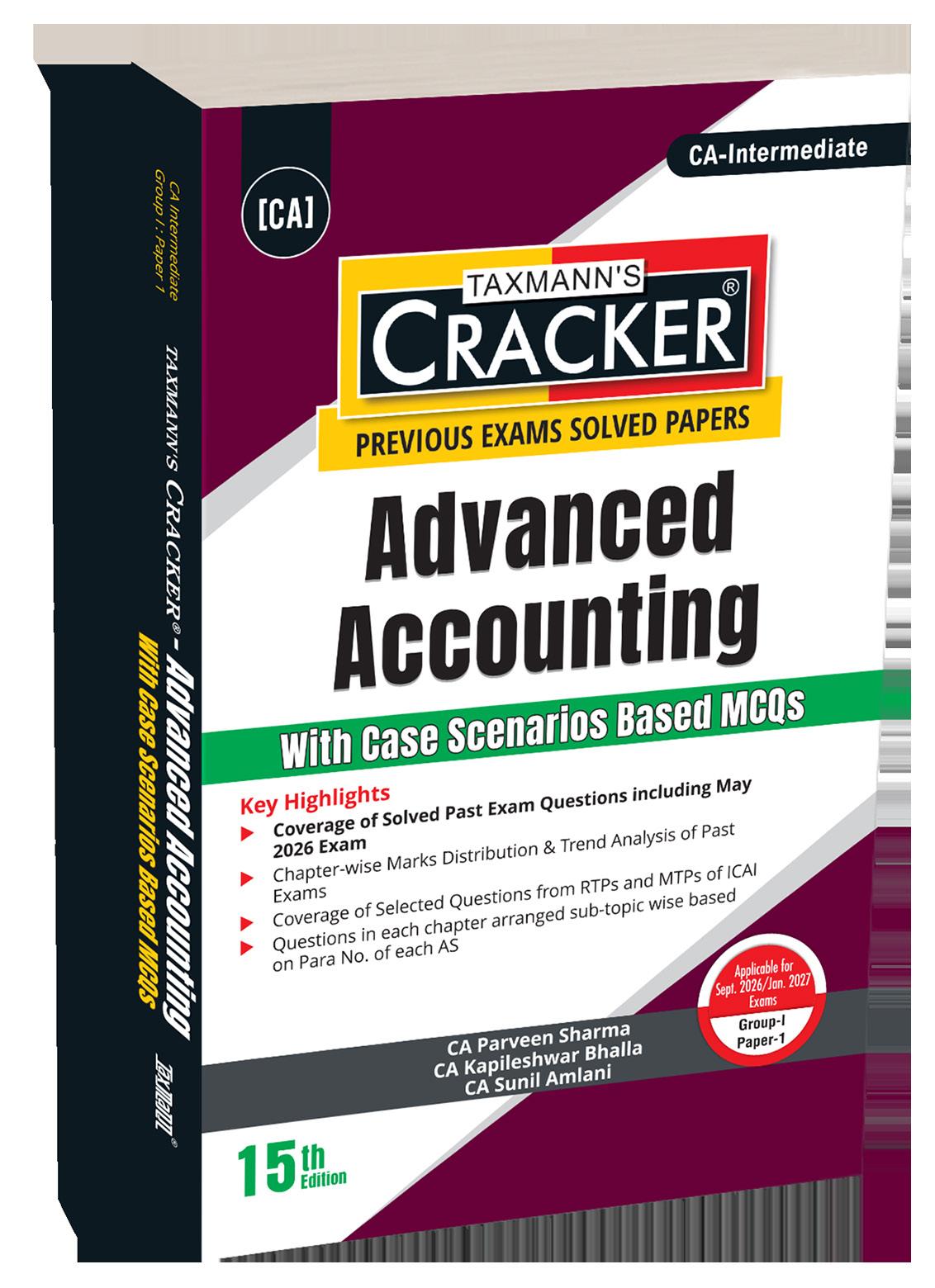
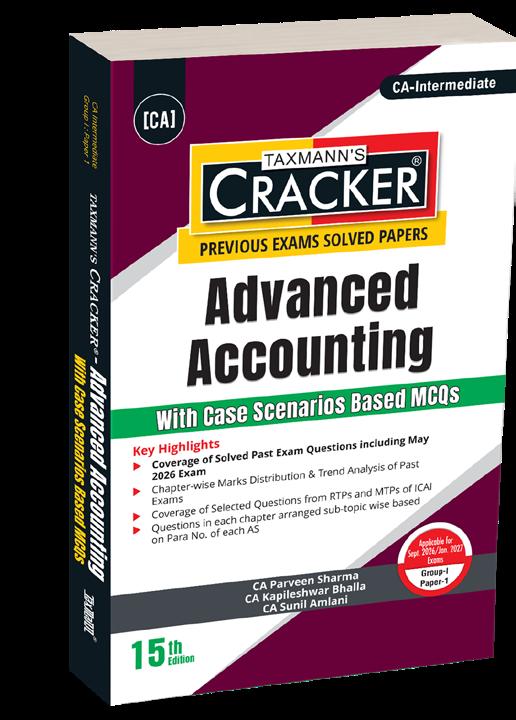
Advanced Accounting | CRACKER is a question-based revision manual for CA-Intermediate Advanced Accounting (Group I – Paper 1), built to take a student from standard-wise recall to exam readiness. Part of Taxmann’s CRACKER series, it consolidates the full examinable question set—solved past papers, ICAI RTP/MTP questions, theory, practicals, and a case-scenario MCQ bank—sequenced along the ICAI module structure and, within each Accounting Standard, along the AS’s own paragraph order. Every question is source- and marks-tagged for exhaustive coverage without repetition.
The Present Publication is the 15th Edition, authored by CA. Parveen Sharma, CA. Kapileshwar Bhalla & CA. Sunil Amlani, with the following noteworthy features:
• [Solved Past Papers (incl. May 2026)] Recent solved attempts, with the May 2026 paper as a separate fully solved suggested-answers section
• [Marks Distribution & Trend Analysis] Chapter-wise marks table (May 2024–May 2026) and attempt-wise trend analysis flagging high-frequency, high-mark topics
• [Study Material Mapping] Comparison table mapping every chapter and unit to its ICAI Study Material reference
• [RTP & MTP Coverage] Source-tagged questions selected from ICAI RTPs and MTPs
• [Para-wise Question Sequencing] Questions arranged sub-topic-wise in the paragraph order of each Accounting Standard
• [Theory & Practical, Tagged] Both retained and labelled, with marks weightage and category against each
• [Case-Scenario MCQ Bank] A consolidated MCQ bank built on case scenarios for objective practice
• [Revision Aids in Answers] Summary tables and process flowcharts embedded within answers