Sample Read
© All rights reserved
Price : ` 525
Sixteenth Edition : February 2026
Published by :
Taxmann Publications (P.) Ltd.
Sales & Marketing :
59/32, New Rohtak Road, New Delhi-110 005 India
Phone : +91-11-45562222
Website : www.taxmann.com
E-mail : sales@taxmann.com
Regd. Office :
21/35, West Punjabi Bagh, New Delhi-110 026 India
Printed at :
Tan Prints (India) Pvt. Ltd.
44 Km. Mile Stone, National Highway, Rohtak Road Village Rohad, Distt. Jhajjar (Haryana) India
E-mail : sales@tanprints.com
Disclaimer
Every effort has been made to avoid errors or omissions in this publication. In spite of this, errors may creep in. Any mistake, error or discrepancy noted may be brought to our notice which shall be taken care of in the next edition. It is notified that neither the publisher nor the author or seller will be responsible for any damage or loss of action to any one, of any kind, in any manner, therefrom. No part of this book may be reproduced or copied in any form or by any means [graphic, electronic or mechanical, including photocopying, recording, taping, or information retrieval systems] or reproduced on any disc, tape, perforated media or other information storage device, etc., without the written permission of the publishers. Breach of this condition is liable for legal action.
For binding mistake, misprints or for missing pages, etc., the publisher’s liability is limited to replacement within seven days of purchase by similar edition. All expenses in this connection are to be borne by the purchaser. All disputes are subject to Delhi jurisdiction only.
CHAPTER
SOLVED PAPER: SEPTEMBER 2025 (SUGGESTED ANSWERS ) P.1
SOLVED PAPER: JANUARY 2026 (SUGGESTED ANSWERS ) P.29
SAMPLE CHAPTER
DESCRIPTIVE QUESTIONS
Q.1 Discuss the limitations which must be kept in mind while evaluating the Financial Statements. [Nov. 2018, 4 Marks]
Ans. Limitations of Financial Statements
1. Historical Cost i.e.
2. Perpetual Continuity & Periodical Account i.e
3. Strengths & Weaknesses
4. Intangible assets
5. Window Dressing
6. Different Accounting Policies
SHORT NOTES
Q.1 Trading account
Ans. Trading account
Q.2 Profit and loss account
Ans. Profit and loss account:
Q.3 Balance sheet
Ans. Balance sheet:
Q.4 Manufacturing A/c
Ans. Manufacturing account:
Q.5 Trial balance
Ans. Trial balance:
14.5
DIFFERENCES
Q.1 Provision & Reserve
Ans. Provision and Reserve:-
Q.2 Capital reserve & Revenue reserve
Ans. Capital reserve and Revenue reserve: -
TRUE OR FALSE
Q.1 Profit and loss account shows the financial position of the concern.
Ans. False:
Q.2 Profit and loss account is a point statement whereas a balance sheet is a period statement.
Ans. False:
Q.3 The provision for discount on debtors is calculated before deducting the provision for doubtful debts from debtors
Ans. False:
Q.4 The gain from sale of capital assets need not be added to revenue to ascertain the net operating profit of a business.
Ans. True:
Q.5 Under the ‘liquidity approach’ assets which are most liquid are presented at the bottom of the balance sheet.
Ans. False:
Q.6 The proprietor of a shop feels that he has made a loss due to closing stock being zero.
Ans. False:
Q.7 Closing stock will never appear in the trial balance.
Ans. False:
Q.8 If Closing Stock appears in the Trial Balance: [Nov. 2018, 2 Marks; June 2024, 2 Marks]; [MTP Jan. 2025]
The closing inventory is then not entered in Trading Account. It is shown only in the balance sheet.
Ans. True:
Q.9 The provision for bad debts is debited to sundry debtors account. [Dec. 2021, 2 Marks]
Ans. False:
Q.10 Overhead is defined as the total cost of direct material, direct wages and direct expenses. [June 2023, 2 Marks]
Ans. False:
Q.11 The gain from sale of capital assets is added to revenue to ascertain the net profit of the business. [Dec. 2023, 2 Marks]
Ans. True:
Q.12 Outstanding salaries for the previous year shall be shown as liability in the current year balance sheet. [RTP Jan. 2025]
Ans. False:
Q.13 The results and position disclosed by final accounts are not exact. [RTP Jan. 2025]
Ans. True: -
PRACTICAL QUESTIONS
Q.1
14.8
Particulars (Dr.) Balance (Cr.) Balance
Provision for Bad Debts
Provision for Discount allowed
Provision for Discount received 1,000
Additional information
a. There was a further bad debt of ` 1,000.
b. During the year sales of ` 8,000 omitted to be recorded.
c. Make a Provision for bad debts @ 5% on debtors.
d. Make a Provision for discount @ 2%.
Show the extract of Profit & Loss Account & Balance Sheet for the above adjustments.
Solution:
Profit and Loss Account (Extract)
Q.2 Below is the trial balance of Shah as on December 31, 2015:
Additional information:
1. Rates have been prepaid to the extent of ` 175.
2. Bad debts ` 500 have to written off. A provision for doubtful debts @ 5% on debtors is necessary.
3. Building has to be depreciated at 2% and Furniture @ 10%.
4. The manager is entitled to a commission of 5% of net profits before charging such commission.
Solution:
Trading and Profit and Loss Account of Shah for the Year ended on December 31, 2015
Balance Sheet of Shah as on December 31, 2015
Q.3 On 1-1-2013 M/s A & Co. had a provision for bad debts of ` 10,880. The bad debts during the year 2013 amounted to ` 9,040. The debtors as at 31-12-2013 were ` 2,24,000. Provision for bad debts @ 5% is maintained by the business. Bad debts during 2014 and 2015 were ` 11,680 and ` 14,160 respectively. The sundry debtors as at 31-12-2014 and 31-12-2015 were ` 2,88,000 and ` 1,36,000 respectively. Prepare necessary Ledger Accounts in the books of M/s. A & Co. Also show how these would appear in the Profit and Loss Account and Balance Sheet for the years 2013 to 2015.
Solution:
Bad Debts A/c
ACCOUNTING (ACCOUNTS) | CRACKER
AUTHOR : S.K. Agrawal, Manmeet Kaur
PUBLISHER : Taxmann
DATE OF PUBLICATION : February 2026
EDITION : 16th Edition
ISBN NO : 9789375617433
NO. OF PAGES : 728
BINDING TYPE : Paperback
DESCRIPTION
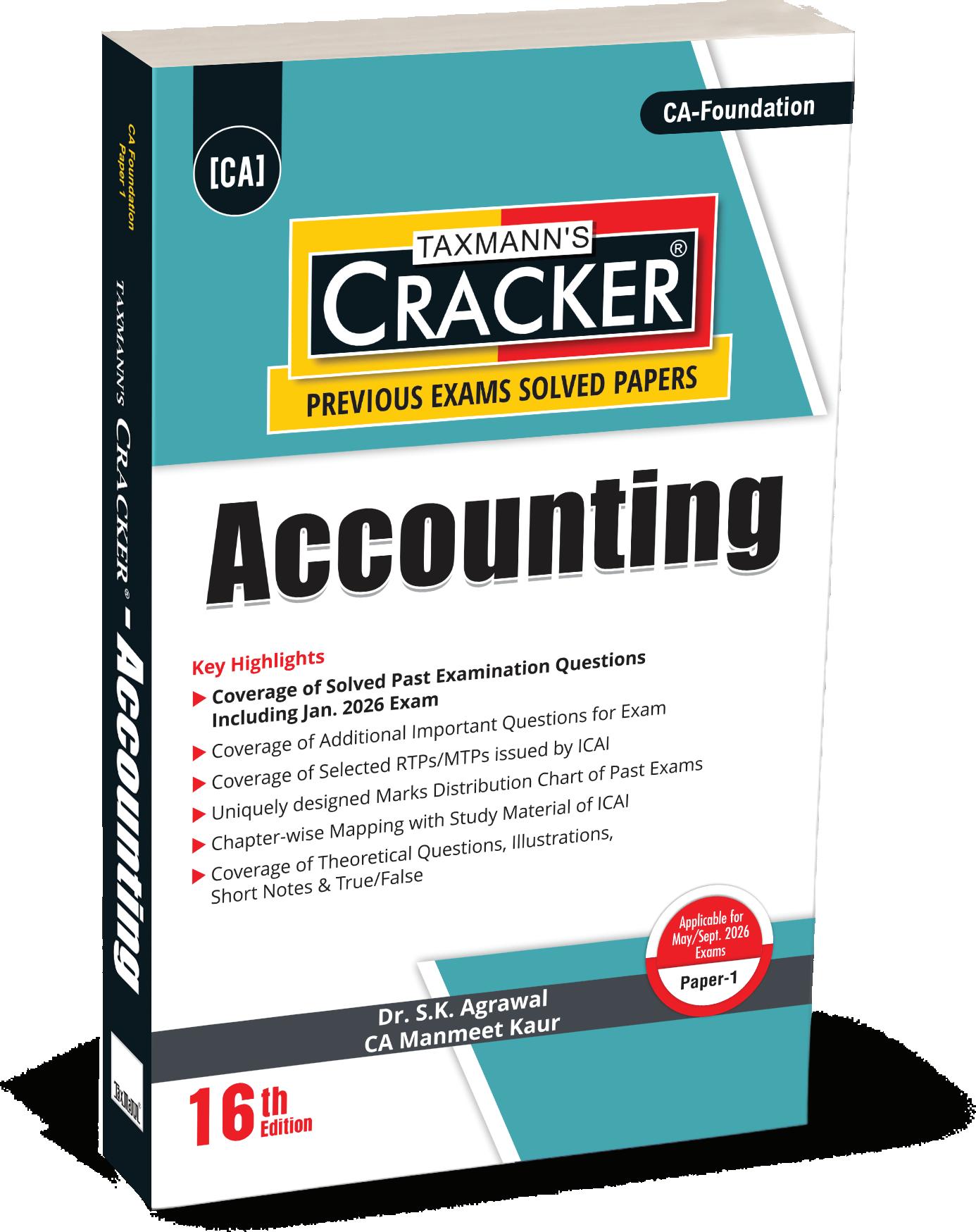
Accounting – CRACKER (Previous Exams Solved Papers) for CA Foundation | Paper 1 is a focused, exam-intelligence manual designed to convert ICAI's Accounting paper into a predictable, practice-driven scoring exercise. Rather than functioning as a conventional teaching textbook, the book serves as an exam-oriented preparation tool, training students to answer questions exactly as ICAI frames, evaluates, and awards marks. Built entirely on past examination behaviour, this CRACKER analyses how ICAI repeatedly tests accounting concepts through numerical problems, theory questions, short notes, and True/False questions, and translates these patterns into a chapter-wise, marks-oriented preparation system. This Edition incorporates fully solved papers up to the January 2026 CA Foundation examination, ensuring alignment with the latest examiner approach for the May & September 2026 attempts.
The Present Publication is the 16th Edition, authored by Dr S.K. Agrawal & CA. Manmeet Kaur, with the following noteworthy features:
• [Solved ICAI Examination Questions up to Jan. 2026] Exhaustive, fully worked solutions covering all major ICAI-asked questions, including the January 2026 paper
• [Chapter-wise Marks Distribution Analysis] Marks distribution tables mapping chapter-wise testing trends across past examinations
• [Chapter-wise Mapping with ICAI Study Material] Explicit cross-referencing with ICAI Study Material chapters and units
• [Coverage of ICAI RTPs & MTPs] Selectively curated Revision Test Papers (RTPs) and Mock Test Papers (MTPs) integrated chapter-wise
• [Additional Important Exam-oriented Questions] High-probability questions based on recurring examiner themes
• [Complete Question-type Coverage] Theoretical questions, numerical illustrations, short notes, and True/False questions as tested by ICAI