
Sample Read

© Taxmann
Price : ` 545
Law stated in this book is as updated till 1st December, 2025
Published by : Taxmann Publications (P.) Ltd.
Sales & Marketing :
59/32, New Rohtak Road, New Delhi-110 005 India
Phone : +91-11-45562222
Website : www.taxmann.com
E-mail : sales@taxmann.com
Regd. Office :
21/35, West Punjabi Bagh, New Delhi-110 026 India
Printed at :
Tan Prints (India) Pvt. Ltd.
44 Km. Mile Stone, National Highway, Rohtak Road Village Rohad, Distt. Jhajjar (Haryana) India
E-mail : sales@tanprints.com
Disclaimer
Every effort has been made to avoid errors or omissions in this publication. In spite of this, errors may creep in. Any mistake, error or discrepancy noted may be brought to our notice which shall be taken care of in the next edition. It is notified that neither the publisher nor the author or seller will be responsible for any damage or loss of action to any one, of any kind, in any manner, therefrom. It is suggested that to avoid any doubt the reader should cross-check all the facts, law and contents of the publication with original Government publication or notifications.
No part of this book may be reproduced or copied in any form or by any means [graphic, electronic or mechanical, including photocopying, recording, taping, or information retrieval systems] or reproduced on any disc, tape, perforated media or other information storage device, etc., without the written permission of the publishers. Breach of this condition is liable for legal action. For binding mistake, misprints or for missing pages, etc., the publisher’s liability is limited to replacement within seven days of purchase by similar edition. All expenses in this connection are to be borne by the purchaser. All disputes are subject to Delhi jurisdiction only.
Table showing sections of Indian Penal Code, 1860 and corresponding sections of Bharatiya Nyaya Sanhita, 2023 I-23
Section key to Bharatiya Nyaya Sanhita, 2023 I-61
41. When right of private defence of property extends
When such right extends to causing any harm other than
43. Commencement and continuance of right of private defence of property
44. Right of private defence against deadly assault when there is risk of harm to innocent person
CHAPTER IV
OF ABETMENT, CRIMINAL CONSPIRACY AND ATTEMPT
Of Abetment
49. Punishment of abetment if act abetted is committed in consequence and where no express provision is made for its punishment
50. Punishment of abetment if person abetted does act with different intention from that of abettor 79
51. Liability of abettor when one act abetted and different act done 80
52. Abettor when liable to cumulative punishment for act abetted and for act done 81
53. Liability of abettor for an effect caused by act abetted different from that intended by abettor
54. Abettor present when offence is committed 83
55. Abetment of offence punishable with death or imprisonment for life 83
56. Abetment of offence punishable with imprisonment 85
57. Abetting commission of offence by public or by more than ten persons 87
58. Concealing design to commit offence punishable with death or imprisonment for life 88
59.
CHAPTER V
79.
85.
123. Causing hurt by means of poison, etc., with intent to commit an offence
124. Voluntarily causing grievous hurt by use of acid, etc.
CHAPTER VII
OF OFFENCES AGAINST THE STATE
147. Waging, or attempting to wage war, or abetting waging of war, against Government of India 198
148. Conspiracy to commit offences punishable by section 147 198
149. Collecting arms, etc., with intention of waging war against Government of India 199
150. Concealing with intent to facilitate design to wage war 200
151. Assaulting President, Governor, etc., with intent to compel or restrain exercise of any lawful power 200
152. Act endangering sovereignty, unity and integrity of India 201
153. Waging war against Government of any foreign State at peace with Government of India 202
154. Committing depredation on territories of foreign State at peace with Government of India 203
155. Receiving property taken by war or depredation mentioned in sections 153 and 154 203
156. Public servant voluntarily allowing prisoner of State or war to escape 204
157. Public servant negligently suffering such prisoner to escape 205
158. Aiding escape of, rescuing or harbouring such prisoner 205
CHAPTER VIII
OF OFFENCES RELATING TO THE ARMY, NAVY AND AIR FORCE
159. Abetting mutiny, or attempting to seduce a soldier, sailor or airman from his duty 206
160. Abetment of mutiny, if mutiny is committed in consequence thereof 207
161. Abetment of assault by soldier, sailor or airman on his superior officer, when in execution of his office 208
162. Abetment of such assault, if assault committed 209
163. Abetment of desertion of soldier, sailor or airman 209
164. Harbouring deserter 210
165. Deserter concealed on board merchant vessel through negligence of master 211
166. Abetment of act of insubordination by soldier, sailor or airman 212
167. Persons subject to certain Acts 212
168. Wearing garb or carrying token used by soldier, sailor or airman 213
CHAPTER IX
OFFENCES
169. Candidate, electoral right defined
Bribery
172. Personation at elections
173. Punishment for bribery
174. Punishment for undue influence or personation at an
CHAPTER X
178. Counterfeiting coin, Government stamps, currency-notes or bank-notes 220
179. Using as genuine, forged or counterfeit coin, Government stamp, currency-notes or bank-notes 223
180. Possession of forged or counterfeit coin, Government stamp, currency-notes or bank-notes 223
181. Making or possessing instruments or materials for forging or counterfeiting coin, Government stamp, currency-notes or bank-notes 224
182. Making or using documents resembling currency-notes or bank-notes 225
183. Effacing writing from substance bearing Government stamp, or removing from document a stamp used for it, with intent to cause loss to Government 226
184. Using Government stamp known to have been before used 227
185. Erasure of mark denoting that stamp has been used 228
186. Prohibition of fictitious stamps
187. Person employed in mint causing coin to be of different weight or composition from that fixed by law
188. Unlawfully taking coining instrument from mint
CHAPTER XI
OF OFFENCES AGAINST THE PUBLIC TRANQUILITY
189. Unlawful assembly
190. Every member of unlawful assembly guilty of offence committed in prosecution of common object
191. Rioting
192. Wantonly giving provocation with intent to cause riot-if rioting be committed; if not committed
193. Liability of owner, occupier, etc., of land on which an unlawful assembly or riot takes place
195. Assaulting or obstructing public servant when suppressing riot, etc.
196. Promoting enmity between different groups on grounds of religion, race, place of birth, residence, language, etc., and doing acts prejudicial to maintenance of harmony
197. Imputations, assertions prejudicial to national integration
CHAPTER XII
OF OFFENCES BY OR RELATING TO
Wearing garb or carrying token used by public servant with fraudulent
CHAPTER XIII OF CONTEMPTS OF THE LAWFUL AUTHORITY OF PUBLIC SERVANTS
206. Absconding to avoid service of summons or other proceeding
207. Preventing service of summons or other proceeding, or preventing publication thereof
208. Non-attendance in obedience to an order from public servant
209. Non-appearance in response to a proclamation under section 84 of Bharatiya Nagarik Suraksha Sanhita, 2023 255
210. Omission to produce document or electronic record to public servant by person legally bound to produce it
Refusing oath or affirmation when duly required by public servant to make it
Refusing to answer public servant authorised to question
216. False statement on oath or affirmation to public servant or person authorised to administer an oath or affirmation
217. False information, with intent to cause public servant to use his lawful power to injury of another person
218. Resistance to taking of property by lawful authority of a public servant
Obstructing public servant in discharge of public functions
Omission to assist public servant when bound by law to give assistance
225. Threat of injury to induce person to refrain from applying for protection to public servant
CHAPTER XIV
230. Giving or fabricating false evidence with intent to procure conviction of
231. Giving or fabricating false evidence with intent to procure conviction of offence punishable with imprisonment for life or imprisonment
SECTION
247. Fraudulently obtaining decree for sum not due 289
248. False charge of offence made with intent to injure 290
249. Harbouring offender 291
250. Taking gift, etc., to screen an offender from punishment 292
251. Offering gift or restoration of property in consideration of screening offender 293
252. Taking gift to help to recover stolen property, etc. 295
253. Harbouring offender who has escaped from custody or whose apprehension has been ordered 295
254. Penalty for harbouring robbers or dacoits 297
255. Public servant disobeying direction of law with intent to save person from punishment or property from forfeiture 298
256. Public servant framing incorrect record or writing with intent to save person from punishment or property from forfeiture 299
257. Public servant in judicial proceeding corruptly making report, etc., contrary to law 300
258. Commitment for trial or confinement by person having authority who knows that he is acting contrary to law 300
259. Intentional omission to apprehend on part of public servant bound to apprehend 301
260. Intentional omission to apprehend on part of public servant bound to apprehend person under sentence or lawfully committed 302
261. Escape from confinement or custody negligently suffered by public servant 304
262. Resistance or obstruction by a person to his lawful apprehension 304
263. Resistance or obstruction to lawful apprehension of another person 305
264. Omission to apprehend, or sufferance of escape, on part of public servant, in cases not otherwise provided for 307
265. Resistance or obstruction to lawful apprehension or escape or rescue in cases not otherwise provided for 308
266. Violation of condition of remission of punishment 308
267. Intentional insult or interruption to public servant sitting in judicial proceeding 309
CHAPTER XV
293.
298.
312.
329. Criminal trespass and house-trespass
330. House-trespass and house-breaking
331. Punishment for house-trespass or house-breaking 381
332. House-trespass in order to commit offence 385
333. House-trespass after preparation for hurt, assault or wrongful restraint 386
334. Dishonestly breaking open receptacle containing property 387
CHAPTER XVIII
OF OFFENCES RELATING TO DOCUMENTS AND TO PROPERTY MARKS
335. Making a false document
336. Forgery 393
337. Forgery of record of Court or of public register, etc. 395
338. Forgery of valuable security, will, etc. 396
339. Having possession of document described in section 337 or section 338, knowing it to be forged and intending to use it as genuine 397
340. Forged document or electronic record and using it as genuine 398
341. Making or possessing counterfeit seal, etc., with intent to commit forgery punishable under section 338 399
342. Counterfeiting device or mark used for authenticating documents described in section 338, or possessing counterfeit marked material 400
343. Fraudulent cancellation, destruction, etc., of will, authority to adopt, or valuable security 402
344. Falsification of accounts 402 Of property marks
345. Property mark
346. Tampering with property mark with intent to cause injury
347. Counterfeiting a property mark
348. Making or possession of any instrument for counterfeiting a property mark 406
349. Selling goods marked with a counterfeit property mark 407
350. Making a false mark upon any receptacle containing goods 408
352. Intentional insult with intent to provoke breach of peace
353. Statements conducing to public mischief
354. Act caused by inducing person to believe that he will be rendered an object of Divine displeasure

Selling child for purposes of prostitution, etc.
98. Whoever sells, lets to hire, or otherwise disposes of any child with intent that such child shall at any age be employed or used for the purpose of prostitution or illicit intercourse with any person or for any unlawful and immoral purpose, or knowing it to be likely that such child will at any age be employed or used for any such purpose, shall be punished with imprisonment of either description for a term which may extend to ten years, and shall also be liable to fine.
Explanation 1. When a female under the age of eighteen years is sold, let for hire, or otherwise disposed of to a prostitute or to any person who keeps or manages a brothel, the person so disposing of such female shall, until the contrary is proved, be presumed to have disposed of her with the intent that she shall be used for the purpose of prostitution.
Explanation 2 For the purposes of this section “illicit intercourse” means sexual intercourse between persons not united by marriage or by any union or tie which, though not amounting to a marriage, is recognised by the personal law or custom of the community to which they belong or, where they belong to different communities, of both such communities, as constituting between them a quasi-marital relation.
Corresponding Provision : Section 372 of IPC, 1860
Classification of Offence : Cognizable. Non-bailable. Court of Session.
COMMENTS
SECTION ANALYSIS
98.1 Ingredients of offence under section 98
Whoever sells, lets to hire, or otherwise disposes of child below eighteen years of age, with intent that such child shall at any age be employed or used for the purpose of prostitution or illicit intercourse with any person or for any unlawful and immoral purpose,
or knowing it to be likely that such child will at any age be employed or used for any such purpose.
98.1-1 Presumption that female child was disposed of with the intent that she shall be used for the purpose of prostitution
When a female under the age of eighteen years is sold, let for hire, or otherwise disposed of to a prostitute or to any person who keeps or manages a brothel, the person so disposing of such female shall, until the contrary is proved,
be presumed to have disposed of her with the intent that she shall be used for the purpose of prostitution.
98.1-2 “Illicit intercourse”
For the purposes of this section “illicit intercourse” means sexual intercourse between persons not united by marriage or by any union or tie which, though not amounting to a marriage, is recognised by the personal law or custom of the community to which they belong or, where they belong to different communities, of both such communities, as constituting between them a quasi-marital relation.
98.1-3 Punishment
Offender shall be punished with imprisonment of either description for a term which may extend to ten years, and shall also be liable to fine.
Buying child for purposes of prostitution, etc.
99. Whoever buys, hires or otherwise obtains possession of any child with intent that such child shall at any age be employed or used for the purpose of prostitution or illicit intercourse with any person or for any unlawful and immoral purpose, or knowing it to be likely that such child will at any age be employed or used for any such purpose, shall be punished with imprisonment of either description for a term which shall not be less than seven years but which may extend to fourteen years, and shall also be liable to fine.
Explanation 1. Any prostitute or any person keeping or managing a brothel, who buys, hires or otherwise obtains possession of a female under the age of eighteen years shall, until the contrary is proved, be presumed to have obtained possession of such female with the intent that she shall be used for the purpose of prostitution.
Explanation 2 “Illicit intercourse” has the same meaning as in section 98.
Corresponding Provision : Section 373 of IPC, 1860
Classification of Offence : Cognizable. Non-bailable. Court of Session.
COMMENTS
SECTION ANALYSIS
99.1 Ingredients of offence under section 99
Whoever buys, hires or otherwise obtains possession of any child below the age of eighteen years
with intent that such child shall at any age be employed or used for the purpose of prostitution or illicit intercourse with any person or for any unlawful and immoral purpose or knowing it to be likely that such child will at any age be employed or used for any such purpose.
99.1-1 Presumption regarding buying, hiring or otherwise obtaining possession of a female under the age of 18 years by a prostitute or person managing a brothel
Any prostitute or any person keeping or managing a brothel, who buys, hires or otherwise obtains possession of a female under the age of eighteen years shall, until the contrary is proved, be presumed to have obtained possession of such female with the intent that she shall be used for the purpose of prostitution.
99.1-2 “Illicit intercourse”
“Illicit intercourse” has the same meaning as in section 98.
99.1-3 Punishment
Offender shall be punished with imprisonment of either description for a term which shall not be less than seven years but which may extend to fourteen years, and shall also be liable to fine.
CHAPTER VI OF OFFENCES AFFECTING THE HUMAN BODY
Of offences affecting life Culpable homicide.
100. Whoever causes death by doing an act with the intention of causing death, or with the intention of causing such bodily injury as is likely to cause death, or with the knowledge that he is likely by such act to cause death, commits the offence of culpable homicide.
Illustrations
(a) A lays sticks and turf over a pit, with the intention of thereby causing death, or with the knowledge that death is likely to be thereby caused. Z, believing the ground to be firm, treads on it, falls in and is killed. A has committed the offence of culpable homicide.
(b) A knows Z to be behind a bush. B does not know it. A, intending to cause, or knowing it to be likely to cause Z’s death, induces B to fire at the bush. B fires and kills Z. Here B may be guilty of no offence; but A has committed the offence of culpable homicide.
(c) A, by shooting at a fowl with intent to kill and steal it, kills B, who is behind a bush; A not knowing that he was there. Here, although A was doing an unlawful act, he was not guilty of culpable homicide, as he did not intend to kill B, or to cause death by doing an act that he knew was likely to cause death.
Explanation 1. A person who causes bodily injury to another who is labouring under a disorder, disease or bodily infirmity, and thereby accelerates the death of that other, shall be deemed to have caused his death.
Explanation 2. Where death is caused by bodily injury, the person who causes such bodily injury shall be deemed to have caused the death, although by resorting to proper remedies and skilful treatment the death might have been prevented.
Explanation 3. The causing of the death of a child in the mother’s womb is not homicide. But it may amount to culpable homicide to cause the death of a living child, if any part of that child has been brought forth, though the child may not have breathed or been completely born.
Corresponding Provision : Section 299 of IPC, 1860
COMMENTS
SECTION ANALYSIS
100.1 Definition ‘culpable homicide’ Whoever causes death by doing an act with the intention of causing death, or with the intention of causing such bodily injury as is likely to cause death, or with the knowledge that he is likely by such act to cause death, commits the offence of culpable homicide.
It follows from section 100 that anyone whose act causes the death of another will be guilty of culpable homicide, if:
(a) if the act by which the death is caused is done with the intention of causing death, or
(b) if the act by which the death is caused is done with the intention of causing such bodily injury as is likely to cause death, or
(c) if the act by which the death is caused is done with the knowledge that he is likely by such act to cause death.
100.1-1 Illustrations
(a) A lays sticks and turf over a pit, with the intention of thereby causing death, or with the knowledge that death is likely to be thereby caused. Z, believing the ground to be firm, treads on it, falls in and is killed. A has committed the offence of culpable homicide.
(b) A knows Z to be behind a bush. B does not know it. A, intending to cause, or knowing it to be likely to cause Z’s death, induces B to fire at the bush. B fires and kills Z. Here B may be guilty of no offence; but A has committed the offence of culpable homicide.
(c) A, by shooting at a fowl with intent to kill and steal it, kills B, who is behind a bush; A not knowing that he was there. Here, although A was doing an unlawful act, he was not guilty of culpable homicide, as he did not intend to kill B, or to cause death by doing an act that he knew was likely to cause death.
100.1-2 Circumstances in which person who causes bodily injury is deemed to have caused death of another
A person who causes bodily injury to another who is labouring under a disorder, disease or bodily infirmity, and thereby accelerates the death of that other, shall be deemed to have caused his death.
Where death is caused by bodily injury, the person who causes such bodily injury shall be deemed to have caused the death, although by resorting to proper remedies and skilful treatment the death might have been prevented.
The causing of the death of a child in the mother’s womb is not homicide. But it may amount to culpable homicide to cause the death of a living child, if any part of that child has been brought forth, though the child may not have breathed or been completely born.
Murder.
101. Except in the cases hereinafter excepted, culpable homicide is murder,––
(a) if the act by which the death is caused is done with the intention of causing death; or
(b) if the act by which the death is caused is done with the intention of causing such bodily injury as the offender knows to be likely to cause the death of the person to whom the harm is caused; or
(
c) if the act by which the death is caused is done with the intention of causing bodily injury to any person and the bodily injury intended to be inflicted is sufficient in the ordinary course of nature to cause death; or
(d) if the person committing the act by which the death is caused, knows that it is so imminently dangerous that it must, in all probability, cause death, or such bodily injury as is likely to cause death, and commits such act without any excuse for incurring the risk of causing death or such injury as aforesaid.
Illustrations
(a) A shoots Z with the intention of killing him. Z dies in consequence. A commits murder.
(b) A, knowing that Z is labouring under such a disease that a blow is likely to cause his death, strikes him with the intention of causing bodily injury. Z dies in consequence of the blow. A is guilty of murder, although the blow might not have been sufficient in the ordinary course of nature to cause the death of a person in a sound state of health. But if A, not knowing that Z is labouring under any disease, gives him such a blow as would not in the ordinary course of nature kill a person in a sound state of health, here A, although he may intend to cause bodily injury, is not guilty of murder, if he did not intend to cause death, or such bodily injury as in the ordinary course of nature would cause death.
(
c) A intentionally gives Z a sword-cut or club-wound sufficient to cause the death of a man in the ordinary course of nature. Z dies in consequence. Here A is guilty of murder, although he may not have intended to cause Z’s death.
(
d) A without any excuse fires a loaded cannon into a crowd of persons and kills one of them. A is guilty of murder, although he may not have had a premeditated design to kill any particular individual.
Exception 1. Culpable homicide is not murder if the offender, whilst deprived of the power of self-control by grave and sudden provocation, causes the death of the person who gave the provocation or causes the death of any other person by mistake or accident:
Provided that the provocation is not,––
(a) sought or voluntarily provoked by the offender as an excuse for killing or doing harm to any person;
(
b) given by anything done in obedience to the law, or by a public servant in the lawful exercise of the powers of such public servant;
(
c) given by anything done in the lawful exercise of the right of private defence.
Explanation.—Whether the provocation was grave and sudden enough to prevent the offence from amounting to murder is a question of fact.
Illustrations
(a) A, under the influence of passion excited by a provocation given by Z, intentionally kills Y, Z’s child. This is murder, in as much as the provocation was not given by the child, and the death of the child was not caused by accident or misfortune in doing an act caused by the provocation.
(
b) Y gives grave and sudden provocation to A. A, on this provocation, fires a pistol at Y, neither intending nor knowing himself to be likely to kill Z, who is near him, but out of sight. A kills Z. Here A has not committed murder, but merely culpable homicide.
(
c) A is lawfully arrested by Z, a bailiff. A is excited to sudden and violent passion by the arrest, and kills Z. This is murder, in as much as the provocation was given by a thing done by a public servant in the exercise of his powers.
(d) A appears as a witness before Z, a Magistrate. Z says that he does not believe a word of A’s deposition, and that A has perjured himself. A is moved to sudden passion by these words, and kills Z. This is murder.
(e) A attempts to pull Z’s nose. Z, in the exercise of the right of private defence, lays hold of A to prevent him from doing so. A is moved to sudden and violent passion in consequence, and kills Z. This is murder, in as much as the provocation was giving by a thing done in the exercise of the right of private defence.
(f) Z strikes B. B is by this provocation excited to violent rage. A, a bystander, intending to take advantage of B’s rage, and to cause him to kill Z, puts a knife into B’s hand for that purpose. B kills Z with the knife. Here B may have committed only culpable homicide, but A is guilty of murder.
Exception 2.—Culpable homicide is not murder if the offender in the exercise in good faith of the right of private defence of person or property, exceeds the power given to him by law and causes the death of the person against whom
he is exercising such right of defence without premeditation, and without any intention of doing more harm than is necessary for the purpose of such defence.
Illustration
Z attempts to horsewhip A, not in such a manner as to cause grievous hurt to A. A draws out a pistol. Z persists in the assault. A believing in good faith that he can by no other means prevent himself from being horsewhipped, shoots Z dead. A has not committed murder, but only culpable homicide.
Exception 3. Culpable homicide is not murder if the offender, being a public servant or aiding a public servant acting for the advancement of public justice, exceeds the powers given to him by law, and causes death by doing an act which he, in good faith, believes to be lawful and necessary for the due discharge of his duty as such public servant and without ill-will towards the person whose death is caused.
Exception 4. Culpable homicide is not murder if it is committed without premeditation in a sudden fight in the heat of passion upon a sudden quarrel and without the offender’s having taken undue advantage or acted in a cruel or unusual manner.
Explanation.—It is immaterial in such cases which party offers the provocation or commits the first assault.
Exception 5. Culpable homicide is not murder when the person whose death is caused, being above the age of eighteen years, suffers death or takes the risk of death with his own consent.
Illustration
A, by instigation, voluntarily causes Z, a child to commit suicide. Here, on account of Z’s youth, he was incapable of giving consent to his own death; A has therefore abetted murder.
Corresponding Provision : Section 300 of IPC, 1860
COMMENTS
SECTION ANALYSIS
101.1 Culpable homicide committed under any of the four specified circumstances is murder, unless the case falls in any of the five exceptions provided in section 101
101.1-1 Murder
Culpable homicide is murder,––
(a) if the act by which the death is caused is done with the intention of causing Death [See Statutory illustration (a) below]; or
(b) if the act by which the death is caused is done with the intention of causing such bodily injury as the offender knows to be likely to cause the death of the person to whom the harm is caused [See Statutory illustration (b) below]; or
(c) if the act by which the death is caused is done with the intention of causing bodily injury to any person and the bodily injury intended to be inflicted is sufficient in the ordinary course of nature to cause death [See Statutory illustration (c) below]; or
(d) if the person committing the act by which the death is caused, knows that it is so imminently dangerous that it must, in all probability, cause death, or such bodily injury as is likely to cause death, and commits such act without any excuse for incurring the risk of causing death or such injury as aforesaid. [See Statutory illustration (d) below]
101.1-2 Statutory Illustrations of murder
(a) A shoots Z with the intention of killing him. Z dies in consequence. A commits murder.
(
b) A, knowing that Z is labouring under such a disease that a blow is likely to cause his death, strikes him with the intention of causing bodily injury. Z dies in consequence of the blow. A is guilty of murder, although the blow might not have been sufficient in the ordinary course of nature to cause the death of a person in a sound state of health. But if A, not knowing that Z is labouring under any disease, gives him such a blow as would not in the ordinary course of nature kill a person in a sound state of health, here A, although he may intend to cause bodily injury, is not guilty of murder, if he did not intend to cause death, or such bodily injury as in the ordinary course of nature would cause death.
(
c) A intentionally gives Z a sword-cut or club-wound sufficient to cause the death of a man in the ordinary course of nature. Z dies in consequence. Here A is guilty of murder, although he may not have intended to cause Z’s death.
(d) A without any excuse fires a loaded cannon into a crowd of persons and kills one of them. A is guilty of murder, although he may not have had a premeditated design to kill any particular individual.
101.1-3 Statutory exceptions to definition of offence of murder
Note the following —
101.1-3a Exception 1 - Act done under grave and sudden provocation which deprives offender of his power of self control—
Culpable homicide is not murder if the offender, whilst deprived of the power of self-control by grave and sudden provocation, causes the death of the person who gave the provocation or causes the death of any other person by mistake or accident. Whether the provocation was grave and sudden enough to prevent the offence from amounting to murder is a question of fact.
The provocation is not,––
(a) sought or voluntarily provoked by the offender as an excuse for killing or doing harm to any person;
(b) given by anything done in obedience to the law, or by a public servant in the lawful exercise of the powers of such public servant;
(c) given by anything done in the lawful exercise of the right of private defence.
STATUTORY ILLUSTRATIONS TO EXCEPTION 1
(a) A, under the influence of passion excited by a provocation given by Z, intentionally kills Y, Z’s child. This is murder, in as much as the provocation was not given by the child, and the death of the child was not caused by accident or misfortune in doing an act caused by the provocation.
(b) Y gives grave and sudden provocation to A. A, on this provocation, fires a pistol at Y, neither intending nor knowing himself to be likely to kill Z, who is near him, but out of sight. A kills Z. Here A has not committed murder, but merely culpable homicide.
(c) A is lawfully arrested by Z, a bailiff. A is excited to sudden and violent passion by the arrest, and kills Z. This is murder, in as much as the provocation was given by a thing done by a public servant in the exercise of his powers.
(
d) A appears as a witness before Z, a Magistrate. Z says that he does not believe a word of A’s deposition, and that A has perjured himself. A is moved to sudden passion by these words, and kills Z. This is murder.
(e) A attempts to pull Z’s nose. Z, in the exercise of the right of private defence, lays hold of A to prevent him from doing so. A is moved to sudden and violent passion in consequence, and kills Z. This is murder, in as much as the provocation was giving by a thing done in the exercise of the right of private defence.
(f) Z strikes B. B is by this provocation excited to violent rage. A, a bystander, intending to take advantage of B’s rage, and to cause him to kill Z, puts a knife into B’s hand for that purpose. B kills Z with the knife. Here B may have committed only culpable homicide, but A is guilty of murder.
101.1-3b Exception 2 - Death caused by offender exercising right of private defence in good faith but exceeding the power given to him by law
Culpable homicide is not murder if— the offender in the exercise in good faith of the right of private defence of person or property, exceeds the power given to him by law and causes the death of the person against whom he is exercising such right of defence without premeditation, and without any intention of doing more harm than is necessary for the purpose of such defence.
STATUTORY ILLUSTRATION TO EXCEPTION 2.
Z attempts to horsewhip A, not in such a manner as to cause grievous hurt to A. A draws out a pistol. Z persists in the assault. A believing in good faith that he can by no other means prevent himself from being horsewhipped, shoots Z dead. A has not committed murder, but only culpable homicide.
101.1-3c Exception 3 - Public servant or person aiding public servant exceeds powers given to him by law and causes death by doing an act which he, in good faith, believes to be lawful and necessary for the due discharge of his duty
Culpable homicide is not murder if— the offender, being a public servant or aiding a public servant acting for the advancement of public justice, exceeds the powers given to him by law, and causes death by doing an act which he, in good faith, believes to be lawful and necessary for the due discharge of his duty as such public servant, and without ill-will towards the person whose death is caused.
101.1-3d Exception 4 - A committed without premeditation in a sudden fight in the heat of passion upon a sudden quarrel
Culpable homicide is not murder if it is committed without premeditation in a sudden fight in the heat of passion upon a sudden quarrel and without the offender’s having taken undue advantage or acted in a cruel or unusual manner. It is immaterial in such cases which party offers the provocation or commits the first assault.
101.1-3e Exception 5 - When the person whose death is caused suffers death or takes the risk of death with his own consent.
Culpable homicide is not murder when the person whose death is caused, being above the age of eighteen years, suffers death or takes the risk of death with his own consent.
STATUTORY ILLUSTRATION TO EXCEPTION 5.
A, by instigation, voluntarily causes Z, a person under eighteen years of age to commit suicide. Here, on account of Z’s youth, he was incapable of giving consent to his own death; A has therefore abetted murder.
Culpable homicide by causing death of person other than person whose death was intended.
102. If a person, by doing anything which he intends or knows to be likely to cause death, commits culpable homicide by causing the death of any person, whose death he neither intends nor knows himself to be likely to cause, the culpable homicide committed by the offender is of the description of which it would have been if he had caused the death of the person whose death he intended or knew himself to be likely to cause.
Corresponding Provision : Section 301 of IPC, 1860
COMMENTS
SECTION ANALYSIS
102.1 Culpable homicide by causing death of person other than whose death not intended
If a person, by doing anything which he intends or knows to be likely to cause death, commits culpable homicide by causing the death of any person, whose death he neither intends nor knows himself to be likely to cause, the culpable homicide committed by the offender is of the description of which it would have been if he had caused the death of the person whose death he intended or knew himself to be likely to cause.
A Concise Textbook on Bharatiya Nyaya Sanhita (BNS) 2023
AUTHOR : Taxmann’s Editorial Board
PUBLISHER : Taxmann
DATE OF PUBLICATION : December 2025
EDITION : 2026 Edition
ISBN NO : 9789375614494
No. of Pages : 504
BINDING TYPE : Paperback
Rs. 545
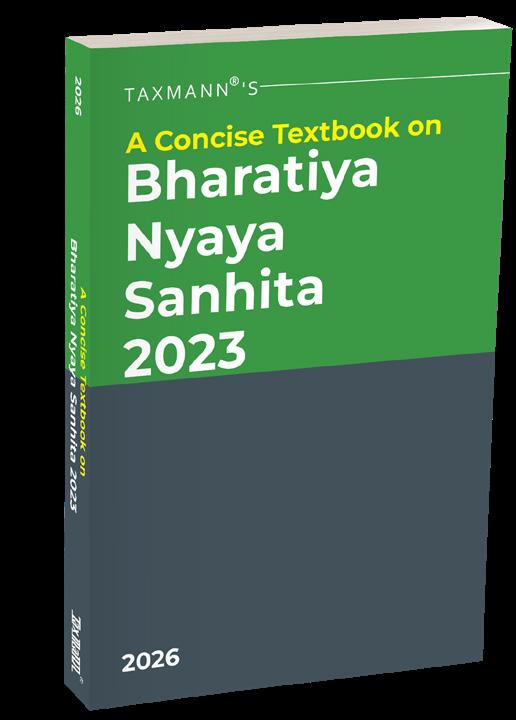
DESCRIPTION
A Concise Textbook on Bharatiya Nyaya Sanhita 2023 is a student-oriented academic textbook that comprehensively presents India’s new substantive criminal law under the Bharatiya Nyaya Sanhita 2023, which replaces the Indian Penal Code 1860. This 2026 Edition is designed not as a mere reproduction of statutory provisions, but as a structured learning resource explaining how the new criminal law framework is to be understood, interpreted, and applied. The book integrates the verbatim statutory text of the Bharatiya Nyaya Sanhita with concise and systematic Comments/ Section Analysis, enabling readers to clearly understand the scope, ingredients, exceptions, classifications, and practical implications of each provision. Its editorial design consciously facilitates the transition from the IPC-centric framework to the BNS regime, ensuring doctrinal continuity while highlighting legislative reform, reorganisation, and innovation. Positioned between a Bare Act and a practitioner commentary, the book functions as a foundational criminal law textbook for academic study, classroom teaching, and examination preparation in the post-IPC era. This book is ideally suited for:
• LL.B. and LL.M. Students
• Judicial Services, APO & Competitive Law Exam Aspirants
• Law Teachers & Academicians
• Law Colleges & University Libraries
The Present Publication is the 2026 Edition, authored by Taxmann’s Editorial Board, with the following noteworthy features:
• [Complete and Updated Coverage of BNS 2023] Presents the full text of the Bharatiya Nyaya Sanhita with structured explanatory support
• [Statutory Text with Section-wise Analysis] Each provision is supplemented with concise Comments/Section Analysis covering:
o Scope and applicability
o Ingredients of offences
o Punishments and gradations
o Exceptions and illustrations
o Interpretative and operational notes
• [Comparative Orientation with IPC 1860] Includes:
o A detailed IPC–BNS section mapping table
o A subject-wise Section Key linking IPC and BNS provisions
o Corresponding provision references for continuity tracking
• [Built-in Procedural Awareness] Provides offence classifications such as:
o Cognisable/Non-cognizable
o Bailable / Non-bailable
o Court of trial
• [Exam & Classroom-friendly Presentation] Uses clear headings, numbered sub-paragraphs, and ingredient-based breakdowns
• [Transition-focused Editorial Design] Assists readers trained under the IPC framework in adapting to BNS structure, numbering, and terminology