
Sample Read
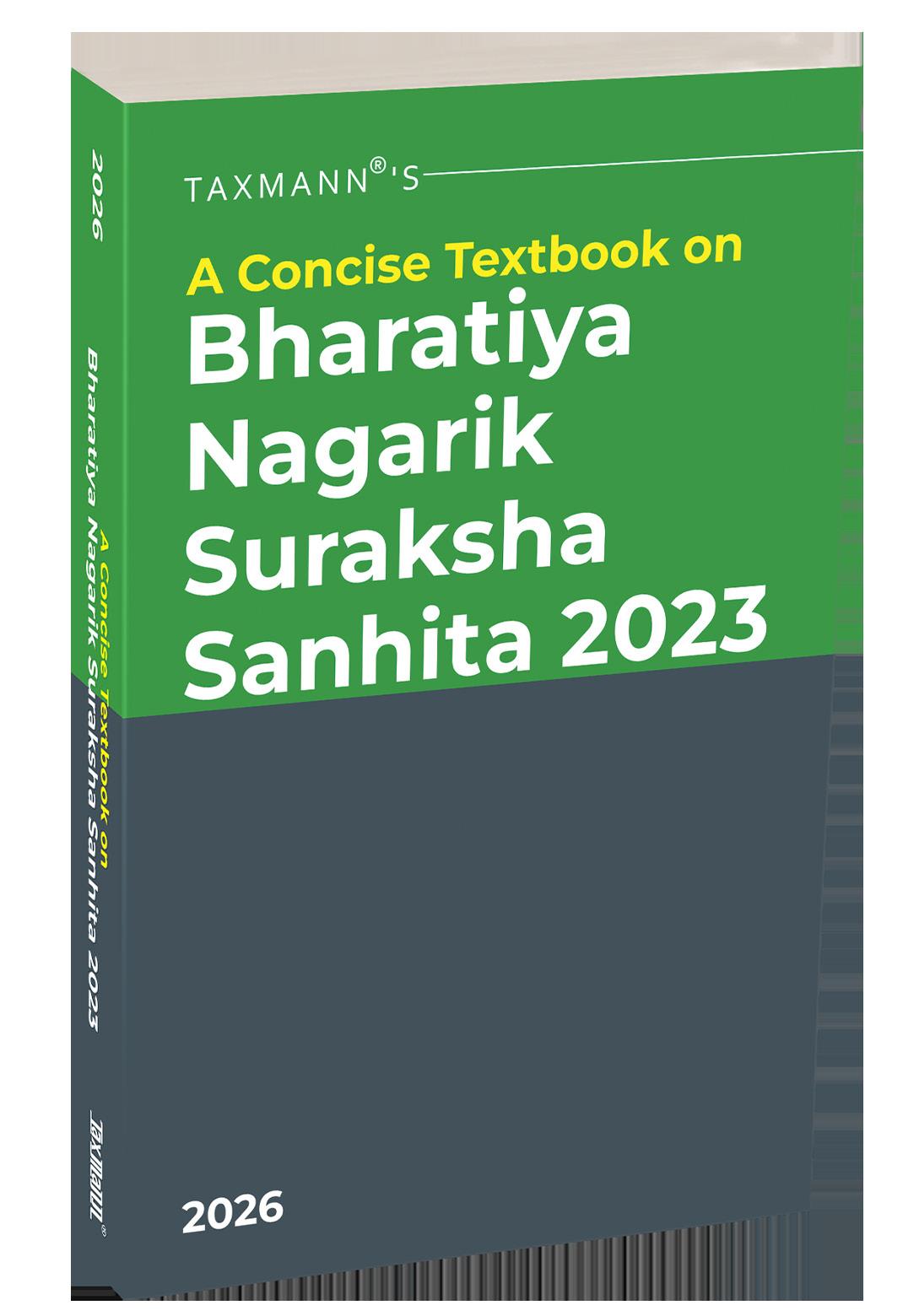

© Taxmann
Price : ` 745
Law stated in this book is as updated till 1st December, 2025
Published by : Taxmann Publications (P.) Ltd.
Sales & Marketing :
59/32, New Rohtak Road, New Delhi-110 005 India
Phone : +91-11-45562222
Website : www.taxmann.com
E-mail : sales@taxmann.com
Regd. Office :
21/35, West Punjabi Bagh, New Delhi-110 026 India
Printed at :
Tan Prints (India) Pvt. Ltd.
44 Km. Mile Stone, National Highway, Rohtak Road Village Rohad, Distt. Jhajjar (Haryana) India
E-mail : sales@tanprints.com
Disclaimer
Every effort has been made to avoid errors or omissions in this publication. In spite of this, errors may creep in. Any mistake, error or discrepancy noted may be brought to our notice which shall be taken care of in the next edition. It is notified that neither the publisher nor the author or seller will be responsible for any damage or loss of action to any one, of any kind, in any manner, therefrom. It is suggested that to avoid any doubt the reader should cross-check all the facts, law and contents of the publication with original Government publication or notifications.
No part of this book may be reproduced or copied in any form or by any means [graphic, electronic or mechanical, including photocopying, recording, taping, or information retrieval systems] or reproduced on any disc, tape, perforated media or other information storage device, etc., without the written permission of the publishers. Breach of this condition is liable for legal action. For binding mistake, misprints or for missing pages, etc., the publisher’s liability is limited to replacement within seven days of purchase by similar edition. All expenses in this connection are to be borne by the purchaser. All disputes are subject to Delhi jurisdiction only.
Table showing sections of Code of Criminal Procedure, 1973 and corresponding sections of Bharatiya Nagarik Suraksha Sanhita, 2023 I-29
Section key to Bharatiya Nagarik Suraksha Sanhita, 2023 I-59
CHAPTER V
ARREST OF PERSONS
CHAPTER VII
CHAPTER VIII
112. Letter of request to competent authority for investigation in a country or
Letter of request from a country or place outside India to a Court or an authority for investigation
CHAPTER IX
CHAPTER X
CHAPTER XI
MAINTENANCE
A.—Unlawful assemblies
B.—Public nuisances
160.
161.
162.
163.
164.
CHAPTER XII
CHAPTER XIII
CHAPTER XIV
JURISDICTION OF THE CRIMINAL COURTS IN INQUIRIES AND TRIALS
207.
CHAPTER XV
CONDITIONS REQUISITE FOR
215. Prosecution for contempt of lawful authority of public servants, for offences against public justice and for offences relating to documents given in
CHAPTER XVI
CHAPTER XVII
COMMENCEMENT OF PROCEEDINGS BEFORE MAGISTRATES
229. Special summons in cases of
Supply to accused of copy of
231. Supply of copies of statements and documents to accused in other cases triable by
232. Commitment of case to Court of Session when offence is triable exclusively by it
233.
CHAPTER XVIII THE CHARGE
241.
B.—Joinder of charges
CHAPTER XIX
CHAPTER XX
CHAPTER XXI
CHAPTER XXII
CHAPTER XXIII
PLEA BARGAINING
CHAPTER XXIV
CHAPTER
CHAPTER XXVI
Power to summon material witness, or examine person
349. Power of Magistrate to order person to give specimen signatures or handwriting, etc.
CHAPTER XXVII
368. Procedure in case of person of unsound mind tried before
372.
CHAPTER XXVIII
Imprisonment or committal of person refusing to answer or produce
389. Summary procedure for punishment for non-attendance by a witness in obedience to summons
CHAPTER
CHAPTER
CHAPTER XXXI
APPEALS
CHAPTER
CHAPTER XXXIII
TRANSFER OF CRIMINAL CASES
CHAPTER XXXIV
A.—Death Sentences
B.—Imprisonment
C.—Levy
463. Warrant for levy of fine issued by a Court in any territory to which this Sanhita does not extend
464. Suspension of execution of sentence of imprisonment 498
D.—General provisions regarding execution
465. Who may issue warrant
466. Sentence on escaped convict when to take effect
467. Sentence on offender already sentenced for another offence
468. Period of detention undergone by accused to be set off against sentence of imprisonment
470. Return of warrant on execution of sentence
Money ordered to be paid recoverable as a fine
E.—Suspension, remission and commutation of sentences
Mercy Petition in death sentence cases
Power to suspend or remit sentences
Power to commute sentence
Restriction on powers of remission or commutation in certain cases
Concurrent power of Central Government in case of death sentences
State Government to act after concurrence with Central Government in certain cases
CHAPTER XXXV
PROVISIONS AS TO BAIL AND BONDS
Maximum period for which undertrial prisoner can be detained
When bail may be taken in case of non-bailable offence
Bail to require accused to appear before next Appellate Court
482. Direction for grant of bail to person apprehending arrest
Special powers of High Court or Court of Session regarding bail
487. Discharge from custody
488. Power to order sufficient bail when that first taken is insufficient
489. Discharge of sureties
490. Deposit instead of recognizance
491. Procedure when bond has been forfeited
492. Cancellation of bond and bail bond
493. Procedure in case of insolvency or death of surety or when a bond is forfeited
494. Bond required from child
495. Appeal from orders under section 491
496. Power to direct levy of amount due on certain recognizances
CHAPTER XXXVI
DISPOSAL OF PROPERTY
497. Order for custody and disposal of property pending trial in certain cases
Order for disposal of property at conclusion of trial
Payment to innocent purchaser of money found on accused
Appeal against orders under section 498 or section 499
CHAPTER XXXVII
IRREGULAR PROCEEDINGS 506. Irregularities which do not vitiate proceedings
Irregularities which vitiate proceedings
508. Proceedings in wrong place
509. Non-compliance with provisions of section 183 or section 316
510. Effect of omission to frame, or absence of, or error in, charge
511.
CHAPTER XXXVIII
LIMITATION FOR TAKING COGNIZANCE OF CERTAIN OFFENCES
513. Definitions
514.
515. Commencement of period of limitation
516. Exclusion of time in certain cases
517. Exclusion of date on which Court is closed
518. Continuing offence
519.
CHAPTER XXXIX
MISCELLANEOUS
527.

CHAPTER XI
A.—Unlawful assemblies
Dispersal of assembly by use of civil force.
148. (1) Any Executive Magistrate or officer in charge of a police station or, in the absence of such officer in charge, any police officer, not below the rank of a sub-inspector, may command any unlawful assembly, or any assembly of five or more persons likely to cause a disturbance of the public peace, to disperse; and it shall thereupon be the duty of the members of such assembly to disperse accordingly.
(2)If, upon being so commanded, any such assembly does not disperse, or if, without being so commanded, it conducts itself in such a manner as to show a determination not to disperse, any Executive Magistrate or police officer referred to in sub-section (1), may proceed to disperse such assembly by force, and may require the assistance of any person, not being an officer or member of the armed forces and acting as such, for the purpose of dispersing such assembly, and, if necessary, arresting and confining the persons who form part of it, in order to disperse such assembly or that they may be punished according to law.
Corresponding Provision : Section 129 of Cr.PC., 1973
COMMENTS
SECTION ANALYSIS
148.1 Dispersal of assembly by use of civil force
Any Executive Magistrate or officer in charge of a police station or, in the absence of such officer in charge, any police officer, not below the rank of a sub-inspector, may command any unlawful assembly, or any assembly of five or more persons likely to cause a disturbance of the public peace, to disperse; and it shall thereupon be the duty of the members of such assembly to disperse accordingly.
148.2 Use of force to disperse the assembly
If, upon being so commanded, any such assembly does not disperse, or if, without being so commanded, it conducts itself in such a manner as to show a determination not to disperse, any Executive Magistrate or police officer, may proceed to disperse such assembly by force, and
may require the assistance of any person, not being an officer or member of the armed forces and acting as such, for the purpose of dispersing such assembly, and if necessary, arresting and confining the persons who form part of it, in order to disperse such assembly or that they may be punished according to law.
Use of armed forces to disperse assembly.
149. (1) If any assembly referred to in sub-section (1) of section 148 cannot otherwise be dispersed, and it is necessary for the public security that it should be dispersed, the District Magistrate or any other Executive Magistrate authorised by him, who is present, may cause it to be dispersed by the armed forces.
(2) Such Magistrate may require any officer in command of any group of persons belonging to the armed forces to disperse the assembly with the help of the armed forces under his command, and to arrest and confine such persons forming part of it as the Executive Magistrate may direct, or as it may be necessary to arrest and confine in order to disperse the assembly or to have them punished according to law.
(3) Every such officer of the armed forces shall obey such requisition in such manner as he thinks fit, but in so doing he shall use as little force, and do as little injury to person and property, as may be consistent with dispersing the assembly and arresting and detaining such persons.
Corresponding Provision : Section 130 of Cr.PC., 1973
COMMENTS
SECTION ANALYSIS
149.1 Use of armed forces to disperse assembly
The District Magistrate or any other Executive Magistrate authorised by him, who is present, may cause an assembly to be dispersed by the armed forces if:—
It is any assembly referred to in sub-section (1) of section 148 (, i.e., any unlawful assembly or any assembly of five or more persons likely to cause a disturbance of the public peace)
It cannot otherwise be dispersed (, i.e., cannot be dispersed without use of armed forces), and
It is necessary for the public security that it should be dispersed [Section 149(1)]
149.2 What such Magistrate may require armed forces to do to disperse assembly
Such Magistrate may require any officer in command of any group of persons belonging to the armed forces to disperse the assembly with the help of the armed forces under his command, and to arrest and confine such persons forming part of it as the Executive Magistrate may direct, or as it may be necessary to arrest and confine in order to disperse the assembly or to have them punished according to law.
149.3 Duty of officer of armed forces to obey such requisition
Every such officer of the armed forces shall obey such requisition in such manner as he thinks fit,
but in so doing he shall use as little force, and do as little injury to person and property, as may be consistent with dispersing the assembly and arresting and detaining such persons.
Power of certain armed force officers to disperse assembly.
150. When the public security is manifestly endangered by any such assembly and no Executive Magistrate can be communicated with, any commissioned or gazetted officer of the armed forces may disperse such assembly with the help of the armed forces under his command, and may arrest and confine any persons forming part of it, in order to disperse such assembly or that they may be punished according to law; but if, while he is acting under this section, it becomes practicable for him to communicate with an Executive Magistrate, he shall do so, and shall thenceforward obey the instructions of the Magistrate, as to whether he shall or shall not continue such action.
Corresponding Provision : Section 131 of Cr.PC., 1973
COMMENTS
SECTION ANALYSIS
150.1 Power of certain armed force officers to disperse assembly
When the public security is manifestly endangered by any such assembly and no Executive Magistrate can be communicated with, any commissioned or Gazetted Officer of the armed forces may disperse such assembly with the help of the armed forces under his command, and may arrest and confine any persons forming part of it, in order to disperse such assembly or that they may be punished according to law;
but if, while he is acting under this section, it becomes practicable for him to communicate with an Executive Magistrate, he shall do so, and shall thenceforward obey the instructions of the Magistrate, as to whether he shall or shall not continue such action.
Protection against prosecution for acts done under sections 148, 149 and 150.
151. (1) No prosecution against any person for any act purporting to be done under section 148, section 149 or section 150 shall be instituted in any Criminal Court except—
(a) with the sanction of the Central Government where such person is an officer or member of the armed forces;
(b) with the sanction of the State Government in any other case.
(2) (a) No Executive Magistrate or police officer acting under any of the said sections in good faith;
(b) no person doing any act in good faith in compliance with a requisition under section 148 or section 149;
(
c) no officer of the armed forces acting under section 150 in good faith;
(d) no member of the armed forces doing any act in obedience to any order which he was bound to obey, shall be deemed to have thereby committed an offence.
(3) In this section and in the preceding sections of this Chapter,—
(a) the expression “armed forces” means the army, naval and air forces, operating as land forces and includes any other armed forces of the Union so operating;
(
b) “officer”, in relation to the armed forces, means a person commissioned, gazetted or in pay as an officer of the armed forces and includes a junior commissioned officer, a warrant officer, a petty officer, a noncommissioned officer and a non-gazetted officer;
(c) “member”, in relation to the armed forces, means a person in the armed forces other than an officer.
Corresponding Provision : Section 132 of Cr.PC., 1973
COMMENTS
SECTION ANALYSIS
151.1 Protection against prosecution for acts done under sections 148, 149 and 150
No prosecution against any person for any act purporting to be done under section 148, section 149 or section 150 shall be instituted in any Criminal Court except—
(a) with the sanction of the Central Government where such person is an officer or member of the armed forces;
(b) with the sanction of the State Government in any other case. [Section 151(1)]
151.2 Not deemed to have committed any offence [Section 151(2)]
The following shall not be deemed to have committed an offence:
Executive Magistrate or police officer acting under any of the said sections in good faith;
Person doing any act in good faith in compliance with a requisition under section 148 or section 149
Officer of the armed forces acting under section 150 in good faith;
Member of the armed forces doing any act in obedience to any order which he was bound to obey,
151.3 Definitions of terms “armed forces”, ”officer” and “member” of armed forces
In this section and in the preceding sections of this Chapter,—
(a) the expression “armed forces” means the military, naval and air forces, operating as land forces and includes any other armed forces of the Union so operating;
(b) “officer”, in relation to the armed forces, means a person commissioned, gazetted or in pay as an officer of the armed forces and includes a junior commissioned officer, a warrant officer, a petty officer, a non-commissioned officer and a non-gazetted officer;
(c) “member”, in relation to the armed forces, means a person in the armed forces other than an officer.
B.—Public nuisances
Conditional order for removal of nuisance.
152. (1) Whenever a District Magistrate or a Sub-divisional Magistrate or any other Executive Magistrate specially empowered in this behalf by the State Government, on receiving the report of a police officer or other information and on taking such evidence (if any) as he thinks fit, considers—
(
a) that any unlawful obstruction or nuisance should be removed from any public place or from any way, river or channel which is or may be lawfully used by the public; or
(
b) that the conduct of any trade or occupation, or the keeping of any goods or merchandise, is injurious to the health or physical comfort of the community, and that in consequence such trade or occupation should be prohibited or regulated or such goods or merchandise should be removed or the keeping thereof regulated; or
(
c) that the construction of any building, or, the disposal of any substance, as is likely to occasion conflagration or explosion, should be prevented or stopped; or
(
d) that any building, tent or structure, or any tree is in such a condition that it is likely to fall and thereby cause injury to persons living or carrying on business in the neighbourhood or passing by, and that in consequence the removal, repair or support of such building, tent or structure, or the removal or support of such tree, is necessary; or
(e) that any tank, well or excavation adjacent to any such way or public place should be fenced in such manner as to prevent danger arising to the public; or
(f) that any dangerous animal should be destroyed, confined or otherwise disposed of,
such Magistrate may make a conditional order requiring the person causing such obstruction or nuisance, or carrying on such trade or occupation, or keeping any such goods or merchandise, or owning, possessing or controlling such building, tent, structure, substance, tank, well or excavation, or owning or possessing such animal or tree, within a time to be fixed in the order—
(i) to remove such obstruction or nuisance; or
(ii) to desist from carrying on, or to remove or regulate in such manner as may be directed, such trade or occupation, or to remove such goods or merchandise, or to regulate the keeping thereof in such manner as may be directed; or
(iii) to prevent or stop the construction of such building, or to alter the disposal of such substance; or
(iv) to remove, repair or support such building, tent or structure, or to remove or support such trees; or
(v) to fence such tank, well or excavation; or
(vi) to destroy, confine or dispose of such dangerous animal in the manner provided in the said order,
or, if he objects so to do, to appear before himself or some other Executive Magistrate subordinate to him at a time and place to be fixed by the order, and show cause, in the manner hereinafter provided, why the order should not be made absolute.
(2) No order duly made by a Magistrate under this section shall be called in question in any Civil Court.
Explanation.—A “public place” includes also property belonging to the State, camping grounds and grounds left unoccupied for sanitary or recreative purposes.
Corresponding Provision : Section 133 of Cr.PC., 1973
COMMENTS
SECTION ANALYSIS
152.1 Conditional order for removal of nuisance
Whenever a District Magistrate or a Sub-divisional Magistrate or any other Executive Magistrate specially empowered in this behalf by the State Government, on receiving the report of a police officer or other information and on taking such evidence (if any) as he thinks fit, considers—
(
a) that any unlawful obstruction or nuisance should be removed from any public place or from any way, river or channel which is or may be lawfully used by the public; or
(b) that the conduct of any trade or occupation, or the keeping of any goods or merchandise, is injurious to the health or physical comfort of the community, and that in consequence such trade or occupation should be prohibited or regulated or such goods or merchandise should be removed or the keeping thereof regulated; or
(c) that the construction of any building, or, the disposal of any substance, as is likely to occasion configuration or explosion, should be prevented or stopped; or
(d) that any building, tent or structure, or any tree is in such a condition that it is likely to fall and thereby cause injury to persons living or carrying on business in the neighbourhood or passing by, and that in consequence the
152.2
(
(
removal, repair or support of such building, tent or structure, or the removal or support of such tree, is necessary; or
e) that any tank, well or excavation adjacent to any such way or public place should be fenced in such manner as to prevent danger arising to the public; or
f) that any dangerous animal should be destroyed, confined or otherwise disposed of,
Such Magistrate may make a conditional order requiring the person causing such obstruction or nuisance, or carrying on such trade or occupation, or keeping any such goods or merchandise, or owning, possessing or controlling such building, tent, structure, substance, tank, well or excavation, or owning or possessing such animal or tree, within a time to be fixed in the order—
(
(
i) to remove such obstruction or nuisance; or
ii) to desist from carrying on, or to remove or regulate in such manner as may be directed, such trade or occupation, or to remove such goods or merchandise, or to regulate the keeping thereof in such manner as may be directed; or
(iii) to prevent or stop the construction of such building, or to alter the disposal of such substance; or
(
iv) to remove, repair or support such building, tent or structure, or to remove or support such trees; or
(
(
v) to fence such tank, well or excavation; or
vi) to destroy, confine or dispose of such dangerous animal in the manner provided in the said order,
or, if he objects so to do, to appear before himself or some other Executive Magistrate subordinate to him at a time and place to be fixed by the order, and show cause, in the manner hereinafter provided, why the order should not be made absolute.
Public Place
A “public place” includes also property belonging to the State, camping grounds and grounds left unoccupied for sanitary or recreative purposes.
152.3 Magistrate’s Order can’t be called in question in any Civil Court
No order duly made by a Magistrate under this section shall be called in question in any Civil Court.
Service or notification of order.
153. (1) The order shall, if practicable, be served on the person against whom it is made, in the manner herein provided for service of summons.
(2) If such order cannot be so served, it shall be notified by proclamation published in such manner as the State Government may, by rules, direct, and a copy thereof shall be stuck up at such place or places as may be fittest for conveying the information to such person.
Corresponding Provision : Section 134 of Cr.PC., 1973
COMMENTS
SECTION ANALYSIS
153.1 Service or notification of order
The order shall, if practicable, be served on the person against whom it is made, in the manner herein provided for service of summons.
153.2 Notification by proclamation or by electronic communication and sticking up copy at place/places, where order can’t be served
If such order cannot be so served, it shall be notified by proclamation or by electronic communication in such manner as the State Government may, by rules, direct, and a copy thereof shall be stuck up at such place or places as may be fittest for conveying the information to such person.
Person to whom order is addressed to obey or show cause.
154. The person against whom such order is made shall—
(a) perform, within the time and in the manner specified in the order, the act directed thereby; or
(b) appear in accordance with such order and show cause against the same; and such appearance or hearing may be permitted through audio-video conferencing.
Corresponding Provision : Section 135 of Cr.PC., 1973
COMMENTS
SECTION
ANALYSIS
154.1 Person to whom order is addressed to obey or show cause
The person against whom such order is made shall—
(a) perform, within the time and in the manner specified in the order, the act directed thereby; or
(b) appear in accordance with such order and show cause against the same; and such appearance or hearing may be permitted through audio video conferencing.
Penalty for failure to comply with section 154.
155. If the person against whom an order is made under section 154 does not perform such act or appear and show cause, he shall be liable to the penalty specified in that behalf in section 223 of the Bharatiya Nyaya Sanhita, 2023, and the order shall be made absolute.
Corresponding Provision : Section 136 of Cr.PC., 1973
COMMENTS
SECTION ANALYSIS
155.1 Penalty for failure to comply with section 154
If the person against whom an order is made under section 154 does not perform such act or appear and show cause, he shall be liable to the penalty specified in that behalf in section 223 of the Bharatiya Nyaya Sanhita, 2023, and the order shall be made absolute.
Procedure where existence of public right is denied.
156. (1) Where an order is made under section 152 for the purpose of preventing obstruction, nuisance or danger to the public in the use of any way, river, channel or place, the Magistrate shall, on the appearance before him of the person against whom the order was made, question him as to whether he denies the existence of any public right in respect of the way, river, channel or place, and if he does so, the Magistrate shall, before proceeding under section 157, inquire into the matter.
(2) If in such inquiry the Magistrate finds that there is any reliable evidence in support of such denial, he shall stay the proceedings until the matter of the existence of such right has been decided by a competent Court; and, if he finds that there is no such evidence, he shall proceed as laid down in section 157.
(3) A person who has, on being questioned by the Magistrate under sub-section (1), failed to deny the existence of a public right of the nature therein referred to, or who, having made such denial, has failed to adduce reliable evidence in support thereof, shall not in the subsequent proceedings be permitted to make any such denial.
Corresponding Provision : Section 137 of Cr.PC., 1973
COMMENTS
SECTION ANALYSIS
156.1 Magistrate shall question the person against whom the order is made as to whether he denies existence of any public right
Where an order is made under section 152 for the purpose of preventing obstruction, nuisance or danger to the public in the use of any way, river, channel or place, the Magistrate shall, on the appearance before him of the person against whom the order was made, question him as to whether he denies the existence of any public right in respect of the way, river, channel or place, and
156.2 Inquiry by Magistrate where person denies public right
If he does so, the Magistrate shall, before proceeding under section 157, inquire into the matter.
156.3 Magistrate to stay proceedings if there are reliable evidence to support the denial
If in such inquiry the Magistrate finds that there is any reliable evidence in support of such denial, he shall stay the proceedings until the matter of the existence of such right has been decided by a competent Court; and if he finds that there is no such evidence, he shall proceed as laid down in section 157.
156.4 Consequence of non-denial on being questioned by Magistrate or failure to adduce reliable evidence for denial
A person who has, on being questioned by the Magistrate under sub-section (1), failed to deny the existence of a public right of the nature therein referred to, or who, having made such denial, has failed to adduce reliable evidence in support thereof, shall not in the subsequent proceedings be permitted to make any such denial.
Procedure where person against whom order is made under section 152 appears to show cause.
157. (1) If the person against whom an order under section 152 is made appears and shows cause against the order, the Magistrate shall take evidence in the matter as in a summons-case.
(2) If the Magistrate is satisfied that the order, either as originally made or subject to such modification as he considers necessary, is reasonable and proper, the order shall be made absolute without modification or, as the case may be, with such modification.
(3) If the Magistrate is not so satisfied, no further proceedings shall be taken in the case:
Provided that the proceedings under this section shall be completed, as soon as possible, within a period of ninety days, which may be extended for the reasons to be recorded in writing, to one hundred and twenty days.
Corresponding Provision : Section 138 of Cr.PC., 1973
COMMENTS
SECTION ANALYSIS
157.1 Evidence to be taken like in a summons-case where person against whom order is made appears and shows cause
If the person against whom an order under section 152 is made appears and shows cause against the order, the Magistrate shall take evidence in the matter as in a summons-case.
157.2 Order to be made absolute if the Magistrate is satisfied that the order is reasonable and proper
If the Magistrate is satisfied that the order, either as originally made or subject to such modification as he considers necessary, is reasonable and proper, the order shall be made absolute without modification or, as the case may be, with such modification.
157.3 No further proceedings if Magistrate not so satisfied
If the Magistrate is not so satisfied, no further proceedings shall be taken in the case
157.4 Time-bound completion of proceedings under this section within 90 days extendable to 120 days for reasons recorded in writing
The proceedings under this section shall be completed, as soon as possible, within a period of ninety days, which may be extended for the reasons to be recorded in writing, to one hundred and twenty days.
Power of Magistrate to direct local investigation and examination of an expert.
158. The Magistrate may, for the purposes of an inquiry under section 156 or section 157—
(a) direct a local investigation to be made by such person as he thinks fit; or
(b) summon and examine an expert.
Corresponding Provision : Section 139 of Cr.PC., 1973
COMMENTS
SECTION ANALYSIS
158.1 Power of Magistrate to direct local investigation and examination of an expert
The Magistrate may, for the purposes of an inquiry under section 156 or section 157—
(a) direct a local investigation to be made by such person as he thinks fit; or (b) summon and examine an expert.
Power of Magistrate to furnish written instructions, etc.
159. (1) Where the Magistrate directs a local investigation by any person under section 158, the Magistrate may—
(a) furnish such person with such written instructions as may seem necessary for his guidance;
(b) declare by whom the whole or any part of the necessary expenses of the local investigation shall be paid.
(2) The report of such person may be read as evidence in the case.
(3) Where the Magistrate summons and examines an expert under section 158, the Magistrate may direct by whom the costs of such summoning and examination shall be paid.
Corresponding Provision : Section 140 of Cr.PC., 1973
COMMENTS
SECTION ANALYSIS
159.1 Powers of Magistrate as regards local investigation directed by him under section 158
Where the Magistrate directs a local investigation by any person under section 158, the Magistrate may—
(
a) furnish such person with such written instructions as may seem necessary for his guidance;
(
b) declare by whom the whole or any part of the necessary expenses of the local investigation shall be paid.
159.2 Investigation report
The report of such person may be read as evidence in the case.
159.3 Direction as to who should bear costs of expert evidence
Where the Magistrate summons and examines an expert under section 158, the Magistrate may direct by whom the costs of such summoning and examination shall be paid.
Procedure on order being made absolute and consequences of disobedience.
160. (1) When an order has been made absolute under section 155 or section 157, the Magistrate shall give notice of the same to the person against whom the order was made, and shall further require him to perform the act directed by the order within the time to be fixed in the notice, and inform him that, in case of disobedience, he shall be liable to the penalty provided by section 223 of the Bharatiya Nyaya Sanhita, 2023.
(2) If such act is not performed within the time fixed, the Magistrate may cause it to be performed, and may recover the costs of performing it, either by the sale of any building, goods or other property removed by his order, or by the distress and sale of any other movable property of such person within or without such Magistrate’s local jurisdiction, and if such other property is without such jurisdiction, the order shall authorise its attachment and sale when endorsed by the Magistrate within whose local jurisdiction the property to be attached is found.
(3) No suit shall lie in respect of anything done in good faith under this section.
Corresponding Provision : Section 141 of Cr.PC., 1973
A Concise Textbook on Bharatiya Nagarik Suraksha Sanhita (BNSS) 2023
AUTHOR : Taxmann’s Editorial Board
PUBLISHER : Taxmann
DATE OF PUBLICATION : December 2025
EDITION : 2026 Edition
ISBN NO : 9789375612032
No. of Pages : 760
BINDING TYPE : Paperback
Rs. 745
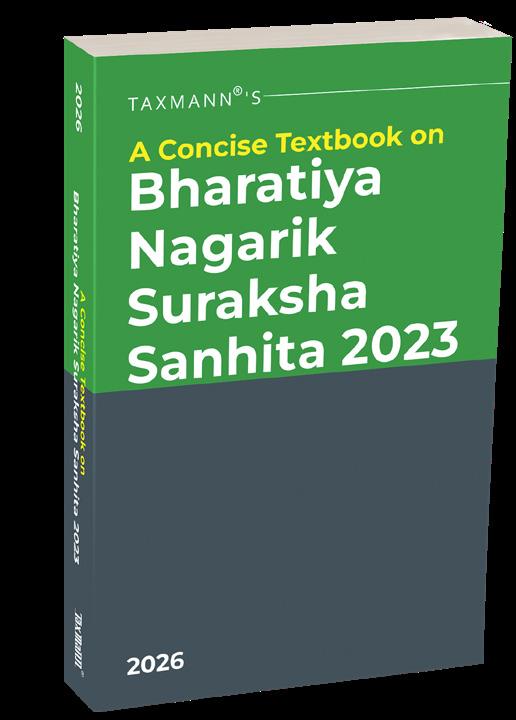
DESCRIPTION
A Concise Textbook on Bharatiya Nagarik Suraksha Sanhita 2023 is a student-centric, pedagogically structured exposition of India’s recodified criminal procedure law, which replaces the Code of Criminal Procedure 1973. This Students’ Edition – 2026 presents the Bharatiya Nagarik Suraksha Sanhita (BNSS) not merely as a statutory text, but as a functional procedural framework governing investigation, arrest, inquiry, trial, sentencing, and post-trial remedies under the modern criminal justice system. Positioned between a Bare Act and a full-scale commentary, the book reproduces the BNSS’s statutory text. It enriches it with concise section-wise analysis, explanatory comments, and continuous cross-references to the CrPC, enabling readers to understand both the substantive provisions and their practical operation. The presentation reflects the BNSS’s shift towards a technology-enabled, transparent, and citizen-centric criminal process, making it particularly relevant during the post-CrPC transition phase.
This textbook is ideally suited for:
• LL.B. and LL.M. Students
• Judicial Services & Competitive Examination Aspirants
• Law Teachers & Academics
• Interns, Court Trainees & Young Legal Professionals
• Police, Prosecution & Compliance Stakeholders (Introductory Level)
The Present Publication is the 2026 Edition, authored by Taxmann’s Editorial Board, with the following noteworthy features:
• [Concise Textbook Format] Designed for learning, comprehension, and examination use
• [Section-wise Explanatory Analysis] Clear comments explaining scope, intent, and procedural consequences
• [CrPC–BNSS Comparative Framework] Tables mapping CrPC, 1973 provisions with corresponding BNSS sections
• [Subject-wise Section Key] Quick location of topics such as arrest, bail, summons, trials, and remedies
• [Technology-enabled Procedure Explained] Coverage of electronic summons, audio-video recording, digital searches, and electronic proceedings
• [Procedural Safeguards & Accountability Focus] Arrest protocols, custody safeguards, police duties, and rights of stakeholders
• [Exam-friendly Presentation] Logical sequencing and structured analysis for revision and answerwriting