Taxmann ITR Week 2026 | 110+ FAQs on Income-tax Returns for AY 2026-27
2. Which form should a taxpayer use to file his
tax return for the assessment year 2026-27?
Q 3. What changes have been introduced in the ITR forms notified for the Assessment Year 2026-27 compared to last year’s ITR forms?
Q 4. I am filing my ITR for AY 2026-27 in July 2026. Since the Income-tax Act, 2025 came into force on 1st April 2026, should I file my Income-tax Return for Assessment Year 2026-27 under the
Q 5. Will taxpayers be required to file two ITRs during the transition year because the ITA 2025 has replaced the ITA 1961?
Q 6. I am a proprietor carrying on business. My turnover is below the tax audit limit, and my accounts are not required to be audited. What is the due date for filing my Income-tax Return?
Q 7. I am only a partner in a partnership firm. I do not carry on any separate business. What is my due date for filing the ITR if the firm’s accounts are not required to be audited?
Q 8. I have only salary income and capital gains. Has my due date for filing the Incometax Return also been extended to 31st August?
Q 9. I am a professional (i.e., a Chartered Accountant, Doctor, or Advocate), and my gross receipts are below the threshold for a tax audit. Will the ITR filing due date be 31st August?
Q 10. I filed my ITR for Assessment Year 2026-27 in July 2026. In January 2027, I discovered that I had omitted to report certain income. Should I file a revised return or an updated return?
I earn a salary of Rs. 14 lakhs. In FY 2025-26, I paid Rs. 4 lakhs to repay the principal of the home loan, Rs. 50,000 for health insurance, and Rs. 1.5 lakh towards the interest on the home loan. Which
Q 20. I am a trader in Futures and Options (F&O). This year, I incurred a loss in F&O trading. Do I still need to file my Income Tax Return (ITR) even though my income is below the
Q 21. I am a salaried individual and have earned long-term capital gains amounting to Rs. 1,20,000 taxable under Section 112A. Which ITR form should I use for filing my return?
Q 22. I am a salaried employee. I do trading in derivatives such as futures and options. What is the deadline for filing my ITR?
Q 23. How to calculate the turnover in the case of F&O?
Q 24. I am a senior citizen, and my only source of income is the interest earned from bank deposits, which is below the maximum exemption limit. The bank has already deducted tax (TDS) from this income. Am I required to file an ITR?
Q 25. Which ITR form is to be used to report income from crypto?
Q 26. I only have income from cryptocurrencies. When is the due date for filing my ITR?
Q 27. Which ITR form is to be used to report winnings from online games?
Q 28. I have returned to India after working in the USA. For AY 2026-27, I am a tax resident of India. Can I still file ITR-1?
Q 30. What are the new disclosures required in the ITR forms while claiming certain deductions?
Q 31. What information does the ITR form seek while claiming the deduction of House Rent Allowance (HRA)?
Q 32. What details does the ITR form seek if the taxpayer claims home loan interest under Section 24(b)?
Q 33. What details does the ITR form seek if the taxpayer claims investment-linked deductions under section 80C?
Q 34. What details does the ITR form seek if the taxpayer claims a deduction of medical insurance under section 80D
Q 35. What details does the ITR form seek if
Q 37. Mr. Aman filed an ITR for the Assessment Year 2023-24 within the due date. On 1305-2026, he found that he failed to report interest income in his ITR. Can he revise his ITR for AY 2023-24?
Q 46. Mr. A has a savings bank account in Australia with a peak balance of AUD 20,000 during the calendar year 2025 and also earned interest of AUD 500. While furnishing his Income-tax Return in India, he wants to know which exchange rate should be used to convert these amounts into Indian Rupees?
Q 47. I paid taxes in a foreign country while working on a project there for three months. How can I claim credit for this in ITR?
Q 48. What is the difference between Schedule FA, Schedule FSI and Schedule TR?
Q 49. How to report the “cost of acquisition” and “sale consideration” of the unlisted equity shares acquired during the year by gift, will, amalgamation, etc.?
Q 50. A person held shares listed on the New York Stock Exchange. Should such shares be treated as unlisted for reporting in the ITR?
Q 51. A person holds shares of a cooperative bank or cooperative society. Should such shares be treated as unlisted shares to be reported in ITR?
Q 52. Do I need to report details of unlisted shares even if I have them as part of my business’s stock in trade?
Q 53. Should details of Foreign Assets be reported in Schedule AL if they have been duly reported in Schedule FA?
Q 54. Do taxpayers need to disclose foreign ESOPs, RSUs or ESPPs even if they have not sold them?
Q
Q 56. Table B of Schedule FA seeks details of ‘Financial Interest’ held by the assessee in any entity. What is the meaning of Financial Interest?
Q 57. Mr. A worked in Australia for three years and returned to India in July 2025. Before returning, he transferred the entire balance from his Australian salary account to his Indian bank account. However, he did not close the Australian bank account. During the relevant year, the account remained dormant, had no transactions and carried a nil balance. Is he still required to disclose the account in his Income-tax Return?
Q 58. Whether details to be reported in Schedule AL if they have been reported in the Balance Sheet Schedule of ITR?
Q 59. I have deposited Rs. 7,00,000 to my
Q 60. Mr. X earned income from cryptocurrencies during the financial year 2025-26. How will such income be reported when furnishing the return of income?
Q 61. Due to my job change, I earned a salary from two employers during the year. Can I claim a standard deduction of Rs. 75,000 against the salary from both employers?
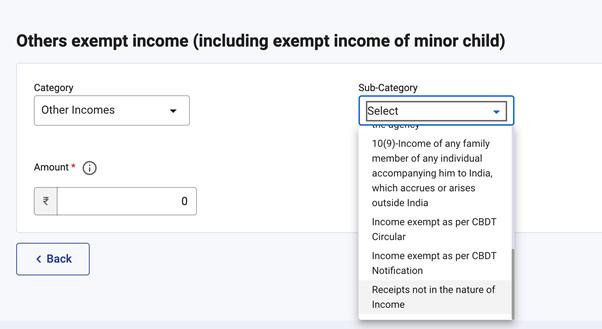
Q 62. The ITR utility contains a new reporting field titled “Receipts not in the nature of income”. Is it mandatory to report all such receipts in this field?
Q 63. How can I reset the password if I do not have access to the mobile number registered with the e-filing portal and Aadhaar?
Q 64. What are the modes for filing a return of income?
Q 65. What is the time limit for sending a signed copy of ITR-V to CPC or verifying the return furnished online?
Q 66. What happens if I do not verify my ITR by December 31, 2026? 54
Q 67. What are the norms related to the verification of ITR? 55
Q 68. Mr. Raj files his ITR on September 10, 2025, and sends the signed ITR-V to CPC Bengaluru on October 8, 2025. CPC Bengaluru received it on October 12, 2025. Will the ITR be treated as verified within 30 days?
Q 69. I have uploaded an ITR, but I found that I missed reporting a few details. Can I cancel it and upload a fresh ITR?
Q 70. When is it mandatory to file the ITR for an individual or HUF?
Q 71. When is it mandatory for a non-resident to file a return of income?
Q 72. Under what circumstances is a non-resident
Q 73. How to furnish a Taxpayer Identification Number (TIN) in the column of “residential status” in the ITR form if the same was not allotted in the resident country?
Q 74. I am a housewife. During the year, I earned a long-term capital gain of Rs. 30 lakhs. I have invested the capital gain in a new house and claimed an exemption under Section 54. Now, my total taxable income is nil. Do I need to furnish ITR?
Q 75. I am a non-resident person. How can I register on the e-filing portal without an Indian Mobile number?
Q 76. I have filed my return, with income computed according to the mercantile method of accounting. Now, I want to file a revised return with income computed according to the cash method of accounting. Can I do so?
Q 77. I have filed an ITR-1 disclosing only salary income. Subsequently, I found that I forgot to disclose the lottery income. Can I change the ITR Form from ITR-1 to ITR-2 while filing the revised return?
Q 78. I identified an error in the processed return and filed a rectification request under section 154. After a few days, I found another error, but the e-filing portal is not allowing me to raise a rectification request for the second time. What can I do?
Q 79. Is it mandatory to furnish ITR if a financial transaction entered into by a person is reported in the Statement of Financial Transaction (SFT)?
Q 80. My return became invalid because I failed to respond to a notice that it was defective. Is there any way to correct that invalid return?
Q 81. Certain information about my income and deductions, etc., is pre-filled in the Income-tax return. What is the source of that information?
Q 84. The Annual Information Statement (AIS) contains incorrect information. Should I report the same figures in my Income-tax Return?
Q 85. What should I do if the information in AIS is incorrect or does not belong to me?
Q
Q
I have earned profit from selling listed shares that I have held for more than 12 months. Will this be treated as capital gain or business profit?
Q 88. I have earned a profit from intra-day trading. Is it taxable as business profit or capital gain?
Q 89. I have earned a long-term capital gain of Rs. 10 lakhs, which is taxable at 12.5% under Section 112A. I have made an eligible investment of Rs. 1 lakh for Section 80C deductions. How much tax do I need to pay on such income?
Q 90. Mr. X has transferred equity shares of various companies after holding them for more than 12 months. Does he need to enter the details of capital gains for each scrip in the ITR?
Q 91. Should property and buyer information be reported under the Capital Gain Schedule if such property is situated outside India and sold to a non-resident?
Q 92. I am a resident individual. In FY 2025–26, I sold listed equity shares of two companies:
Q 93. Mr. X received share buy-back consideration from a domestic company on October 5, 2024. How is this income taxed?
Q 94. Mr. Rajesh purchased a house on 30-09-2001 for Rs. 1,20,000. He paid stamp duty of Rs. 10,000 and Rs. 5,000 towards the brokerage. He sold the property for Rs. 50 lakhs on 01-08-2025. He invested Rs. 45 lakhs to purchase another residential house property for exemption under Section 54. How much capital gain tax would Mr. Rajesh pay in the Financial Year 2025-26?
Q 95. In FY 2025-26, Mr. A earned a salary of Rs. 40 lakhs and sold a property bought in 2015. His LTCG was Rs. 5 lakhs with indexation and Rs. 15 lakhs without indexation. Opting for the grandfathering rule, he paid tax on Rs. 5 lakhs, but his ITR showed total income as Rs. 55 lakhs (Rs. 40 lakhs + Rs. 15 lakhs), attracting 10% surcharge. Is the ITR utility computing surcharge correct?
Q 99. I filed an income tax return to claim a tax refund, but it failed because I mentioned an incorrect bank account number. How can I submit the correct bank account number?
102. I have a bank fixed deposit of Rs. 1,50,000. My total income (including accrued interest on FDs) is below the taxable limit. How to avoid the deduction of tax on interest income?
103. How can I avoid a tax deduction if I earn an interest income of Rs. 40,000 from saving deposits, and my total income, including such interest income, is below the taxable limit?
105. The income-tax department has raised a demand against Mr A for the assessment year 2025-26. He did not pay the tax demand and filed ITR for the next assessment year, in which a refund was claimed. Whether such a refund can be adjusted against his pending tax demand?
I am a non-resident filing an Income-tax return in India. I do not maintain a bank account in India. Can I get my
108. I failed to submit a rent receipt and proof of tax-saving investment to my employer, due to which HRA exemption and certain other deductions were not given to me. How can I claim a refund of such excess tax paid, as the tax deducted from my income is higher than my actual tax liability?
Q 109. I am a salaried person living in rented premises. The HRA component in my CTC is less than the actual rent paid. Can I claim a Section 80GG deduction in respect of such excess rent?
Q 110. How to claim the deduction of a donation given to an organisation approved under Section 80G?
Q 111. How can you claim the deduction of donations given to political parties?
Q 112. I purchased electoral bonds and donated them to political parties in FY 2025-26. Can I claim a deduction, given the Supreme Court declared the electoral bonds scheme unconstitutional?
Q 113. Is it mandatory to furnish the PAN of the landlord to the employer for claiming exemption of HRA?
Q 114. I have earned a salary income of Rs. 800,000 and have a loss of Rs. 300,000 from house property. Can I set off such a loss against my salary income?
Q 115. I have a long-term capital loss of Rs. 70,000 from the sale of listed equity shares. Whether the same can be allowed to be set off or carried forward?
Q 116. My minor daughter earned Rs. 10,00,000 by participating in a skill-based competition. Is she required to file an ITR for the concerned year?
Q 117. I have received some income on behalf of my deceased father in my account during the year. My father failed to write his will before dying, and the partition has not yet taken place. In whose hands will such income be taxed?
Q 118. Mr. X died on 23-08-2025. Before his death, he received a salary income of Rs. 12 lakhs. After his death, some interest income accrued in his account. Is an ITR required to be filed for the relevant year?
Q 119. Can a legal heir file the return of the deceased assessee if DSC is mandatory?
Due dates and applicable ITR Forms
Q1. What
are the due dates for filing of Income-tax Returns for the Assessment Year 2026-27?
The due dates for filing of ITRs for various types of assessees are as follows:
If assessee is required to furnish a report of transfer pricing (TP) Audit in Form No. 3CEB
If the assessee is a partner in a firm, who is required to furnish a report of Transfer Pricing (TP) Audit in Form No. 3CEB
If an Individual is a spouse of a person, being a partner in a firm required to furnish a report of Transfer Pricing (TP) Audit in Form No. 3CEB and the provisions of section 5A apply to such spouse.
30-11-2026
30-11-2026
30-11-2026
Company assessee not required to furnish transfer pricing audit report in Form No. 3CEB 31-10-2026
If the assessee is required to get its accounts audited under Income-tax Act or any other law 31-10-2026
If the assessee is a partner in a firm whose accounts are required to be audited 31-10-2026
If an Individual is a spouse of a person, being a partner in a firm whose accounts are required to be audited, and the provisions of section 5A apply to such spouse
31-10-2026
If partner in a firm whose accounts are not required to be audited and spouse of such partner if provisions of Section 5A applies 31-08-2026
If assessee has income from business or profession and tax audit is not required 31-08-2026
In any other case 31-07-2026
Q2. Which form should a taxpayer use to file his income tax return for the assessment year 2026-27? Nature
Salary Income
Income from salary/pension (for ordinarily resident person)
Income from salary/pension (for not ordinarily resident and non-resident person)
Any individual who is a director in any company
If payment of tax in respect of ESOPs allotted by an eligible start-up has been deferred
Income from House Property
Income or loss from two house properties (excluding brought forward losses and losses to be carried forward)
Individual has brought forward loss or losses to be carried forward under the head House Property
Income or loss from more than two house properties
Income from Business or Profession
Income from business or profession
Income from presumptive business or profession covered under section 44AD, 44ADA and 44AE (for person resident in India)
Income from presumptive business or profession covered under section 44AD, 44ADA and 44AE (for not ordinarily resident and non-resident person)
Interest, salary, bonus, commission or share of profit received by a partner from a partnership firm
Capital Gains
Long-term capital gains taxable under Section 112A and not exceeding Rs. 1.25 lakhs
Long-term capital gains taxable under the following provisions:
• Section 112A and it exceeds Rs. 1.25 lakhs
• Section
Short-term capital gains taxable under any provision
Taxpayer has held unlisted equity shares at any time during the previous year
Capital gains/loss on sale of investments/property
Nature of income
Income from Other Sources
Family Pension (for ordinarily resident person)
Family Pension (for not ordinarily resident and nonresident person)
Income from other sources (other than income chargeable to tax at special rates including winnings from lottery and race horses or losses under this head)
Income from other sources (including income chargeable to tax at special rates including winnings from lottery and race horses or losses under this head)
Dividend income exceeding Rs. 10 lakhs taxable under Section 115BBDA
Unexplained income (i.e., cash credit, unexplained investment, etc.) taxable at 60% under Section 115BBE
Person claiming deduction under Section 57 from income taxable under the head’ Other Sources’ (other than deduction allowed from family pension)
Deductions
Person claiming deduction under Section 80QQB or 80RRB in respect of royalty from patent or books
Person claiming deduction under section 10AA or Part-C of Chapter VI-A
Total Income
Agricultural income exceeding Rs. 5,000
Total income exceeding Rs. 50 lakhs
Assessee has any brought forward losses or losses to be carried forward under any head of income
Computation of Tax liability
If an individual is taxable in respect of an income but TDS in respect of such income has been deducted in hands of any other person (i.e., clubbing of income, Portuguese Civil Code, etc.)
Claiming relief of tax under sections 90, 90A or 91
Others
Assessee has:
• Income from foreign sources
• Foreign Assets including financial interest in any foreign entity
• Signing authority in any account outside India
Nature of income
Income has to be apportioned in accordance with Section 5A
If the tax has been deducted on cash withdrawal under Section 194N
Person has deposited more than Rs. 1 crore in one or more current account
Person has incurred more than Rs. 2 lakhs on foreign travelling
Person has incurred more than Rs. 1 lakh towards payment of the electricity bill
Person has turnover from business exceeding Rs. 60 lakhs
Person has gross receipts from profession exceeding Rs. 10 lakhs
Aggregate amount of TDS and TDS is Rs. 25,000 (Rs. 50,000 in case of senior citizen) or more
Aggregate deposit in the saving bank account is Rs. 50 lakh or more
* ITR-1 can be filed by an individual who is ordinarily resident in India. ITR-4 can be filed only by an Individual or HUF who is ordinarily resident in India and by a firm (other than LLP) resident in India.
Other Assessees
Firm (excluding LLPs) opting for presumptive taxation scheme of section 44AD, 44ADA or 44AE
Firm (including LLPs)
Association of Persons (AOPs)
Body of Individuals (BOI)
Local Authority
Artificial Juridical Person
Companies other than companies claiming exemption under Section 11
Nature
Persons including companies required to furnish return under:
• Section 139(4A);
• Section 139(4B);
• Section 139(4C);
• Section 139(4D); ✓
Business Trust ✓
Investment Fund, as referred to in Section 115UB ✓
Q3. What changes have been introduced in the ITR forms notified for the Assessment Year 2026-27 compared to last year’s ITR forms?
The CBDT usually changes the ITR forms annually to incorporate amendments made to the Income-tax Act by the previous Finance Act. However, the ITR forms notified for the Assessment Year 2026-27 include some additional reporting requirements in addition to the changes resulting from the Finance Act 2025 amendments. Some of the key changes introduced in the new ITR forms are as follows:
(a) The ITR forms require the reporting of turnover and income from futures and options (F&O) trading. Specific columns have been introduced to report turnover from F&O trading and the income from such trading credited to the profit and loss account.
(b) A new reporting column has been introduced in Part A - OI (Other Information) in the ITR forms, requiring taxpayers to disclose the amount for the disallowance of MSME interest under Section 43B(h).
(c) The ITR forms require reporting by individuals and entities who are partners in one or more partnership firms during the relevant financial year. It now requires additional details of the amount of interest due or received from the partnership firm and the amount of remuneration due or received from the partnership firm.
(d) The ITR forms include a column for reporting fees paid under Section 234-I for furnishing a revised return of income.
(e) The assessee claiming a deduction under Section 80G is required to report the IFSC and Transaction Reference Number.
(f) The assessees opting for the presumptive taxation scheme are required to disclose their investments.
(g) The charitable trusts are required to report the total value of investments, rather than the nominal value, in Schedule J. Further, reporting is required for the validity period of registration obtained under other laws.
(h) The non-residents opting for the presumptive taxation scheme for businesses covered under Sections 44B, 44BB, 44BBA, 44BBC, or 44BBD are now required to disclose the gross receipts/turnover and net profit from such businesses in the new column.
(i) The ITR forms clarify that interest earned from companies, Non-Banking Financial Companies (NBFCs), and Housing Finance Companies (HFCs) shall be reported under the ‘Other’ column of Schedule OS.
(j) The ITR forms have been updated by amending the declaration in Part A–GEN to capture whether income is being offered under Section 44BBD and by incorporating specific reporting in Schedule BP to disclose such deemed profits, in line with the other presumptive taxation provisions.
You can read all the changes notified in the new ITR forms from the link given below:
Analysis of 20+ changes in the new ITR forms applicable for assessment year 2026-27 [2026] 184 taxmann.com 703 (Article)
Q4. I am filing my ITR for AY 2026-27 in July 2026. Since the Income-tax Act, 2025 came into force on 1st April 2026, should I file my Income-tax Return for Assessment Year 2026-27 under the Income-tax Act, 2025?
No, the ITR for Assessment Year 2026-27 must be furnished in accordance with the provisions of the Income-tax Act, 1961 (‘ITA 1961’). Although the Income-tax Act, 2025 (‘ITA 2025’) has come into force with effect from 1st April 2026, it applies only to Tax Year 2026-27 and subsequent tax years. The return for Assessment Year 2026-27 relates to the Previous Year 2025-26, which ended on 31st March 2026, when the ITA 1961 was in force.
Therefore, the computation of income, determination of tax liability and filing of the return for Assessment Year 2026-27 shall continue to be governed by the provisions of the ITA 1961, even if the return is furnished after 1st April 2026.
Q5. Will taxpayers be required to file two ITRs during the transition year because the ITA 2025 has replaced the ITA 1961?
No, the taxpayers are not required to furnish two ITRs merely because the ITA 2025 has replaced the ITA 1961. For the financial year 2025-26, the return of income shall be furnished for Assessment Year 2026-27 under the provisions of the ITA 1961. Similarly, the return for Tax
Year 2026-27 will become due only after the end of that tax year, in accordance with the due dates prescribed under the ITA 2025.
Thus, there is no overlap that would require taxpayers to file two returns during the transition year. The return under the ITA 1961 and the return under the ITA 2025 relate to two different income periods and will be furnished in their respective due courses.
Q6. I am a proprietor carrying on business. My turnover is below the tax audit limit, and my accounts are not required to be audited. What is the due date for filing my Income-tax Return?
The Finance Act, 2026 has extended the due date for filing the return of income from 31st July to 31st August for assessees having income from business or profession whose accounts are not required to be audited. Earlier, such taxpayers were required to furnish their return by 31st July. The amendment provides you with an additional month to finalise your books of account and complete the return filing process.
For example, Mr. A is engaged in a trading business as a sole proprietor. His turnover for the previous year 2025-26 is Rs. 80 lakhs, and he is not liable to have his accounts audited under the Income-tax Act or any other law. Since Mr. A is carrying on business and his accounts are not required to be audited, the due date for furnishing his return for the Assessment Year 2026-27 shall be 31st August 2026.
Q7. I am only a partner in a partnership firm. I do not carry on any separate business. What is my due date for filing the ITR if the firm’s accounts are not required to be audited?
The Finance Act, 2026 has extended the due date for filing the return of income for a partner of a firm whose accounts are not required to be audited. This benefit is available even if the partner has no separate business or professional income. The due date depends upon the status of the partnership firm, not merely on the nature of the partner’s own income.
For example, Mr. B is a partner in a partnership firm. The firm is not liable to a tax audit, and Mr. B has no separate business or professional income. Apart from his share of profit and interest from the firm, he also has salary income and bank interest. Since the firm’s accounts are not required to be audited, the due date for furnishing the ITR for the Assessment Year 2026-27 shall be 31st August 2026.
Q8. I have only salary income and capital gains. Has my due date for filing the Income-tax Return also been extended to 31st August?
No, the extension of the due date from 31st July to 31st August is available only to specified taxpayers having income from business or profession whose accounts are not required to be
audited, and to partners of non-audit firms. The amendment does not apply to taxpayers who do not have business or professional income. Accordingly, salaried individuals, pensioners, investors, and other taxpayers filing returns without business or professional income shall continue to be governed by the due date of 31st July, unless they fall under any other category for which a different due date has been prescribed.
For example, Ms. C is a salaried employee. She also earned interest income and capital gains from the sale of mutual funds in the previous year 2025-26. She has no business or professional income. In this case, she will be required to file her return for the Assessment Year 2026-27 on or before 31st July 2026.
Q9. I am a professional (i.e., a Chartered Accountant, Doctor, or Advocate), and my gross receipts are below the threshold for a tax audit. Will the ITR filing due date be 31st August?
Yes, the Finance Act, 2026 has extended the due date for furnishing the return of income from 31st July to 31st August for assessees having income from business or profession whose accounts are not required to be audited under the Income-tax Act or any other law. The benefit of the extended due date is available not only to persons carrying on business but also to professionals such as Chartered Accountants, doctors, advocates, architects, engineers, consultants, and other professionals, provided they are not required to have their accounts audited.
For example, Mr. A is a Chartered Accountant carrying on practice as a sole proprietor. His gross professional receipts for the previous year 2025-26 are below the prescribed threshold for a tax audit. Therefore, he is not required to have his accounts audited under the Incometax Act. Accordingly, the due date for furnishing his return of income for the Assessment Year 2026-27 shall be 31st August 2026. However, if his accounts are required to be audited under the Income-tax Act or any other law, the due date for furnishing the return shall remain 31st October 2026.
Q10. I filed my ITR for Assessment Year 2026-27 in July 2026. In January 2027, I discovered that I had omitted to report certain income. Should I file a revised return or an updated return?
Where an assessee has already furnished the original return of income but subsequently discovers any omission, wrong statement or error therein, the appropriate course of action is to file a revised return under Section 139(5). An updated return under Section 139(8A) is intended for cases where the time limit for filing a revised return has expired.
The Finance Act, 2026 has extended the time limit for furnishing a revised return. An assessee can now furnish a revised return within 12 months from the end of the relevant previous year or before the completion of the assessment, whichever is earlier.
Earlier, a revised return could be furnished only within 9 months of the end of the relevant previous year. The Finance Act, 2026 has extended the time limit by three months, thereby providing taxpayers with additional time to rectify any genuine omission or mistake. Accordingly, if you filed the original return for Assessment Year 2026-27 in July 2026 and discovered in January 2027 that certain income had been omitted, you should furnish a revised return, provided the assessment has not been completed. For Assessment Year 2026-27, the revised return can ordinarily be furnished up to 31st March 2027.
However, such additional 3 months will be available upon payment of a fee under Section 234I, introduced by the Finance Act, 2026. It provides that where the revised return is furnished after the expiry of 9 months but within 12 months from the end of the relevant financial year, the assessee is required to pay the following fee prescribed under Section 234-I:
(a) Rs. 1,000, where the total income does not exceed Rs. 5 lakhs; and
(b) Rs. 5,000, in any other case.
For example, in the case of Assessment Year 2026-27, if an assessee furnishes a revised return after 31st December 2026 but on or before 31st March 2027, the revised return will be valid only after payment of the applicable fee under section 234-I.
Q11. I filed my belated return on 31st December 2026. Can I still revise it if I discover any mistake later?
A return furnished under section 139(4) (belated return) can also be revised under section 139(5), provided the prescribed time limit has not expired. Prior to the amendment made by the Finance Act, 2026, a revised return could be furnished only up to 31st December of the relevant assessment year. Consequently, where a taxpayer furnished a belated return towards the end of the permissible period, there was practically no opportunity to revise it. To remove this hardship, the Finance Act, 2026 has extended the time limit for furnishing a revised return until the end of the relevant assessment year, or until completion of the assessment, whichever is earlier. However, if the revised return is furnished more than 9 months after the end of the relevant previous year, the prescribed fee under section 234-I is payable.
For example, Mr. A could not file his original return for the Assessment Year 2026-27 within the due date. He furnished a belated return on 31st December 2026. In February 2027, he realised that he had omitted to report interest income. Since he furnished the belated return on 31st December 2026 and discovered the omission in February 2027, he can furnish a revised return up to 31st March 2027, subject to payment of the applicable fee under Section 234-I.
Q 12. What is the new tax regime under section 115BAC?
Section 115BAC of the ITA 1961 provides an alternative tax regime (new tax regime) for Individuals, HUFs, AOPs, BOIs, and AJPs (‘eligible assesses’). Under this tax regime, eligible assesses have the option of being taxed at reduced rates based on their income brackets.
If an eligible assessee opts for this regime, the income shall be taxable at the following rate for assessment year 2026-27:
to 4,00,000
4,00,001 to 8,00,000
8,00,001 to 12,00,000
12,00,001 to 16,00,000
From 16,00,001 to 20,00,000
From 20,00,001 to 24,00,000
A resident individual who has opted for the new tax regime can claim a rebate of up to Rs. 60,000, provided his total income does not exceed Rs. 12,00,000. However, if the total income exceeds the threshold limit of Rs. 12,00,000, the marginal rebate is allowed.
Furthermore, an assessee opting for the new tax regime is required to satisfy the following conditions:
(a) The total income of the assessee is computed without claiming specified exemptions and deductions (discussed in FAQ 15)
(b) The total income of the assessee is computed without set-off of losses or depreciation carried forward from earlier years if such loss or depreciation is attributable to any of the specified exemptions and deductions
(c) The total income of the assessee is computed without set-off of any loss under the head “Income from house property” with any other head of income
(d) The total income of the assessee is calculated after claiming depreciation in the prescribed manner, and if the depreciation rate of any block of assets exceeds 40%, it is restricted to 40%. and
(e) The total income of the assessee is computed without claiming any exemptions or deductions for allowances or perquisites provided under any other law for the time being in force.
(Read more: New tax regime for Individual, HUF, AOP, BOI or AJP on Taxmann.com/Practice)
Q 13. How to choose between the old and new tax regimes?
The decision to opt for the new tax regime will depend on the amount of exemptions and deductions available to the assessee. If an individual has no deductions or exemptions to claim, it would always be beneficial for him to opt for the new tax regime.
On the other hand, if an individual is eligible to claim deductions/exemptions like Section 80C, Section 80D, House Rent Allowance or interest on a housing loan under Section 24, it is recommended that taxes be calculated under both regimes to determine which is more beneficial.
To calculate the tax under both regimes, you may use ‘ Tax Calculator – Old Regime Vis-À-Vis New Regime’ available on the Income-tax Dept. website.
Q 14. The field to claim deduction for interest on borrowed capital in respect of my self-occupied house property is disabled in the ITR utility. Why am I unable to claim the deduction?
If the field to claim deduction for interest on borrowed capital in respect of a self-occupied house property is disabled in the ITR utility, it generally indicates that you have opted for the new tax regime under section 115BAC. The new tax regime is the default tax regime for individuals, HUFs and certain other taxpayers. Under this regime, deduction for interest on borrowed capital in respect of a self-occupied house property is not allowable. Consequently, the ITR utility disables this field where the new tax regime has been selected. If you wish to claim deduction for interest on housing loan in respect of a self-occupied house property, you should opt for the old tax regime, subject to the fulfilment of the prescribed conditions under the Income-tax Act.
Q 15. What are the exemptions and deductions not available in the new tax regime?
The option to pay tax at lower rates shall be available if the total income is computed without claiming the following exemptions or deductions:
(a) Leave Travel concession [Section 10(5)]
(b) House Rent Allowance [Section 10(13A)]
(c) Official and personal allowances (other than those as may be prescribed) [Section 10(14)]
(d) Allowances to MPs/MLAs [Section 10(17)]
(e) Exemption for income of minor [Section 10(32)]
(f) Deduction for units established in Special Economic Zones (SEZ) [Section 10AA]
(g) Entertainment Allowance [Section 16(ii)]
(h) Professional Tax [Section 16(iii)]
(i) Interest on housing loan (In case of property referred under section 23(2) i.e. selfoccupied house property) [Section 24(b)]
(j) Additional depreciation in respect of new plant and machinery [Section 32(1)(iia)]
(k) Deduction for investment in new plant and machinery in notified backward areas [Section 32AD]
(l) Deduction in respect of tea, coffee or rubber business [Section 33AB]
(m) Deduction in respect of business consisting of prospecting or extraction or production of petroleum or natural gas in India [Section 33ABA]
(n) Deduction for donations made to approved scientific research associations, universities, colleges or other institutes for doing scientific research that may or may not be related to business [Section 35(1)(ii)]
(o) Deduction for payment made to an Indian company for doing scientific research which may or may not be related to business [Section 35(1)(iia)]
(p) Deduction for donations made to universities, colleges, or other institutions for doing research in social science or statistical research [Section 35(1)(iii)]
(q) Deduction for donations made for or expenditure on scientific research [Section 35(2AA)]
(r) Deduction for capital expenditure incurred for certain specified businesses, i.e., cold chain facility, warehousing facility, etc. [Section 35AD]
(s) Deduction for expenditure on agriculture extension project [Section 35CCC]
(t) Deduction under Sections 80C to 80U other than specified under Section 80JJAA, Section 80CCD(2), Section 80CCH(2), and Section 80LA(1A) [Chapter VI-A].
(Read more: New tax regime for Individual, HUF, AOP, BOI or AJP on Taxmann.com/Practice)
Q 16. What is the break-even point of deductions at different income levels where tax liability is the same under both regimes?
The following table lists the break-even points for deductions at income levels of Rs. 8 lakh, Rs. 9 lakh, Rs. 10 lakh, Rs. 12.50 lakh, Rs. 15 lakh, Rs. 20 lakh, Rs. 24 lakh and Rs. 30 lakh.
8,00,000 3,00,000
9,00,000 4,00,000
10,00,000 5,00,000
The new regime will be beneficial if the assessee is eligible to claim a deduction of less than Rs. 3,00,000.
The new regime will be beneficial if the assessee is eligible to claim a deduction of less than Rs. 4,00,000.
The new regime will be beneficial if the assessee is eligible to claim a deduction of less than Rs. 5,00,000.
12,50,000 4,75,000 70,200 70,200 The new regime will be beneficial if the assessee is eligible to claim a deduction of less than Rs. 4,75,000.
The new regime will be beneficial if the assessee is eligible to claim a deduction of less than Rs. 5,37,500.
The new regime will be beneficial if the assessee is eligible to claim a deduction of less than Rs. 7,08,333.
The new regime will be beneficial if the assessee is eligible to claim a deduction of less than Rs. 7,75,000.
The new regime will be beneficial if the assessee is eligible to claim a deduction of less than Rs. 7,75,000.
Q 17. I earn a salary of Rs. 14 lakhs. In FY 2025-26, I paid Rs. 4 lakhs to repay the principal of the home loan, Rs. 50,000 for health insurance, and Rs. 1.5 lakh towards the interest on the home loan. Which tax regime should I choose?
Here’s the comparison in a table format for an individual under 60 years of age:
In the above example, the new tax regime results in a lower tax liability (Rs. 81,900) compared to the old tax regime (Rs. 1,17,000).
Q 18. How to opt for the new tax regime under Section 115BAC?
The new tax regime is the default regime for Individuals, HUFs, AOPs, BOIs, and AJPs. If an assessee does not want to opt for the new tax regime, he will have to explicitly opt out of it and choose to be taxed under the old tax regime.
An assessee having income from a business or profession can opt out of the new tax regime and switch to the old tax regime by furnishing Form No. 10-IEA on or before the due date for filing the return of income under Section 139(1). Further, once he exercises the option of the old tax regime, it shall apply for the year in which the option is exercised and for the subsequent assessment year.
This form can be filed at https://www.incometax.gov.in/ > e-file > Income Tax forms > file Income Tax Forms.
If the assessee has income other than income from a business or profession and wants to opt for the old tax regime, he must indicate his choice of the tax regime in the ITR while filing an income return.
(Read more: New tax regime for Individual, HUF, AOP, BOI or AJP on Taxmann.com/Practice)
Q 19. What lower tax regimes are available to other assessees under the Income-tax Act?
The Income Tax Act contains alternative tax regimes under the provisions mentioned in the table below for other assessees, which are not the default tax regimes. Thus, a taxpayer wishing to opt for an alternative tax regime must file a specified form on or before the due date of filing an income tax return (ITR).
Alternative Tax Regime under Applicable to Filing of Form
Section 115BA Domestic Company Form 10-IB
Section 115BAA Domestic Company Form 10-IC
Section 115BAB Domestic Company Form 10-ID
Section 115BAD
Section 115BAE
Co-operative society Form 10-IF
Co-operative society Form 10-IFA
This form can be filed from https://www.incometax.gov.in/ > e-file > Income Tax forms > file Income Tax Forms
Requirement to file ITR
Q 20. I am a trader in Futures and Options (F&O). This year, I incurred a loss in F&O trading. Do I still need to file my Income Tax Return (ITR) even though my income is below the exemption limit?
Individuals and HUFs must file an ITR if their income before claiming capital gain exemption and deductions under Chapter VI-A exceeds the maximum exemption limit. Since you have incurred a loss during the year, you are not required to submit an ITR under normal circumstances. However, it is still necessary to file the ITR to carry forward the F&O losses. Therefore, you should file your return of income on or before the due date to carry forward the losses.
Q 21. I am a salaried individual and have earned long-term capital gains amounting to Rs. 1,20,000 taxable under Section 112A. Which ITR form should I use for filing my return?
Up to Assessment Year 2024-25, even if an assessee’s LTCG under Section 112A fell within the exemption limit of Rs. 1.25 lakhs and no tax was payable, the presence of capital gains income rendered them ineligible to file ITR-1 or ITR-4. Instead, they were required to file returns in ITR-2 or ITR-3 forms, which are more complex and time-consuming.
Now, ITR forms allow salaried individuals eligible to file ITR-1 and small business owners eligible to file ITR-4 to continue using these forms, even if they have LTCG, provided the total LTCG does not exceed Rs. 1,25,000, which is taxable under Section 112A, and there is no brought-forward or carry-forward capital loss.
Accordingly, a salaried individual having LTCG of Rs. 1,20,000 can choose ITR-1 to file a return of income for Assessment Year 2026-27.
Q 22. I am a salaried employee. I do trading in derivatives such as futures and options. What is the deadline for filing my ITR?
The gains or losses arising from trading in F&O are always taxable under the head of ‘Profits and Gains from Business or Profession’. Income or loss from F&O shall be deemed as normal business income (non-speculative business) even though delivery is not affected in such transactions.
As your income from F&O falls under the business head, it is important to calculate your turnover to determine whether you are required to have your accounts audited. The turnover computation is crucial because the requirement for a tax audit is based on turnover. If your turnover exceeds the specified limit, you must have your accounts audited, and in such cases, the due date for filing your ITR will be 31st October. However, if your turnover is below the specified limit, the due date to file the ITR will be 31st August.
Q 23. How to calculate the turnover in the case of F&O?
The Income-tax Act does not contain any provision or guidance for the computation of turnover in F&O trading. However, the ‘Guidance Note on Tax Audit’ issued by the ICAI prescribes the method of determining turnover. This method to compute turnover is only for the purpose of computing ‘turnover’ for tax audit. The turnover in such types of transactions is to be determined as follows:
(a) The total of favourable and unfavourable differences is taken as turnover.
(b) Premiums received on the sale of options are also included in turnover. However, where the premium received is included for determining net profit for transactions, it should not be included separately.
(c) In respect of any reverse trades, the difference thereon should also form part of the turnover.
(d) In case of an open position as at the end of the financial year (i.e., trades which are not squared off during the same financial year), the turnover arising from the said transaction should be considered in the financial year when the transaction has been actually squared off.
(e) In case of delivery-based settlement in a derivatives transaction, the difference between the trade price and the settlement price shall be considered as turnover. Further, in the hands of the transferor of the underlying asset, the entire sale value shall also be considered as business turnover where the underlying asset is held as stock in trade.
For example, Mr. A enters into the following transaction during the financial year:
Note 1 – Mr. A has an open position in underlying options as on 31st March 2023. Thus, the turnover from such options shall be computed in the financial year in which the transaction is squared off or settled for delivery.
Note 2 - Delivery-based settlement in a Call (Long) option transaction can be made only if the option is “in the money”, which means the market price (settlement price) is above the strike price (trade price). However, if there is a profit/loss in the option premium amount, then it shall be considered in the calculation of turnover.
Thus, the turnover of Mr A shall be as follows:
* As the amount of premium received is already considered for computing the profit or loss from the transaction, it is not included again while computing the turnover.
** Mr. A has open position in underlying shares as on 31st March 2023. Hence, the turnover from such options shall be computed in the financial year in which transaction is squared off or settled for delivery.
Q 24. I am a senior citizen, and my only source of income is the interest earned from bank deposits, which is below the maximum exemption limit. The bank has already deducted tax (TDS) from this income. Am I required to file an ITR?
Filing an ITR is not mandatory since your income is below the maximum exemption limit. However, it is important to note that if the amount of tax paid by an individual exceeds his actual tax liability, the excess amount is considered an ‘income-tax refund’ that can be
claimed by filing a return. If you are eligible for an income-tax refund, it can only be claimed by filing the ITR. Since the tax has been deducted from your interest income, filing the ITR to claim the refund of TDS is advisable. You cannot claim any refund if you do not file the return.
Q 25. Which ITR form is to be used to report income from crypto?
If you have income from transferring cryptocurrencies (Virtual Digital Assets), you should report such income in ‘Schedule VDA’ in ITR-2 or ITR-3. It is important to note that you cannot use ITR-1 or ITR-4 to report this income.
Q 26. I only have income from cryptocurrencies. When is the due date for filing my ITR?
If you earn income only from cryptocurrencies, the due date for filing your ITR depends on the head under which you report this income. When reporting income from the transfer of virtual digital assets in ‘Schedule VDA’, you need to select whether it falls under the category of business income or capital gains. Here is how the due dates are determined based on the chosen category:
Capital Gains: If you report the income as capital gains, your due date for filing the ITR will be 31st July.
Business Income: If you report the income as business income, you need to compute the turnover to determine whether you must get your accounts audited. If your turnover exceeds the specified limit, you must have your accounts audited, and in that case, the due date for filing your ITR will be 31st October. However, if your turnover is below the specified limit, the due date for filing your ITR will be 31st August.
Q 27. Which ITR form is to be used to report winnings from online games?
Any winnings from online games shall be taxable under Section 115BBJ at the rate of 30%.
If you have winnings from online games, you should report such income in ‘Schedule OS’ in ITR-2 or ITR-3. It is important to note that you cannot use ITR-1 or ITR-4 to report this income.
Q 28. I have returned to India after working in the USA. For AY 2026-27, I am a tax resident of India. Can I still file ITR-1?
The eligibility to file ITR-1 depends not only on your residential status and income but also on whether you hold any foreign assets or have income from foreign sources.
The ITR-1 is available only to resident individuals having specified sources of income and who do not hold any foreign assets or earn foreign income. If you have returned to India after working abroad and continue to hold any foreign asset, such as a foreign bank account,
retirement account, shares, mutual funds or any other financial interest outside India, you are not eligible to furnish ITR-1.
Therefore, if you are required to report foreign assets in Schedule FA, you should furnish ITR2 if you do not have business income or ITR-3 if you have income from business or profession.
Q 29. I have a foreign retirement account but no foreign income. Which ITR should I file?
A foreign retirement benefit account is regarded as a foreign asset. Therefore, even if no income has accrued or been received from such account during the relevant previous year, the taxpayer may still be required to disclose the account in the Income-tax Return.
Therefore, a resident taxpayer holding such accounts is not eligible to furnish these simplified return forms. Hence, if you have salary income and hold a foreign retirement account, you should ordinarily furnish ITR-2. If you also have income from business or profession, the appropriate form would be ITR-3.
Disclosure required for tax deductions
Q 30. What are the new disclosures required in the ITR forms while claiming certain deductions?
The ITR forms require taxpayers to provide additional details while claiming deductions under various provisions of the Income-tax Act. These enhanced disclosure requirements apply to the following deductions:
(a) House Rent Allowance (HRA) [Section 10(13A)]
(b) Interest on home loan [Section 24(b)]
(c) Investment-linked deductions [Section 80C]
(d) Medical insurance [Section 80D]
(e) Interest on loan taken for specific purposes [Sections 80E, 80EE, 80EEA and 80EEB]
Q 31. What information does the ITR form seek while claiming the deduction of House Rent Allowance (HRA)?
To claim exemption for House Rent Allowance (HRA), taxpayers are now required to provide the following additional information:
(a) Place of work (metro or non-metro)
(b) Actual HRA received
(c) Actual rent paid
(d) Salary details as per Section 17(1)
(e) Enter the amount in the relevant column of ‘50%/40% of salary’
Q 32. What details does the ITR form seek if the taxpayer claims home loan interest under Section 24(b)?
To claim a deduction for interest on a home loan under Section 24(b) in the ITR, taxpayers are required to provide loan-related information, such as:
(a) Whether the loan is taken from a bank or other than a bank?
(b) Name of the bank/Institution/Person from which the loan is taken
(c) Loan Account number of the Bank/Institution
(d) Date of sanction of the loan
(e) Total amount of the loan
(f) Loan outstanding as on the last date of the financial year
(g) Interest on borrowed capital u/s 24(b).
To claim the deduction under Section 24(b), all the above-mentioned fields are mandatory.
Q 33. What details does the ITR form seek if the taxpayer claims investment-linked deductions under section 80C?
Section 80C allows an Individual or HUF to claim a deduction of Rs. 1,50,000 for specific investments, deposits or payments. The deduction is allowed under this provision for making payments for life insurance, education expenses, contributions to the provident fund, repayment of housing loans, contributions to certain small saving schemes, contributions to pension funds, or fixed deposits. In the ITR, Schedule 80C requires the following additional details from the taxpayers:
(a) Amount eligible for deduction; and
(b) Policy number or Document Identification number.
Q 34. What details does the ITR form seek if the taxpayer claims a deduction of medical insurance under section 80D
Section 80D allows a deduction in respect of the amount paid for the health insurance policy, preventive health check-up, contribution to CGHS and expenditure on medical treatment. An individual can claim a deduction in respect of the amount incurred for himself, family or parents. A maximum deduction of Rs. 100,000 can be claimed under this provision. In the ITR, Schedule 80D requires the following additional details from the taxpayers:
(a) Name of the Insurer (Insurance company); and
(b) Policy number.
Q 35. What details does the ITR form seek if the taxpayer claims a deduction of interest paid on a loan taken for specific purposes?
Sections 80E, 80EE, 80EEA, and 80EEB offer deductions to individuals for the interest paid on certain types of loans. These include loans taken for higher education, purchase of a first home, affordable housing, and electric vehicles. To claim a deduction under these provisions, taxpayers are required to provide the following details:
(a) Name of the bank or institution from which the loan is taken
(b) Loan Account number of the Bank/Institution
(c) Date of sanction of the loan
(d) Total amount of the loan
(e) Loan outstanding as on the last date of the financial year
(f) Amount of interest paid
(g) Vehicle registration number [For Section 80EEB]
Q36. What are the consequences if a taxpayer claims deductions by furnishing fake information?
Section 270A of the Income-tax Act provides for the levy of a penalty in cases of underreported income. The penalty may be levied at the rate of 50% of the tax payable on underreported income or 200% where under-reported income is in consequence of misreporting.
Thus, claiming fake deductions or making bogus claims results in misreporting of income and may attract a penalty of 200% of the tax payable on the under-reported income.
Q 37. Mr. Aman filed an ITR for the Assessment Year 2023-24 within the due date. On 13-05-2026, he found that he failed to report interest income in his ITR. Can he revise his ITR for AY 2023-24?
Section 139(5) allows a taxpayer to file a revised income return if he discovers an omission or error in the original return. For assessment year 2023-24, a revised return could be filed within 9 months from the end of the relevant previous year or before completion of the assessment, whichever is earlier; that is, till 31st December, 2023, which has already expired.
Where an assessee missed the deadline to file the revised return or if there was no error or omission in the original return, Section 139(8A) allows filing of an updated return, which gives an assessee a longer duration to file the return of income. An updated return can be filed within 48 months from the end of the relevant assessment year (subject to certain conditions). An updated return can be filed, even after the expiry of the time limits specified for filing of the revised return, along with additional tax payable.
In the financial year 2026-27, a person can file an updated return for the assessment years 2022-23, 2023-24, 2024-25 and 2025-26.
(Read More: Updated Return of Income on taxmann.com/practice)
Q 38. Who is not eligible to file an updated return?
All taxpayers are eligible to file an updated return. However, such a return cannot be filed in the following circumstances:
(a) If an updated return is a return of a loss except where it has the effect of reducing the loss originally declared or converting the loss into an income.
(b) In case an updated return results in a lower tax liability
(c) In case an updated return results in an increase in the refund
(d) In case of a search initiated against the assessee
(e) Where books of account or assets, etc., are requisitioned in case of the assessee
(f) In case a survey is conducted against the assessee
(g) Where documents or assets seized or requisitioned in case of any other person belong to the assessee
(h) In case an updated return has already been filed
(i) In case the assessment is pending or completed
(j) In case AO has information about the assessee under the specified Acts
(k) In case AO has information about the assessee under DTAA or TIEA
(l) In case any prosecution proceeding is initiated or
(m) In case of a person or class of persons as notified by the CBDT.
However, an updated return can be filed in pursuance of notice of income escaping assessment under Section 148. Where an assessee chooses to file an updated return in pursuance of a Section 148 notice, the implications shall be as under:
• Such an updated return shall be furnished within the period specified in the notice.
• The assessee shall be precluded from filing a return in pursuance of the said notice in any other manner.
• Additional tax shall be increased further by 10% of tax and interest. Thus, the additional tax rate in this case shall be 35%, 60%, 70% and 80%, as against the normal additional tax rate of 25%, 50%, 60% and 70%, as the case may be.
• Additional income reported in an updated return filed pursuant to a notice under Section 148 shall not form the basis for imposing a penalty under Section 270A.
(Read More: Updated Return of Income on taxmann.com/practice)
Q 39. Can I update my return if my previous ITR was a loss return?
The Finance Act 20026 permitted the filing of an updated return if the original return was a return of loss and the updated return:
• Reduces the originally declared loss, or
• Converts the loss into income.
However, this exception is subject to the following conditions:
(a) Condition 1: Initial loss must have been sustained
The exception applies where a person has sustained a loss in the relevant tax year. Accordingly, the year for which the updated return is furnished must be a year in which the assessee has incurred a loss. The loss may arise under any head of income.
(b) Condition 2: Return of loss must have been filed
The assessee must have furnished a return of loss. A return of loss is a return in which the total income is a loss, not merely a return in which a loss arises under a particular head.
(c) Condition 3: Return of loss must have been filed within the due date
The return of loss must have been furnished within the due date allowed under Section 139(1). In other words, the assessee cannot file the updated return if the original return of loss was filed belatedly.
It may, however, be noted that if the assessee had originally filed a return within the due date showing positive income, but subsequently revised the return to declare a loss, the revised return replaces the original return. In such a case, the return would be treated as a return of loss filed within the prescribed time, and therefore, the updated return may be allowed.
The following table explains the situations in which the updated return can be or cannot be filed:
Status of original return
No return filed Total income is a loss
Return of loss Loss increased in updated return
Return filed with positive income
Income is converted into loss in updated return
Return of loss Loss reduced in updated return
Return of loss Loss is converted into income in updated return
Return filed with income but loss under one head
Return of loss
Return of loss filed after the due date
Updated return reduces the loss under that head but total income remains positive
Updated return reduces loss and also results in refund
Updated return reduces loss
Remarks
Updated return cannot be filed because no earlier return of loss has been filed.
Updated return cannot be filed because it increases the loss originally declared.
Updated return cannot be filed as the original return was not a return of loss.
Updated return can be filed as all conditions are fulfilled.
Updated return can be filed as all conditions are fulfilled.
Updated return is permitted under general provisions as it increases total income.
Updated return cannot be filed as it increases the refund.
Updated return cannot be filed because the original return of loss was not filed within the due date specified under Section 139(1).
Q 40. Can I file an updated return after receiving a notice under Section 148?
The Finance Act 2026, w.e.f. 01-03-2026, has allowed the filing of an updated return even in pursuance of a notice under Section 148. Such an updated return shall be furnished within the period specified in the notice. Further, the assessee shall be precluded from filing a return pursuant to the said notice in any other manner. However, the assessee shall be liable to pay an additional tax of 10% of tax and interest where an updated return is filed in pursuance of a notice under Section 148. Thus, the additional tax rate in this case would be 35%, 60%, 70% and 80%, as against the normal additional tax rate of 25%, 50%, 60% and 70%,
as the case may be. In such a situation, the additional income reported in an updated return filed pursuant to a notice under Section 148 shall not form the basis for imposing a penalty under Section 270A.
Where an assessee does not file an updated return in pursuance of a notice under Section 148 and instead files a regular return in response to such notice or does not file a return at all. In such cases, in addition to a penalty under Section 270A for underreporting or misreporting of income, prosecution proceedings may also be launched under Section 276C for tax evasion and under Section 276CC for non-filing of return.
Q 41. Is there any fee or penalty levied upon the taxpayer for furnishing an updated return?
No penalty or fee is levied upon a person who wishes to furnish an updated return. However, he is required to pay an additional tax in accordance with Section 140B. The additional tax shall be equal to 25% of the aggregate of tax and interest payable by a person on the filing of the updated return, where such return is furnished after the expiry of the due date of filing of belated or revised return but before completion of a period of 12 months from the end of the relevant assessment year. Where filed after 12 months but before the completion of 24 months, the additional tax shall be 50%. Where the return is filed after 24 months but within 36 months, the additional tax shall be 60%, and if filed after 36 months but within 48 months from the end of the relevant assessment year, the additional tax payable shall be 70% of the aggregate of tax and interest. The table below enumerates the additional tax payable by an assessee on filing of the updated return after certain months from the expiry of the due date.
Additional tax For which assessment year, the additional tax will be payable if the updated return is filed between 01-04-2026 and 31-03-2027
25%
50%
60%
70%
Assessment Year 2025-26
Assessment Year 2024-25
Assessment Year 2023-24
Assessment Year 2022-23
Further, a fee under Section 234F shall be charged if such a person did not furnish a return of income for that Assessment Year for which he is furnishing an updated return.
(Read More: Updated Return of Income on taxmann.com/practice)
Q 42. Is there a separate form for filing an updated return?
No separate ITR forms have been notified for filing an updated return. A taxpayer is required to furnish an updated return on those ITR forms notified for the respective Assessment Year for which an updated return is to be furnished. Such an ITR form is to be filed along with the newly notified form ITR-U.
ITR-U seeks the following additional details from the taxpayers:
Part A General Information (ITR-U)
This part of ITR-U seeks general information from taxpayers related to the filing of an updated return. It includes the following:
a) Are you eligible to file an updated return? i.e., a person is not falling in such circumstances wherein an updated return cannot be filed.
b) Selecting the ITR form for filing an updated return
c) Reasons for updating income. This includes reasons such as returns previously not filed, income not reported correctly, wrong heads of income chosen, etc.
d) Are you filing an updated return within 12 months from the end of relevant AY or between 12 to 24 months from the end of relevant AY?
e) Are you filing an updated return to reduce carried forward loss, unabsorbed dep., or tax credit?
Part B – Computation of updated income and tax payable (ITR-U)
This part of ITR-U includes heads of income under which additional income is reported. The taxpayer is required to mention only additional income. As reported in Part B TI of the ITR form, total income shall also be reported here to compute the additional tax payable by the assessee on the updated return.
Adjustments such as previously paid tax, refund issued to the taxpayer, and fee for default in the furnishing of return of income under Section 234F shall be considered while calculating such additional tax.
Tax Payments (ITR-U)
This part of ITR-U includes details of tax payment by the assessee on the updated return under Section 140B and details of payments of advance tax, self-assessment tax, and regular assessment tax, the credit for which has not been claimed in the earlier return.
Reporting in Schedules
Q 43. Is a taxpayer required to disclose all bank accounts he holds during the financial year?
Yes, the ITR forms require taxpayers to disclose details of all bank accounts held in India at any time during the previous year. However, disclosing dormant accounts is excluded.
Q 44. Is it mandatory to provide a secondary address in the ITR form?
The ITR Forms applicable for the Assessment Year 2026-27 have introduced a separate field requiring taxpayers to furnish a secondary address, in addition to the primary address.
Earlier, the ITR Forms required disclosure of only one address; now the revised forms have introduced the concept of a Primary Address and a Secondary Address.
While filing the return, the utility first requires the taxpayer to furnish the primary address. Thereafter, it prompts the taxpayer to specify whether the secondary address is the same as the primary address.
If the taxpayer selects “Yes”, the secondary address is automatically populated with the primary address details, and no additional information is required. However, if the taxpayer selects “No”, the details of the secondary address become mandatory and must be furnished before the return can be successfully validated.
Q 45. What should be the ‘relevant accounting period’ for reporting foreign assets in Schedule FA?
Reporting in Schedule FA (Foreign Assets) is mandatory for a taxpayer who is a resident in India and:
(a) He holds any asset outside India
(b) He has signing authority in any account located outside India or
(c) He has income from any source outside India.
This schedule is not required to be filed by a taxpayer who is a non-resident (NR) or Not ordinarily Resident (NOR).
Schedule FA requires reporting of assets held outside India. Such reporting is required if those assets are held at any time during the relevant accounting period. Reporting is required even if the asset is held for a single day during the relevant accounting period.
The ITR Forms use the expression “calendar year ending as on 31st December 2025”. This implies that the assessee shall furnish the details of all foreign assets held between 01-012025 and 31-12-2025 in return to be filed for the assessment year 2026-27. Irrespective of the fiscal year followed in the foreign country (like, Australia follows July to June, Costa Rica
follows October to September, etc.), the reporting will be made if the specified foreign assets are held on 31-12-2025.
Example 1
Relevant previous year
01-04-2025 to 31-03-2026
Relevant calendar year 01-01-2025 to 31-12-2025
Date of purchase of shares of Google LLC January 2025
Is the assessee required to furnish the details regarding the foreign assets acquired? Yes
The assessee is required to furnish the details of Google LLC’s share in ITR applicable for the Assessment Year 2026-27 even if he has not held the foreign asset in the relevant previous year.
Example 2
Relevant previous
01-04-2025 to 31-03-2026
Relevant calendar year 01-01-2025 to 31-12-2025
Date of purchase of shares of Google LLC January 2026
Is the assessee required to furnish the details regarding the foreign assets acquired? No
The shares of Google LLC were acquired within the previous year, but after the end of the relevant calendar year. Thus, the assessee is not required to furnish the details of Google LLC’s share in the ITR applicable for the Assessment Year 2026-27. The disclosure requirement for such investment shall only arise in the Tax Year 2026-27.
Q 46. Mr. A has a savings bank account in Australia with a peak balance of AUD 20,000 during the calendar year 2025 and also earned interest of AUD 500. While furnishing his Income-tax Return in India, he wants to know which exchange rate should be used to convert these amounts into Indian Rupees?
While furnishing the ITR, any amount denominated in a foreign currency must be converted into Indian Rupees using the Telegraphic Transfer Buying Rate (TTBR) of the State Bank of India (SBI), as applicable on the relevant date.
The relevant date for conversion depends upon the nature of the amount being reported, as explained below:
Particulars Exchange Rate
Relevant Date
Peak balance in a foreign bank account TTBR Date on which the peak balance occurred
Value of investment in a foreign asset
Foreign-sourced income
TTBR Date of acquisition of the investment
TTBR Closing date of the relevant calendar year (i.e., 31st December 2025 for AY 2026-27)
TTBR (Telegraphic Transfer Buying Rate) means the rate of exchange adopted by the State Bank of India for buying the relevant foreign currency through telegraphic transfer, having regard to the guidelines issued by the Reserve Bank of India.
For the purpose of reporting foreign assets in Schedule FA for the Assessment Year 2026-27, the relevant reporting period is the calendar year from 1st January 2025 to 31st December 2025.
Taxpayers should avoid using exchange rates available on internet portals or commercial websites merely because they are readily accessible. Such rates may differ from the Telegraphic Transfer Buying Rate prescribed under the Income-tax Rules and may result in incorrect reporting of foreign assets or foreign income. Accordingly, while furnishing the return of income, taxpayers should use the applicable SBI Telegraphic Transfer Buying Rate for the relevant date and retain appropriate records of the exchange rate adopted.
Q 47. I paid taxes in a foreign country while working on a project there for three months. How can I claim credit for this in ITR?
If an assessee has paid tax in any foreign country or specified territory outside India, he shall be allowed a credit for the same by way of deduction or otherwise. The credit shall be allowed in the year in which the assessee offered such income to tax or assessed to tax in India. Rule 128 of Income-tax Rules 1962 lays down broad principles and conditions for the computation and claim of foreign taxes paid in overseas countries by the resident taxpayers.
A statement of foreign income offered to tax and the foreign tax deducted or paid on such income is required to be submitted in Form No. 67. The statement specifying the nature of income and foreign tax deducted or paid is required to be furnished as per the due dates mentioned below:
Return filing under
Section 139(1), i.e., Original return
Section 139(4), i.e., Belated return
Section 139(8A), i.e., Updated return
Due date of filing documents to claim FTC
On or before the end of assessment year
On or before the end of assessment year
On or before the date of filing of return
The form must be furnished electronically through the e-filing portal. Further, the details of relief claimed for taxes paid outside India must be reported in ‘Schedule TR’ of the ITR form.
Q
48. What is the difference between Schedule FA,
Schedule FSI and Schedule TR?
Though all three schedules relate to foreign income or assets, each serves a different purpose.
Schedule FA requires disclosure of foreign assets held by a Resident and Ordinarily Resident during the relevant calendar year. It covers foreign bank accounts, financial interests, immovable property, trusts, retirement accounts and other foreign assets.
Schedule FSI (Foreign Source Income) is used to report income earned from sources outside India, such as foreign salary, interest, dividends, capital gains or professional income.
Schedule TR (Tax Relief) is used for claiming relief or credit in respect of foreign taxes paid under the applicable Double Taxation Avoidance Agreement (DTAA) or Section 91.
A taxpayer may be required to furnish one or more of these schedules depending upon whether he holds foreign assets, earns foreign income or claims credit for foreign taxes.
Q 49. How to report the “cost of acquisition” and “sale consideration” of the unlisted equity shares acquired during the year by gift, will, amalgamation, etc.?
To keep a check on the investment in closely held companies, a new table has been inserted in ITR forms [ITR-2, ITR-3 & ITR-5] to seek the following details in respect of unlisted equity shares held at any time during the previous year by an assessee:
(a) Name of the company
(b) Type of company
(c) PAN of the company
(d) No. and cost of acquisition of shares held at the beginning of the year
(e) No. of shares, face value, issue price (or purchase price), and date of purchase of shares acquired during the year
(f) No. and sale consideration of shares transferred during the year and
(g) No. and cost of acquisition of shares held at the end of the previous year.
If the ‘cost of acquisition’ or ‘sale consideration’ of unlisted shares is not ascertainable because those shares were received under a gift, will, amalgamation, etc., then the assessee may enter zero or the appropriate value in respective fields.
The details furnished in this table are required only for reporting and are irrelevant to the computation of income or tax liability1
Q 50. A person held shares listed on the New York Stock Exchange. Should such shares be treated as unlisted for reporting in the ITR?
Instructions to ITR Forms clarified that if a person held shares of a company listed in a recognised stock exchange outside India during the previous year, the same shall not be considered unlisted shares for reporting in the ITR. However, it should be noted that the reporting of such holding shall be made in the Schedule FA.
Q 51. A person holds shares of a cooperative bank or cooperative society. Should such shares be treated as unlisted shares to be reported in ITR?
Instructions to ITR Forms clarified that a person is required to report the details of equity shareholding in entities registered under the Companies Act that are not listed on any recognised stock exchange. Thus, shares held in a cooperative bank or cooperative society are not considered unlisted shares for reporting in the ITR.
Q 52. Do I need to report details of unlisted shares even if I have them as part of my business’s stock in trade?
Yes, even if you held unlisted equity shares as stock‐in‐trade of a business during the previous year, you are required to report this.
Q 53. Should details of Foreign Assets be reported in Schedule AL if they have been duly reported in Schedule FA?
Schedule AL in Income-tax returns form (ITR 2 and ITR 3) requires individuals/HUFs to declare the value of assets and liabilities if their total income exceeds Rs. 1 crore. Further, Schedule FA requires reporting of assets held outside India. Reporting in Schedule FA is mandatory for a taxpayer who is a resident in India. It is not required to be filed by a taxpayer who is a Non-resident (NR) or a Not-ordinarily Resident (NOR). Though both schedules require reporting yet, they serve different purposes. Schedule FA seeks details of foreign assets and income from any source outside India. An assessee has to enter details of foreign assets if they were held even for a single day during the relevant accounting period. On the other hand, Schedule AL seeks details of assets and liabilities the assessee holds at the end of the previous year. Therefore, details of foreign assets are to be reported in Schedule AL if the assessee holds the same at the end of the previous year.
1 Circular No. 18/2019, dated 08-08-2019
Q 54. Do taxpayers need to disclose foreign ESOPs, RSUs or ESPPs even if they have not sold them?
Yes, if a taxpayer is a Resident and Ordinarily Resident (ROR) in India and holds foreign shares acquired under an Employee Stock Option Plan (ESOP), Restricted Stock Units (RSUs) or an Employee Stock Purchase Plan (ESPP), such holdings are required to be disclosed in Schedule FA, even if they have not been sold during the relevant previous year.
The requirement to furnish Schedule FA is not dependent upon the sale of the shares or the earning of any income from them. Instead, it is based on whether the taxpayer held the specified foreign asset during the relevant reporting period. Accordingly, the reporting requirement arises even where no capital gains, dividend or other income has arisen from such foreign employee stock holdings.
Q 55. What is the meaning of beneficial owner or beneficiary for reporting in Schedule FA?
Explanation 4 to Section 139(1) of the Income-tax Act 1961 defines the meaning of ‘beneficial owner’. As per the Explanation, a beneficial owner means an individual who has provided, directly or indirectly, consideration for the asset. Further, if such asset is held for the immediate or future benefit of the individual providing the consideration or any other person.
Q 56. Table B of Schedule FA seeks details of ‘Financial Interest’ held by the assessee in any entity. What is the meaning of Financial Interest?
As per the instructions to ITR forms, financial interest would include, but is not limited to, any of the following cases:
(a) The resident assessee is the owner of record or holder of legal title of any financial account, irrespective of whether he is a beneficiary or not
(b) The owner of record or holder of the title in one of the following:
• An agent, nominee, attorney, or a person acting in some other capacity on behalf of the resident assessee with respect to the entity
• A corporation in which the resident assessee owns, directly or indirectly, any share or voting power
• A partnership in which the resident assessee owns, directly or indirectly, an interest in partnership profits or an interest in partnership capital
• A trust of which the resident assessee has a beneficial or ownership interest or
• Any other entity in which the resident assessee owns, directly or indirectly, any voting power, equity interest or assets or interest in profits.
Q 57. Mr. A worked in Australia for three years and returned to India in July 2025. Before returning, he transferred the entire balance from his Australian salary account to his Indian bank account. However, he did not close the Australian bank account. During the relevant year, the account remained dormant, had no transactions and carried a nil balance. Is he still required to disclose the account in his Income-tax Return?
If Mr. A is a Resident and Ordinarily Resident (ROR) in India during the relevant previous year, the dormant foreign bank account is required to be disclosed in Schedule FA, even though no transaction took place during the year and the account had a nil balance.
The requirement to furnish Schedule FA is not linked to the amount lying in the account or whether any income has been earned from it. What is relevant is whether the taxpayer held the foreign bank account at any time during the relevant reporting period. Therefore, such accounts continue to be foreign assets and, if reportable, should be disclosed in the Incometax Return.
Hence, before filing the return, taxpayers should review all foreign bank accounts, whether active, dormant or having a nil balance, to ensure that the applicable disclosure requirements are duly complied with.
Q 58. Whether details to be reported in Schedule AL if they have been reported in the Balance Sheet Schedule of ITR?
The assets and liabilities disclosed in the balance sheet of the business in Part A-BS of ITR are not required to be reported in Schedule AL.
Q 59. I have deposited Rs. 7,00,000 to my provident fund account. Is there any reporting requirement?
The Finance Act 2021 has amended Sections 10(11) and 10(12) to provide that no exemption shall be allowed in respect of interest income accrued during the previous year in the recognised and statutory provident fund to the extent it relates to the contribution made by the employee exceeding Rs. 2,50,000 in any previous year on or after 01-04-2021.
The interest income accruing regarding the employee’s contribution over Rs. 2,50,000 shall be taxable under the head of “income from other sources”. However, if such a person has contributed to a fund in which there is no contribution by the employer, the limit of Rs. 2,50,000 shall be increased to Rs. 5,00,000. The method for the computation of such interest income has been prescribed in Rule 9D.
ITR forms seek separate reporting of interest accrued on Provident Fund to which no exemption is available.
(Read More: Employee Provident Fund on taxmann.com/practice)
Q 60. Mr. X earned income from cryptocurrencies during the financial year 2025-26. How will such income be reported when furnishing the return of income?
Virtual Digital Asset (VDA) covers cryptocurrencies, Non-Fungible Tokens (NFTs), and any other notified digital asset. It does not cover Indian currency, CBDCs, Foreign currency, and notified digital assets. If you generate any income from the transfer of VDAs, it must be reported in Schedule VDA in the ITR form. The income generated from the transfer of virtual digital assets will be subject to taxation at a rate of 30% and applicable surcharge and cess. It is important to note that you cannot avail deductions for any expenses, except for the cost of acquisition, if applicable, when calculating such income.
Schedule VDA requires details such as the acquisition date, transfer date, category of income for taxation, acquisition cost in case of a gift, and consideration received. If you have income from VDA, you cannot file ITR-1 or ITR-4. Instead, such income can be reported in ITR 2 or ITR 3. Such income can be taxed either under the head of business income or capital gains.
(Read More: Taxation of Virtual Digital Assets (VDAs) on taxmann.com/practice)
Q 61. Due to my job change, I earned a salary from two employers during the year. Can I claim a standard deduction of Rs. 75,000 against the salary from both employers?
If you have worked with more than one employer during the financial year, it is necessary to report salary income from all employers in ‘Schedule S’. You should obtain Form 16 from each employer to help you file a return. A Standard Deduction of Rs. 75,000 is an absolute and unconditional deduction allowed to an employee, and it does not require any supporting evidence or investment. This deduction can be claimed only once per year, regardless of the number of job changes during that period. Therefore, you cannot claim the deduction of Rs. 75,000 twice for the salary received from both employers.
Q 62. The ITR utility contains a new reporting field titled “Receipts not in the nature of income”. Is it mandatory to report all such receipts in this field?
For the Assessment Year 2026-27, the ITR utilities contain a new reporting field titled “Receipts not in the nature of income”.
The apparent objective of this field is to provide a separate reporting mechanism for receipts which do not constitute income under the Income-tax Act, such as gifts from specified relatives, loan receipts, capital receipts and sale proceeds of rural agricultural land.
However, taxpayers should note that the notified ITR Forms do not contain this field. Further, there has been no corresponding amendment in the Income-tax Act, the Income-tax Rules or the instructions to the ITR Forms requiring disclosure of every receipt which is not in the nature of income.
Accordingly, the introduction of this field appears to be a utility-level reporting feature intended to facilitate voluntary disclosure and greater transparency. It does not, by itself, create a statutory obligation to disclose every non-taxable receipt or alter the taxability of such receipts. Therefore, taxpayers should exercise appropriate judgment having regard to the nature, materiality and circumstances of the receipt while furnishing the return of income.
Filing of Returns
Q
63. How can I reset the password if I do not have access to the mobile number registered with the e-filing portal and Aadhaar?
If you do not have access to a mobile number registered with the e-filing portal or a mobile number linked with Aadhaar, you can reset your password using a valid DSC. A taxpayer can reset the password even if the DSC is not registered on the portal. However, the DSC should be linked to the taxpayer’s PAN. Alternatively, you can also log in directly using the Net Banking facility.
If these options are also unavailable, you can send a request to efilingwebmanager@ incometax.gov.in. You must attach and share the following details in the request email:
• A scanned copy of the taxpayer’s PAN
• A scanned PDF copy of identity proof (such as passport, voter identity card, driving license, Aadhaar card, or bank passbook with photo)
• Scanned PDF copy of address proof (such as passport, voter identity card, driving license, Aadhaar card, or bank passbook with photo)
• A written letter requesting to reset the password with valid reasons.
Attach the documents in ZIP format only; otherwise, your request will not be processed. All documents must be self-attested by the taxpayer. The request for password reset must come from the assessee’s registered email ID in the e-filing profile. Once the documents are validated, the reset password link will be sent to the email ID from which the request was received.
Q 64. What are the modes for filing a return of income?
The filing of income tax returns must be electronic, either online or using the offline utility provided by the Income Tax Department. However, individuals aged 80 or above who are submitting returns in ITR-1 or ITR-4 have the option to file in paper mode.
If the return of income is filed through electronic mode, then the assessee has the following options:
(a) E-filing using a Digital Signature (DSC)
(b) E-filing through Net Banking or
(c) E-filing through Aadhaar OTP
(d) E-filing under Electronic Verification Code (EVC).
If the return of income is filed using a DSC, Aadhaar OTP, Net Banking or under EVC, then there is no requirement to send the signed copy, ITR-V (i.e., acknowledgement of return filed electronically) to Bengaluru CPC. However, where the return is filed without DSC, Aadhaar OTP or EVC, the assessee shall send the signed copy of ITR V to the following address either by ordinary post or by speed post only:
“Income Tax Department – Centralized Processing Centre, Income-tax Department, Bengaluru -560500.”
Q 65. What is the time limit for sending a signed copy of ITR-V to CPC or verifying the return furnished online?
The time limit for e-verification or submission of ITR-V is 30 days from the date of electronic filing of the return of income2. If the return of income is not verified within 30 days of the date of uploading or by the due date for filing the return as specified in the IT Act, whichever is later, the return will be considered invalid for non-verification3. It should be noted that if the return is filed before the due date but verified after 30 days have elapsed, which falls after the due date for filing the return of income, the return shall be considered a belated return of income.
For instance, you upload your income tax return on July 1st, 2026. You’re required to verify it within 30 days, which means by July 31st, 2026. However, you can verify it until December 31st , 2026, which is the due date for filing a belated return. If you verify it after 31st July but before 31st December, your return will be treated as a belated return.
Q 66. What happens if I do not verify my ITR by December 31, 2026?
If you do not verify or submit the ITR-V by December 31, 2026, which is the final verification date for the Assessment Year 2026-27, the return will be treated as invalid due to nonverification.
However, if you have a valid reason or a reasonable cause that prevented you from verifying the return, you can request the condonation of delay by providing an appropriate explanation for the delay. However, the return will be verified and treated as valid only if the Income-tax Department approves the condonation request.
2 The limitation period to verify the return has been reduced from 120 days to 30 days vide Notification No. 5 of 2022, dated 29-7-2022
3 The outer date to verify the return has been introduced vide Notification No. 2 of 2024, dated 31-03-2024.
Q 67. What are the norms related to the verification of ITR?
The CBDT4 has specified the guidelines for the ITR verification as follows:
(a) The date of uploading the ITR will be considered as the date of furnishing the return of income if e-verification/ITR-V of such return of income is submitted within 30 days of uploading.
(b) The date of e-verification/ITR-V submission shall be treated as the date of furnishing the return of income if the e-verification/ITR-V is submitted 30 days after uploading the return. Accordingly, all the consequences of the late filing of returns under the Incometax Act shall follow.
For example, the due date for filing the ITR is July 31, 2026. Mr. X filed his ITR on July 5, 2026, and verified it on August 2, 2026, within 30 days of filing. Thus, the ITR filing date for Mr. X would be July 5, 2026. However, if he verifies the ITR on August 10, 2026, beyond the 30-day period, the verification date, August 10, 2026, will be considered the filing date. In this case, the return will be treated as a belated return and consequences related to the furnishing of a belated return shall apply.
Q 68. Mr. Raj files his ITR on September 10, 2025, and sends the signed ITR-V to CPC Bengaluru on October 8, 2025. CPC Bengaluru received it on October 12, 2025. Will the ITR be treated as verified within 30 days?
Previously, the date of dispatch of the speed post containing the duly verified ITR-V was used to determine the 30-day time limit. However, effective from April 1, 2024, the date on which the duly verified ITR-V is received at the CPC will be considered for determining the 30-day period from the date of uploading the ITR5. Therefore, in this case, the ITR will not be considered as duly verified within the 30-day period.
Q 69. I have uploaded an ITR, but I found that I missed reporting a few details. Can I cancel it and upload a fresh ITR?
Yes, the taxpayer can discard an ITR if he does not want to verify it so that the department cannot consider it for processing. Once a taxpayer discards an ITR, it is treated as never filed by him. The taxpayer can find the Discard option on the e-filing portal.
4 Notification No. 05 of 2022, dated 29-07-2022, and Notification No. 2 of 2024, dated 31-03-2024
5 Notification No. 2 of 2024, dated 31-03-2024
This option is visible only against ITRs that have been pending verification. You cannot discard an ITR that has been verified.
Q 70. When is it mandatory to file the ITR for an individual or HUF?
A. Income exceeding the threshold limit
If the income of an individual or HUF (resident or non-resident), before claiming the following deductions or exemptions, exceeds the maximum exemption limit, then filing of a return is mandatory:
(a) Exemption under Section 10(38)
(b) Deduction under Section 10A,10B,10BA
(c) Exemption under section 54, 54B, 54D, 54EC, 54F, 54G, 54GA or 54GB and
(d) Deduction under Section 80C to 80U
B. Assets outside India
An Individual (resident and ordinary resident in India) shall file his return of income, even if his income does not exceed the maximum exemption limit if he:
(a) Holds, as a beneficial owner or otherwise, any asset (including any financial interest in any entity) located outside India
(b) Has signing authority in any account located outside India and
(c) Is a beneficiary of any asset (including any financial interest in any entity) located outside India.
C. Seventh Proviso to Section 139(1)
Filing of return of income is mandatory irrespective of gross total income if the assessee’s case is covered under the seventh proviso to Section 139(1). This provision requires every
person who is otherwise not required to file the return due to the reason that his income does not exceed the maximum exemption limit to file the return of income if during the previous year:
(a) He has deposited more than Rs. 1 crore in one or more current accounts maintained with a bank or a cooperative bank
(b) He has incurred more than Rs. 2 lakh for himself or any other person for travel to a foreign country or
(c) He has incurred more than Rs. 1 lakh towards the payment of the electricity bill
(d) If total sales, turnover, or gross receipts of business exceed Rs. 60 lakhs during the previous year
(e) If the total gross receipt in the profession exceeds Rs. 10 lakhs during the previous year
(f) If the total tax deducted and collected during the previous year is Rs. 25,000 or more. The threshold limit shall be Rs. 50,000 in case of a resident individual of the age of 60 years or more, or
(g) If the aggregate deposit in one or more savings bank accounts of the person is Rs. 50 lakh or more during the previous year.
Note: The situations mentioned in points (d) to (g) have been notified by the CBDT via Notification No. 37/2022, dated 21-04-2022.
(Read More: Return of Income on taxmann.com/practice)
Q 71. When is it mandatory for a non-resident to file a return of income?
If a non-resident person has income that is taxable in India, the filing of an Income-tax return shall be done in accordance with the provisions applicable in the case of the corresponding resident assessee. However, suppose a firm is deemed a fiscally transparent entity according to the provisions of the DTAA signed between India and a foreign country (in which such firm is a resident). In that case, the return shall be filed in accordance with the status of the partner in that firm.
(Read More: Filing of Income-tax Return by Non-residents on taxmann.com/practice)
Q 72. Under what circumstances is a non-resident exempt from filing a return of income?
Non-resident assessees in the following circumstances shall not be required to file the return of income with respect to their income taxable in India, provided the payer has withheld taxes from the payment of such income.
A. Non-resident Indian
Where the total income of a non-resident Indian consists of the following incomes, no return is required to be furnished if tax has been deducted from such income:
(a) Investment income from a foreign exchange asset (i.e., shares or debentures of an Indian co., etc.)
(b) Long-term capital gains from such foreign exchange assets.
B. Non-resident sportsperson
No return is required to be furnished by a non-resident and non-citizen sports person, including an athlete, if his income consists of the following income and tax has been deducted therefrom:
(a) Income from participation in any game or sport in India (other than the winnings from lotteries, etc., as referred to under Section 115BB)
(b) Advertisement Income
(c) Income from the contribution of articles relating to any game or sport in India in any newspapers, journals or magazines.
C. Non-resident sports association
No return is required to be furnished by a non-resident sports association or institution if its income consists of any amount guaranteed to be paid or payable in relation to any game or sport played in India (other than the winnings from lotteries, etc., as referred under Section 115BB) and tax has been deducted therefrom.
D. Non-resident entertainer
Non-resident and non-citizen entertainers are not required to furnish a return if their income consists of any income received or receivable from their performance in India, and tax has been deducted therefrom.
E. Non-residents having specified income
No return is required to be furnished by a non-resident person (including a non-resident foreign company) if its total income consists of the following incomes and tax has been deducted therefrom:
(a) Interest on bonds, as referred to in Section 115AC, issued by an Indian company under the following schemes and purchased in foreign currency:
(b) Dividend on GDRs as referred to in Section 115AC
(c) Dividend income
(d) Interest received from Government or Indian concern on monies borrowed or debt incurred by Government or Indian concern in foreign currency
(e) Interest received from an Infrastructure Debt Fund, as referred to in Section 10(47)
(f) Interest on borrowings in foreign currency or monies borrowed by way of Rupee Denominated Bonds as referred to in Section 194LC
(g) Interest on the investment made by FII or QFI in a Rupee-Denominated Bond of an Indian company or Government security as referred to in Section 194LD
(h) Distributed income being interest received or receivable from a Special Purpose Vehicle as referred to in Section 194LBA(2)
(i) Income from units purchased in foreign currency of a mutual fund, as specified in Section 10(23D)
(j) Royalty or fees for technical services [other than those referred to in section 44DA(1)] received from the Government or an Indian concern in a situation as referred to in Section 115A(1)(b).
If the income of a non-resident is covered under clause (c) to (j) as referred above, he shall be exempt from the filing of a return of income provided the tax has been deducted from such income at a rate not less than the rate prescribed under relevant provisions.
F. A foreign company whose POEM is in India
A foreign company is said to be a resident in India if its place of effective management (POEM) is in India. However, no return is required to be filed by a foreign company if its total income consists of only the following incomes and tax have been deducted therefrom at a rate not less than the rate prescribed under relevant provisions:
(a) Dividend Income
(b) Interest received from Government or Indian concern on monies borrowed or debt incurred by Government or Indian concern in foreign currency
(c) Interest received from an Infrastructure Debt Fund, as referred to in Section 10(47)
(d) Interest on borrowings in foreign currency or monies borrowed by way of Rupee Denominated Bonds as referred to in Section 194LC
(e) Interest on the investment made by FII or QFI in a Rupee-Denominated Bond of an Indian company or Government Security as referred to in Section 194LD
(f) Distributed income being interest received or receivable from a Special Purpose Vehicle as referred to in Section 194LBA(2)
(g) Income from units purchased in foreign currency of a mutual fund, as specified in Section 10(23D).
This relaxation from filing a return of income is available even if a foreign company is deemed a resident of India.
G. Non-residents having income from an investment fund located in IFSC
Section 194LBB provides that where any income, other than business income, is distributed to unit holders (whether resident or non-resident) in respect of units of Investment Fund, tax shall be deducted therefrom at the applicable rates. Consequently, the deductee is required to furnish his return of income according to Section 139 of the Act.
The CBDT has exempted6 non-resident (and a foreign company) deductees from the requirement of filing an Income-tax return. This exemption is subject to the fulfilment of the following conditions:
(a) The non-resident has earned income from an Investment Fund set up in an International Financial Services Centre (IFSC) located in India
(b) This income is the only income of such non-residents that is taxable in India and
(c) Tax due on such income has been deducted and deposited to the credit of the Central Government in accordance with section 194LBB
(d) He has not been issued a notice to file the return of income under Section 142(1), Section 148, Section 153A, or Section 153C.
H. Non-resident or foreign co. having income from investment in a specified fund
The CBDT has exempted7 non-resident or foreign co. from the requirement of filing of Income-tax returns. This exemption is subject to the fulfilment of the following conditions:
(a) The assessee (i.e., a non-resident or a foreign company) has earned income in India from the investment made in Category III AIF, which fulfils the conditions of being a specified fund as referred to under Section 10(4D)
(b) The assessee does not earn any income in India other than the income from investment in the aforesaid AIFs during the previous year.
(c) Income-tax due on such income has been deducted at source and remitted to the Central Government by such AIF at the rates specified in Section 194LBB and
(d) The assessee has furnished the following details and documents to the AIF:
• Name, e-mail id and contact number
• Address in the country or specified territory of which he is a resident
• A declaration that he is a resident of a country or specified territory outside India and
6 Notification No. S.O. 2672(E), dated 26-07-2019
7 Notification No. 119, dated 11-10-2021
Q 73. How to furnish a Taxpayer Identification Number (TIN) in the column of “residential status” in the ITR form if the same was not allotted in the resident country?
With effect from Assessment Year 2019-20, besides specifying the residential status, the assessee is required to provide additional information about his residential status, i.e., no. of days of stay in India, the jurisdiction of his residence, and tax identification number in case he is a non-resident.
In some countries, Taxpayer Identification Numbers (TINs) are given as identification numbers used for tax compliance and to assess taxpayers by revenue tax authorities.
The CBDT has clarified10 that where a TIN has not been allotted to a non-resident person by his resident country, the non-resident can mention his passport number instead of TIN.
Q 74. I am a housewife. During the year, I earned a long-term capital gain of Rs. 30 lakhs. I have invested the capital gain in a
new house and claimed an exemption under Section 54. Now, my total taxable income is nil. Do I need to furnish ITR?
Yes, filing an Income tax return is mandatory as total income before claiming capital gain exemption under Sections 54, 54B, 54EC, 54F, 54G, 54GA, and 54GB exceeds the maximum amount not chargeable to tax. Section 139 mandates the filing of returns where the assessee’s total income exceeds the maximum exemption limit before claiming capital gain exemption.
(Read More: Return of Income by Non-residents on taxmann.com/practice)
Q 75. I am a non-resident person. How can I register on the e-filing portal without an Indian Mobile number?
Mobile number and email ID are mandatory fields for creating an account at the e-filing portal. The e-filing portal requires a new user to verify his mobile number and email by submitting the One-time Password (OTP) sent on such mobile number and e-mail ID. However, you do not need an Indian mobile number; you can also register with a mobile number from a foreign country. The department will send an OTP to the primary mobile number and primary e-mail ID, which you need to enter to create an account at the portal.
10 Circular No. 18/2019, dated 8-8-2019
Q 76. I have filed my return, with income computed according to the mercantile method of accounting. Now, I want to file a revised return with income computed according to the cash method of accounting. Can I do so?
After the return filing, if the assessee discovers any omission or wrong statement and finds it necessary to correct it, he can file a revised return. However, this option to file the revised return is not available if the reason is other than omission or wrong statement. A change in the method of accounting is not an omission or wrong statement. Thus, the method of accounting cannot be changed by filing a revised return.
Q 77. I have filed an ITR-1 disclosing only salary income. Subsequently, I found that I forgot to disclose the lottery income. Can I change the ITR Form from ITR-1 to ITR-2 while filing the revised return?
Yes, you can file the revised return in a different form. The IT Act does not prohibit the filing of a revised return in a new form.
Q 78. I identified an error in the processed return and filed a rectification request under section 154. After a few days, I found another error, but the e-filing portal is not allowing me to raise a rectification request for the second time. What can I do?
You cannot submit a rectification request if the Income Tax Department has not processed your previous request, and you must wait for the processing of the previous rectification request before filing a new request.
Q 79. Is it mandatory to furnish ITR if a financial transaction entered into by a person is reported in the Statement of Financial Transaction (SFT)?
Filing of return of income is governed by Section 139 only. A person is not required to file a return of income if his case does not fall under any of the criteria mentioned in Section 139 (Refer to FAQ 45). There is no such requirement that furnishing of return is mandatory if a person has entered into a financial transaction reported in SFT.
Q 80. My return became invalid because I failed to respond to a notice that it was defective. Is there any way to correct that invalid return?
If a return has been declared invalid, it shall be deemed that no return has been filed by the taxpayer. In such a case, a new return can be furnished if the time limit for furnishing the original/belated return has not yet expired. If the time limit for furnishing the return has expired, you cannot file the return for such an assessment year. In that situation, the Assessing Officer can proceed to make the best judgment assessment under Section 144. Alternatively, you may approach the CBDT to condone the delay in filing the return.
Annual Information Statement (AIS)
Q 81. Certain information about my income and deductions, etc., is pre-filled in the Income-tax return. What is the source of that information?
The Government has enlarged the scope of Form 26AS to cover information regarding various transactions made by a person during the year. The CBDT 11 has omitted Rule 31AB, and a new Rule 114-I has been inserted to provide that the authorities will upload the Annual Information Statement (AIS) in Form No. 26AS in the registered account of the assessee. Such form shall consist of the following information:
(a) Information relating to TDS and TCS
(b) Information relating to Specified Financial Transactions (SFT)
(c) Information relating to the payment of taxes
(d) Information relating to demand and refund
(e) Information relating to pending proceedings
(f) Information relating to completed proceedings
(g) Relating to GST return
(h) Foreign remittance reported in Form 15CC filed by the Authorised Dealers
(i) Information in Annexure-II of the Form 24Q of the last quarter
(j) Information in ITR of another taxpayer (like, HRA)
(k) Interest on income tax refund
(l) Information in Form 61/61A
(m) Off Market Transactions Reported by Depository/Registrar and Transfer Agent (RTA)
(n) Information about dividend reported by Registrar and Transfer Agent (RTA)
(o) Information about purchase of mutual fund reported by Registrar and Transfer Agent (RTA) and
(p) Information received from any officer, authority, or body performing any functions under any law or information received under an agreement referred under section 90 or section 90A or information received from any other person to the extent it may be deemed fit in the interest of the revenue.
All such relevant information available in AIS shall be automatically pre-filled in the relevant ITR Form.
(Read More: Annual Information Statement (AIS) on taxmann.com/Practice)
Q 82. Can a taxpayer access the information available in the Annual Information Statement (AIS)?
An assessee can access AIS information by logging into his income-tax e-filing account. If he feels that the information furnished in AIS is incorrect, duplicate, or relates to any other person, he can submit his feedback thereon.
An assessee can access and respond to AIS information from the income-tax e-filing portal. Alternatively, he can also use an offline utility.
Q 83. How to access the Annual Information Statement (AIS) online?
The following are the steps to access the AIS information online:
Step 1: Log in to the Income-tax e-filing website at https://www.incometax.gov.in/
If you are a new user, you must first register on the e-filing portal.
Step 2: After log-in, click on AIS
Step 3: The next screen provides the instructions for the Annual Information Statement (AIS) and Taxpayer Information Summary (TIS). TIS displays the information available in AIS category-wise. It shows the original and revised values (i.e., value processed after the taxpayer’s feedback). The revised values in TIS are used to pre-fill the return.
Step 4: Click on the next tab of ‘AIS’. On the redirected screen, two tiles appear - Taxpayer Information Summary (TIS) and Annual Information Statement (AIS). Select the relevant financial year from the drop-down and click on the AIS tile to view the information.
Step 5: The information available in AIS is displayed in Parts A and B on the next screen.
Part A contains the general information about a taxpayer (i.e., PAN, Aadhaar, Name, Date of Birth, Mobile Number, E-mail ID, and Address).
Part B contains the comprehensive information of a taxpayer for the selected financial year as uploaded by the prescribed income-tax authority. The information in Part B is divided into the following categories:
(a) TDS/TCS Information
(b) SFT Information
(c) Payment of Taxes
(d) Demand and Refund
(e) Other Information.
Step 6: The information available in AIS can be downloaded in CSV, JSON, or PDF format. The user will have to download the transactions in CSV format for every category of transaction separately. In contrast, the entire AIS can be downloaded only in PDF or JSON.
If you select the PDF format, the downloaded PDF will be password-protected. To open the file, you must enter the combination of the PAN (in lower case) and the date of birth in case of an individual taxpayer or the date of incorporation/formation for the non-individual taxpayer in the format DDMMYYYY without any space.
For example, if the PAN is AAAAA1234A and the date of birth is 21st January 1991, then your password will be aaaaa1234a21011991
(Read More: How to access Annual Information Statement (AIS) online? on taxmann.com/ Practice)
Q 84. The Annual Information Statement (AIS) contains incorrect information. Should I report the same figures in my Incometax Return?
No, the Annual Information Statement (AIS) is only an information statement compiled by the Income-tax Department from various reporting sources. It is not conclusive evidence of the taxpayer’s income.
If any information appearing in the AIS is incorrect, duplicated or does not pertain to the taxpayer, the return should be furnished based on the correct facts and books of account. The taxpayer should also submit online feedback against the incorrect transaction in the AIS so that the information is appropriately updated.
Therefore, taxpayers should reconcile the information appearing in the AIS with their own records before furnishing the Income-tax Return.
Q 85. What should I do if the information in AIS is incorrect or does not belong to me?
If a taxpayer feels that the information furnished in AIS is incorrect, duplicate, relates to any other person, etc., he can submit his feedback. Responses to AIS information can be made online directly from the income-tax e-filing portal or offline utility.
(Read More: How to submit feedback on AIS Information (online)? on taxmann.com/ Practice)
Q 86. How to submit feedback on AIS Information (online)?
Step 1: Visit the Income-tax e-filing portal and access AIS information.
Step 2: On accessing AIS, the assessee will find the comprehensive information for the selected financial year under Part B in the following tabs:
(a) TDS/TCS Information
(b) SFT Information
(c) Payment of Taxes
(d) Demand and Refund
(e) Other Information.
Step 3: Click on the relevant tab to view the source-wise information.
Step 4: Click on the left-hand icon to expand the source-wise information to view transactionlevel information.
Step 5: Click on the “Optional” tab in the feedback column to provide and submit feedback on the concerned transaction. An assessee can also submit feedback on multiple transactions in bulk.
An assessee can choose the following types of feedback:
• Information is correct
• Information is not fully correct
• Information relates to other PAN/Year
• Information is duplicate /included in other information
• Information is denied
• Customised Feedback. This is based on the information category. If the transaction relates to an income, then an additional option, “Income is not taxable”, shall appear in the feedback options drop-down list.
Step 6: Once the feedback is submitted, a success message shall appear indicating that the Taxpayer Information Summary (TIS)12 will be updated accordingly. Further, the feedback may be shared with an information source for comments/responses. The assessee can download the acknowledgement receipt from the activity history.
(Read More: How to submit feedback on AIS Information (online)? on taxmann.com/ Practice)
12 Taxpayer Information Summary (TIS) displays the information available in AIS category-wise. It shows original value as well as revised value (i.e., value processed after taxpayer’s feedback). The revised values in TIS is used for prefilling of return.
Capital Gains
Q 87. I have earned profit from selling listed shares that I have held for more than 12 months. Will this be treated as capital gain or business profit?
Vide Circular No. 6/2016, dated 29-2-2016, the CBDT has instructed the Assessing Officers to consider the following while deciding whether the surplus generated from the sale of listed shares or other securities is taxable as capital gains or business income:
1. Where the assessee himself, irrespective of the period of holding of listed shares and securities, opts to treat them as stock-in-trade, the income arising from the transfer of such shares/securities would be treated as its business income.
2. Regarding listed shares and securities held for more than 12 months immediately preceding the date of its transfer, if the assessee desires to treat the income arising from the transfer thereof as capital gains, the same shall not be put to dispute by the Assessing Officer. However, once taken by the assessee in a particular Assessment Year, this stand shall remain applicable in subsequent Assessment Years. The taxpayer shall not be allowed to adopt a different/contrary stand in this regard in subsequent years.
The CBDT has formulated the above principles to reduce litigation and maintain consistency in treating income derived from the transfer of shares and securities. All the relevant provisions of the Act shall continue to apply to the transactions involving the transfer of shares and securities.
The CBDT 13 has decided that the income arising from the transfer of unlisted shares would be considered under the head ‘Capital gains’, irrespective of the holding period, to avoid disputes/litigation and maintain a uniform approach.
Q 88. I have earned a profit from intra-day trading. Is it taxable as business profit or capital gain?
Intra-day trading is considered a speculative business; the resultant gain or loss would be a speculative gain or loss. Speculative gain is taxed at normal rates, and speculative losses can only be set off against speculative profit.
13 Letter F.No.225/12/2016/ ITA.II, dated May 2, 2016
Q 89. I have earned a long-term capital gain of Rs. 10 lakhs, which is taxable at 12.5% under Section 112A. I have made an eligible investment of Rs. 1 lakh for Section 80C deductions. How much tax do I need to pay on such income?
The benefit of the maximum exemption limit shall be available from long-term capital gains taxable under Section 112A. However, the assessee cannot take the benefit of the deduction available under Chapter VI-A. The taxable income and tax liability thereon shall be calculated as follows: Particulars
Total income (long-term capital gains in excess of Rs. 1,25,000) 8,75,000
maximum amount not chargeable to tax 2,50,000
Q 90. Mr. X has transferred equity shares of various companies after holding them for more than 12 months. Does he need to enter the details of capital gains for each scrip in the ITR?
The Finance Act 2018 has allowed exemption to the gains made on the listed shares/specified units up to 31-01-2018 by introducing a grandfathering mechanism for the computation of long-term capital gains for these shares. With respect to Assessment Year 2020-21, the CBDT has clarified14 that the scrip-wise details are required to be filled up for those shares/ units that are eligible for grandfathering. Following the press release, we may conclude that the scrip-wise details are not required in income tax return forms for AY 2026-27 to compute gains that are not eligible for grandfathering.
Q 91. Should property and buyer information be reported under the Capital Gain Schedule if such property is situated outside India and sold to a non-resident?
Schedule CG of ITR requires the assessee to furnish details relating to the immovable property transferred during the year. To track all the transactions related to the sale of immovable properties, the schedule seeks the buyer’s information, such as the buyer’s name, PAN/ Aadhaar No., address of the property, date of purchase and sale of land/building, country and zip code, etc.
14 Press Release, dated 26-09-2020
It is mandatory to furnish these details regardless of whether the immovable property sold is situated in India or outside India. However, quoting the buyer’s PAN is mandatory only if tax is deducted under section 194-IA or is mentioned in the documents related to the sale of the property.
Q 92. I am a resident individual. In FY 2025–26, I sold listed equity shares of two companies:
• Company A: Purchased in June 2022 for Rs. 1,50,000 and sold in June 2025 for Rs. 3,00,000
• Company B: Purchased in June 2022 for Rs. 1,00,000 and sold in August 2025 for Rs. 3,00,000
Both transactions were subject to STT at the time of purchase and sale. What will be the capital gain tax liability as per Section 112A?
The Finance (No. 2) Act, 2024, has provided a uniform tax rate of 12.5% on long-term capital gain arising from the transfer of any capital asset on or after 23-07-2024. Where the capital asset is transferred on or before 22-07-2024, the long-term capital gain shall be taxable at the rate of 20% or 10% (in case of certain securities, including listed shares).
Additionally, the exemption limit under Section 112A has been increased from Rs. 1,00,000 to Rs. 1,25,000 with effect from 23-07-2024. While computing this limit, the total longterm capital gains from all transfers during the period 01-04-2024 to 31-03-2025 must be aggregated.
For ITRs filed for AY 2026-27, there is no requirement to segregate gains from listed shares sold on or before 22 July 2024 or after. For AY 2026-27, the entire gains shall be taxed at 12.5%.
This requirement applied to ITRs filed for AY 2025-26. Listed shares sold on or before 22-072024 were taxed at 10% on the amount exceeding Rs. 1,25,000, and gains from sales on or after 23-07-2024 were taxed at 12.5%.
In the ITR forms for AY 2026-27, dual reporting has been removed, as the rate change was relevant only for the transitional period in the previous year, 2024-25. Since no such midyear change exists for the previous year relevant to AY 2026-27, the requirement to bifurcate capital gains based on transfer date is no longer necessary, thereby simplifying the reporting framework
Q 93. Mr. X received share buy-back consideration from a domestic company on October 5, 2024. How is this income taxed?
Until September 30, 2024, when a domestic company bought back its own shares, it was required to pay additional tax under Section 115QA on the income distributed. In that case, the amount received by the shareholder was exempt under Section 10(34A), and the shareholder had no further tax liability. The Finance (No. 2) Act, 2024, changed this approach. Effective from 01-10-2024, the entire consideration received by shareholders on the buy-back of shares by a domestic company will be taxed in the hands of the shareholders as a dividend under Section 2(22)(f). Hence, the amount received by Mr X shall be taxable under the head “Income from Other Sources”.
Following the Finance Act 2026 amendment, the change to buyback taxation under the ITA 2025, with effect from 01-04-2026, shall apply to buybacks made during the tax year 2026-27. For ITRs filed for AY 2026-27, the buyback of shares by a listed or unlisted domestic company shall continue to be treated as a deemed dividend under Section 2(22)(f).
Q 94. Mr. Rajesh purchased a house on 30-09-2001 for Rs. 1,20,000. He paid stamp duty of Rs. 10,000 and Rs. 5,000 towards the brokerage. He sold the property for Rs. 50 lakhs on 01-08-2025. He invested Rs. 45 lakhs to purchase another residential house property for exemption under Section 54. How much capital gain tax would Mr. Rajesh pay in the Financial Year 2025-26?
Mr. Raj sold his residential house after holding it for more than 24 months; hence, the gains would be treated as long-term capital gain. The Finance (No. 2) Act, 2024 introduced a uniform tax rate of 12.5% without indexation for all taxpayers on long-term capital assets transferred on or after 23-07-2024. However, for the transition period, a grandfathering provision allows resident individuals and resident HUFs to choose between the old tax rate (20% with indexation) and the new tax rate (12.5% without indexation) when calculating long-term capital gains on land or buildings acquired on or before 22-07-2024.
The computation of capital gain from the sale of the house during the financial year 2024-25 shall be as follows:
Particulars
Date of purchase 30-09-2001 30-09-2001
Date of sale 01-08-2025 01-08-2025
Period of holding 23+ Years 23+ Years
Nature of capital gain Long-term Long-term
Full value of consideration [A]
Cost of acquisition
Indexed Cost of Acquisition [C] (Rs. 1,20,000 * 376/100)
50,00,000
1,20,000
1,20,000
4,51,200Long-term capital gain before exemption under Section 54 [D = A – (B or C)]
Investment in new house [E]
Exemption under Section 54 [F = Lower of D or E]
[G = D – F]
Long-term capital gain [I = G * H]
saving under the old regime
37,740 -
Mr. Rajesh can opt to compute long-term capital gain and pay tax on it as per the old regime (after claiming the indexation of the cost of acquisition). This will result in a tax saving of Rs. 37,740 in his case.
Q 95. In FY 2025-26, Mr. A earned a salary of Rs. 40 lakhs and sold a property bought in 2015. His LTCG was Rs. 5 lakhs with indexation and Rs. 15 lakhs without indexation. Opting for the grandfathering rule, he paid tax on Rs. 5 lakhs, but his ITR showed total income as Rs. 55 lakhs (Rs. 40 lakhs + Rs. 15 lakhs), attracting 10% surcharge. Is the ITR utility computing surcharge correct?
The grandfathering provision has the following implications:
(a) It applies only to resident individuals and resident Hindu Undivided Families (HUFs). A non-resident person, company, partnership firm or any other assessee is not eligible for this benefit.
(b) It applies only to the transfer of a long-term capital asset, being land or building or both. This provision does not cover other long-term capital assets, such as gold or bullion.
(c) The land or building must have been acquired on or before 22-07-2024 to qualify for the grandfathering benefit.
(d) The provision is applicable if the tax on long-term capital gains from the transfer of such land or building computed under the new LTCG regime exceeds the tax computed under the old LTCG regime.
(e) If the amount of tax under the new regime exceeds the amount of tax under the old regime, the excess amount shall be ignored.
In short, resident individuals and HUFs can choose to pay the lower tax from two methods:
• Option A (Pre-amended law): Tax at 20% with indexation (e.g., tax on Rs. 5 lakh LTCG).
• Option B (New law): Tax at 12.5% without indexation (e.g., tax on Rs. 15 lakh LTCG).
The grandfathering provision allows the relief by providing that “such excess shall be ignored”, which clearly indicates that if the tax computed under the new rate, i.e., 12.5% without indexation, exceeds the tax payable under the pre-amendment provisions, i.e., 20% with indexation, the excess amount calculated as per the new rate is to be ignored. The net effect is that only the lower tax computed as per the amended or pre-amended provisions shall be payable. Thus, this grandfathering provision offers relief only in terms of tax liability, not in terms of computation methodology. Accordingly, LTCGs shall be computed and added to the total income without applying the indexation benefit, as provided by the amended law. As the long-term capital gain, computed as per the new provision, is added to the total income, and in case it exceeds the surcharge threshold limit, the surcharge is charged by the utility. In other words, though the assessee can save the tax liability in respect of the capital gains due to the grandfathering provisions, but surcharge shall be levied as it depends upon the quantum of the total income. Thus, the surcharge in Mr. A’s case is not a result of any error in the ITR utility.
Tax payment, TDS, TCS, and refund
Q 96. Is pre-validating a bank account on the e-filing portal mandatory to claim a refund?
The Income-tax Department mandates that taxpayers pre-validate their bank accounts on the e-filing portal to enable direct crediting of tax refunds. This step ensures that the account is active and owned by the taxpayer, minimising errors and fraud.
To pre-validate a bank account, Go to Profile>> My Bank Account>> Add Bank Account>> Provide the correct required details and validate.
On successful submission, a request will be sent to the respective bank or NPCI for validation. Once validation is successful, a taxpayer can nominate the bank account for a refund.
Q 97. ITR forms require details of the Legal Entity Identifier (LEI). What is it, and who needs to report it?
The Legal Entity Identifier (LEI) is a 20-character alphanumeric code that uniquely identifies parties in financial transactions worldwide. It has been implemented to improve the quality and accuracy of financial data reporting systems for better risk management.
As per the RBI Regulations, all single payment transactions of Rs. 50 crores and above, undertaken by entities (non-individuals), should include the remitter and beneficiary LEI information. This applies to transactions undertaken through the NEFT and RTGS payment systems.
In accordance with RBI regulations, the new ITR Forms include a column for furnishing the LEI number. A taxpayer is required to furnish the LEI details if he is seeking a refund of Rs. 50 crores or more.
Q 98. Can I claim the credit of tax deducted in advance on income that is taxable in subsequent years?
Certain provisions of TDS (including TCS) require the deduction of tax at source at the time of payment or at the time of credit, whichever occurs earlier. Advance payments are also subject to TDS. The Schedule of TDS/TCS in the ITR forms provides columns to fill in the information on tax deducted in previous years, but credit for the same is to be claimed in the future year. One cannot claim credit of TDS pertaining to income that is taxable in the subsequent year. Thus, such TDS credit can be carried forward to the subsequent year and can be claimed in the year income is offered to tax.
Q 99. I filed an income tax return to claim a tax refund, but it failed because I mentioned an incorrect bank account number. How can I submit the correct bank account number?
You can submit your correct bank account number after selecting the option of refund reissue. The procedure to apply for a refund re-issue is outlined hereunder:
1. Log in to www.incometax.gov.in
2. Go to ‘Services’ and select ‘Refund Re-issue’.
3. Select ‘Create Refund Re-issue Request’
4. Select the record for which you want to submit a request for a refund re-issue.
5. Select the bank account where you would like to receive the refund.
6. Click on the ‘Proceed to Verification’ button.
Q
100. What to do in case of a TDS mismatch?
Credit for TDS as claimed in return may match with the balance appearing in Form 26AS, but the Assessing Officer still raises demand for payment of the differential amount of TDS. The CBDT 15 has highlighted that such tax credit mismatches may happen due to the following mistakes:
1. Invalid/incorrect TAN of deductor
2. Furnishing the same TAN for more than one deductor
3. Filing information in wrong TDS Schedules in the Return Form
5. Tax deducted by one deductor was wrongly included in the amount of tax deducted by another deductor.
Consequently, the tax credit could not be allowed to the taxpayers while processing returns despite the tax credit being available in the Form 26AS statement. The CBDT, therefore, has directed the taxpayers to verify if the demand raised is due to tax credit mismatch on account of such incorrect particulars and submit rectification requests with correct particulars of TDS/ tax claims for correction of these demands. The rectification requests have to be submitted to the jurisdictional Assessing Officer if such an officer processes the return or the taxpayer is informed by CPC, Bengaluru, that such rectification is to be carried out by the Jurisdictional
15 Press Note No. 402/92/2006, dated 17-04-2014,
Assessing Officer. In all other cases of processing by CPC, Bangalore, an online rectification request can be made in the following manner:
Step 1: Log in to the e-filing portal.
Step 2: Click on Services > Rectification > Rectification of order passed by CPC
Step 3: On the next page, click New Request
Step 4: Select the Assessment Year from the drop-down. Click Continue.
Step 5: On the next screen, select the option of ‘Tax Credit Mismatch Correction’ from the following types of Income-tax rectification requests:
(a) Return Data Correction (Offline)
(b) Tax Credit Mismatch Correction
(c) Reprocess the Return
Step 6: The schedules under this request type are auto-populated based on the records available in the corresponding processed return. To edit or delete a schedule, select it and click Edit or Delete.
Step 7: Enter the correct details in the relevant schedules and click ‘Continue’ to submit the request.
On submission, you will be taken to the verification page.
Where the TDS mismatch is due to an error in the TDS return filed by the deductor, you should approach the deductor to rectify the TDS return.
Q 101. How to claim TDS credit in ITR if the deductor did not deposit TDS?
A taxpayer should approach his deductor and request to deposit TDS with the Government and file a TDS statement. However, he has no legal power to enforce the deductor to do so. Thus, if the deductor has refused the taxpayer’s request, he can submit TDS proof to the dept.
The ITR forms are annexure-less. Hence, a taxpayer cannot attach any supporting documents along with the ITR to support the TDS claim. Thus, it is advisable to file the ITR, claim TDS credit, and wait for its processing. Once the ITR is processed, the taxpayer will receive notice of a TDS mismatch.
Upon receiving such notice, he can file a reply and supporting documents showing that the TDS has been duly deducted from his income. The taxpayer can submit the salary slips to support his claim. Further, he can submit the bank statement showing credit for his net salary/other income after the deduction of TDS.
AO may allow the taxpayer a TDS credit if the documents submitted are found correct and cancel the demand raised by the CPC. However, if he does not allow the TDS credit, the taxpayer’s only option is to approach the Court.
It is essential to note Instruction No. 275/29/2014, dated 01-06-2015. The CBDT has directed that, as per Section 205, the assessee shall not be called upon to pay the tax to the extent tax has been deducted from his income where the tax is deductible at source under the provisions of Chapter XVII. Thus, the Act puts a bar on direct demand against the assessee in such cases, and the demand on account of tax credit mismatch cannot be enforced coercively. This may be brought to the notice of all the Assessing Officers that if the facts of the case so justify, the assessees are not put at any inconvenience on account of a default of deposit of tax into the Government account by the deductor.
(Read More: Can I claim credit of TDS deducted by the employer but not paid by it to Govt.? on taxmann.com/practice)
Q 102. I have a bank fixed deposit of Rs. 1,50,000. My total income (including accrued interest on FDs) is below the taxable limit. How to avoid the deduction of tax on interest income?
You can file a self-declaration to the bank in Form 15H if you are a senior citizen. Otherwise, you can file a self-declaration in Form 15G. From 01-04-2026, such a declaration is to be made in Form No. 121 under the Income-tax Rules, 2026.
Q 103. How can I avoid a tax deduction if I earn an interest income of Rs. 40,000 from saving deposits, and my total income, including such interest income, is below the taxable limit?
If the interest payable on time deposits exceeds Rs. 40,000, the tax will be deducted under Section 194A. Interest payable on savings deposits does not attract TDS. To avoid the deduction of tax at source under Section 194A, the individual can furnish a declaration under Section 197A in Form 15G or Form 15H, as the case may be. Such a declaration can be furnished if the relevant income, in respect of which he is eligible to file a declaration, does not exceed the maximum exemption limit, and tax on his estimated total income for the financial year in which such income is to be included is nil.
From 01-04-2026, such a declaration to receive certain incomes without deduction of tax is to be made in Form No. 121 under the Income-tax Rules, 2026.
Q 104. My return has been processed, and it shows ‘Outstanding Tax Demand’. What should I do now?
A facility has been provided on the e-filing website to provide online responses to such demands. The actions required to be performed by the taxpayer are as follows:
Step 1: Log in to the e-filing portal.
Step 2: Click Pending Actions > Response to Outstanding Demand to view a list of all outstanding demands. If you wish to pay the demand, click ‘Pay Now’ to pay the demand.
Step 3: On the Response to Outstanding Amount page, click ‘Submit Response’ to submit a response to outstanding demand. Depending on the scenario, you can go to the relevant section:
(a) If the demand is correct, but you have not paid the tax
(b) If the demand is correct and you have already paid the tax
(c) If you disagree with the demand (in full or part)
If the demand is correct, you can submit that the demand is correct. On such selection, you will be taken to the e-Pay tax page, where you can make the tax payment. A success message and a Transaction ID are displayed on successful payments.
If the demand is correct and you have already paid the tax, click ‘Add Challan Details’ and add the details of challan, Type of Payment (minor head), Challan Amount, BSR Code, Serial Number, and Date of Payment. Click ‘Attachment’ to upload a copy of the challan (PDF). Click Save. On successful validation, a success message is displayed along with a Transaction ID.
If you disagree with the demand (in full or part), click ‘Add Reasons’. Select the appropriate reasons for disagreement and enter the relevant details. Click Confirm to confirm your submission. A success message and a Transaction ID are displayed on successful submission.
Please keep a note of the Transaction ID for future reference.
Q 105.The income-tax department has raised a demand against Mr A for the assessment year 2025-26. He did not pay the tax demand and filed ITR for the next assessment year, in which a refund was claimed. Whether such a refund can be adjusted against his pending tax demand?
The CBDT has empowered the CPC to adjust tax demand against the tax refunds due to the assessee. Thus, the refund claimed by Mr. A can be adjusted with the demand standing against him for the Assessment year 2025-26.
Q 106. Should I pay a fee under Section 234F if there is a delay in filing of income tax return?
A fee under Section 234F is levied if the assessee does not furnish the return of income on the due dates prescribed under Section 139(1). The amount of such late-filing fee shall be Rs. 5,000 if the return is furnished after the due date specified under Section 139(1). However, if the total income of the person does not exceed Rs. 5 lakhs, then Rs. 1,000 shall be the late filing fee.
The late filing fee under Section 234F shall not apply to taxpayers where return filing is not mandatory, and the taxpayer is filing such return of income voluntarily.
(Read More: Fee for default in furnishing return of income on taxmann.com/practice)
Q 107. I am a non-resident filing an Income-tax return in India. I do not maintain a bank account in India. Can I get my tax refund in any foreign bank account?
The Income-tax dept. allows payment of tax refunds in the foreign bank account of nonresident taxpayers. Non-residents are required to mention the following details in the ITR form:
(a) SWIFT Code of Foreign Bank Account
(b) Name of Bank and
(c) International Bank Account Number (IBAN).
Deductions & Rebate
Q108. I failed to submit a rent receipt and proof of tax-saving investment to my employer, due to which HRA exemption and certain other deductions were not given to me. How can I claim a refund of such excess tax paid, as the tax deducted from my income is higher than my actual tax liability?
Even if exemption of House Rent Allowance under Section 10(13A) and deductions under Chapter VI-A are not considered by the employer in Form 16, they can be claimed in the Income-tax return. Accordingly, the excess tax deducted by the employer can be claimed as a refund.
Q109. I am a salaried person living in rented premises. The HRA component in my CTC is less than the actual rent paid. Can I claim a Section 80GG deduction in respect of such excess rent?
Section 80GG explicitly denies the deduction to the assessee having any income falling under section 10(13A) (House Rent Allowance). Since your salary structure contains an HRA component, you are not eligible to claim a deduction under section 80GG.
Q110. How to claim the deduction of a donation given to an organisation approved under Section 80G?
To claim a deduction under section 80G, the taxpayer must provide the details of their donations in ‘Schedule 80G’ in the ITR form as applicable to them. This schedule consists of four tables: Table A, B, C, and D. Each table corresponds to a different category of NGO/ charitable institution. One must ensure that donation information is entered in the correct table.
While filling the table, a taxpayer will be required to provide the following details of their donations to charitable institutions or specified funds during the year:
(a) Name and address of the donee
(b) PAN of the donee
(c) The total amount of the donation - with a break-up of the amount paid in cash and other modes
(d) Eligible amount of the donation, which is the amount that is eligible for deduction
In the ITR forms from the Assessment Year 2023-24, a new column has been added to Table D. This column requires disclosure of the ARN (Donation Reference Number) for donations
made to entities where a 50% deduction is allowed, subject to the qualifying limit. The ARN should be obtained from the donation certificate issued in Form 10BE by the donee institutions and mentioned in the ITR.
The ITR forms for the AY 2026-27 have introduced the following two additional reporting requirements in this Schedule for claiming deductions:
(a) Transaction reference number for UPI transfers or the cheque/IMPS/NEFT/RTGS reference number, and
(b) IFS code of the bank.
In addition to providing the necessary information in ‘Schedule 80G’, it is also essential to separately mention the total amount of deduction claimed under Section 80G in Schedule VI-A if you are filing a return of income in form ITR-2 or ITR-3.
Q111. How can you claim the deduction of donations given to political parties?
Section 80GGC allows a deduction for contributions to a political party or electoral trust. Schedule 80GGC requires the furnishing of the following details:
• Date of Contribution
• Contribution Amount (with a breakdown of contributions made in cash and other modes)
• Eligible Contribution Amount
• Transaction Reference Number for UPI transfer or Cheque Number/IMPS/NEFT/RTGS
• IFS Code of the Bank
The ITR forms for AY 2026-27 now require two additional details from the taxpayer seeking a deduction under section 80GGC. Taxpayers are required to provide the name of the political party and its PAN under Schedule 80GGC.
Q112. I purchased electoral bonds and donated them to political parties in FY 2025-26. Can I claim a deduction, given the Supreme Court declared the electoral bonds scheme unconstitutional?
The Supreme Court, in the case of Association for Democratic Reforms v. Union of India [2024] 159 taxmann.com 383 (SC), struck down the Electoral Bond Scheme as unconstitutional as it violates the Right to Information under Article 19(1)(a) of the Constitution of India. The Apex Court has also directed the State Bank of India (SBI) to stop issuing electoral bonds and to submit electoral bond details to the Election Commission of India.
Under the Income Tax Act, contributions (excluding cash) to any registered political party or electoral trust, including through electoral bonds, are eligible for deductions from taxable income under Sections 80GGB and 80GGC.
It should be noted that these sections are still legal and valid. The Supreme Court did not address the validity of Sections 80GGB/80GGC or the eligibility to claim deductions for amounts spent on electoral bonds by purchasers. Therefore, you can claim a deduction for the amount spent on purchasing electoral bonds during the Financial Year 2025-26.
Q113. Is it mandatory to furnish the PAN of the landlord to the employer for claiming exemption of HRA?
If the annual rent paid by the employee exceeds Rs. 100,000 per annum, it is mandatory for the employee to report the PAN of the landlord to the employer. In case the landlord does not have a PAN, a declaration to this effect from the landlord with the name and address of the landlord should be filed by the employee.
Set-off of losses
Q114. I have earned a salary income of Rs. 800,000 and have a loss of Rs. 300,000 from house property. Can I set off such a loss against my salary income?
Section 71 allows the set-off of losses from house property against any other income. However, losses under the head ‘house property’ shall be allowed to be set off only to the extent of Rs. 200,000 in any assessment year. Thus, only a loss of Rs. 200,000 can be adjusted against your salary income and a loss of Rs. 100,000 shall be carried forward for set-off in subsequent years.
(Read More: Inter-head Adjustment on taxmann.com/practice)
Q115. I have a long-term capital loss of Rs. 70,000 from the sale of listed equity shares. Whether the same can be allowed to be set off or carried forward?
Tax is levied under Section 112A at the concessional rate of 12.5% on long-term capital gains arising from the transfer of said securities if the long-term capital gain exceeds Rs. 1.25 lakh.
The new section 112A provides for the taxability of long-term capital gains above Rs. 1.25 lakh. As a gain of up to Rs. 1.25 lakh is not chargeable to tax, it could not be called exempt income. Therefore, any long-term capital loss arising from the sale of listed equity shares can be set off and carried forward.
Income taxable in the hands of other person
Q116. My minor daughter earned Rs. 10,00,000 by participating in a skill-based competition. Is she required to file an ITR for the concerned year?
Any income of a minor child is added to the income of the parents. However, if a minor child earns any income by applying his skill, talent or specialised knowledge and experience, it is excluded from the clubbing provision. The minor child is assessable on such income through his guardian. You need to apply for the PAN of your daughter in Form 49A on her behalf. From 01-04-2026, the PAN application for an Indian Citizen is to be filed in Form No. 93.
After obtaining PAN, you need to register yourself on the e-filing portal as her representative assessee and file ITR for the concerned Assessment Year. The PAN application for a minor child shall be filed and signed by a representative assessee on her behalf. In such cases, the details of the minor and the representative assessee shall also be furnished under the PAN application Form.
Q117. I have received some income on behalf of my deceased father in my account during the year. My father failed to write his will before dying, and the partition has not yet taken place. In whose hands will such income be taxed?
Where a person has died intestate (without leaving behind a Will), his estate devolves immediately to his legal heirs according to the personal law that governed the deceased. In such a case, whatever income accrued or received by the deceased person from the date of death till the last day of the financial year shall be considered as income of the legal heir and disclosed in his Income-tax return.
Q118. Mr. X died on 23-08-2025. Before his death, he received a salary income of Rs. 12 lakhs. After his death, some interest income accrued in his account. Is an ITR required to be filed for the relevant year?
Yes, filing a return is a must in this case. The obligation to file ITR would be as follows:
a) Income accruing before the death of Mr. X
ITR must be filed in the name of the deceased (Mr. X) under his PAN by his legal representative. Thus, the ITR for the salary income of Rs. 12 lakhs have to be filed by the legal representative of Mr X.
b) Income accruing after his death
Had Mr. X prepared the will before his death, the executor would have been required to file an ITR before distribution. After that, the legal representatives must file the return in their personal capacity.
As Mr. X had not prepared his will before his death, his legal heirs must file ITR in their personal capacity. Thus, the interest income shall be added to the income of legal representatives or legal heirs, as the case may be.
Q119. Can a legal heir file the return of the deceased assessee if DSC is mandatory?
Yes, a legal heir can file a return on behalf of the deceased assessee, even if DSC is mandatory. To file such a return, the legal heir has to obtain a DSC in his capacity. To file the return on behalf of the deceased, a person has to first register as a legal heir on the income-tax India e-filing website.
You need to enter the name, PAN, and date of death of the deceased person. Further, upload the scanned copy of the following documents.
(a) Copy of PAN card of the deceased
(b) Copy of death certificate
(c) Copy of Legal heir proof as per the norms
(d) Copy of Letter of Indemnity (optional)
The Income-tax department will verify the request, and once the request is approved, the legal heir will be able to carry on all the e-filing-related services on behalf of the deceased.
on Income Tax | GST | FEMA Accounting!
Practice can help you
If your answer to any of the below question is ‘Yes’,
Are you relying on the internet or discussion forums for answers to your queries?
Are you investing significant time and effort into legal research and understanding complex concepts?
Are you finding resources to stay updated with regular and relevant information?
Do you have difficulty in drafting notice replies or appeal submissions?
Is it hard to find resources to get comprehensive guidance on statutory compliances?
Are you having trouble analysing the impact of a transaction under various?
What Modules Does Taxmann.com | Practice Offer?
Income
Tax
Understand law in simple language
Get answers to your queries
Draft exceptional notice replies and submissions
Learn the step-by-step process of compliances
Know industry-specific exemptions GST
Learn complete GST law in simple language
Step-by-step guidance on GST compliances
Draft exceptional replies to notices
Real-time updates on statutory changes FEMA
Comprehensive guidance on foreign transactions
Answers to specific queries on FEMA
Learn compliances for inward or outward remittances
Excel in accounting with Journal Entries Accounting
Clear and concise guidance on Accounting Standards
Assist in preparation of financial statement
Effortless compliance with disclosure requirements
The Core Technology of Taxmann.com | Practice
Tutorials Learn the Compliances and Filing, the Easy Way
Landmark Rulings
Concise & To-the-Point Case Laws, featuring Taxmann’s Legacy Database from 1922
Formats
Ready-to-use Documents, to Put Your Practice on a Fast & Winning Track
Your Queries plus Our Expertise equals to Your Answer
Announcements
Journal Entries
Complying with Accounting Standards made easy
Offering Plans as Per Your Need Individual Plans Income-tax
Combo Plans
Combo 1
Income Tax and GST
6750/yearly
Combo 2 9999/yearly Income Tax, GST, FEMA and Accounting
Yearly Subscription Price (Save 30%)
Monthly Subscription Price
Payments and Subscription
[Instant Activation] Your subscription starts as soon as you make the payment online
[Where Can I Access?] Use the Practice module anywhere, anytime, on your Desktop/Laptop, Smartphone, Tablet
[How to Cancel?] Start or stop your subscription at anytime, with no cancellation fees
†[Automatic Recurring Payments for Monthly Plans] As a Taxmann Member, you are automatically charged once a month on the date you signed up. You can cancel your subscription online at any time.
Frequently Asked Questions about Taxmann.com | Practice
What is Taxmann's Practice?
Taxmann’s Practice is a virtual legal assistant for practitioners and professionals to:
• Understand complex legal concepts;
• Give instant and best-in-class advice;
• Write extraordinary submissions for assessments and appeals;
• Answer all challenging queries of clients and management; and
• Learn the process of compliances required under various laws.
What does Taxmann's Practice do?
This platform delivers complete, updated, accurate, and authentic content in a simple language that is easy to understand and use. You can search any concept using keywords, Sections, etc. It provides you with in-depth coverage on every concept from all applicable laws. One of the unique features of tax practice is inter-linking between different laws. For example, you wish to know about the implications of selling immovable property. This platform provides guidance from the Income-tax Act, GST, Company law, Accounting Standard and FEMA relating to the sale of immovable property.
Why should I subscribe to Taxmann's Practice?
Practitioners and professionals working in the industry often struggle to get the updated, accurate and comprehensive guidance on any transaction or concept. They have no choice but to refer to free blogs and spurious information on social sites or discussion forums. Though many websites provide a summary of the provisions, but these are not updated regularly. Thus, it is distressing for any professional to guide the client or the management relying on such information, which might be outdated, incomplete, or inaccurate. Furthermore, Indian laws are both dynamic and extensive. An Act is not sufficient to understand a concept unless it is read in conjunction with relevant Rules, Circulars, and Notifications prescribed in relation to that. Sometimes it is also essential to know the jurisprudence to conclude a complex problem. The process of researching and understanding takes a considerable amount of time and effort.
Taxmann's Practice gives you access to everything you need to know about a concept or a transaction in simple language from a single window. It gives you updated, comprehensive, authentic, and accurate guidance on every aspect of various laws. A team of professionals has compiled and vetted each document uploaded on the platform. These documents are constantly amended on a real-time basis to ensure that the information you rely on is accurate and tenable before the authorities. It will save your considerable time and effort in legal research and understanding the concepts.
How is it different from Taxmann's Research?
Taxmann launched a research platform for tax professionals working in litigations, advisory, or assessment. This platform has a database of case laws, statutes, articles, commentaries, and much more. In the last 20+ years, Taxmann’s Research has become the first choice for revenue officers and professionals to access authentic statutory material, case laws, and other research material. It is meant for those who are interested in research, litigation, assessment, advisory work, etc.
In contrast, Practice is for the professionals to understand the implications of law, to get the readymade material for day-to-day work and to do the compliances.
What do I get in Taxmann's Practice?
On every concept, Practice gives you access to:
• Read to understand the concept;
• FAQs on that concept;
• Tutorials explaining the Compliances Required;
• Formats of Standard Replies;
• Deeds, or Applications;
• Summary of Landmark Rulings;
• Circulars & Notifications; and
• Recent Updates
All these documents are amended frequently on a real-time basis so that the information you are relying upon remains valid and tenable before the authorities.