FOREIGN TRADE POLICY 2023
[w.e.f. 1stApril, 2023]
CHAPTER 1
LEGAL FRAMEWORK AND TRADE FACILITATION
A. LEGAL FRAMEWORK
1.0 Legal Basis of Foreign Trade Policy
The Foreign Trade Policy (FTP) 2023 is notified by Central Government, in exercise of powers conferred under Section 5 of the Foreign Trade (Development & Regulation) Act, 1992 (No. 22 of 1992) [FT (D&R) Act], as amended.
1.1 Duration of FTP
The Foreign Trade Policy (FTP) 2023 incorporating provisions relating to export and import of goods and services, shall come into force with effect from 1st April, 2023 and shall continue to be in operation unless otherwise specified or amended. All exports and imports made up to 31.03.2023 shall, accordingly, be governed by the relevant FTP, unless otherwise specified.
1.2 Amendment to FTP
Central Government, in exercise of powers conferred by Section 3 and Section 5 of FT (D&R) Act, 1992, as amended from time to time, reserves the right to make any amendment to the FTP, by means of notification, in public interest.
1.3 Hand Book of Procedures (HBP) and Appendices & Aayat Niryat Forms (ANF)
Director General of Foreign Trade (DGFT) may, by means of a Public Notice, notify Hand Book of Procedures, including Appendices and Aayat Niryat Forms or amendment thereto, if any, laying down the procedure to be followed by an exporter or importer or by any Licensing/Regional Authority or by any other authority for purposes of implementing provisions of FT (D&R) Act, the Rules and the Orders made thereunder and provisions of FTP.
1.4 Specific provision to prevail over the general
Where a specific provision is spelt out in the FTP/Hand Book of Procedures (HBP), the same shall prevail over the general provision.
1.5
Transitional Arrangements
(a)Any License/Authorisation/Certificate/Scrip/instrument bestowing financial or fiscal benefit issued before commencement of FTP 2023 shall continue to be valid for the purpose and duration for which it was issued, unless otherwise stipulated.
(b)Item wise Import/Export Policy is delineated in the ITC (HS) Schedule I and Schedule II respectively. The importability/exportability of a particular item is governed by the policy as on the date of import/ export. The date of import/export is defined in para 2.17 of HBP 2023. Bill of Lading and Shipping Bill are the key documents for deciding the date of import and export respectively. In case of change of policy from ‘free’ to ‘restricted/prohibited/state trading’ or ‘otherwise regulated’, the import/export already made before the date of such regulation/restriction will not be affected. However, the import
1
through High Sea sales will not be covered under this facility. Further, the import/export on or after the date of such regulation/restriction will be allowed for importer/exporter who has a commitment through Irrevocable Commercial Letter of Credit (ICLC) before the date of imposition of such restriction/regulation and shall be limited to the balance quantity, value and period available in the ICLC. For operational listing of such ICLC, the applicant shall have to register the ICLC with jurisdictional RA against computerized receipt within 15 days of imposition of any such restriction/regulation. Whenever, Government brings out a policy change of a particular item, the change will be applicable prospectively (from the date of Notification) unless otherwise provided for.
B. TRADE FACILITATION AND EASE OF DOING BUSINESS
1.6 National Committee on Trade Facilitation (NCTF)
India has ratified the World Trade Organization’s Trade Facilitation Agreement (TFA) in April 2016. To facilitate coordination and implementation of the TFA provisions, an inter-ministerial body i.e. National Committee on Trade Facilitation (NCTF) has been constituted.
TFA emanates from the following four pillars:
i. Transparency: focus on improved access to accurate and complete information.
ii. Technology: development and use of digital and detection technologies to ease out trade bottlenecks and improve efficiency.
iii. Simplification of Procedures and Risk based Assessments: simplified, uniform and harmonised procedures with increased adoption of a risk based management approach.
iv. Infrastructure Augmentation: enhancement of infrastructure, particularly the road and rail infrastructure leading to ports and the infrastructure within ports, airports, ICDs, Land Customs Stations is a major enabler for growth in trade that cuts across all stakeholders.
National Trade Facilitation Action Plan aims to achieve : -
• Improvement in Ease of Doing Business through reduction in transaction cost and time
• Reduction in cargo release time
• A paperless regulatory environment
• A transparent and predictable legal regime
• Improved investment climate through better infrastructure
1.7 DGFT as a facilitator of exports/imports
DGFT has a commitment to function as a facilitator of exports and imports. Focus is on good governance, which depends on efficient, transparent and accountable delivery systems. In order to facilitate international trade, DGFT consults various Export Promotion Councils as well as Trade and Industry bodies from time to time.
[1.7A Consultation with Stakeholders
The Central Government, in the course of formulation of Foreign Trade Policy, as and when it deems reasonable to do so, may seek views, suggestions, comments or feedback from relevant stakeholders, including importers/exporters/industry experts with regard to formulation, incorporation of specific provision(s) or amendments in the Foreign Trade Policy, and to the extent possible, 30 days’ time-period may be provided to such relevant stakeholders for submission of their views, suggestions, comments or feedback.
Notwithstanding the above, the Central Government reserves the right to suo moto formulate, amend or incorporate any specific provisions in the Foreign Trade Policy, without seeking views, suggestions, comments, or feedback from stakeholders.
1.7B Soliciting of views, suggestions, comments or feedback
After receiving the views, suggestions, comments or feedback as provided for in para 1.07A, if such views, suggestions, comments or feedback are not incorporated in the Foreign Trade Policy thereof, the Central Government may to the extent possible and if deems reasonable to do so, provide, to the relevant stakeholders, including importers/exporters/industry experts from whom such views, suggestions, comments or feedback
1. Inserted by D.G.F.T. Notification No. 47/2024-2025, dated 2-1-2025.
were received, the reasons for not considering their views, suggestions, comments, or feedback while formulating, amending or incorporating specific provisions in the Foreign Trade Policy:
Provided nothing in the above para shall oblige or mandate the Central Government to disclose reasons for not incorporating views, suggestions, comments or feedback, that—
i. has the potential to or will adversely affect trade relations with any foreign country;
ii. would adversely affect food, economic or national security of India;
iii. is in conflict with any government policies, strategic programs, international obligations or commitments or long-term plans and would undermine the objectives of such policies or programs;
iv. addresses matters unrelated to trade or serve narrow, private or special interests to the detriment of or contrary to the broader public interest, good; or
v. would require the disclosure of confidential or classified information.
Nothing shall confer any legal right whatsoever on any person to seek reasons for his views, comments, opinions or feedback, not being incorporated in the Foreign Trade Policy thereof.]
1.8 Free passage of Export Consignment
Consignments of items meant for exports shall not be withheld/delayed for any reason by any agency of Central/State Government. In case of any doubt, authorities concerned may ask for an undertaking from exporter and release such consignment.
1.9 No seizure of export related Stock
No seizure shall be made by any agency so as to disrupt manufacturing activity and delivery schedule of exports. In exceptional cases, concerned agency may seize the stock on the basis of prima facie evidence of serious irregularity. However, such seizure should be lifted within 7 days unless the irregularities are substantiated.
1.10
Export of perishable agricultural Products
To reduce transaction and handling costs, a single window system to facilitate export of perishable agricultural produce is being facilitated through Agricultural and Processed Food Products Export Development Authority (APEDA). The detailed procedure is at Appendix 1C.
1.11 Niryat Bandhu - Hand Holding Scheme for new export/import entrepreneurs
DGFT is implementing the Niryat Bandhu Scheme for mentoring new and potential exporter on the intricacies of foreign trade through counselling, training and outreach programmes including the ‘Districts as Export Hubs’ initiative with ‘industry partners’, ‘knowledge partners’ and other stakeholders to create vibrant District-Product-Market relevant knowledge ecosystem.
1.12 DGFT Online Customer Portal
Export Import related information including Acts, Rules, Policy and Procedures etc. are available online at DGFT portal https://dgft.gov.in/.
1.13 Issue of e-IEC (Electronic-Importer Exporter Code)
Importer Exporter Code (IEC) is mandatory for export/import from/to India as detailed in paragraph 2.05 of this Policy. DGFT issues Importer Exporter Code in electronic form (e-IEC). For issuance of e-IEC, application can be made on DGFT website (https://dgft.gov.in).
1.14 Online facility for e-RCMC/RC Related Processes
DGFT has created a common digital platform for application of issuance, renewal, amendment and related processes pertaining to Registration Cum Membership Certificate (RCMC)/Registration Certificate (RC) issued by Registering Authorities in electronic form as per Chapter 2 of HBP.
1.15 Online facility for e-Certificate of Origin (e-CoO)
DGFT has created a common digital platform for issue of Preferential and Non-Preferential Certificate of Origin (e-CoO) by designated agencies. The CoO Certificates are issued in an online environment without any physical interface (https://coo.dgft.gov.in).
A unique number i.e. UDIN (Unique Document Identification Number) and a QR code is endorsed on every e-CoO for validation and authentication by user agencies.
1.16 Online facility to file Quality Control and Trade Disputes (QCTD)
DGFT has created a common digital platform for handling Quality Control and Trade Disputes cases as per Chapter 8 of Foreign Trade Policy where all jurisdictional Indian Mission abroad and Regional Authorities of DGFT have been onboarded to work towards amicable resolution of disputes raised by Indian/Foreigner Importer/Exporter in online environment.
1.17 Electronic record of export proceeds through e-BRC & EDPMS
(a) e-BRC (Electronic Bank Realisation Certificate) has enabled DGFT to capture details of realisation of export proceeds directly from the Banks through secured electronic mode. This has facilitated the implementation of various export promotion schemes without any physical interface with the stakeholders.
(b) RBI has also developed a comprehensive IT-based system called Export Data Processing and Monitoring System (EDPMS) for monitoring of export of goods and software and facilitating AD banks to report various returns through a single platform. RBI EDPMS data available in DGFT IT System can also be used by exporters on DGFT portal.
1.18
IT Initiatives in DGFT
DGFT has undertaken a number of IT Initiatives to enable a paperless, contactless and transparent environment for availing benefits under the export promotion schemes with a view to improve the ease of doing business. The details of these initiatives have been provided in Para 1.04 of Handbook of Procedures.
1.19 24 × 7 Helpdesk Facility
A dedicated 24 × 7 Helpdesk facility has been put in place to assist the exporters in filing online applications on the DGFT portal and other matters pertaining to Foreign Trade Policy.
1.20 Trade Data and Statistics
Continuous efforts are being made for better collection, compilation and wider dissemination of Trade Data and Statistics to help the policy makers, researchers, exporters and importers to formulate their trade strategy. The trade statistics for merchandise trade is available at—
i. Department of Commerce’s portal at https://commerce.gov.in & data bank available at https://tradestat. commerce.gov.in/eidb/default.asp,
ii. DGCI&S portal at http://www.dgciskol.gov.in and
iii. NIRYAT Portal at https://niryat.gov.in.
1.21 Trade Facilitation at Customs
CBIC has undertaken a number of initiatives to facilitate Trade. Some of these are as follows:
i 24 × 7 Customs clearance in 20 sea ports and 17 Airports and extended clearance in ICDs as per the needs of the Trade.
ii. Single Window in Customs
iii. E-Sanchit – Enabling Paperless clearance environment
iv. Pan-India Implementation of Faceless e-Assessment in imports.
v. TURANT Customs
vi. Implementation of electronic messages from Document Clearance to Cargo Movement
vii. Paperless Customs initiatives - Preparation and issuance of electronic documents like e-LEO SB, e-Gatepass/e-OOC etc.,
viii. Contactless customs initiatives such as Turant Suvidha Kendras (TKSs).
ix. Release of ICE-DASH–Indian Customs EoDB Monitoring Dashboard
x. Direct Port Delivery (DPD) on imports and Direct Port Entry (DPE) on exports
xi. Compliance Information Portal (CIP)
xii. End to End automated and simplified procedure for Import of certain specified Goods at Concessional Rate of Duty or for specified end use.
For detailed guidelines/procedures visit https://www.cbic. gov.in/and https://icegate.gov.in/.
1.22 Authorised Economic Operator (AEO) Programme
(
a) Based upon WCO’s SAFE Framework of Standards, ‘Authorised Economic Operator (AEO) programme’ has been developed by Indian Customs to enable business involved in the international trade to reap the following benefits:
(i) Secure supply chain from point of export to import;
(ii) Ability to demonstrate compliance with security standards when contracting to supply overseas importers/exporters;
(iii) Enhanced border clearance privileges in Mutual Recognition Agreement (MRA) partner countries;
(iv) Minimal disruption to flow of cargo after a security related disruption;
(v) Reduction in dwell time and related costs; and
(vi) Customs advice/assistance if trade faces unexpected issues with Customs of countries with which India have MRA.
(
b) The AEO programmes have been implemented by other Customs administrations that give AEO status holders preferential Customs treatment in terms of reduced examination, faster clearances and other benefits. Indian Customs has signed MRA with South Korea, Taiwan, Hong Kong and US Customs to recognize respective AEO Programmes to enable trade to get benefits on reciprocal basis.
(
c) As a step further towards trust-based compliance, Indian Customs has introduced the new/revamped Authorised Economic Operator (AEO) Programme wherein extensive benefits, including greater facilitation and self-certification, have been provided to those entities who have demonstrated internal strong control system and compliance with CBIC.
(d) Under the AEO program of Indian Customs, the MSMEs are also covered.
For detailed guidelines/procedures, visit https://www.aeoindia.gov.in/and https://www.cbic.gov.in/.
1.23 Towns of Export Excellence (TEE)
(a) Objective: Development and growth of export production centres. A number of towns have emerged as dynamic industrial clusters contributing handsomely to India’s exports. It is necessary to grant recognition to these industrial clusters with a view to maximize their potential and enable them to move up the value chain and also to tap new markets.
(
b) Selected towns producing goods of Rs. 750 Crore or more may be notified as TEE based on potential for growth in exports. However, for TEE in Handloom, Handicraft, Agriculture and Fisheries sector, threshold limit would be Rs. 150 Crore. The following facilities will be provided to such TEE:
(i) Recognized associations of units will be provided financial assistance under MAI scheme, on priority basis, for export promotion projects for marketing, capacity building and technological services.
(ii) Common Service Providers in these areas shall be entitled for Authorisation under EPCG scheme.
(c) Notified Towns (TEE) are listed in Appendix 1B.
1.24 Duty Free Entitlements to Select Sectors
With a view to expand employment opportunities, certain special focus initiatives for Marine Products and Sports Goods & Toys sectors are required. These sectors are being provided the following duty free entitlements (only basic customs duty is exempted) as per the relevant Customs Notifications:
(a) Marine Sector - Duty free import of specified specialized inputs/chemicals and flavouring oils not exceeding 1% of FOB value of seafood exports during the preceding financial year.
(b) Sports Goods and Toys - Duty free import of specified inputs not exceeding 3% of FOB value of sports goods exports during the preceding financial year.
For details, refer relevant Customs Notifications in this regard.
1.25 Status Holder Certification
(
a) The objective behind certifying certain exporter firms as “Status Holder” is to recognize such exporter firms as business leaders who have excelled in international trade and have successfully contributed to country’s foreign trade. Status Holders are expected to not only contribute towards India’s exports but also provide guidance and handholding to new entrepreneurs.
(
b) All exporters of goods, services and technology having an import-export code (IEC) number, on the date of application, shall be eligible for recognition as a status holder based on export performance. An applicant may be categorized as status holder on achieving the threshold export performance in the current and preceding three financial years as indicated in para 1.26 of Foreign Trade Policy. However, for Gems & Jewellery Sector above export performance threshold during the current and preceding two financial years shall be required. The export performance shall be counted on the basis of FOB of export earnings in freely convertible foreign currencies or in Indian Rupees as per para 2.53 of the FTP.
(
c) For deemed export, FOR value of exports in Indian Rupees shall be converted in USD at the exchange rate notified by CBIC, as applicable on 1st April of each Financial Year.
(d) For granting status, an export performance would be necessary in all the three preceding financial years (and in all the two preceding financial years for Gems & Jewellery Sector).
1.26 Status Holder Categories
Status Category Export Performance Threshold In USD Million
One Star Export House 3
Two Star Export House 15
Three Star Export House 50
Four Star Export House 200
Five Star Export House 800
1.27 Grant of Double Weightage
(
a) Double Weightage shall be available for grant of One Star Export House Status category only. Such benefit of double weightage shall not be admissible for grant of status recognition of other categories namely Two Star Export House, Three Star Export House, Four Star export House and Five Star Export House. The exports by IEC holders under the following categories shall be granted double weightage for calculation of export performance for grant of status:
i. Micro and Small Enterprises as defined in Micro, Small & Medium Enterprises Development (MSMED) Act, 2006
ii. Manufacturing units having ISO/BIS Certification
iii. Units located in North Eastern States including Sikkim, and Union Territories of Jammu, Kashmir and Ladakh
iv. Export of fruits and vegetables falling under Chapters 7 and 8 of ITC HS
(b) A merchandise shipment/service rendered can get double weightage only once in any one of above categories.
1.28 Other Conditions for Grant of Status
(a) Export performance of one IEC holder shall not be permitted to be transferred to another IEC holder. Hence, calculation of exports performance based on disclaimer shall not be allowed.
(b) Exports made on re-export basis shall not be counted for recognition.
(c) Export of items under Authorisation, including SCOMET items, would be included for calculation of export performance.
1.29 Privileges of Status Holders
A Status Holder shall be eligible for privileges as under:
(a) Authorisation and Customs Clearances for both imports and exports may be granted on self-declaration basis;
(
(
(
(
(
(
b) Input-Output norms may be fixed on priority within 60 days by the Norms Committee; Special scheme in respect of Input Output Norms to be notified by DGFT from time to time, for specified status holder;
c) Exemption from furnishing of Bank Guarantee for Schemes under FTP, unless specified otherwise anywhere in FTP or HBP;
d) Exemption from compulsory negotiation of documents through banks. Remittance/receipts, however, would be received through banking channels;
e) Two star and above Export houses shall be permitted to establish Export Warehouses as per Department of Revenue guidelines;
f) The status holders would be entitled to preferential treatment and priority in handling of their consignments by the concerned agencies.
g) Manufacturers who are also status holders (Three Star/Four Star/Five Star) will be enabled to self-certify their manufactured goods (as per their IEM/IL/LOI) as originating from India with a view to qualify for preferential treatment under different preferential trading agreements (PTA), Free Trade Agreements (FTAs), Comprehensive Economic Cooperation Agreements (CECA) and Comprehensive Economic Partnership Agreements (CEPA). Subsequently, the scheme may be extended to remaining Status Holders. Manufacturer exporters who are also Status Holders shall be eligible to self-certify their goods as originating from India as per Para 2.93(e) of Hand Book of Procedures;
(
h) Status holders shall be entitled to export freely exportable items (excluding Gems and Jewellery, Articles of Gold and precious metals) on free of cost basis for export promotion subject to an annual limit of Rupees One Crore or 2% of average annual export realization during preceding three licensing years, whichever is lower. For export of pharma products by pharmaceutical companies, the annual limit would be 2% of the average annual export realisation during preceding three licensing years. In case of supplies of pharmaceutical products, vaccines and lifesaving drugs to health programmes of international agencies such as UN, WHO-PAHO and Government health programmes, the annual limit shall be upto 8% of the average annual export realisation during preceding three licensing years. Such free of cost supplies shall not be entitled to Duty Drawback or any other export incentive under any export promotion scheme.
1.30 Skilling
and Mentorship Obligations
(a) To improve the trade ecosystem by enhancing the available skilling opportunities, Status Holders are being made “partners” in providing mentoring and training in international trade. Status Holders will endeavour to provide skill upgradation/training in international trade as detailed below :
Status
Number of Trainees per year
Two Star Export House 5
Three Star Export House 10
Four Star Export House 20
Five Star Export House 50
(b) A model training program of a minimum duration of 6 weeks would be put up in public domain for guidance.
(c) Detailed eligibility requirements, selection criteria, training curriculum etc. will be at the discretion of the Status Holder.
1.31 Inter-Ministerial Committee for MSME Trade related grievances
An inter-ministerial committee to be set up to examine MSME trade related grievances which have policy ramifications. This will expedite decision making with a ‘whole of government approach’.
1.32 Citizen’s Charter
DGFT has in place a Citizen’s Charter, giving time schedules for providing various services to clients. Timeline for disposal of an application is given in Chapter 11 of HBP.
GENERAL PROVISIONS REGARDING IMPORTS AND EXPORTS
2.0 Objective
The general provisions governing import and export of goods and services are dealt with in this chapter.
2.1 Policy regarding import/Exports of goods
(
a) Exports and Imports shall be ‘Free’ except when regulated by way of ‘Prohibition’, ‘Restriction’ or ‘Exclusive trading through State Trading Enterprises (STEs)’ as laid down in Indian Trade Classification (Harmonized System) [ITC (HS)] of Exports and Imports. The list of ‘Prohibited’, ‘Restricted’, and STE items can be viewed under ‘Regulatory Updates’ at https://dgft.gov.in
(b) Further, there are some items which are ‘Free’ for import/export, but subject to conditions stipulated in other Acts or in law for the time being in force.
2.2 Indian Trade Classification (Harmonised System) [ITC (HS)] of Exports and Imports
(
a) ITC (HS) is a compilation of codes for all merchandise/goods for export/import. Goods are classified based on their group or sub-group at 2/4/6/8 digits.
(
b) ITC (HS) is aligned at 6-digit level with international Harmonized System goods nomenclature maintained by World Customs Organization (http://www.wcoomd.org). However, India maintains national Harmonized System of goods at 8-digit level notified under First Schedule of the Customs Tariff Act,1975 which may be viewed under ‘Regulatory Updates’ at http://dgft. gov.in and at https://www.cbic.gov. in
(
c) The import/export policies for all goods are indicated against each item as per its ITC (HS). Schedule I of ITC (HS) lays down the Import Policy regime while Schedule II of ITC (HS) lays down the Export Policy regime.
(d) Except where it is clearly specified, Schedule I of ITC (HS), Import Policy is for new goods and not for Second Hand goods. For Second Hand goods, the Import Policy regime is given under Para 2.31 of this FTP.
2.3 Compliance of Imports with Domestic Laws
(a) Domestic Laws/Rules/Orders/Regulations/technical specifications/environmental/safety and health norms applicable to domestically produced goods shall apply, mutatis mutandis, to imports, unless specifically exempted.
(b) However, goods to be utilized/consumed in manufacture of export products may be exempted by DGFT from domestic standards/quality specifications.
1[(c) The list of Ministries/Departments whose notifications on mandatory QCOs, that are exempted by the DGFT for goods to be utilised/consumed in manufacture of export products, are given in Appendix-2Y of FTP 2023]
1[2.3A
Importability of items under Advance Authorisation/EOU/SEZ without compliance to the mandatory Quality Control Orders (QCOs)
Import of Inputs under Advance Authorisation/EOU/SEZ without compliance to the mandatory QCOs, shall be subjected to the following conditions :
(i) For Advance Authorisation
(a) Import of inputs under the Advance Authorisation without compliance to the mandatory QCOs shall be with pre-import condition. Such inputs shall be utilised in the manufacturing of the export product (making normal allowance for wastage) and shall be exported under the same authorisation.
(b) Exemption from mandatory QCOs shall be specifically endorsed in the Advance authorisation, upon the request of the authorisation holder. Imports under Authorisation without specific endorsement of exemption shall be made in accordance with mandatory QCOs.
1. Inserted by D.G.F.T. Notification No. 71/2023, dated 11-3-2024.
(
c) Any unutilised imports or the products manufactured with inputs imported without compliance to the mandatory QCOs, shall not be transferred to DTA, even after regularisation of default in fulfilment of export obligation. For the purpose of this para, unutilised imports means imported inputs (without compliance of mandatory QCOs) which have not been accounted for, as per SION/Ad hoc Norms, in the product exported under the same authorisation.
(d) The unutilised imports shall be regularised as follows :
(i) The unutilised material shall be destroyed in the presence of jurisdictional GST/Customs authorities who shall certify the destruction of the goods or same may be re-exported; (ii) In addition, such unutilised imports, irrespective of origin of goods, shall be liable to payment of effective duty on MFN basis along with interest on the exempted material, to Customs Authorities plus composition fee of an amount equivalent to 10% of the CIF value of unutilized imported inputs to DGFT. Proof thereof shall be submitted to the RA concerned before grant of EODC.
(e) The exemption from QCO will be available for physical exports only and such exemption will not be allowed for deemed exports for Advance Authorisation Holders.
(f) The facility of clubbing under para 4.36 of Handbook of Procedures (HBP), 2023 shall not be available.
1[(g) The Export Obligation period for such authorizations shall be as per Para 4.40 of Handbook of Procedures.]
(h) Import of Inputs without compliance to the mandatory QCOs under DFIA scheme is not allowed.
(i) This exemption is further subject to para 2.03(c) of FTP.
(ii) For EOUs
(i) Exemption from applicability of mandatory QCOs issued under the BIS Act, 2016, shall be provided to EOU on import of inputs which are required for export production. No DTA clearance of such inputs or goods manufactured made out of such inputs, are allowed. An undertaking to that effect will be submitted to the Customs authorities by the EOU at the time of importation and a copy of the same shall also be submitted to the Development Commissioner concerned. The exemption from QCO will be available for physical exports only and such exemption will not be allowed for deemed exports. This exemption is further subject to para 2.03(c) of FTP.
(iii) For SEZ
(i) Exemption from applicability of mandatory QCOs issued under the BIS Act, 2016, shall be provided to SEZ on import of inputs which are required for export production. No DTA clearance of such inputs or goods manufactured made out of such inputs, are allowed. An undertaking to that effect will be submitted to the concerned Development Commissioner of the SEZ by the SEZ Unit at the time of importation. The exemption from QCO will be available for physical exports only. This exemption is further subject to para 2.03(c) of FTP.]
2.4 Authority to specify Procedures
DGFT may, specify Procedures to be followed by an exporter or importer or by any licensing/Regional Authority (RA) or by any other authority for purposes of implementation of the provisions of FT (D&R) Act, the Rules and the Orders made thereunder and the FTP. Such procedures, or amendments if any, shall be published by means of a Public Notice.
2.5 Importer-Exporter Code (IEC)
An IEC is a 10-character alpha-numeric number allotted to an entity (firm/company/LLP etc.) and is mandatory for undertaking any export/import activities. With a view to maintain the unique identity of an entity, consequent upon introduction/implementation of GST, IEC shall be same as Permanent Account Number (PAN) and shall be separately issued by DGFT based on an online application.
1. Substituted by D.G.F.T. Notification No. 28/2025-26, dated 28-8-2025.
R.K. JAIN’S FOREIGN TRADE POLICY 2023
AUTHOR : Centax’s Editorial Board
PUBLISHER : Centax Law Publications
DATE OF PUBLICATION : May 2026
EDITION : 30th Edition | 2026
ISBN NO : 9789349247031
NO. OF PAGES : 1264
BINDING TYPE : Paperback
Rs. 2,695
DESCRIPTION
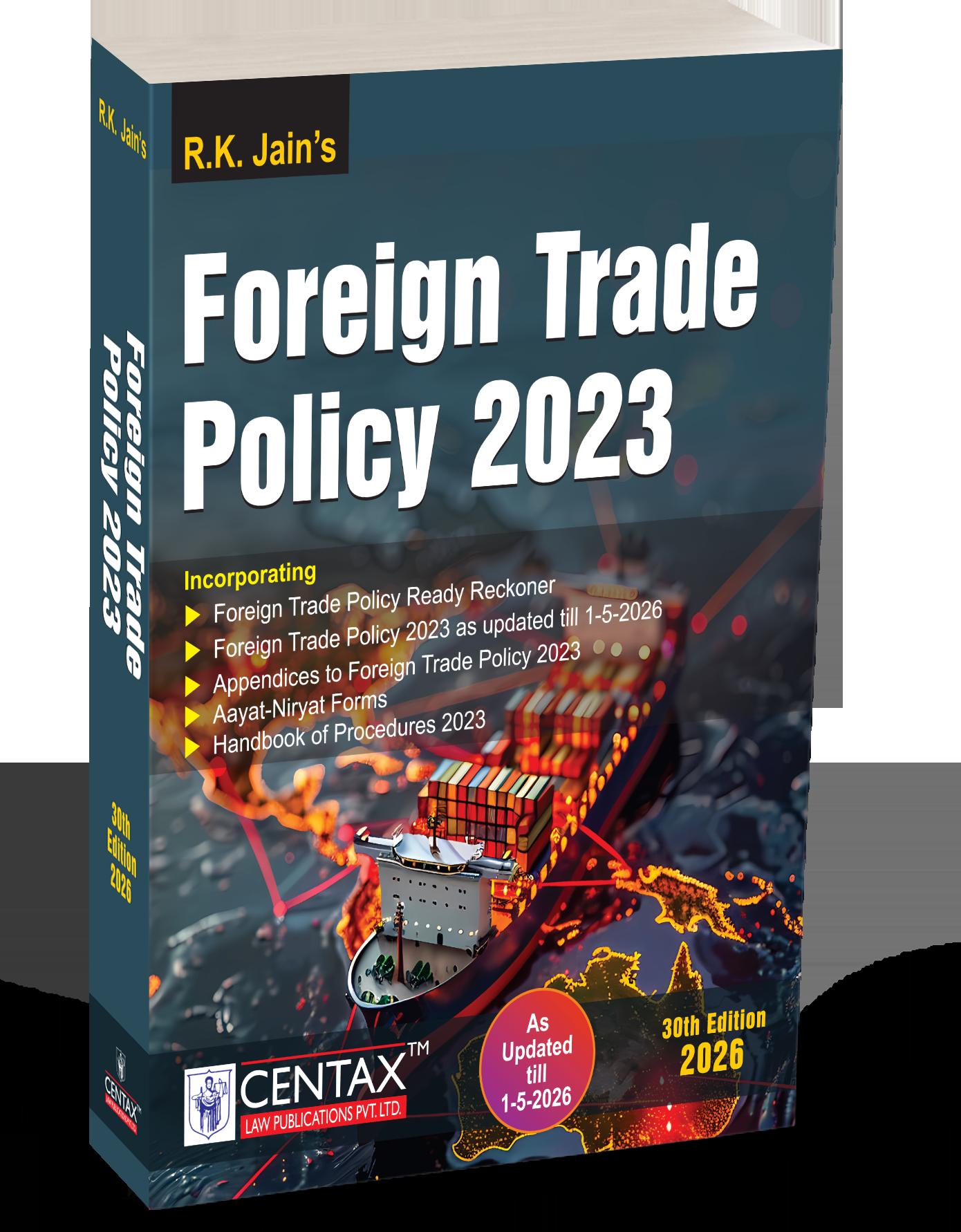
R.K. Jain's Foreign Trade Policy 2023, in its 30th Edition (2026), is the definitive single-volume compendium of India's foreign-trade legal regime, consolidating under one cover every operative instrument governing the cross-border movement of goods, services, and technology from India. This Edition presents the FTP 2023 framework—originally notified with effect from 1st April 2023—as it stands today, with every subsequent notification, public notice, trade notice and DGFT instruction integrated into the relevant clause without disturbing original paragraph numbering. The volume is architected as a complete EXIM reference shelf, opening with a practitioner-oriented Ready Reckoner of twenty chapters, followed by the unabridged statutory text of FTP 2023, the Handbook of Procedures 2023, the full set of Appendices, the complete suite of Aayat-Niryat Forms, a curated body of operative Customs notifications and DGFT Public Notices, and the parent legislation and subordinate rules. First published in 2000 and revised across thirty cycles spanning the Exim Policy 1997–2002 era through FTP 2004–09, 2009–14, 2015–20 and the present FTP 2023, the title has been the authoritative working reference of India's EXIM community for over a quarter-century. This book is intended for the following audience:
• Customs and Indirect-Tax Practitioners, CAs, CSs, CMAs and Tax Advocates
• Exporters, Importers, Merchant Exporters and Merchanting Traders
• SEZ Units and Developers, EOUs, EHTP/STP/BTP Units and FTWZ Operators
• Holders of AA, DFIA, EPCG and Diamond Imprest Authorisations
• Status Holders (One-Star to Five-Star)
• CHAs, Freight Forwarders, Logistics and Trade-Facilitation Consultants
• Banks and Financial Institutions handling export finance and trade settlement
• DGFT Officers, Customs Officers and Departmental Trainees
• Export Promotion Councils, FIEO, Commodity Boards and Industry Chambers
• IFSC Market Participants and IFSCA-Regulated Entities
• Academic Institutions, Doctoral Scholars and Students
• Government Ministries and Inter-Ministerial Committees
The Present Publication is the 30th Edition | 2026, updated till 1st May 2026. This book is edited by Centax's Editorial Board with the following noteworthy features:
•[Amended & Updated] Reflects the FTP 2023 regime fully updated through every notification, public notice, trade notice and DGFT instruction issued up to 1st May 2026
•[Twenty-Chapter Ready Reckoner] Translates the statutory policy into a scheme-by-scheme operating manual in plain expository prose, equipped with worked tables, illustrative examples and procedural roadmaps
•[Verbatim Statutory Text] Unabridged text of FTP 2023 and HBP 2023 reproduced exactly as notified, with all consequential amendments incorporated without disturbing original paragraph numbering
•[Cross-Referenced Architecture] Every policy paragraph is linked to its corresponding HBP provision, prescribed Aayat-Niryat Form, underlying Customs notification and operative Public Notice
•[Comprehensive Glossary of Acronyms] Covers the entire spectrum of DGFT, Customs, FEMA, GST and trade-facilitation terminology
•[Key Highlights Précis] A dedicated front-of-book section mapping the seven structural pillars introduced by FTP 2023—ease of doing business, export-promotion initiatives, Districts as Export Hubs, e-commerce facilitation, manufacturing impetus, including PM MITRA, the one-time Amnesty Scheme for EO defaults, and SCOMET streamlining
•[Complete Aayat-Niryat Forms Catalogue] All prescribed forms reproduced verbatim—from ANF-1A through the full SCOMET form suite
•[Curated Notifications Section] Operative Customs notifications and DGFT Public Notices organised thematically—AA/DFIA/EPCG exemptions, Gem and Jewellery, SEZ and EOU, RoDTEP and RoSCTL, and Public Notices from 1-4-2023 through May 2026
•[Allied Acts and Rules] Brings together the Foreign Trade (Development and Regulation) Act 1992 and the Foreign Trade (Regulation) Rules 1993
•[List of Notifications Index] A chronological-cum-thematic index enabling reverse navigation from notification number to operative text
•[Tabular Treatment Throughout] Thresholds, fees, value-addition norms, time-limits, weightage factors, port-restriction tables and TRQ allocations presented for quick reference
•[Dual-Use Design] Built for cover-to-cover study by new entrants and pinpoint reference by experienced practitioners