
Sample Read
©
INDIAN INSTITUTE OF BANKING AND FINANCE, MUMBAI, 2026
PRINTING AND PUBLISHING RIGHTS WITH THE PUBLISHER
All rights reserved. No part of this publication may be reproduced, stored in or introduced into a retrieval system, or transmitted in any form or by any means (electronic, mechanical, photocopying, recording or otherwise), without the prior written permission of Indian Institute of Banking & Finance.
Any person who does any unauthorised act in relation to this publication may be liable to criminal prosecution and civil claims for damages.
While every care has been taken in compiling the information contained in this publication, Indian Institute of Banking & Finance accepts no responsibility for any errors or omissions.
Updated by Mr. Veerasekaran Manimaran, Former DGM, Canara Bank and Mr. N V Chalapathi Rao, Former IIBF Faculty & Retd. DGM, erstwhile Syndicate Bank
Edition : 2026
Price : ` 875
Published by :
Taxmann Publications (P.) Ltd.
Sales & Marketing :
59/32, New Rohtak Road, New Delhi-110 005 India
Phone : +91-11-45562222
Website : www.taxmann.com
E-mail : sales@taxmann.com
Mumbai
35, Bodke Building, Ground Floor, M.G. Road, Opp. Railway Station, Mulund (W), Mumbai - 400 080 Mob. +91-9322247686, 9619668669, 7045453844/45/51
E-mail : sales.mumbai@taxmann.com; nileshbhanushali@taxmann.com
Regd. Office :
21/35, West Punjabi Bagh, New Delhi-110 026 India
Printed at :
Tan Prints (India) Pvt. Ltd.
44 Km. Mile Stone, National Highway, Rohtak Road, Village Rohad, Distt. Jhajjar (Haryana) India
E-mail : sales@tanprints.com
This book is meant for educational and learning purpose. The author/s of the book has/have been taken all reasonable care to ensure that the contents of the book do not violate any existing copyright or other intellectual property rights of any person in any manner whatsoever. In the event the author(s) has/have been unable to track any source and if any copyright has been inadvertently infringed, please notify the publisher in writing for corrective action.






Financial Markets
1.1 AN OVERVIEW OF MARKETS AND FUNCTIONS
Financial markets are markets, which facilitate the raising of resources and/or the investment of surplus funds. These markets are platform for sellers/borrowers and buyers/investors to come together and undertake transactions in financial securities/instruments. These markets also facilitate handling of various risks. Financial markets can be sub-divided as under:
1.1 AN OVERVIEW OF MARKETS AND FUNCTIONS
Financial markets are markets , which facilitate the raising of resources and / or the investment of surplus funds . These markets are platform for sellers / borrowers and buyers / investors to come together and undertake transactions in financial securities / instruments . These markets also facilitate handling of various risks . Financial markets can be sub - divided as under :
1. Capital markets, which consist of Stock Markets and Bond Markets,
2. Foreign exchange markets, which facilitate the trading of foreign exchange,
3. Mutual Fund Markets, which facilitate pooling of resources of investors for investment in equity and/or debt market,
4. Insurance markets, which facilitates handling of various risks,
5. Money markets, which provide short-term debt financing and investment; and
6. Commodity markets, which facilitate the trading of commodities.
Financial markets are regulated markets . Currently there are a number of regulators of these markets in India . The regulator for Capital Markets is Securities and Exchange Board of India ( SEBI ). Commodity market , which was regulated by Forward Markets Commission , is now being regulated by SEBI w . e . f ., September 28 , 2015 . SEBI also regulates Mutual Funds also and mutual funds have formed a self regulatory agency in the form of Association of Mutual Funds of India ( AMFI ) which is an industry body of mutual funds
Foreign Exchange Markets and Money Markets are regulated by the Reserve Bank of India ( RBI ). Insurance Regulatory and Development Authority of India ( IRDAI ) regulates insurance companies . The term derivative means a contract between two or more parties whose value is based on an agreed - upon underlying financial asset , commodity , index or security . Financial derivatives are regulated by the Reserve Bank of India while the commodity derivatives come under the purview of Securities and Exchange Board of India ( SEBI ).
Markets can be classified as primary market or secondary market in terms of access . The primary market is the financial market for the initial issue and placement of securities while the secondary market is the market where securities ( bonds , shares , derivatives , etc .) are traded In the case of primary market , unlike the secondary market , no organized stock exchanges are necessary . The primary market is facilitated by many intermediaries like arrangers , issue managers , issuing bank , registrars , book runners , etc ., who intermediate between investors and an issuer . Issue managing , advising and underwriting are activities which earn a fee or commission .
The secondary market ( also called aftermarket ) is the market for trading of securities . This market can be in the form of Over The Counter ( OTC ) where the transaction takes place between two parties directly and or through organized stock exchanges . In the secondary market , securities are sold by and transferred from one investor to another . The efficiency and price discovery in the financial market is enhanced when the secondary market is highly liquid and transparent . The eligibility of stocks and bonds for trading , and the functioning of stock exchanges in the secondary market is regulated through SEBI ( Securities & Exchange Board of India ). Most stock exchanges in India have been demutualized . These stock exchanges have also established robust trading systems and practices .
A stockbroker is a regulated professional individual , usually associated with a brokerage firm or broker - dealer , who buys and sells stocks and other securities through a stock exchange or over the counter , in return for a fee or commission . Now - adays , thanks to IT driven trading platforms , trading systems and electronic form of holding of shares ( demat ), investors are able to trade in the market directly but through broking houses Stock brokers deal with many clients and many relatively small transactions This can be contrasted with the primary markets and initial public offerings , which can be seen as the wholesale side of the capital market . Issue of securities and Corporate bonds in the primary market is also governed by guidelines issued by SEBI . There are a number of investor protection oriented practices introduced by SEBI which have to be adhered to and complied by Issuers .
1.2 CLASSIFICATION OF FINANCIAL MARKETS
The various financial markets can be classified as under :
1.2.1 The Money Market
The money market is a general term for the markets in which banks lend to and borrow money or money equivalent from each other , trade in securities / treasury bills and financial instruments such as Certificates of Deposit ( CDs ) or enter into agreements such as Repos and Reverse Repos . The money market normally trades in maturities up to one year . Money market securities are generally very safe investments which return a relatively low interest rate that is most appropriate for temporary cash storage or short - term time horizons . Money market functions either on an OTC ( Over The Counter ) or screen based system .
1.2.2 The Foreign Exchange Markets
The foreign exchange markets are those wherein the currencies of various countries are traded . Since a foreign currency cannot be used to settle a transaction within a particular country , currencies of various countries are traded in the market as if they are commodities . This market is usually highly liquid particularly in the G7 currencies ( USD , JPY , EUR , CHF , GBP , CAD , AUD ). The liquidity of the market is high as major international banks continually provide the market with both bid ( buy ) and ask ( sell ) offers
Major foreign exchange trading centres are located in New York , Tokyo , London , Hong Kong , Singapore , Paris and Frankfurt . The foreign exchange market is open 24 hours daily throughout the week ( closing worldwide Friday afternoon till Sunday ). Due to geographical differences , it is seen that if the European Market is closed the Asian Market or US Market will be open . Because of this , all world currencies are
continuously on trade . Traders can react to news when it breaks , rather than waiting for the market to open , as is the case with most other markets .
In the foreign exchange markets , fluctuations in the currency exchange rate occur frequently due to developments in the world economy or the national economies . This is in contrast to the equity market where a stock ( share ) may lose or gain value , for which reasons may become apparent when a report forecasts upward or downward revision in the important financial parameters of the company or changes in its key personnel . However , sometimes the value of share may change just on rumour .
1.2.3 Mutual Funds
Mutual fund is the coming together of investors who have identical investment desires Professional mutual funds are intermediaries , who sell units and collect funds from investors . The money received from the investors in the fund is deployed in buying and selling securities listed in the prospectus to the scheme . Mutual funds are run by Asset Management Companies ( AMCs ). Each AMC can launch one or more schemes / plans and take subscription from investors . Each Mutual fund will decide its rules of operation ( which securities will the mutual fund buy ; what is the minimum investment required by a potential investor in the fund ; what will be the transaction charges for investors who invest in the fund ; etc .) and will seek Regulators ’ approval before approaching the public for subscriptions . Wherever the mutual fund schemes are quoted on stock exchanges , one can buy and sell through stock exchange . However in most schemes , the fund itself buys and sells its units every day on the quoted price . This provides much needed liquidity to unit holders . Mutual funds have started the process of disintermediation and they have competed reasonably well with banks in mobilizing deposits towards units of mutual funds .
1.2.4 Capital Market
The capital market is the market for buying / selling of long - term debt and equity - backed securities . Companies , Governments , Banks and Financial Institutions raise funds for their long - term uses through the capital market . In terms of instruments and practices , the capital market can be broadly classified into the stock market and the bond market . Shares , debentures and bonds are issued and traded in the capital market. Equity , company and stock exchange related issues are regulated by Securities and Exchange Board of India ( SEBI ). Bond market , more particularly G - Sec market , and financial institutions - related issues are regulated by Reserve Bank of India . Capital market consists of ( i ) Stock markets , which facilitate equity investment and buying and selling of shares of companies listed on the stock exchanges , and ( ii ) Bond markets , which deal with issue of debt contracts and the buying and selling of bonds and debentures
Derivative is a futures or an option contract market . A derivative market is a market which could either be an OTC ( Over The Counter ) or exchange driven market . Derivatives are instruments developed on the price movement and volatility of an underlying equity , bond or financial contract . Derivative contract specifies the right or obligation to receive or deliver cash at a future date , based on some future event such as the targeted price of an underlying security or the performance of an index . These contracts are mainly aimed at providing risk cover for interest rate changes or change in prices of equity instruments . Derivative market is a huge and growing market . The derivative ( commodity and financial derivatives ) markets have their own sets of rules and practices . Though the commodity and derivative exchanges are organized on the pattern of stock exchanges , there are substantial differences in the way trade and settlement takes place .
1.2.5 Insurance Markets
The insurance companies and AMCs ( Asset Management Companies ) of mutual funds are part of the financial system . They can invest monies in securities and deposit funds with banks . As such , they are part of the money markets also . Over and above this , insurance market has a crucial role to play inasmuch as it provides certain risk management tools to the corporates and financial markets . Absence of such risk mitigants will affect the efficiency of the financial market . Insurance companies are broadly divided into two categories , Life Insurance Companies and General Insurance Companies . Insurance industry in India is regulated by Insurance Regulatory and Development Authority of India .
1.2.6 Commodity Markets
Commodity markets provide trading facilities for raw and primary commodities, which are traded on regulated commodity exchanges as standardized contracts . Similar to an equity market where one buys or sells shares , one buys or sells commodities in the commodity markets
Commodity futures refer to a standardized agreement to buy or sell an asset in future , at a price agreed today .
Commodity Exchange Traded Funds are index funds and track commodities . Stocks which belong to commodity sectors like metal , energy , agriculture etc . are known as Commodity Stocks .
Commodity Mutual Funds invest in stocks belonging to commodity sectors or Fund of Funds , which invest in other Commodity Funds .
Out of 4 National Exchanges recognized / registered for forward / futures trading in commodities , Multi Commodity Exchange ( MCX ), Mumbai contributed about 96% of market share in year 2023-24 .
Spot trading
A spot trade is the purchase or sale of a commodity for immediate delivery . Spot trade is settled “ on the spot ”, as opposed to a future contract where delivery is made at a certain time in future .
Forward Contract
u A forward contract is an agreement between two parties (counterparties) for the delivery of a physical asset (e.g., oil or gold) at a certain time in the future for a certain price that is fixed at the time of the contract.
u Forward contracts can be customized to accommodate any commodity, in any quantity, for delivery at any point in the future, at any place.
Future Contracts
u Future contracts are highly standardized and well-specified commitments for a carefully described goods (quantity and quality of the goods) to be delivered at a certain time and place (acceptable delivery date) and in a certain manner (method for closing the contract) and the permissible price fluctuations are specified (minimum and maximum daily price changes).
Other Features of Future Contracts
u All the commodities are not suitable for futures trading and for conducting futures trading. For being suitable for futures trading the market for commodity should be competitive, i.e. , there should be large demand for and supply of the commodity. The commodity should have long shelf-life and be capable of standardization and gradation.
u Price discovery is done through two popular methods. The fundamental analysis is concerned with basic supply and demand information, such as, weather patterns, carry over supplies, relevant policies of the Government and agricultural reports. Technical analysis includes analysis of movement of prices in the past.
Forward vs . Futures
Any quantity
Any product
The Major players in commodity market
u Speculator
No
No
A trader who enters the futures market in pursuit of profit, accepting risk in the endeavour.
u Hedger
A Trader who enters the futures market to reduce some pre-existing or perceived risk exposure.
u Broker
An Individual or firm acting as an intermediary by conveying customers’ trade instructions. Account executives or floor brokers are examples of brokers.
Futures and Forward trade in Commodity Markets were earlier regulated by Forward Markets Commission (FMC). FMC has since been merged with Securities and Exchange Board of India (SEBI) with effect from 29th September, 2015. With the merger of Forward Markets Commission with SEBI, the following functions of FMC have been taken over by SEBI:
u Grant of recognition or withdrawal of recognition of any association.
u Observing the forward markets and taking appropriate action for regulating the Commodity Markets.
u Collecting & publishing information relating to trading conditions in respect of goods including information relating to demand, supply and prices and submission of periodical reports on working of forward markets in commodities.
u Recommending improvements in the organization and working of forward markets.
u Undertaking inspection of books of account and other documents of recognized/ registered associations.
Policy and regulatory hurdles currently restrict banks and financial institutions from participating in the commodity market . Banks are also prohibited trading under the Banking Regulation Act , 1949 . The Banking Regulation Act, 1949 (section 8) prohibits banks from directly or indirectly dealing in buying or selling goods (commodities) except in the case of realizing the security. However , it has been reported that Reserve Bank of India is actively considering giving in - principle approval for Foreign Institutional Investors ( FIIs ) and banks to participate in commodity markets which have vast potential .
Banks authorized by the Reserve Bank of India to operate the Gold Deposit Scheme and Banks , which are allowed to enter into forward gold contracts in India in terms of the guidelines issued by the Department of Regulation ( including the positions arising out of inter - bank gold deals ) are permitted to hedge the price risk of Gold through Exchange - traded and over - the - counter hedging products available overseas .
1.3 ROLE OF THE EMERGING MARKETS: BRICS
BRICS refers to Brazil , Russia , India , China and South Africa . The acronym was originally created in 2001 by Jim O ’ Neil of Goldman Sachs to highlight the exceptional role of important emerging economies and only included Brazil , Russia , India and China (BRIC). The characteristics generally adopted to distinguish the countries’ group:
1. The outstanding size of their economies,
2. Strong growth rates, leading to increasing significance in world economy,
3. The demand for a stronger political voice in international governance structures, which corresponds to their economic status.
In 2011 South Africa joined the group thus becoming the BRICS At the 2023 BRICS summit , the bloc formally invited six more countries Argentina , Egypt , Ethiopia , Iran , Saudi Arabia and the United Arab Emirates to join Argentina chose not to join BRICS after change in the government and Saudi Arabia is reportedly still considering its membership .
The BRICS ministers responsible for foreign affairs , finance , economy , trade , agriculture and health have met . At the officials level , meetings have been held to discuss science and technology , national security , competition and statistics . BRICS countries are the emerging protagonists in international development cooperation and their role is significantly and rapidly changing .
Each BRICS country has a distinctive economic characteristic , despite the fact that all the BRICS countries enjoyed a high growth rate during most of the last decade that makes the group a powerful force in the global economy Russia is a commodity - driven economy , China is a powerhouse of exports , India is a domestic demand - driven economy , Brazil has much developed economic structure and South Africa represents the fast - growing region of Africa . The BRICS economies also account for an estimated 37.3% of global gross domestic product based on purchasing power parity as of April 2024 . China alone represents 19.05% while India accounts for 8.3% , according to International Monetary Fund ( IMF ). Meanwhile , the United States and the European Union account for roughly 14.5% each . The BRICS bloc is increasingly becoming a major economic power with regards to Commodities trading .
BRICS and International Development - South - South Cooperation ( SSC )
BRICS are striving to capitalize on their economic leverage for more political influence . BRICS growing impact on Low Income Countries ( LICs ) through trade , foreign
direct investment and development financing is significant. Therefore, it is challenging the traditional western donors such as the EU , US and Japan . These relations instill the vision of South - South Cooperation ( SSC ), which is based on solidarity , shared experiences and self - reliance of the South . The development cooperation is focusing on trade , investment and economic growth as the main vehicles of advancement that can be achieved via regional integration and neighbours ’ bilateral cooperation . The cooperation also insists on the principles of non - interference and national sovereignty . It doesn ’ t focus on issues related to governance and social standard which are crucial for LICs countries ’ sustainable development .
BRICS as new stakeholder in 21st century Global Agenda
It is clear that the high growth rate , economic potential and demographic development are putting the BRICS increasingly in a leading position in setting the global agenda and having a greater say in the global governance . Since their first summit , the BRICS countries have called for a more multi - polar world order based on cooperation , coordinated action and collective decision - making of all states . Hence , they started to form a strategic alliance to reform for the 21st century the institutions of global governance such as the World Bank , International Monetary Fund and the United Nations Security Council that have remained unchanged since the world war of 1945 . The BRICS as a group are expected to step up their role and extend to pressing peace and security challenges , from terrorism , piracy and nuclear non - proliferation to regional security in North Africa and the Middle East . The level of coordination amongst the BRICS countries in setting the global agenda is still to be examined in the coming years . The round table is an expert consultation on dimensions of the evolving role of the BRICS in different angles
BRICS New Development Bank ( NDB )
In their last summit in July 2014 , BRICS leaders have approved creating the BRICS New Development Bank which would fund long - term investment in infrastructure and more sustainable development . Now , it is known as New Development Bank ( NDB) . The estimated unmet needs in the emerging and developing countries , the field of infrastructure and more environmentally sustainable forms of development are around US $ 1 trillion annually . The BRICS bank with an authorized capital of $ 100 billion as well as a separate contingency reserve arrangement of $ 100 billion , created jointly by Brazil , Russia , India , China and South Africa , could mark a profound shift in the way global finance and politics might operate in the years ahead In 2021 , the NDB began expanding its membership and admitted Bangladesh , Egypt , the United Arab Emirates and Uruguay as its new member countries . Algeria has been approved for membership in the New Development Bank ( NDB ) in 2024 .
The BRICS bank , like the World Bank , is expected to fund much needed physical and social infrastructure in the BRICS countries . The contingency reserve arrangement will act like the IMF , which provides temporary bail - out funds to economies facing capital flight and currency crisis .
1.4 ROLES AND FUNCTIONS OF PARTICIPANTS
IN THE FINANCIAL MARKET
1.4.1 Banks
Banks participate in the capital market and money market . Within the capital market , banks take active part in bond markets . Banks also invest in equity and mutual funds as a part of their fund management Banks take active trading interest in the bond market and have certain exposures to the equity market also Banks also participate in the market as clearing houses Banks also deal in the foreign exchange market by purchasing / selling foreign exchange .
1.4.2 Primary Dealers (PDs)
PDs deal in government securities both in primary and secondary markets . Their basic responsibility is to provide two - way quotes and act as market makers for government securities and strengthen the government securities market .
1.4.3 Financial Institutions (FIs)
FIs provide / lend long - term funds for various activities in the economy . FIs raise their resources through issue of long - term bonds in the capital market and by borrowings from international financial institutions , like International Finance Corporation ( IFC ), Asian Development Bank ( ADB ) International Development Association ( IDA ), International Bank for Reconstruction and Development ( IBRD ), etc
1.4.4 Stock Exchanges
A stock exchange is duly approved by the Regulators to provide sale and purchase of securities by “ open cry ” or “ online ” on behalf of investors through brokers . The stock exchanges provide clearing house facilities for netting of payments and delivery of securities . Such clearing houses guarantee all payments and deliveries . Securities traded in stock exchanges include equities , debt , and derivatives . Currently , in India , only dematerialized securities are allowed to be traded on the stock exchanges . Settlement in securities account is made by depositories through participants ’ accounts . It is essential that stock exchanges are corporatized and de - mutualized so that there can be greater transparency in the trades and better governance in markets , without any clash of interest .
1.4.5 Brokers
Only brokers approved by Capital Market Regulator can operate on stock exchange Brokers perform the job of intermediating between buyers and sellers of securities They help build up order book , price discovery , and are responsible for a contract being honoured . For their services brokers earn a fee known as brokerage .
1.4.6 Investment Bankers (Merchant Bankers)
These are agencies / organizations regulated and licensed by SEBI , the Capital Markets Regulator . They arrange raising of funds through equity and debt route and assist companies in completing various formalities , like filing of the prescribed documents and other compliances with the Regulator ( s ). They advise the issuing company on book building , pricing of issue , arranging registrars , bankers to the issue and other support services . They can under write the issue and also function as issue managers . They may also buy and sell on their own account . As per regulatory stipulations , such own account business should be separately booked and confined to scrips where insider information is not available to the investment / merchant banker . Investment / Merchant banking can be an exclusive business A bank can also undertake these activities
1.4.7 Foreign Institutional Investors (FIIs)
FIIs are foreign based funds authorized by Capital Market Regulator (SEBI) to invest in countries ’ equity and debt market through stock exchanges . They are allowed to repatriate sale proceeds of their holdings , provided sales have been made through an authorized stock exchange and taxes have been paid . FIIs enjoy de facto capital account convertibility . FII operations provide depth to equity and debt markets and result in increased turnover . In India , these activities have brought in technological advancements , besides foreign funds in equity and debt market .
1.4.8 Custodians
Custodians are organizations which are allowed to hold securities on behalf of customers and carry out operations on their behalf . They handle both funds and securities of Qualified Institutional Borrowers ( QIBs ), including FIIs . Custodians are supervised by the Capital Market Regulator In view of their position and as they handle the payment and settlements , banks are able to play the role of custodians effectively . Thus most banks perform the role of custodians .
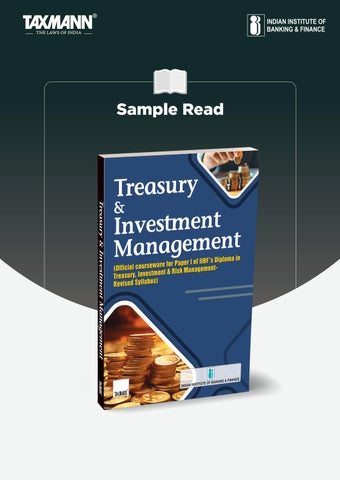
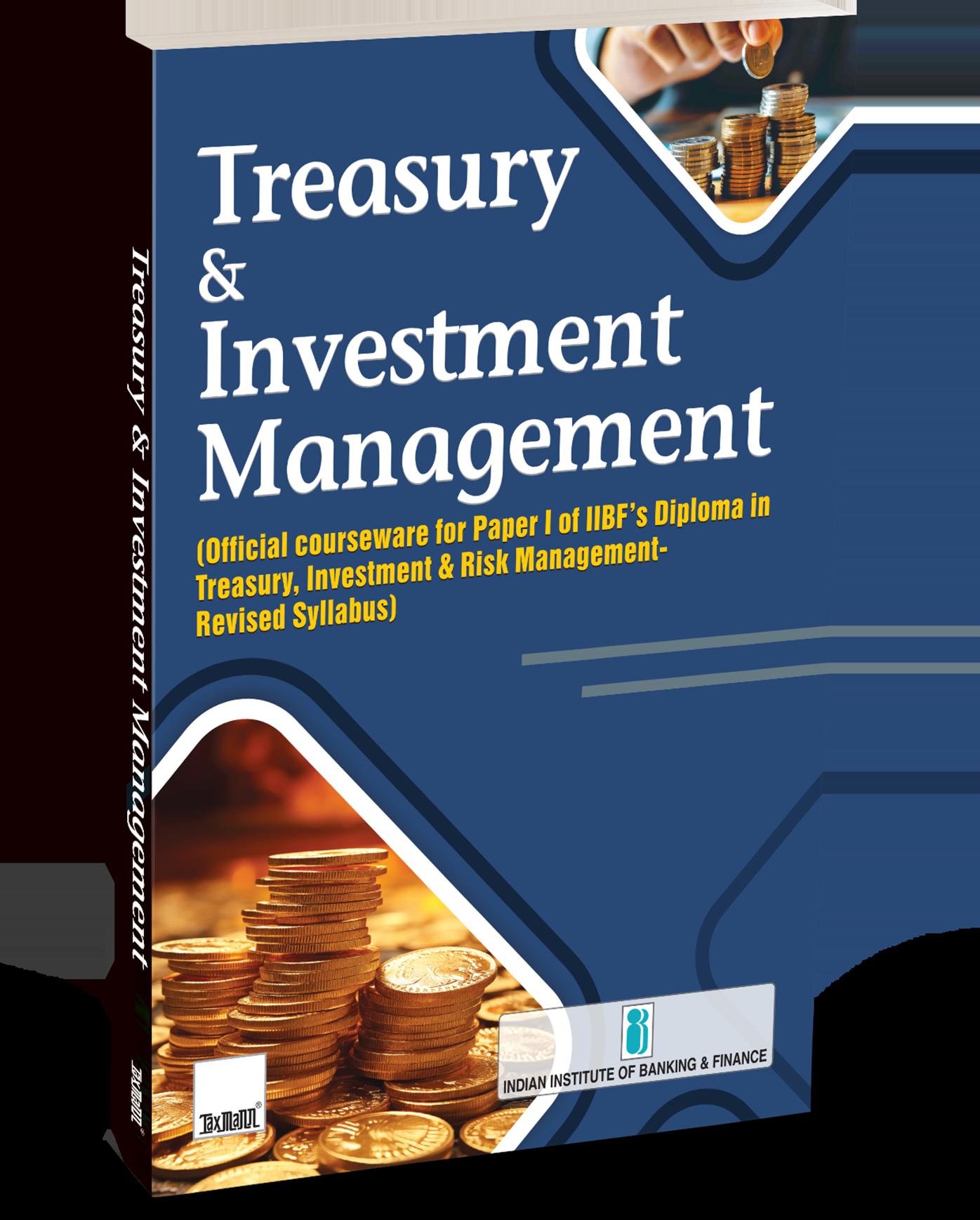
TREASURY & INVESTMENT MANAGEMENT
AUTHOR : Indian Institute of Banking & Finance (IIBF)
PUBLISHER : Taxmann
DATE OF PUBLICATION : July 2026
EDITION : 2026 Edition
ISBN NO : 9789375611905
NO. OF PAGES : 580
BINDING TYPE : Paperback
Rs. 875
DESCRIPTION
Treasury & Investment Management is the official, IIBF-authorised courseware for Paper I of the Certificate Examination in Treasury, Investment and Risk Management (DTIRM), conducted by the Indian Institute of Banking & Finance (IIBF).
The 2026 Edition offers a complete, front-to-back account of how a modern bank treasury works—from the structure of financial markets, through the products that are traded and priced, to the operations, risk controls, regulations, and technology that hold the dealing room together.
Written in a structured, self-study style, it carries the reader from first principles (what a money market is, how an exchange rate is quoted) to advanced material (pricing an interest-rate swap, computing NDTL for CRR/SLR, running a front-mid-back office control framework). It is deliberately India-anchored—built around RBI, SEBI, FEDAI, FIMMDA, and CCIL frameworks and instruments—while placing that detail within global market practice. It reflects contemporary market conventions and the latest regulatory developments, and covers the forces reshaping treasury today—automation, Straight-Through Processing (STP), ERP integration, blockchain, advanced electronic trading and settlement platforms, and the shift from LIBOR to risk-free benchmark rates such as SOFR. The result serves equally as an examination text and a practical desk reference for navigating an integrated treasury environment with competence, compliance, and confidence.
The book is written for anyone who needs a rigorous, practice-oriented grounding in treasury and investment management:
• DTIRM Examination Candidates
• Banking and Finance Professionals
• Treasury Dealers and Front/Mid/Back Office Staff
• Investment Managers and Fixed-Income/Forex Practitioners
• Risk, Audit, and Compliance Practitioners
• Students, Faculty, and Researchers in Banking, Finance, and Management Programmes
The Present Publication is the 2026 Edition, updated by Mr Veerasekaran Manimaran (Former DGM | Canara Bank) and Mr N V Chalapathi Rao (Former IIBF Faculty & Retd. DGM | erstwhile Syndicate Bank). Taxmann exclusively publishes this book for the Indian Institute of Banking and Finance (Certificate Examination in Treasury, Investment & Risk Management (DTIRM)—Paper I), with the following noteworthy features:
•[Official IIBF Courseware] The prescribed, syllabus-aligned text for DTIRM Paper I—a self-contained study kit covering the full syllabus
•[Fully Revised 2026 Edition] Updated for current market conventions, RBI guidelines, and evolving regulatory expectations
•[End-to-end Treasury Coverage] Markets → products → treasury operations → liquidity → risk → dealing-room controls → regulation → technology, in one logical progression
•[Emerging-technology Coverage] Automation, STP, ERP integration, blockchain, and modern trading/settlement platforms, with a dedicated chapter on IT in treasury
•[Benchmark-reform Ready] Explains the LIBOR-to-SOFR transition and its practical impact on pricing and products
•[Worked, Quantitative Treatment] Day-count conventions, bond valuation and DCF, and the pricing of futures, forward rate agreements (FRAs), and interest-rate/currency swaps
•[Regulatory Source Material Built In] RBI guidelines, FEDAI rules, extracts from the FIMMDA Handbook of Market Practices, and CCIL settlement mechanics
•[Governance, Ethics & Controls] Treasury governance, conflicts of interest, dealing-room code of conduct, investment controls, and front/mid/back-office segregation
•[Built-in Self-Assessment] 'Check Your Progress' multiple-choice questions with answer keys at chapter ends, plus diagrams, charts, and illustrations
•[Two Ready-reference Annexures] General Principles (dealing controls, FEDAI/FIMMDA practice) and a comprehensive Treasury Terminology glossary
•[Dual-purpose Design] Equally effective as an exam-preparation text and a professional desk reference