Sample Read
© NATIONAL INSTITUTE OF SECURITIES MARKETS, MUMBAI, 2026 PRINTING AND PUBLISHING RIGHTS WITH THE PUBLISHER All rights reserved. No part of this publication may be reproduced, stored in or introduced into a retrieval system, or transmitted in any form or by any means (electronic, mechanical, photocopying, recording or otherwise), without the prior written permission of National Institute of Securities Markets. Any person who does any unauthorised act in relation to this publication may be liable to criminal prosecution and civil claims for damages. While every care has been taken in compiling the information contained in this publication, National Institute of Securities Markets accepts no responsibility for any errors or omissions. Workbook Version : March 2026 Price : ` 1150 Published by : Taxmann Publications (P.) Ltd. Sales & Marketing : 59/32, New Rohtak Road, New Delhi-110 005 India Phone : +91-11-45562222 Website : www.taxmann.com, E-mail : sales@taxmann.com Mumbai 35, Bodke Building, Ground Floor, M.G. Road, Opp. Railway Station, Mulund (West), Mumbai-400080 Ph : +91-22-25934806, 25934807, 25934809; Mobile : 09322247686, 9619668669, 7045453844/45/48/51 E-mail : sales.mumbai@taxmann.com; nileshbhanushali@taxmann.com Regd. Office : 21/35, West Punjabi Bagh, New Delhi-110 026 India Printed at : Tan Prints (India) Pvt. Ltd. 44 Km. Mile Stone, National Highway, Rohtak Road, Village Rohad, Distt. Jhajjar (Haryana) India E-mail : sales@tanprints.com
DISCLAIMER The contents of this publication do not necessarily constitute or imply its endorsement, recommendation, or favoring by the National Institute of Securities Markets (NISM) or the Securities and Exchange Board of India (SEBI). This publication is meant for general reading and educational purpose only. The statements/explanations/concepts are of general nature and may not have taken into account the particular objective/move/aim/need/circumstances of individual user/reader/organization/institute. Thus NISM and SEBI do not assume any responsibility for any wrong move or action taken based on the information available in this publication. Therefore before acting on or following the steps suggested on any theme or before following any recommendation given in this publication user/reader should consider/seek professional advice. The publication contains information, statements, opinions, statistics and materials that have been obtained from sources believed to be reliable and the publishers of this title have made best efforts to avoid any errors. However, publishers of this material offer no guarantees and warranties of any kind to the readers/users of the information contained in this publication. Since the work and research is still going on in all these knowledge streams, NISM and SEBI do not warrant the totality and absolute accuracy, adequacy or completeness of this information and material and expressly disclaim any liability for errors or omissions in this information and material herein. NISM and SEBI do not accept any legal liability what-so-ever based on any information contained herein. While the NISM Certification examination will be largely based on material in this workbook, NISM does not guarantee that all questions in the examination will be from material covered herein.
CONTENTS PAGE
Foreword Acknowledgement About NISM Certifications About the Certification Examination for Mutual Fund - Specialized Investment Fund Distributors Syllabus outline with weightages
I-3 I-5 I-7 I-9 I-21
MODULE 1: MUTUAL FUND DISTRIBUTORS CHAPTER 1 INVESTMENT LANDSCAPE 1.1 1.2 1.3 1.4 1.5 1.6 1.7 1.8 1.9
Investors and their Financial Goals Savings or Investments? Different Asset Classes Investment Risks Risk Measures and Management Strategies Behavioural Biases in Investment Decision Making Risk Profiling Understanding Asset Allocation Do-it-yourself versus Taking Professional Help
3 8 11 16 21 22 25 25 27
CHAPTER 2 CONCEPT AND ROLE OF A MUTUAL FUND 2.1 2.2 2.3
Concept of a Mutual fund Classification of Mutual Funds Growth of the mutual fund industry in India
31 41 59 I-11
CONTENTS
PAGE
CHAPTER 3 LEGAL STRUCTURE OF MUTUAL FUNDS IN INDIA 3.1 3.2 3.3 3.4 3.5
Structure of Mutual Funds in India Key Constituents of a Mutual Fund Organization Structure of Asset Management Company Role and Support function of Service Providers Role and Function of AMFI
61 63 67 70 75
CHAPTER 4 LEGAL AND REGULATORY FRAMEWORK 4.1 4.2 4.3 4.4 4.5
Role of Regulators in India Role of Securities and Exchange Board of India Due Diligence Process by AMCs for Distributors of Mutual Funds Investor Grievance Redress Mechanism AMFI Code of Conduct for Intermediaries
79 80 99 99 101
CHAPTER 5 SCHEME RELATED INFORMATION 5.1 5.2
Mandatory Documents Non-Mandatory Disclosures
105 126
CHAPTER 6 FUND DISTRIBUTION AND CHANNEL MANAGEMENT PRACTICES 6.1 6.2
I-12
The role and importance of mutual fund distributors Different kinds of mutual fund distributors
131 132
CONTENTS
PAGE
6.3 6.4 6.5 6.6 6.7 6.8 6.9 6.10
Modes of distribution Pre-requisites to become Distributor of a Mutual Fund Revenue for a mutual fund distributor Commission Disclosure mandated by SEBI Due Diligence Process by AMCs for Distributors of Mutual Funds Difference between distributors and Investment Advisors Nomination facilities to Agents/Distributors and Payment of Commission to Nominee Change of distributor
134 139 143 148 149 150 153 155
CHAPTER 7 NET ASSET VALUE, TOTAL EXPENSE RATIO AND PRICING OF UNITS 7.1 7.2 7.3 7.4 7.5 7.6
Fair Valuation Principles Computation of Net Assets of Mutual Fund Scheme and NAV Dividends & Distributable Reserves Concept of Entry and Exit Load and its impact on NAV Key Accounting and Reporting Requirements NAV, Total expense ratio and pricing of units for the Segregated Portfolio
159 164 174 176 177 178
CHAPTER 8 TAXATION 8.1 8.2 8.3 8.4 8.5 8.6 8.7
Applicability of taxes in respect of mutual funds Capital Gains Income Distribution cum Capital Withdrawal Stamp Duty on Mutual Fund Units Setting off of Capital Gains and Losses under Income Tax Act Securities Transaction Tax Tax benefit under Section 80C of the Income Tax Act
182 184 186 188 189 190 191
I-13
CONTENTS
PAGE
8.8 8.9
192 192
Tax Deducted at Source Applicability of GST
CHAPTER 9 INVESTOR SERVICES 9.1 9.2 9.3 9.4 9.5 9.6 9.7 9.8 9.9 9.10 9.11 9.12 9.13 9.14 9.15 9.16 9.17
The NFO process New Fund Offer Price/On-going Offer Price for subscription Investment Plans and Services Allotment of Units to the Investor Account statements for investments Mutual Fund Investors Filling the Application Form for Mutual Funds Financial Transactions with Mutual Funds Cut-off Time and Time Stamping KYC Requirements for Mutual Fund Investors Systematic Transactions Operational aspects of Systematic Transactions Non-Financial Transactions in Mutual Funds Change in Status of Special Investor Categories Investor transactions – Turnaround times Unclaimed Assets Voluntary Lock-in/Debit freeze facility to Mutual Fund folios
196 197 198 201 203 204 207 212 225 229 239 244 248 255 259 262 263
CHAPTER 10 RISK, RETURN AND PERFORMANCE OF FUNDS 10.1 10.2 10.3 10.4
I-14
General and Specific Risk Factors Factors that affect mutual fund performance Drivers of Returns and Risk in a Scheme Measures of Returns
267 281 284 294
CONTENTS
PAGE
10.5 10.6 10.7 10.8
SEBI Norms regarding Representation of Returns by Mutual Funds in India Risks in fund investing with a focus on investors Measures of Risk Certain Provisions with respect to Credit risk
300 300 304 308
CHAPTER 11 MUTUAL FUND SCHEME PERFORMANCE 11.1 11.2 11.3 11.4 11.5 11.6 11.7 11.8 11.9
Benchmarks and Performance Price Return Index or Total Return Index Basis of choosing an appropriate performance benchmark Benchmarks for equity schemes Benchmarks for Debt Schemes Benchmarks for Other Schemes Quantitative Measures of Fund Manager Performance Tracking Error Scheme Performance Disclosure
317 318 319 320 320 322 325 328 329
CHAPTER 12 MUTUAL FUND SCHEME SELECTION 12.1 12.2 12.3 12.4
Scheme Selection based on Investor needs, preferences and risk-profile Risk levels in mutual fund schemes Scheme Selection based on investment strategy of mutual funds Selection of Mutual Fund scheme offered by different AMCs or within the scheme category 12.5 Selecting options in mutual fund schemes 12.6 Do’s and Don’ts while selecting mutual fund schemes Appendix 1: Fourth Schedule of Securities and Exchange Board of India (Mutual Funds) Regulations, 2026 Appendix 2: AMFI Code of Ethics
335 338 340 349 353 354 359 361 I-15
CONTENTS
PAGE
Appendix 3: AMFI’s Code of Conduct for Intermediaries of Mutual Funds Appendix 4: Additional Knowledge Resources
367 376
MODULE 2: EQUITY DERIVATIVES CHAPTER 13 BASICS OF DERIVATIVES 13.1 13.2 13.3 13.4 13.5 13.6 13.7
Basics of Derivatives Derivatives Market – History & Evolution Indian Derivatives Market Market Participants Types of Derivatives Market Significance of Derivatives Various risks faced by the participants in derivatives
381 381 383 384 385 386 387
CHAPTER 14 UNDERSTANDING THE INDEX 14.1 14.2 14.3 14.4 14.5 14.6 14.7
Introduction to an Index Significance of the stock index Types of Stock Market Indices Attributes of an Index Index management Major Indices in India Application of Indices
389 390 390 393 395 397 398
CHAPTER 15 INTRODUCTION TO FORWARDS AND FUTURES 15.1
I-16
Introduction to forward contracts
401
CONTENTS
PAGE
15.2 15.3 15.4 15.5 15.6 15.7 15.8 15.9
Futures contracts Contract specifications of futures contracts Some important terminology associated with futures contracts Differences between Forwards and Futures Payoff Charts for Futures contracts Futures pricing Price discovery and convergence of cash and futures prices on the expiry Uses of futures
403 404 408 413 414 417 423 423
CHAPTER 16 INTRODUCTION TO OPTIONS 16.1 Basics of options 16.2 Contract specifications of exchange-traded options 16.3 Moneyness of an option 16.4 Intrinsic value and time value of an option 16.5 Payoff Charts for Options 16.6 Distinction between futures and options contracts 16.7 Basics of Option Pricing and Option Greeks 16.8 Option Pricing Models 16.9 Implied volatility of an option 16.10 Analysis of options from the perspectives of buyer and seller
435 439 441 442 443 451 452 457 458 460
CHAPTER 17 STRATEGIES USING EQUITY FUTURES AND EQUITY OPTIONS 17.1 17.2 17.3
Futures contracts for hedging, speculation and arbitrage Use of Options for Trading and Hedging Arbitrage using options: Put-call parity
470 480 508
I-17
CONTENTS
PAGE
17.4 17.5
Delta-hedging Interpreting open interest and put-call ratio for trading strategies
509 510
MODULE 3: INTEREST RATE DERIVATIVES CHAPTER 18 INTRODUCTION TO INTEREST RATE, INTEREST RATE INSTRUMENTS AND FIXED INCOME MARKET 18.1 Understanding the Interest Rate Concept 18.2 Fixed Income Securities 18.3 Type of Fixed Income Securities 18.4 Equity Securities v. Debt Securities 18.5 Concept of risk-free interest rate 18.6 Term Structure of Interest Rates 18.7 Conversion of Rate into Amount 18.8 Accrued Interest 18.9 Spot Rate (Zero Rate) and Holding Period Return 18.10 Coupon, Current Yield and Yield-To-Maturity 18.11 Determining Cash Flow, Yield and Price of Bonds 18.12 Risk Measures 18.13 Role of the Debt Market 18.14 Primary and Secondary Debt Market in India
517 522 523 534 536 539 544 550 553 555 561 574 588 590
CHAPTER 19 INTEREST RATE DERIVATIVES 19.1 19.2 19.3
I-18
Derivatives: Definition and Economic Role Products in Derivatives Market Growth Drivers of Derivatives
613 618 625
CONTENTS
PAGE
19.4 19.5 19.6
Market Participants in Interest Rate Derivatives Market Underlying of Interest Rate Derivatives OTC versus Exchange-Traded Derivatives
627 628 631
CHAPTER 20 EXCHANGE TRADED INTEREST RATE FUTURES 20.1 20.2 20.3 20.4 20.5 20.6 20.7
Interest Rate Futures Pay off Charts for Futures Contract Contract Specification of Exchange Traded Interest Rate Futures Lot Size, Tick Size and Change in Contract Value for each Tick change Rationale for Introducing Exchange Traded Interest Rate Derivatives in India Advantages and Limitations of Future Contracts in Comparison to FRA Interest rate futures price computation
636 641 645 652 654 655 658
CHAPTER 21 EXCHANGE TRADED INTEREST RATE OPTIONS 21.1 Basics of Options 21.2 Difference between futures and options 21.3 Style of options 21.4 Moneyness of an option 21.5 Basics of Option Pricing and Option Greeks 21.6 Option pricing methodology 21.7 Implied Volatility (IV) 21.8 Pay off Diagrams for Options 21.9 Contract Specification of Exchange Traded Interest Rate Options 21.10 Comparison of Exchange Traded IRO and OTC IRO 21.11 Market Indicators
667 669 670 671 672 680 683 684 694 696 697
I-19
CONTENTS
PAGE
CHAPTER 22 STRATEGIES USING EXCHANGE TRADED INTEREST RATE DERIVATIVES 22.1 22.2 22.3 22.4 22.5 22.6 22.7
I-20
Market participants Hedging through Exchange Traded Interest Rate Derivatives Option Trading Strategies Use of Interest Rate Derivatives for Speculative Transaction Use of Interest Rate Derivatives by Arbitragers Trading spreads using ETIRD Limitation of Interest Rate Derivatives for Hedgers
703 706 714 737 739 742 743
CHAPTER 7 NET ASSET VALUE, TOTAL EXPENSE RATIO AND PRICING OF UNITS LEARNING OBJECTIVES: After studying this chapter, you should learn about: ¾ Fair Valuation Principles and relevance for investors ¾ Computation of Net Assets of mutual fund scheme ¾ Dividends & Distributable Reserves ¾ Concept of Entry and Exit Load and its impact on NAV ¾ Key accounting and reporting requirements applicable to mutual funds ¾ NAV, Total expense ratio and pricing of units for the Segregated Portfolio
7.1 Fair Valuation Principles An investor in a mutual fund scheme is the beneficial owner of the units one has bought. Expand this further, and it means that the ownership of the mutual fund scheme is collectively in the hands of all the investors at any point in time. At the same time, the investors can sell their units and new investors can buy. Thus, periodically, the ownership could also change. In such a case, it becomes very important that any investor in the scheme gets a fair price for one’s investments. In order to ensure such fair treatment to all investors, SEBI has laid down certain fair valuation principles. The asset management companies are required to compute and carry out a valuation of investments made by its scheme(s) in accordance with the investment valuation norms specified in the Seventh Schedule of SEBI (Mutual Funds) 159
NET ASSET VALUE, TOTAL EXPENSE RATIO AND PRICING OF UNITS
Regulations, 2026. The primary objective behind the introduction of these principles was to ensure fair treatment to all investors including existing investors as well as investors seeking to purchase or redeem units of mutual funds in all schemes at all points of time. At the same time, the valuation principles also address the mispricing risk and reduce the vulnerability of short-term debt-oriented schemes to redemption pressure. The 10 principles as laid out by SEBI are as under: Principle No.1: The valuation of investments shall be based on the principles of fair valuation i.e., valuation shall be reflective of the realizable value of the securities/assets. The valuation shall be done in good faith and in true and fair manner through appropriate valuation policies and procedures. Principle No.2: The policies and procedures approved by the Board of the Asset Management Company shall identify the methodologies that will be used for valuing each type of securities/assets held by the mutual fund schemes. Investment in new type of securities/assets by the mutual fund scheme shall be made only after establishment of the valuation methodologies for such securities with the approval of the Board of the asset management company. Principle No.3: The assets held by the mutual funds shall be consistently valued according to the policies and procedures. The policies and procedures shall describe the process to deal with exceptional events where market quotations are no longer reliable for a particular security. Principle No.4: The asset management company shall provide for the periodic review of the valuation policies and procedures to ensure the appropriateness and accuracy of the methodologies used and its effective implementation in valuing the securities/ assets. The Board of Trustee and the Board of asset management company shall be updated of these developments at appropriate intervals. The valuation policies and procedures shall be regularly reviewed (at least once in a Financial Year) by an independent auditor to seek to ensure their continued appropriateness.
160
NET ASSET VALUE, TOTAL EXPENSE RATIO AND PRICING OF UNITS
Principle No.5: The valuation policies and procedures approved by the Board of asset management company should seek to address conflict of interest. Principle No.6: Disclosure of the valuation policy and procedures (with regard to valuation of each category of securities/assets where the scheme will invest, situation where these methods will be used, process and methodology and impact of implementation of these methods, if any) approved by the Board of the asset management company shall be made in Statement of Additional Information, on the website of the asset management company/mutual fund and at any other place where the Board may specify to ensure transparency of valuation norms to be adopted by asset management company. Principle No.7: The responsibility of true and fairness of valuation and correct NAV shall be of the asset management company, irrespective of disclosure of the approved valuation policies and procedures i.e., if the established policies and procedures of valuation do not result in fair/appropriate valuation, the asset management company shall deviate from the established policies and procedures in order to value the assets/ securities at fair value provided that: Any deviation from the disclosed valuation policy and procedures may be allowed with appropriate reporting to Board of Trustees and the Board of the asset management company and appropriate disclosures to investors. Principle No.8: The asset management company shall have policies and procedures to detect and prevent incorrect valuation. Principle No.9: Documentation of rationale for valuation including inter scheme transfers shall be maintained and preserved by the asset management company as per Seventh Schedule of SEBI (Mutual Fund) Regulations, 2026 to enable audit trail. Principle No.10: In order to have fairness in the valuation of debt and money market securities, the
161
NET ASSET VALUE, TOTAL EXPENSE RATIO AND PRICING OF UNITS
asset management company shall take into consideration prices of trades of same security or similar security reported at all available public platform. In addition to the above, a mutual fund may value its investments according to the Valuation Guidelines notified by SEBI. In case of any conflict between the Principles of Fair Valuation and Valuation Guidelines, the Principles of Fair Valuation detailed above shall prevail. Valuation A mutual fund scheme invests the investors’ money in a portfolio of securities created and managed based on the investment objective and strategy of the scheme. The investments include securities, money market instruments, privately placed debentures, securitised debt instruments, gold/silver and gold/silver related instruments, real estate assets and infrastructure debt instruments and assets. The NAV of the scheme will depend upon the value of this portfolio, which in turn, depends upon the value of the securities held in it. The valuation of these securities to determine the net asset value has to be done in accordance with the valuation guidelines laid down by SEBI and AMFI. This includes the following guidelines: 1. Traded Securities other than money market and debt securities: a. The securities shall be valued at the last quoted closing price on the stock exchange. b. When the securities are traded on more than one recognised stock exchange, the securities shall be valued at the last quoted closing price on the stock exchange where the security is principally traded. It would be left to the asset management company to select the appropriate stock exchange, but the reasons for the selection should be recorded in writing. There should, however, be no objection for all scrips being valued at the prices quoted on the stock exchange where a majority in value of the investments are principally traded. c. Once a stock exchange has been selected for valuation of a particular security, the asset management company shall record reasons for the change of the exchange in writing. d. When on a particular valuation day, security has not been traded on the selected stock exchange, the value at which it is traded on another stock exchange may be used. 162
NET ASSET VALUE, TOTAL EXPENSE RATIO AND PRICING OF UNITS
e. When a security is not traded on any stock exchange on a particular valuation day, the value at which it was traded on the selected stock exchange or any other stock exchange, as the case may be, on the earliest previous day may be used provided such date is not more than thirty days prior to the valuation date. 2. Non-traded securities other than money market and debt securities: a. When a security is not traded on any stock exchange for a period of thirty days prior to the valuation date, the scrip must be treated as a ‘non-traded’ scrip. b. Non-traded securities shall be valued “in-good faith” by the asset management company on the basis of appropriate valuation methods based on the principles approved by the Board of the asset management company. Such decision of the Board must be documented in the Board minutes and the supporting data in respect of each security so valued must be preserved. The methods used to arrive at values “in-good faith” shall be periodically reviewed by the trustees and reported upon by the auditors as “fair and reasonable” in their report on the annual accounts of the fund. For the purpose of valuation of non-traded securities58, the following principles should be adopted: — i. equity instruments shall generally be valued on the basis of capitalization of earnings solely or in combination with the net asset value, using for the purposes of capitalization, the price or earnings ratios of comparable traded securities and with an appropriate discount for lower liquidity; ii. in respect of convertible debentures and bonds, the non-convertible and convertible components shall be valued separately. The non-convertible component should be valued on the same basis as would be applicable to a debt instrument. The convertible component should be valued on the same basis as would be applicable to an equity instrument. If, after conversion, the resultant equity instrument would be traded Pari passu with 58
SEBI (Mutual Fund) Regulations (2026), in the case of real estate mutual funds schemes, investments in unlisted equity shares shall be valued as per the norms specified by the Board in this regard.
163
NET ASSET VALUE, TOTAL EXPENSE RATIO AND PRICING OF UNITS
an existing instrument which is traded, the value of the latter instrument can be adopted after an appropriate discount of the non-tradability of the instrument during the period preceding the conversion while valuing such instruments, the fact whether the conversion is optional should also be factored in; iii. in respect of warrants to subscribe for shares attached to instruments, the warrants can be valued at the value of the share which would be obtained on the exercise of the warrant as reduced by the amount which would be payable on exercise of the warrant. A discount similar to the discount to be determined in respect of convertible debentures [as referred to above] must be deducted to account for the period which must elapse before the warrant can be exercised; 3. Valuation of Physical Gold and Silver: As per SEBI (Mutual Funds) Regulations, 2026, the valuation of physical gold and silver is based on the polled spot prices published by recognised stock exchanges that are used for the settlement of physically delivered gold and silver derivative contracts. The spot polling mechanism complies with the guidelines specified by SEBI from time to time59.
7.2 Computation of Net Assets of Mutual Fund Scheme and NAV 7.2.1 Net Assets of Scheme Let us understand the concept with a simple example. Investors have bought 20 crores units of a mutual fund scheme at Rs. 10 each. The scheme has thus mobilized 20 crores units × Rs. 10 per unit i.e., Rs. 200 crores. An amount of Rs. 140 crores, invested in equities, has appreciated by 10 percent. The balance amount of Rs. 60 crores, mobilized from investors, was placed in bank deposits and money market instruments. 59 https://www.sebi.gov.in/legal/circulars/feb-2026/valuation-of-physical-gold-and-silver-held-by-mutual-fundschemes_100001.html
164
NET ASSET VALUE, TOTAL EXPENSE RATIO AND PRICING OF UNITS
Interest and dividend received by the scheme is Rs. 8 crores, scheme expenses paid is Rs. 4 crores, while a further expense of Rs. 1 crore is payable. If the above details are to be captured in a listing of assets and liabilities of the scheme, it would read as follows: Particulars
Amount (Rs. crore)
Liabilities Unit Capital (20 crore units of Rs. 10 each) 200 Profits {Rs. 8 crores (interest and dividend received) minus Rs. 4 crores 3 (expenses paid) minus Rs. 1 crore (expenses payable)} Capital Appreciation on Investments held (10 percent of Rs. 140 crores) 14 Unit-holders’ Funds in the Scheme 217 Expenses payable 1 Scheme Liabilities 218 Assets Market value of Investments (Rs. 140 crore + 10 percent) 154 Bank Deposits and money market instruments {Rs. 60 crores (original) 64 plus Rs. 8 crores (interest and dividend received) minus Rs. 4 crores (expenses paid)} Scheme Assets 218
The unitholders’ funds in the scheme are commonly referred to as “net assets”. The assets of the scheme are the investments held by it. This along with the accrued income that includes dividend or interest due on securities held in the portfolio but not yet received, and receivables, such as the amount due on shares sold, constitute the total assets. The scheme may have some short-term liabilities and accrued expenses. The current liabilities include payables for securities bought and borrowings for a period not exceeding six months to meet liquidity needs. As is evident from the table: ¾ Net assets include the amount originally invested, the profits booked in the
scheme, as well as the appreciation in the investment portfolio. ¾ Net assets increase when the market prices of securities held in the portfolio
increase, even if the investments have not been sold and profits realized. 165
NET ASSET VALUE, TOTAL EXPENSE RATIO AND PRICING OF UNITS
¾ A scheme cannot show better profits by delaying payments. While calculating
profits, all the expenses that relate to a period need to be considered, irrespective of whether or not the expense has been paid. In accounting language, this is called the accrual principle. ¾ Similarly, any income that relates to the period will boost profits, irrespective
of whether or not it has been actually received in the bank account. This again is in line with the accrual principle. 7.2.2 Net Asset Value In the market, when people talk of NAV, they refer to the value of each unit of the scheme. This is equivalent to: Unit-holders’ Funds in the Scheme (Net Assets) ÷ No. of outstanding Units In the above example, it can be calculated as: Rs. 217 crores ÷ 20 crores i.e., Rs. 10.85 per unit. An alternate formula for calculating NAV is: (Total Assets minus Liabilities other than to Unitholders) ÷ No. of outstanding Units i.e., (Rs. 218 crores – Rs. 1 crore) ÷ 20 crores i.e., Rs. 10.85 per unit. From the above, it follows that: a. Higher the interest, dividend and capital gains earned by the scheme, higher would be the NAV. b. Higher the appreciation in the investment portfolio, higher would be the NAV. c. Lower the expenses, higher would be the NAV. The summation of these three parameters gave us the profitability metric as being equal to: (A) + Interest income (B) + Dividend income (C) + Realized capital gains (D) + Valuation gains (E) – Realized capital losses 166
NET ASSET VALUE, TOTAL EXPENSE RATIO AND PRICING OF UNITS
(F) – Valuation losses (G) – Scheme expenses Example 1: Calculate the NAV given the following information: ¾ Value of stocks: Rs. 150 crores ¾ Value of bonds: Rs. 67 crores ¾ Value of money market instruments: Rs. 2.36 crores ¾ Dividend accrued but not received: Rs. 1.09 crores ¾ Interest accrued but not received: Rs. 2.68 crores ¾ Fees payable: Rs. 0.36 crore ¾ No. of outstanding units: 1.90 crores
NAV = (Value of stocks + Value of bonds + Value of money market instruments + Dividend accrued but not received + Interest accrued but not received – Fees payable)/No. of outstanding units NAV = (150 + 67 + 2.36 + 1.09 + 2.68 – 0.36)/1.90 = 222.77/1.90 = Rs. 117.25 Example 2: Calculate the NAV given the following information: ¾ Value of stocks: Rs. 230 crores ¾ Value of money market instruments: Rs. 5 crores ¾ Dividend accrued but not received: Rs. 2.39 crores ¾ Amount payable on purchase of shares: Rs. 7.5 crores ¾ Amount receivable on sale of shares: Rs. 2.34 crores ¾ Fees payable: Rs. 0.41 crore ¾ No. of outstanding units: 2.65 crores
NAV = (Current value of investments held + Income accrued + Current assets – Current liabilities – Accrued expenses)/No. of outstanding units Income accrued is the dividend declared but not received. Expenses accrued include fees payable. The NAV is calculated as: NAV = (230 + 5 + 2.39 + 2.34 – 7.5 – 0.41)/2.65 = 231.82/2.65 = Rs. 87.48
167
NET ASSET VALUE, TOTAL EXPENSE RATIO AND PRICING OF UNITS
7.2.3 Mark to Market The process of valuing each security in the investment portfolio of the scheme at its current market value is called ‘mark to market’ i.e., marking the securities to their market value. Why is this done? The NAV is meant to reflect the true worth of each unit of the scheme because investors buy or sell units on the basis of the information contained in the NAV. If investments are not marked to market, then the investment portfolio will end up being valued at the cost at which each security was bought. Valuing shares of a company at their acquisition cost, say Rs.15, is meaningless if those shares have appreciated to, say Rs. 50. If the scheme were to sell the shares at the time, it would recover Rs. 50 and not Rs. 15. When the NAV captures the movement of the share from Rs.15 to Rs. 50, then it is meaningful for the investors. What happens if the portfolio was not marked to market and investors are issued units post the NFO also at the face value of the unit? Consider the following example: Unit Capital Rs. 1,00,000 Face Value per unit Rs. 10 No. of units issued (Unit Capital/Face Value 10,000 units (Rs. 1,00,000/Rs. 10 per unit) per unit) Net Asset of the scheme Rs. 1,50,000 Net Asset Value (Net Asset of the scheme/ Rs. 15 (Rs. 1,50,000/10,000) No. of units issued)
CASE 1 Assume an investor buys 100 units when the NAV is Rs. 15 and the units are issued to him at the face value of Rs. 10. Post the purchase, the schemes numbers will be as follows:
168
Particulars Unit Capital No. of outstanding units
Value Rs. 1,01,000 10100 units
Net Assets Net Asset Value (NAV)
Rs. 1,51,000 Rs. 14.95
Calculation Rs. {1,00,000 + (100 × 10)} (10000 + 100) units OR (Rs. 101000/ Rs. 10 per unit) Rs. {1,50,000 + (100 × 10)} Rs. (1,51,000/10100)
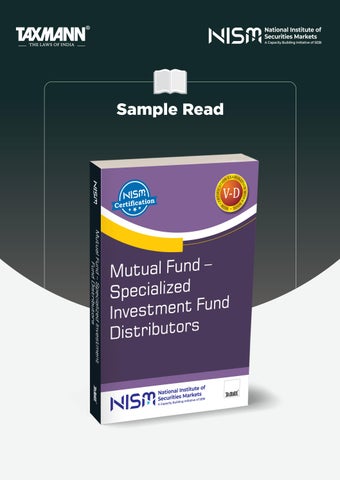
MUTUAL FUND – SPECIALIZED INVESTMENT FUND DISTRIBUTORS AUTHOR
:
PUBLISHER : DATE OF PUBLICATION : EDITION : ISBN NO : NO. OF PAGES : BINDING TYPE :
National Institute of Securities Markets (NISM) | An Educational Initiative of SEBI Taxmann September 2026 Workbook Version - March 2026 9788167011732 768 Paperback
Rs. 1,150 DESCRIPTION Mutual Fund – Specialized Investment Fund Distributors is developed by the National Institute of Securities Markets and published by Taxmann. SEBI has introduced the Specialized Investment Fund (SIF) as a new product line within the mutual fund framework. An SIF requires a minimum investment of ₹10 lakh and runs long-short strategies using derivatives. Distributing it therefore requires both mutual fund knowledge and derivatives expertise. The workbook covers three subjects in one volume, across 22 chapters. Module 1 covers mutual fund distribution, Module 2 covers equity derivatives and Module 3 covers interest rate derivatives. Every chapter opens with learning objectives and closes with sample questions. Every computation is worked in full, and every strategy is shown with its payoff table, payoff chart and break-even point. This book is intended for the following audience: • Individual Mutual Fund and Specialized Investment Fund Distributors • Employees of Organisations • Employees of Asset Management Companies • Existing ARN-holders • Registered Investment Advisers, Relationship Managers and Wealth Management • Product, Compliance, Operations and Risk Personnel • Treasury and Dealing Personnel • Students, Job Aspirants, Trainers and Coaching Institutions The Present Publication is the March 2026 version. It is current with the SEBI (Mutual Funds) Regulations 2026 and the SEBI Master Circular of March 2026, and carries industry data up to February and March 2026. It is veveloped and reviewed by the NISM Certification Team, together with NISM Subject Matter Experts Mr Sundar Sankaran, Ms Sunita Abraham, Mr Amit Trivedi, Mr Joydeep Sen, Dr Aparna Bhat, Mr A. C. Reddi and Mr Sunil M. Gawde, and the Examination Committee constituted for this certification. The noteworthy features of the book are as follows: • [Prescribed Text] The examination is largely based on this material. No supplementary reading is required • [Marks Mapped Chapter by Chapter] Chapter weightages total 150 marks, with 68 for Module 1, 52 for Module 2 and 30 for Module 3 • [Three Subjects in One Volume] Mutual fund distribution, equity derivatives and interest rate derivatives, each covered to examination depth • [Ninety-nine Sample Questions] Every chapter closes with a set, with answers marked in bold. Many are numerical • [Fifty Worked Strategies] 25 equity and 25 interest rate positions, each with a payoff table, payoff chart, maximum profit, maximum loss and break-even • [Computations Shown in Full] NAV, expense ratios, taxation, returns and risk, hedge ratios, arbitrage, bond pricing, duration and convexity, all worked step by step • [Spreadsheet Functions Named] CAGR, variance, standard deviation and yield functions are identified, in line with the Excel and LibreOffice workstations used at test centres • [The SIF Regime is Integrated] SIF provisions appear within the six chapters they govern, not in a separate annexure • [Amended & Updated] Reflects the 2026 Regulations, the full trail commission model, the July 2024 capital gains regime, the revised equity derivatives expiry and contract-size rules, and the 2025 changes to nomination, KYC and the government securities market • [Codes of Conduct Reproduced in Full] The SEBI Code of Conduct for AMCs and trustees, the AMFI Code of Ethics and the AMFI Code of Conduct for Intermediaries appear as appendices • [A Single Footnote Series of 136 Notes] Carrying circular references, SEBI, RBI and AMFI sources, and cross-references • [Continued Reference Value] Cut-off and turnaround tables, expense ratio slabs, benchmark maps, tax tables and contract specifications remain useful in practice
Buy Now