


© NATIONAL INSTITUTE OF SECURITIES MARKETS, MUMBAI, 2026
PRINTING AND PUBLISHING RIGHTS WITH THE PUBLISHER
All rights reserved. No part of this publication may be reproduced, stored in or introduced into a retrieval system, or transmitted in any form or by any means (electronic, mechanical, photocopying, recording or otherwise), without the prior written permission of National Institute of Securities Markets.
Any person who does any unauthorised act in relation to this publication may be liable to criminal prosecution and civil claims for damages.
While every care has been taken in compiling the information contained in this publication, National Institute of Securities Markets accepts no responsibility for any errors or omissions.
‘Readers should look for the latest contents of this workbook on NISM website at https://api.nism.ac.in/cmp/ or any other link as provided by NISM, as the contents might have undergone updation/s after printing of this book.’
Workbook Version : December 2025
Price : ` 250
Published by :
Taxmann Publications (P.) Ltd.
Sales & Marketing :
59/32, New Rohtak Road, New Delhi-110 005 India
Phone : +91-11-45562222
Website : www.taxmann.com, E-mail : sales@taxmann.com
Mumbai
35, Bodke Building, Ground Floor, M.G. Road, Opp. Railway Station, Mulund (West), Mumbai-400080
Mobile : 09322247686, 9619668669, 7045453844/45/48/51
E-mail : sales.mumbai@taxmann.com; nileshbhanushali@taxmann.com
Regd. Office : 21/35, West Punjabi Bagh, New Delhi-110 026 India
Printed at : Tan Prints (India) Pvt. Ltd.
44 Km. Mile Stone, National Highway, Rohtak Road, Village Rohad, Distt. Jhajjar (Haryana) India
E-mail : sales@tanprints.com
The contents of this publication do not necessarily constitute or imply its endorsement, recommendation, or favoring by the National Institute of Securities Markets (NISM) or the Securities and Exchange Board of India (SEBI). This publication is meant for general reading and educational purpose only.
The statements/explanations/concepts are of general nature and may not have taken into account the particular objective/move/aim/need/circumstances of individual user/reader/organization/institute. Thus NISM and SEBI do not assume any responsibility for any wrong move or action taken based on the information available in this publication.
Therefore before acting on or following the steps suggested on any theme or before following any recommendation given in this publication user/reader should consider/seek professional advice.
The publication contains information, statements, opinions, statistics and materials that have been obtained from sources believed to be reliable and the publishers of this title have made best efforts to avoid any errors. However, publishers of this material offer no guarantees and warranties of any kind to the readers/users of the information contained in this publication.
Since the work and research is still going on in all these knowledge streams, NISM and SEBI do not warrant the totality and absolute accuracy, adequacy or completeness of this information and material and expressly disclaim any liability for errors or omissions in this information and material herein. NISM and SEBI do not accept any legal liability what-so-ever based on any information contained herein.
While the NISM Certification examination will be largely based on material in this workbook, NISM does not guarantee that all questions in the examination will be from material covered herein.
AbouttheCertificationExamination–NISM-IFSCA-01:CertificationCourse onAntiMoneyLaunderingandCounterTerroristFinancingintheIFSCI-9 SyllabusoutlinewithweightagesI-15
7.1

After studying this chapter, you should know about:
Definition, objective and explanation of the concept and importance of Prevention of Money Laundering as per PMLA 2002.
Authorities entrusted for investigations regarding money laundering
Prevention of Money Laundering Act (PMLA) forms the core of the legal framework put in place by India to combat money laundering. It is an act to prevent moneylaundering and to provide for confiscation of property derived from, or involved in, money-laundering and for matters connected therewith or incidental thereto. Prevention of Money Laundering Act (PMLA) and the Prevention of Money Laundering Rules (PMLR) notified there under came into force with effect from July 1, 2005.
Director, FIU-IND and Director (Enforcement) have been conferred with exclusive and concurrent powers under relevant sections of the Act to implement the provisions of the Act. The PMLA and rules notified thereunder impose obligation on banking companies, financial institutions, and intermediaries and persons carrying on a designated business or profession, to verify identity of clients, maintain records and furnish information to FIU-IND.
This section defines terms used in the Act
(1) In this Act, unless the context otherwise requires, —
(a) “Adjudicating Authority” means an Adjudicating Authority appointed under sub-section (1) of section 6;
(
b) “Appellate Tribunal” means the Appellate Tribunal established under section 25;
(
c) “Assistant Director” means an Assistant Director appointed under sub-section (1) of section 49;
(
d) “attachment” means prohibition of transfer, conversion, disposition or movement of property by an order issued under Chapter III;
(da) “authorised person” means an authorised person as defined in clause (c) of section 2 of the Foreign Exchange Management Act, 1999 (42 of 1999);
(e) “banking company” means a banking company or a co-operative bank to which the Banking Regulation Act, 1949 (10 of 1949) applies and includes any bank or banking institution referred to in section 51 of that Act;
(f) “Bench” means a Bench of the Appellate Tribunal;
(fa) “beneficial owner” means an individual who ultimately owns or controls a client of a reporting entity or the person on whose behalf a transaction is being conducted and includes a person who exercises ultimate effective control over a juridical person11a;
(g) “Chairperson” means the Chairperson of the Appellate Tribunal;
(h) “chit fund company” means a company managing, conducting or supervising, as foreman, agent or in any other capacity, chits as defined in section 2 of the Chit Funds Act, 1982 (40 of 1982);
(ha) “client” means a person who is engaged in a financial transaction or activity with a reporting entity and includes a person on whose behalf the person who engaged in the transaction or activity, is acting;
(i) “co-operative bank” shall have the same meaning as assigned to it in clause (dd) of section 2 of the Deposit Insurance and Credit Guarantee Corporation Act, 1961 (47 of 1961);
11a From the IFSCA perspective the meaning of beneficial owner has been explained in point 6.3.6 of this book.
PREVENTION OF MONEY LAUNDERING ACT, 2002
(ia) “corresponding law” means any law of any foreign country corresponding to any of the provisions of this Act or dealing with offences in that country corresponding to any of the scheduled offences;
(ib) “dealer” has the same meaning as assigned to it in clause (b) of section 2 of the Central Sales Tax Act, 1956 (74 of 1956);
(j) “Deputy Director” means a Deputy Director appointed under sub-section (1) of section 49;
(
k) “Director” or “Additional Director” or “Joint Director” means a Director or Additional Director or Joint Director, as the case may be, appointed under sub-section (1) of section 49;
(l) “financial institution” means a financial institution as defined in clause (c) of section 45-I of the Reserve Bank of India Act, 1934 (2 of 1934) and includes a chit fund company, a housing finance institution, an authorised person, a payment system operator, a nonbanking financial company and the Department of Posts in the Government of India;
(
m) “housing finance institution” shall have the meaning as assigned to it in clause (d) of section 2 of the National Housing Bank Act, 1987 (53 of 1987);
(n) “intermediary” means, —
(i) a stock-broker, sub-broker share transfer agent, banker to an issue, trustee to a trust deed, registrar to an issue, merchant banker, underwriter, portfolio manager, investment adviser or any other intermediary associated with securities market and registered under section 12 of the Securities and Exchange Board of India Act, 1992 (15 of 1992); or
(ii) an association recognised or registered under the Forward Contracts (Regulation) Act, 1952 (74 of 1952) or any member of such association; or
(iii) intermediary registered by the Pension Fund Regulatory and Development Authority; or
(iv) a recognised stock exchange referred to in clause (f) of section 2 of the Securities Contracts (Regulation) Act, 1956 (42 of 1956);
(na) “investigation” includes all the proceedings under this Act conducted by the Director or by an authority authorised by the Central Government under this Act for the collection of evidence;
(
o) “Member” means a Member of the Appellate Tribunal and includes the Chairperson;
(p) “money-laundering” has the meaning assigned to it in section 3;
(q) “non-banking financial company” shall have the same meaning as assigned to it in clause (f) of section 45-I of the Reserve Bank of India Act, 1934 (2 of 1934);
(
r) “notification” means a notification published in the Official Gazette;
(ra) “offence of cross border implications”, means—
(i) any conduct by a person at a place outside India which constitutes an offence at that place and which would have constituted an offence specified in Part A, Part B or Part C of the Schedule, had it been committed in India and if such person the proceeds of such conduct or part thereof to India; or
(ii) any offence specified in Part A, Part B or Part C of the Schedule which has been committed in India and the proceeds of crime, or part thereof have been transferred to a place outside India or any attempt has been made to transfer the proceeds of crime, or part thereof from India to a place outside India.
Explanation.—Nothing contained in this clause shall adversely affect any investigation, enquiry, trial or proceeding before any authority in respect of the offences specified in Part A or Part B of the Schedule to the Act before the commencement of the Prevention of Money-laundering (Amendment) Act, 2008:
(rb) “payment system” means a system that enables payment to be effected between a payer and a beneficiary, involving clearing, payment or settlement service or all of them.
Explanation. —For the purposes of this clause, “payment system” includes the systems enabling credit card operations, debit card operations, smart card operations, money transfer operations or similar operations;
(rc) “payment system operator” means a person who operates a payment system and such person includes his overseas principal.
Explanation.—For the purposes of this clause, “overseas principal” means, —
(A) in the case of a person, being an individual, such individual residing outside India, who owns or controls or manages, directly or indirectly, the activities or functions of payment system in India;
(B) in the case of a Hindu undivided family, Karta of such Hindu undivided family residing outside India who owns or controls or manages, directly or indirectly, the activities or functions of payment system in India;
(C) in the case of a company, a firm, an association of persons, a body of individuals, an artificial juridical person, whether incorporated or not, such company, firm, association of persons, body of individuals, artificial juridical person incorporated or registered outside India or existing as such and which owns or controls or manages, directly or indirectly, the activities or functions of payment system in India;
(s) “person” includes; —
(i) an individual,
(ii) a Hindu undivided family,
(iii) a company,
(iv) a firm,
(v) an association of persons or a body of individuals, whether incorporated or not,
(vi) every artificial juridical person, not falling within any of the preceding sub-clauses, and
(vii) any agency, office or branch owned or controlled by any of the above persons mentioned in the preceding sub-clauses;
(sa) “person carrying on designated business or profession” means, — a person carrying on activities for playing games of chance for cash or kind, and includes such activities associated with casino;
Inspector-General of Registration appointed under section 3 of the Registration Act, 1908 as may be notified by the Central Government; real estate agent, as may be notified by the Central Government; dealer in precious metals, precious stones and other high value goods, as may be notified by the Central Government;
OF MONEY LAUNDERING ACT, 2002
person engaged in safekeeping and administration of cash and liquid securities on behalf of other persons, as may be notified by the Central Government; or
person carrying on such other activities as the Central Government may, by notification, so designate, from time-to-time;
(sb) “precious metal” means gold, silver, platinum, palladium or rhodium or such other metal as may be notified by the Central Government;
(sc) “precious stone” means diamond, emerald, ruby, sapphire or any such other stone as may be notified by the Central Government;
(t) “prescribed” means prescribed by rules made under this Act;
(u) “proceeds of crime” means any property derived or obtained, directly or indirectly, by any person as a result of criminal activity relating to a scheduled offence or the value of any such property or where such property is taken or held outside the country, then the property equivalent in value held within the country or abroad.
Explanation.—For the removal of doubts, it is hereby clarified that “proceeds of crime” include property not only derived or obtained from the scheduled offence but also any property which may directly or indirectly be derived or obtained as a result of any criminal activity relatable to the scheduled offence.
(v) “property” means any property or assets of every description, whether corporeal or incorporeal, movable or immovable, tangible or intangible and includes deeds and instruments evidencing title to, or interest in, such property or assets, wherever located.
Explanation. —For the removal of doubts, it is hereby clarified that the term “property” includes property of any kind used in the commission of an offence under this Act or any of the scheduled offences;
(va) “real estate agent” means a real estate agent as defined in clause (88) of section 65 of the Finance Act, 1994;
(w) “records” include the records maintained in the form of books or stored in a computer or such other form as may be prescribed;
(wa) “reporting entity” means a banking company, financial institution, intermediary or a person carrying on a designated business or profession;
(x) “Schedule” means the Schedule to this Act;
PREVENTION OF MONEY LAUNDERING ACT, 2002
(y) “scheduled offence” means—
(i) the offences specified under Part A of the Schedule; or
(ii) the offences specified under Part B of the Schedule if the total value involved in such offences is one crore rupees or more; or
(iii) the offences specified under Part C of the Schedule;
(z) “Special Court” means a Court of Session designated as Special Court under sub-section (1) of section 43;
(za) “transfer” includes sale, purchase, mortgage, pledge, gift, loan or any other form of transfer of right, title, possession or lien;
(zb) “value” means the fair market value of any property on the date of its acquisition by any person, or if such date cannot be determined, the date on which such property is possessed by such person.
(2) Any reference, in this Act or the Schedule, to any enactment or any provision thereof shall, in relation to an area in which such enactment or such provision is not in force, be construed as a reference to the corresponding law or the relevant provisions of the corresponding law, if any, in force in that area.
This section gives the definition of Offence of Money Laundering. Whosoever, directly or indirectly attempts to indulge or knowingly assists or knowingly is a party or is actually involved in any process or activity connected with the proceeds of crime including its concealment, possession, acquisition or use and projecting or claiming it as untainted property shall be guilty of offence of money-laundering. Further, the Act clarifies that a person shall be guilty of offence of money-laundering if such person is found to have directly or indirectly attempted to indulge or knowingly assisted or knowingly is a party or is actually involved in one or more of the following processes or activities connected with proceeds of crime, namely: —
(a) concealment; or
(b) possession; or
(c) acquisition; or
(d) use; or
(e) projecting as untainted property; or
(f) claiming as untainted property, in any manner whatsoever
The process or activity connected with proceeds of crime is a continuing activity and continues till such time a person is directly or indirectly enjoying the proceeds of crime by its concealment or possession or acquisition or use or projecting it as untainted property or claiming it as untainted property in any manner whatsoever.
The PMLA is divided in multiple sections. An illustrative list regarding applicability/ scope of coverage of these sections12 is as mentioned below:
Section 1Short title, extent & Commencement
Section 2Definitions
Section 3Offence of Money Laundering
Section 4Punishment for Money Laundering
Section 5Attachment of property involved in money-laundering.
Section 11AVerification of identity by reporting entity
Section 12Reporting entity to maintain records
Sections 12A & 12AA Access to Information
Section 13Powers of the Director
Section 14No civil or criminal proceedings against reporting entity, its Directors & Employees in certain cases
Section 15Procedure and manner of furnishing information by reporting entities
Section 26Appeals to Appellate Tribunal
Section 39Right of appellant to take assistance of authorised representative and of Government to appoint presenting officers
Section 40Members etc. to be public servants
Section 41Civil court not to have jurisdiction
Section 42Appeal to high court
Section 44Offences triable by special courts
Section 48Authorities under the Act
Section 49Appointment and powers of authorities and other officers
12 Source: https://fiuindia.gov.in/files/AML_Legislation/pmla_2002.html
PREVENTION OF MONEY LAUNDERING ACT, 2002
Section 50Powers of authorities regarding summons, production of documents and to give evidence etc.
Section 54Certain officers and others to assist in inquiry etc.
Section 56Agreements with foreign countries
Section 66Disclosure of information
Section 69Recovery of Fine or Penalty
Section 73Power to make Rules
Section 75Power to remove difficulties
As per Section 4 of the PMLA 2002, “Whoever commits the offence of moneylaundering is punishable with rigorous imprisonment for a term which will not be less than three years but which may extend to seven years and shall also be liable to fine.
However, it may be noted that where the proceeds of crime involved in moneylaundering relates to any offence specified under paragraph 2 of Part A of the Schedule, the provisions of this section shall have effect as if for the words “which may extend to seven years”, the words “which may extend to ten years” had been substituted.
As prescribed under Section 5 of the Act, where the Director or any other officer not below the rank of Deputy Director authorised by the Director for the purposes of this section, has reason to believe (recorded in writing), on the basis of material in his possession, that--
(a) any person is in possession of any proceeds of crime; and (b) such proceeds of crime are likely to be concealed, transferred or dealt with in any manner which may result in frustrating any proceedings relating to confiscation of such proceeds of crime may, by order in writing, provisionally attach such property for a period not exceeding one hundred and eighty days from the date of the order, in such manner as may be prescribed
As per Section 12 of the PMLA 2002, the requirement for maintenance of records by reporting entities has been specified. According to the section
(1) Every reporting entity is required to—
(
a) maintain a record of all transactions, in such manner as to enable it to reconstruct individual transactions;
(b) furnish to the Director within such time as may be prescribed, information relating to such transactions, whether attempted or executed, the nature and value of which may be prescribed;
(
c) maintain record of documents evidencing identity of its clients and beneficial owners as well as account files and business correspondence relating to its clients.
(2) Every information maintained, furnished or verified, save as otherwise provided under any law for the time being in force, shall be kept confidential.
(3) The records referred to in clause (a) of sub-section (1) shall be maintained for a period of five years from the date of transaction between a client and the reporting entity.
(4) The records referred to in clause (c) of sub-section (1) shall be maintained for a period of five years after the business relationship between a client and the reporting entity has ended or the account has been closed, whichever is later.
(5) The Central Government may, by notification, exempt any reporting entity or class of reporting entities from any obligation under this Chapter.
As illustrated under Section 56 of the PMLA 2002 the international co-operation between countries for the purpose of prevention of money laundering has been specified. Accordingly
(1) The Central Government may enter into an agreement with the Government of any country outside India for:
(a) enforcing the provisions of this Act;
PREVENTION OF MONEY LAUNDERING ACT, 2002
(b) exchange of information for the prevention of any offence under this Act or under the corresponding law in force in that country or investigation of cases relating to any offence under this Act, and may, by notification in the Official Gazette, make such provisions as may be necessary for implementing the agreement.
(2) The Central Government may, by notification in the Official Gazette, direct that the application of this Chapter in relation to a contracting State with which reciprocal arrangements have been made, shall be subject to such conditions, exceptions or qualifications as are specified in the said notification.
For effective implementation of the Act, maintenance and reporting of records is an important requirement. Under the PML Rules, Rule 3 – Maintenance of records of transactions, the following transactions have been specified, for which records have to be maintained and reports are to be furnished to FIU-IND14:
(
a) All cash transactions of the value of more than rupees 10 lakh or its equivalent in foreign currency.
(b) All series of cash transactions integrally connected to each other which have been individually valued below rupees ten lakhs or its equivalent in foreign currency where such series of transactions have taken place within a month and the monthly aggregate exceeds an amount of ten lakh rupees or its equivalent in foreign currency;
(c) All transactions involving receipts by non-profit organisations of value more than rupees ten lakh, or its equivalent in foreign currency;
(d) All cash transactions where forged or counterfeit currency notes or bank notes have been used as genuine or where any forgery of a valuable security or a document has taken place facilitating the transactions;
(e) All suspicious transactions, whether or not made in cash, including attempted transactions.
13 Note: No cash transactions are permitted in IFSC domain.
14 Source: https://fiuindia.gov.in/files/AML_Legislation/notification.htmland https://fiuindia.gov.in/pdfs/downloads/Brochures%20on%20FIU.pdf
AUTHOR : NISM | An Educational Initiative of SEBI
PUBLISHER : Taxmann
DATE OF PUBLICATION : March 2026
EDITION : December 2025
ISBN NO : 9789375615330
No. of Pages : 168
BINDING TYPE : Paperback
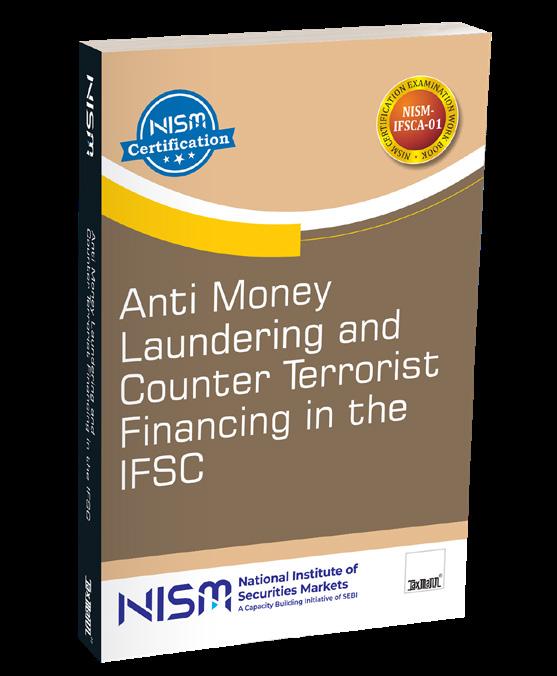
Anti-Money Laundering and Counter-Terrorist Financing in the IFSC is a comprehensive guide to the AML, CTF, Proliferation Financing (PF), and KYC regulatory framework that governs the IFSC ecosystem. Developed as the official NISM Certification Examination Workbook for the IFSCA-01 course, it functions as both an exam preparation resource and a structured compliance reference for professionals working in GIFT IFSC. The book covers India’s domestic AML legislation—PMLA 2002, PML Rules 2005, and Scheduled Offences—alongside the IFSCA (AML, CFT and KYC) Guidelines 2022, FATF Recommendations, trade-based money laundering, and five enforcement case studies from FIU-IND and IFSCA adjudicating orders. This book is intended for the following audience:
• Capital Market Intermediaries in IFSC
• Compliance & AML/CFT Professionals
• Virtual Digital Asset Service Providers
• Legal & Risk Teams
• NISM-IFSCA-01 Examination Candidates
The Present Publication is the December 2025 Workbook Version, published by Taxmann for the National Institute of Securities Markets (NISM). The workbook has been developed by the NISM Certification Team in collaboration with NISM Subject Matter Expert—Ms. Monica Sachdeva, with review inputs from the International Financial Services Centres Authority (IFSCA).
• [Dual-framework Coverage] Includes India’s domestic AML/CFT laws (PMLA, PML Rules, Scheduled Offences) and the IFSCA-specific regulatory framework (IFSCA AML, CFT, and KYC Guidelines 2022), helping readers understand the layered compliance structure controlling IFSC operations
• [Enforcement Case Studies] Presents five case studies based on actual FIU-IND and IFSCA adjudications—Bybit Fintech Limited, Prowess Insurance Brokers, Neo Asset Management, Way2Wealth Brokers, and Paytm Payments Bank—demonstrating PMLA violations and penalties
• [FATF Recommendations & Global Standards] Covers the FATF’s mandate, its 40 Recommendations, IX Special Recommendations on terrorist financing, FATF-Style Regional Bodies, Grey/Blacklist mechanisms, and trade-based money laundering with red-flag indicators
• [IFSCA vs. Other Regulators—Comparative Analysis] Offers a comparative table highlighting differences between IFSCA AML/CFT guidelines and those of RBI, SEBI, IRDAI, and PFRDA
• [Comprehensive KYC Norms] Details CDD requirements for natural persons, legal entities, and legal arrangements; PEP accounts; Enhanced, Simplified, and Ongoing Due Diligence; V-CIP and Digital KYC onboarding; sanctions screening; and periodic CDD updates
• [Chapter-end Sample Questions] Concludes each chapter with sample questions aligned to the examination pattern
• [Syllabus-weightage Mapping] Outlines a syllabus with chapter-wise marks allocation totalling 50 marks