Residential Rainscaping: Analysis of Residents' Participation in Rain Garden Programs and Stormwater
Residential Rainscaping:
Analysis of Residents’ Participation in Rain Garden Programs and Stormwater Management in the City of Ann Arbor, Michigan
Renee Magyar
University of Michigan, Taubman College of Architecture and Urban Planning
Master of Urban and Regional Planning – Professional Project – May 2026
EXECUTIVE SUMMARY
Annual precipitation in the City of Ann Arbor, Michigan is increasing along with population, impervious surface, and stormwater runoff. Nearly half of the land in the city is owned privately by residents, so as a result, property owners hold a great deal of responsibility for understanding the importance of stormwater management, taking action on their properties, and following best practices for stormwater infiltration.
Washtenaw County Water Resources launched rain garden programming in 2005 to provide resources and information to help encourage residents to manage stormwater on their property by installing rain gardens. The rain garden programming is seemingly successful, yet there has been no formal research to date that has evaluated the program's long-term effectiveness.
My professional project has three parts. The first is an analysis of the spatial distribution of rain gardens by subwatershed (creekshed). Findings help inform where future efforts for program outreach and expansion should be targeted based on the goals of increasing coverage in neighborhoods with either fewer rain gardens per residential area, fewer rain gardens per impervious surface area, or that have the greater impacts on water quality and stormwater quantity. The analysis revealed three options for priority locations for program expansion: (1) to have the largest number of rain gardens relative to residential area, focus on Fleming Creek, Traver
Creek, and Lower Middle Huron; (2) to have the largest number of rain gardens relative to impervious area, focus on Fleming Creek, Traver Creek, and Mallets Creek; and (3) to offset stormwater runoff in areas with the greatest water quality impairments, focus on Allen Drain, Malletts Creek, Millers Creek, and Swift Run.
In the second part of the project, I analyzed responses to a county-wide survey conducted in January 2025 by the Washtenaw County Rain Gardening Program with support from the University of Michigan School of Information. The survey responses informed the design of the interview questions for Part 3 of my project.
In the third part, I interviewed several of those who had responded to the 2025 survey and found similar themes across the survey responses and interviews. Respondents are dealing with water-related problems in their yards or homes, yard aesthetics are important, and rain gardens are growing in popularity. Lack of time, the difficulty of manual labor, and invasive species are common challenges. Rain gardeners are looking for opportunities for continuing education, community learning, and support with garden installation. Rain gardens in this project are in good condition. Supporting these and other existing rain gardens to help ensure long-term effectiveness will be important, as will increasing program participation to increase the number of gardens around the city.
ACKNOWLEDGMENTS
I owe a debt of gratitude to everyone who helped with this project, first and foremost to my advisory committee. Professor Larissa Larsen and my client, Susan Bryan with Washtenaw County Water Resources, provided expert guidance and support throughout in shaping and informing the project.
Thank you also to Jennifer Lawson, Water Quality Manager, with the City of Ann Arbor who was an important silent-partner client and my connection to Susan Bryan.
Ellie Bain, Tony Bedogne, and Paul Steen and Kelly McCabe at the Huron River Watershed Council each contributed time, talent, or data resources for the spatial analysis.
Thank you to all of my rain garden interview participants for their time and enthusiasm for this project.
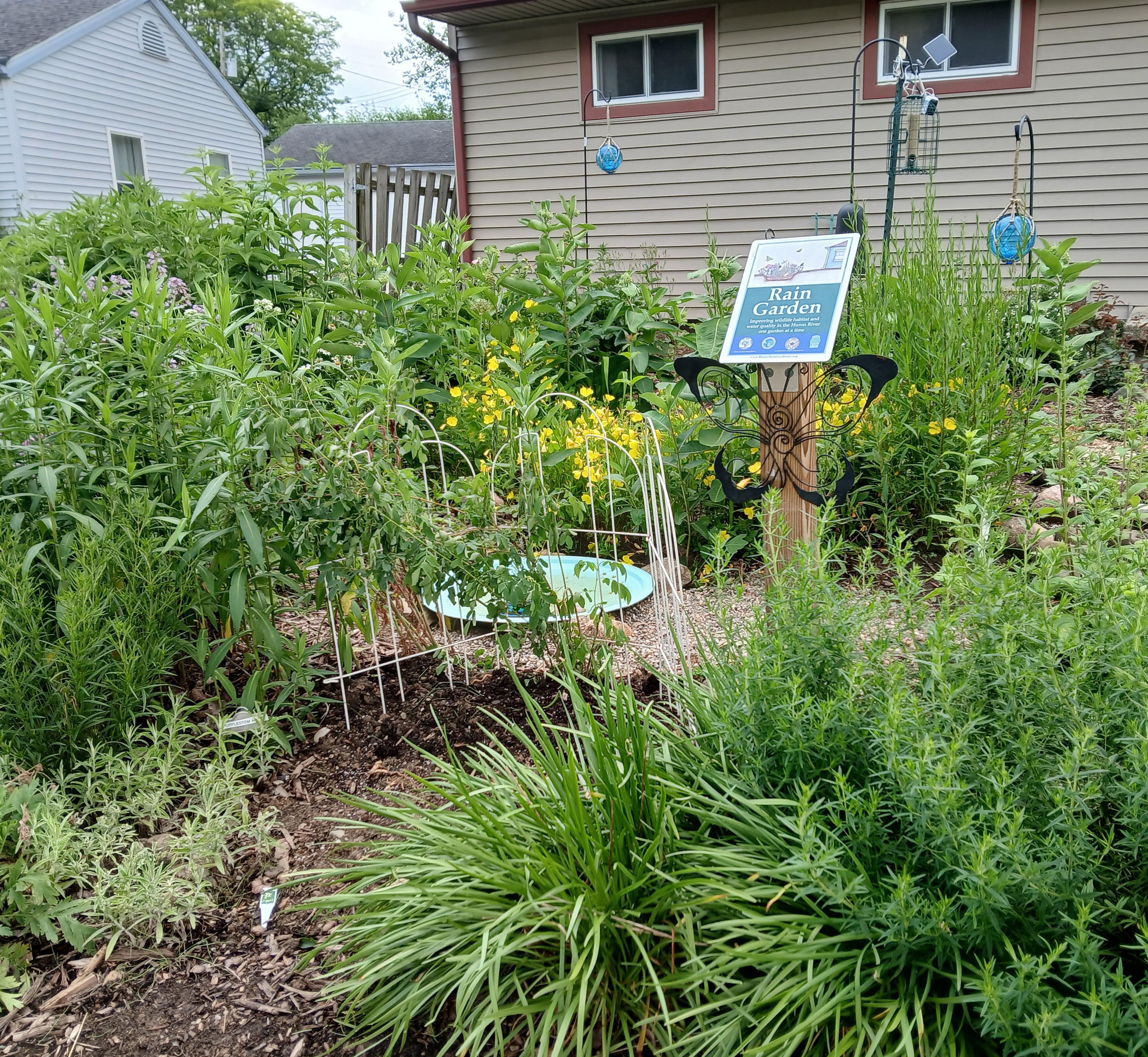
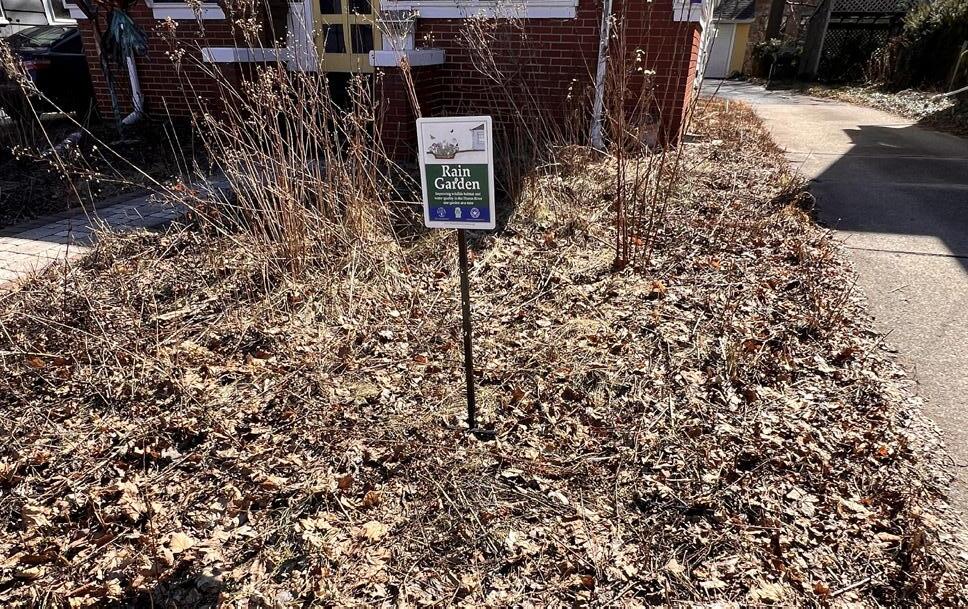
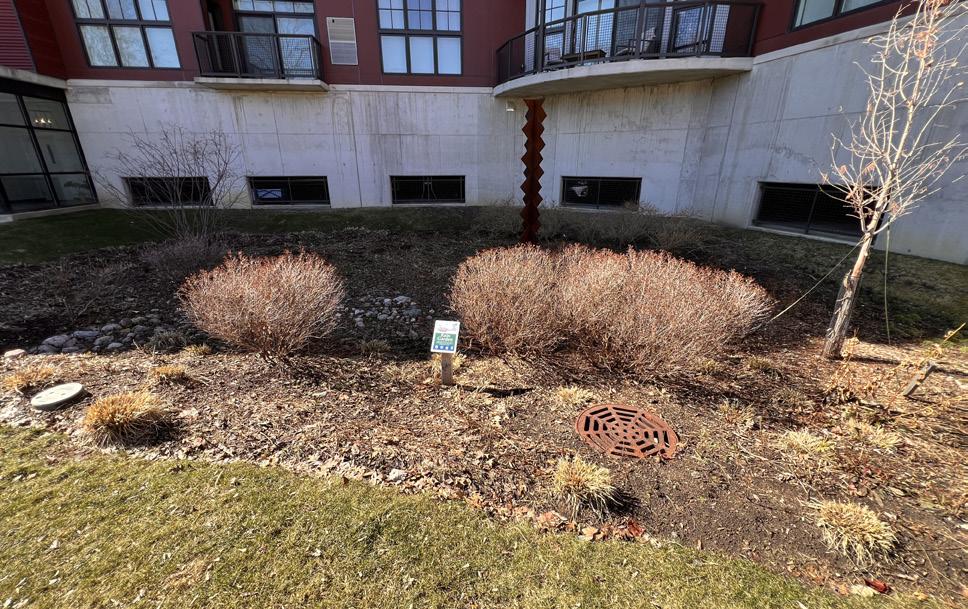
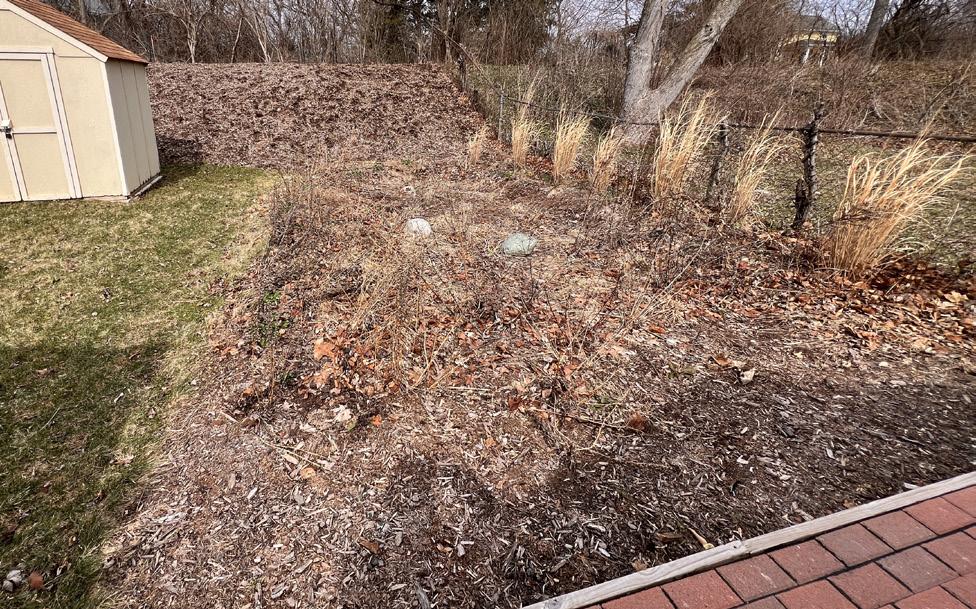
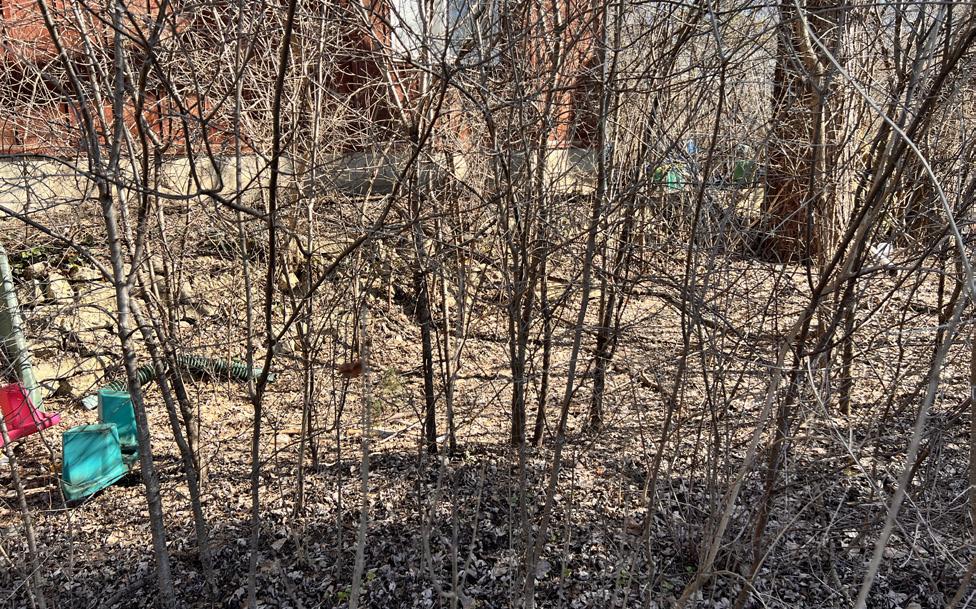
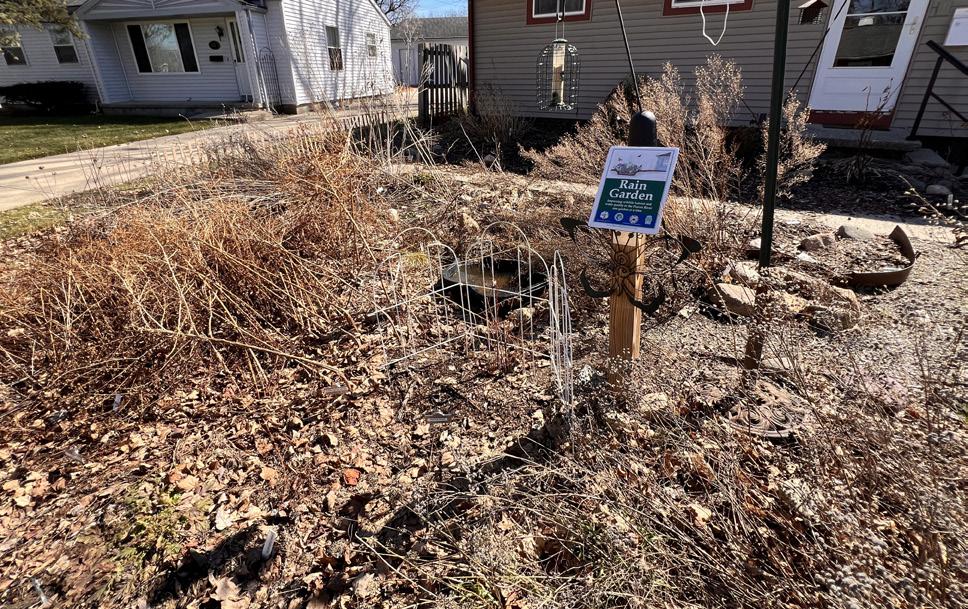
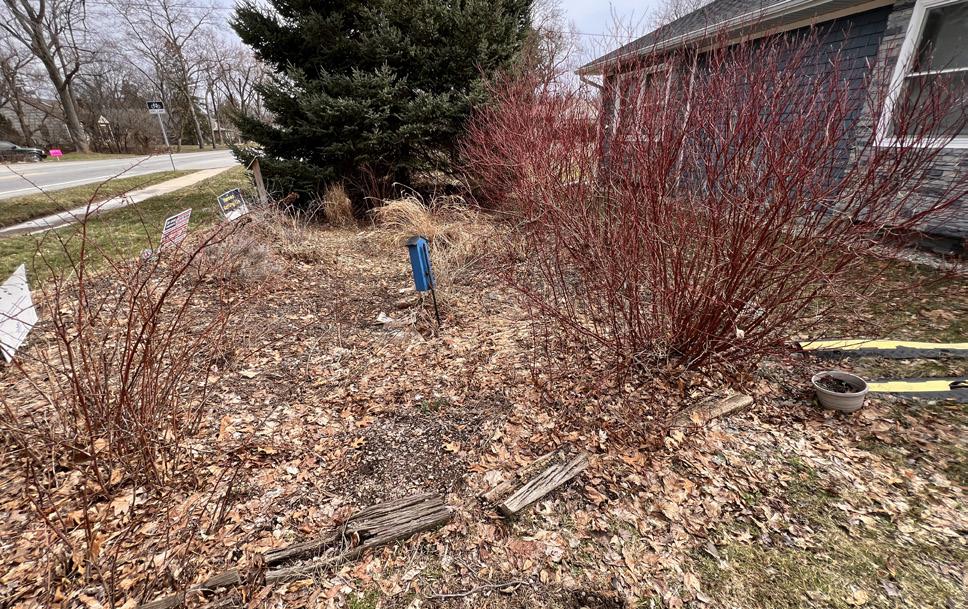
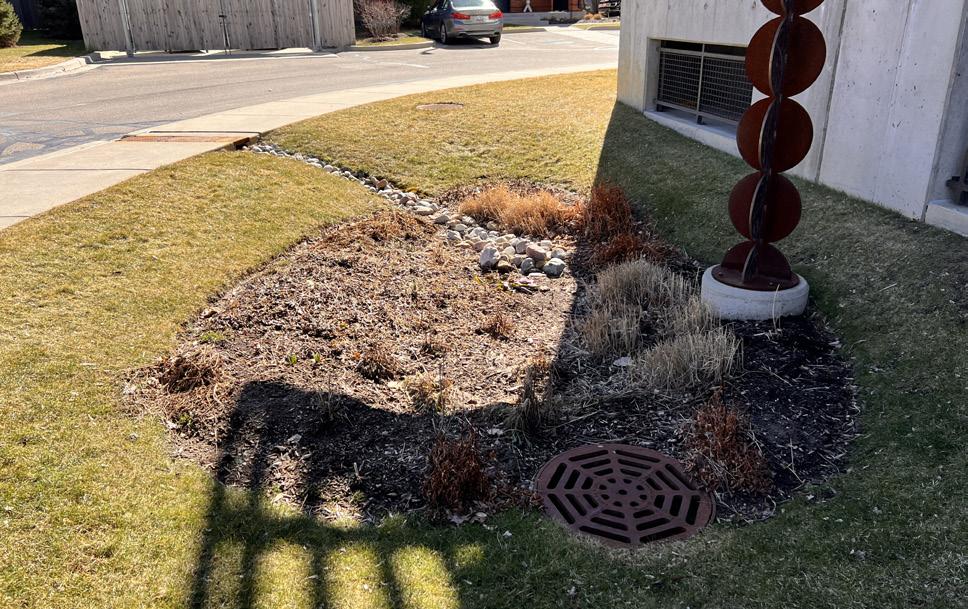
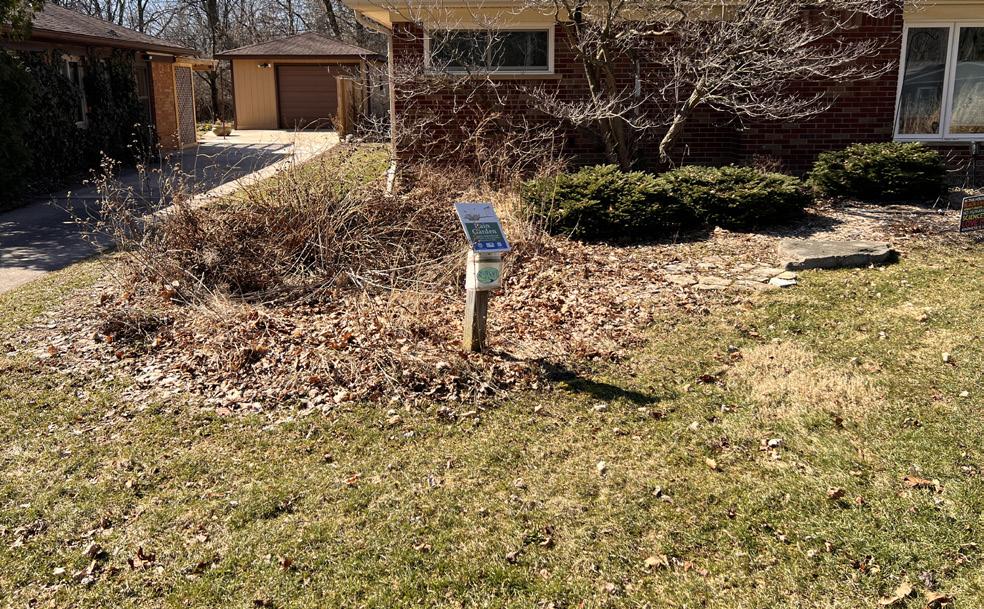
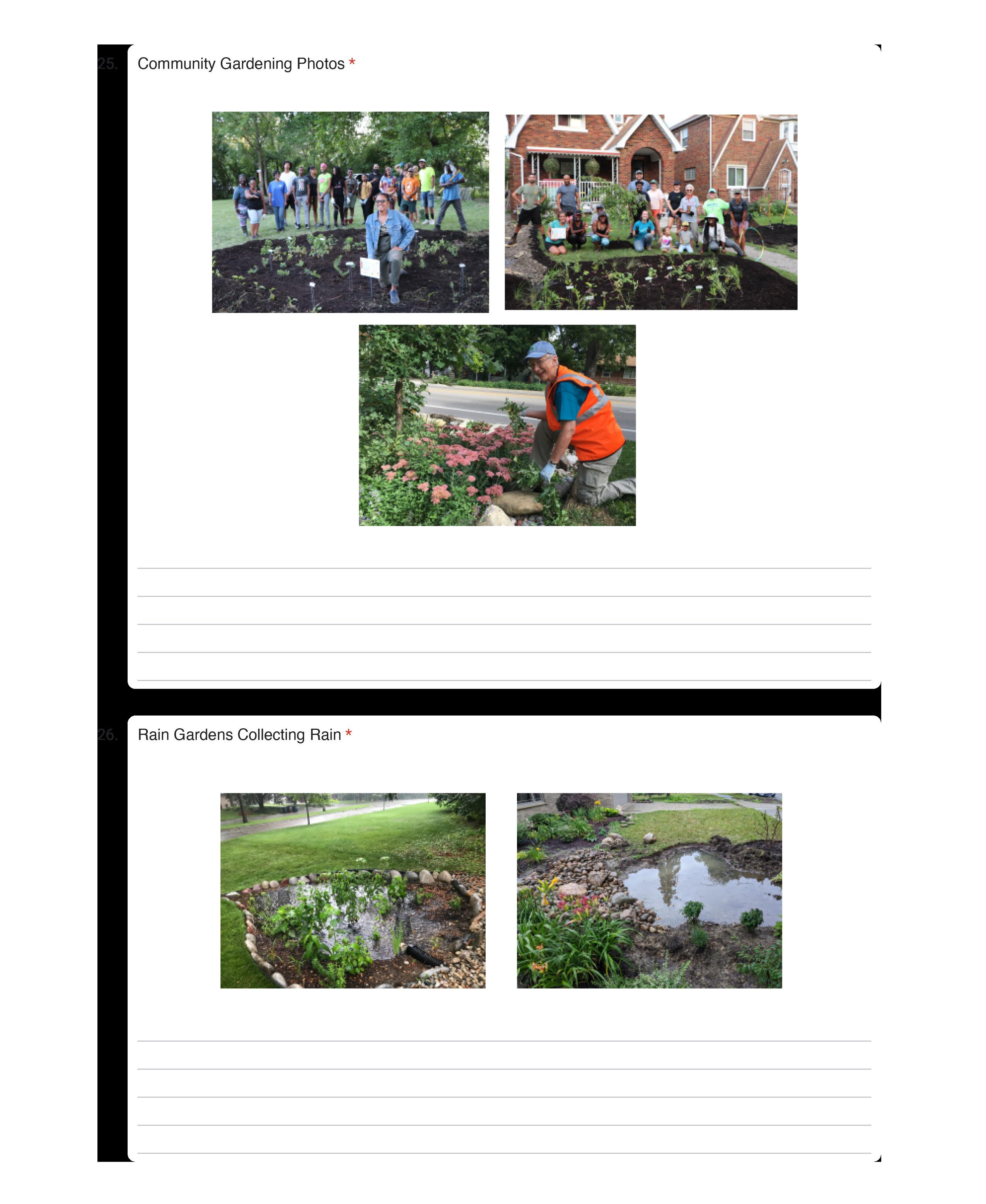
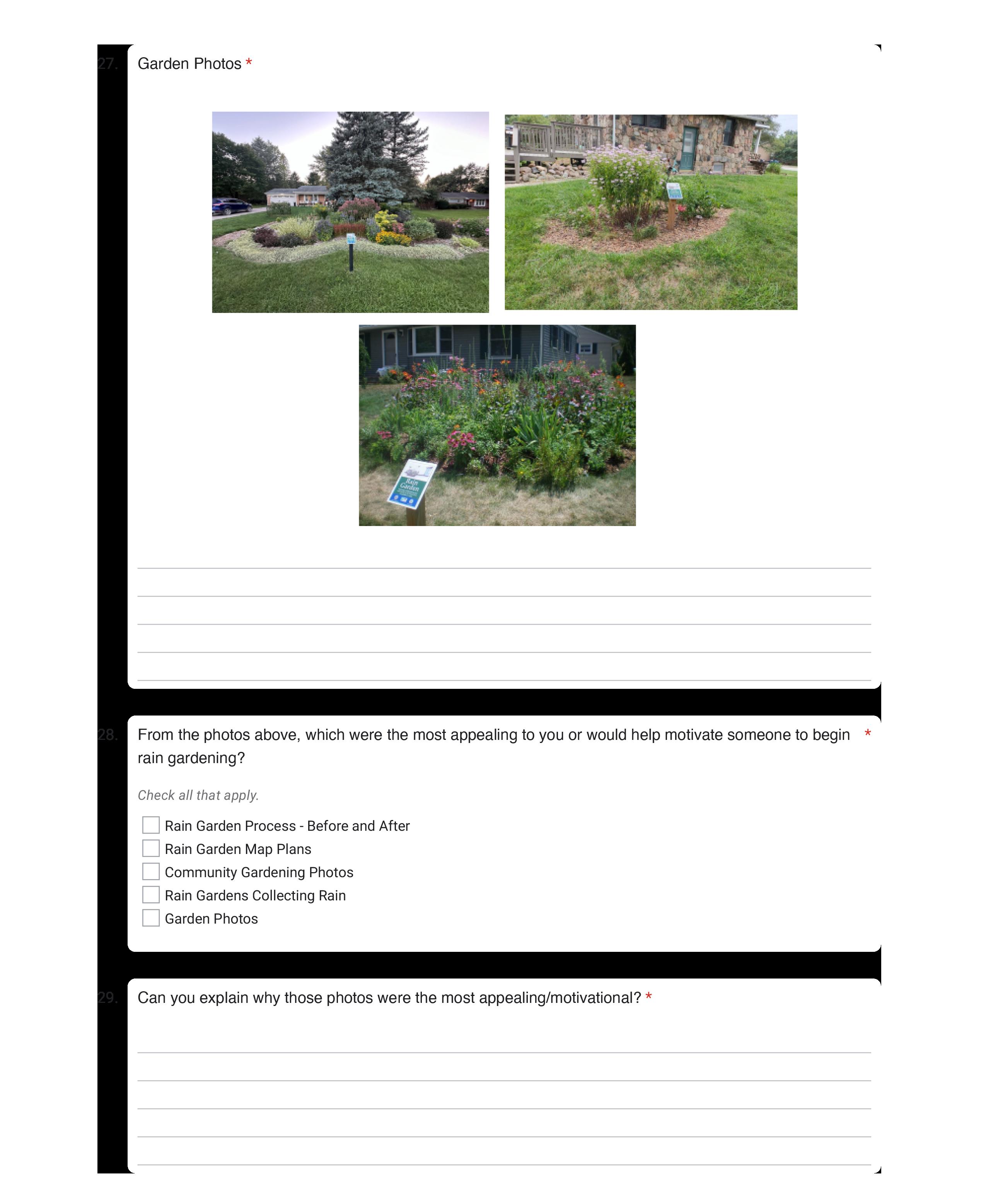
(Photos on the cover and pages 8 and 9 are courtesy of rain garden interview participants.)
1 INTRODUCTION 5
2 LITERATURE REVIEW 8
3 SPATIAL DISTRIBUTION OF RAIN GARDENS BY SUBWATERSHED 10
3.1 METHOD 10
3.2 FINDINGS 12
3.3 RESULTS 14
3.4 LIMITATIONS 21
3.5 RECOMMENDATIONS: PRIORITY LOCATIONS FOR PROGRAM EXPANSION 21
4 SURVEY RESPONSES 22
5 INTERVIEWS 24
5.1 METHOD 24
5.2 FINDINGS 25
5.3 GARDEN CONDITION ASSESSMENT THEMES 31
5.4 LIMITATIONS 32 5.5 RECOMMENDATIONS: LESSONS LEARNED FROM PARTICIPANTS AND LITERATURE REVIEW 33
6 REFERENCES 38
7 APPENDICES 41
APPENDIX 1 JANUARY 2025 SURVEY 41
APPENDIX 2 2026 INTERVIEW QUESTIONS 51
1. INTRODUCTION
Between 1951 and 2024, the amount of annual precipitation in the City of Ann Arbor, Michigan increased by 46.8% and the city’s population grew from 48,251 to 122,925.1,2 With urban expansion and population increase comes a measurable increase in impervious surface,3,4,5 an increase in stormwater runoff carrying pollutants unfiltered into the Huron River,6 7 8 9 and a greater challenge of managing water quality in the Huron River watershed.
While the City of Ann Arbor is responsible for managing stormwater, nearly half of the land in the city (48.4%) is owned privately by residents.10 As a result, property owners hold a great deal of responsibility, perhaps unknowingly, for understanding the importance of stormwater management, taking action on their properties, and following best practices for stormwater infiltration on residential sites.11 The City incentivizes residents to reduce impervious surface on their properties by imposing a stormwater fee with a rate based on the volume of stormwater their property sends to the stormwater system, represented by the amount of impervious surface
1 “Extreme Precipitation | GLISA.”
2 “K200104: Population by Age - Census Bureau Table.”
3 Chabaeva et al., Development of a Population Density and Land Use Based Regression Model to Calculate the Amount of Imperviousness.
4 Lee and French, “Regional Impervious Surface Estimation.”
5 Stankowski, “Population Density as an Indirect Indicator of Urban and Suburban Land-Surface Modification.”
6 City of Ann Arbor, “Stormwater.”
7 Huron River Watershed Council, “Adopt a Storm Drain.”
8 Huron River Watershed Council, “Non-Point Source Pollution (Stormwater Runoff).”
9 US EPA, “Soak Up the Rain.”
10 City of Ann Arbor Master Plan: Land Use Element.
11 City of Ann Arbor Master Plan: Land Use Element.
on their property.12,13 Homeowners can receive a credit on their water utility bill by installing green stormwater infrastructure, such as a rain garden, rain barrel, or cistern, however, relatively very few (6.4%) residential properties participate in the credit program.14,15
Washtenaw County Water Resources launched rain garden programming in 2005 to provide resources and information to help encourage residents to manage stormwater on their property by installing rain gardens. Core to their technical support for residential rain gardening are on-site consultations to assess best placement for a rain garden and a hands-on Master Rain Gardener (MRG) course where residents can learn how to properly design and install a rain garden.
Washtenaw County works in close partnership with the City of Ann Arbor to help the City meet their State of Michigan Department of Environment, Great Lakes, and Energy (EGLE) municipal stormwater discharge permit requirements.16 The County leads the effort to grow rain garden program participation, encourage more residents to install rain gardens on their properties, and otherwise increase the number of rain gardens across the county. Toward this effort, in 2010, the City of Ann Arbor implemented updates to their residential stormwater code requiring homeowners to install additional stormwater
12 City of Ann Arbor, “Stormwater Rates.”
13 Revenue generated from the fee helps pay for maintenance of the stormwater system.
14 City of Ann Arbor, “Residential Stormwater Credits.”
15 City of Ann Arbor Division of Assessing, “Stormwater Credits.”
16 Michigan Department of Environment, Great Lakes, and Energy, “Municipal Stormwater Program.”
management measures for any new imper vious areas greater than 200 square feet. Properly designed and installed rain gardens meet these requirements. Residents can also qualify for a stormwater utility credit if they have a rain garden that meets design, drainage, and infiltration requirements. However, as of 2026, only 6.4 percent of residents are enrolled in the credit program. These strategies will only be effective long-term if residents maintain their rain gardens to ensure proper stormwater infiltration.
The rain garden programming is seemingly successful, with over 675 rain gardens city-wide and over 1,000 county-wide in 2025.18 Yet there has been no formal research to date that has evaluated the program's long term effectiveness.
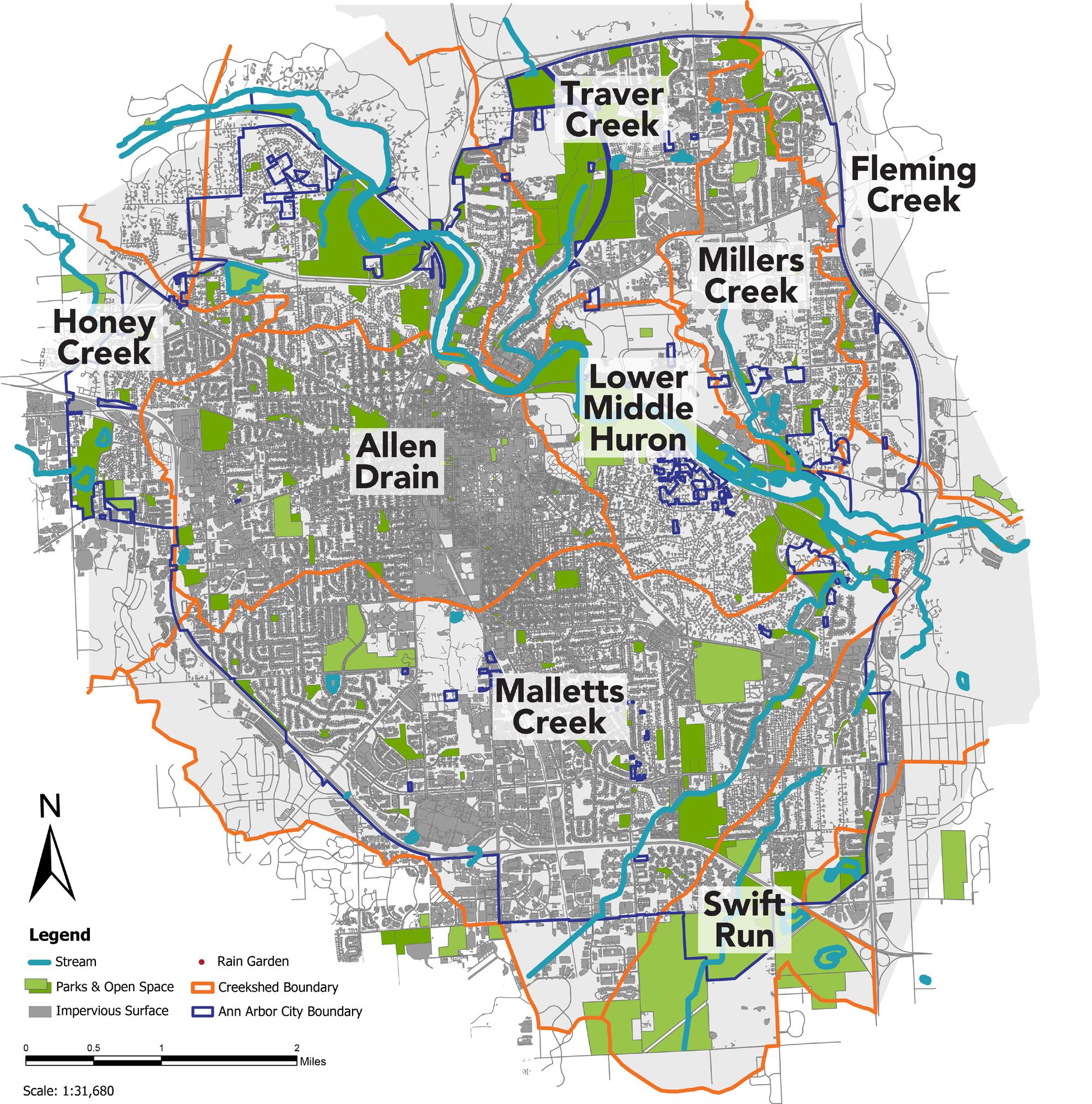
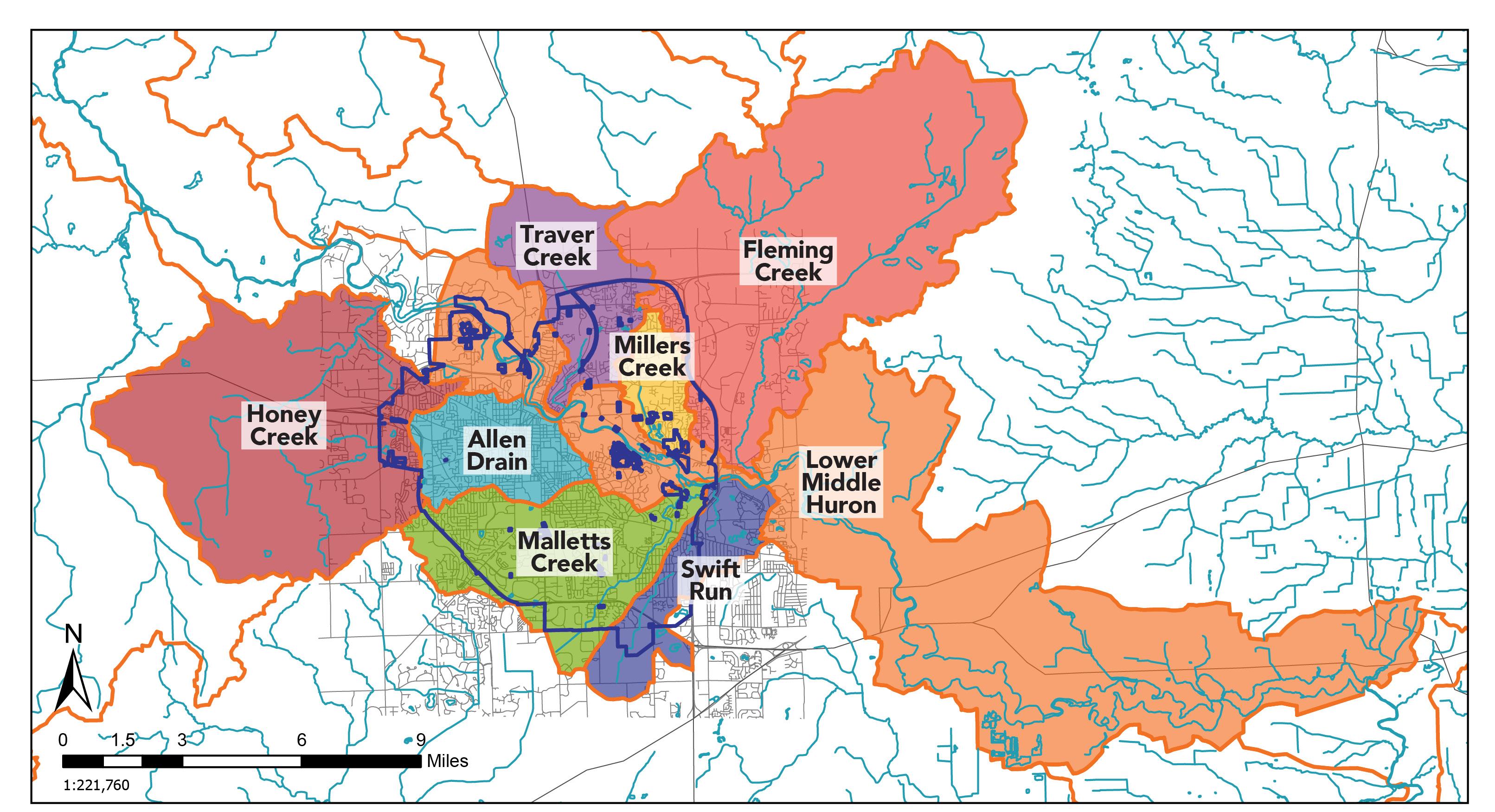
Figure 1 shows the eight subwatersheds (creeksheds) of the greater Huron River watershed that are located within the City of Ann Arbor: Allen Drain, Fleming Creek, Honey Creek, Malletts Creek,
17
18
City of Ann Arbor, “Stormwater Rates.”
Washtenaw County, “RainScaping in Southeast Michigan.”
Lower Middle Huron, Millers Creek, Swift Run, and Traver Creek.
My professional project had three parts. In the first part, I assessed the distribution of existing rain gardens in the eight subwatersheds (creeksheds) within the City of Ann Arbor’s boundary in relation to impervious surface and housing tenure (owned versus rented housing). This allowed me to understand which neighborhoods are generating the most stormwater, capturing the most stormwater in rain gardens, and which populations are installing rain gardens.
In the second part, I analyzed the results of a January 2025 online survey conducted countywide by Washtenaw County Water Resources
with support from the University of Michigan School of Information.
In the third part, I interviewed 24 rain gardeners in Ann Arbor. From the interviews and survey results, I gained an understanding of participants’ experiences with their rain gardens, particularly their motivations for installing a rain garden and barriers they face with long-term rain garden maintenance. Together, the findings inform recommendations for program expansion by highlighting replicable successes and uncovering areas for improvement.
Figure 2 shows the full geographic scope of the eight creeksheds. It is important to note that Fleming Creek and Lower Middle Huron to the east and Honey Creek to the west each have only a small portion of their total area within the Ann Arbor city boundary, denoted by the blue outline.
The State of Michigan GIS Open Data Watershed Boundary layers refer to the section of the Middle Huron creekshed that is within the Ann Arbor city boundary as Middle Middle Huron. I use Lower Middle Huron following the naming used by the Huron River Watershed Council.
2. LITERATURE REVIEW
Climate change is bringing increasingly intense storms and greater volumes of stormwater that threatens surface water quality in the United States. 1 Many traditional "gray infrastructure" methods to manage stormwater involve transporting stormwater directly to local waterways. Much of this gray infrastructure is aging and lacks sufficient capacity to manage increasingly large volumes of stormwater. This is contributing to a greater frequency of high-cost property damage from flooding events.2
Municipalities are increasingly adopting green infrastructure systems as alternatives to "gray infrastructure" to manage stormwater for the variety of environmental, economic, and social benefits they provide.3,4 Green infrastructure uses vegetation and soil for stormwater filtration, infiltration, and evapotranspiration to treat and soak up rainwater on site.5
Rain gardens are one form of green infrastructure, designed to capture rainwater from buildings, streets, sidewalks, and other impervious surfaces. They are typically small, sunken areas planted with native drought-resistant vegetation, or a combination of native and non-native species that, after establishing, are able to survive with little additional water. The gardens collect and filter water and allow stormwater to infiltrate into the ground through soil, sand, or gravel.6
3 McFarland et al., “Guide for Using Green Infrastructure in Urban Environments for Stormwater Management.”
4 “Benefits of Green Infrastructure | US EPA.”
5 US EPA, “About Green Infrastructure.”
6 US EPA, “Types of Green Infrastructure.”
Proper maintenance of rain gardens is essential for ensuring their ability to filter and infiltrate stormwater.7 The condition of a garden, including the health and variety of plant species, is an important indicator of the garden's performance and what interventions are needed for long-term maintenance and presence in the landscape. Native plants are ideal for their long root systems which are more effective for holding and helping infiltrate greater volumes of water.8
Other cities have initiated rain garden initiatives similar to Ann Arbor involving participants with
7 Asleson et al., “Performance Assessment of Rain Gardens.”
8 “Native and Non-Native Root Comparison Chart.”
different levels of knowledge and motivations. In 2006, researchers at North Carolina State University developed an educational program on rain gardens that included installation of residential demonstration rain gardens, among other resources.9 After two years, researchers followed up to assess the condition of the demonstration gardens and found that avid gardeners were the most motivated and had the highest rate of success with maintaining a healthy garden, while those that installed gardens as required by law saw the most garden failures.10
Research by Asleson et al. (2009) looked at the condition of rain gardens in Minnesota to assess functionality and found that poorly performing rain gardens were unsuccessful as a result of failing vegetation due to lack of maintenance.11
Cities can look to build social diffusion strategies into rain garden programs to encourage installation and maintenance of new rain gardens. Having visual access to existing rain gardens can influence others to install their own rain gardens.12 Friends and acquaintances are seen as trustworthy sources of information and by demonstrating their own successes with managing stormwater on their properties can serve as a model for others.13
9 Woodward et al., “Lessons Learned.”
10 Woodward et al., “Lessons Learned.”
11 Asleson et al., “Performance Assessment of Rain Gardens.”
12 Hunter and Brown, “Spatial Contagion.”
13 Costanzo et al., “Energy Conservation Behavior.”
3. SPATIAL DISTRIBUTION OF RAIN GARDENS BY SUBWATERSHED
The analysis of the spatial distribution of rain gardens by subwatershed (creekshed) was designed to help inform where future efforts for program outreach and expansion should be targeted based on the goals of increasing coverage in neighborhoods with either fewer rain gardens per residential area, fewer rain gardens per impervious surface area, or that have the greater impacts on water quality and stormwater quantity.
The primary research question was, "How does the distribution of residential rain gardens in Ann Arbor’s eight creeksheds relate to tenure (owned versus rented housing) and the amount of stormwater runoff caused by impervious surfaces?" The following five questions helped structure the spatial research. The associated program recommendation goals are shown in parentheses.
1) Which creeksheds have the least number of rain gardens and lowest density of rain gardens (gardens per square mile)? (To increase coverage in neighborhoods with fewer rain gardens.)
2) Which neighborhoods have the greatest areas of impervious surface? (To increase rain garden coverage in these areas with the greatest impact on reduced water quality.)
3) What is the estimated annual volume of stormwater runoff in each creekshed? (To inform water quality impacts.)
4) What is the estimated annual volume of stormwater controlled by rain gardens in each creekshed? (To show the degree to which rain gardens are offsetting storm water runoff volumes.)
5) What is the distribution of rain gardens in relation to housing tenure (owner versus rental housing)? (To show the population of residents most likely to engage in rain gardening and to identify new audiences for outreach.)
3.1 METHOD
Part of this research was conducted for the final project for Introduction to Geographic Information Systems (GIS) (URP 520) during the Fall 2025 semester. My research partner in this class was Ellie Bain, a fellow Master of Urban and Regional Planning student. Therefore, I will use the term 'we' in this section to honestly reflect our partnership.
We used ArcGIS Pro to map spatial data layers and calculate stormwater runoff and Excel to create graphs and charts. We used the following GIS layers and datasets for visual mapping and extracting values:
• Rain gardens: GIS shapefile with known rain garden point locations, stormwater volume capacity as of October 2025, and installation dates.1
1 Washtenaw County Water Resources, “RainScapingExport.”
• Creeksheds: GIS shapefile with perimeter and acreage of all Huron River creeksheds; Used the perimeter boundaries to clip other layers and isolate data within each creekshed.2
• Ann Arbor zoning: GIS shapefile with area of each zoning district.3
• Impervious surface areas: GIS shapefile with area (in sq. ft.) of impervious surface per parcel in the City of Ann Arbor.4 Used creekshed layers to isolate surface area per creekshed.
• Housing tenure: GIS shapefile of U.S. Census block groups.5 Table export from the American Community Survey with data on the total number of renters, owners, and percent of owners in every block group in Washtenaw County.6
• Ann Arbor city boundary: GIS shapefile used to clip and remove data outside the city boundary.7
We used the following layers and formulas to calculate and map stormwater runoff by creekshed:
• Impervious surface stormwater runoff: GIS layers with impervious surface area per creekshed and a field to calculate runoff volume per creekshed in gallons.
First we measured the amount of impervious surface area in each creekshed and then applied
2 Huron River Watershed Council, “Huron Creeksheds.”
3 City of Ann Arbor, “Ann Arbor Zoning.”
4 City of Ann Arbor, “Ann Arbor Impervious Surfaces.”
5 “USA Census Block Group Boundaries.”
6 “B25007: Tenure by Age of Householder - Census Bureau Table.”
7 City of Ann Arbor, “Ann Arbor City Boundary.”
a stormwater calculator to find approximately how much runoff each creekshed produces each year. We used a stormwater runoff formula to estimate annual runoff by creekshed in gallons:
V = A x C x P
[V] Volume of stormwater runoff (gallons) = [A] Impervious surface area (sq. ft.) x [C] Runoff coefficient (varies based on surface characteristics and conditions) x [P] Annual average rainfall depth (inches).
The coefficient [C] is calculated as:
C = Q / P
[C] Runoff coefficient = [Q] Peak runoff rate (cubic feet per second or cubic meters per second) / [P] Rainfall intensity (inches per hour or millimeters per hour).
To calculate Ann Arbor’s runoff coefficient (C=0.46350365), we used EPA National Stormwater Calculator data for Q (average annual runoff in inches: 17.78) and P (average annual rainfall in inches: 38.36 [2023 data]).8
We used the following GIS layers for visual reference on maps:
• Ann Arbor features: Open spaces, parks, roads.9,10,11
• Natural features: Streams.12
8 U.S. Environmental Protection Agency, “National Stormwater Calculator.” (Note: Averages vary based on the number of years analyzed.)
9 City of Ann Arbor, “Ann Arbor Non City Open Spaces.”
10 City of Ann Arbor, “Ann Arbor Parks.”
11 City of Ann Arbor, “Ann Arbor Road Centerline.”
12 State of Michigan, “Hydrography Lines (V17a).”
3.2 FINDINGS
Impervious surfaces are a primary contributor to stormwater runoff volume and reduced water quality. The following tables provide a snapshot of impervious surface and stormwater runoff in relation to rain gardens per creekshed, impervious area, and residential area.
The Huron River Watershed Council maintains Ecological Health Score (EHS) ratings on the ecological health of each creekshed in the Huron River watershed.13 The score is based on land use (primarily the amount of impervious surface), natural area land coverage, stream flow,
13 Huron River Watershed Council, “Discover Your Creekshed.”
stream habitat, macroinvertebrate community, fish community, E. coli, total suspended solids, stream temperature, conductivity (amount of dissolved salts), dams, and contaminants.
Figure 3 shows the percentage of each creekshed with land cover as impervious surface.
Table 1 shows impervious surface area and percentage of land cover as impervious surface for each creekshed, the estimated annual stormwater runoff, and the Ecological Health Score of each creekshed. Listed in order by Ecological Health Score, most impacted to least impacted.
Fleming Creek Swift Run
Traver Creek
Honey Creek
Millers Creek
Malletts
Table 2 shows the amount of the city that each creekshed covers, the distribution and density (rain gardens per sq. mile) of rain gardens per creekshed, and the estimated volume of stormwater that rain gardens in each creekshed are controlling each year. Listed by rain gardens per square mile.
Table 3 shows rain gardens relative to residential area which includes the percentage of each creekshed that is zoned residential, the size of that area, and the number of rain gardens per square mile of
area (density of rain gardens). Listed by number of rain gardens per
Table 4 shows rain gardens relative to impervious area which includes the percentage of each creekshed that is covered with impervious surface, the total size of those surfaces, and the number of rain gardens per area of impervious surface. Listed by number of rain gardens per square mile of residential area.
3.3 RESULTS
1) Fleming Creek, Traver Creek, and Swift Run have the least number of rain gardens. Fleming Creek, Traver Creek, and Lower Middle Huron have the lowest densities of rain gardens.
The portions of Fleming Creek, Traver Creek, and Swift Run within the Ann Arbor city boundary contain the least number of rain gardens. Fleming Creek, Traver Creek, and Lower Middle Huron have the fewest rain gardens per square mile.
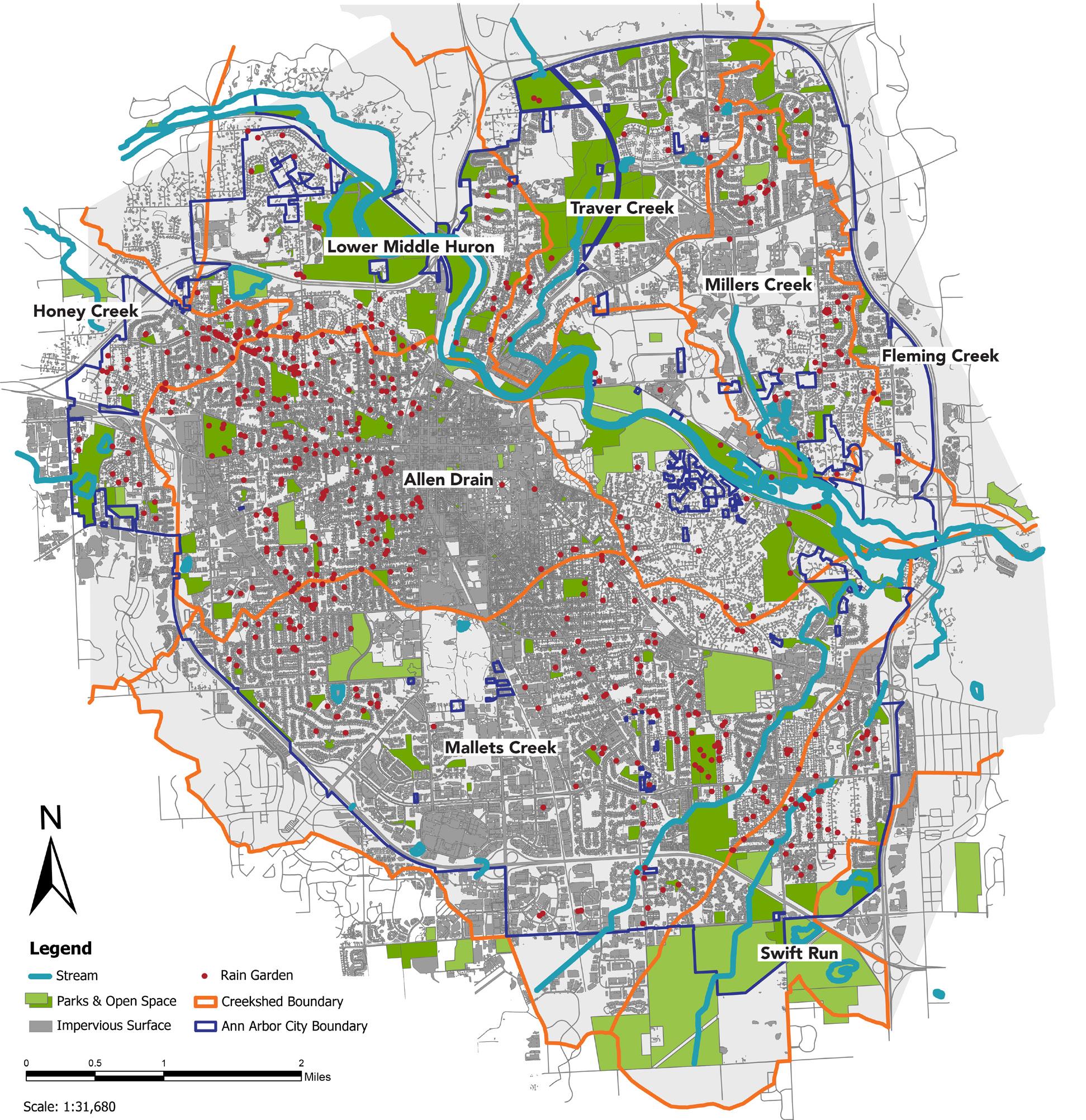
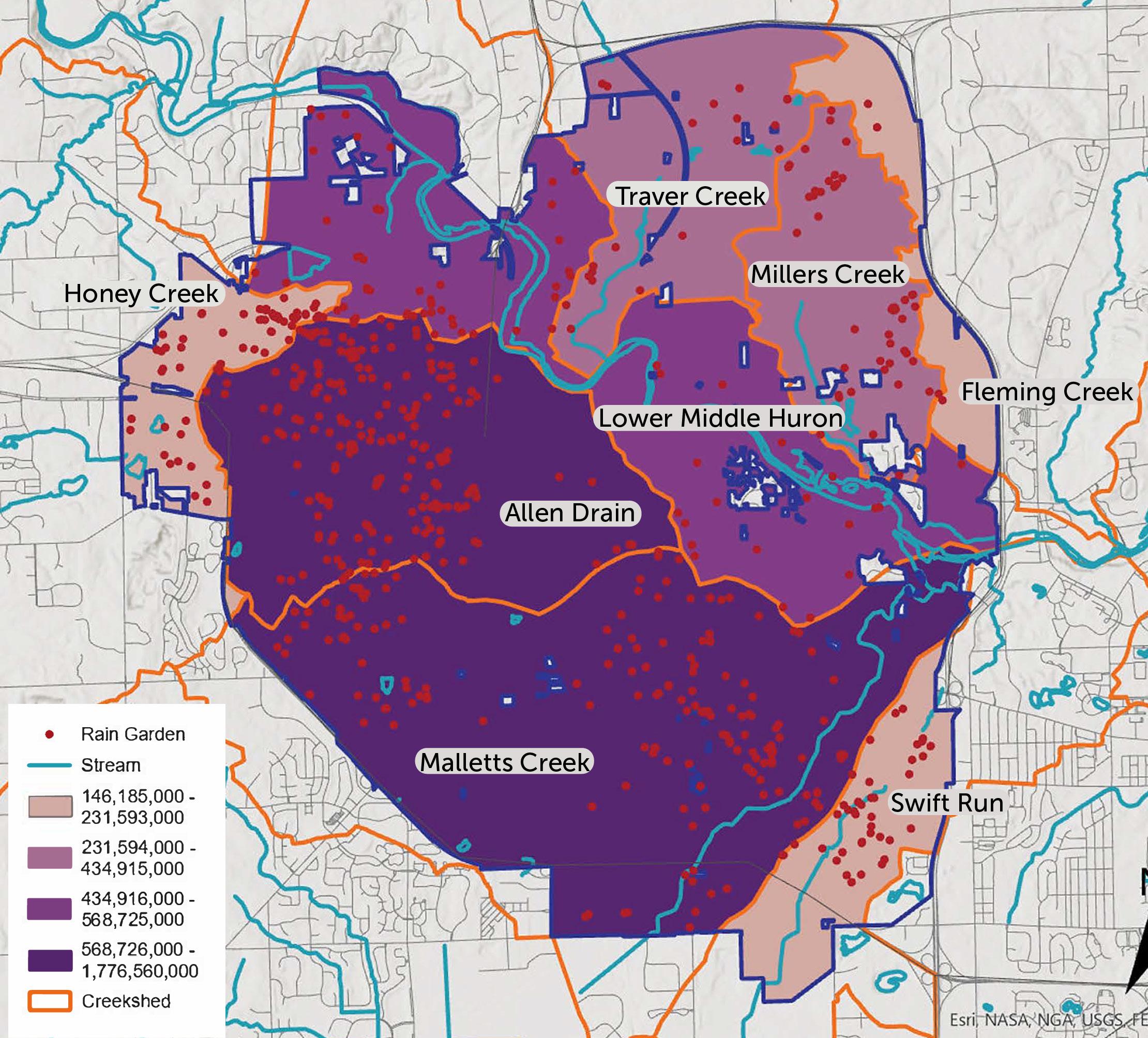
The Rain Garden Distribution by Creekshed map (Figure 6) depicts the location of each rain garden within Ann Arbor’s eight creeksheds.
Honey Creek and Allen Drain have the greatest percentages of their area zoned residential and the highest density of rain gardens in residential areas (number of rain gardens per sq. mile of residential area)(see Table 3).
Figure 6 shows where rain gardens are distributed across the city with areas of impervious surface in dark gray. The high percentage of rain gardens in Allen Drain is quite apparent as are the large areas of impervious surface in Allen Drain and Malletts Creek.
Figure 4: Rain gardens per creekshed
Figure 5: Rain gardens
square
2) Allen Drain and Malletts Creek have the greatest areas of impervious surface.
Partly due to their large sizes relative to other creeksheds (with the exception of Lower Middle Huron which is slightly larger than Allen Drain), but primarily due to land uses, Allen Drain and Malletts Creek have substantially greater areas of impervious surface relative to the other creeksheds.
Allen Drain 2.81 sq.mi. (55%)
Figure 7: Impervious surface area in each creekshed in sq. miles with the percentage of land cover in each creekshed that is impervious.
3) Fleming Creek, Honey Creek, and Swift Run have the least impervious surface area and therefore generate the least stormwater runoff, approximately 146 million to 231 million gallons of stormwater annually.
The larger creeksheds with the greatest areas of impervious surface (Allen Drain and Malletts Creek) contribute approximately 568 million to 1.77 billion gallons of stormwater annually.
The direct connection between impervious surface area and stormwater runoff volume is apparent in Figure 8. Malletts Creek is the largest creekshed at 8.6 square miles in size (area within the City of Ann Arbor boundary) and 3.58 square miles of impervious surface. Lower Middle Huron is the second largest at 6.2 square miles in land area within the city, yet it has less imper-
3.58 sq.mi. (42%)
Creek
0.29 sq.mi. (28%)
Middle Huron 1.15 sq.mi. (19%)
0.41 sq.mi. (32%)
0.85 sq.mi. (38%) Swift Run
0.47 sq.mi. (29%) Honey Creek
0.88 sq.mi. (31%) Millers Creek
8: Stormwater runoff (millions of gallons)
vious surface than Allen Drain which has 2.81 square miles of impervious surface area, which includes University of Michigan central campus and downtown in its eastern half, which contributes a significant amount of impervious surface.
Figure
Malletts Creek
Lower
Traver Creek
Table 5. Estimated stormwater runoff per creekshed with impervious surface. Totals are repeated from Table 1 to provide context for Figure 9.
9: Estimated annual stormwater runoff volume by creekshed (in gallons)
Figure
4) Allen Drain and Malletts Creek have the greatest number of rain gardens and therefore control the largest volumes of stormwater annually.
The size (volume capacity) of individual rain gardens in each creeksheds is similar enough that the number of gardens is parallel to the volume of stormwater captured in each creekshed. In other word, Fleming Creek’s three rain gardens are not so large that they can capture as much stormwater as Traver Creek’s 20 gardens.
While Allen Drain and Malletts Creek contribute the largest volumes of stormwater, they also have the greatest number of rain gardens controlling the most stormwater of all of the creeksheds. Allen Drain rain gardens capture approximately 3 million gallons annually, and Malletts Creek rain gardens capture approximately 2 million gallons annually.
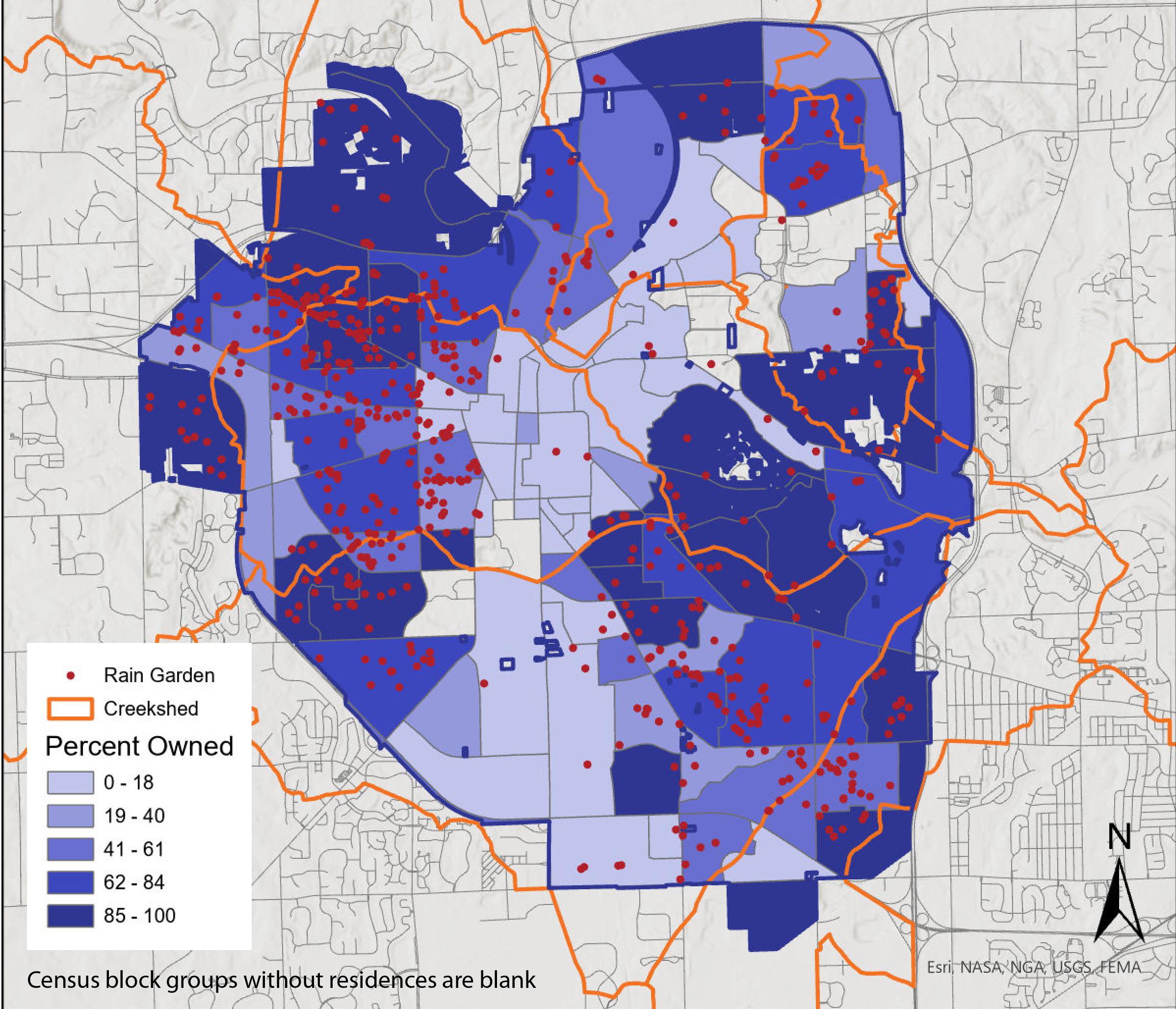
5) A greater proportion of rain gardens are located in neighborhoods with higher percentages of homes that are owned versus rented.
The residential neighborhoods with the greatest distribution of rain gardens are largely composed of single family homes, so not surprisingly, home owners are a large percentage of the rain gardener population. While rain gardens exist in both low and high home ownership areas, the distribution of rain gardens clearly favors areas where ownership is more common. This may be
Figure 10: Estimated volume of stormwater controlled by rain gardens (gallons) annually
because renters may lack either the resources and/or authority to create rain gardens when living in a rental property. Conversely, they may not want to invest the time and resources to install a garden on a rented property.
The tenure analysis highlights an important equity dimension of establishing rain gardens. Overall, rain gardens tend to be located in the areas where they are needed most based on stormwater volumes, despite being divided along socioeconomic lines. Properties without rain gardens are more susceptible to heavy rain events that can cause pooling water and basement flooding. Without the benefit of a rain garden to drain the yard, renters are at a higher risk of having to deal with water problems.
Figure 11: Housing Tenure by Census Block Group. A greater proportion of rain gardens are located in neighborhoods with higher percentages of homes that are owner-occupied. The block groups are categorized by the percent of households who own versus rent their home, with the darkest color showing 85 to 100 percent ownership and the lightest color showing 0 to 18 percent ownership.
Table 6: Rain gardens per owner-occupied housing. As the percentage of home ownership in a neighborhood (block group) increases, the number of rain gardens also increases.
Figure 12 shows that while there is only a slightly higher percentage of homes across Ann Arbor that are renter-occupied, as the percentage of owner-occupied homes in a block group increases, the number of rain gardens sharply increases.
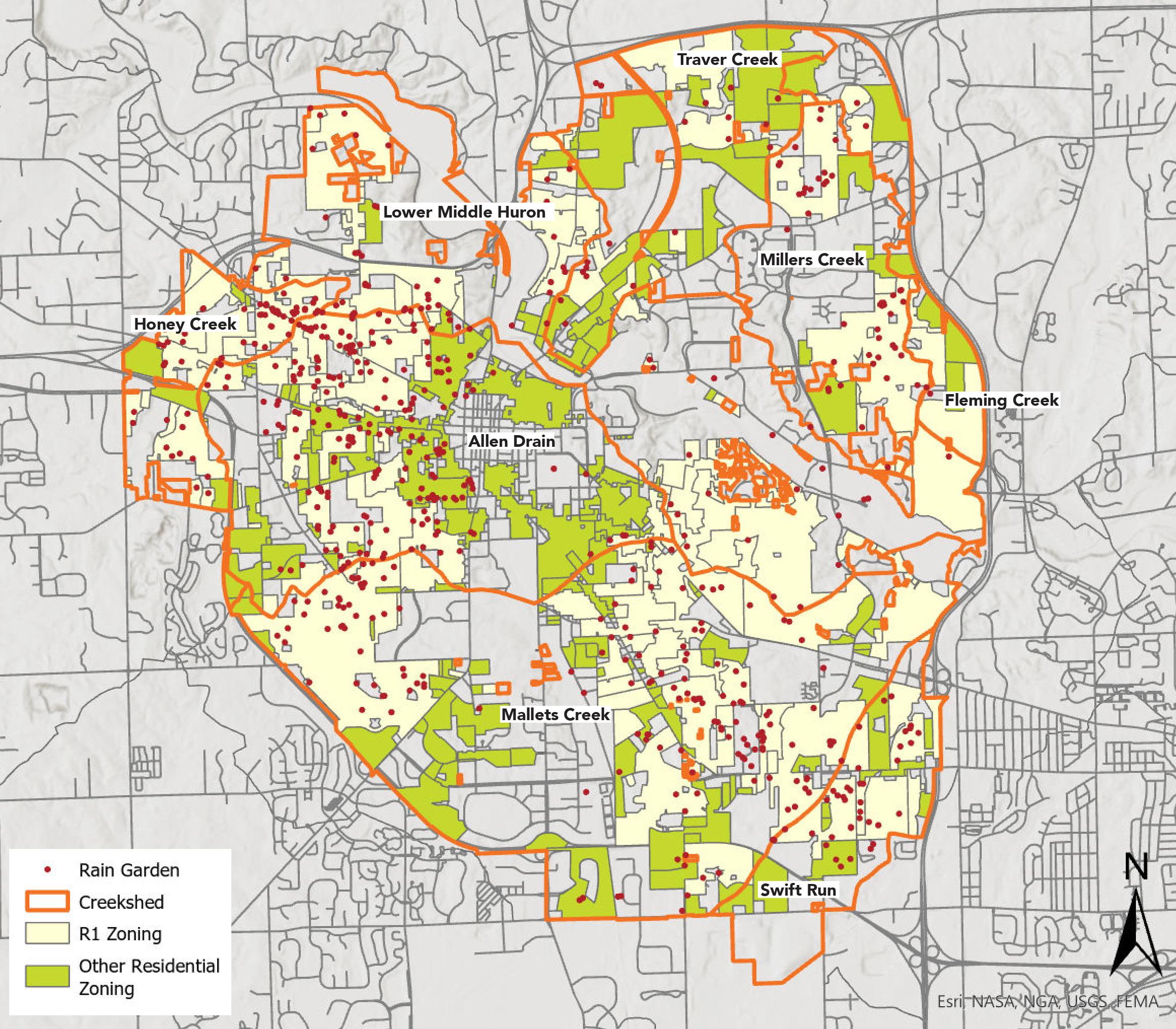
In Figure 13, there are 465 rain gardens located in R1 zones, 88 in other housing zones, and 81 outside of residential areas.
Figure 13: Residential zoning and creeksheds in Ann Arbor. R1 is single family housing.
Figure 12. Rain gardens by
3.4 LIMITATIONS
Given that this project looked only at residential rain gardens, the volume of stormwater runoff controlled does not take into account rain gardens located on university, municipal, or commercial properties, or other non-resident areas. Impervious surface areas and stormwater runoff calculations above include all properties in the city. To fully understand the extent that rain gardens are managing stormwater runoff in Allen Drain and Malletts Creek, in particular, it would be important to account for all rain gardens from those specific properties in those creeksheds.
3.5 RECOMMENDATIONS:
PRIORITY LOCATIONS FOR PROGRAM EXPANSION
The spatial analysis reveals several options for targeting program expansion efforts. Depending on the specific goals, the County or City may opt for one listed below.
Goal 1) Having the largest number of rain gardens relative to residential area:
Allen Drain, Honey Creek, and Millers Creek have the greatest number of rain gardens per square mile of residential area. Therefore, efforts to balance the distribution across the city should focus efforts on the creeksheds with the lowest density of rain gardens per residential area, which are Fleming Creek, Traver Creek, and Lower Middle Huron. (See Table 3, p. 13)
Goal 2) Having the largest number of rain gardens relative to impervious area:
Honey Creek, Swift Run, and Allen Drain have the greatest number of rain gardens per square
mile of impervious surface. Therefore, efforts to balance distribution relative to impervious surface areas should focus on creeksheds with the lowest number of rain gardens per impervious area. These are Fleming Creek, Traver Creek, and Mallets Creek. (See Table 4, p. 14)
Goal 3) Offsetting stormwater runoff in areas with the greatest water quality impairments:
Allen Drain and Malletts Creek have the greatest percentage of impervious surfaces and generate the largest volumes of stormwater runoff. Allen Drain also has the lowest Ecological Health Score of all of the creeksheds.1 (See Table 1, p. 12)
The Huron River Watershed Council identified Malletts Creek, Millers Creek, and Swift Run as priority creeksheds for installation of green stormwater infrastructure based on land use, flashy flows—the rapid rate of peak water levels and dissipation of stormwater—and water quality impairments due to phosphorus, sediments, and bacteria.2 3 4 That Allen Drain and Malletts Creek also have the greatest number of rain gardens presents an opportunity for greater social diffusion, with existing rain gardens acting as points of influence for neighbors.
1 Huron River Watershed Council, “Discover Your Creekshed.”
2 Kelly McCabe, “Creekshed Stormwater Runoff Volumes.”
3 “Chemistry and Flow Monitoring Results - Washtenaw County - Huron River Watershed Council.”
4 “Flashiness | U.S. Geological Survey.”
4. SURVEY RESPONSES
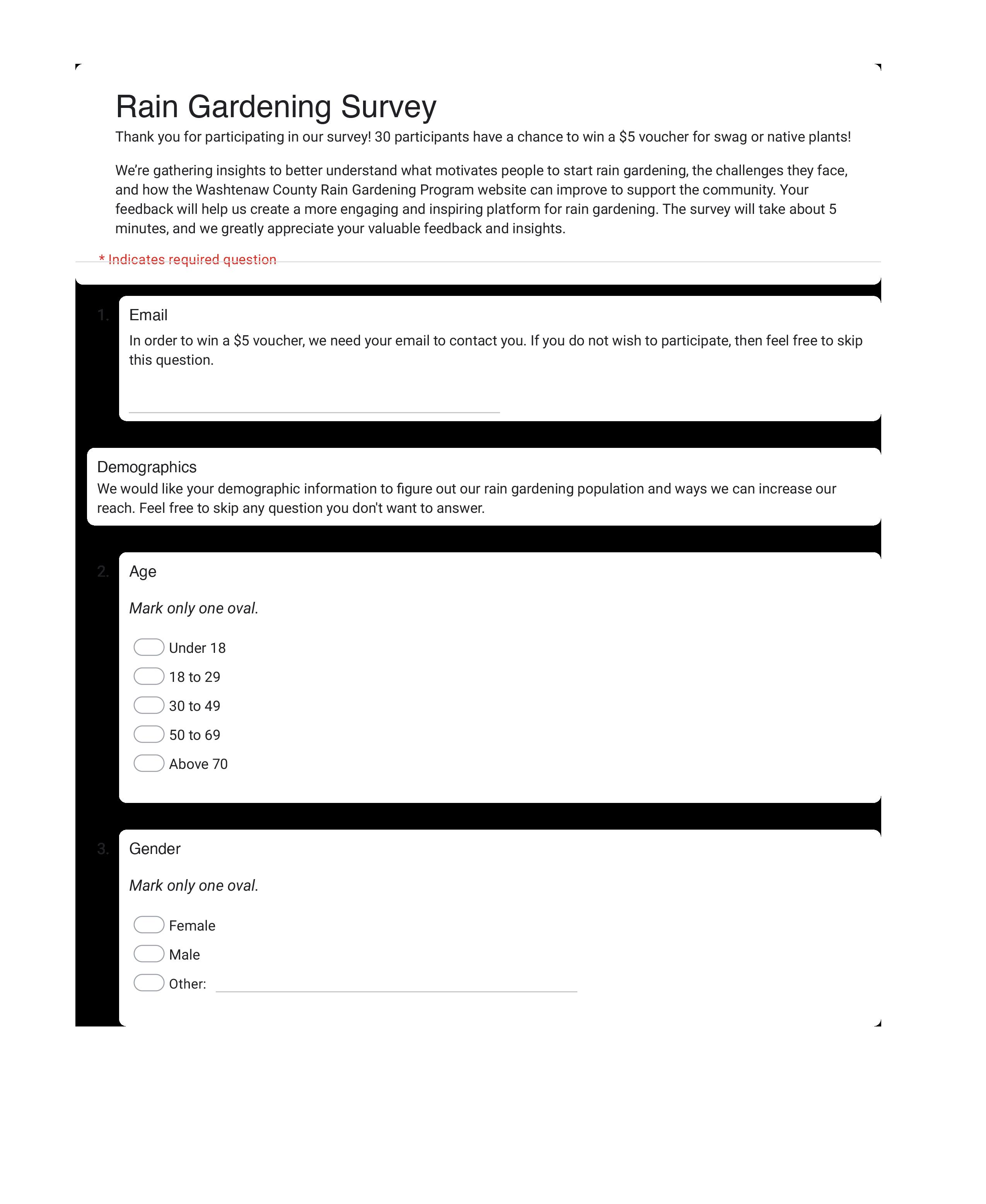
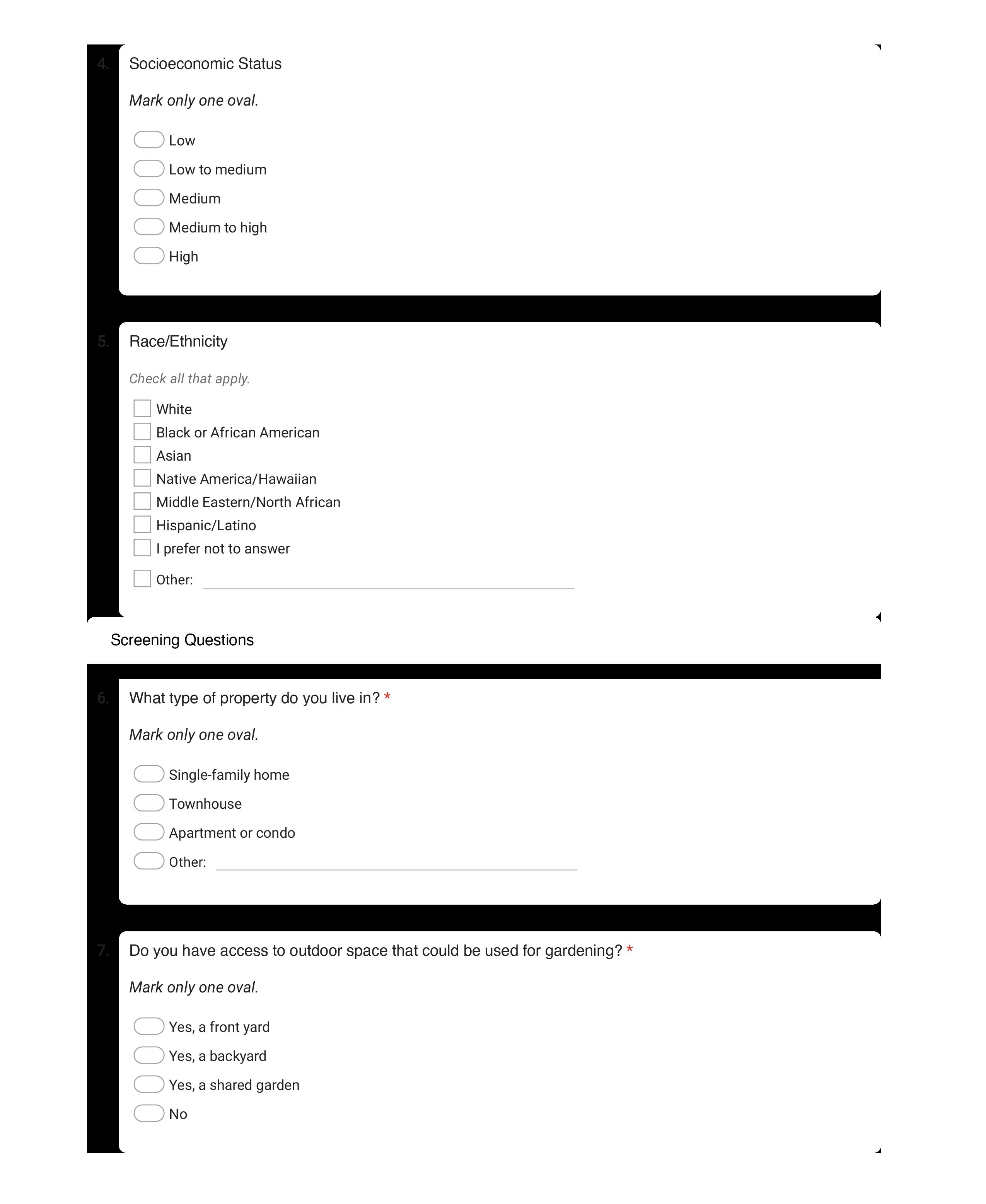
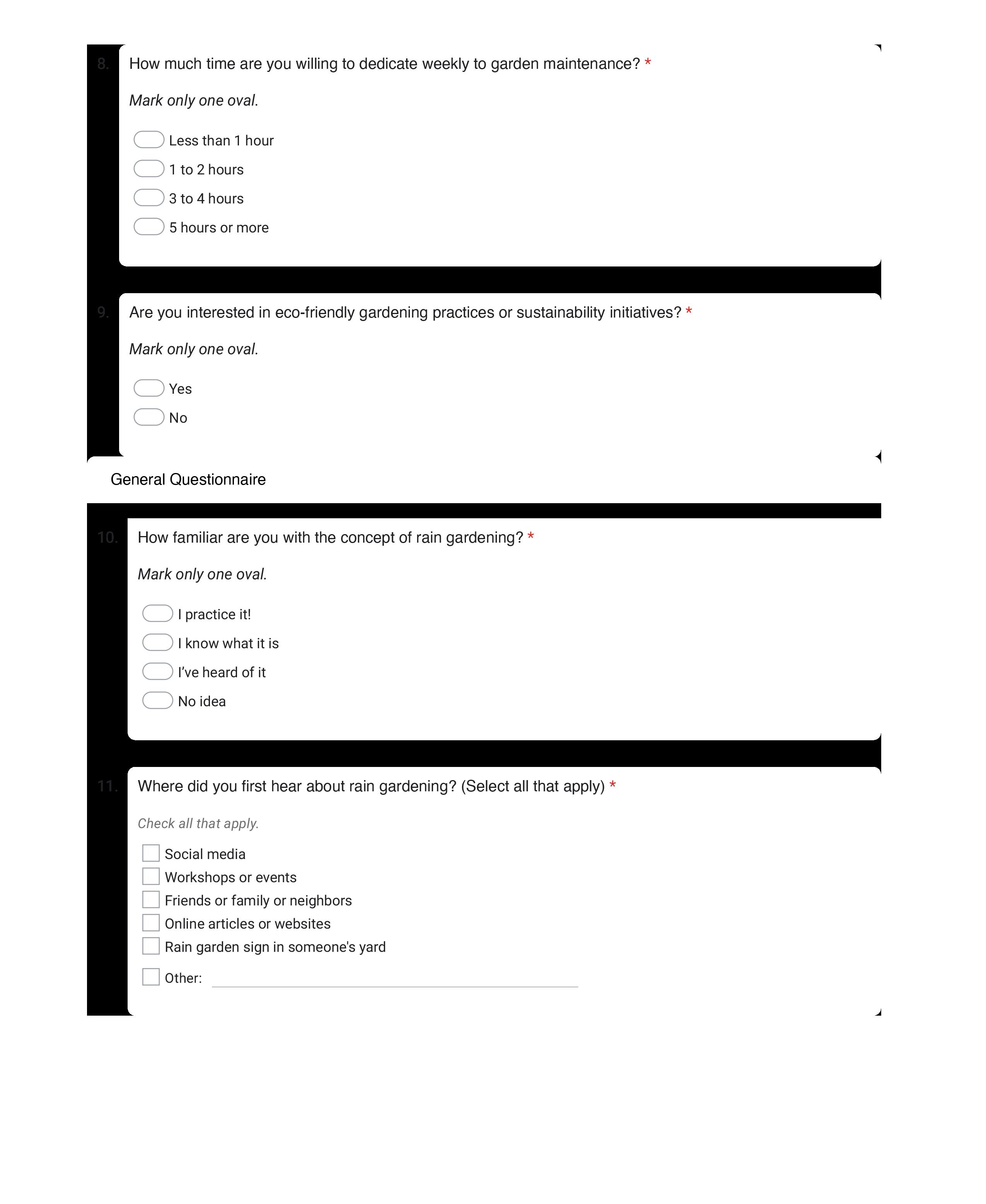
An important element of assessing Ann Arbor’s rain garden programming was to learn about the experiences of residents currently involved with rain gardening. In January of 2025, with support from the University of Michigan School of Information, the Washtenaw County Rain Gardening Program conducted an online survey of county residents who are currently rain gardening or planning to start. The survey sought to uncover what motivates people to start rain gardening, the challenges they face, and how the program can improve their website to better serve the rain gardening community.1
The 2025 survey included questions on:
• respondents’ degree of familiarity with rain gardening.
• respondents’ goals for installing a rain garden.
• obstacles respondents faced in their rain gardener journey.
• motivations for overcoming the obstacles.
• social interaction with a rain gardening community.
• basic demographic and socioeconomic data.
Assessing the survey responses formed the starting point for my qualitative research. The survey
1 “Rain Gardening Survey.”
also provided an option for respondents to provide an email address if they wanted to be added to a drawing for a promotional item. The email address was an important piece of identifying information for my later research.
SUMMARY OF JANUARY 2025 SURVEY RESPONSES
• Number of responses: 151 respondents from across Washtenaw County
• Ages: 5% are under 30, 33% are 30 to 49, 40% are 50 to 69, and 20% are over 70
• Socio-economic status: 12% of respondents are of low or low-to-medium income, 73% are medium or medium-to-high income, 11% are high income, and 4% did not respond
• Where respondents have space for a rain garden: More than 60% have space for a rain garden in the back yard and 34% in the front yard
• The amount of time respondents are willing to spend on maintenance: 61% are willing to spend between 1 and 4 hours on maintenance, 26% to spend more than 5 hours, and 13% to spend less than 1 hour
• Familiarity with the concept of rain gardening: 56% reported that they are practicing rain gardening (indicating a high degree of
familiarity), 37% know what rain gardening is, 5% have heard of it, and 1% have no idea about the concept
• How many are currently practicing rain gardening: 58% reported they are currently practicing rain gardening,2 21% are planning to become rain gardeners, and 21% are not currently rain gardening
• Duration of time that respondents have had a rain garden: 50% installed their rain garden more than one year ago, 8% between 3 and 6 months ago, and 21% do not yet have a rain garden
• Respondents’ stated goals for rain gardening:3 71% installed a garden to reduce water runoff and pollution, 64% to support wildlife, 39% to improve their yards, 25% to complete a meaningful project, 25% for a fun new gardening idea, 16% to fix basement flooding issues, and 13% to become an expert in the neighborhood.
• Respondents’ most challenging obstacles related to installing a rain garden:4 Manual labor was a challenge for nearly half of respondents (44%) due largely to age, energy levels, past injuries, or the difficulty of digging clay soils. Time availability was a challenge for 29% due to competing priorities such as young children or the overall scope of the project. Lack of knowledge was a challenge for 22%, including which plants to install and how to design a garden. The cost of plants or hiring help with manual labor was a chal-
2 Two percent (3 individuals) under-reported their familiarity on the previous question.
3 This was a closed-ended question with an option to select all that apply.
4 This was a closed-ended question with a follow-up question on the reasoning.
lenge for 17%. Lack of resources, fear of failure, and public judgment were a challenge for several others.
• Motivations for overcoming obstacles to installing a garden: Respondents expressed a range of motivations, including addressing water problems in their yards, doing good for the environment, a desire to help or attract wildlife, personal motivation to complete the project, receiving needed help or connections to other rain gardeners, or to meet a city requirement related to a building project.
• Resources that would have helped make rain garden installation easier: Nearly half of respondents (45%) reported that mentorship from experienced gardeners would have made starting a garden easier. About a third of others (33-39%) could have benefited from access to detailed guides, free or discounted materials, or expert consultation, and about a quarter (23%) could have used financial assistance to install a rain garden.
• Likelihood of joining a rain garden community or group: 68% of respondents were either likely or strongly likely to join a rain gardening community group, 31% were unlikely or strongly unlikely to join.
• Helpfulness of a Q&A section on the Washtenaw Rain Gardening website: 93% of respondents would be likely or very likely to find such a section helpful.
See Appendix 1 on page 41 for the full list of January 2025 survey questions.
5. INTERVIEWS
To build on what the County learned through the January 2025 survey, I interviewed several of the people who had responded to the survey. I conducted 24 interviews between January 23rd and February 21st, 2026. Based on interviewees’ preferences, fifteen were held on Zoom, seven were by phone, and two were in person.
My interview questions expanded on data previously collected through the 2025 survey. My goals were to uncover any nuances that might have been missed due to the structure of the 2025 survey questions, in particular related to motivations and challenges, and to gather new data on rain garden condition and functionality.
5.1 METHOD
Interview question design
The interview questions were grouped into two key areas of inquiry. First, I wanted to learn about individuals’ personal experiences and perspectives on stormwater and rain gardening. Questions addressed the rain gardeners’ motivations for installing a rain garden, their expectations of and barriers to maintenance, and their levels of knowledge about stormwater and rain gardening prior to and following installation of a rain garden. My intention was to uncover common themes amongst participants’ motivations and challenges that could be addressed through changes in the rain garden programming.
Second, I wanted to learn about the physical conditions and circumstances in each interviewee’s yard including whether the rain gar-
den has been functioning correctly (infiltrating water successfully) or whether its condition had deteriorated over time and, if so, why.1 I asked questions about the age and condition of the garden, change in diversity of plants, health of plants, struggles with invasive plants, and pooling water or soil erosion in the yard and/or flooding inside the home, comparing before and after rain garden installation.
See Appendix 2 on page 51 for a complete list of 2026 interview questions.
Subject selection
I selected interview subjects from the pool of January 2025 survey respondents who installed a rain garden within the City of Ann Arbor boundary. The survey did not ask for a physical address, so the email address provided by some was the only method available for identifying individuals and matching them to a physical address. Of the 151 survey respondents, 121 respondents had provided an email address. Using other contact lists provided by the County, I was able to match 70 of the 121 respondents to physical addresses.
I used Google Earth and ArcGIS Pro to geocode and map the 70 addresses to filter out those not located within Ann Arbor. Of these 70, 28 are located within the City of Ann Arbor boundary. These 28 potential interview subjects were distributed around the city in fairly close propor-
1 Rain garden functionality is assessed in part by the rate of stormwater infiltration. I did not perform any soil infiltration tests on participants’ rain gardens. Interviewees provided their subjective assessments of how they perceived the rate of infiltration in their gardens.
tion to the distribution of all rain gardens in each creekshed: 8 in Allen Drain, 5 in Honey Creek, 10 in Malletts Creek, 2 in Lower Middle Huron, 2 in Miller Creek, and 1 in Swift Run. There were no respondents from Fleming Creek or Traver Creek.
My initial goal was to interview only those survey respondents who had installed a rain garden at least 10 years prior. My intention was to learn how the condition of their gardens had changed over time, and if long-term maintenance was a key issue to address. However, of the 28 potential subjects, only 5 had a garden 10 or more years old.
In January of 2026, I completed the PEERRS (Program for the Education and Evaluation of Responsible Research and Scholarship) Human Subjects training and received notification of exemption from the Institutional Review Board. I subsequently sent two emails to the 28 potential interviewees to introduce the project and request an interview (the second email only to those who did not reply to the first). In total, I received 23 responses granting an interview. (I conducted a 24th interview simultaneously with an additional member of one household who provided different responses to many of the questions.) This was sufficient to meet my target of 20 to 30 interviews, so I did not need to reach out a third time or expand the pool further to contact other residents by mail. For the interview itself, fifteen preferred to meet by Zoom, seven by phone, and two in person.
Site visits
As a final element of my qualitative study design, I conducted site visits to assess the condition of each interviewee’s rain garden. During interviews, each subject granted me permission to either schedule a time to see backyard gardens, or granted me permission to see front yard gar-
dens from the sidewalk if it was not possible to schedule a site visit.
I was able to conduct 16 site visits in early March of 2026. In two cases, interviewees sent numerous photographs from the previous growing season, which served as a substitute. During my site visits, I took photos, and I also received additional photos of previous growing seasons from a few other interviewees with whom I met.
The remaining five site visits did not happen for a variety of reasons: no response to follow up requests for scheduling a time; discovering during the interview that they did not yet have a rain garden installed (though these individuals still provided valuable responses for many of the experiential questions); or having moved away from Ann Arbor since installing the rain garden.
5.2 FINDINGS
About the rain gardeners interviewed:
• Age: Most interviewed are retired or near retirement: 46% (11) are age 70 or older; 21% (5) are 50 to 69; 25% (6) are 30 to 49; and 8% (2) are under age 30.
• Prior stormwater knowledge: Prior to installing a rain garden, the median (and average) self-rated level of general knowledge about stormwater was 5 on a scale of 1 (lowest) to 10 (highest).
• Prior rain gardening knowledge: Prior general knowledge about rain gardens was lower than stormwater knowledge. The median self-rated level of general knowledge about rain gardening prior to installation was 2.8 on a scale of 1 (lowest) to 10 (highest); the average was 3.
• Master Rain Gardeners: Just under half (48%) have completed the Master Rain Gardener course, but all are involved in some way with the Master Rain Gardener program, such as receiving a newsletter or attending a plant swap.
Themes emerged:
• Dealing with water-related problems: The vast majority (86%, 19 households) had a water-related problem in their basement or yard. Only 23% (5) of these households were required by the City to install a rain garden. These percentages indicate that the City’s regulation is beneficial for motivating homeowners to install a rain garden who might not have otherwise. They also show that most households are coming to rain gardening for other reasons, independent of the City. It is important to note that the pool of interviewees were found through a connection to the Washtenaw County rain garden program, so those who have installed a rain garden under City requirements are underrepresented.
• Yard aesthetics are important, and the benefits of native plants outweigh concerns for what the neighbors think: Rain gardeners are motivated to improve the look of their yards. Several expressed awareness that native plant landscaping is still outside the cultural norm for yard appearance, yet the benefit they gain from native plants outweighs their concerns for what the neighbors think. Rain gardeners interviewed appreciate the beauty of native plants and their ability to absorb and filter stormwater. They believe that rain gardens can look as attractive as any other kind of garden, and that it is easy to build an attractive rain garden that looks like a regular landscape bed despite having a special function.
> 79% mentioned the importance of yard aesthetics either as a primary motivation or a general value.
> 83% expressed that they value native landscaping or native plants whether or not they had a water problem to fix. This included three who are directing water from the roof into a rain garden but who do not have any flooding or pooling problems.
> There is a perceived or real divide between rain gardeners and neighbors with traditional yards based on chosen landscape aesthetics, with one interviewee commenting that some may think that she is “the ‘crazy lady’ with a wild yard,” however another noted a growing awareness and acceptance of rain gardens.
> Rain gardeners shared strategies for garden design to increase their acceptance in the neighborhood, including using defined edging to create a tidier look. They also suggested putting “prettier plants” around the outside perimeter of a rain garden to appease neighbors who might think the rain garden is full of weeds. Some have installed rain garden signage in the front yard to inform neighbors.
> One interviewee has learned how to talk about the benefits of rain gardening with non-rain gardeners by talking about what the other person cares about, such as property management or reduced maintenance needs.
• Rain gardens are growing in popularity: The median age of rain gardens in the sample (5.6 years) is relatively young in relation to how long interviewees have been in their homes (median 14.5 years).
Condition, success, and functionality of rain gardens overall
The median age of the rain gardens in the sample is 5.6 years. Overall, the self-reported success of the rain gardens was rated highly, with a median rating of 9 on a scale of 1 (lowest) to 10 (highest) and an average rating of 8.1.
The question framed a rating of 10 as including a wide diversity of native plants, no dead plants, no invasive species, and continues to drain well. Interviewees noted in other questions that plant diversity has shifted towards more native plants, and comments about lower ratings tended to mentioned invasive species as the reason.
The overwhelming response was that the rain gardens are working; 100% of those who installed a rain garden to deal with water-related issues (pooling, flooding, erosion) have greatly improved or eliminated the problem entirely.
Rain garden success is illustrated by the reduction of stormwater runoff. 90% (18) gardens are either draining at the same rate or faster than when installed due to plant growth and deeper root systems absorbing water faster. Two gardens (10% of interviewees) are draining a bit slower and much more slowly than when first installed due to abundant plant density or a relatively greater depth of the garden and ability to hold more water. The low frequency of overflow also indicates well functioning gardens. The median number of times in a year that the rain gardens overflow their perimeters is zero, and
the average is less than once per year (0.6 times). Additionally, one surprising finding is that the frequency of overflow has not noticeably increased in recent years, despite the increasing severity of storms due to climate change. This indicates that the rain gardens are still correctly sized for the stormwater volumes on site.
Condition, success, and functionality of rain gardens 10+ years old
The rain gardens explored in this project are functioning very well overall. This was wonderful to discover, but it does not indicate guaranteed long-term success for gardens city-wide. Supporting existing rain gardens and gardeners to ensure they continue to function well would require less time and effort than recruiting new rain gardeners or rebuilding neglected gardens.
Of those interviewed, six installed their gardens 10 or more years ago, including one that was installed in 2016. All but one were self-rated as “very successful,” with a score of 9 or 10. All but one are draining at about the same rate or slightly faster than when installed. All except one (garden E.) have had minor to moderate plant diversity change.
Landscaping styles of the homes with gardens over 10 years old range from very natural, with a large proportion of native plants, to traditional with large areas of lawn. Interviewees have been in their homes between 15 and 30 years. Two interviewees are between ages 50 and 69, and four are over age 70.
The common themes reported by interviewees about maintaining a successful garden are adequate free time for maintenance; access to resources to hire help or family / friends / neighbors to help with maintenance; physical energy
for manual labor; and a strong personal interest in gardening. It is worth noting that there is an inherent risk of homeowners moving and new owners having no interest in maintenance.
Motivations for installing a rain garden
Understanding the motivations of existing rain gardeners can help the County or City expand or improve their programming and tailor their outreach efforts to potential new program participants.
Table 7 shows an overview of how interviewees with gardens 10+ years old described the condition of their gardens. I have added some context from my site visits.
Installed a rain garden to capture roof water and wanted wildflowers. No problems with water. Interviewee tends once per month. Small yard, all natural landscaping.
The rain garden was installed to capture roof water. Had no problems with water. Interviewee hired help for installation, is an avid gardener with free time (retired) and maintains the yard often. Also receives help on occasion from neighborhood kids. Medium size yard, no turf grass, all natural landscaping.
The rain garden is well-maintained by the interviewee (retiree) with help from family. Tends once per month.
Large yard, large area of turf grass.
Interviewee believes both gardens are too overgrown and need to be rebuilt and is not physically capable of doing so. The second garden is deeper, holds more water, drains more slowly than the first garden. Tends once per month.
Medium size yard, some turf grass.
Rain garden was installed to manage water issues. Interviewee reports that it still drains. Interviewee lacks time and energy for tending due to having a physical job. Lacks resources to hire help. Large yard, no turf, fully overgrown
Interviewee moved to a new address nearby in 2021. I saw the original garden from the sidewalk and it still contains plantings and appears to be collecting water from the roof. Very small yard, no turf grass.
F.
When asked on the January 2025 survey for their “goal with rain gardening,” reducing water runoff and pollution, supporting local wildlife and pollinators, and improving the look of their yard were the most common responses.2
• 9% (2) were mainly motivated to install a rain garden for aesthetic purposes but also solved a minor water issue as a secondary benefit.
• The remaining 14% (3) of respondents did not have a water problem and installed their rain garden entirely voluntarily to change the landscaping for improved aesthetics, to have a lower maintenance yard, to pursue an interest in native plants and attracting wildlife, or to have a more environmentally friendly yard and benefit the watershed and river water quality by promoting water infiltration.
Maintenance themes
• Those who are regular gardeners spend more time maintaining the rain garden.
During the interviews, when I asked an open-ended interview question about their motivations for installing a rain garden, the degree of necessity for installing a rain garden became clearer.
• In addition to the general consensus of wanting to do something good for the environment, 86% (19) of respondents reported they had a water-related problem.
• 54% (12) were primarily motivated to install a rain garden to manage pooling or soil erosion in the yard, or flooding in the basement.
• 23% (5) were required by the City to install a rain garden as a result of additional impervious surface on their property, the home was new construction, or to obtain a permit for a basement sump pump.
2 The survey question included an open option of “Other” but there were no responses to that category from this group.
• Those with more available time are more likely to spend time installing and maintaining a rain garden, or took on the project as a hobby.
• Those with less free time due to having children at home, or busy work and personal lives, are less likely to spend time maintaining the garden.
• Manual labor is a challenge for older respondents. Several respondents over age 70 had resources to hire help with installation or maintenance.
• The actual garden maintenance time requirements were less than or the same as what gardeners expected at the time of installation. 25% (5) reported much less time than expected, 40% (8) reported a bit less time, and 30% (6) reported the same amount of time. One person reported a bit more time than expected, and no one reported much more time than expected. The general con-
Table 8. Responses to the January 2025 survey question, "What was your goal with rain gardening?"
sensus was that once the rain garden plants were established and filled out the garden, there was little work needed in most cases.
• Overall, the amount of time that interviewees actually spend tending their gardens is similar to the amount of time they reported on the January 2025 survey that they would be willing to dedicate to tending a garden.
Challenges/barriers: Lack of knowledge, time, and physical ability as well as the presence of invasive species
The main themes related to maintenance challenges echo what was reported in the January 2025 survey:
• Lack of knowledge, such as learning plant species lessons, which are the aggressive spreaders, and figuring out the “right plant for the right place”
• Lack of time for maintenance
• Physical difficulty of manual labor, especially for the older gardeners
• Managing invasive species or aggressive spreaders
According to my interviews, cost was less of a barrier than was reported in the 2025 survey. Invasive Species
81% of interviewees reported some degree of struggle with invasive plants, either native or non-native. 24% (5) had minor problems, 48% (10) had Moderate trouble, and 9% (2) had major struggles. 19% (4) had no struggles.
Several interviewees named various problematic
invasive species, but Canada anemone (anemone canadensis) stood out as a common problem for many of those who installed their garden during the early years of the Master Rain Gardener program. At the time, Canada anemone was included in the list of recommended native plant species. It is a native flowering ground cover known to be aggressive, and several interviewees are struggling to remove it. The species has since been removed from the top 20 recommended plants. Thistle received the second greatest frequency of mentions as problematic, however respondents did not note a specific species.
Stormwater runoff from adjacent properties
While 25% of respondents (5) experience stormwater runoff from an adjacent property, it did not initially serve as a motivation for installing the rain garden. 70% (14) do not have runoff from an adjacent property, and 5% (1) were not sure if any stormwater runoff came from another property.
5.3 GARDEN CONDITION ASSESSMENT THEMES
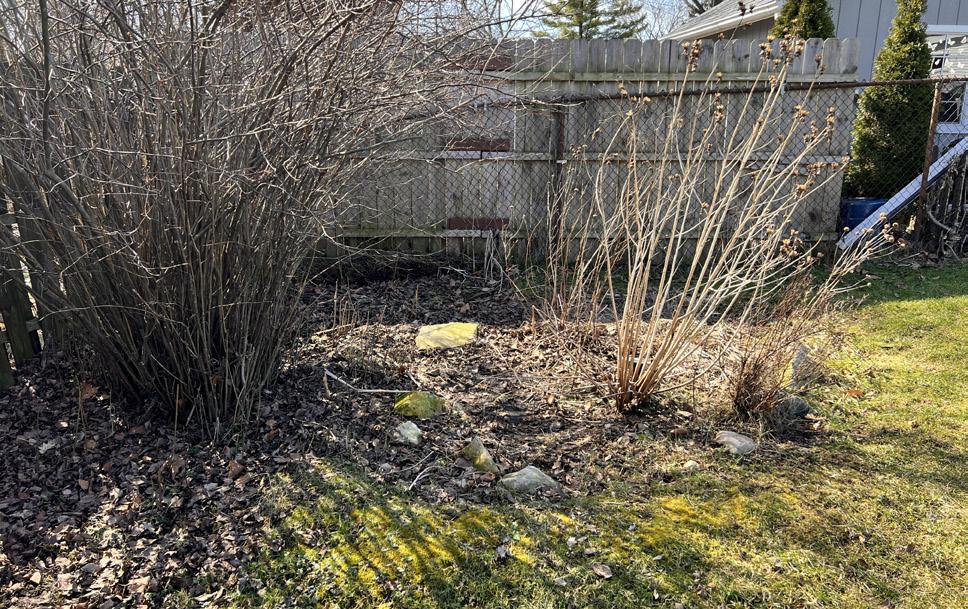
It was helpful to see the gardens to get a better understanding of the descriptions conveyed during interviews. Due to the timing of my visits in March 2026, there was a consistent density of dormant shrubs, standing dead growth and leaves from the previous growing season, or cutback plant material.
Winter maintenance behaviors reflect the goals of individual gardeners. Many preferred to leave dead plant material in place to provide habitat for nesting insects, while others preferred a more manicured look. The presence of leaf litter from a single growing season would not greatly affect drainage rates.
Overall, the apparent condition of the gardens matched the success ratings provided by interviewees (see page 26), though I did not see any gardens following a rain event to verify their assessments; all of the gardens were dry during my visits. One garden was very overgrown due to lack of time for maintenance, and was rated as a 3 for its continuing ability to drain, though the interviewee also mentioned that some of the water it collects also flows to a lower pond.
Self-reported rating: 9
Self-reported rating: 10
Self-reported rating: 9
Self-reported rating: 7
Self-reported rating: 3
I also looked at the overall landscaping and the approximate percentage of turf grass with typical small shrub plantings versus native or natural landscaping. My goal was to understand how common natural landscaping is, particularly in the front yard where it is visible to neighbors, and how rain gardens might fit within neighborhood aesthetics.
35% of interviewees yards had only native or ornamental plants and no turf grass, 40% had some amount of turf grass, and 25% had a more traditional yard with large areas of turf grass. The higher percentages with some amount of turf grass shows that a rain garden can fit with any type of landscaping, which might be beneficial information for those with traditionally landscaped homes who might assume that a yard must be fully converted to native plantings to accommodate a rain garden.
5.4 LIMITATIONS
It is important to note that the interview sample population was relatively small, and was sourced from a prior survey, so responses may not be representative of all rain gardens in the city. Additionally, conducting site visits during winter when plants were dormant did not allow for a thorough observation of the current conditions. Ideal observation times would be during summer or early fall following a large rain event.
Self-reported rating: 10 (no turf grass)
Self-reported rating: 9 (small areas of turf)
Self-reported rating: 9 (large areas of turf)
Self-reported rating: 7 (large areas of turf)
5.5 RECOMMENDATIONS: LESSONS LEARNED FROM PARTICIPANTS AND LITERATURE REVIEW
The following recommendations are derived from results of the interviews and external resources.
1) Takeaway lessons about stormwater management or rain gardens
Either through the MRG course or during their own work on their rain garden, interviewees collectively gained a wealth of knowledge from the experience of installing and maintaining a garden, and from observing its functionality. Following is a compilation of what interviewees have learned since installing their rain gardens.
• Rain garden design and functionality: Rain gardening is less complicated the more they learn about it. Interviewees found it was easier than expected to build and maintain something that is so effective at managing, absorbing, and filtering large volumes of water from intense storms or sump pumps.
• Stormwater management and use: There is now a greater awareness of neighborhood drainage issues, how water flows in the yard, how to control and direct the flow into the soil, and how to use stormwater to water the garden.
• Watershed health awareness: There is a greater awareness of the impact that stormwater has on the watershed from runoff and pollutants that can be picked up and washed from a driveway into the storm sewer. Some did not previously know that stormwater that entered storm drains flows directly to the Huron River.
Additionally, several commented on the ability of rain gardens to filter water before it reaches the river.
• Plant knowledge: Many stated that they have learned a lot about native plants, including the ability of deep root systems more common to native plants to improve drainage and increase stormwater absorption; the types and numbers of plants to install for different light and soil moisture conditions and to attract pollinators.
Others shared some lessons learned, including that the beneficial long root systems can also be a challenge, if trying to remove a plant; aggressive plants need to be divided to prevent them from taking over the rain garden.
And another shared a strategy for improving yard aesthetics of new rain gardens, which is to plant a non-invasive floral annual, such as tall zinnia, between native plants to give the garden a full look while the native plants were getting established.
• Benefits of rain gardens for wildlife: Several also mentioned the amount and diversity of wildlife that visit their yards because of the food and habitat provided by the native plantings, birds and pollinators in particular.
2) Interviewees' recommendations and feedback
What is working for rain gardeners:
• The Master Rain Gardener program and staff received high accolades overall from those interviewed who had attended the course or met with staff.
• Interviewees like the plant swaps, plant sales, and yard tours.
• The program (course) and events provide a welcoming atmosphere for newcomers.
• Interviewees appreciate the online option for MRG certification.
• The resources are useful, the plant guides in particular3
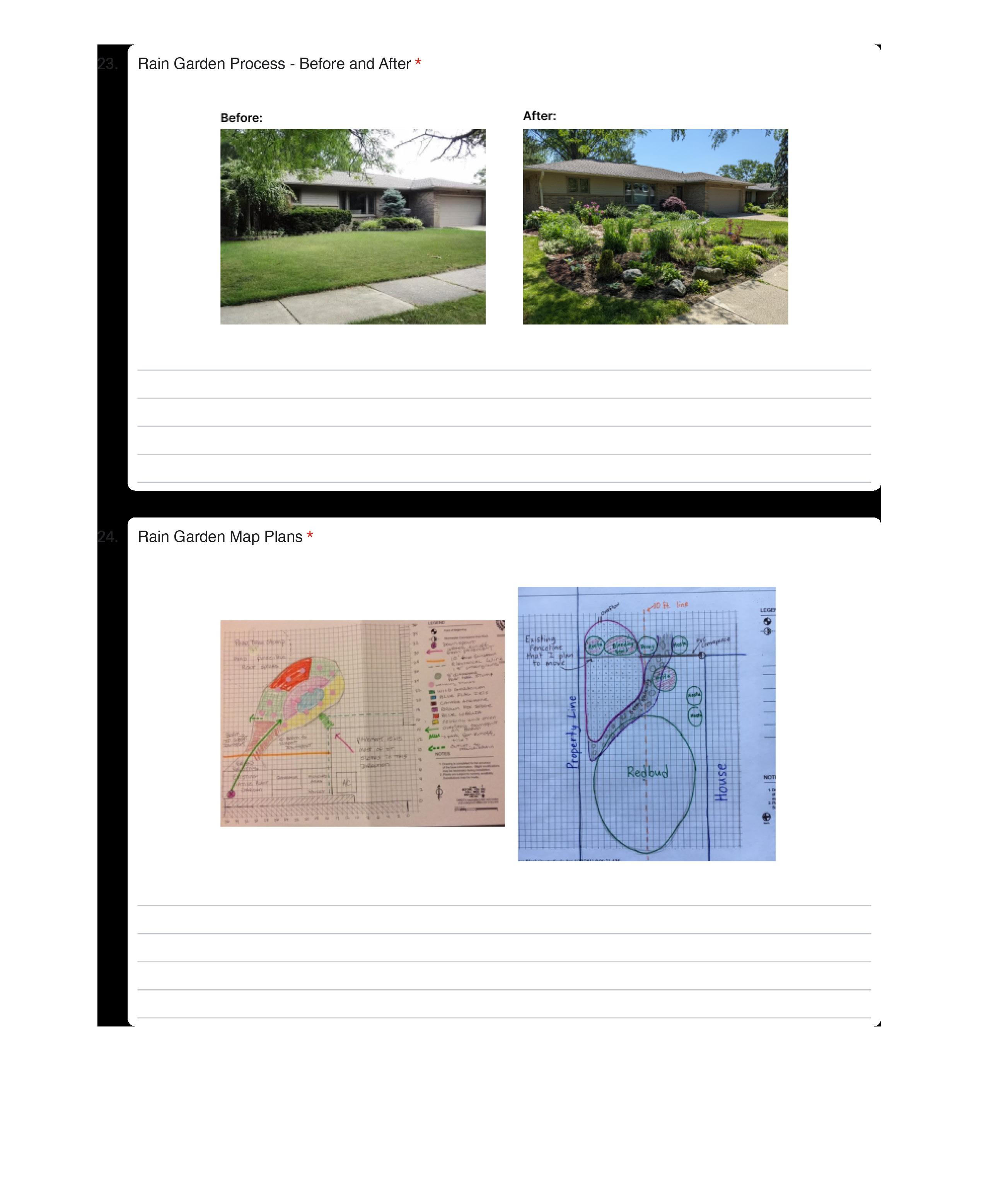
• Before and after photos are enjoyable and inspiring
Rain gardeners could benefit from:
Continuing education
• Design recommendations for variable yard heights, such as when the driveway is lower than the yard
• A general course on the difference between rain gardening and native plant landscaping
• Refresher MRG courses on specific plants or horticulture
• Bite-sized information, such as, "If you have clay soil, try these three plants."
Social, community
• Opportunities to meet and learn from other rain gardeners was a recurring theme
• New rain gardeners would benefit from having a mentorship program and a single point of contact for answering questions.
3 If the County plans to extend its plant guides, Oregon Metro's "Native plants for Willamette Valley yards" booklet may be a useful resource and model. https://www.oregonmetro.gov/ resources/native-plants-willamette-valley-yards-booklet
• Having help from volunteers for manual labor
• A rain gardener appreciation event (every couple of years) to acknowledge the work being done to manage stormwater and to meet other rain gardeners.
• Several offered to help with gardening if they were asked, especially for a new garden/rain gardener in their neighborhood
• Follow up contact and mentorship “buddies” for new, reluctant, and/or low-confidence gardeners
• Would like more interaction among neighbors who have rain gardens, for sharing plants, information, and ideas
• A cohort-based MRG program to have others to learn with and share support, and share the work through group rain garden installations. For example, the cohort installs one member’s garden each weekend until all are installed.
Ongoing benefits & resources
• Discounts at local nurseries
• Updating the landscaper list with companies willing to take on small, unique jobs
• A fall plant sale at wholesale rate with fall-plantable plants for those who got inspired over summer
Other
• Clarity on data or methods used by the City to determine the correct size for a required rain garden; better integration of County and City information for water-related permits
• A volunteer-run intake process at plant swaps to screen invasive plants and provide plant identification tags
What went wrong for rain gardeners:
• Several early MRG participants still struggle with Canada anemone (Anemone canadensis). Omission of this species has been addressed in the new MRG coursepack, so ensure that all online resources have been updated, such as partner organizations that post the handbook.4
• Ensure there is sufficient warning about aggressive spreaders in the MRG course and materials.
• Participant experience with City of Ann Arbor rain garden sizing requirements; Ensure calculation methods for rain garden size and shape are consistent between County and City’s Impervious area worksheets.5
3) Maintain rain garden effectiveness
Priority 1: Ensure ongoing maintenance of existing rain gardens.
Once a rain garden is established, it will be important to ensure that it is maintained over time, especially if there is any indication the household lacks time, resources, or dedicated interest in maintenance.
Potential strategies:
• Establish neighborhood-based teams with volunteer mentors to guide new rain gardeners. Assign younger, more physically capable members to help those who are older or less physically capable. Allocate resources, such as free plants or discounted supplies. Host bi-annual fun work events. Provide special recognition for participating households. Rotate maintenance efforts around the team’s territory.
• If possible, track the condition over time of rain gardens installed under the City’s requirement for stormwater management measures with newly added impervious surface. The requirement is a good way to establish new rain gardens, however, given that installment is only partially voluntary (other options include a rain barrel, drywell, cistern, swale, storage basin, or porous pavement), it may be a challenge to ensure the longterm success of rain gardens installed under this requirement as homeowners may not be inherently motivated to care for the garden once they receive the desired permit.6
Considerations:
• Change of home ownership is somewhat inevitable over time, yet there is no certainty that new owners will be interested in maintaining their newly acquired rain garden.
4 As of April 2026, Canada anemone still appears in the 2015 MRG coursepack found on the Friends of the Rouge DIY Rain Garden Guidance webpage: https://therouge.org/diy-rain-garden-guidance/; links to: https://therouge.org/wp-content/uploads/2018/04/Homeowners.handbook.cover_.2015.06.25_ web.pdf
5 “Impervious Area Worksheet Checklist: One and Two Family Homes.”
6 Woodward et al., “Lessons Learned.”
4) Increase program participation
Priority 1: Address barriers to entry.
Over 25% of interviewees cited cost or lack of resources as a challenge or barrier in their rain gardening journey.
Potential strategies:
• Promote the free self-paced online MRG certification course to younger and/or lower income residents. Create a scholarship program for the in-person course. Establish incentives for new course participants.
Considerations:
• The most likely population to take up rain gardening are those with adequate time (retired, empty nesters, families with independent teenagers) or with adequate resources to hire help, either for part of the project, like the hardest work of digging the trough, or from start to finish. Focusing on this well-resourced population, however, raises equity issues. Adequate resources and/or volunteer hours must also be dedicated to households with limited time and resources.
Priority 2: Increase the visibility of rain gardens for increased spatial contagion.7
To see a greater uptake in rain garden installation may require greater public awareness of the benefits of rain gardens and a normalization of native plant landscaping. There may be a real or perceived social stigma of having a “messy looking yard,” which may be a barrier for some, especially those living in traditionally landscaped neighborhoods. Attractive and functional rain gardens are the best advertisement for diffusion.
Potential strategies:
• Encourage all rain gardeners without a front yard sign to install a sign in a visible yet appealing or unobtrusive location, such as a front fence or mailbox post. To understand barriers to placing a sign, include a question in the next online survey about reasoning.
Several of those interviewed have encouraged others to install a garden but there is little knowledge that these efforts were successful. Increase the visibility of existing gardens, especially for homes with rain gardens in the backyard.
About 40% of interviewees’ rain gardens are only in the backyard and not visible from the street. Ensure there is signage visible at all times from the sidewalk for both front and backyard gardens. Messaging might indicate that the home practices rain gardening even if it is not placed in a rain garden, such as "Rain garden on site," or "This home is stormwater certified."
• Encourage back yard Master Rain Gardeners to install a second rain garden in the front yard to capture additional stormwater. Spark their interest with a new challenge: Establish criteria for certification of properties (rather than just of individuals), with tiers for different attributes. Similar to Master Rain Gardener Certification, stormwater property certification must carry responsibility. No-bar programs, such as the Pollinator-Aware Yard Care Program,8 are less likely to inspire dedicated action. See Portland, Oregon's Backyard Habitat Program for an example of a successful yard certification program.9
8 City of Ann Arbor, “Pollinator-Aware Yard Care.”
• Appeal directly to properties adjacent to and nearby to existing rain gardens with a series of attractively designed mailers that illustrate the various benefits of rain gardens, each highlighting a different benefit as the key message. Solving water problems and having a lower-maintenance (and lower cost) yard are broadly relevant motivations.
86% of interviewees installed a rain garden to deal with a water problem. Appeal to homes that are dealing with standing water, mud, or erosion due to poorly drained soils, flat terrain, high water tables, or a history of street pooling.
The expectation that rain gardens will increase property value is strongly associated with a support for rain gardens in Midwestern cities.10 A desire to attract birds and butterflies was the primary motivator for one interviewee’s neighbor to install a rain garden.
Include myth busters, such as, “Rain gardens do not host mosquitoes.” 11 Include timelimited incentives such as a large (<$150) one-time utility credit upon certified installation,12 or a tiered credit per square foot of lawn removed.
5) Maintain a record of participants’ motivations
If repeating the January 2025 survey, include question number 15 (see Appendix 1) and if they system allows, instead of providing the option to "check all that apply," require that responses be ranked in order of relevance or importance. This may help determine primary motivations. Expand the options to include exterior water problems. Additionally, some of the interview questions could be incorporated into a new survey as the length permits (see Appendix 2.)
11
12 Fomby et al., “Effectiveness of a Time-Limited Incentive on Participation by Hard-to-Reach Respondents in a Panel Study.”
10 Bahrou et al., “Factors That Drive Resident Support for Planned Rain Gardens in Urban Neighborhoods.”
Scheirer, Decreasing Mosquitoes with Stormwater Basins and Rain Gardens.
6. REFERENCES
Asleson, Brooke C., Rebecca S. Nestingen, John S. Gulliver, Raymond M. Hozalski, and John L. Nieber. “Performance Assessment of Rain Gardens.” JAWRA Journal of the American Water Resources Association 45, no. 4 (2009): 1019–31. https://doi. org/10.1111/j.1752-1688.2009.00344.x
“B25007: Tenure by Age of HouseholderCensus Bureau Table.” United States Census Bureau, n.d. Accessed April 4, 2026. https://data.census.gov/ table/ACSDT5Y2023.B25007?q=B25007&g=050XX00US26161$1500000
Bahrou, Andrew, Douglas L. Bessette, and Jeremy Brooks. “Factors That Drive Resident Support for Planned Rain Gardens in Urban Neighborhoods.” Journal of Sustainable Water in the Built Environment 10, no. 1 (2024): 05023005. https://doi.org/10.1061/ JSWBAY.SWENG-516
“Benefits of Green Infrastructure | US EPA.” Accessed September 24, 2025. https://www.epa.gov/ green-infrastructure/benefits-green-infrastructure
Chabaeva, Anna A., Daniel L. Civco, and Sandy Prisloe. Development of a Population Density and Land Use Based Regression Model to Calculate the Amount of Imperviousness. 2004.
“Chemistry and Flow Monitoring ResultsWashtenaw County - Huron River Watershed Council.” Accessed April 5, 2026. https://www.hrwc.org/ what-we-do/programs/chemistryandflow/washtenaw-results/
City of Ann Arbor. “Ann Arbor City Boundary.” Geodatabase. City of Ann Arbor, Michigan, n.d. https://data.a2gov.org/city-of-ann-arbor/ city-boundary
City of Ann Arbor. “Pollinator-Aware Yard Care.” Accessed April 5, 2026. https://www.a2gov. org/sustainability-innovations-home/sustainability-natural-resources/natural-features/pollinator-aware-yard-care/
City of Ann Arbor. “Residential Stormwater Credits.” Accessed March 13, 2026. https://www. a2gov.org/systems-planning/water-resources/ stormwater/residential-stormwater-credits/
City of Ann Arbor. “Stormwater.” Accessed April 4, 2026. https://www.a2gov.org/systems-planning/water-resources/stormwater/
City of Ann Arbor. “Stormwater Rates.” Accessed March 13, 2026. https://www.a2gov.org/ systems-planning/water-resources/stormwater/ stormwater-rates/
City of Ann Arbor Division of Assessing. “Stormwater Credits.” March 2026.
City of Ann Arbor Master Plan: Land Use Element. City of Ann Arbor, 2009. https://www.a2gov. org/media/e02froy2/land_use_plan_nov09.pdf
City of Ann Arbor, Michigan. “Ann Arbor Impervious Surfaces.” City of Ann Arbor, Michigan, n.d. Geodatabase.
City of Ann Arbor, Michigan. “Ann Arbor Non City Open Spaces.” n.d. Geodatabase. https://data. a2gov.org/city-of-ann-arbor/non-city-open-spaces
City of Ann Arbor, Michigan. “Ann Arbor Parks.” n.d. Geodatabase. https://data.a2gov.org/ city-of-ann-arbor/parks
City of Ann Arbor, Michigan. “Ann Arbor Road Centerline.” n.d. Geodatabase. https://data.a2gov. org/city-of-ann-arbor/road-centerline
City of Ann Arbor, Michigan. “Ann Arbor Zoning.” n.d. Geodatabase. https://data.a2gov.org/cityof-ann-arbor/zoning-districts
Costanzo, Mark, Dane Archer, Elliot Aronson, and Thomas Pettigrew. “Energy Conservation Behavior: The Difficult Path from Information to Action.” American Psychologist (US) 41, no. 5 (1986): 521–28. https://doi.org/10.1037/0003-066X.41.5.521
“Extreme Precipitation | GLISA.” Accessed April 4, 2026. https://glisa.umich.edu/resources-tools/climate-impacts/extreme-precipitation/
“Flashiness | U.S. Geological Survey.” April 6, 2023. https://www.usgs.gov/media/images/flashiness
Fomby, Paula, Narayan Sastry, and Katherine A. McGonagle. “Effectiveness of a Time-Limited Incentive on Participation by Hard-to-Reach Respondents in a Panel Study.” Field Methods 29, no. 3 (2017): 238–51. https://doi.org/10.1177/1525822X16670625
Hunter, Mary Carol R., and Daniel G. Brown. “Spatial Contagion: Gardening along the Street in Residential Neighborhoods.” Landscape and Urban Planning 105, no. 4 (2012): 407–16. https://doi. org/10.1016/j.landurbplan.2012.01.013
Huron River Watershed Council. “Adopt a Storm Drain.” Accessed September 24, 2025. https:// www.hrwc.org/volunteer/adoptastormdrain/
Huron River Watershed Council. “Discover Your Creekshed.” Accessed April 4, 2026. https:// hrwc.maps.arcgis.com/apps/instant/lookup/index. html?appid=e164aadaf13748b99ead5d0201ad650a
Huron River Watershed Council. “Huron Creeksheds.” n.d. Geodatabase.
Huron River Watershed Council. “Non-Point Source Pollution (Stormwater Runoff).” Accessed March 12, 2026. https://www.hrwc.org/our-watershed/threats/non-point-source-pollution/
“Impervious Area Worksheet Checklist: One and Two Family Homes.” City of Ann Arbor, Michigan, n.d. https://www.a2gov.org/media/fnab5qyo/ impervious20area20worksheet20for20residential20new20construction.pdf
“K200104: Population by Age - Census Bureau Table.” Accessed April 4, 2026. https://data. census.gov/table/ACSSE2024.K200104?t=Populations+and+People&g=160XX00US2603000&y=2024&d=ACS+1-Year+Supplemental+Estimates
Lee, Sugie, and Steven P. French. “Regional Impervious Surface Estimation: An Urban Heat Island Application.” Journal of Environmental Planning and Management 52, no. 4 (2009): 477–96. https://doi. org/10.1080/09640560902868207
McFarland, Andrea R., Larissa Larsen, Kumelachew Yeshitela, Agizew Nigussie Engida, and Nancy G. Love. “Guide for Using Green Infrastructure in Urban Environments for Stormwater Management.” Environmental Science: Water Research & Technology 5, no. 4 (2019): 643–59. https://doi.org/10.1039/ C8EW00498F
Michigan Department of Environment, Great Lakes, and Energy. “Municipal Stormwater Program.” Accessed April 4, 2026. https://www.michigan.gov/ egle/about/organization/water-resources/stormwater/municipal
“Native and Non-Native Root Comparison Chart.” Mid-America Regional Council, n.d. https:// cfpub.epa.gov/npstbx/files/KSMO_KnowYourRoots. pdf
“Rain Gardening Survey.” Washtenaw County Rain Gardening Program, January 2025.
Scheirer, Krista. Decreasing Mosquitoes with Stormwater Basins and Rain Gardens. n.d. https://lowersalfordtownship.org/media/1753/decreasing-mosquitoes-with-stormwater-basins-and-rain-gardens. pdf
Smith, Adam B. “U.S. Billion-Dollar Weather and Climate Disasters, 1980 - Present (NCEI Accession 0209268).” NOAA National Centers for Environmental Information, 2020. https://doi.org/10.25921/ STKW-7W73
Stankowski, Stephen. “Population Density as an Indirect Indicator of Urban and Suburban Land-Surface Modification.” In Geological Survey Research 1972: Scientific Notes and Summaries of Investigations in Geology, Hydrology, and Related Fields. U.S. Government Printing Office, 1972.
State of Michigan. “Hydrography Lines (V17a).” Geodatabase. n.d. https://gis-michigan.opendata. arcgis.com/datasets/f34a4c83afea4736a003e9f92bb0c6c8_2/explore
U.S. Environmental Protection Agency. “National Stormwater Calculator.” Accessed April 4, 2026. https://swcweb.epa.gov/stormwatercalculator/
US EPA, OW. “About Green Infrastructure.” Overviews and Factsheets. September 30, 2015. https://www.epa.gov/green-infrastructure/ about-green-infrastructure
US EPA, OW. “Types of Green Infrastructure.” Overviews and Factsheets. July 25, 2022. https:// www.epa.gov/green-infrastructure/types-green-infrastructure
US EPA, REG 01. “Soak Up the Rain: What’s the Problem?” Collections and Lists. August 20, 2015. https://www.epa.gov/soakuptherain/soak-rainwhats-problem
“USA Census Block Group Boundaries.” Geodatabase. ArcGIS Living Atlas of the World, n.d. Accessed April 4, 2026. https://www.arcgis.com/home/ item.html?id=2f5e592494d243b0aa5c253e75e792a4&sublayer=0
Washtenaw County. “RainScaping in Southeast Michigan.” Accessed April 4, 2026. https:// gisappsecure.ewashtenaw.org/public/rainscaping/?page=View-Everybody%27s-Projects
Washtenaw County Water Resources. “RainScapingExport.” n.d. Geodatabase.
Woodward, Mitch, William Hunt, and Wendi Hartup. “Lessons Learned: The North Carolina Backyard Rain Garden Program.” November 10, 2008, 1–9. https://doi.org/10.1061/41009(333)104
APPENDIX 1. JANUARY 2025 SURVEY
APPENDIX 2. 2026 INTERVIEW QUESTIONS
Residential Rainscaping: Analysis of Residents’ Participation in Rain Garden Programs and Stormwater Management in the City of Ann Arbor, Michigan.
Interview Questions January-February, 2026
1) How long have you lived at this address?
2) How many rain gardens are installed on your property (or on a shared condo property)? OR If you are using a shared or community garden, where is it/which one?
3) What year did you complete the installation of your rain garden(s)?
4) What were your top 3 motivations for installing a rain garden?
5) Before you installed your rain garden, did you experience floods or erosion on your property?
6) Do you experience stormwater runoff from an adjacent property?
7) Since you installed your rain garden, have you noticed a decrease in surface pooling, flooding, or erosion on your property?
8) On a scale of 1 to 10 (with 10 being the greatest) how would you rate your level of general knowledge about stormwater when you first got involved with rain gardening?
9) On a scale of 1 to 10 (with 10 being the greatest) how would you rate your level of knowledge of rain gardening before you installed your own rain garden?
10) What are three things you have learned about stormwater management or rain gardens since you installed your rain garden?
11) Please describe your involvement with the City’s or County’s rain garden programs.
- Have you attended a plant swap?
- Do you receive the Master Rain Gardener email newsletter?
- Have you participated in the Master Rain Gardener program?
- If yes, in what year did you participate in the Master Rain Gardener program?
12) On a scale of 1 to 10 (with 10 being the greatest) how would you describe the success of your rain garden? For example, a rating of 10 might include a wide diversity of native plants, no dead plants, no invasive species, and continues to drain well. A rating of 0 may indicate the garden is no longer present.
13) How has plant composition (diversity of species) changed since you installed the garden?
14) Do you struggle with any invasive plants, either native or non-native?
15) On a scale of 1 to 5, compared to when you first installed the garden, how quickly does the water drain out?
1) Much faster than when first installed.
2) Somewhat faster than when first installed.
3) About the same as when first installed.
4) A bit slower than when first installed.
5) Much more slowly than when first installed.
16) In a year, how frequently does your rain garden overflow?
17) (if yes to 16) From your experience, has the annual number of overflow occurrences increased over time?
18) How often do you tend or clean up the garden, including removing weeds?
19) On a scale of 1 to 5, how do actual garden maintenance requirements compare to your expectations at the time you installed the garden?
1) Much less than what you expected
2) A bit less than what you expected
3) About what you expected
4) A bit more than what you expected
5) Much more than what you expected
20) What challenges have you experienced, if any, with maintaining the garden?
21) Estimate how many other residents in Ann Arbor you have encouraged to install a rain garden?
22) Do you know of others in Ann Arbor who have installed a rain garden as a result of seeing your garden?
23) The Master Rain Gardener Program team would love to add new gardens to the citywide map of gardens. Do you think these other gardeners would be willing to share their address? If yes, can you provide contact information for them?
24) Do you have any recommendations for improving Washtenaw County’s rain garden programming? (Prompt if needed) Is there anything you wish you had learned that you did not learn during the Master Rain Gardener program?
Residential Rainscaping: Analysis of Residents' Participation in Rain Garden Programs and Stormwater by Taubman College of Architecture and Urban Planning - Issuu