TK63 Canton and Beyond

Page 1


TASTING KITCHEN

CANTON AND BEYOND

HONG KONG

Architects of Taste 入味之境

Structure in Every Sip 杯中岭南

MACAU

From Vision to Flavor

GUANGZHOU

TASTINGKITCHEN

CANTON AND BEYOND 63

Tasting Kitchen (TK), Asia’s epicurean lifestyle media group, leads the way to the world’s best in food and drink, art and design, and luxury travel adventures. Tasting Kitchen (TK) 是亚太地区最具前瞻性的奢华生活方式品牌 , 荟萃全球高品质的生活文化,艺术设计,以及舌尖上的梦幻美味。

Tasting Kitchen Limited • www.tasting-kitchen.com

SHANGHAI: Room H2, No 25, Lane 550 South Shaanxi Road, Shanghai • 上海市徐汇区陕西南路 550 弄嘉善老市 25 号 H2 室 HONG KONG: Units 1-2, 6/F., Oceanic Industrial Centre, 2 Lee Lok Street, Ap Lei Chau, Hong Kong • 香港鸭脷洲利乐街 2 号海湾工贸中心 6 楼 1 室 MACAU: Rua do Volong n2-a, Lazarus Verde, Rés-do-chão C, Macau • 澳门和隆街 2 号晶品艺楹地面 C 座

Mark Hammons FOUNDER & PUBLISHER

创办人兼出版人 mark@tasting-kitchen.com

Joey Cheang DEPUTY PUBLISHER

副出版人兼主编 joey@tasting-kitchen.com

Lauriane Lemaire MANAGING DIRECTOR

常务董事 lauriane@tasting-kitchen.com

Mamie Chen

Marilyn Burkley

Robert Burkley

Zita Wan

SENIOR EDITORS

资深编辑

Kate Nicholson

CONTRIBUTING EDITOR

ART AND DESIGN

特约编辑-艺术设计专栏

Regina Li

CHINESE EDITOR

中文编辑

David Hartung DIRECTOR OF PHOTOGRAPHY

摄影总监

J. Carl Kerkman, MFA

IMAGE EDITOR

图像编辑

Jin Lao

IMAGE TECHNICIAN

图像技术员

Vivian Pun

DIGITAL CONTENT MANAGER

数字媒体经理

Victoria Lei

PROJECT MANAGER

项目经理

Alicia Beebe ART DIRECTOR 艺术总监

Lucy Morgan

BUREAU CHIEF, PARIS

巴黎区编辑主管

Wilson Fok

Joyce Kwok

Julie Tu

Chris Zhang

CONTRIBUTING WRITERS

特約作家

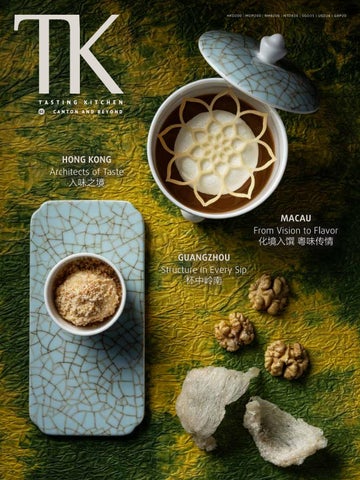
ON THE COVER

Photography by David Hartung

Executive Chinese Chef Anthony Ho of Zi Yat Heen at Four Seasons Hotel Macao presents Sweetened Walnut Cream with Bird’s Nest Glutinous Rice Dumpling, inspired by the famed sesame dumplings of Shanghai. This elegant dessert embodies “ingredient fusion and elevation” in a harmonious dialogue between textures and flavors, with silky walnut cream complementing nourishing bird’s nest wrapped in soft dumplings.

澳门四季酒店紫逸轩中餐厅 行政总厨何鑫涛的燕窝汤圆 伴生磨合桃露,受上海擂沙 汤圆启发而创作。这道精致 甜点体现了「食材的融合与 升华」 滋补燕窝包裹于软 糯汤圆之中,搭配香滑合桃 露,形成质地与口味的和谐 对话。

Elaine Wong CHIEF MARKETING OFFICER 营销总监 elaine@tasting-kitchen.com

John Ng

WINE & SPIRITS DIRECTOR

葡萄酒及烈酒总监

Phoebe Yeung

SENIOR ACCOUNT DIRECTOR

高级客戶总监

Khushee Soni MARKETING EXECUTIVE

市场营销主管

Robin Chappelle

INTERNATIONAL BUSINESS DIRECTOR

国际业务总监

GROUP ADVERTISING

广告查询 sales@tasting-kitchen.com

SUBSCRIPTIONS

订阅查询 subscriptions@tasting-kitchen.com

TRANSLATION SERVICES

翻译服务

Babel Communications jonna@babel.com.tw

PRINTING 印刷 Asia One Printing Limited 宏亚印务有限公司

Jaakko Sorsa

OCEAN TABLE EXECUTIVE CHEF OCEAN TABLE 行政总厨 jaakko@tasting-kitchen.com

Jonna Chen

ACCOUNTS MANAGER

客户经理

Natalie Fong

PARTNERSHIPS MANAGER

商务合作经理

Amber Qian

MARCOM MANAGER, MAINLAND CHINA

市场传讯经理

Eddie Cheung

EDITORIAL DIRECTOR, MAINLAND CHINA

中国内地编辑总监

©Tasting Kitchen Limited 2026

All rights reserved

Welcome to TK63, Canton and Beyond

This issue began with a collaboration with the Hong Kong Tourism Board and a simple but meaningful idea: to celebrate what makes Hong Kong memorable. Not only its great dining rooms, but also the deeper food culture that gives the city its character – its soy sauce makers, seafood traditions, roast meat masters, clay pot rice specialists, cha chaan tengs, dai pai dongs, neighborhood markets – as well as the many people who sustain its appetite for excellence.

As our team worked on this issue, what became clear was the sheer breadth of Canton’s influence. It is not a single style or a fixed tradition. It is a living culture shaped by craftsmanship, memory, discipline, and constant evolution.

In Hong Kong, that spirit appears in everyday rituals and in fine dining alike. In Macau, it takes on new form through chefs who honor Cantonese foundations while giving them fresh expression. In Guangzhou, it extends into the cocktail world, where Lingnan heritage is reinterpreted with structure, elegance, and imagination.

TK Director of Photography David Hartung spent weeks on the ground in Hong Kong with our editorial team and contributing writer Wilson Fok, helping document a city whose food identity lives as vividly in its streets and workshops as in its celebrated restaurants and bars.

From there, this issue travels further – to Hangzhou, New Zealand, Copenhagen, Kenya, Negros, and beyond – but a common thread remains: a respect for place and craft and for the people behind them.

If there is a spirit that runs through these pages, it is the spirit of Canton itself: depth without show, confidence without noise, and a belief that the finest things are built patiently, then made to look effortless.

亲爱的 TK 读者,展卷愉快。

欢迎阅读 TK 第 63 期《越 粤》。

本期始于与香港旅游发展局的一次 合作,以及一个简单而有意义的想法: 致敬香港之所以令人难忘的一切。不仅 是那些出色的餐厅,更是赋予这座城市 独特个性的深层饮食文化 酱油匠 人、海鲜传统、烧味大师、煲仔饭专家、 茶餐厅、大排档、街坊市场,以及那些 始终维系着这座城市对卓越的追求的人 们。

在制作本期杂志的过程中,我们愈 发清晰地感受到广东文化影响之广。它 不是某一种风格,也不是一成不变的传 统。它是一种由匠心、记忆、严谨和不 断演变所塑造的活文化。在香港,这种 精神既体现在日常饮食,也体现在高级 餐饮之中。在澳门,厨师们在尊重粤菜 根基的同时赋予其全新表达,让这种精 神焕发新的面貌。在广州,它延伸至鸡 尾酒的世界,岭南文化遗产在结构、优 雅与想象力中被重新演绎。

TK 摄影总监 David Hartung 与我们 的编辑团队及特约撰稿人 Wilson Fok 在 香港实地工作了数周,记录下一座城市 的饮食身份 它在街巷和作坊中的鲜 活程度,丝毫不亚于那些享有盛誉的餐 厅和酒吧。

从那里出发,本期继续远行 中 国杭州、新西兰、哥本哈根、肯尼亚、 内格罗斯,以及更远的地方 但始终 贯穿着一条共同的线索:对地方、匠艺 和背后之人的尊重。

如果书中有一种精神贯穿始终,那 便是广东的精神:深厚而不张扬,自信 而不喧嚣,相信最好的事物都是耐心铸 就,然后看起来毫不费力。

Founder and Publisher

14 Cellar to Table • 18 Lines of Descent • 22 Artistic Trajectory

26 Listening to the Past • 28 Language of the Steppe • 32 Form and Feeling

34 Architects of Taste • 78 Transformative Tastes • 82 From Vision to Flavor

Time and terroir inspire the look of Louis XIII’s Art de la Table collection. 时间与风土启发了路易十三 「餐桌艺术」系列的设计。

cellar to table

Louis XIII translates the artistry of its celebrated Cognac into a new collection of luxury dinnerware.

LOUIS XIII COGNAC has graced prestigious tables from the Château de Versailles to the Elysée Palace. This year, for the first time, the venerable maison expands into the broader dining experience with the launch of its Art de la Table dinnerware collection.

To produce two inaugural series crafted in Limoges, the Cognac maker collaborated with famed French porcelain house J.L Coquet.

“With our two collections, Soil Is Our Soul and Light of Time, the journey extends from starter to dessert,” notes Louis XIII Executive Director Anne-Laure Pressat. “Each piece is designed to echo the craftsmanship, heritage, and artistry that define Louis XIII Ultimately, we want people to feel connected to something larger than the table itself, a celebration of terroir, time, and savoir-faire.” Dubbed heirloomsin-the-making, the two series are limited to 750 individually numbered editions.

路易十三干邑曾摆放在凡尔赛宫及 爱丽舍宫的尊贵餐桌上。今年,这 个历史悠久的酒庄首次将视野拓展 至更广泛的餐饮体验领域,推出了 「餐桌艺术(Art de la Table)」餐具 系列。这家干邑生产商与法国知名 瓷器品牌 J.L Coquet 携手合作,在 利摩日制作两款首发之 作。

All pieces in Soil Is Our Soul, from teacups to dinner plates, center on origin. Thick rims feature a textured matte surface created from 3D scans of the ancient chalk earth underlying Grande Champagne, the terroir that Louis XIII is crafted from. In Light of Time, the inspiration moves from literal interpretation to transformation, with the rim of each object featuring translucent facets carved into the porcelain. “It’s a metaphor for the decades of aging that slowly reveal Louis XIII ’s distinctive amber hue,”

路易十三执行总 监 Anne-Laure Pressat 表示:「我们的两个系列『土壤之 魂(Soil Is Our Soul)』和『时光之 光(Light of Time)』,让用餐之旅 从开胃菜延伸至甜点。每一件作品 都旨在体现路易十三所定义的精湛 工艺、悠久传承与艺术美感。我们 希望人们能感受到与餐桌之外更广 阔世界的连结,那是对风土、时光 与技艺的颂扬。」这两个被誉为「未 来的传家宝」的系列,每款均限量 750 件,每套均有独立编号。

从茶杯到餐盘,「土壤之魂」 的所有作品皆以「根源」为核 心。厚实的边缘饰有哑光质感的表 面,其灵感源自对香槟区古老白垩 土 那片孕育路易十三的风土的 三维扫描。而「时光之光」系列, 灵感从具象诠释转向「蜕变」,每

酒香瓷韵

Forty J.L Coquet porcelain artisans sculpted the pieces and finished them with hand-painting.

四十位 J.L Coquet的 瓷器工匠精心雕琢作品,

The collection debuts at Singapore’s Restaurant Born, helmed by chef-owner Zor Tan. 该系列在新加坡的Born首次亮相,该餐厅由主厨兼老板Zor Tan掌舵。

says Pressat. The process of creating the pieces, sculpted by forty J.L Coquet porcelain artisans and finished with hand-painting, led to the development of new manufacturing techniques.

Art de la Table debuts in Singapore at Michelin-starred Restaurant Born, helmed by chef-owner Zor Tan. Known for his stylish French-Asian contemporary cuisine, Tan has designed an eightcourse menu to showcase the collection. “I’m lucky to have plates that help to bring out the essence of a dish,” he says. “Sometimes ingredients have to match well with the plate, but in this case, I find that the tableware enhances whatever you put on it. I want the guests to see, touch, and experience the textures from different angles.”

The narratives behind the pieces have clearly inspired Tan’s menu development. “When they sent the pieces and I touched them,” he says, “I thought, wow, they’re so delicate and elegant in both the way they’re designed and in the story behind them. I’m a big fan of storytelling – it’s something we focus on at Restaurant Born.”

Heritage and craftsmanship remain central to the identity of Louis XIII , whose history stretches back more than a century and a half. This new handcrafted collection of Limoges porcelain tableware, however, demonstrates that innovation is equally as important to the maison’s oeuvre. “The Singapore event and future dining experiences are designed to immerse guests in the narrative of Louis XIII through Art de la Table,” notes Pressat. “We expect chefs to create unparalleled sensory journeys, elevating the appreciation of Louis XIII to new heights. Following this launch, you will see us continue to extend the legacy of Louis XIII beyond the cellar through experiences, collaborations, and innovations that respect our essence while opening new horizons.”

件器物的边缘皆饰有雕刻于瓷面上的半透明切面。 Anne-Laure 解释:「这是一种隐喻,象征数十年的 陈酿时光,让路易十三独特的琥珀色光泽得以缓缓 呈现。」由四十位 J.L Coquet 瓷器工匠雕刻并以手绘 收尾的创作过程,亦促成了全新制造工艺的研发。

「餐桌艺术」餐具在新加坡的米其林星级餐厅 Born 首度亮相,该餐厅由主理人兼主厨 Zor Tan 掌舵。

Zor 以其风格独到的法式亚洲当代料理闻名,他特别 设计了一套八道式的菜单来呈现这一系列。他表示: 「我很幸运能拥有这些餐盘,它们有助于呈现一道菜 的灵魂。有时食材必须与餐盘相配,但我发现这套 餐具能让置于其上的任何食物升华。我希望宾客们 能看到、触摸到,并从不同角度体验这些质感。」

作品背后的故事显然激发了 Zor 的菜单创作灵 感。他说:「他们寄来这些作品,当我触摸它们时, 我想,哇,它们的设计方式和背后的故事都如此精 致优雅。我是故事的忠实爱好者 这也是我们在 Born 所专注的。」

路易十三的历史可追溯至超过一个半世纪前, 而传承与工匠精神始终是品牌的核心。然而,这套 全新手工制作的利摩日瓷器餐具系列亦证明,创新 对于品牌的作品体系同样至关重要。Anne-Laure 指 出:「新加坡的这次活动及未来的餐饮体验,旨在通 过『餐桌艺术』让宾客沉浸于路易十三的故事之中。 我们期待主厨们能创造出无与伦比的感官旅程,将 人们对路易十三的品鉴提升至新高度。此次发布之 后,我们将继续通过体验、合作与创新来延续路易 十三的传承,超越酒窖的界限,既尊重我们的精髓, 同时开拓新的视野。」

lines of descent

Exploring family, memory, and mastery, Hong Kong artist Hung Fai redefines traditional ink painting.

AS THE SON of celebrated traditional ink artist Hung Hoi, contemporary ink artist Hung Fai might be said to have been destined to the medium. But instead of the brush his father wields, Fai uses pens, metal rulers, watering cans, folded paper, and the side of his palm.

His solo exhibition A Veiled Revelation, which wrapped up in January at Grotto Fine Art in Hong Kong, acts, he says, as “a kind of review of my work in recent years. It includes times when I hit creative bottlenecks as well as moments of breakthrough, including a shift toward more personal themes, changes in tools, and experiments with installations that combine painting with light and shadow.”

Inviting his father into his work has been a long challenge. Hoi inspired Fai to become an artist, but the pressure was at times overwhelming. After developing his own artistic language, Fai invited his father to work with him for the first time in 2014. Today, they understand each other better, and their partnership has settled into a natural rhythm. “Over the past decade,” says Fai, “my father’s painting style has changed a lot, which has been a constant surprise to me. Collaborating as father and son is a lifelong project.”

作为著名传统水墨艺术家熊海的儿子,当代水 墨艺术家熊辉或许命中注定要与这一媒介结缘。

然而,与父亲挥舞的毛笔不同,熊辉使用的是 钢笔、金属尺、喷壶、折纸,甚至是自己手掌 的侧面来作画。

他在香港嘉图现代艺术举办的个展「显与 隐」于一月收官。他形容这次展览「是对我近 年创作的一次回顾。当中既有遇到创作瓶颈的 时刻,亦有取得突破的瞬间,包括转向更个人 的主题、工具的改变,以及结合绘画与光影的 装置实验」。

邀请父亲参与自己的创作,曾是他长久以 来的挑战。熊海启迪熊辉走上艺术之 路,但那份压力,有时亦令人难以承 受。在摸索出属于自己的艺术语言后, 熊辉于 2014 年首次邀请父亲合作。

Fai explores the relationship between inheritance and innovation in The Six Principles of Chinese Painting – Transmission XXIII, an artwork that is simultaneously a reinterpretation of Xie He’s six principles of painting ( 绘画六法 ) and a collaboration with his artist father. “Copying, or lin mo ( 临摹 ), has always held a very important place in the study of traditional painting,” notes Fai. “I adopted methods similar to tracing, but our choice of tools reveals the differences between us.” Representing a new approach to the father-son alliance, Reconstruction II involves folding his father’s dampened cinnabar landscape, filling blank areas with his paintings, and drawing dots that follow the seeping red lines.

Maze I, a nine-panel work, is an example of Fai’s ink-diffusion technique. To create the painting, he successively opened folded layers of ink-soaked and saturated xuan paper. Moving continuously around the work, he drew lines on the paper with an inkless pen and a ruler. In a modernization of the visual hierarchy found in traditional ink paintings, the mirrored segments resist a single focal point, moving instead in a clockwise, labyrinthine spiral toward a bright center.

Maze I, 2025, ink on paper, 214.5 x 214.5 cm (set of nine panels, each 71.5 x 71.5 cm)

《迷之一》,2025年,水墨纸本, 214.5 x 214.5厘米(九联屏, 每幅71.5 x 71.5厘米)

page 18

如今,他们更加理解彼此,二人的协作亦愈发 自然流畅。熊辉说:「过去十年,父亲的画风变 化很大,这常让我感到惊喜。父子之间的合作, 是一生的课题。」

熊辉在作品《绘画六法 传移摹写之 二十三》中探讨了传承与创新的关系 这既 是对谢赫「绘画六法」的重新诠释,亦是与父 亲的一次合作。熊辉说:「临摹在传统绘画的学 习中一直占据着非常重要的地位。我采用了类 似摹写的方法,但我们选择的工具,恰恰揭示 了彼此之间的差异。」《重构之二》则代表了父 子联手的崭新路径:他将父亲浸润过的朱砂山 水画对折,以自身的画作填补留白之处,再沿 着渗开的红线落笔点染。

九联作品《迷之一》是熊辉墨迹渗化技法 的范例。创作时,他反复翻开层层浸透墨汁的 宣纸折页;在作品四周游走,以无墨的硬笔与 金属尺在纸上勾勒线条。画作中的镜射区块拒 绝单一的焦点,转而以顺时针的迷宫式螺旋, 向明亮的中心盘旋推进 这是对传统水墨画 视觉层级的当代演绎。

The Six Principles of Chinese Painting –Transmission XXIII (with Hung Hoi), 2025, ink and color on paper, 80 x 179.5 cm 《绘画六法 传移摹写之二十三》 (熊海合作),2025年,水墨 设色纸本,80 x 179.5厘米

page 19

Reconstruction II (with Hung Hoi), 2025, ink and color on paper, 96.5 x 90.5 cm

《重构之二》(熊海合作), 2025年,水墨设色纸本, 96.5 x 90.5厘米

artistic trajectory

A major exhibition at M+ traces the evolution of the work of Chinese-French painter Zao Wou-Ki, from Paris in the 1940s to his later abstract breakthroughs.

TO A YOUNG ZAO WOU-KI arriving in Paris in 1948, European print practices were a freeing pursuit, a lively, unpredictable departure from the rigorous techniques of Chinese calligraphy and woodblock printing he had trained in. From lithography and etching to drypoint and aquatint, he explored it all with vigor, creating a body of work that spanned decades and directly influenced the abstract canvases

1948 年,年轻的赵无极抵达巴黎。对他而言,欧洲的 版画技艺是一种解放的追寻,与他所受训的严谨中国书 法和木版画技法截然不同,充满活力且无从预料。从石 版画、蚀刻版画,到干刻版画与飞尘法蚀刻版画,他满 怀热忱地尝试每一种技法,留下横跨数十年 的创作脉络,并直接影响了他最为人知的抽 象画作。「每一幅版画作品的创作过程,都

“The process of making every single print can be regarded as experimentation. 每一幅版画的创作过程,都可视为一场实验。” Wu Mo 武漠

for which he is best known. “The process of making every single print can be regarded as experimentation,” says Dr. Wu Mo, Sigg Collection curator at M+.

Visitors to Hong Kong’s M+ museum of contemporary visual culture can see nearly one hundred eighty of these works up close, for the first time in Asia. They were donated by the late artist’s wife, Françoise Marquet-Zao, with additional pieces from Zao’s daughter, Sin-May Roy Zao. Fifty more paintings, prints, books, and works on paper are on loan from other institutions and collections. “The turning points of Zao WouKi’s art trajectory can be clearly seen throughout the exhibition as we split the sections chronologically,” says Wu. “Encountering Printmaking” covers Zao’s earliest experiments with printmaking, “Towards Abstraction” focuses on compositions from the late 1950s, and “No Boundaries” encompasses his works from the late 1970s.

The etchings with aquatint shown on these pages, Untitled (1960) and Untitled (1963), reflect changes in Zao’s use of gesture, surface, and technical risk as his abstraction became more assertive and less descriptive. At the time, he was still exploring ideograms, a course set in motion in the 1950s through the paintings of Swiss artist Paul Klee. “Zao Wou-Ki reinterpreted ancient Chinese oracle bone script and bronze inscriptions, rendering them as abstract symbols in his compositions,” notes Wu. “Over time, these concrete symbols gradually disappeared from the imagery, transforming into light, color, and flowing lines.”

Still new to life in France, Zao frequently incorporated aspects of Chinese culture into the work, as seen in the 1963 print, where, says Wu, “the swift and decisive linear structures expressed the artist’s observations of natural forces combined with his inner state, thereby revealing the harmony and naturalness of Taoist philosophy.”

Visitors to the exhibition, on view until May 3, can engage with his process through videos, interactive presentations, and illustrative books, allowing them to, as Wu says, “understand Zao’s experimental spirit through tactile experience and different ways of seeing.”

Zao Wou-Ki, Untitled, 1960, etching and aquatint, M+, Hong Kong. Gift of Sin-May Roy Zao, 2020. Zao Wou-Ki © ProLitteris, Zurich, 2025.

赵无极,《无题》,1960年,飞尘法蚀刻版画,M+,香港。赵善美

捐赠,2020年,赵无极 © ProLitteris,Zurich,2025,M+,香港

可视为一场实验。」M+ 希克策展人武漠博士 如是说。

香港当代视觉文化博物馆 M+ 的参观 者,可以近距离欣赏近 180 件这类作品。这 些作品首次在亚洲展出,由其遗孀 Françoise Marquet-Zao 捐赠,另有一部分来自其女儿赵 善美。此外,还有五十幅画作、版画、书籍及 纸本作品,借展自其他机构与收藏。武漠说: 「展览按时间顺序划分章节,赵无极艺术轨迹 的转折点清晰可见。」「初遇版画」涵盖了赵无 极最早的版画实验;「走向抽象」聚焦 20 世纪 50 年代末的创作;而「随心所欲」则呈现 20 世纪 70 年代末以后的作品。

本页展示的飞尘法蚀刻版画《无题》 (1960 年)与《无题》(1963 年),反映了赵 无极在抽象风格日益果敢、愈发脱离具象之际, 其笔触、画面与技法冒险的演变。当时,他仍 在探索象形符号 这条路径始于 20 世纪 50 年代,受瑞士艺术家 Paul Klee 画作的启发。 武漠指出:「赵无极重新诠释了中国古代甲骨 文与青铜器铭文,将它们化为构图中的抽象符 号。随着时间的推移,这些具象符号逐渐从画 面中消失,转化为光、色彩与流动的线条。」

初抵法国不久,赵无极常将中国文化元 素融入创作中,1963 年的版画即是一例。武 漠说:「那迅捷而果断的线性结构,既表达了 艺术家对自然力量的观察,亦融合了他的内心 状态,从而展现道家哲学的和谐与自然。」

展览将持续至 5 月 3 日,参观者可通过 影片、互动展示与图录,走近赵无极的创作历 程。正如武漠所言:「透过触感体验与不同的 观看方式,观众将能体会他的实验精神。」

Zao Wou-Ki, Untitled, 1963, etching and aquatint, M+, Hong Kong. Gift of Françoise Marquet-Zao, 2024. Zao Wou-Ki © ProLitteris, Zurich, 2025. 赵无极,《无题》,1963年,飞尘法蚀刻版画,M+,香港,Françoise Marquet捐赠,2024年,赵无极 © ProLitteris,Zurich,2025,M+,香港 previous page

The hotel design features light-toned materials, including wood, natural stone, handmade bricks, textured plaster, and laminated glass.

酒店设计采用浅色系材质,包括木材、天然石材、手工砖、质感灰泥与夹层玻璃。

Bespoke furniture was designed to maximize the sense of space and guest comfort. 定制家具旨在将空间感与宾客舒适度最大化。

倾听往昔

listening to the past

Ancient architecture meets modern hospitality when B.L.U.E. Architecture Studio reimagines Yangzhou’s Jiangnan House.

THE HISTORIC CITY OF YANGZHOU is undergoing a transformation, but that doesn’t necessarily mean replacing old with new. Instead, ancient cultural heritage is being preserved in a way that resonates with twenty-first-century residents and visitors.

Jiangnan House, a newly opened property from Vanke Hotels & Resorts, encompasses numerous legacy buildings in the city’s historic center, Guangling Ancient City. Tasked with converting the structures into contemporary accommodations were several stakeholders, including Southeast University’s Architects and Engineers Co. Ltd. and Beijing’s B.L.U.E. Architecture Studio.

历史名城扬州正在经历蜕变,但这并不意味着简单 的破旧立新。相反,古老的文化遗产正以一种能与 二十一世纪的居民和游客产生共鸣的方式被悉心保 存下来。

广陵有熊酒店是万科酒店及度假 村最近推出的项目,坐落于广陵古城这 个历史城区之中,涵盖多座历史建筑。 负责将这些老建筑改造为现代住宿空间的,包括东 南大学建筑设计研究院有限公司与北京 B.L.U.E. 建 筑设计事务所等多家机构。

The B.L.U.E. Architecture Studio team leaned heavily into Yangzhou’s classical garden courtyards for aesthetic inspiration.

B.L.U.E.建筑设计事务所团队从扬州古典园林庭院中汲取美学灵感。

The hotel lobby features the original wooden framing of the former Subei Cinema.

酒店大堂保留了原苏北电影院的木质框架。

Despite Jiangnan House’s state of disrepair, the B.L.U.E. team retained its original timber frame, which now encloses a central pond and corridors inspired by Yangzhou’s classical garden courtyards. The hotel’s lobby is in the former Subei Cinema, and public areas and guest rooms are adorned with film-themed works created by local artists. “With these elements, the architecture is not a cold, physical space but a vessel where memories are kept and where mind, body, and soul connect to create meaningful moments,” notes Shuhei Aoyama, B.L.U.E.’s founder and director.

The B.L.U.E. design team was responsible for the entire hotel’s interior as well as the facades of two new buildings housing forty guest rooms and various hotel facilities, including dining venues. They continued the Yangzhou courtyard theme throughout the property, using traditional materials like bamboo- and wood-molded concrete, hand-carved stone tiles, and reclaimed gray bricks laid in contemporary patterns. “It all comes together to create a modern yet heritagerich atmosphere,” says Aoyama. “What remains constant for us is that we see renovation as a dialogue. The process is not about what we want to do but about listening to what the building has to say.”

尽管这片区域昔日年久失修,但 B.L.U.E. 团 队保留了其原始木质框架。如今,木质框架围合 出一方中央水庭,回廊蜿蜒其间,灵感正源自扬 州古典园林的庭院意境。酒店大堂落址于昔日的 苏北电影院,公共区域与客房内,则点缀着当地 艺术家创作的电影主题作品。

B.L.U.E. 创始人兼总 监青山周平表示:「通过这些元素,建筑不再是冰 冷的物理空间,而成为承载记忆的容器 让思 想、身体与灵魂相连,缔造有意义的时刻。」

B.L.U.E. 设计团队负责酒店整体的室内设计, 以及两栋新建建筑的外立面。这两栋新建筑内设 有四十间客房与包括餐饮空间在内的各项设施。 他们以扬州庭院为主题贯穿全案,使用竹模混凝 土、木纹混凝土、手凿石板,以及以当代手法铺 砌的回收青砖等传统材料。青山周平说:「这一切 共同营造出一种既现代又富有历史底蕴的氛围。 对我们而言,始终不变的是将改造视为一场对话。

这个过程不在于我们想做什么,而在于倾听建筑 本身的声音。」

The domed roof of Hotel Indigo Nalati’s entrance is reminiscent of a yurt. 酒店入口的穹顶,令人联想 起草原上的毡房。

The circular bar is inspired by the trees of the steppe. 圆形吧台的灵感源自草原树木。

草原细语

language of the steppe

From architectural concept to interior design, Hotel Indigo Nalati is at one with the rolling landscape and sweeping vistas of Ili Kazakh.

THE WORLD-RENOWNED VIEWS along the Duku Highway in China’s Xinjiang region are a priceless scenic asset that Hotel Indigo Nalati takes full advantage of. The domed roofs of the boutique resort in Nalati in Xinjiang’s Ili Kazakh Autonomous Prefecture are expertly conceived by international hotel design firm CCD / Cheng Chung Design to mimic the backdrop of undulating grassland and steep peaks, and the irregular clusters of buildings reference nomadic settlements. Indeed, for CCD CEO Joe Cheng, the most rewarding aspect of the project “was seeing diverse expertise converge into a unified vision – one where architecture, interiors, and landscape speak the same language.”

中国新疆独库公路沿途举世闻名的景致, 是无价的自然资产,而新疆华美胜地那拉 提英迪格酒店正将这份得天独厚的优势发 挥得淋漓尽致。这座精品度假酒店坐落于 新疆伊犁哈萨克自治州那拉提镇,其穹顶 建筑由国际酒店设计公司 CCD (郑中设计事务所)匠心打造, 巧妙呼应着周围起伏的草原与 陡峭的山峰;不规则的建筑群 落,则让人联想到游牧民族的聚居地。对 CCD 创始人郑忠而言,此项目最令人欣慰 之处在于「见证不同领域的专业融为一体, 成就同一愿景 让建筑、室内设计与景 观,说着同一种语言。」

Guests are surrounded by locally sourced brick, stone, and timber as they peruse menus crafted with a knowledge of local cuisine. 宾客细阅以当地饮食为特 色的菜单,四周环绕着当 地红砖、石材与木材。

Inside, the earth-toned lobby and 151 guest rooms, replete with skylights, lattice screens, and traditionally patterned carpets, take inspiration from yurts. Everything is rooted in the region’s unique seasonal color shifts using natural materials like locally sourced red brick, washed stone, and carved timber. A central hearth-like fireplace unifies the lobby, and floor-to-ceiling windows frame expansive views of the surrounding grasslands. “The goal was quiet immersion, not nostalgia,” says Cheng. The property’s F&B venues, SHOW: A Neighborhood Cafe and Bright Bar, are purposefully communal, offering menus crafted with a deep knowledge of local cuisine. The gentle curves found in walls, furniture, fixtures, and a circular bar inspired by the steppe’s trees recall

走进室内,大地色系的大堂与 151 间客房, 配以天窗、格栅屏风、传统图案的地毯,处处可 见毡房的灵感痕迹。一切皆根植于当地独特的季 节色彩变换,并选用当地红砖、水洗石与雕木等 自然材质。大堂中央的壁炉是空间的核心,而落 地玻璃窗则框起草原的辽阔景致。郑忠表示:「我 们的目标是营造静谧的沉浸感,而非怀旧的复刻 之情。」酒店的餐饮空间恰秀 邻里餐厅与光 邻 里酒吧,特意打造聚会的氛围,菜单设计亦源自 对当地饮食文化的深刻理解。墙身、家具、固定 装置,以至灵感来自草原树木的圆形吧台,都带

Guest rooms feature yurtlike lattice walls, traditionally patterned carpets, and views of grasslands, mountains, and starry skies.

客房内设有毡房风格的格栅 墙、传统图案地毯,窗外则 是草原、山脉与星空美景。

a meandering river’s edge or village paths. “We wanted guests to feel relaxed and connected, able to gather, linger, or observe.”

Of course, the project wasn’t without challenges, like long transport distances and extreme seasonal conditions inherent to the area. “This led us to innovate in masonry techniques and detailing, allowing materials to perform both environmentally and aesthetically,” notes Cheng. “The resulting textures are deeply tied to place.”

In fact, the CCD team’s work on Hotel Indigo Nalati impressed on them the importance of designing with, not against, the changing seasons and considering “how hospitality can further support ecological sensitivity and cultural continuity.”

着让人想到蜿蜒河岸或村庄小径的柔和弧线。「我 们希望客人感到放松、与此地连结,能够在此相聚、 流连,或静静观察。」

当然,这个项目也面临诸多挑战,例如长途运 输距离和当地特有的极端季节气候。郑忠指出:「这 促使我们在砌石工法与细节处理上寻求创新,让材 料既能应对环境,亦能展现美学。」最终呈现的质 感,与这片土地紧密相连。事实上,CCD 团队在这 次工作中,更加认识到顺应季节更迭进行设计的重 要性,与自然协作,而非对抗。也思考了「款待之道, 如何能进一步承载生态敏感度与文化的延续」。

翠色流光 风土之味

form and feeling

Peridot offers terroir-inspired cocktails and plant-based haute cuisine in a sensuous setting, embraced by twenty thousand points of light.

LUMINOUS WITH THE SUBTLE HUE of its namesake gemstone, Peridot, the city’s sky-high cocktail and dining destination at Summit 38 atop The Henderson, has brought the “Natural Futurism” of acclaimed design firm Studio Paolo Ferrari to Hong Kong.

Peridot’s spectacularly surreal vision of tomorrow, conceived by Paolo Ferrari as a spatial cocoon, envelops guests in its serene interplay of light, texture, and color. Walls and ceilings merge seamlessly in a continuous volume of soft green, punctuated by a matrix of numberless glowing cylinders of frosted acrylic capped with gleaming steel.

Providing a grounded counterpoint to the interior’s celestial network is a monumental bar sculpted from green marble. A striking pastel green grand piano is surrounded by accents of polished glass and steel that reflect light mesmerizingly, as sweeping views of the city shimmer across mirrored finishes.

Plush mohair seating and custom lacquered furnishings nestle in carved alcoves, romantically intimate spaces that invite lingering. Every

Peridot 是坐落于 The Henderson Summit 38 中的餐饮新地标,以名字橄榄石的含 蓄色调为灵感,将著名设计事务所 Studio Paolo Ferrari 的「自然未来主义」带到香港。

设计师 Paolo Ferrari 将 Peridot 对未来 的超现实想象化作一个茧型的空间,以光 线、材质与色彩交织出静谧韵律,包裹每 一位来客。墙壁与天花无缝融合,连绵的 橄榄绿色空间中,点缀着无数发光的磨砂 圆柱,顶部以亮面钢材收边,错落有致。

与这天际网络形成对比的,是以绿色 大理石雕琢而成的磅礴吧台,为空间注入 沉稳基调。一座柔和的淡绿色三角钢琴, 与抛光玻璃、不锈钢装饰相映成趣。光影 在镜面之间流动,城市景致亦随之跃动。

detail contributes to an atmosphere that effortlessly evolves as the natural light of day turns to the evening’s glamorous glow.

Extraordinary surroundings are matched by Peridot’s equally extraordinary cocktail and culinary offerings. The Global Terroir Cocktail Programme, curated by Director of Beverage François Cavelier, is a visionary initiative that each quarter celebrates a selected spirits-producing region, exploring its terroir and telling the stories of its makers and its drinking culture. World-renowned Argentinian chef Lisandro Illa, who began his career at famed Noma and Popl, brings plant-based cuisine to a delectably new level of sophistication. Often using complex fermentation techniques, his dishes transform familiar ingredients into new creations.

With its boldly unconventional design, terroir-inspired cocktails, and refined plant-based cuisine, Peridot weaves an unforgettable immersive dining experience.

雕刻式壁龛之中,安放着柔软的马海毛座 椅与订造亮面家具,构成浪漫亲密的角落,令人 驻足。每个细节都让空间的氛围随着日光流转; 当夜幕降临,自然光线蜕变成璀璨光芒。

非凡的空间,匹配同样非凡的调酒与美馔。 由饮品总监 François Cavelier 打造的风土鸡尾酒 系列,每季聚焦一个烈酒原产地,探索其风土人 情,诉说酿造匠人与酒饮文化的动人故事。

阿根廷名厨 Lisandro Illa 掌舵的素食佳肴,则将 植物性餐饮升华至崭新境界。他曾任职于传奇餐 厅 Noma 及 Popl,擅长运用复杂的发酵技术将 熟悉的食材化为全新创作,为食客带来惊喜。 革新破格的空间设计、风土启发的鸡尾酒 和精致的素食料理,串联成 Peridot 令人难以忘 怀的沉浸式餐饮体验。

ARCHITECTS of TASTE

As Hong Kong welcomes Asia’s 50 Best Restaurants’ awards ceremony, TK explores the city’s culinary landscape, a thriving complex of timehonored craftsmanship and bold innovation.

INTERVIEWED BY WILSON FOK

WRITTEN BY JOEY CHEANG AND ROBERT BURKLEY

PHOTOGRAPHY BY DAVID HARTUNG

THE CITY’S POSITION as a global culinary destination isn’t defined by accolades alone – it’s rooted in a profound cultural foundation built on tradition, expertise, and boundless creativity. Understanding Hong Kong’s gastronomic brilliance requires an exploration of the techniques, ingredients, and practices that comprise its culinary DNA

Hong Kong’s dining landscape thrives on contrast – where traditional recipes coexist with innovation, street food stalls operate near Michelin-starred establishments, and culinary knowledge passes through generations with meticulous attention.

What distinguishes this culinary heaven is the passionate perfectionism permeating every level of food preparation, creating a gastronomic experience that captivates both visitors and locals alike.

香港之所以成为全球美食之都,从 不仅凭奖项加冕。它的底蕴,是植 根于传统、技艺与无尽创意交织而 成的深厚文化语系。要读懂香港的 餐饮传奇,就得了解它的厨艺基因, 细探那些构成滋味的技法、食材与 匠心。

香港的饮食版图以对比与和谐 为特色——传统食谱与前卫创新并 存,街边小吃与米其林星级餐厅毗 邻,烹饪知识代代相传,精益求精。

这座美食天堂的与众不同之 处,在于那份渗透到每一道工序 的热情与完美主义,交织成一次 次让游客和本地人都为之着迷的 美食体验。

SAMANTHA SIN

传统之柱

THE PILLARS OF TRADITION

Hong Kong’s diverse culinary landscape stands on fundamental elements that have been perfected over generations. These building blocks, from the umami-rich soy sauce undergirding Cantonese cuisine to the precise steaming techniques for seafood, are among the city’s intangible cultural treasures.

香港的饮食版图由数代锤炼的基础元素支撑。

从为粤菜注入灵魂的醇厚酱油,到蒸煮海鲜分秒不差的掌火之功, 都是这座城市无可取代的无形滋味遗产。

HONG KONG’S SOY SAUCE production represents one of the city’s most important culinary traditions. Artisanal producers like Yuan’s continue creating world-class products using traditional fermentation methods that rely on natural climatic conditions and non-GMO soybeans.

The production process remains largely unchanged through generations: soybeans are steamed, mixed with wheat flour, and left to ferment in massive clay urns under the sun. This slow maturation—often taking months—develops the complex umami flavors that form the foundation of Cantonese cuisine.

From Premium Light Soy Sauce to Royal Soy Sauce, these products represent a rejuvenation of a disappearing craft that dedicated sauce artisans are striving to preserve, creating a liquid heritage that connects today’s dining experiences with centuries-old traditions.

酱油酿造,是香港最深厚的饮食传统之一。即使 时代变迁,本地酱园如颐和园,依然恪守古法, 仰赖天时,以非基因改造黄豆,酿出世界级的酱料。

生产过程几乎未曾改变:大豆经蒸煮后与麦 粉混合,置于陶瓮中在阳光下发酵,数月的时光 淬炼出那复杂深邃的鲜味,成就粤菜的灵魂底蕴。

从金标生抽到御品酱油等顶级逸品,每一滴 都是对一门濒临失传的手艺的深情复兴,更是无 数酱艺匠人倾尽全力将其保留的见证,创造了一 种液态遗产,将当代餐桌与数百年历史的传统紧 密相连。

Seafood Mastery 蒸鲜之 技

IN TRADITIONAL CANTONESE FEASTS, a whole steamed fish symbolizes completion and prosperity. With success hinging entirely on ingredient quality and precise timing, steaming remains the classic seafoodcooking method, as well as the one that is healthiest and best allows the natural umami flavor of premium seafood to shine without interference.

But, as chef Hideaki Sato of Ta Vie observes, “Hong Kong is a dynamic melting pot of cultures, and restaurants are always evolving for the better.”

This evolution extends to seafood preparation with such alternate techniques as salt-and-pepper treatment, ideal for squid, prawns, and fresh abalone. The resulting quick-fried textures showcase the superior quality of the ingredients while paying tribute to traditional methods.

在传统粤宴之上,一尾完整的蒸鱼,象征圆满与丰盛。 成败仅系于两件事:食材的优劣与时间的拿捏。蒸,既 是经典,亦是最健康的烹煮方法,能让海鲜自身的鲜味 得到最大程度的保留。

但正如 Ta Vie 旅的主厨佐藤秀明所言:「香港是一 个流动的文化熔炉,餐厅一直在发展进步。」

这种演化亦见于海鲜的烹饪技法 例如避风塘式 的椒盐风味,尤其适合鱿鱼、鲜虾和新鲜鲍鱼。这种做 法能提升口感,既彰显食材之本,亦向传统技法致敬。

The Roasting Ritual 烧味之道

CONSIDERED THE CROWN JEWEL of Cantonese cuisine, siu mei embodies Hong Kong’s culinary craftsmanship. Chinese restaurants often dedicate specialized teams of chefs skilled in selecting and marinating meat cuts before roasting them in standing ovens. Although the term literally means “roasted varieties,” siu mei encompasses not only spit-roasted meats but also includes white cut steamed chicken and soy-sauce chicken.

Among the most popular varieties is char siu, or barbecued pork, known for its iconic red color and sweet glaze. A great char siu balances lean-to-fat ratio perfectly, with charred bits along the exterior and an interior that remains juicy and tender. The sought-after pork collar butt cut provides the ideal balance for the perfect bite. This iconic preparation can be found at Michelin-starred establishments like Chai Wan’s Sun Kwai Heung as well as at notable restaurants like West Villa and Mott 32, where it’s made with premium Spanish Iberico pork.

Roast suckling pig, often the centerpiece at banquets, is typically spitroasted to produce a glossy, thin, cracklingly crispy skin. A vanishing art is the roasting of meats in underground fire pits, where whole pigs are lowered and roasted for hours, with a distinctive touch of charcoal-grilled flavor permeating the meat.

烧味,可说是粤菜中的瑰宝,亦是香港烹 饪工艺的写照。中式餐厅多设专门负责烧 味的团队,师傅们精于拣选及腌制肉料, 再将之悬挂于烤炉之中细心炙烤。烧味二 字,字面意为「烧烤之味」,实则涵盖甚 广——从明炉挂烧到白切鸡、豉油鸡,尽 在其中。

众多烧味之中,叉烧堪称经典。那 一抹嫣红与蜜色光泽,早已烙印在香港 人的集体味觉记忆里。上乘叉烧肥瘦均 匀,外层微带焦脆,内里却肉汁丰盈、 柔软可口。最令人追捧的,当属猪颈靠 肩的一块梅花肉。从柴湾新桂香烧腊这 样的米其林推荐小店,到西苑酒家、卅 二公馆等以西班牙黑毛猪入馔的名店, 皆以一碟自家叉烧,诉说着对这门手艺 的执着。

宴席之上,乳猪往往是当之无愧的 主角。明火旋烤之间,薄脆的猪皮逐渐 绽放光泽。还有一门几近失传的古法 地炉烧烤。将整猪悬入地下石炉慢烤数 小时,让肉质沁入一缕若有若无的炭香。

The Clay Pot Legacy 瓦煲之重

FEW DISHES embody Hong Kong’s culinary soul like clay pot rice. This deceptively simple dish requires extraordinary precision: expert sourcing of ingredients, thoroughly soaked rice, adequate stirring during simmering, and minimal intervention once toppings are added. The cooking process, traditionally done on inconsistent charcoal stoves rather than predictable electric ranges, demands heightened attention to detail.

The secret lies in positioning the pot at precisely the right angle so that the sides receive enough direct heat to develop the coveted crackling rice crust – a technique that requires years of practice to perfect and that masters guard closely.

若要说能承载香港饮食灵魂的,必属煲仔饭。它看似朴实,却容 不得半点将就:选食材要准,浸米要透,搅拌要恰到好处,以及 在加入配料后尽量减少干预。烹煮煲仔饭的炭火炉温度难测,变 幻不定,远非恒稳的电炉可比。而这份不可预期,更需给予更深 的专注与匠心。

真正的秘密,在于瓦煲摆放的斜度 让边缘受热均匀,才 能结出金黄香脆的饭焦。那是师傅不轻易传人的深厚技艺,也唯 有经年累月的专注,才能读懂那团火。

THE EVOLUTION OF TRADITION

“Hong Kong is constantly evolving,” says Chef May Chow of Little Bao, famed for clever riffs on classic comfort foods. “One of the great things about us is that we never forget what makes us special, and we focus on that and do better every day.”

It is precisely this dynamic tension between honoring the past and embracing the future that continues to attract global attention to Hong Kong’s vibrant food culture.

以对经典舒适料理的巧妙再诠释而闻名的小包包(Little Bao) 主厨周思薇说:「香港一直在不断变化。我们最可贵之处,在于 从不忘记那份与生俱来的独特;我们专注于此,日日精进,只 为做得更好。」

正是在这种「守」与「破」的张力之间,香港的饮食文化吸 引了世界的目光。

Cha Chaan Teng Culture

茶餐厅文化

PERFECTLY EMBODYING this dynamism is Hong Kong’s unique answer to the café – the cha chaan teng. These establishments blend casual dining with café culture by offering everything from hot and iced beverages to local bakery specialties like pineapple buns and egg tarts.

The famous cha chaan teng milk tea, recognized by UNESCO as an intangible cultural heritage, exemplifies Hong Kong’s culinary richness. This seemingly simple beverage, a blend of various black teas strained through silk stockings and enriched with evaporated milk, represents generations of refinement and meticulous precision

若要为这种动态张力寻找一个完美载体, 那便是茶餐厅。它将休闲餐饮与咖啡庁文 化融为一体,菠萝包与蛋挞并陈,冷热饮 皆备。

获联合国教科文组织列为非物质文化 遗产的港式奶茶,本身就是一部香港饮食 浓缩史。由数种红茶拼配,以丝袜茶袋冲 拉,最后注入淡奶 这杯看似简单的饮 料,沉淀着好几代人的匠心。

The Sidewalk Culinary Stage

街头烹饪剧场

DAI PAI DONGS, or open-air food stalls, represent the epitome of Hong Kong’s democratic food culture. For travelers and locals alike, these establishments offer culinary theater at its finest: flames leaping from blazing stoves, cooks demonstrating their wildly jerking wok tosses, and steam billowing as dishes are prepared in mere minutes.

The term “dai pai dong” refers specifically to a food vendor who operates under a “dai pai” license – literally a framed certificate larger than a conventional license. Though the government has retired issuance of these permits, what makes dai pai dong cuisine special is the elusive “wok hei” or “breath of the wok” – that distinctive smoky flavor achieved when ingredients are caramelized in a hot wok at precisely the right temperature.

Hong Kong’s dai pai dong scene flourishes in two main areas: a section of Stanley Street in Central, specializing in stirfries and noodle soups; and Sham Shui Po in Kowloon, where favorites like Oi Man Sang are lauded for their amazing stir-fried creations. The best dai pai dong experience involves simply strolling along, selecting dishes to share while enjoying the excitement and showmanship of skilled performers who can cook just about anything with a few quick tosses of a wok.

大排档这片户外食摊,是香港平民饮食文化的灵魂舞台。对旅客 与本地人而言,这里上演着最精彩的烹饪剧场 炉火腾跃之间, 厨师手腕翻飞,铁锅猛烈摇晃,锅中食材随之起舞;蒸汽翻涌之间, 一道道菜在短短几分钟内便新鲜出炉。

「大排档」之名,源于一种较一般牌照面积更大的「大牌」 牌照。虽然政府早已停发此类牌照,但大排档的魅力,全在那难 以言传的「锅气」 食材在高温铁锅中以精准火候快速爆炒,焦 糖化之际渗出的一缕独特烟熏香气。

香港的大排档主要集中在两个区域:中环士丹利街一带,多 以小炒与粉面为主;九龙深水埗一带则有爱文生等名店,以锅气 惊人的炒功闻名遐迩。游走其间,随意点几道菜与友人共享,看 厨师们以翻飞的铁锅变出一道道美味 那份即兴的表演与澎湃 的生命力,正是大排档最动人的风景。

The Craft Spirits Renaissance

新造酒浪潮

HONG KONG’S BURGEONING CRAFT SPIRITS scene reflects the city’s innovative spirit. Local distilleries like Two Moons and Perfume Trees Gin have gained international recognition for their distinctive botanicals that range from Chinese medicinal herbs to dried tangerine peel and local citrus fruits.

The creative energy behind these craft beverages mirrors that of the city’s restaurant scene – a continuous balancing act of pushing boundaries while respecting cultural foundations.

香港本地蒸馏酒的崛起,正是这座城 市创新灵魂的印证。致月、白兰树下 等本地酒厂,将中药材、陈皮、本地 柑橘等风土元素入酒,酿出具辨识度 的香气体系,屡获国际掌声。

这股创作能量,与餐饮界的氛围如 出一辙:突破边界之际,始终紧扣文化 的根。

风味区域 THE NEIGHBORHOODS OF FLAVOR

Hong Kong’s layered food culture manifests across a diversity of neighborhoods, each of which tells its own story. From Central to Island West to Sham Shui Po, each offers a distinct gastronomic experience that makes up an essential part of the city’s multifaceted culinary identity.

香港层次丰富的饮食文化,在不同社区各自生长、发声。

从中环到港岛西再到深水埗,每一区都提供独特的餐饮体验, 皆是这座城市味觉拼图中不可或缺的一环。

CENTRAL EPITOMIZES Hong Kong’s harmonization of tradition and innovation. Here, heritage monuments stand alongside modern architecture, creating an accessible culinary landscape where wonton noodle shops, award-winning cocktail bars, dim sum tea houses, and internationally acclaimed restaurants are all within walking distance.

The district hosts a superlative array of fine-dining establishments, from China Tang and Luk Yu Tea House to international stars like 8½ Otto e Mezzo BOMBANA, the first Italian restaurant outside Italy to earn three Michelin stars.

Central’s thriving cocktail scene has garnered global recognition, with establishments like Bar Leone, COA, ARGO, and The Aubrey regularly placing among Asia’s most celebrated bars.

中环

是香港传统与创新和谐融合的完美缩影。在这个便捷 的美食天堂,古迹与玻璃帷幕并存,云吞面店与屡获殊荣的鸡 尾酒吧、点心茶室与国际知名的米其林三星餐厅,都近在咫尺。

这里是精致餐饮的集中点 从唐人馆、陆羽茶室,到 首家在意大利境外摘下米其林三星的意式餐厅 8 ½ Otto e Mezzo BOMBANA,皆落户于此。

中环蓬勃发展的鸡尾酒文化享誉全球,Bar Leone、COA、 ARGO、The Aubrey 等酒吧常年占据亚洲最佳酒吧榜单。

Island West: From Markets to Modern Cafés

港岛西:

从干货街到精品咖啡

STRETCHING from Sheung Wan to Kennedy Town, Island West brims with fascinating contrasts. The “Seafood Street” district along Queen’s Street West to Des Voeux Road West offers vendors of Chinese medicinal herbs, dried seafood, homemade preserved sausages, rare dried mushrooms, and regional spices – all lending the area an alluring collective aromatic identity.

In Kennedy Town, a thriving café scene offers cold brews and artisanal pastries made by creative young chefs who lead the neighborhood’s evolution toward contemporary culinary expressions.

从上环到坚尼地城,港岛西是一条充满反差美学的味觉轴线。皇后街 至德辅道西一带的「海味街」,药材、海味、腊肠、菇菌、香料铺陈夹道, 空气中弥漫着独一无二的芳香印记。

而在坚尼地城,新一代年轻主厨进驻开设精品咖啡馆,冷萃咖啡、 手工糕点陆续登场 这里正以当代的语汇,谱写新的饮食篇章。

Sham Shui Po: Artisanal Haven

深水埗 :手艺聚落

AWAY FROM THE BUSTLING CITY CENTER lies residential Sham Shui Po, a district that has undergone remarkable transformation over the years.

In the early 1950s, Hong Kong’s textile and garment industries flourished, becoming leading sectors in Asia. Though these industries faded by the 1980s, Sham Shui Po evolved into a hub for handicrafts and retail shops selling fabrics, garments, buttons, and ribbons that continue to attract locals and tourists.

Walking along quiet side streets, visitors can discover workshops preserving traditional craftsmanship, where artisans create handmade leather goods and textiles using time-honored techniques. These small establishments add historical depth and artistic character to the neighborhood.

Beyond crafts, Sham Shui Po has recently become home to independent cafés nestled among textile shops, offering hand-brewed coffee in spaces with Northern European aesthetics. This blend of innovative spirit and youthful energy ensures the coexistence of coffee culture and artisanal craftsmanship for generations to come.

离开繁嚣城市中心,走进住宅区林立的深水埗。这个社区 在近年经历翻天覆地的改变。

1950 年初,香港的纺织与成衣业发展蓬勃,成为亚 洲数一数二的行业龙头。当时行业兴旺,值得关注与骄傲。

随着工业于 80 年代日渐式微,深水埗地区经历变迁,纺织 成衣业不再,但区内手工艺批发与零售店依然旺盛,当中 包括售卖布匹、成衣、钮扣、绳结等店铺,广受港人与旅 客欢迎。

深水埗社区街道两旁的小巷里,游客们能在宁静街角 的小店体会到传统的手艺传承,偶尔还能在皮革小店找到 手工缝制的小袋子与精美小物,为生活增添几分历史感与 手作艺术气息。

工艺以外,深水埗近年成为文青气息咖啡馆的聚集区 域,这些独立咖啡店在纺织旧店铺林立的街道上穿插,纯 白北欧风格的装潢、享受着手工咖啡和一刻悠闲的客人, 都为这个曾经繁华的小区添上一抹怀旧的宁静。小区中的 创新点子与年轻的风格,让咖啡文化与手艺聚落风气得以 传承下去。

永续未来

THE

SUSTAINABLE FUTURE

As Hong Kong’s food scene continues to progress, sustainability has become a central focus for many of its leading establishments.

随香港饮食格局持续推进,可持续发展已成为一线餐厅的命题。

Urban Farming Initiatives 都市耕种

URBAN FARMS are emerging throughout Hong Kong as innovative solutions to food sustainability challenges. These green spaces serve as both agricultural sites and educational platforms, offering workshops on sustainable practices and the farm-to-table journey.

Sino Group’s “Farm Together” program has established twenty-one urban farms across Hong Kong, creating over fifty-seven thousand square feet of public green space. The Hong Kong Gold Coast Hotel’s organic farm cultivates twenty varieties of crops without chemical fertilizers or pesticides. These initiatives produce healthy food and foster community engagement through farmer’s markets where local growers sell fresh produce directly to consumers, reflecting Hong Kong’s commitment to sustainability within an urban environment.

城市农场正在香港各地兴起,为食物可持续 发展提供创新解决方案。这些绿色空间既是 农业区域,也是教育平台,提供关于可持续 农业实践的工作坊。

信和集团的「一喜种田」计划已在香 港建立了二十一个都市农场,创造了超过 五万七千平方尺的公共绿地。香港黄金海岸 酒店的有机农场培育了二十多种农作物,不 使用化学肥料或农药。

这些计划不仅生产健康食物,还通过农 夫市集促进社区参与,反映了香港在都市环 境中对可持续发展的承诺。

田园至餐桌的创新

LANDMARK MANDARIN ORIENTAL’S AMBER, which holds three Michelin stars, has also transformed its conventional fine-dining approach into a sustainability-driven concept under the guidance of culinary director Richard Ekkebus. The reinvented restaurant has significantly reduced its carbon footprint by showcasing fresher flavors from produce sourced from neighboring regions.

置地文华东方酒店的 Amber 拥有三颗米 其林星,在厨艺总监 Richard Ekkebus 的 主导下,从传统精致餐饮转型为以永续发 展为导向的理念。新生的 Amber 透过选 用邻近地区的新鲜食材,大幅降低碳足迹。

CHEF SIMON ROGAN’S ROGANIC, awarded both a Michelin star and a Michelin Green Star, underscores its commitment to sustainability. Following its relocation to Lee Garden One in Causeway Bay, the restaurant continues to maintain its sharing menu format highlighting locally grown vegetables and herbs, while its zero-waste ethos remain intact.

Simon Rogan 主厨的 Roganic 荣获米其林一星及绿星认 证,餐厅完美展现对可持续发展的坚持。自搬迁至铜锣 湾利园一期以来,这间餐厅持续采用共享菜单的形式, 精选本地蔬菜与香草,并始终坚持零废弃的环保理念。

CHEF DAVID TOUTAIN’S debut in Hong Kong focuses on the life cycle of plants, introducing diners to unexpected forms and flavors. With seasonal, vegetable-forward tasting menus, Feuille follows a philosophy both culinary and ecological.

David Toutain 主厨在香港的首家餐厅 Feuille 围绕「大 自然植物的生命周期」这一主题展开,为食客们带来 了前所未有的食物形态与风味体验。餐厅提供以时令 蔬菜为主的品味菜单,彰显了其融合美食与生态理念 的烹饪哲学。

AT ONE-MICHELIN-STAR MORA, founder-chef Vicky Lau is reducing foreign imports by maximizing the potential of soybeans. Moving beyond conventional tofu and soy milk, Lau elevates this humble ingredient by creatively incorporating soy-based products into her dishes and even into lifestyle items like soy candles.

米其林一星餐厅 Mora 的创办人兼 主厨刘韵棋,以大豆为载体,拓展 本地食材的边界。她跳脱豆腐、豆 浆的传统框架,以创意将大豆转化 为菜肴乃至大豆蜡烛等生活物件, 降低对进口食材的依赖。

THE ESSENCE OF HONG KONG’S APPEAL

What makes Hong Kong’s food scene special is the passionate community behind it, from traditional sauce makers and innovative mixologists to dai pai dong masters and visionary chefs.

构成香港饮食风景的,是背后那一群满腔热忱的人 世代传承的 酱油匠人、创意无边的调酒师、大牌档里烟火中挥锅的师傅。 香港风味之本

THIS SOCIAL ESSENCE – bringing people together through extraordinary food experiences – remains the heart of Hong Kong’s appeal as Asia’s ultimate dining capital, a destination where cultural heritage and unbounded innovation continuously interact to create delicious new flavors.

这种社交本质 以非凡的美食 体验将人们聚集在一起 始终 是香港作为亚洲顶级美食之都的 魅力所在。在这里,文化传承与 无界创新不断对话,交织出崭新 而动人的风味。

“Everybody wants to come and eat, everyone travels to Hong Kong for food, not just Cantonese, but also French, Italian, and the best bars in the world.

人人都为吃而来到香港 不 只粤菜,还有法菜、意菜, 以及世界顶尖的酒吧。”

VICKY CHENG 郑永麒 VEA & WING VEA 及永

“Hong Kongers are curious and keen to explore novelty in cuisine, with full appreciation of our multiculturalism.

香港的食客充满好奇, 勇于探索味蕾的未知 领域,也很欣赏本地 餐饮的多元文化。”

UMBERTO BOMBANA

8½ OTTO E MEZZO BOMBANA

“Hong Kong is a dynamic melting pot of cultures. Its reputation as a capital of top gastronomy is internationally known, and restaurants are always evolving for the better.

香港是一座流动的文化熔炉, 东西交汇、新旧交融。其作为美 食之都的美誉早已远播国际, 这里的餐厅仍在不断演化”

GUILLAUME GALLIOT

“What keeps me buzzing is the passion and inspiration that pops up around every corner. There are no boundaries for creativity.

这座城市最让我着迷的, 是处处涌动的热情与灵感。

创意从来都没有边界。

ANTONIO LAI

QUINARY & THE OPPOSITES

“Hong Kong is as diverse as a city can be. Hong Kongers love all food and keep developing ways to refine their taste for cuisine.

香港是一座极多元化的城市。

香港人热爱各种美食, 并且不断探索提升自身 美食品味的方法。”

ADAM WONG 黄隆滔 FORUM RESTAURANT 富临饭店

“Hong Kong’s bar scene is one of the best in Asia. What’s unique is that there are so many bars concentrated together in one area and the scene is very international, just like the city itself.

香港的酒吧文化,堪称亚洲顶 尖。最独特之处,在于众多 风格各异的酒吧汇聚于方寸 之间 整片区域非常国际 化,一如这座城市本身。”

SHINGO GOKAN 后闲信吾 GOKAN

“Hong Kongers live to eat, deep dive into expertise and traditions, and establish the city as a melting pot of food cultures.

香港人「为食而生」 他们钻研技艺、深究 传统,将这座城市塑造成一个饮食文化熔炉。”

MAY CHOW 周思薇

LITTLE BAO 小包包

“The can-do attitude of HK-ers is instrumental in ensuring maximum efficiency and promoting the city as a global culinary destination with great restaurants and bars. We always stay ahead of the curve.

香港人那股「凡事皆可能」的劲头, 是保持高效率的关键,也让香港得 以成为顶尖餐饮目的地 这里的 餐厅与酒吧,始终走在时代前端。”

“The most important thing about Hong Kong is that people really appreciate cuisine and are motivated to fuel their passion by eating out.

在香港,最可贵的是人们真正懂得 欣赏美食,并且乐于用每一次外 出用餐,滋养对味道的热忱。”

HIDEAKI SATO 佐藤秀明

“Cantonese cuisine really resonates with me. I’ve learned so much more about the food, and I also get to work with independent purveyors, like local farms and tea houses, in creating my cocktails.

粤菜与我有一种共鸣。我从中 学会的不只关于美食,更学会 了与那些独立匠人合作 本 地农场、老字号茶庄 将他 们的故事调进我的鸡尾酒里。”

LORENZO ANTINORI BAR LEONE

“Hong Kong is a highly developed culinary destination. It stands out by offering an unparalleled variety of live seafood and the best fresh produce from both East and West.

香港是顶尖美食之都,游水海鲜选 择丰富,东西方顶级时鲜应有尽 有 这份丰盛,世间少有。”

DANNY YIP  叶一南 THE CHAIRMAN 大班楼

COURTESY OF THE CHAIRMAN

“Hong Kong is positioned as one of the best, most sophisticated cities in the world. Its international reputation has been shaped by its desire to continue polishing and refining in a quest for perfection.

香港是世界上最顶尖、最成 熟的城市之一。这座城市的 国际声誉,来自那份不断 打磨、精益求精的精神。”

THERESA MAK 麦丽敏 DASHIJIE 大师姐

“It’s the community spirit and collective work that form Hong Kong’s heritage.

正是这种社区精神与集体努力, 塑造 了香港的文化传承。”

JAY KHAN COA

Yellow Croaker Meat Dumpling with Brown Croaker Fish Maw

transformative tastes

Hennessy celebrates the exciting Year of the Fire Horse by pairing three of its illustrious cognacs with the Michelinstarred cuisine of Yong Fu Hong Kong.

PHOTOGRAPHY BY

AN EXCEPTIONAL food and wine pairing goes beyond simple harmony between glass and plate. Transcending mere enhancement of flavor, it can raise the act of dining to the level of a cultural experience. This year, Hennessy’s ongoing pairing explorations take a bold step in this direction as the famed French cognac house, with a presence in the Chinese market of more than one hundred sixty years, reveals its intimate understanding of the lunar calendar’s significance.

In 2026, with the once-every-sixtyyears arrival of the fire horse or bing wu, the heavenly “bing” fire burns with solar intensity, inspiring the earthly “wu” horse to spur transformation. To mark the momentous occasion, Hennessy unveiled The Horse Edition.

It also partnered with Yong Fu Hong Kong, celebrated for its distinctive Ningbo cuisine, to curate the Start of Spring Banquet. In this collaboration, Hennessy was set to surpass its roles as libation and collectible art, becoming an emblem of the union of Chinese and Western aesthetics.

Yong Fu Hong Kong General Manager Yu Qiong, with her deep understanding of Ningbo’s culinary heritage, saw the restaurant’s venture into pairing Hennessy with Ningbo cuisine as a logical progression: “Archaeological finds at the Hemudu culture site reveal that Ningbo’s relationship with fermented spirits dates back more than seven thousand years.” Executive Chef Liu Zhen believes that Hennessy’s rightful place at a Ningbo banquet is also attributable to the cuisine’s evolution over the past three decades: “A new wave of passionate, creative chefs on China’s culinary scene has allowed modern Ningbo cuisine to keep its essence while embracing a more innovative approach.”

Chef Liu crafted ten courses to accompany three selected Hennessy cognacs. In creating truly memorable pairings, his considerations went beyond mere flavor compatibility to achieving conceptual resonance.

The menu opened with an assortment of five cold appetizers paired with Hennessy V.S.O.P, whose fragrant sweetness and supple texture provided complementary

Claypot Braised River Eel Rice paired with Hennessy X.O
X.O

notes. The dish’s ingredients, including wind-cured eel and salted crab, require timeconsuming techniques like curing and air-drying that echo the centuries of inherited craftsmanship behind Hennessy V.S.O.P. James Hennessy, an exceptional blend that pays tribute to one of the House’s pioneering figureheads, was paired with two main courses embodying the same spirit of innovation. Monkfish Liver Rice Burger Wrapped in Caul Fat unfolded in layered textures. The luxurious richness of Zhoushan monkfish liver, contrasted with crispy pork caul fat, was nestled in a local-style fermented steamed bun. The imaginative accompaniments were seaweed powder, avocado purée, and a hint of wasabi.

Yellow Croaker Meat Dumpling with Brown Croaker Fish Maw drew inspiration from Ningbo’s traditional Sanhuang soup. A testament to the chef’s skill and creativity, the dish features fresh yellow croaker meat encased in delicate croaker maw. For classic Hennessy X.O, Chef Liu transformed one of Ningbo’s ten signature dishes into his substantial Claypot Braised River Eel Rice. Brimming with intricate nuances, both the dish and the cognac are bold and complex. A spoonful of rice followed by a sip of X.O was a meeting of equals, each elevating the other to new heights.

一场精彩的餐酒搭配,从来不限于酒与菜的 融合互补,单纯替滋味加分;真正的高度, 在于能否将餐桌升华为文化场域。

轩尼诗今年的尝试,正是往这个维度的 大胆实践。这个来自法国的干邑品牌,深耕 中国市场超过一百六十年,深谙干支历法的 含义。

2026 年是六十年一遇的丙午火马之年。 「丙」火如太阳炽热,激励「午」马积极变革。 轩尼诗推出马年限量典藏回应年份,并与香 港的米其林一星宁波菜食府「甬府」合办立 春宴,将干邑从杯中物、艺术收藏,蜕变成 融合中西品鉴美学的文化标志。

香港甬府总经理俞琼对宁波饮食文化有 深厚的理解。餐厅首次以干邑搭配宁波菜, 在她看来是一个顺理成章的企划。她说:「从 河姆渡文化遗址中可见,宁波早在七千多年 前便与酒结下渊源。」

餐厅行政总厨刘震认为,干邑能够走进 宁波菜的宴席,亦依赖菜系过去三十年的自 身蜕变。「中国餐饮界涌现了有热情、敢创新 的新一代厨师,让现代宁波菜得以保留底蕴, 同时拥有更开放的姿态。」刘师傅为丙午马年 立春宴设计了十道菜,搭配三款精选轩尼诗 干邑。他不独思量两者风味合拍度,更试着 从意涵出发,打造饶富深度的餐酒配对。

宴席以五道前菜拼盘拉开帷幕,配搭轩 尼诗 V.S.O.P,与其芬芳甜香和柔滑口感相得 益彰。前菜中的风鳗筒、咸蟹等,都是时间 的工艺 风干、腌渍等,与轩尼诗 V.S.O.P 所承传的二百多年酿酒工艺如出一辙。 向品牌先驱人物 James Hennessy 致意 的詹姆士 轩尼诗干邑,则搭配两道同样承载 创新精神的主菜。「网油鲛安康肝米汉堡」以 当季盛产的舟山安康鱼肝裹上猪网油脆炸, 并放在当地特色的酒酿米馒头之中,搭配苔 菜粉、牛油果酱,再加入些许青芥茉,层次 立现。「石首三味」以宁波传统三黄汤为灵感, 用鲜鮸鱼胶包裹鲜黄鱼肉,尽显工夫与巧思。 刘师傅以宁波十大名菜之一锅烧河鳗, 与经典的轩尼诗 X.O 干邑作配对,演绎为主 食「锅烧河鳗釜饭」。两者风格皆灿烂、复杂, 充满微妙的细节:一口饭、一口干邑,仿如 英雄相敬,因对方而升华。

FROM VISION TO FLAVOR

Time has taught Zi Yat Heen’s Executive Chinese Chef Anthony Ho a simple truth: the deepest flavors are not created but remembered.

THERE’S A DISH Anthony Ho has never forgotten. It wasn’t some grand banquet spectacle but a humble plate of sweet-and-sour pork (goo lou yuk), fragrant with the warmth of a childhood shaped by his father’s world in the Hong Kong food industry. “It was that early memory of taste,” he says simply, “that gently guided the direction of my life.”

The memory has traveled with him across Singapore, Hong Kong, Mainland China, and now Macau, where he serves as executive Chinese chef at Zi Yat Heen, the acclaimed Cantonese restaurant at Four Seasons Hotel Macao that has been awarded both a Michelin star and a Black Pearl diamond for several consecutive years. “Recognition is both affirmation and motivation to keep improving. We must always stay true to our original passion, approaching every dish with the same care and dedication as if we were cooking for our very first guest.”

To understand what that means, it helps first to understand how he interprets Cantonese cuisine itself, by distilling its essence into four characters: freshness, purity, roundedness, mellowness. Freshness embraces the principle of eating only what the season offers. Purity means honoring the truest flavor rather than masking it with culinary technique. Roundedness and mellowness speak to quiet harmony, with every element finding its natural place alongside the others.

The soul of Cantonese cuisine lies in knowing exactly when to use what and how to let its flavor speak at the right moment. As Ho explains: “Techniques will evolve, ingredients may change, but the spirit of respecting the season, respecting the ingredient, and respecting the guest – that’s what keeps traditional Cantonese cuisine timeless.”

让何鑫涛悄然步向名厨之路的那道菜,不是 酒宴上的鸿篇巨制,也不是磨砺多年方能驾 驭的技法展示,而是一碟朴素的咕噜肉。父 亲从事餐饮,厨房的香气与风味是他成长的 背景。他说:「这份最初的味觉记忆,悄然引 领着我的人生方向。」

这份记忆,随他从新加坡、中国香港、 内地,最终来到中国澳门。如今,何师傅担 任澳门四季酒店中餐厅行政总厨,执掌粤菜 食府紫逸轩,连续多年摘得米其林一星及黑 珍珠一钻。谈及荣誉,他表示:「荣誉对我们 而言,既是肯定,亦是向上提升的动力。我 们应该要时刻保持初心,恪守每一道菜,依 然像第一天做给第一位客人那样用心 。」

That attentiveness gave rise to one of his most beloved creations. During a four-hands dinner in Kuala Lumpur, he encountered an elderly local Chinese gentleman who spoke fondly of a taste from his past – the aromatic wok hei of sizzling dried shallots and preserved olives. Ho turned longing into inspiration by marrying the pungent fragrance of dried shallots and the savory punch of salted olives with plump lobster, all brought to life by the intense heat of the wok. More than just the recreation of a remembered flavor, wok-fried lobster with dried shallots and salted olives became a heartfelt response, a cordial gesture conveyed through food. As Chef Ho puts it: “Our guests are our best teachers. Their yearnings are often where our creations begin.”

Zi Yat Heen’s current menu embodies that philosophy in dish after dish. The roasted Peking duck is a signature meditation. More than twentyfour hours of preparation go into each bird, with skin coaxed to a lacquerthin crispness and pancakes rolled fresh by hand every morning. Ho insists on tableside carving by chefs, a moment of exchange between culinary team and guest. Pairing options extend beyond the traditional hoisin to a curry satay sauce carrying the complex flavors of Macau’s cultural identity.

If the Peking duck represents a cherished tradition carried forward with care, the gold leaf caviar stuffed suckling pig roll makes a different argument. More than ten stages of preparation involve forty-eight hours of craftsmanship. The skin is roasted to a glassy brittleness, and the

要明白这份「尊重」,先要理解他如何解 读粤菜。何师傅秉持「天时地材,化境入馔」 的哲学,将粤菜概括为四字:鲜、纯、圆、润。鲜, 是不时不食的馈赠 ,顺应季节。纯, 是呈现食材最真实的味道,而非以 厨艺遮掩。圆与润,是盘中各物 自然相遇的和谐。他的行事哲学: 尊重时令,信任食材。粤菜的精髓, 正是懂得在对的时间,用对的食 材,呈现最恰如其分的风味。何 师傅表示:「技法会演进,选材会创新,但那 份『尊重天时、尊重食材、尊重客人』的文 化精神,才是传统粤菜历久弥新的灵魂所在。 守住了这份精神,无论如何创新,根都在。」

这份倾听,催生了他最受欢迎的其中一 道创作。某次在吉隆坡的四手联弹交流,他 遇到当地一位华侨,言语间尽是对「儿时味道」 的深深怀念:那股干葱与榄角爆香的镬气只 留在記忆里,早已从生活中消失。何师傅把 这份记忆化作灵感,以干葱的辛香、榄角的 咸鲜,猛火爆炒出丰腴的龙虾,创作出「干 葱榄角爆龙虾」。这道菜不只是为他重现记忆 中的味道,更是以食物传递温暖的回应。何 师傅说:「客人是我们最好的老师。他们的思 念,往往就是创作的起点。」

紫逸轩最独特的吸引力,真正不可取代 的,是「人」的温度。其中对食材的讲究、 对工序的执着、对细节的敏感,全是发自内 心。紫逸轩的团队受训不只是服务,更要记忆, 包括口味偏好、饮食禁忌、特別纪念日。

翻开紫逸轩的菜单,这份哲学在一道 道菜里变得具体。北京片皮烤鸭是传统与精 进之间关系的一次深思。每只鸭子需经超过 二十四小时的工序,外皮烤至薄脆如漆,饼

Whole 25-Head Yoshihama Abalone with Supreme Oyster Sauce
Steamed Pork Patties, Sea Urchin, Crab Meat

Australian Lobster 澳洲龙虾

interior unfolds in careful layers of cured meats, mushrooms, dried shrimp, and Thai glutinous rice. The finishing touch is a flourish of sustainably sourced French caviar, an accent that speaks not of fusion for its own sake but of a quiet curiosity.

The chilled Amela tomato with passion fruit and osmanthus jelly offers another kind of revelation. Sometimes referred to as the “Hermès of tomatoes,” the Japanese Amela arrives with a natural sweetness and complexity that needs very little coaxing. It meets the bright acidity of passion fruit and the gentle floral whisper of osmanthus in a thoughtful composition where premium ingredients converse not in opulence but in harmony.

Ho’s newest creation, steamed pork patties crowned with sea urchin and coral crabmeat, brings his entire philosophy into focus in a single dish. Rooted in the soulful comfort of a traditional home-style recipe, it is elevated by bold, imaginative touches. The result is a balance of contrasts, each element coexisting without conflict, each bite unfolding in layers.

Spring arrives at Zi Yat Heen with a menu that reads like an ode to the season’s abundance: steamed star garoupa rolls with bamboo piths

皮每日新鲜手制,由厨师在桌边即席分鸭,让 宾客近距离感受刀工之精准与烤鸭的酥脆香 气 。配酱不止于传统海鲜酱,亦备有融合澳 门本地风情的咖喱沙爹酱。这份巧思源自对饗 客的细心体察,让来自不同文化背景的宾客, 都能以我们作为主场的熟悉方式,与这道经典 菜品展开对话。

若说片皮鸭是一脉相传的传统,金箔鱼 子酱腊味糯米乳猪卷则展现另一种态度。超过 十道工序,四十八小时匠心调制,猪皮烤至晶 莹酥脆,内里铺叠腊味、香菇、虾米与泰国糯 米,最终以可持续法国鱼子酱点缀收尾。

同样叫人意外的,是一道冷前菜:百香 果桂花番茄 。这种被誉为「番茄中的爱马仕」 的日本番茄,天然甜度与层次感已无需过多修 饰,搭配百香果的鲜亮酸度与桂花的轻柔芬芳, 以顶级食材重新诠释涼菜小品的和谐之美。

Executive Chinese Chef Anthony Ho 中餐厅行政总厨何鑫涛

and Yunnan ham, finished with a whisper of caviar; purple asparagus with sautéed clam, Chinese chives, and black truffle; French morel mushrooms stir-fried with sautéed sliced lotus root, simultaneously earthy and ethereal.

For those who want to go deeper, Ho is hosting an Abalone Master Class this season that will guide VIP guests through the art of preparing one of the Cantonese cuisine’s most revered ingredients. Beginning with a welcome cocktail, the event ends with a bespoke abalone dinner.

The restaurant has also revived its Cantonese-style dessert trolley, a rolling gallery of nostalgia where guests may choose from a daily rotation of traditional Chinese pastries and Western sweets, each a small ceremony of anticipation.

Watching the young chefs in his kitchen grow prouder and more focused with each recognition the restaurant receives, Ho reflects: “People ask me what Zi Yat Heen sells, and I tell them, it’s not just Cantonese cuisine. It’s the feeling of being cared for. In an age where everything is AI-driven, there are still people willing to spend twentyfour hours on a roast duck, forty-eight hours on a single handmade dish, people who take the time to remember a regular guest’s preferences. That almost stubborn devotion might be what makes this place truly irreplaceable.”

The Michelin stars and Black Pearl diamonds serve a purpose beyond validation. They forge a collective identity, a quiet understanding among the team that their daily, almost obstinate, commitment to craft is the driving force behind Zi Yat Heen’s steady advance.

最新创作海胆花蟹肉扒土鱿蒸肉饼,将他 的哲学浓缩于一菜品。在传统的家常底蕴之上, 注入大胆巧思,既延续了记忆中的温暖,也展 现出粤菜突破边界的无限可能,记忆的熨帖与 惊喜的雀跃,在同一口中毫无违和。

春日翩然而至,紫逸轩的新菜单包括鱼子 酱翡翠星斑竹笙卷、松露韭黄、紫芦笋炒贵妃蚌、 法国鲜羊肚菌百合芦笋炒莲藕片,土地的气息 与轻盈并存。何师傅今季亦将主持鲍鱼品鉴大 师班,亲自带领宾客钻研鲍鱼的烹调艺术,以 专属鲍鱼晚宴作结。此外,紫逸轩推出中式甜 品餐车,怀旧中式糕点及西式甜点将由宾客亲 自挑选。

看着厨房里的年轻厨师因餐厅所获得的认 可而变得更加自豪、更加专注,何师傅说:「有 人问我,紫逸轩卖的是什么?我说,我们卖的不 只是粤菜,而是一份『被用心对待』的感受。在 这个凡事讲求 AI 的时代,还有人愿意二十四小 时制作一只烤鸭、用四十八小时完成一道手工 菜,用心记住熟客的口味偏好 这份近乎固 执的坚持,或许才是紫逸轩最无可取代的地方。」 那些米其林星和黑珍珠钻的意义,在于给 一支团队一个共同的身份,让他们相信,每日 那些近乎固执的坚持,正是紫逸轩继续前行的 力量 。

紫逸轩精装拼盘

烧椒酱鲜鲍鱼、指橙红酒鹅肝、金箔鱼子酱乳猪件

Zi Yat Heen Deluxe Appetizers
Fresh Abalone with Hangzhou Chilli
Chilled Foie Gras Cube, Red Wine, Finger Lime
Barbecued Suckling Pig with Kristal Caviar and Gold Leaf

以本致新

innovation with roots

At DIVA, Chef Kwok-Hung Cheng brings his unique contemporary touch to time-honored Cantonese cuisine.

MACAU, A CITY WHERE MASTER CHEFS ABOUND and Michelinand Black Pearl-listed restaurants dominate the scene, has become a prestigious and competitive arena for high-end Chinese cuisine. But Chef Kwok-Hung Cheng, who was born in nearby Hong Kong, isn’t the least bit fazed by the challenge.

After leading top-tier Chinese restaurants in Singapore and Taipei, he returned last year to the local area to become executive Chinese chef at DIVA, W Macau – Studio City’s signature Cantonese restaurant.

澳门形同高级中菜武林,名师云集,他们主理的 餐厅均在米其林、黑珍珠等餐饮评鉴榜单上雄据 一席。然而,生于香港的郑国雄师傅却无惧此间 竞逐。

High on the hotel’s fortieth floor, DIVA features an art deco-influenced interior whose dining space transforms as night falls into a stage with the city’s dazzling skyline as backdrop. The striking decor has served to inspire a clear direction for Chef Cheng’s culinary approach: “DIVA’s cuisine must be equally stylish,” he says, “but it can’t forget its roots.”

郑师傅先后领军新加坡、中国 台北的星级中餐厅后,于去年底毅然 回归港澳,接掌澳门新濠影汇 W 酒 店的粤菜餐厅「嬅」,成为中餐行政 总厨。

位于酒店四十楼的嬅,室内设计以装饰艺 术风格打造。当夜幕降临,窗外城市天际线的光 影交织,用餐空间转化为一个华丽舞台。摩登的 装潢启发了郑师傅为菜式定下清晰的方向:「嬅 的菜式也必须时尚,但不能忘本。」

DIVA 嬅

Shrimp Dumplings, Caviar 鱼籽酱彩蝶饺

For the chef, “its roots” implies faithfulness to the local food culture and to the core philosophy of Cantonese cuisine. Cheng points out that before Portuguese settlers arrived in the mid-Ming dynasty, Macau was a fishing village, home to thousands of fishermen who unloaded and sold their fresh catches at the Inner Harbour piers. Only later did the settlement grow to become a maritime trading port. Using this slice of Macau’s history to tell cultural stories, he has carefully stocked a row of glass fish tanks in the kitchen with live seasonal seafood, ranging from Australian rock lobster to tiger grouper. Every selection is perfectly cooked to order to ensure that guests enjoy the freshest possible contemporary dining experience of Macau’s heritage.

Modern Chinese cuisine has popularized individual portions, a trend that has gradually replaced the traditional large-servingplatter format. Besides savoring the flavors of the dishes, guests are

在他看来,「本」必须忠于所在地的饮食文 化,以及粤菜的核心哲学。他指出,在明朝中叶、 葡萄牙人到来之前,澳门是一个小渔村,是成千 上万名渔民的家,大批新鲜鱼虾海产在内港码头 上岸贩售,之后才成为海上贸易港。他期望利用 这段澳门历史诉说文化故事,并特意在厨房的一 排玻璃鱼缸内,养着多种精选时令海鲜,如南澳 龙虾、老虎斑等,全部即点即煮,务求让客人品 尝到澳门历史文化中的当代美食体验。

现代中餐流行「位上」,逐渐取代传统大份 的例牌形式;而客人在品尝之际,也会用感官鉴 赏眼前的菜式。「味觉固然重要,但视觉能影响 第一印象,亦需用心钻研。」

以招牌点心鱼籽酱彩蝶饺为例 将一半

Kwok-Hung Cheng

郑国雄

encouraged to appreciate them with their eyes. “Taste is, of course, important,” notes Cheng, “but visual presentation makes the first impression, and it requires thoughtful planning and design.”

A good example is the restaurant’s signature dim sum, Shrimp Dumplings, Caviar. Half of the dough is first tinted a dreamy purple using water colored with butterfly pea flowers. The dumplings are then filled with handpicked crabmeat, shrimp, asparagus, and other ingredients before being artfully folded. When the steamer lid is lifted, three elegant “butterflies” appear on the plate.

With main courses, Chef Cheng also strives for delicate, refined presentation. For his Sautéed A5 Wagyu Beef with

Stir-fried Sliced Abalone, Black Truffle Sauce 黑松露酱爆鲜鲍柳

澄面皮加入蝶豆花水,染成梦幻的紫色;放上手拆蟹肉、 虾仁、芦笋等馅料后,仔细包摺成形,待出蒸炉后掀盖, 三只优雅彩蝶跃现盘上。

郑师傅为主菜摆盘时也力求秀气细腻,就像羊肚菌淮 山爆 A5 和牛粒,和牛都裁成一粒粒工整的小骰子才奉客。 郑师傅分享他设计菜式时的体贴:「我认为出色的中餐主 厨,总能替客人周到设想 每一道菜是否都能优雅地夹 起、利落地入口?食材会不会藏着细骨,让人吃得拘谨?」 最能体现其中讲究的,莫过于他对鱼类的处理。传统 粤菜餐厅多是全鱼上桌,嬅的做法则是将鲜鱼去骨后,分 切成一口尺寸的鱼块,免除客人在席间挑刺的尴尬。让不 少客人再三回味的三葱干烧龙利球便是好例子。郑师傅特 意选用澳门本湾龙脷,先细致起出两片完整鱼柳,再以精

Morel Mushrooms, Chinese Yam, the tender meat is cut into precise, bite-sized morsels before serving. “I believe a firstclass Chinese chef always considers the guest’s perspective: Can every dish be elegantly managed and neatly eaten? Are there small hidden bones that might make dining awkward?”

This attentiveness extends especially to seafood. Traditional Cantonese restaurants always serve whole fish, but at DIVA, they are meticulously filleted and cut into bite-sized pieces, sparing guests the hassle of picking out bones at the table. For the popular Stir-fried Sole Fillets, Shallots, Garlic, Chef Cheng specifically selects Macau sole, deftly removing the two whole fillets and then using precise knife work to cut them into twenty evenly sized, square pieces. “Because they are so thin, frying them

准刀工切成二十件大小均一的方正鱼块。「因为鱼块很 薄,拉油时得专心,不小心多了两三秒,肉就会变老。」

最终成就的龙脷,每件吃来都是酥脆又鲜嫩,维持一致 的美味和质感。

从餐厅的冬季时令菜单中,可探见郑师傅在摆盘 寻探破格的同时,始终恪守粤菜「顺时而食」的传统。

清汤花胶羊腩煲、酱皇荔香焗狮头鹅等,足见他充分了 解广府菜、潮州菜的季节感,亦能在传统之中加以改造, 为客人带来新鲜感,借此深化餐厅「精准刀工、古法新 用」的新定位。

郑师傅的坐镇,恰为现代高级中餐指出了一条出 路 创新不在于模仿西方形式,而在于深掘亚洲味 觉印记,施以匠心谱写传承新章。

Wok-scalded Western Rock Lobster, Celery, Garlic 芹香油泡西澳龙虾

→ Pan-fried Star Grouper Fillet, Soy Sauce 头抽煎焗星斑球

Wok-fried A5 Wagyu Beef, Morel Mushrooms, Chinese Yam 葱烧羊肚菌鲜淮山 A5 和牛粒

requires concentration,” he says. “A careless two or three seconds extra, and the flesh will toughen.” The resulting sole, achieving deliciously consistent flavor and texture, is both crispy and meltingly tender.

From a perusal of the restaurant’s winter menu, it’s clear that Cheng, as he continues to explore bold presentation, always honors the Cantonese tradition of “Tasting the Seasons.” Dishes from Braised Lamb Belly and Fish Maw in Clear Broth to Roasted Goose with Taro, Soya Sauce demonstrate his deep rapport with the seasonal sensibilities of Cantonese and Chaozhou cuisines. His creativity within tradition offers fresh perspectives to guests while reinforcing the restaurant’s new positioning around “precise knife work, traditional craftsmanship, and innovation.”

Chef Cheng’s leadership points a way forward for modern Chinese fine dining, not in imitating Western forms but in delving ever-deeper into Asian culinary traditions and applying masterful skills to writing a new chapter in an age-old story.

excavating flavors

In Hangzhou Botanical Garden, Ru Yuan has become Chef Fu Yueliang’s workshop for cultural memory.
Chinese Celery and Snow Pear

WITHIN A GARDEN’S VERDANT DEPTHS, Chef Fu Yueliang is conducting what might be today’s most important “archaeological dig” in the field of Chinese cuisine – except that his tools are cleavers, not brushes, and his artifacts are flavors buried beneath decades of standardization.

“Call me Chef Fu,” he says. This simple preference defines a man who walked away from the gleaming towers of international hospitality to found Ru Yuan, his “lonely restaurant – my deliberately imperfect translation of ‘guardian,’” a name suggesting both solitude and duty.

At Ru Yuan, which claimed a Michelin star within seven months and a second within a year, Fu methodically rebuilds Hangzhou culinary traditions nearly worn down by the logic of efficiency. His Pagoda Braised Pork Belly, for example, represents not innovation for its own sake but rather a “restoration project across time.”

在园林的苍翠深处,傅月良主厨正在进行或许 是当今中餐领域最重要的「考古发掘」。只是他 的工具不是毛刷,而是菜刀;他所挖掘的,不 是文物,而是被深埋于数十年标准化进程之下、 近乎湮灭的风味。

「叫我傅师傅就好。」这句简单的坚持,勾 勒出一个从国际酒店业璀璨高楼抽身而退的人。 他创办了如院,并称之为自己的「孤独的餐 厅」 「这是我对『守护者』一词刻意不完美 的翻译。」这个名字里既有孤独,亦有担当。

INTERVIEWED BY EDDIE CHEUNG • WORDS BY JOEY CHEANG

He transformed the classic by slicing a six-centimeter cube of pork belly into a four-hundred-centimeter-long ribbon two millimeters thin in under three minutes, a feat of knife work that turned rustic comfort food into edible architecture. But the real breakthrough came when he began varying the filling seasonally: smoked bamboo shoots in spring, chestnuts in autumn, ginkgo nuts in winter. “Diners expect tradition,” he explains, “but they also deserve surprise.”

Analytical precision married to seasonal improvisation defines Fu’s approach to reviving Hangzhou cuisine. Take his Poached Marble Goby with Sweet Vinegar Sauce, refined through seventy-five versions, or Longjing Shrimp, based on research that justified his insistence on smallbatch wok cooking and was later confirmed by food historian Li Ke in Liang Shiqiu’s writings.

Ru Yuan’s loud acclaim tells one story, but the real narrative unfolds in Fu’s quieter moments – perfecting the balance between tea fragrance and shrimp sweetness, consulting texts to understand why vinegar fish should evoke crab, refusing to let servers explain dishes: “The first bite belongs to the guest.”

His partner, Iris Tan, brings operational exactitude honed through two decades in luxury hospitality. A certified sommelier who approaches wine

如院在开业短短七个月后便摘 下米其林一星,一年后再获二星。

在这里,傅师傅有条不紊地重建着 几近被效率逻辑消磨的杭帮菜传统。

以他的金牌扣肉为例,这不是为创 新而创新,而是一场「跨越时空的 修复工程」。

他将一块六厘米见方的五花肉,在三分钟 内切成厚仅两毫米、长达四米的薄片,一气呵成, 把质朴的家常菜化作可食用的建筑艺术。但真 正的突破,在于他按季节更换馅料:春用烟笋、 秋入板栗、冬藏银杏。他解释:「食客期待传统, 但也值得一份惊喜。」

傅师傅复兴杭州菜的方法,是将分析之精 准与季节之即兴巧妙融合。他的西湖醋鱼,历 经七十五次改良;他的龙井虾仁,则基于对小 批量炒制工艺的深入研究,这一做法后来得到 了美食史学家李克在梁实秋著作中的印证。

如院的声名远播讲述的是一条故事线,但 真正的叙事更常发生在傅师傅的静谧时光里: 反复拿捏茶香与虾甜的平衡,翻阅典籍,探究 醋鱼何以唤起蟹味,并坚持不让服务员在食客 动筷前先行解说菜品。「第一口,应属于客人自 己。」

他的合伙人谭慧芳,则以二十年奢华酒店 业淬炼出的运营精准,为餐厅保驾护航。作为

pairings with the same rigor Fu applies to recipes, she ensures that Ru Yuan’s service matches its culinary ambitions. Even the restaurant’s design by Taiwanese architect Liu Ronglu mirrors the cuisine’s tension between preservation and progress. Traditional materials meet contemporary techniques; shadows and light create what Fu describes as “rustic serenity.”

Fu’s definition of authenticity challenges contemporary obsession with the new. His Four Happiness Dumplings, for instance, honor Qing Dynasty imperial banquets with a skin-to-filling ratio that speaks to technical mastery serving historical accuracy. His Eight Treasures of Hangzhou soup reimagines Buddha Jumps Over the Wall as something lighter, cleaner, but no less complex. “Hangzhou’s essence,” he notes, “is restraint within richness.”

Fu’s recognition as 2026 Black Pearl Restaurant Guide Chef of the Year validates this approach and suggests that China’s food culture hungers for depth alongside novelty. In the Mainland’s rapidly evolving dining landscape, where chains scale overnight and social media creates instant sensations, Fu represents something almost anachronistic: the chef as cultural custodian, the restaurant as research institute, the meal as historical dialogue.

认证侍酒师,她以傅师傅对待菜肴的同样严谨, 设计餐酒搭配,让如院的服务与其烹饪追求相匹 配。由台湾建筑师刘荣禄操刀的空间设计,也映 照着菜式中传承与进化的张力。传统材质遇上当 代技法,光影交错间,正是傅师傅所说的「质朴 宁静」。

傅师傅对「正宗」的理解,挑战了当代对 新奇的迷恋。他的四喜饺致敬清宫盛宴,皮馅比 例的精准尽显技艺精湛与历史精准。他的杭八 鲜,则将佛跳墙重新想象为一盅更轻盈清澈,却 同样深邃的汤物。他表示:「杭帮菜的精髓,在 于丰盈中的克制。」

获评 2026 黑珍珠餐厅指南「年度主厨」头 衔,既是对傅师傅的肯定,亦折射出中餐文化在 追逐新奇之余,对深度的渴求。在内地日新月 异的餐饮版图中,连锁品牌一夜扩张、社交媒体 瞬息造势,傅师傅代表着一种近乎复古的存在: 厨师作为文化守护者,餐厅作为研究机构,一席 饭作为与历史的对话。

Fu Yueliang 傅月良
Bean Curd Stick Soup with Lotusshaped Bird’s Nest, Snow Pear Pastry, Lotus Seed and Quail Egg 燕窝莲花酥莲子云衣羮
Kaeo “sea tulip”
Kaeo 的海郁金香

HONOR THE WILD

At Amisfield, chef Vaughan Mabee translates the rugged terrain of New Zealand’s Central Otago into an unforgettable culinary narrative of artistry and respect.

Little oak trees

IN THE DEEP SOUTH of New Zealand, where the razor-edged peaks of The Remarkables pierce the sky and the glacial waters of Lake Wakatipu lie like polished stone, a region declares itself without apology. This is Queenstown’s backyard – Central Otago – a landscape of theatrical beauty and clear, cold light. Here, amid the pioneering vines of the Amisfield Winery on the shores of Lake Hayes, a restaurant conducts a singular dialogue with this untamed place. And the interpreter is a chef who speaks its raw, alluring language.

Vaughan Mabee, a man of glorious contradiction, is a chef with the hands of a hunter and the heart of a poet, a culinary figure of global repute who finds his truth in solitude. To dine at Amisfield is to be guided by him along a culinary plotline where respect is not a garnish but the foundation. His ethos, though disarmingly simple, demands everything: “When you kill something, you honor it. You see its beauty.” From this principle, a twenty-five-course odyssey is born.

在新西兰最南端,卓越山脉的嶙峋山峰直刺云霄, 瓦卡蒂普湖的冰川之水静如镜面,这片土地以毫 无矫饰的姿态宣示着自己的壮丽。这里是皇后镇 的后花园 中奥塔哥,一处充满摄人美景与清 澈寒光的地方。在海耶斯湖畔的 Amisfield 酒庄, 一片开拓性的葡萄园之中,有一家餐厅正与这片 原始之地进行着一场独特的对话。而这场对话的 译者,是一位善用原始且迷人的语言叙事的主厨。

Vaughan Mabee 是一个充满美妙矛盾的人。 他拥有猎人之手与诗人之心,是一位享誉全球却 于独处中找到真我的烹饪艺术家。在 Amisfield 用餐,即是跟随他沿着烹饪的故事线前行。在这 里,敬重并非点缀,而是基石。他的理念朴实得 令人意外,却要求极致:「当你取用生命,必先礼 赞其美。」二十五道菜的味觉史诗,便由此诞生。

| TK | canton & beyond

At the outdoor hearth, burning birch wood slowly renders the whole beast in its own fat, the rich aroma of wild game scenting the alpine air.

味在自溶脂油中缓缓炙熟,山 林间弥漫着馥郁的香气。

Wild New Zealand duck salami

To understand the meal, you must first understand the sourcing, a web of relationships woven into the fabric of land and sea. It begins on the wind-whipped coast at Bluff, the mainland’s southernmost tip, where Mabee’s fifteen-year partnership with free-diver Aaron transcends commerce. It’s a pursuit of the pristine, exemplified by the blackfoot pāua, a decadeold abalone that becomes the star of an audacious years-long experiment. This is a cuisine built on community and patience, a philosophy that flows as naturally as the estate’s celebrated pinot noir from the schist-rich soils of the vineyard itself.

The story unfolds with a forager’s grace. An opening gesture of smoked tawaka fungus, delicate as a pale flower, nestles in the thorny embrace of a matagouri branch. Then, in a signature act of technical poetry, white asparagus from Amisfield’s long-standing grower is shaved into hundreds of strands and reassembled into a fragile sweet bundle – an elegant thought on a plate.

But the true drama awaits upstairs. The transition is a sensory jolt as the refined hush of the main dining room gives way to a darker, more primal space. The heavy door swings open to AC/DC’s electrifying “Thunderstruck,” a sound cue for what comes next. This is Private Taste of the Wild, and Mabee presides with a butcher’s focused authority. Here, that Bluff pāua, combined with wild boar fat and fermented for more than sixteen months, is presented as a saucisson. A translucent slice held over glowing charcoal blooms with a smoky, umamirich fragrance, the embedded pāua glowing like amber glass. The taste is a stunning convergence of forest floor and ancient ocean.

The room is a cabinet of culinary curios that challenge form and feeling. A mallard beak – its edible counterpart a liquid-nitrogen-set consommé – is stuffed with duck rillette and fermented elderberry. Mabee heats his knife to a blaze to slice it clean. Then, the piece that steals breath: the Flying Salami. A meticulously taxidermied duck – its bones removed, its form preserved with sail-making stitches learned by Mabee from his father – is stuffed with forcemeat of its own and its mate’s flesh.

“These ducks mate for life,” explains the chef, whose flying bird of love is the ultimate, poignant testament to his philosophy, an artistry that generates awe.

欲品其餐,必先知其源。一张交织于山海之间的网 络,是这一切的起点。它始于风大浪急、南陆最南端的 布拉夫海岸。Vaughan 与自由潜水员 Aaron 长达十五年 的合作早已超越商业范畴,成为对至臻之味的纯粹追寻, 其象征便是十年生的黑足鲍。它成为了多年来大胆实验 的主角,也体现了料理的根基:社区、耐心,以及如同 酒庄那来自板岩丰富土壤的著名黑皮诺葡萄酒一样自然 流淌的哲学。

故事以采集者的优雅姿态徐徐展开。开胃菜是烟熏 塔瓦卡菌,细腻如淡色的花朵,栖居于马塔古里树枝的 刺丛之中。接着,一道标志性的技术诗篇上演:来自长 期合作的种植园的白芦笋被削成数百细丝,再重新组装 成一个精致的甜味束 犹如餐盘上一缕优雅的思绪。

然而,真正的戏剧还在楼上等着。从主餐区精致的

The narrative pivots effortlessly seaward. A jewel from the Southern Ocean, New Zealand king crab, is presented with minimalist precision. The sweet, delicate meat is adorned only by a drizzle of its own clear broth – a study in pure flavor.

The culmination arrives outdoors, beside fire.

Mabee’s Whole Beast Presentation renders the philosophy tangible. A Fiordland deer is offered in totality, its loin barbecued over flame, its bones, hung vertically for hours, dripping into a foundational sauce glazed with Bluff seaweed. Mountain meets ocean in woodsmoke.

This high-wire performance takes place in deliberate counterpoint to Mabee’s private world. He retreats to a rustic mountain home, his “hobbit hole,” where a self-hunted pheasant becomes a golden pithivier, or a whitebait omelet is served on cheap white bread, to be eaten – by family rule – with hands.

静谧,转入一个更暗、更原始的空间,感官为之震撼。随着沉重的 大门开启,AC/DC 乐队激昂的《Thunderstruck》响起,为即将到来 的一切定下音调。这里是「荒野私享体验」,Vaughan 以屠夫般的 专注权威在此主理。来自布拉夫的鲍鱼与野猪脂肪结合,经过十六 个多月的发酵,化为一节风干肉肠。切一片近乎透明的薄片,置于 炽热的炭火之上,顿时绽开烟熏与浓醇鲜香,嵌入其中的鲍鱼如琥 珀色玻璃般熠熠生辉。这味道是森林大地与远古海洋的惊人交汇。

这个房间如同一个挑战形式与感受的烹饪奇珍柜。一个绿头鸭 喙 其可食用部分是液氮凝固的清汤 内填鸭肉酱与发酵接骨 木果。Vaughan 将刀烧至灼热,利落切分。而后,是那一件夺人心 魄的作品:「飞翔的萨拉米」。一只经过精心剥制、剔骨并以帆船缝 纫技法(Vaughan 从其父习得)塑形的鸭子,填满着用其自身及伴 侣的肉制成的肉糜。主厨解释:「这些鸭子终生相伴。」这只承载着 爱意、振翅欲飞的鸟儿,是他烹饪哲学极致、深刻的情感见证,一 种令人敬畏的艺术表现。

叙事又从容转向海洋。来自南大洋的珍宝 新西兰帝王蟹, 以极简的精确度呈现。甜美细腻的蟹肉,仅以清澈的原汤点缀 这是一次对纯粹风味的探索。

White asparagus 白芦笋
Greenbone, whitebait 青骨鱼,银鱼

Hare and crayfish 野兔,螯虾

Farther still, in a secluded cabin with Duke, his dog, time expands. He might barbecue a whole lamb for seven hours for the ultimate sandwich or patiently curate his catches in a personal charcuterie room. These are not escapes from his craft but its essential source code, interior monologues that fuel the public conversation.

At Amisfield, Vaughan Mabee works at the farthest edge of exegesis. His technique, honed from European culinary structure to the foragingled avant-garde, is applied not to impress but to listen. Every partnership, every gathered ingredient, every patient year serves the single goal of clearing the noise so that the fiercely beautiful voice of Central Otago can make itself heard. What one takes away, more than the memory of extraordinary food, are the echoes of a tale of the wild, deeply felt, intimately understood, and faithfully honored.

高潮在户外、篝火之畔降临。Vaughan 的「整兽呈现」让这一哲 学变得可触可感。一整只峡湾鹿被完整奉上,其里脊在火焰上炙烤, 骨骼则垂直悬挂数小时,滴落的精华融入以布拉夫海藻增味的基底酱 汁。山林与海洋,于木柴烟霭中相遇。

这场高难度的演绎,与 Vaughan 的私人世界形成鲜明对比。他退 回山林中的家,一间于山间的质朴木屋,他的「霍比特人洞」。在那里, 他自己猎获的野鸡化作金黄酥脆的皮蒂维耶馅饼,或者被置于白面包 上的银鱼煎蛋 依照家庭规矩,需用手取食。

在更远的、只有爱犬 Duke 相伴的僻静小屋里,时间仿佛停滞。

他或许会用七小时慢烤一整只羔羊,只为制作终极版三明治;或是在 私人熟成室里耐心地处理他的猎物。这些并非逃离他的技艺,而是其 本质的源代码,是滋养公共对话的内心独白。

在 Amisfield,Vaughan 工作于诠释的极限边缘。他的技艺,从 欧洲烹饪体系锤炼至以采集为先导的先锋风格,皆并不为炫技,而是 为了倾听。每一次合作,每一份采集的食材,每一年的耐心等待,都 为了同一个目标:拂去喧嚣,让中奥塔哥那狂野而壮美的「声音」,可 以被清晰听见。

最终令人久久回味的,不止非凡食物的记忆,更是一则关于荒野 的故事 那被深切感受、透彻理解、虔诚礼赞的回响。

以食为媒 跨界汇聚

CONVERGING IN COPENHAGEN

Chef Rasmus Munk organizes a five-day culinary conference of sharing, comparing, and learning.

There’s a moment of collective excitement, where the absolute stillness of a crowd’s concentration can also feel like vigorous movement, their silence like the loudest of cries.

有那么一个瞬间,人群的兴奋凝结为屏息凝神的专注, 却暗涌着剧烈的脉动;他们的静默,如同最响亮的呐喊。

On a snowy January morning, as the rich notes of a tenor voice drifted onto the stage of Copenhagen’s DR Koncerthuset, an audience of culinary students, international chefs, gastronomy media, and food enthusiasts were at once motionless, quiet, and energized. Speakers were preparing to discuss the intersection of gastronomy, art, and ethics at a oneday symposium, part of CONVERGENCE, a larger culinary conference held in the Danish capital and organized by Alchemist Restaurant and Chef Rasmus Munk.

一个雪花纷飞的一月早晨,当男高音的悠扬歌声 飘入哥本哈根 DR 音乐厅的舞台,满座的烹饪学 生、国际厨师、美食媒体与美食爱好者瞬间静默 下来,却又被注满能量。演讲者们正准 备在一场为期一天的研讨会上探讨美 食、艺术与伦理的交汇 这是「汇 聚(CONVERGENCE)」大会的一部分。 这场大规模的烹饪会议由 Alchemist 餐厅及其主厨 Rasmus Munk 组织,并在丹麦首都举行。

Chef Josh Niland of Saint Peter in Sydney wheeled a large trolley displaying a perfectly butchered pike perch onto the stage to demonstrate just how many parts of the creature are suitable for consumption – an object lesson in avoiding waste. Chef Vicky Cheng from Wing in Hong Kong delivered a paean to cultural collaboration, explaining how his use of Chinese ingredients with French cooking

悉尼 Saint Peter 餐厅的主厨 Josh Niland 将一 辆展示着完美分割的梭鲈的大推车推上舞台,亲身 示范这条鱼有多少部位适合食用 这是一节关 于避免浪费的实物教学。香港永餐厅的主厨郑永麒 则赞颂了文化协作,他解释自己如何以中国食材 结合法式烹饪技法,展现烹饪如何联结而非分裂

In Alchemist’s kitchen, chefs take a break from mise en place. 厨师们忙里偷闲,暂停备料工作。

人们。意大利 Al Gatto Verde 餐厅的主厨 Jessica Rosval 深入探讨身份的定义,让与会者热泪盈眶。

她分享了「乌班图」的理念,即我们的存在只有 在与他人相关联时才有意义,我们的身份既是个 人之物,亦是群体之物。来自法国图卢兹的学者 Anne-Claire Yemsi Paillissé 则引导大家思考艺术 的定义,以及美食如何被视为一种艺术表达。

2025 年底,Rasmus 对撕裂社群、影响世界 局势的动荡感到不安,于是萌生了举行「汇聚」 的想法。他决定邀请来自六大洲的六十多位名厨, 在 2026 年 1 月 29 日至 2 月 2 日期间,一同在白 天分享理念,夜晚共同烹饪。

techniques shows how cooking can unite rather than divide. Chef Jessica Rosval of Al Gatto Verde in Italy brought the audience to the brink of tears as she delved into the definition of identity. She shared the philosophy of ubuntu – the idea that our existence matters only in relation to others, that our identity is at once personal and communal.

Anne-Claire Yemsi Paillissé, an academic from Toulouse, France, got the audience to pondering the definition of art and how gastronomy may be viewed as artistic expression.

The idea for CONVERGENCE came about at the end of 2025, when Munk was feeling unsettled about world events threatening to fracture communities. He decided to invite more than sixty chefs from six continents to share ideas by day and cook together at night from January 29 to February 2, 2026.

Every year international culinary events like the Michelin and 50 Best awards offer wonderful opportunities for busy chefs to meet, cement friendships, and share ideas. The main purpose of these ceremonies, however, is to present industry awards, something that generates an atmosphere of healthy competition among the attending chefs. Munk wanted this gathering to be free from any individual quest for success, choosing the name to evoke a sense of

每年,米其林与「50 最佳」等国际餐饮盛事, 都为忙碌的厨师们提供了难得的相聚机会,让他 们巩固友谊、交流想法。然而,这些典礼的主要 目的仍是颁发行业奖项,这在参与的厨师之间营 造了一种良性竞争的氛围。Rasmus 希望这次聚会 能摆脱对个人对成功的追逐,他选择「汇聚」之名, 正是为了唤起一种以分享凝聚彼此的精神。这一 次,所有参与者都获得了同等的回报:灵感、新 想法,以及非凡的烹饪体验。

周五举行的研讨会向公众开放。其余几个 上午,与会者则前往 Alchemist 附近的实验空间 SPORA,参与一系列更私密的讲座 讲者正是 将在晚宴上献艺的厨师们。与会者探讨着宏大的 议题:多样性、地理、移民、气候、季节,以及 它们对食物身份的影响;还有那个永恒的问题: 艺术的定义为何?美食是否可被纳入其中? 一个想法逐渐浮现:无论以何种形式呈现, 艺术都涉及某种程度的互动;艺术在陪伴中的体 验最佳,而感知的比较中蕴含着美。如果艺术还 能提供一个学习的契机,那就更好了。随着演讲 者们轮番发言,有一点变得愈发清晰:在这五天 的「汇聚」中,参与者确实一同分享、比较、学习。

反对将美食视为艺术的观点,常以饮食的实 用性为据 我们需要食物,它不是可有可无的,

Names of the visiting chefs rotate around diners’ heads in Alchemist’s dining room.

在Alchemist的用餐区,到访客席厨师的名字在食客头顶流转。

而进食的行为会改变我们的细胞结构, 这一点与聆听音乐或欣赏画作不同。但 食物在生理层面影响身体的同时,其他 艺术形式同样具有转化之力。艺术激发 情感,而情感会以身体的方式呈现:呼 吸加速或屏息、皮肤升温或冷却、泪水 盈眶,我们大笑、恐惧、厌恶或震惊。

每晚,不少于十二位国际名厨加入 Rasmus 及其庞大的厨房团队,共同打 造一场盛宴。Alchemist 的常客通常可 以期待五十道「印象」 旨在引发思 考、点燃想象、愉悦味蕾的小巧菜品。 食客穿梭于餐厅的不同区域,与厨师和 表演者相遇,并被楼上用餐区半球形穹 顶上的投影所吸引。

在「汇聚」的五晚期间,则有三十 至四十道菜肴。用餐比平日更为静态。 宾客从楼下区域开始,品尝一系列小 点,然后移步楼上入座,享用来访厨师 与 Alchemist 团队共同创作的佳肴。地 面空间挤满了将菜式直接呈现给食客的 厨师;穹顶以静谧之姿散发着魅力 海景从斑斓褪为苍白,一颗被血管环绕 的巨大心脏搏动着,花瓣飘落,参与厨 师的名字在食客头顶缓缓轮换。

在这个充满创意能量的环境中, 很难反驳美食作为一种艺术形式的资 格 空间的戏剧性、每一道精心设计 的菜肴背后的用心、精准与情感,以及 服务中的表演元素,共同构成一件跨媒 介的装置作品。

回到研讨会现场,当男高音离场后, 丹麦文化部长 Jakob Engel-Schmidt 宣 布,政府将探讨正式承认美食为一种艺 术表达的可能性,将其与音乐、表演艺 术及视觉艺术置于同一文化领域。

这一消息令在场与会者及主办方 都感到意外,引发了一阵自发的掌声, 仿佛这份宣言就与刚才的咏叹调一样 动人。Alchemist 传播主管兼编剧 Lena Ilkjaer 走上舞台,满脸欣喜地做了一个 「丢麦克风」的手势。

得益于 21 世纪初的新北欧饮食运 动,以及近年来 Alchemist 所代表的创 意与社会关怀的影响力,丹麦一直被视 为烹饪创新的目的地。如今,随着政府 考虑将美食正式承认为艺术,丹麦正将 自己定位为全球的先行者。

coming together in the spirit of sharing. On this occasion there are equal rewards for all participants: inspiration, new ideas, and extraordinary culinary experiences.

The symposium, which took place on Friday, was open to the public. On other mornings, participants made their way to SPORA , the research laboratory close to Alchemist for a series of more intimate talks from chefs who would be cooking at the event. Between the talks, attendees discussed big ideas – diversity, geography, migration, climate, seasons – and their effects on food identity, as well as the ever-present question of the definition of art, and whether gastronomy can be considered as such.

The idea emerged that, in every form it takes, art involves some level of interaction, that art is best experienced in company and that there is beauty in the comparison of perceptions. And if art can offer a learning moment, so much the better. It became clear as the speakers took turns that over the course of the five days, CONVERGENCE participants would indeed share, compare, and learn together.

One argument against gastronomy as art is often the utility of cuisine, the fact that we need food, that it is not optional, and that the act of eating changes our cellular structure in a way that listening to music or admiring a painting does not. But, while food affects the body on a physiological level, other art forms also have a transformative effect. Art provokes emotions, and emotions display themselves physically: breathing quickens or pauses, skin warms or cools, tears fill our eyes, we laugh or feel fear, disgust, or shock.

Each night, no fewer than twelve international chefs joined Munk and his large brigade to create a special feast. Guests at Alchemist can usually expect fifty “impressions” – small bite-sized courses designed to provoke thought, spark the imagination, and delight the palate. Moving through different zones of the restaurant, they met chefs and performers and are entranced by projections on the ceiling of his hemisphere-shaped upstairs dining room.

Denmark has plans to recognize gastronomy as an art form.

By contrast, during the five nights of CONVERGENCE, there were thirty to forty dishes. Dining was more static than usual. Guests began in the downstairs area of the restaurant with a selection of snacks, then moved upstairs and were seated to enjoy creations by both visiting chefs and the Alchemist team. The floor space was packed with chefs presenting their dishes directly to diners, the domed ceiling quietly mesmerized, a seascape changed from colorful activity to pale decay, a huge heart surrounded by blood vessels pulsed, petals fell, and the names of participating chefs rotated above diners’ heads.

In this environment, a powerhouse of creative energy, it was hard to argue against gastronomy qualifying as an art form in light of the theatrical nature of the space; the care, precision, and emotion behind each perfectly designed dish; and the performance elements of service that came together like a multidisciplinary installation.

In this environment, a powerhouse of creative energy, it was hard to argue against gastronomy qualifying as an art form.
在这个充满创意能量的环

Back at the symposium, when the opera singer left the stage, Danish Minister for Culture Jakob Engel-Schmidt announced that his government would be exploring the possibility of formally recognizing gastronomy as an artistic expression, placing it in the same cultural realm as music and the performing and visual arts.

This news took both audience and organizers by surprise, provoking a spontaneous burst of applause for a message which seemed nearly as lyrical as the singer’s aria. Alchemist Head of Communication/Scriptwriter Lena Ilkjaer took the stage and mimed dropping her microphone with palpable delight. Thanks to the New Nordic Food Movement in the early 2000s and, more recently, the creative and socially conscious influence of Alchemist, Denmark has long been seen as a destination for culinary innovation. With the government now considering the recognition of gastronomy as art, the country is positioning itself as global front-runner.

Legendary chef Wolfgang Puck brings iconic dining brand Spago to Shanghai.

Grilled and roasted Australian rib-eye steak, served with cheddar-cheese-topped baked potatoes, celery root purée, and a reduced red wine sauce

PERCHED HIGH ATOP THE ST. REGIS on the Bund, Spago, Shanghai, offers guests the trademark culinary style of one of the world’s most celebrated chefs accompanied by spectacular views of the city skyline.

Wolfgang Puck believes that Shanghai – a place where tradition and innovation collide every day – is a city that authentically manifests the everevolving art of cuisine. And it’s precisely because Puck’s California cuisine is not confined by boundaries that it has found an apt new expression on the Bund, not by replicating Spago’s Beverly Hills flagship but by rediscovering the balance between the familiar and the fresh in the context of Shanghai.

One example of a brilliantly fresh Spago idea that has become a familiar favorite is its famous smoked salmon pizza. The combination of dill sour cream, red onion, chives, and smoked salmon, established when Spago Beverly Hills opened in 1982, has remained virtually unchanged, and in Shanghai, it lives on. “A classic remains a classic because it has stood the test of time,” notes Executive Chef Luke Omarzu. “And we wouldn’t change it just because we’re in a different city.”

The Spago brand, operating in multiple global locations, has taken Omarzu around the world. With his international experience serving as a vast pool of culinary inspiration, he encourages employees from diverse backgrounds to propose ideas and share family memories and regional traditions. Each Spago restaurant makes use of worldwide resources in selecting the perfect elements for its local context.

The results of this cultural fusion are on delicious display in every dish. Spago Shanghai’s grilled and roasted Australian rib-eye steak, served with cheddar-cheese-topped baked potatoes, celery root purée, and a reduced red wine sauce, meets the city’s predilections for charcoal-fired cooking and top-tier ingredients while also aligning with the tenets of Wolfgang Puck’s culinary philosophy – high temperature, rapid cooking, and preservation of natural flavors. “Here in China, we stay true to our methods,” says Omarzu. “Charcoal fire, premium meats, classic sauces – these are the foundations of Spago.”

传奇名厨 Wolfgang Puck 将其标志性的烹饪艺术带到坐落于上海外 滩瑞吉酒店之巅的 Spago,并伴以城市天际线的壮丽景致。

Wolfgang Puck 认为上海这个传统与创新每天碰撞的城市,正 是餐饮艺术不断演进的最佳诠释之地。因他开创的加州料理本身并 不设限,才能在外滩找到新的表达方式 不是复制 Spago Beverly Hills,而是在上海的语境中再次找到熟悉与新鲜之间的关系。

Spago 的标志性烟熏三文鱼披萨就是最直接的例子。莳萝酸奶 油、红洋葱、细香葱与烟熏三文鱼的组合 这道 1982 年 Spago Beverly Hills 开业时就确立的招牌菜,四十多年来配方几乎没有改变。 在上海,它依然保持原版的经典味道。行政主厨 Luke Omarzu 说:「经 典之所以是经典,是因为它经过了时间验证,我们不会因为在不同城 市就轻易改变它。」

Spago 品牌全球多地运营,也曾将 Luke 带到世界各地。这种经 历本身就是一个巨大的灵感池。他会鼓励来自不同背景的员工提出想 法、分享他们的家庭记忆与地域传统。每一家 Spago 餐厅都在使用 全球资源,却只保留最适合本地的部分。

这种文化交融的成果体现在每一道菜上。煎烤澳洲肉眼牛排配 车打芝士焗土豆、芹菜根泥及红酒浓缩汁,既契合本地食客对炭火 烹饪和顶级食材的喜爱,也是 Wolfgang Puck  烹饪哲学的核心 高温、快速、保留食材本身的风味。Luke 说:「我们不会因为在中 国就改变烹饪方式。炭火、优质肉类、经典酱汁 这些是 Spago 的基础。」

时空并行

TIAO’s creative cocktails, layered with rich storytelling, promise the authentic flavors of Beijing. time and taste

Caochang Hutong

TIAO

十条

NESTLED AT THE CORNER where Caochang Alley meets the bustling thoroughfare, TIAO, the contemporary cocktail bar at Mandarin Oriental Qianmen, Beijing, evokes the traditional charm of old Beijing hutongs with stylishly modern flair. In its uniquely imaginative cocktails, the authentic essence of Beijing blends seamlessly with contemporary life.

Spanning two floors, the bar, named for the hutong on which it resides, conjures a sense of reflection on past and present. The cocktail menu, now in its third edition, Worlds Apart, finds inspiration in the concept of “Parallel Timelines.” By drawing on the fourand-a-half-century legacy of Caochang Hutong, it intertwines meaningful chapters in the city’s story with global historical events.

北京前门文华东方酒店的现代鸡尾酒吧「十 条」隐匿于草厂十条与喧闹街道的转角,两 层空间既复刻了老北京胡同的传统意蕴,同 时摩登感十足。透过独具创意的鸡尾酒,京 城的地道风情与现代生活在此完美交融。

“We see Beijing’s heritage from a ‘worldview’ perspective,” says Head Bartender Matt Guo, who honed his skills in the UK, has worked for several international luxury hotel brands, and has been widely recognized in global bartending competitions, including placing among the UK’s top fifty in the 2024 World Class bartending competition. “At the time Newton was discovering gravity, for instance, fascinating things were also happening here.

“Hutongs,” he notes, “are like time tunnels, allowing one to explore the profound historical and cultural heritage of Beijing.” By building on

两层的酒吧以所在胡同名字「十条」而 命名,颇有古今映照之感。目前第三辑鸡尾 酒单概念取自「平行时空」,借 用北京草厂胡同初见雏形至今 450 年间的发展为线索,将这座 城市的重要篇章与世界历史交织 相连。

首席调酒师郭威说:「我们以『世界观』 来看待北京的文化历史。」郭威在英国积累 了丰富经验,并曾就职于多家国际顶级酒店 品牌。他的才华在国际调酒赛事中屡获认可, 2024 年在 World Class 世界调酒大赛中更成 功入围英国前五十。「比如说同一个时间,牛 顿发现了地心引力,北京也正在发生一些有 意思的事情。」

classic cocktail frameworks and incorporating local flavors, Guo creates one-of-a-kind experiences that are complex in taste and rich in storytelling, offering guests a glimpse into the vibrant daily life of the city.

One of the bar’s signature drinks is the Caochang Hutong. “There’s a local Guizhou sour soup hotpot, known for its fermented sour taste,” says Guo, “and we wanted to express this with a Tiki-style cocktail. We use whiskey and baijiu as the base, infusing it with frozen green Sichuan peppercorns for added flavor and soul. The baijiu is first coldbrewed with jasmine tea to amp up the floral and tea notes, and then we add a touch of fermented sourness found in Guizhou sour soup.”

Much like Beijing’s winding and intersecting hutongs, brimming with history, the story of TIAO flows through every glass. And, says Guo, Worlds Apart is hardly the denouement, because future chapters are already brewing.

他说:「胡同就像时空隧道,能感受到北 京深厚的历史文化底蕴。」他在经典鸡尾酒框 架之上融入在地风味,带来兼具味觉层次与 故事性的独特体验,亦能让客人体验到原住 民的鲜活日常。

其中最具代表性的酒款,无疑是「草厂 胡同」。郭威介绍说:「附近有一家贵州酸汤 火锅,口感是发酵的酸。我们试着用 Tiki 类 型的鸡尾酒来表达,以威士忌和白酒作为基 酒 , 再用冷冻的青花椒来赋予它更多风味与灵 魂。白酒会先用茉莉花茶进行冷萃,增添茶 香与花香,最后加入一些贵州酸汤中发酵的 酸度。」

「十条」的故事在每一只酒杯中流转。犹 如胡同本身,曲折交错,蕴藏历史。正如郭 威所言,「平行时空」并非终章,未来的故事 已在慢慢酝酿。

Matt Guo

E=MC² 能量方程式

Aroma 留香

The Orchard 牛顿的苹果

Dancing Notes 跳动的音符

structure in every sip 榫卯之致 杯中岭南

LIÁNG celebrates Lingnan heritage with dramatic design and creative cocktails.

The interior design reimagines the classic Lingnan architectural element with sleek modernity. 简约现代的空间设计重绎传统岭南建筑精髓。

WRAPPED IN THE EVENING’S EMBRACE, Mandarin Oriental, Guangzhou’s newly opened cocktail bar, LIÁNG, brings architectural elegance and innovative flavors to a metropolis that is both open to the world and deeply rooted in traditional Lingnan culture. Every raised glass is a toast to the bar’s fresh interpretation of the city’s vibrant Pearl River nightlife scene.

LIÁNG ’s interior, drawing inspiration from the allimportant crossbeam of traditional Lingnan architecture, is crafted by renowned Steve Leung Design Group. A magnificent horizontal beam stretching across the room serves as both structural support and visual focal point, prompting a dialogue between contemporary design language and classic Lingnan structural themes. What historically was an indispensable element of mechanical stability becomes a contemporary artistic form that bridges past and present and achieves a satisfying balance between age-old structural necessity and modern luxury.

温润的夜色里,广州文华东方酒店全新鸡尾酒吧 「樑」正以建筑雅韵与创新风味,为这座开放而又 深植于岭南传统文化的城市注入鲜活气息。举杯 之间,珠江畔的夜生活美学,自此有了新的注解。

「樑」的空间由梁志天酒店设计(SLH)团队 执笔,灵感取自榫卯结构,以当代设计语言对话 岭南经典建筑元素。步入酒吧,一条壮 观的横樑贯穿其间,既作为支撑结构, 亦是空间的视觉焦点,将昔日不可或缺 的力学支撑,升华为贯穿古今的艺术形 态,是现代奢华与在地元素的完美平衡。

在这道标志性横樑之下,主吧台犹如光影交 错的沉浸剧场,不同质感的木饰与抛光金属相互 辉映,彰显不凡魅力。而将视线放远,空间逐渐 由室内延伸至露天庭院,社交场被赋予了更具轻 快活力的一幕,能量自由流动,典雅与松弛相融合。

Beneath this iconic feature, the main bar transforms into an immersive theater of light and shadow where wooden finishes of varying textures mingle harmoniously with polished metals. The indoor space gracefully extends to an open-air courtyard with an ambiance that blends elegance and ease.

调酒师正是在此极富建筑结构感的美学空间 中,以精湛技艺演绎液体炼金术。由此,酒吧团 队亦独创一套「结构调酒学」,以结构美学与东方 哲思来重新定义鸡尾酒,不是堆砌风味,而是建 造结构。每一款鸡尾酒的调制均重视细节,如同

Vermilion Beam
Wood’s Respite

The main bar showcases textured woods in varied finishes, engaging in a harmonious dialogue with polished metals. 在主吧台,不同质感的木饰与抛光金属相映成趣。

Amid this striking setting, skilled mixologists perform their liquid alchemy. Following the bar’s unique “Structural Mixology” approach, based on architectural aesthetics and Eastern philosophy, they construct each drink with the same meticulous attention to detail that was practiced by the master builders of traditional Lingnan structures. The five Chinese elements of wood, fire, earth, metal, and water are symbolically integrated into the flavor profiles and presentations of eight signature cocktails that embody the essence of Lingnan culture.

Among these is Wood’s Respite, whose base of calvados is infused with the delicate aroma of jasmine tea liqueur. Evoking a spring breeze in a Lingnan courtyard, it is fresh, invigorating, and perfectly quenching.

For whiskey enthusiasts, Vermilion Beam offers a vivacious blend of strawberry jam and Ratafia Rossi cherry liqueur. Adorned with a fiery flourish of red chili threads, it conveys the passionate intensity of Yang.

Yin Harmony, which reimagines the classic Lingnan beverage  zhu zhe mao gen, features freshly pressed sugarcane juice, pear, and gin. Its soothing sensation and herbal fragrance offer a pleasurably sweet experience that seeks to harmonize the body’s “hot air” with the cooling power of Yin.

Beneath LIÁNG’s central beam, glasses clink in celebration, and each sip becomes an encounter with tradition. The bar – in everything from interior design to its cocktail menu – carries on Mandarin Oriental, Guangzhou’s signature aesthetic ethos of understated sophistication. And, in tribute to Lingnan culture, it eloquently expresses the East’s philosophy of “finding beauty in structure, attaining harmony through balance.”

建筑大师构筑传统岭南建筑时的精雕细琢。 同时将五行的木、火、土、金、水元素融 入风味与形态中,打造出八款镌刻着岭南 基因的特色鸡尾酒。

「木息」以卡尔瓦多斯苹果白兰地为基 底,融入茉莉花茶利口酒的清雅,恰似岭 南庭院初春的穿堂风,交织着空气的湿润, 清新酸爽,解渴怡神。

喜欢威士忌鸡尾酒则可以点一杯「朱 樑」。草莓酱与罗西樱桃利口酒交织出绚烂 甜韵,末了装饰一簇诱人的红椒丝。它充 满「阳」的热烈,张力十足。

「阴和」重塑了岭南经典的「竹蔗茅根 水」,演绎在地风味。鲜榨甘蔗汁、梨与金 酒带出清凉感与草本香气,清甜适口。这 款调酒以「阴」之沉静力量,巧妙平衡体 内「热气」。

朱梁之下,觥筹交错,举杯间入口的 已不仅是鸡尾酒的微醺,更是与一段传统 的相遇。延续广东文华东方酒店一贯的美 学风格,「樑」从室内设计到酒单都展现出 优雅内敛的底蕴,既是致敬岭南文化,亦 完美诠释了「于结构中见美,在平衡处得韵」 的东方哲思。 PRESENTED BY MANDARIN ORIENTAL,

杯酒连城

where the world meets

Wing Lei Bar & Friends celebrates global connection in the heart of Macau by transforming Wynn Palace into a year-long platform for international bartending talent.

MACAU HAS ALWAYS THRIVED on exchange. For centuries, cultures have intersected here, shaping a city defined by dynamism and dialogue. At Wing Lei Bar, that same energy now finds contemporary expression.

With Wing Lei Bar & Friends, the twenty-nine seat salon positions itself as a deliberate convergence point for the international bartending community. Across four quarterly volumes in 2026, acclaimed bars from Asia and the world’s most influential cocktail capitals – including New York, London, and Tokyo – will take up residence behind the bar. Rather than asking guests to travel the globe in search of great drinks, Wing Lei Bar brings the world to Macau.

“Wing Lei Bar & Friends” 计划让这仅设 29 个座 位的酒吧,成为国际调酒界的交汇点。在 2026 年的四个季度中,来自亚洲及全球 最具影响力的调酒之都(包括纽约、伦敦、 东京)的顶尖酒吧,将轮席驻场。永利吧 不再让宾客远渡重洋寻访佳酿,而是将世 界带到澳门。

这是最纯粹的交流形式。技艺在此切磋、本地 食材遇上国际视野、经典透过多元视觉被重新诠释。 每个周末都不仅是一场客席调酒活动,更是一场对话。

This is exchange in its purest form. Techniques are shared, 澳门一直在交流中茁壮。数百年来,文化在此交汇, 形塑出一座以活力与对话著称的城市。如今,这股能 量在永利吧以现代形式得到了展现。

local ingredients meet international perspectives, and classics are reinterpreted through varied cultural lenses. More than a guest shift, each weekend becomes a conversation.

That philosophy extends beyond what is poured. Inspired by football culture, the campaign introduces a year-long collectible sticker series featuring visiting bartenders and their signature cocktails. “We’re turning guest shifts into a collector’s sport,” says Head Mixologist Mark Lloyd. “It’s a way to make these moments tangible, something you can take home, trade, and return for.” Playful yet intentional, the concept reflects a belief that great bars are built not only on craft but also on connection.

The spirit of exchange is equally distilled in UNITY, Lloyd’s newly reintroduced signature menu. Created after a year of international travel and collaboration, UNITY reads like a collection of friendships translated into liquid form. Precision and creativity sit alongside personal narrative, reinforcing the idea that the best bars evolve through communication.

Following Wynn’s role in hosting the Asia’s 50 Best Bars 2025 awards, Wing Lei Bar is no longer simply celebrating global talent – it’s convening it. In doing so, it reinforces Macau’s status not just as a luxury destination but as a gathering place where ideas interact and the art of exchange comes alive.

这份理念,延伸至杯中物以外。活动受足球文 化启发,推出一系列全年可收集的限量贴纸,收录驻 场调酒师及其招牌鸡尾酒的肖像。首席调酒师 Mark Lloyd 表示:「我们把客席调酒变成一项收藏游戏,让 这些瞬间变得触手可及,成为你可以带回家、交换、 甚至为此再度回访的纪念品。」这个概念既有玩味而不 失深意,亦反映了一个信念:优秀的酒吧不只建基于 技艺,更系于人与人的连结之上。

这种交流精神同样浓缩于 Mark 重新推出的招牌 酒单「众味合一」之中。这份酒单酝酿于一整年的国 际游历与合作,如同一段段友谊的液态珍藏。精准与 创意并存,个人叙事交织其中,再次印证:最好的酒吧, 总在对话中演进。

在永利担任 2025 年「亚洲 50 最佳酒吧」颁奖典 礼东道主后,永利吧不再只是礼赞全球人才 它正 将他们凝聚起来。与此同时,它巩固了澳门作为奢华 旅游目的地的地位,更作为一个让思想碰撞,让交流 艺术活现于当下的地方。

Wing Lei Bar & Friends celebrates the art of exchange with guest bartending talent from around the world.

“Wing Lei Bar & Friends” 计划汇聚全球调酒人才,共谱交流艺术。

local liquid wanderlust

ARGO’s new cocktail menu takes guests in two directions on a flavor-filled Hong Kong expedition of discovery.

THE CAREER of ARGO Beverage Manager Jonathan Gabbay has been one long worldwide professional tour – from the French city of Lyon where he was born to Hong Kong, via Paris, Geneva, and Miami. Now the multitalented mixologist has decided to press pause and drink in the extraordinary beauty, culture, community, and industry that Hong Kong has to offer.

Ranked No. 11 on the list of Asia’s 50 Best Bars 2025, ARGO is known for its restless curiosity and a penchant for creating drinks that tell compelling stories. Gabbay’s latest menu, Exploration, carries on that spirit with twelve new cocktails in two chapters. Six drinks are the products of collaboration with Hong Kong craftspeople, and six speak of the region’s terroir and seasonal local produce.

For chapter one, “Local Encounters,” Argo’s bartenders crafted thought-provoking cocktails that feel reflective and personal by joining forces with six local artisans: herb-infused spirits producer Magnolia Lab, wildly popular Big JJ Seafood Hotpot, modern cha chaan teng Tai On Coffee & Tea, agrofood brand LoCoFARMS, nature-inspired artist Tam Mei Yi Amy, and traditional tattoo master Marcus Yuen of The 59 Tattoo studio.

Layered, textured, and playful, these drinks are exemplified by the joyous Hong Kong Punch. A co-creation with Tai On Coffee & Tea in tribute to the city’s sophisticated beverage culture, it’s a blend of Rémy Martin V.S.O.P, Iichiko Shochu, and Magnolia Lab Magnolia Oriental Botanical Liqueur topped with black tea and egg tart foam and served with a butter tartlet for scooping the foam.

Chapter two, “Seasonal Journeys,” turns to the land with six cocktails that are shaped by all that the city and its surroundings offer naturally throughout the year. Clean and direct, they align with the contemporary appetite for simplicity – with surprises. Based on the structure of modern classics, each is anchored by a seasonal ingredient: roots, herbs, florals, nuts, pickled notes. It’s a menu that shifts with the calendar, bringing guests new delights with every visit.

ARGO 酒水经理 Jonathan Gabbay 的职涯是一场漫长的环球巡礼 从出生地里昂,途经巴黎、日内瓦、迈阿密。如今,他决定在香港 稍作停驻,细细品味这里的美景、文化、社群与行业魅力。

位列 2025 年「亚洲 50 最佳酒吧」第 11 位的 ARGO,以其好奇 心与富有故事性的调酒而闻名。Jonathan 的最新酒单 “Exploration” 延续了这种精神,透过两个篇章呈现十二款全新鸡尾酒。其中六款 是 ARGO 与香港匠人携手共创,另外六款则诉说着这片土地的风土 与时令物产。

在第一章 “Local Encounters” 中,ARGO 与六位本 地匠人合作,调制出引人沉思又充满个人色彩的鸡尾酒: 草本烈酒「五味杂陈」、珍姐海鲜火锅饭店、大安茶氷厅、 农食品牌「本地种植」、以自然为灵感的艺术家谭美怡,以及 The 59 Tattoo 的纹身大师 Marcus Yuen。

这些调酒层次丰富、质感鲜明、玩味十足。其中 Hong Kong Punch 是与大安茶氷厅共同创作的佳作,向香港的饮品文化致敬。 它融合了人头马 V.S.O.P 干邑、亦竹烧酒与「五味杂陈」同名烈酒, 顶部覆盖红茶与蛋挞泡沫,并伴以一块用来舀取泡沫的牛油挞。

Perhaps the best thing about a journey, however diverting, is the comfort of returning home. And in cocktail terms, homecoming arrives in the form of “Timeless Passages,” a lineup of ten classics with an ARGO twist that have been on the menu since opening day.

第二章 “Seasonal Journeys” 则转向大地,六款鸡尾酒皆由香港 及附近的自然馈赠所塑造。它们纯净直接,呼应现代人对简约的追求, 却又暗藏惊喜。以现代经典调酒的结构为基底,每一款都以一种时 令食材为灵魂:根茎、香草、花卉、坚果、腌渍风味。这份酒单随 季节流转,宾客每次到访皆有新意。

旅程再精彩,最令人安心的仍是归家的温暖。以鸡尾酒的语言 来说,“Timeless Passages” 便是归乡的港湾 十款自开业以来便 常驻酒单、融合 ARGO 独特风格的经典调酒,将一直在此静候。

Jonathan Gabbay

K E N Y A ’ S KENYA’S

IN KENYA’S LAIKIPIA HIGHLANDS,

A YOUNG LODGE TAKES ROOT ON OLD LAND.

e had barely settled into our first game drive when the radio crackled. Lions on the high plains. Our guide, Tele – lean, angular, binoculars on a chest harness –

looked back to ask if we wanted to try and catch them before the sun set. He put the Land Cruiser in gear and off we went.

The drive up the escarpment took fifteen minutes: we bucked across red dirt ruts, everyone holding onto whatever they could reach, and at the top, the world opened up and went quiet.

Five lionesses had arranged themselves on a mound of red earth at different heights, like a band posed for a portrait by Annie Leibovitz. The matriarch was at the summit with an arrogant air while the others sat around her in various attitudes of solidarity, but also some with expressions that hinted at private, ongoing grievances. For several minutes nobody moved. Then the matriarch gave an enormous yawn and walked off. The others followed one by one into the tall grass until there was nothing left but the empty red mound and the last of the light.

Tele passed back wool blankets and hot-water bottles. The highland air at eighteen hundred meters has an edge to it once the sun drops, and as everyone digested what they had seen, there were long stretches when the diesel clatter of the engine was the only sound on the drive home.

Suyian Lodge is &Beyond’s first new lodge in fifteen years, set on a forty-four-thousand-acre conservancy with fourteen suites and a maximum of twenty-eight guests. “In The Mara, you might have fifty vehicles at a single sighting,” says Pixie Iuel, the general manager. “Here, you might not see another soul all day.” To open the lodge, Pixie drove into the four surrounding communities and interviewed people on instinct – two hundred in Kinamba in a single day. Seventy-eight percent of the staff come from those communities and some were herding cattle the year before.

“I joined &Beyond in 2006,” Charity Cheruiyot tells us over dinner, arms crossed, bracelets catching the candlelight, her eyes scanning the room with the unconscious rhythm of someone who’s spent twenty years reading the bush. “Coming to twenty years now. As the first female guide in Kenya.”

我们初次展开游猎之旅时,无线电里突然传来劈啪声 高地上有狮子出没。我们的向导 Tele 身形精瘦,胸前挂 着望远镜,回头询问我们是否想在日落前一探究竟。他 开动越野车,我们便出发了。

沿着陡坡向上行驶约十五分钟:车身颠簸地驶过赭 红土沟,每个人都紧抓着手边能固定的物体。抵达山顶 后,天地豁然开朗,一片寂静。

五只母狮错落在高低起伏的红色土堆上,犹如一 支在著名摄影师 Annie Leibovitz 的镜头前摆好姿态的乐 队,神情各异。狮群首领傲然伫立于最高处,其他几只 母狮则围绕在它身侧,神情兼具团结与些许隐约的不满。 好几分钟,它们纹丝不动。然后,那只母狮打了个大大 的哈欠,缓缓走开。其余的母狮也一只接一只跟随而去, 没入高耸的草丛,直到最后只剩空荡的红土堆与夕阳的 一抹余晖。

Tele 递来羊毛毯和热水袋。海拔一千八百米的高地 空气在日落后变得沁人肌骨,大家一边回味方才所见, 一边驱车回程。返程途中,很长一段时间只有柴油引擎 的轰隆声。

Suyian Lodge 为 &Beyond 十五年来第一家新 建旅馆,坐落于占地 178 平方公里的保护区内,拥有 十四间套房,最多可容纳二十八位房客。总经理 Pixie Iuel 说:「在马赛马拉,你可能一次就看到五十辆车, 而在这里,你可能一整天都遇不到任何人。」筹备旅馆 期间, Pixie 亲自驾车前往周边四个社区,凭直觉采访 当地居民 仅一天之内就在基南巴访问了两百人。 如今,百分之七十八的员工来自这些社区,有些人前 一年还在放牛。

Charity 与我们共进晚餐时表示:「我在 2006 年加 入 &Beyond。」她双臂交叉抱在胸前,手镯在烛光下 闪烁,眼神不自觉地扫视四周,仿佛已在丛林中历练了 二十年。「快二十年了。我是肯尼亚第一位女性导游。」

秃鹫珠鸡是珠鸡科中体型最大的品种,栖息于东非的干燥草原与荆棘丛中。

Vulturine guinea fowl. The largest of the guinea fowl species, native to East Africa’s dry grasslands and thornbush.

A lioness readies her muscles for a hunt with a downward dog pose – claws dug in, spine at full extension, everything taut. Her companion stays low, alert with ears pitched forward. Laikipia lions are leaner than the prides in the Mara, shaped by rougher country and longer distances. The grassland is sparser and the prey scatters wide, so a pride can cover more ground in a night than most visitors will drive in a day.

一头母狮以下犬式伸展肌肉,为狩猎蓄势待发 利爪深陷泥 土,脊背绷至极致,每一寸肌肉都如拉满的弓弦。它的伙伴 低伏在旁,竖耳警戒,目光如电。相较于马拉草原的狮群, 莱基皮亚的狮子身形更为精瘦 那是被粗犷大地与辽阔疆域 所雕琢的痕迹。高原上,草木稀疏,猎物四散,一个夜晚的 巡行,足以覆盖多数访客驱车整日方能丈量的土地。

| TK | canton & beyond

Her mother wanted her to be a teacher or a nurse. Her father paid for her to study tourism – six months, then another six, then another six. She graduated into nothing. It was 2002.

She picked up a waitressing job in Nairobi. At the restaurant, someone mentioned a company called Conservation Corporation Africa, which later became &Beyond. Charity walked off the street into their office, left her CV with a receptionist, and walked out. “I was like, maybe by the time I get home, my CV will be in a dustbin.”

Months later, they called. Could she drive a vehicle?

She could not.

They told her to enroll in driving school. Before she could finish the course, they called again for a trainee guide position. She got a temporary travel document and a license in a week and showed up with both in hand. “They looked at me and said, I’ve never seen a sense of urgency like you have.”

They sent her to Tanzania for training. The roads had flooded. She spent her first night outside in a stuck vehicle. In the morning they crossed the Grumeti River on ropes tied between trees, the water swollen and brown below.

“They told me after we crossed that there were crocodiles and hippos in that river. I’m happy they told me after, because if they’d told me before, I don’t think I would have crossed.”

Two weeks into the selection course, she called her father and told him she was done.

“He told me, ‘Listen very carefully. If you come home defeated, you are not welcome home. Look for another home.’”

She went back to her tent and sat with a small mirror and asked herself: why exactly do you think this is so hard? Slowly, concentrating on one thing at a time, the pieces started fitting.

She was posted to &Beyond’s Kichwa Tembo Tented Camp in the Maasai Mara.

“Nobody was ready to receive me. They said, I think you better change your career now. Don’t waste time.” One afternoon, while she was driving, a male colleague threw a blanket over her windscreen from behind.

“I hit the brakes. I said, why are you doing this? He said, I just wanted to see your reaction.”

她的母亲曾希望她成为教师或护士,父亲则资 助她学习旅游课程 六个月,再六个月,又六个 月。2002 年毕业后,她却一无所获。

她在内罗毕找到一份服务生的工作。餐厅里, 有人提起一家名为「非洲保护公司(Conservation Corporation Africa)」的企业,日后发展为 &Beyond。Charity 直走进他们的办公室,将履历 交给接待员,然后离开。「我那时想,等我回到家, 履历大概早被扔进垃圾桶了。」

几个月后,他们来了电话:问她会开车吗? 不会。

他们要她去驾训班学习。课程尚未结束之时, 他们又来电招实习导游。一周之内,她获得临时的 旅行证件和正式驾照,带着它们前往报到。「他们 看着我说:『我从没见过像你这样行动力这么强的 人。』」

他们送她到坦桑尼亚受训。道路被洪水淹没, 第一晚她便受困车中,露宿野外。隔天早上,众人 用绳索绑在树间,渡过格鲁美地河 河水湍急, 河底翻涌着棕黄泥浪。

「过河后他们才告诉我,河里有鳄鱼和河马。 我很庆幸他们是事后才说,如果事先知道,我想我 肯定不敢过河。」

为期两周的选拔课程结束后,她打电话告诉父 亲自己完成了。

「他告诉我:『你仔细听着。如果你垂头丧气地 回家,没人会欢迎你。自己想办法吧。』」

她回到帐篷,对着一面小镜子坐下,问自己: 你觉得这一切为什么这么难?慢慢地,她一次只专 注一件事,事情开始逐渐明朗。

她被派往 &Beyond 位于马赛马拉的科契瓦坦 伯营地。

「没人愿意接纳我。他们说:『我觉得你最好现 在就换工作,别浪费时间了。』」某天下午,她开车时, 一位男同事从后方把毯子扔到她的挡风玻璃上。

「我踩了刹车。我说:『你做什么?』他说:『我 只是想看看你的反应。』」

She kept showing up. She took the luggage runs and airstrip transfers and bush dinners – the unglamorous hours nobody wanted. When vehicles got stuck, she got out and pushed. Her first clients took one look at her and refused. “They said, I cannot be guided by a woman.” She was reassigned. “But I did my game drive like it was the last drive I’d ever do. And my guests saw everything.” At dinner that night, everyone at the table wanted to know who their guide had been.

“The man who refused me came back the next morning. He said, I’m so sorry. I underestimated you.”

Her father passed away before she could take him on safari. She took her mother instead – booked a flight to The Mara, the first time her mother had been on a plane, and put her up in a tent as a guest.

“My mom told me at the end, I’m so proud of you. I’m happy.”

From Charity’s salary, three of her sisters went through university. When asked what achievement matters most, she doesn’t mention any awards.

“The best thing I’ve left The Mara with is knowing that four female guides came after me. I’ve paved the way.”

她坚持不懈。她负责搬运行李、机场接送、丛 林晚餐 那些没人愿意做的枯燥工作。车子陷入 泥泞时,她便下车推车。她的第一批客人只看了她 一眼便拒绝。「他们说,我不能接受一个女人当向 导。」她被调换职务。「我尽心尽力地完成了那次游 猎,就像这是我最后一次机会一样。我的客人们看 到了所有的一切。」当晚的晚餐上,同桌每个人都 想知道这位向导是谁。

「拒绝我的那个人第二天早上又来了。他说:『非 常抱歉,我低估了你。』」

在她有机会带父亲去游猎之前,父亲便离世了。

于是她带母亲去了 订了飞往马赛马拉的机票, 那是母亲第一次搭飞机,她安排母亲住进帐棚,像 接待一位客人那样。

「我妈妈离开前对我说:『我为你感到骄傲。我 真的为你高兴。』」

Charity 的薪水供养了三个妹妹上大学。当被 问及最重视的成就是什么时,她没有提到任何奖项。

「我留给马赛马拉最好的东西,就是知道后来 有四位女性向导加入。我为她们铺平了道路。」

TELE ONCE STOOD ten meters from seven lions on a walking safari, holding their gaze for thirty minutes while they decided what to do about him. “Lions are born with an instinct to go after anything that runs. So if you stand, they’re like – what is this thing?”

Tele 曾经在一次健行中,站在距离七头狮子仅十 米之处,与它们对视了三十分钟,看着狮群商量该 如何处置他。「狮子天生就有追逐奔跑物体的本能。

所以如果你站着不动,它们就会想 这是什么?」

On our second morning we tracked a leopard along the road. Tele leaned forward over the wheel, reading marks in the dust, then suddenly drove off the road and through the brush. “I saw the tracks didn’t cross the road. So the only option was that direction.” There, beneath a thicket, was a male leopard. Tele looked as happy as if it was his first leopard sighting ever.

He carries a pouch of ash to check the wind on walking safaris, and one morning he led us on foot to read stories in the dust –giraffe tracks, hyena ovals, the two-toed marks of kudu. A flock of vulturine guinea fowl crossed our path, with their skull-like heads and plumage an electric blue that looked too fantastical for the landscape. A francolin exploded out of the brush at our feet and everyone jumped. Leopard urine, Tele mentioned, smells like buttered popcorn.

The walking safari, like the bush breakfasts and the sundowners by the river, shared one quality that seems obvious: you were outside the vehicle. We’d been told that inside the Land Cruiser we registered to the animals as a single large animal. Step out and the calculation changes: you become an individual, and more specifically, a soft, slow, and pink one at that. We’d been coming across unexpected animals all day long—couldn’t the same happen while having a bottle of craft beer by the river? It never did, and it’s an argument for hiring the most experienced guides you can afford.

Tele

第二天早上,我们沿着公路追踪一头花豹。

探身向前,越过方向盘,仔细辨认尘土中的痕迹, 然后突然驶离公路,穿越灌木丛。「我看到脚印没有 越过公路,所以唯一的可能就是往那个方向去了。」 只见一片灌木丛下,一头雄豹赫然现身。Tele 看起 来欣喜若狂,仿佛这是他第一次遇见花豹。

他随身带着一小袋灰烬,用来在步行游猎时辨 别风向。一天清晨,他带领我们徒步和辨认尘土中 的故事 长颈鹿的蹄印、鬣狗的椭圆足迹、捻角 羚的两趾印记。一群秃鹰珠鸡从我们面前掠过,它 们骷髅般的头部和电光蓝的羽毛与周围的景色格格 不入,显得太过奇幻。一只鹧鸪蓦地从脚边灌木丛 中窜出,吓了我们一跳。Tele 说,花豹的尿液闻起 来像奶油爆米花。

步行游猎,包括丛林早餐和河畔日落小酌,都 有一个显而易见的共同点:你终于走出了车外。我 们早前得知,在越野车里,我们对动物而言就像一 个庞大的整体。但一下车,情况便截然不同 你 变成了一个独立的个体,更确切地说,是一个柔软、 缓慢、粉红色的个体。我们一整天都在邂逅意想不 到的动物 难道就不能在河边喝着精酿啤酒时也 遇到同样的动物吗?答案是否定的。这也正是为什 么最好挑选自己预算范围内经验最丰富的向导。

Charity Cheruiyot, the first female guide in Kenya, out on a game drive with a new &Beyond colleague. 肯尼亚第一位女性导游Charity Cheruiyot正带着新加入&Beyond的同事,驰骋于旷野之间。

NOT EVERY DRIVE produced sightings. “You can stand somewhere in The Mara and see lions moving, see a cheetah on a hill,” Charity said. “Here, the bush is thicker. We’re still learning the patterns.” After two decades in a place she knew completely, she’d come to Suyian to know what it felt like to learn again. There were stretches when nothing moved but the clouds, and we learned to treasure the silence.

On our last night, a biryani appeared. We’d mentioned the day before, in passing, that we loved biryani. Someone heard, and a pot of saffron rice over lamb came to the table late and unannounced. We ate family-style and it was extremely spicy, which everyone handled with varying degrees of composure.

“That’s the attitude Pixie was looking for,” Charity said quietly. “That wasn’t the person’s job. But they saw something they could do for someone, and they did it.”

并非每次出游都能看见动物。Charity 说:「在马赛 马拉,你随便站在哪里都能看到狮子走动,看到山 坡上的猎豹。这里灌木丛更茂密。我们仍在摸索它 们的习性。」在完全熟悉的土地上生活了二十年后, 她来到 Suyian,就是为了体验重新学习的感觉。有 时,除了云朵,万物静止不动,我们学会了珍惜这 份宁静。

最后一晚,一锅香喷喷的印度香饭出现了。

前一天,我们随口提了一句我们喜欢吃印度香饭。

原来有人听见了,一锅藏红花羊肉饭便在深夜悄悄 端上桌来。我们围坐着享用,这道菜极其辛辣,每 个人都专注地品尝。

Charity 轻声说:「这正是 Pixie 想要的那种态 度。这并非他们的职责所在,但他们看见自己能为 别人做些什么,于是就去做了。」

General Manager Pixie Iuel

总经理Pixie Iuel

On the third night a blood moon rose and we stood on the terrace in blankets watching the Milky Way come out in stages.

On our first afternoon, there’d been giraffes on the hillside across from the lodge, a scene so effortless we assumed they came every evening, the way commuters take the same train. We never saw them there again.

“You don’t always see what you came for,” Charity said. “But you should always feel that your guide never stopped thinking about you.”

Suyian offers the chance to be part of something completely fresh – the guides still learning the land, the land still learning to trust – and if you return, the story will be new again.

第三晚,一轮血月升起,我们裹着毯子站在 露台上,看着银河缓缓显现。

第一天下午,我们在旅馆对面的山坡上看见 长颈鹿,它们出现得如此自然,我们以为它们每 晚都会来,就像通勤族每天搭同一班火车。然而 之后,我们再也没在那里见过它们。

Charity 说:「你未必总能如愿以偿,但你始 终应该感受到,你的向导从未停止为你费心。」

Suyian 带来参与全新体验的难得机会 导 游们正在探索这片土地的奥秘,而这片土地也在 慢慢建立对人类的信任 每次重访,都将为您 呈现一段崭新的故事。

The conservancy sits on what was once a cattle ranch, and the relationship between livestock, land and wildlife is evolving every day.

这个保护区坐落在曾经是一个牛牧场 的土地上,牲畜、土地和野生动物之 间的关系每天都在变化。

Scenes from a Samburu community near the Suyian Conservancy. A herder holds his son outside their home.

来自Suyian保护区附近的Samburu社区 的场景。一位牧民在他们家门外抱着他 的儿子。

Across the village, a boy carries a kid goat back from grazing — a job he likely inherited the day he could walk.

在村子的另一边,一个男孩抱着一只小山 羊从放牧地回来。这份工作可能是他一学 会走路就继承的。

Ranger breakfast on the conservancy. The kitchen team drives out early to set up under whatever tree offers the best shade and sightline – the chairs face the open plain so nothing approaches unseen. The breakfast spread is generous: fresh juice, pastries, eggs cooked to order on a gas burner.

As you arrive for sundowners on the Ewaso Narok River, staff wave as if they’ve been expecting you all day. The craft beer was cold and the hippos stayed in the river.

在保护区里享用游猎早餐。厨房团队一早便驱车出发,在一棵能同 时提供最佳树荫与视野的树下,铺开清晨的盛宴 椅子面向开阔 的平原,不错过任何从远方而来的身影。丰盛的早餐包括鲜榨果 汁、酥皮糕点、燃气炉上现点现做的蛋料理。若在黄昏时分来到埃 瓦索纳罗克河畔,会看到工作人员早已在那里等候,挥手致意,仿 佛已期待了一整天。手中的精酿啤酒冰凉沁人,而河马们,也乖乖 地待在水里,不來打擾。

The Rock Sanctuary, the ancient granite formation that dominates the view from Suyian’s terrace and inspired the lodge’s curved architecture. Its surfaces bear rock paintings from early pastoral communities, and its crevices shelter hyraxes and nesting raptors. Leopards use kopjes like these as lookout points. On a clear day, the view beyond runs unbroken to Mount Kenya. 「岩石圣所」是古老的花岗岩 山丘,矗立于Suyian露台的视 线中央,更是整个弧形建筑的 设计灵感。岩壁上,依稀可 见早期游牧民族留下的岩画。 岩缝之间,蹄兔栖息,猛禽筑 巢,花豹则常以此为了望台。 天气晴朗时,视野无边无际, 一直延伸至肯尼亚山的山顶。

Warthogs on the move across the highland plateau. They run with their tails straight up like antennae, which makes them easy to spot even in tall grass – a design flaw they compensate for with surprising speed and a willingness to turn and fight with their tusks. 高地平原上,疣猪们成群奔驰。它 们的尾巴笔直竖起,像一根根天 线,这让它们即使在长草丛中也 无所遁形。这个「缺陷」,却 被它们惊人的速度与敢于转身以 尖锐獠牙迎战的勇气所弥补。

| TK | canton & beyond

SOIL, SEA, AND SOVEREIGNTY

NEGROS SPENT A CENTURY EXPORTING SWEETNESS AND IMPORTING FOOD. NOW IT’S REBUILDING THE CAPACITY TO FEED ITSELF.

WORDS AND PHOTOGRAPHY BY MARK

“FARMERS DESERVE TO BE RICH.”

Ramon “Chin-Chin” Uy Jr. said it standing over a mound of soil at his farm on the outskirts of Bacolod. He plunged both hands into the heap and came up with a fistful of material so dark and crumbly it looked like coffee grounds.

“Black gold,” he said.

Uy’s farm is called Fresh Start Organics. In 2005, when he took over land that had been chemically farmed into exhaustion, agronomists told him nothing would grow. The soil was acidic, compacted, effectively dead.

He composted instead. He built vermiculture beds where African nightcrawlers process waste into castings so dense a handful can transform a planting bed. He calls them his “first employees,” a crew working around the clock, asking nothing but decomposing matter. The piles, he said, reach temperatures around 70°C, hot enough to kill pathogens and accelerate decomposition.

He brought in native black pigs – “happy pigs,” he calls them – who snort and roam in muddy pastures rather than cages, wallowing and socializing. They’re never given

Fresh Start

Founder Ramon

“Chin Chin” Uy Jr.

antibiotics or growth drugs. Their rooting turns crust into living soil; their manure creates fertility.

“One teaspoon of healthy soil,” he told me, “has more organisms than all the people on Earth.”

We feed the soil, Uy likes to say, and the soil feeds the plant.

Negros Occidental now has roughly sixteen thousand hectares of certified organic farmland and around five hundred certified organic farmers, according to provincial agriculture officials. They’ve branded it the Organic Capital of the Philippines – a title Uy treats as an assignment, not an award.

「农民理应富足。」

Ramon “Chin-Chin” Uy Jr. 站在巴科洛德郊外自家农场的土堆旁说 出这句话。他双手插入土堆,捧出一把如咖啡渣般漆黑松散的泥土。

他说:「这是黑金。」

Ramon 的农场名为「有机新生农场」。2005 年,当他接手这片因 化肥耕作而耗竭的土地时,农学家告诉他这里将寸草不生。土壤酸化、 板结,几乎已成死地。

但他选择堆肥。他建造了蚯蚓养殖床,让非洲夜行蚯蚓将废弃物 转化为肥沃的蚯蚓粪,一把就足以改变整片养殖床。他称它们为「首 批员工」,这支队伍昼夜不息地工作,只要求腐烂的物质作为报酬。他 说,这些土堆温度可达 70°C,足以杀死病原体并加速分解。

他引入了本地黑猪 他称之为「快乐猪」,它们在满是泥泞的 牧场中嬉戏、打滚,而非被关在笼子里。它们从未被喂食抗生素或生 长药物。它们的拱食行为使硬土变为活土,它们的粪便创造了肥力。

Since 2005, according to Uy, Fresh Start has trained more than twenty thousand Filipino farmers in organic practices, many through government partnerships, turning a farm into a kind of curriculum. Today he serves as a slow food international councilor for Southeast Asia and sits on the board of IFOAM Asia.

“Sustainable is no longer enough,” he said. “Regeneration is the future. If you just sustain, you keep things as they are. We have to heal what was broken. No matter what happens outside the island – wars, pandemics, supply chain collapses – Negrenses can eat. That is sovereignty. That is what we’re building.”

Ramon 介绍说:「一茶匙健康的土壤,其内的微生物数量比地球 上的人口总数还要多。」

他常说我们滋养土壤,土壤则滋养植物。

据省级农业官员称,西内格罗斯如今拥有约一万六千公顷的有机 认证农田和约五百名有机认证农民。他们将其打造为「菲律宾有机之 都」——Ramon 将此视为一项使命,而非荣誉。

据 Ramon 说,自 2005 年以来,他的农场已通过政府合作等方 式培训了超过两万名菲律宾农民掌握有机耕作技术,将农场变成了一 种课程。如今,他担任东南亚慢食国际理事会成员,亦是 IFOAM 亚 洲董事会的成员。

他说:「可持续已不再足够,再生才是未来。如果只是维持现状, 一切都将停滞不前。我们必须修复被破坏的一切。无论岛外发生什 么 战争、疫情、供应链崩溃 内格罗斯人都能有饭吃。这就是 主权。这就是我们正在建设的东西。」

【巴科洛德】

BACOLOD

Aged wild boar glazed with guava jus, Negrense cheese cannoli, and river prawn kinilaw open Chef Don Colmenares’s hyperlocal degustation at Sauma. 以番石榴汁釉面的陈年野猪肉, 内格罗斯奶酪卷,以及河虾生鱼片。

这是Don Colmenares厨师在Sauma 餐厅提供的超本地化品鉴菜单。

“ADD VALUE OR VANISH.”

Reena Gamboa said it over a bowl of kansi at a local eatery in Bacolod. The setting was a simple table, ceiling fan overhead, with beef shank and marrow in a broth sharpened with batwan, the native souring fruit that makes the soup taste like Negros.

Gamboa is the executive director of Slow Food Philippines and one of the organizers bringing Terra Madre Asia & Pacific to Bacolod. Organizers welcomed more than two thousand delegates from around twenty countries to gather at the Provincial Capitol for five days, the event built around a theme of “From Soil to Sea.”

“Not everyone can afford to go to Turin,” she told me. “We wanted to bring the movement closer to the communities shaping it.”

But that evening, she wanted to talk about what the delegates would actually find when they arrived.

“People still hear Bacolod and think sugar,” she said. “They don’t think organic vegetables, they don’t think fine robusta, they don’t think heirloom cacao or protected reefs, but that’s what we’ve been building.”

For more than a century, Negros Occidental was a single-crop economy. Sugarcane

「要么增值,要么消失。」

Reena Gamboa 在巴科洛德一家当地餐馆边享用坎西汤(kansi) 边说出这句话。餐馆环境简朴,头顶有吊扇,牛骨和骨髓在加入本地酸 果巴特旺(batwan)的汤中熬煮,使汤带有内格罗斯的独特风味。

Reena 是菲律宾慢食协会的执行董事,也是将「大地母亲 亚 洲与太平洋(Terra Madre Asia & Pacific)」活动带到巴科洛德的组织者 之一。来自约二十个国家的两千多名代表齐聚省议会大厦,进行为期五 天的大会,主题为「从土壤到海洋」。

她表示:「不是每个人都能负担得起前往都灵的费用。我们希望让 这一运动更贴那些塑造它的社区。」

但那天晚上,她想谈谈代表们到达后将实际看到什么。

Reena 说:「人们提到巴科洛德,还是会想到糖,他们不会想到有 机蔬菜、优质罗布斯塔咖啡、传统可可或受保护的珊瑚礁,但这正是我 们一直在建设的。」

一个多世纪以来,西内格罗斯一直是单一作物经济。甘蔗覆盖了 整个景观,粮食则依赖进口。当 20 世纪 80 年代全球糖价暴跌时,那 些只种植甘蔗的家庭站在自己的土地上,不知该如何利用。

Reena 深知这一行业的历史。她的家族仍拥有一座以传统方式管 理的甘蔗农场。她向我讲述了其中的复杂性:作为货币流通的仓库收据 (quedans,即存储在糖厂的糖的纸质凭证)、堆积如山的许可证、禁止 农民未经交易商许可出售自己的糖的规定。

她说:「即使作为甘蔗农,我也不能卖自己的糖,我只能为个人使 用领取几袋。其余的,我必须将纸质凭证卖给交易商,由他们提取。」

她已故的姑姑 Doreen Gamboa Fernandez,花费数十年记录菲律 宾饮食文化,撰写关于坎西汤和巴特旺等食材的文章。她是首批坚持认 为菲律宾美食应与法国或日本美食一样受到学术关注的人之一,认为它 具有结构、地域差异和值得保存的词汇。Reena 就在这样的传承中长大。

dominated the landscape and food was something imported. When global prices crashed in the 1980s, households that had grown nothing but cane stood on land that they didn’t know how to use.

Gamboa knows the industry from inside. Her family owns a sugar farm, still conventionally managed. She walked me through its complexity: warehouse receipts called quedans (paper claims on sugar stored in a mill) that function like currency, permits stacked on permits, a prohibition against farmers selling their own sugar without a trader’s license.

“Even as a sugar farmer,” she said, “l can’t sell my own sugar. I can only claim a small number of sacks for personal use. The rest, I have to sell a piece of paper to traders, and they’re the ones who can withdraw it.”

Her aunt, the late Doreen Gamboa Fernandez, spent decades documenting Philippine foodways, writing about dishes like kansi and ingredients like batwan. She was among the first to insist that Philippine cuisine deserved the same scholarly attention as French or Japanese, that it had structure, regional variation, and a vocabulary worth preserving. Gamboa grew up with that inheritance.

“If we keep the flavors,” she told me, “we keep the stories. And if we keep the stories, we keep the people.”

She told me about asin tibuok, a traditional salt from Guimaras that requires burning driftwood, filtering the ash through a basket, adding coconut milk, and cooking for eight hours until it becomes a compact block. The community that makes it was thinking of stopping. “Nobody was interested in taking it on,” she said. Then Erwan Heussaff arrived, filmed their story, and the craft suddenly had value again. Heussaff won a James Beard award for his reporting and now they’re producing once more.

She pressed a wedge of batwan against the bowl with her spoon. “This is why we did any of it.”

她表示:「如果我们保留这些风味,我们就保留了故事。如果我们保留了故事, 我们就留住了人民。」

她给我讲了关于阿辛 蒂布克盐(asin tibuok)的故事,这是一种来自吉马拉 斯岛的传统盐,制作过程包括燃烧浮木、用篮子过滤灰烬、加入椰奶并煮八小时, 直至变成紧实的块状。制作这种盐的社区曾考虑停产。她回想:「没人感兴趣接手。」

后来,Erwan Heussaff

到来拍摄了他们的故事,这项工艺突然又有了价值。Erwan 的报导获得了詹姆斯比尔德奖,现在他们再次开始生产这种海盐。

她用勺子将一块巴特旺压在碗边。「这就是我们做这一切的意义所在。」

Reena Gamboa, executive director of Slow Food Philippines
Reena Gamboa

【帕哈诺科伊】 PAHANOCOY

BEFORE DINNER, Uy walked us through the farm.

He plucked leaves for us to try: lemongrass stalks that we chewed like gum, intensely citrus; a tiny leaf he called “root beer plant” that tasted of sarsaparilla; a fresh stevia leaf, delightfully sweet. One guest bit into wild oregano and laughed – “That’s crazy, like herbal candy.”

By the time we sat down at Lanai, the restaurant at Fresh Start Organics, we had already sampled the landscape.

Chef Patrick Go’s menu sources 98 percent of its ingredients from Negros Island. A salad of farm greens arrived with burrata made from waterbuffalo milk fifteen kilometers away and dressed in calamansi vinaigrette.

Humba, the Visayan sweet-savory pork stew, arrived reimagined as toast: braised black pig from Uy’s own herd, shredded and piled on brioche, gratinéed with shavings of a three-year-old cheese from the mountains of Murcia.

Adlai, an indigenous grain also known as Job’s Tears, arrived cooked risotto-style in batwan broth with native pork. The dish split the difference between arroz caldo and risotto: comfort food that had learned some Italian.

Dessert was something Uy calls “Chocolate Immigrant” – heirloom Criollo cacao, muscovado sugar, and carabao milk. The name acknowledges the journey while the taste emphasizes a sense of place. A pinch of asin tibuok, the rare sea salt Gamboa had told me about, arrived on top – a tiny crunch that awakened everything.

Each dish related the same story that Uy had been telling all day: the plate was the final proof.

在「有机新生农场」切割甘蔗。

晚餐前,Ramon 带我们参观了农场。

他摘下叶子给我们品尝:我们像嚼口香糖一样嚼 着柠檬草茎,味道浓烈如柑橘;一种他称为「根汁啤 酒植物」的小叶子带有沙士的味道;新鲜的甜叶菊叶, 甜得令人愉悦。一位客人咬了一口野生牛至,笑了说: 「这太神奇了,像草药糖果。」

当我们坐在「有机新生农场」的餐厅 Lanai 时, 我们已经品尝过这片土地的风味。

主厨 Patrick Go 的菜单中,98% 的食材来自内格 罗斯岛。一份农场蔬菜沙拉搭配了用 15 公里外水牛奶 制成的布拉塔奶酪,并淋上金柑醋汁。

阿德莱(Adlai),一种也被称为「约伯之泪」的 本土谷物,用巴特旺汤和本地猪肉以烩饭形式烹制。

这道菜介于菲律宾鸡肉粥(arroz caldo)和烩饭之 间 是学了点意大利手艺的慰藉食物。

甜点是一种 Ramon 称为「巧克力移民」的食 物 传统克里奥罗可可、红蔗糖和卡拉宝牛奶制成。

这个名字点出迁徙的历史,味道则带有归属感。上面 撒了一小撮 Reena 曾告诉我的稀有阿辛 蒂布克海 盐 一小点脆响唤醒了所有味道。

维萨扬甜咸猪肉炖菜(humba)以吐司形式呈现: 来自 Ramon 牧场的炖黑猪肉,撕碎后堆在布里欧修面 包上,撒上来自穆尔西亚山区的陈化三年的奶酪,烤 至金黄。

每道菜都讲述了 Ramon 一整天都在讲述的故事。

盘子是最终的证明。

Ma Divina Ocular cutting sugarcane at Fresh Start Organics. Ma Divina Ocular

【坎拉翁】 KANLAON

“WE DIDN’T KNOW WHAT WE WERE GROWING.”

Teddy Cañete shared this from the slopes of Mount Kanlaon, where coffee trees grow under shade canopy and the farms look more like forests than fields.

Cañete’s grandparents and parents farmed coffee here, but for most of that history, the family treated it as a bulk commodity. “We picked everything – green, yellow, ripe,” he said. “We sold it to traders for whatever price they gave us. They told us our coffee was bad, so we believed them.”

In the 1980s, during the height of the insurgency, their area was declared a no-man’s-land. “Every time we got caught by the military in that area,” Cañete said, “we were considered members of the New People’s Army, or sympathizers. We were forced to transfer.”

He eventually returned, acquired a small property through agrarian reform, and began working with Thomas Sproten, an international coffee grader who’d made Bacolod home. He’s been working with Negros coffee growers since 2004, and in 2016 he opened Coffee Culture, an artisan roastery that runs cuppings and classes so enthusiasts and hospitality students don’t have to go to Manila or Cebu to learn the craft.

Sproten taught selective harvesting (only ripe cherries picked by hand), controlled fermentation (timing, temperature, sanitation), and slow drying (weeks instead of days). In Minoyan, “slow” can mean forty to forty-five days on drying beds, with the beans disturbed three times daily.

The logic, Cañete realized, was simple. “Coffee is a fruit,” he said. “How can you imagine eating a good fruit mixed with unripe fruit, eating a ripe mango compared to an unripe mango? It’s the same.” He developed what he calls a “see, then touch” philosophy for quality control – if you can see defects, you can feel them too.

“Thomas doesn’t know how to grow coffee,” laughed Cañete. “But he has a lot of information about processing. And he has connections outside. I’m a good farmer, but my understanding about the market? I don’t know. That’s the beauty of this collaboration.” Sproten sources beans from Cañete’s network and others, and the farmers learn what the market values. What began as a survival crop has become something closer to craft.

The environmental math matters to him. By his estimates, a productive coffee tree absorbs around twenty kilograms of carbon dioxide per year, and the shade trees – rambutan, cacao, banana –absorb far more. He believes his farm sequesters significant carbon annually, though the numbers are hard to verify.

In 2020, Minoyan joined the Slow Food Coffee Coalition, the first such community in the Asia-Pacific. Two years later, Cañete traveled to Italy to meet coffee farmers from other regions and countries.

“That really gave me more inspiration,” he said, “more eagerness to produce good, clean, and fair coffee as our contribution to preserving and protecting our environment.”

「我们当时不知道自己种植的是什么。」

Teddy Cañete 正站在坎拉翁山的山坡上,并 这样告诉我。那里的咖啡树在树荫下生长,农场看 起来更像森林,而非田野。

Teddy 的祖父母和父母都在这里种植咖啡,但 在大部分时间里,这个家庭都将其视为大宗商品。

他说:「我们什么都摘 绿的、黄的、熟的。 我们以交易商给出的任何价格卖给他们。他们说我 们的咖啡不好,我们也信以为真。」

20 世纪 80 年代,在叛乱最严重的时期,他们 的地区被划为无人区。Teddy 说:「每次我们在那个 地区被军队抓住,我们都被视为新人民军成员或支 持者。我们被迫转移。」

他最终回来了,通过土地改革获得了一小块土 地,并开始与 Thomas Sproten 合作。Thomas 是一 位国际咖啡品鉴师,已在巴科洛德定居。自 2004 年起,他一直与内格罗斯的咖啡种植者合作。他在 2016 年开设了艺术咖啡烘焙店「咖啡文化」,井提 供咖啡品鉴会和课程,因此咖啡爱好者和酒店专业 的学生无需前往马尼拉或宿务即可学习这一技艺。

Thomas 教授了选择性采摘(仅手工采摘完全 成熟的咖啡果)、控制发酵(时间、温度、卫生) 和慢速干燥(数周而非数天)。

在米诺扬,「慢速」可能意味着在干燥床上晾 晒四十到四十五天,每天翻动咖啡豆三次。

Teddy 意识到,这其中的逻辑很简单。「咖啡 是一种水果。你怎么能想象吃一种好水果混着未熟 的水果,就像混着吃熟芒果与未熟的芒果?道理是 一样的。」

他发展了一种「先看后摸」的质量控制理念 如果你能看到缺陷,你也能感受到。

Teddy 笑道:「Thomas 不知道如何种植咖啡, 但他很了解咖啡加工,他在外界也有人脉。我是个 好农民,但我对市场的了解?我不知道。这就是合 作的美丽之处。」Thomas 从 Teddy 的网络和其他人 那里采购咖啡豆,而农民们则了解到市场看重什么。 咖啡最初是一种人们赖以生存的作物,如今已变得 更像一门手艺。

环境方面的考量对他很重要。据他估计,一棵 高产咖啡树每年吸收约二十公斤二氧化碳,而遮荫 树 红毛丹、可可、香蕉 吸收得更多。他相 信自己的农场每年能固存大量碳,尽管具体数字难 以核实。

2020 年,米诺扬加入了慢食咖啡联盟,这是 亚太地区首个此类社区。两年后,Teddy 前往意大利, 见了其他地区和国家的咖啡农。他回忆道:「那真 的给了我更多灵感,更渴望生产出优质、洁净、公 平的咖啡,作为我们对保护环境的贡献。」

BAGO

“CACAO IS PROMISCUOUS.”

Chris Fadriga laughed as he said it, walking through his nursery outside Bago City. His cacao trees grow in rows under partial shade. He selected a ripe pod, cracked it against a stone, and held up the result.

The beans inside were pale – not the expected purple of commodity cacao, but white and pinkish, almost ghostly.

“Criollo,” he said. “Ancient line.”

「可可很风流。」

Chris Fadriga 笑着说,一边走在巴戈市外的苗圃中。 他的可可树在部分遮荫下生长。他挑选了一个熟透的可 可豆荚,在石头上敲开,展示里的成果。

里面的豆子是淡色的 不是预期中商品可可的 紫色,而是白色和粉红色,几乎像幽灵一样。

他说:「这是克里奥罗,一个古老的品种。」

克里奥罗是最受珍视的优质风味可可:花香、果香,

Criollo is fine-flavor cacao at its most prized: floral, fruity, complex in ways bulk varieties rarely match. It’s also fragile, low-yielding, and easily diluted by cross-pollination. Over centuries of hybridization, genetically pure Criollo has become rare.

Fadriga didn’t believe that story applied everywhere. For more than a decade, he traveled across the Philippines, visiting backyard trees and neglected plantings, collecting samples from varieties ignored for generations. He sent leaf tissue to the University of the West Indies in Trinidad and Tobago for DNA analysis.

Since 2020, Fadriga’s nursery has documented more than two dozen cultivars. Some are high-Criollo hybrids (more than 80 percent Criollo DNA) bred for better vigor. Others tested as pure ancient lines, with one sample coming back at 99.97 percent Criollo.

Fadriga says cacao reached the Philippines early via the ManilaAcapulco galleon trade. Because the country is an archipelago, isolated stands survived without as much cross-pollination. The old genetics persisted in backyards.

“If we lose the old varieties,” he said, “we lose future aromas. The next great chocolate may be hiding in a backyard tree.”

His propagation method is both scientific and practical: grafting Criollo

“IF WE LOSE THE OLD VARIETIES, WE LOSE FUTURE AROMAS. THE NEXT GREAT CHOCOLATE MAY BE HIDING IN A BACKYARD TREE.

如果我们失去了 古老品种,我们 就失去了未来 的香气。下一款 伟大的巧克力可 能就藏在一棵 后院的树上。 ”

复杂程度远超批量品种。但它也很脆弱、产量低, 且容易因异花授粉而被稀释。经过几个世纪的杂 交,纯种克里奥罗已变得罕见。

Chris 不相信这种说法适用于所有地方。十 多年来,他走遍菲律宾,探访后院树木和被忽视 的种植园,收集了多个被遗忘了数代的品种样本。

他将叶片组织送到特立尼达和多巴哥的西印度群 岛大学进行基因分析。

自 2020 年以来,Chris 的苗圃已记录了超过 二十四个品种。有些是高克里奥罗杂交品种(克 里奥罗的基因超过 80%),培育得更健壮的植株。

其他则经检测为纯正古老品种,其中一个样本的 克里奥罗基因达到了 99.97%。

Chris 说,可可很早就通过马尼拉 - 阿卡普尔 科大帆船贸易到达了菲律宾。由于菲律宾是一个 群岛国家,孤立的种植园得以幸存,没有太多异 花授粉。古老基因在后院中得以延续。 他说:「如果我们失去了古老品种,我们就 失去了未来的香气。下一款伟大的巧克力可能就 藏在一棵后院的树上。」

Chris Fadriga, Criollo Cacao Nursery & Plantation

scions onto hardy Trinitario rootstock. “Vigor below, perfume above,” he said. “So delicate flavor can survive on sturdier legs.”

He isn’t building a plantation, but rather distributing seedlings to dozens of smallholders across Negros and teaching fermentation and drying along the way. “Not by locking it up,” he said. “By spreading it out. You save a variety by giving it away.”

His partner Debbie handles much of the post-harvest work – fermentation, drying, transformation from pod to product.

“Single-cultivar ferments let chocolatiers compose, not just blend,” she told me. When beans are separated by variety, a chocolate-maker can orchestrate flavor rather than average it out.

In 2021, beans from his network were named among the top fifty in the world at the Cocoa of Excellence competition. A head judge called him afterward.

“She told me opening the sample gave her goose bumps,” Fadriga recalled. “Aroma can make the body recognize rarity before the mind catches up.”

“The award didn’t change the beans. It changed the way people perceived them.”

他的繁殖方法既科学又实用:将克里奥罗接穗嫁接 在强壮的特立尼达里奥砧木上。他解释:「下方强健,上 方芬芳。这样,风味更细腻的品种才能在更强壮的根基 上得以延续。」

Chris 不是在建立一个种植园,而是向内格罗斯各地 的数十个小农户分发幼苗,并教授发酵和干燥技术。他说: 「不是把可可锁起来,而是传播出去。你要通过赠送来拯 救一个品种。」

他的伙伴 Debbie 负责大部分的采后工作 发酵、 干燥、从豆荚到产品的转化。

Debbie 说 :「单一品种种植能让巧克力师能够进行 创作,而不仅仅是混合。」当可可按品种分开,巧克力制 作者就能够精心调配风味,而非将其简单平均化。

2021 年,他的其中一款可可在「卓越可可(Cocoa of Excellence)」竞赛中被评为世界前五十。一位首席评 委后来给他打电话。

Chris 回想:「她告诉我,打开样本让她起了鸡皮疙 瘩。因为香气能让身体在大脑反应过来之前就意识到稀 有性。」

「奖项没有改变可可,而是改变了人们对它们的看法。」

THE BOAT PILOT IN SAGAY was explaining how to tell male crabs from females. Males have a narrow apron under the shell, females, a wide one. If a female was gravid – heavy with eggs – she’d go back into the water.

“She carries millions of eggs,” said Richard Aquino, president of the local crabbers’ association. “If we keep her, we steal from next year.”

We were tasting fresh crab under a tarp strung between wooden poles near the shore of the Sagay Marine Reserve, a thirty-two-thousand-hectare sanctuary off the northern coast of Negros Occidental. Around seventy families belong to the local crabbers’ association, but only about twenty boats go out each day, rotating turns so everyone gets a chance to earn.

The blue swimming crabs they catch are a regional delicacy –sweet, briny, prized in markets from Manila to Hong Kong. But prices here don’t match export demand. The best crabs leave and locals can

萨盖的船长正在解释如何区分雄蟹和雌蟹。雄蟹的 壳下有一个窄窄的盖子,雌蟹的则很宽。如果雌蟹 怀卵 满是蟹籽 她就会回到海里。

当地蟹农协会主席 Richard Aquino 说:「她带 着数百万蟹籽,如果我们留住她,我们就在剥夺明 年的收成。」

我们正在萨盖海洋保护区附近的一个用木杆 撑起的帐篷下品尝新鲜螃蟹。这个保护区位于西内 格罗斯北部海岸,占地三万两千公顷。当地蟹农协 会有大约七十个家庭,但每天只有大约二十艘船出 海,轮流作业,让每个人都有机会赚钱。

他们捕捉的蓝蟹是地区美味 甜美、咸鲜, 在马尼拉到香港的市场上都很受欢迎。但这里的价 格跟不上出口需求。最好的螃蟹被运走,而当地人 很少能吃得起螃蟹。这其中的讽刺意味人尽皆知。

Richard 说:「我们出口我们吃不到的东西。

rarely afford to taste what they catch. The irony isn’t lost on anyone.

“We export what we can’t eat,” said Aquino. “But if we don’t protect it, there’s nothing left to export – or to eat.”

Sagay’s reserve was established decades ago, but enforcement was uneven until the community itself began to patrol. Fisherfolk who once resented the boundaries began to split their work. Some continued with regulated gear in legal areas. Others trained as guides, boatmen, or cooks for community-run ecotourism.

Reserve records show thirty-five local sea guardians now patrol. In one five-month stretch, a community-led project generated more than PHP 2.5 million – money that went into households, engine repairs, school fees.

“So we have a reason to protect,” the boat pilot said.

Nobody pretends that protection solves everything. Waters are warming; storm tracks are shifting. “The catch is smaller now,” said one fisherman. “But we keep protecting, because what else can we do?”

但如果我们不保护它,就没有什么可出口的了 也没有什么可吃的了。」

萨盖的保护区几十年前就已建立,但直到社 区自己开始巡逻,执法才变得严格。曾经对边界 感到不满的渔民开始分工合作。一些人在合法区 域继续使用规范的渔具。其他人则接受培训,成 为导游、船夫或厨师,为社区经营的生态旅游服务。

保护区记录显示,现在有三十五名当地海洋 守护者在巡逻。在短短五个月里,一个社区主导 的项目创造了超过 250 万菲律宾比索的收入 这些钱流入了家庭、维修发动机、支付学费。

船长说:「所以我们有理由保护它。」

没有人会认为保护能解决一切问题。海水在 变暖;风暴轨迹在偏移。一位渔民说:「现在渔获 量减少了,但我们仍然坚持保护措施,因为我们 还能做什么呢?」

SARAVIA

“I’VE MADE EVERY MISTAKE THERE IS TO MAKE.”

Kiko Torno laughed. He was walking the dikes at 7 Hectares, a farm built on abandoned prawn ponds about eight hundred meters from the Visayan Sea. The property had sat empty for thirty years before he revived it.

Torno came to aquaculture from a successful career in advertising. He took a two-month course at SEAFDEC in Iloilo, then learned the rest by trial and error.

“I’ve wiped out stock. Lost a lot. I knew that if you adopted artificial practices, in three or four months you’d start making money. This way, I projected a loss for five years.”

Instead of monoculture, he cultivates many species: milkfish, sea bass, mud crabs, oysters, clams, seaweed. Filterfeeders clean the water. Predators regulate populations. The tide brings in wild fry and micro-life that become part of the food web.

Kiko Torno at 7 Hectares, Saravia

He calls it self-healing: “When one species collapses, the other species compensate. We’re not trying to control every detail. We’re trying to listen.”

He’s as particular about freshness as he is about ecology. “We don’t sell anything less than five hundred grams – a pound,” he said. “And the day we ship it, that’s the only time we harvest it. From the ponds around 3 a.m., it’s in your home by nine or ten in the morning.”

The system’s wildness can surprise him. Once, a three-meter moray eel snuck into the ponds through the tidal channels. “It almost wiped out my entire stock,” Torno said. “It was well-fed.” They eventually caught it – and cooked it.

7 Hectares hosts tasting meals at wooden tables beside the ponds: thirteen courses built entirely on the daily catch. One signature dish is horn snails, a “pest” that other farms poison, slow-cooked in coconut milk with banana blossom. They arrive in a shallow bowl, tender and briny, the coconut sweet against the mineral edge of the shell meat.

“They throw these out,” Torno said. “But if you guys love escargot, this is better.”

A UP Visayas study found the snails to have nutritional properties that surprised researchers, but Torno’s point is simpler: what one system treats as waste, another recognizes as value.

He charges what he believes the food is worth, around PHP4,500 per person.

“When we underprice,” he said, “we tell people our work doesn’t matter. I refuse to tell that story.”

He’s trying to establish Slow Fish in Asia. “Unknown to many,” he said, “75 percent of fish supplied globally comes from Asia.” The stakes, in other words, are not just local.

The problem he’s trying to solve goes deeper than farming practices: “There were two generations that forgot what a fresh fish looks like, tastes like, smells like, feels like.” He means in Manila, where fish arrives frozen or farmed in ways that optimize yield over flavor, where the memory of the sea has faded.

When someone mentioned that a Michelin inspector might visit Bacolod during Terra Madre, Torno shrugged.

“I couldn’t care less. I just want to tell my story.”

And when people ask how his model can scale, he corrects the premise: “It doesn’t scale. It diversifies.”

「我犯遍了所有能犯的错误。」

Kiko Torno 笑道。他正走在「7 公顷农场」的堤坝上,这是 一个位于维萨扬海约八百米外、由废弃虾塘重建而成的农场。这 片土地空置了三十年后,他使其重获新生。

Kiko 在广告业有着成功的职业生涯,后来转向水产养殖。他 在伊洛伊洛的东南亚渔业发展中心(SEAFDEC)参加了为期两个 月的课程,通过反复试验摸索出了其余的知识。

「我曾经颗粒无收,损失惨重。我知道,如果采用人工方式, 三四个月后就能开始赚钱。但这样,我预计会亏损五年。」

他没有采用单一养殖模式,而是养殖多种物种:虱目鱼、鲈 鱼 、泥蟹、牡蛎、蛤蜊、海藻。滤食性生物净化水质,捕食性生 物调节种群数量。潮汐带来野生鱼苗和微生物,成为食物网的一 部分。

他称之为自我修复:「当一个物种数量锐减时,其他物种会 补偿。我们不是试图控制每一个细节,我们是在倾听自然规律。」

他对新鲜度的要求与对生态的重视程度一样高。他表示:「我 们不卖任何小于五百克 也就是一磅的鱼,而且我们只在发货 的那天捕获。凌晨 3 点左右从池塘捞出,上午 9 点或 10 点就能 到你家。」

生态系统的野性有时会让他惊讶。有一次,一条三米长的海 鳗通过潮汐通道溜进了池塘。Kiko 说:「它几乎消灭了我的整个 鱼群。它吃得很饱。」他们最终抓住了它 并煮了它。

「7 公顷农场」在池塘边的木桌旁提供品尝套餐 十三道 菜全部由当日的收成烹制而成。其中一道招牌菜是角螺,这是一 种在其他农场会被毒死的「害虫」,用椰奶和香蕉花慢煮。它们 盛在浅碗中,鲜嫩咸鲜,椰奶的甜味与壳肉的矿物风味相得益彰。 Kiko 说:「他们会把这些扔掉。但如果你喜欢蜗牛,这个更 好吃。」

菲律宾维萨亚斯大学的一项研究发现,这些蜗牛具有令研究 人员惊讶的营养特性,但 Kiko 的观点更简单:一个系统视为废物 的东西,另一个系统则会认识到其价值。

他按照自己认为食物应有的价格收费,每人大约 4500 菲律 宾比索。

他说:「如果我们定价过低,就等于告诉人们我们的工作毫 无介值。我拒绝这样说。」

他正试图在亚洲建立「慢食鱼(Slow Fish)」运动。他表示: 「许多人不知道,全球 75% 的鱼来自亚洲。换句话说,这不仅关 乎本地。」

他试图解决的问题比养殖实践更深刻:「有两代人忘记了新 鲜鱼的样子、味道、气味和触感。」他指的是在马尼拉,鱼到达 时是冷冻的,或者是以牺牲风味为代价优化产量的方式养殖,人 们对海的记忆已经淡去。

当有人提到米其林评审员可能在大地母亲活动期间访问巴科 洛德时,Kiko 耸了耸肩。

「我一点也不在乎。我只想讲述我的故事。」

当人们问他的模式如何扩展时,他会纠正这个前提:「它不 会扩展。它会变得多样化。」

【大地母亲】

TERRA MADRE

BY THE TIME the delegates arrived, the Provincial Capitol Lagoon had become a village of food stalls and conference tents. Twentyfive hundred people from more than twenty countries gathered over five days – farmers and fisherfolk, chefs and activists, researchers and Indigenous seed-keepers. All were drawn by some version of the same conviction: that food systems could be rebuilt from the ground up.

The centerpiece was the Community Kitchen, all sixty-one of Bacolod’s barangays cooking for one another – not one menu designed for visitors, but dozens of dishes made from what each neighborhood still knows how to make. Street food stands from Japan, Singapore, Korea, and across the Philippine archipelago stretched across the grounds, all with their own versions of “local.” A farmers’ market ran alongside with local grains, dried seafood, root crops – the island’s proof of concept.

Evenings meant kitchen takeovers in Bacolod-area restaurants, where visiting chefs cooked shoulder-to-shoulder with local talents at sold-out events. Taste workshops ran during the day: chefs demonstrating kinilaw techniques, others discussing heirloom rice preservation, panels exploring farmer-chef partnerships.The gathering came in the wake of two typhoons that had recently struck parts of Negros Island. The damage was still being assessed, and some farmers and fishers were rebuilding even as the event opened. Organizers chose to continue. Slow Food’s presence, they argued, would support the local economies that urgently needed it.

A political position emerged as well. The proposed introduction of GMO crops on Negros drew organized opposition from delegates. The public stance was unanimous: the island’s status as the Organic Capital of the Philippines was not negotiable.

The program’s final day closed with the launch of Sarap & Palayok, a reissue of the work of Doreen Gamboa Fernandez, the aunt that Gamboa had told me about over kansi

There were echoes of something Gamboa said that first night: “Slow Food is for anyone who eats. The work is making sure everyone gets to eat well, not just the people who can afford to fly in for a festival.”

The question of who benefits ran as an undercurrent beneath everything. Minoyan’s coffee commanded higher prices that didn’t always distribute evenly across the chain. Criollo networks remained fragile, dependent on obsession and markets that might lose interest. Terra Madre Asia & Pacific would return every two years, organizers announced – a commitment to continuity.

The island that once exported sweetness and imported food had begun to tell a different story, one built at the level of soil and sea.

当代表们到达时,省议会大厦的环礁湖已变成了 一个遍布食物摊位和会议帐篷的村庄。来自二十 多个国家的两千五百人齐聚一堂,共度五天 农民和渔民、厨师和活动家、研究人员和原住民 种子守护者。他们都被相同的信念所吸引:食物 系统可以从根本上重建。

活动中心是社区厨房,巴科洛德的六十一个 社区都为彼此烹饪 没有为访客设计的统一菜 单,而是各个社区仍然擅长制作的数十道菜肴。

来自日本、新加坡、韩国和菲律宾群岛的小吃摊 遍布场地,各自都有其「本地」版本的美味。一

个农民市场出售当地谷物、干海产、根茎作物 这是该岛的概念验证。

晚上,巴科洛德地区各家餐厅的厨房接管活 动,来访的厨师与当地厨师并肩烹饪,门票售罄。

白天举办各类美食工作坊:厨师展示腌鱼技术, 其他人讨论传统大米的保存方法,还有小组探讨 农厨合作关系。

这次聚会正值内格罗斯岛部分地区遭受两次 台风袭击之后。损失仍在评估中,一些农民和渔 民甚至在活动开幕时仍在重建家园。主办方选择 继续举办。他们认为,慢食运动的参与将为急需 帮助的当地经济提供支持。

一个政治立场也出现了。代表们对在内格 罗斯引入转基因作物的提议表示了强烈反对。公 众立场是一致的:内格罗斯作为菲律宾有机之都 的地位不容置疑。活动的最后一天以《Sarap & Palayok》的再版发行落下帷幕,这是 Reena 向 我讲述的她的姑姑 Doreen Gamboa Fernandez 的作品。

这让人回想起 Reena 第一天晚上说的话: 「『慢食』面向所有食客。我们的工作是确保每个 人都能吃得好,而不仅仅是那些能负担得起飞来 参加节日的人。」

谁是受益者的问题一直贯穿其中。米诺扬的 咖啡价格更高,但这种高价并不总能均匀分配给 整个产业链。克里奥罗可可的系统仍然脆弱,依 赖于人们的执着和可能失去兴趣的市场。组织者 宣布「大地母亲 亚洲与太平洋」活动将每两

年举行一次 这是一种对连续的承诺。

那个曾经出口蔗糖、进口食物的岛屿,如今 已经开始讲述一个不同的故事,一个在土壤和海 潮之间写下的篇章。

great wine of china

TK publisher Mark Hammons talks with General Manager Charles Treutenaere of Domaine de Long Dai about the remarkable development of a Rothschild wine with a Chinese soul. § TK 出版人 Mark Hammons 与瓏岱酒庄总经理 Charles Treutenaere 对话,畅谈一个拥有中国灵魂的罗斯柴尔德葡萄酒的非凡发展。

What sort of wine is Long Dai?

There’s not one wine in China that’s more East-meetsWest than this one. Even though technically there’s a lot from Bordeaux, it’s really a Chinese wine at heart. The intention is to sell 80 percent of the volume in China.

What is the production volume?

Depends on vintage, because it’s really a vintage wine. It’s from Penglai in Shandong Province. “Qiu Shan Valley” is becoming an appellation – it should be recognized as the first small appellation of China.

Why did you choose Penglai?

We’re the only appellation in China on the seashore. The sea brings temperate climate. In other regions, you need to bury the vines in winter because it’s too cold and dry, so a vine may need to be changed every fifteen to twenty years. Penglai is the Holy Grail for terroir in China.

Tell us about your team.

It’s bilingual, French and Chinese, even though they’re all Chinese. Most studied in France. It’s a bicultural company, which is super-important because wine is about cultural traditions. And we use very traditional techniques, no over-intervention. We have six hundred terraces, small plots of planted vines producing different tastes of grape. We analyze each terrace before we plant. We now have forty-two hectares, mainly with cabernet sauvignon, cabernet franc, and marselan.

Why marselan?

There’s so much more to Long Dai than just what’s in the bottle. It’s the people, the teams at the winery, at the vineyard, in hospitality.

瓏岱的内涵远不止于瓶中的美酒。

它更在于人,在于酒庄的团队,在于葡萄 园的工作人员,在于热情周到的服务。

Marselan is becoming the emblematic varietal for China. It was introduced in 2000 through cooperation between the French and Chinese governments. It adds spicy notes you can’t find in a classic Bordeaux blend. Interestingly, six years ago, Bordeaux officially introduced marselan as an approved varietal.

We used to have more than 80 percent cabernet sauvignon. Now it’s less than 50 percent, because cabernet franc and marselan have great expression. And we’re trying petit verdot now.

Have you adopted any Chinese growing traditions?

The terrace system was already in Yantai for centuries. We kept that, just remodeled the terraces to fit our way of working grapes. With the monsoon influence in summer, it helps drain water. What those people were doing centuries ago makes complete sense.

How did you go about starting Long Dai?

This is the first fine wine that the Rothschilds have built from scratch. None of their other châteaux, including Lafite, was from scratch. DBR could have chosen to make a commercial wine, but, no, we wanted to produce a great wine from China for Chinese wine lovers.

What would you say makes it a truly Chinese wine?

It’s about the identity of the place. We don’t invent stories – we find out what is there, and we have very deep relationships with the local people. It’s all about local culture, and when you come to Long Dai, you feel it. We serve Lu cuisine, one of China’s eight great cuisines.

And we didn’t try to build a French

瓏岱是怎样的葡萄酒?

在中国,没有一款酒比它更能体现东西交融。虽然从技术层面而言, 它融合了许多波尔多的元素,但它骨子里是一款真正的中国葡萄酒。我们 的目标是将百分之八十的产量留在中国销售。

产量是多少?

这取决于年份,因为它是一款年份葡萄酒。它产自山东蓬莱。「丘山 山谷」正逐渐成为一个法定产区 它有望成为中国第一个获得认可的小 型法定产区。

为什么在蓬莱?

我们是唯一一个位于滨海的中国产区,海洋带来了温和的气候。在 其他产区,由于冬季过于寒冷干燥,葡萄藤需要埋土防寒,因此每十五至 二十年就得更换一次。蓬莱堪称中国风土的「圣杯」。

请介绍一下你的团队。

虽然我们的团队成员全都是中国人,但我们会使用法语和中文双语沟 通。他们大多曾在法国留学。这是一家跨文化的公司,这一点至关重要, 因为葡萄酒关乎文化传统。

我们采用非常传统的技艺酿酒,避免过度干预。我们有六百块梯田, 这些小块的葡萄园种植着能出产不同风味的葡萄的葡萄藤。我们在种植前 会先分析每块梯田。目前我们拥有四十二公顷葡萄园,主要种植赤霞珠、 品丽珠和马瑟兰。

为什么选择马瑟兰?

马瑟兰正逐渐成为中国的标志性品种。它是在 2000 年通过中法两国 政府的合作引入的。它带来的辛香气息,是经典波尔多混酿中找不到的。 有趣的是,波尔多在六年前正式将马瑟兰列为法定品种。

我们过去赤霞珠的种植比例超过八成,现在已降至五成以下,因为品 丽珠和马瑟兰的表现非常出色。我们目前也在尝试种植小维多。

你们有没有借鉴中国的种植传统? 梯田在烟台已有数百年历史。我们保留了这一传统,只是重新调整了 梯田的格局,以适应我们的葡萄种植方式。夏季受季风影响时,梯田有助 于排水。数百年前人们的做法,完全合乎情理。

创立瓏岱的契机是怎样的? 这是罗斯柴尔德家族首个从零开始打造的精品葡萄酒。他们旗下的其 它酒庄,包括拉菲在内,都不是从零起步的。拉菲罗斯柴尔德男爵酒业公 司本可以选择酿造一款商业化的葡萄酒,但我们希望为中国的葡萄酒爱好 者,酿造一款来自中国的伟大葡萄酒。

château. The Grand Hall is a traditional Chinese wooden structure with no nails, like in the Forbidden City. Everything is kept stable by balance, like the wine we make.

And what about balance with the environment?

Last year, the whole group, including Long Dai, became certified HVE (Haute Valeur Environnementale). We respect the environment, embrace ESG , and support the community. We’re testing different irrigation approaches – it’s science, so you experiment.

What’s your vision for the winery?

There’s so much more to Long Dai than just what’s in the bottle. It’s the people, the teams at the winery, at the vineyard, in hospitality. It’s the architecture. Combining art and wine is in the DNA of the family. We’re working on creating a jazz festival, and we invite the local handicapped association to the winery every year for arts events. The next step is to attract even more people to Long Dai.

你认为是什么让它成为一款真正的中国葡萄酒? 在于这片土地的独特性。我们不编造故事 我们去发掘 真实存在的东西,我们与当地人有着非常深厚的连结。这一切 关乎本土文化,当你来到瓏岱,你就能感受到这一点。我们提 供的鲁菜,正是中国八大菜系之一。

我们也没有试图建造一座法国式的酒庄。大厅采用的是中 国传统木结构建筑,不用一钉一卯,就像紫禁城一样。一切皆 通过平衡来维系稳定,正如我们所酿造的葡萄酒。

那与环境的平衡呢?

去年,整个集团,包括瓏岱在内,都获得了 HVE(高环境 价值)认证。我们尊重环境,践行 ESG 理念,并支持当地社区。 我们正在尝试不同的灌溉方式 这是科学,所以需要不断尝 试。

你对酒庄的愿景是什么?

瓏岱的内涵远不止于瓶中的美酒。它更在于人,在于酒庄 的团队,在于葡萄园的工作人员,在于热情周到的服务,也在 于建筑。将艺术与葡萄酒结合,是家族基因的一部分。我们正 筹备一场爵士音乐节,每年也会邀请当地残疾人组织到酒庄参 与艺术活动。下一步,是吸引更多人来到瓏岱。

匠心承继

风味新生

from past to future

The Nikka Limited blends more than one hundred spirits to create a whisky that carries forward the pioneering vision of Masataka Taketsuru.

KNOWN AS “the father of Japanese whisky,” Masataka Taketsuru founded Nikka Whisky’s predecessor company in 1934 in Yoichi, Hokkaido, a place reminiscent of the Scottish Highlands. “Masataka learned the art of whisky-making in Scotland and then challenged himself to create it in Japan, a land with very different climate and culture,” notes Junji Iseki, recently named Nikka’s chief blender. “He constantly embraced trial and error and opened new frontiers. We’ve inherited that by creating spirits with a wide range of aromas and flavors and blending them in pursuit of a taste that had never existed before.”

That’s exactly what the renowned distillery has accomplished with the release in 2025 of The Nikka Limited. But beyond its fresh, multilayered flavors, this remarkable whisky symbolizes the passing of the torch in 2025 from Chief Blender Hiromi Ozaki to Iseki, as well as a celebration of Iseki’s appointment. And through its creation, Nikka Whisky continues a long tradition of excellence shaped by patience and precision.

Development of The Nikka Limited was a collaborative process between the two blenders. “By exchanging ideas and discussing it together,” says Ozaki, “we were able to achieve flavor profiles that would not have been possible through individual work alone.” Adds Iseki: “There were no radical changes in our approach. We focus on harmony, blending a wide range of spirits with different aromas and flavors. This time, however, we aimed for greater depth and breadth by incorporating newer spirits from Moji Distillery and Satsuma Tsukasa Distillery, as well as newly developed flavor profiles from Yoichi and Miyagikyo.”

Ozaki offers tasting notes regarding what whisky lovers should expect: “You’ll find the deep richness of well-aged Yoichi and Miyagikyo whiskies, the fullness of Ben Nevis, and a balanced array of fruity aromas. They’re accented by the sharp, green bamboo-like character of relatively young Mizunara cask whisky, which adds a crisp edge.”

As for what comes next, Iseki returns to cultural fundamentals: “We hope to enrich our customers’ lives as we strive to create even more delicious and distinctive spirits, blends that emphasize harmony – in the Japanese sense of wa, a unique Japanese ideal of harmony and balance.”

被誉为「日本威士忌之父」的竹鹤政孝,于 1934 年在北海道余市 一个令他联想起苏格 兰高地的地方,创立了 Nikka 威士忌的前身公司。 Nikka 威士忌新任首席调酒师井関润治说:「竹 鹤政孝在苏格兰学习了威士忌酿造技术,之后挑 战自我,在日本这片气候与文化截然不同的土地 上将其复现。他不断试错,开拓新领域。我们继 承了这份精神,酿造出香气与风味各异的原酒, 再通过调和,追寻前所未有的独特味道。」 这正是这座著名酿酒厂于 2025 年推出限定 The Nikka Limited 时所取得的成就。除了拥有 清新而多层次的风味,这款非凡的威士忌更象征 着 2025 年首席调酒师尾崎裕美将接力棒传递给 井関润治的重要时刻,亦是对井関润治就任的礼 赞。通过这款威士忌的诞生,Nikka 延续了由耐 心与精准塑造的卓越传统。

The Nikka Limited 的研发,是两代调酒师 携手合作的成果。尾崎裕美表示:「通过交流想 法、共同探讨,我们得以实现那些单凭个人无法 企及的风味轮廓。」井関润治补充:「我们的手法 没有根本性的改变。我们注重和谐,调和拥有不 同香气与风味的多种原酒。不过,这次我们通过 加入九州门司蒸馏厂与萨摩司蒸馏厂的更新鲜的 原酒,以及余市、宫城峡的全新风味特点,追求 更深的层次与更广泛的风味。」

尾崎裕美分享了威士忌爱好者期待的品鉴 笔记:「您会发现陈年余市与宫城峡熟成原酒的 深邃醇厚、班尼富蒸馏厂原酒的饱满口感及层次 分明的果香。相对年轻的水楢桶原酒那如绿竹般 的锐利气息,则为整体增添了清爽感。」

至于未来的方向,井関润治回归文化的本 源:「我们希望酿造出更美味、更具个性的原酒, 追求以日本独特的和谐及平衡的理念『和』为核 心的调和之作,以此丰富顾客的生活。」

五感苏醒 经典焕新

the redesigned negroni

Cris Song is named champion at Campari Red Hands Mainland China Regional Finals 2025.

LAST NOVEMBER IN SHANGHAI, a cocktail exploration themed around the “Negroni Family Tree” reached its climax at the Red Hands Mainland China Regional Finals. Under a competition format focused on the five senses, bartender Cris Song from Shanghai’s Pony Up won the championship with his original cocktail, Concerto Negroni. Second place went to Chase Yang and third to Craft Luo. This January, Song, representing Mainland China in the Campari Red Hands APAC 2025 competition, was again declared champion.

During the Mainland China Regional Finals, eighteen contestants had demonstrated their exceptional skills and boundless creativity as they confirmed Campari’s remarkable versatility in cocktail creation. Song’s Concerto Negroni began with a clear artistic concept, drawing inspiration from the “hunting” scene in the “Autumn” movement of Antonio Vivaldi’s The Four Seasons: porcini mushrooms evoke the earthy scent of the forest, the smokiness of mezcal simulates traces of gunpowder, and the rich texture of butter symbolizes the harvest. The Negroni’s classic structure was transformed into a vibrant, narrative-driven expression of local flavor.

“Campari,” says Song, “is like the indispensable interlude in a concerto, connecting the past with the future.” The thought reflects Campari’s dual role as an eloquent base spirit that fulfills classic paradigms and also prompts cutting-edge creativity.

Since its inception in 1860, Campari, with its iconic red hue, has been sparking the passion of bartenders in their exploration of flavors. And since its debut in China in 2018, Campari Red Hands has spearheaded a multidimensional competition process that includes online video competition, practical bar tastings, and on-site final competition.

“Campari Red Hands cocktail competition is about honoring classics

去年 11 月,一场以「内格罗尼家族树」为命题 的味觉探索,在 2025 年金巴利红手调酒大赛 中国大陆区总决赛迎来高潮。在聚焦「五感」 的赛制下,来自上海 Pony Up 的调酒师宋星儒 (Cris)凭借作品 Concerto Negroni 摘得中国大 陆区桂冠,杨浩林(Chase)、罗杰(Craft)分 别荣获亚、季军。宋星儒在今年 1 月, 代表中国参与亚太区决赛,并再次 赢得冠军。

回顾中国大陆区总决赛,18 位选手以金巴利为核心充分展现了他们精湛的 调酒技艺与满满的创意,也印证了金巴利在调 酒中的高度可塑性。宋星儒的创作 Concerto Negroni,始于一个清晰的艺术概念。他从 Antonio Vivaldi 的《四季・秋》乐曲描绘的「狩 猎」画面中撷取灵感:以牛肝菌带出森林的泥 土气息,梅斯卡尔的烟熏感模拟火药痕迹,最 后以黄油的丰润油脂感象征丰收。这使经典的 内格罗尼结构,焕发出充满叙事张力的在地风 貌。

他分享道:「金巴利如同协奏曲中的间奏, 不可或缺且承前启后。」这正体现了金巴利作 为灵魂基酒,既能坚守经典框架,亦能激发无 穷创意的双重角色。

金巴利自 1860 年诞生以来,那抹标志性 的红色,始终是调酒师探索风味的热情源泉。

金巴利红手调酒大赛自 2018 年登陆中国, 历经蓄力,去年强势回归,经过视频创意赛、

with our original aspiration and empowering the future with craftsmanship,” says Pauline D. Cha, managing director of Greater China at Campari Group and board member of Campari Academy. “Jointly created by the Campari brand and Campari Academy, it’s not only a competition but also our effort to empower the sustainable development of the bartending industry.”

酒吧巡味体验赛及现场决赛等三维赛程。金巴厘 集团大中华区董事总经理、金巴厘学苑校董查道 荃(Pauline D.Cha)女士表示:「以初心致敬经典, 以匠心赋能未来。由金巴利品牌与金巴厘学苑联 合打造的金巴利红手调酒大赛既是一场赛事,也 是我们赋能调酒行业可持续发展的努力。」

SUBSCRIBE

(TK)

CUBANACÁN

50 years of sourcing and refining the world’s finest caviar.

Zi Yat Heen 紫逸轩

5 Authentic Cantonese Dining

Estrada Da Baía De N. Senhora Da Esperança, S/N, Taipa, Macau, China, Macau 999078

澳门路氹城北达拜亚大马路 澳门四季酒店大堂楼层

Mon - Sat: 12:00 - 14:30 (last order at 14:15)

Sun & Public Holidays: 11:30 - 15:00 (last order at 14:45)

Daily: 18:00 - 22:30 (last order at 22:00) q +853 2881 8818

Amisfield

5 Western 10 Lake Hayes Road, RD 1, Queenstown 9371, Arrowtown 9351, New Zealand

q +64 3 442 0556

ARGO

5 Bar

1/F, Four Seasons Hotel Hong Kong, 8 Finance Street, Central, Hong Kong

香港中环金融街8号香港四季酒店1楼

Mon-Thur: 17:00-01:00

Fri-Sat: 17:00-02:00 q +(852) 3196 8882

DIVA 嬅

5 Cantonese

40/F, W Macau – Studio City, Estrada do Istmo, Cotai, Macau

澳门路氹连贯公路澳门新濠影汇W酒店40 楼

12:00-15:00; 18:00-22:30 q +853 8865 1366

LIÁNG 樑

5 Bar

Mandarin Oriental, Guangzhou, 389 Tianhe Road, Tianhe District, Guangzhou 广州天河区天河路389号广州文华东方酒店

17:30-01:00 q +86 20 3808 8881

Peridot

5 Fermentation-forward Plant-based Haute Cuisine

Summit 38, 38/F, The Henderson, 2 Murray Road, Central, Hong Kong

香港中环美利道2号The Henderson 38楼 (Summit 38)

Mon-Thur: 12:00-1:00

Fri-Sat: 12:00-2:00

q +852 9722 8388

A Smart casual

Ru Yuan 如院

5 Zhejiang Cuisine

11 Yuquan Road, Xihu, Hangzhou, Zhejiang

浙江省杭州市西湖区玉泉路11号

11:30-14:00; 17:30-21:00 q +86 571 8707 9088

Spago, Shanghai

5 California-inspired Cuisine

21/F, The St. Regis on the Bund, Shanghai, No.538 Zhongshan Dong Er Road, Huangpu District, Shanghai

上海黄浦区中山东二路 538 号上海外滩瑞 吉酒店21楼

17:30-22:30 q +86 21 5368 8889

Suckling pig stuffed with fried rice, preserved meat, Kristal caviar, and gold leaf

金箔魚子醬臘味糯米乳豬卷

TIAO 十条

5 Bar

No.40, West Xinglong Street, Dongcheng District, Beijing

北京市东城区西兴隆街40号

Sun-Thur: 18:00-01:00

Fri-Sat: 18:00-02:00 q +86 10 8592 8888

Wing Lei Bar 永利吧

5 Bar

Wynn Palace, Avenida da Nave Desportiva, Cotai, Macau

澳门路氹体育馆大马路澳门永利皇宫 17:00-01:00 q +853 8889 3663

A Casual elegant

Yong Fu 甬府

5 Ningbo Cuisine

Shop 2 at G/F & 1/F, Golden Star Building, 20-24 Lockhart Road, Hong Kong

香港湾仔骆克道20-24号金星大廈地下2号

铺及1楼

12:00-15:00; 18:00-23:00 q +852 2881 7899

BEIJING:

BEIJING:

LLADRO雅致 北京国贸商城精品店

LLADRO雅致 北京国贸商城精品店

北京市朝阳区建国门外大街1号国贸商场南区4层SL4009

北京市朝阳区建国门外大街1号国贸商场南区4层SL4009

+86(010) 65055018

+86(010) 65055018

HONG KONG:

HONG KONG: LLADRO雅緻 海港城精品店

LLADRO雅緻 海港城精品店

香港九龍尖沙咀海港城海洋中心2樓260A號舖 +852 23218039

香港九龍尖沙咀海港城海洋中心2樓260A號舖 +852 23218039

当瓷成为艺术

当瓷成为艺术

Turn static files into dynamic content formats.

Create a flipbook