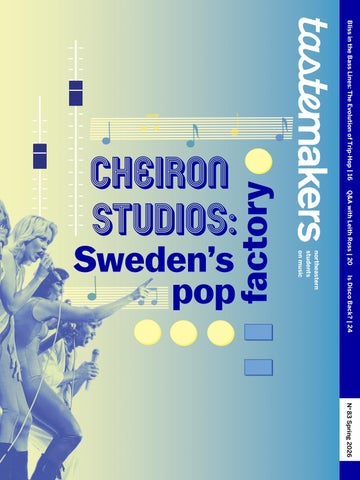
factory
northeastern students on music
o | 20 | N From Groupie Freaks to Tumblr Geeks The Future Funky: A History of Afrofuturism in Music o52 | 16 Is | 08 | 18 Bliss in theof Bass The Evolution of Trip-Hop Q&A |with Leith Ross | 20 | 40 Is Disco Back? | 24 The Revival of Pop Music Musicians the Lines: Silver Screen Eurovision Goes Global 28 Beabadoobee N2026 63 No 83 Spring 43
Cheiron Studios:
Sweden’s pop
Staff President Connor Bedell Editor in Chief Gabriel Barbier-Saiah Art Directors Camille MacMillin Anna Levesque Collateral Designer Allison Lee Design Coordinator Marley Wallingford Promotions Director Alexa Rand Photo Directors Faith Nguyen Ananya Singh Features Editor Rilyn Szabo Reviews Editors Sam Pollak Joseph Manganello Interviews Editor Paige Pataky
Social Media Directors Emily Seitz Hannah Storer Nico Mallias Treasurer James Ryan Staff Writers Alejandro Hernandez Camille MacMillin Charlie Settimi Connor Bedell Emily Seitz Emmett Pearlman Gabriel Barbier-Saiah Gabriel Lynch Greta Radcliff Hannah Storer Imaan Mandsaurwala Isabella Bernstein Izzy Hrubec James Ryan Joseph Manganello Josephine Chong Kaitlyn Conly Kate Yanulis Katie Colella Kayli Harley Lain Orndorff Lin Luo Marisol Lopez
Mat Kurti Mya Jassey Nikhil Jagannath Olivia Kramer Paige Pataky Peter Phelan Rayan Singh Remi Santos Rilyn Szabo Sam Jamison Sam Pollak Tristen Schilling Valentina Cunha Victoria Felix Eduardo Art & Design Anna Levesque Allison Lee Bailey Harden Camille MacMillin Faye AlAwwad Kezzy Domingo Marley Wallingford Molly Forman Nina Roshe Rachel Viets Ruth Gebru Sarah Cao Sarah Thomas Sophie Heidelmann
Promotions Alexa Rand Ananya Singh Caroline Rushmore Charlie Settimi Emily Seitz Hannah Storer Kaitlyn Conly Kenady Sloan Lana Serpico Lucy Weld Niko Mallias Reuben Colten Photography Alex Hernandez Ananya Singh Angelina Sharifi Anna Kelly
Jackson Goodman Jacob Lopez Jacob Oshinsky Maizy Kharrazian Maya Abel Maya Gerum Olivia Watson Peter Phelan Prisha Patel Pritika Aidasani Riya Thadani Ryan Huang Samantha Lioanag Soham Wagulde Tejas Marulkar Vivaan Lunkad
Ava Russo Aya Souissi Bree Morango Caroline Xue Charlene Lam Charlie Sturtevant Collin Norcross Cullen Thurston Curtis DeSmith Darin Zullo Devyn Rudnick Faith Nguyen Jackson Burker
Get More Can’t get enough? Check out more original content on
tastemakersmag.com
@tastemakersmag
Jeremy Zucker, Royale
Photo by Anna Kelly (Health Science)
Tastemakers Music Magazine 434 Curry Student Center 360 Huntington Ave. Boston, MA 02115 tastemakersmag@gmail.com © 2026 tastemakers music magazine all rights reserved
Meet the Staff Staff Writer
Izzy Hrubec is listening to...
Foo Fighters Wasting Light Led Zeppelin Led Zeppelin II Rage Against the Machine Rage Against the Machine
Designer
Molly Forman is listening to... Rescene "Bloom"
Major Media and Screen Studies & Political Science Graduating 2029 Favorite Venue Cubby Bear Tastemaker Since Fall 2025 Quote
“That’s one of the great things about music. You can sing a song to 85,000 people and they’ll sing it back for 85,000 different reasons.”
Major Psychology & Design Graduating 2028 Favorite Venue MGM Music Hall Tastemaker Since Fall 2025 Quote
“Stay focused and trust the process.”
The Marian "Sienna" Chuu "Xo, My Cyberlove"
Photographer
Jacob Oshinsky is listening to...
Jockstrap I Love You Jennifer B
Major Electrical Engineering Graduating 2027 Favorite Venue Royale Tastemaker Since Spring 2024 Quote
“What's with this dog motif?”
Mouseatouille DJ Set Racing Mount Pleasant Racing Mount Pleasant
Promotions Member
Lucy Weld
is listening to... Solange True Beach House Depression Cherry Mk.gee Two Star & The Dream Police
Major Health Science Graduating 2027 Favorite Venue Red Rocks Tastemaker Since Spring 2026 Quote
"You know she brings it to you every ball."
Jonah Kagen, The Sinclair
Photo by Maya Gerum (Mechanical Engineering)
Table of Contents Cover Story
32
Cheiron Studios: Sweden’s Pop Factory The Cheiron formula is a guide to the perfect pop song. Learn about how this Swedish record label changed pop music forever.
Reviews
8
14
Who Fits Into Indie Sleaze?
Bliss in the Bass Lines: The Evolution of Trip-Hop Learn how trip-hop, the genre that’s the perfect soundtrack for drugged-out hazes and introspection, has changed over the years.
22
30
Bladee’s Philosophy for Drainers Bladee, Sweden’s strangest darling, is known for his blend of cloud rap and electronic music. If you take a closer look, his music contains a lot of spiritual and philosophical meaning.
Constructing a Wall of Sound The wall of sound technique is an orchestrally grounded approach to producing popular music, where intense ubiquitous sound fills up the space of a song.
Is Disco Back? Despite disco’s polarizing reputation, the sounds of its sparkling synthesizers and four-on-the-floor rhythms have slowly crept back into mainstream music.
After Changes Upon Changes: The Timeless Poetry of Simon and Garfunkel One of the most well-known folk-rock duos of the late 1960s tackled loneliness, connection, and the inevitable passing of time during their too-short career.
Marty Supreme (Original Soundtrack), Fred again.., By Storm, Searows
Fans of musicians who are considered to be a part of the “indie sleaze revival” may be reviving the disordered thinking that was present in the original indie sleaze movement.
16
26
Album Reviews
Features
12
24
Streaming and the Transformation of the Modern Album Artists now have full reign over the length of their albums, something once dictated by the physical restraints of LPs and CDs. How has this changed the makeup of an album?
36
Interviews
20 48
Q&A with Nick Shea: Boston’s Most Prolific Cartoonist-RapperExtraordinaire You may recognize rapper Nick Shea from his graffiti cartoonface tags around Boston. Learn more about his everchanging status as an artist and community figure.
Etcetera
47
Dissects: Lizzy McAlpine - "reckless driving" Lizzy McAlpine conjures up an emotional whirlwind on this track from her second studio album, Five Seconds Flat.
52
Underrated: Edgehill
53
Taste of Nostalgia: Comin’ Out Hard
The Sounds of Hawkins, Indiana From the iconic arpeggiated, synthy intro to full-volume '80s hits that bring a character back from the brink of death, the music of Stranger Things is never incidental.
Q&A with Leith Ross: The Art of Questioning Tastemakers spoke with Canadian singer-songwriter Leith Ross to discuss grief, radical optimism, and community-oriented mindsets.
Another Flower in the Garden: The Benefit of Solo Projects Although solo projects may carry a bad reputation, recent examples have shown that they don’t extinguish a band’s creative flame.
40
Going out to a bar isn’t for the music. But during many live performances, the sonic ambiance of bars is just as, if not more, important than the drinks you order and the people you’re with.
Why Country Matters and Where to Start The massive umbrella of country contains a rich history and a variety of encompassed genres, and despite its crucial role in Americana, the culture remains widely misunderstood.
38
44
The Backbone of a Bar: A Perfect Soundtrack
Rock band Edgehill believes that being in a band is just as much about closeness with one another as it is about closeness with fans.
Rappers 8Ball and MJG set the groundwork for the pimps and gangsters alike that would come after them with their debut album.
ROCK
Calendar March
1
4
6
11
Dodie House of Blues Mariah The Scientist Memoire Boston Aries Paradise Rock Club
Maggie Lindemann Paradise Rock Club
Rainbow Kitten Surprise MGM Music Hall
bbno$ MGM Music Hall
14
19
20
21
BENEE Paradise Rock Club
Sticky Fingers House of Blues
Subtronics MGM Music Hall The Hives House of Blues
Prospa Royale
22
23
28
29
FKA twigs MGM Music Hall
Rochelle Jordan Paradise Rock Club
Zara Larsson House of Blues
CupcakKe Big Night Live
30 Lady Gaga TD Garden
April
OMM
ENDS
Florence + the Machine April 19 @ TD Garden The instructions are right there in the name, so everybody get ready to scream at the Florence + the Machine show at TD Garden on April 19th! Expect a high-energy, deeply emotional experience with some amazing vocals while the band highlights their newly released album Everybody Scream on a world tour. Ananya Singh (Political Science & Economics) FKA Twigs March 22 @ MGM Music Hall Do you feel the Afterglow? A poet once said, “eusexua” is about feeling alive and present in the moment. On March 22nd, join Grammy winner FKA Twigs at MGM Music Hall for the Body High Tour. With supporting act Tokischa, it’s going to be a night that blends club and vogue where you can crash the system, diva doll. See you there xx Niko Mallias (Pre-Med Psychology)
2
3
4
8
Cardi B TD Garden
TWICE TD Garden Hayley Williams House of Blues
TWICE TD Garden Hayley Williams House of Blues The Brook & The Bluff Big Night Live
The Neighbourhood TD Garden Machine Girl Royale
10
11
15
16
LANY Roadrunner
Alice Phoebe Lou Berklee Performing Arts Center
I DONT KNOW HOW BUT THEY FOUND ME Paradise Rock Club
Good Kid Roadrunner
17
18
19
20
Snail Mail Big Night Live
Lewis Capaldi MGM Music Hall The Last Dinner Party Roadrunner
Florence + the Machine TD Garden
Raye MGM Music Hall
22
24
Demi Lovato TD Garden
Sports Middle East
Alice Phoebe Lou April 11 @ Berklee Performing Arts Center I’m no “Mind Reader,” but I know you want to see Alice Phoebe Lou live on April 11th at the Berklee Performing Arts Center! Touring her latest record, Oblivion, you’re bound to experience a dreamy blend of indie pop and sad-girl guitar folk – an evening “You and I” definitely don’t want to miss! Emily Seitz (Health Science/ Psychology) Good Kid April 16 @ Roadrunner There’s “No Time to Explain” – Good Kid is coming to Boston! “Summer” might not be here yet, but it’s coming early to Roadrunner on April 16th! Catch Good Kid on their “Can We Hang Out?” tour for some “Bubbly” and high-energy indie rock you won’t be able to stop dancing to! Hannah Storer (Computer Science and Game Development)
Jules, Afterhours
Photo by Faith Nguyen (Architecture)
Album Reviews
Reviews
7
Fred again..
Fresh
USB002 Released December 12, 2025 Label Atlantic Record UK Genre UK Garage Tasty Tracks “Beto's Horns - fred remix,” “leavemealone,” “Ambery”
Spring 2026
8
It feels reductive to call USB002 an album. The most recent installment of Fred again’s ever-evolving, “infinite” album project, USB, this compilation is the result of 3 years, shifting from singles to an EP to multiple versions of one album. USB is effectively a permanent dropbox of songs, clearing storage space from Fred again’s hard drive, and now we can all listen to each and every file. It’s easy to get lost in a collection so varied and expansive. While it seems Fred again doesn’t have a refined narrative or uniform vision through the 34 tracks, USB002 provides a collection of dependable bangers that both explore endless corners of EDM and guarantee to get people bumping on the dance floor. Fred again is not new to making franchises. Born Frederick John Philip Gibson, he first spent years doing out-ofthe-spotlight production work on hits from every area of music, overseeing a third of the UK’s number 1 singles in 2019, before launching a project of his own and taking on the moniker of Fred again. Gibson’s breakout, the Actual Life album trilogy, is composed of covid-era releases filled with ambient house tracks that feature an introspective tone and scrapbooking of field recording clips. The trilogy, wrapping in 2022, placed Gibson even closer to music industry royalty and propelled Fred again further in front of mainstream dance music. Now, Fred again seems ready to rave. While each Actual Life project bears tracklists
filled with ambient house songs showcasing lush piano and personal reflections, USB002 is chock full of bass-heavy, UK garage bangers perfectly suited for stadium venues and pashmina-wearing fraternity brothers to fill them. This is a transition Gibson has been gradually making over time, but feels fully realized with USB’s live performance focus. In its most recent form of USB002, the newest tracks to be added to USB come as a product of Gibson’s 10-week, 10-city tour throughout this fall. One track would drop each week to coincide with each tour stop’s secret gig, venue locations only being unveiled the previous weekend. Just as Gibson used the Actual Life albums to document the pandemic’s impact on personal and community-wide scales, USB‘s end goal feels as though not to create a narrative throughline as it is to document the experience of both creating and consuming electronic music live. The entire experience is deeply new-age Fred again. Gibson’s industriously quick work ethic (the Actual Life trilogy was released across a short 18 months) shines through USB002’s endless room for new additions. The sprawling 34-song album racks up a near-two and a half hour runtime, making endless turns into drum and bass, UK garage, and techno-house. The album gives a home to default anthems in many Fred again performances, like the slamming speedgarage single “Jungle” and the booming rap track “Victory Lap” that vibrates under features from Skepta and Plaqueboymax. The album also gives listeners a hefty supply of utility tracks that don’t pack as much of a punch, but are equally as trustworthy in their ability to floor-fill. Tracks from previous albums — and tracks played earlier on this very album — are also remixed and reworked multiple times over. It feels as though Gibson’s need to keep making beats is insatiable. A similar Fred again staple, USB002 fully engages Gibson’s knack for collaboration, every song but one having multiple artists behind it. Both the number and variety of features is impressive, pulling from countless realms of EDM and rap, and venture into rock and R&B. But, not every feature successfully comes off genre-crossing. On many tracks, collaborators feel reduced down to being extra pads added to Gibson’s DJ deck, sporadically injected into songs as short vocal samples or slight textural accents, and rarely having enough stylistic influence to even feel present. While “You’re a star” seems to be the track with the highest potential for genre-crossing, featuring punk band Amyl
and the sniffers, it shies away from any rock influences. The song samples solely the lead vocals from the band’s song “Big Dreams,” where usually ultra-expressive lead singer Amy Taylor sings more monotonously, and places the sample atop a breakbeat that does little to split from the path of other Fred again tracks. A similar promise comes from “OKOK,” with four collaborators on the bill. Of those credited include JPEGMAFIA and Danny Brown, whose co-produced experimental rap album SCARING THE HOES boasts maniacally eclectic, fantastically avant-garde production. Yet, “OKOK” pulls little from the duo — using them only for vocal samples and barely incorporating their musical influence. In all of USB002’s collaborative chaos, Gibson rarely punches his features forward. In a project so set on constant expansion – and with such a lengthy runtime – the commitment to make Fred again songs with only sprinkles of outside influences feels like passing up an easy opportunity to cover more diverse ground. But, there are also shining successes where Gibson shares the spotlight. “Beto’s Horns - fred remix” – featuring breakouts CA7RIEL and Paco Amoroso – takes pieces from the duo’s playfully boastful mix of Latin funk and rap fusion, opening with victoriously ascending horns before dropping into a deep, bass-heavy beat. Throughout the musical shifts, CA7RIEL and Paco Amoroso’s trademark quirky vocals stay at the center. “leavemealone,” is a drum and bass rager featuring wildly rhythmic sample chops of Baby Keem’s “South Africa” and “BULLIES.” Despite totally reworking the rapper’s songs, it takes few guesses to know who’s rapping over the nocturnal and rapid beat. “Baby again..,” with Skrillex and Four Tet behind it, pulls from influences of both collaborators’ sub-genres, taking a house approach that balances Four Tet's ambient IDM sound with Skrillex’s dubstep-adjacent inclinations. An ever-evolving, ever-streamable compilation of mixes and flips, USB002 is an extended-cut piece that feels fueled by Gibson’s deep enthusiasm about electronic music’s technology and community alike. While the project lacks curation and, consequently, refinement at times, there is a consistent and evident pulse of fervor across all tracks. With each new addition to the USB, it feels like Gibson just can’t get enough of music-making, nor the fun he can bring listeners by letting them near the booth.
Paige Pataky (History, Culture & Law)
8
Daniel Lopatin
Fresh
Marty Supreme (Original Soundtrack) Released December 25, 2025 Label A24 Music Genre Electronic Tasty Tracks “Endo's Game,” "I Love You Tokyo," "The Real Game," "Force of Life"
Few films from the past year are as intense and inexhaustible as Marty Supreme, the latest project from director Josh Safdie. Arriving in tandem with the movie is the score for the film, Marty Supreme (Original Soundtrack), a collection of 23 tracks from electronic producer Daniel Lopatin. Lopatin, better known for his work as Oneohtrix Point Never, has crafted progressive compositions to accompany Josh and Benny Safdie’s productions since 2017’s Good Time. The intense soundtrack for the on-the-run thriller was Lopatin’s first attempt at a film score. Their partnership continued with Uncut Gems, released in 2021, where Lopatin introduced even more tension and undercurrent to the anxious world that these characters lived in. The soundtrack’s grittiness and cinematic scope was noted as a highlight of the film. Lopatin's work often taps into the minds of unsettled men frantically sprinting from one goal point to the next. On this latest offering, Marty Supreme, Lopatin offers a finely tuned vision of the titular character’s haywire lifestyle while delivering some of his most abstract and cinematic arrangements yet. Marty Supreme follows Marty Mauser, a young man in 1950s New York City, who competes in professional table tennis tournaments and dreams of a championship
at the fast-approaching British Open. Played by Timothée Chalamet, Marty’s desire to represent the United States on the postwar global stage and elevate recognition of table tennis as a sport serve as fuel to his journey for immortalization. His intense drive leads to erratic behavior and uneven outcomes as he navigates his way by exhausting all means to his end. Lopatin’s score chronicles Marty’s story with suspenseful and cryptic synths, introducing lush passages throughout the album that pair marvelously with the more meditative electronic sections that appear on the soundtrack. The score is no doubt chaotic; sudden bursts of synth pierce through chilled waves of sound, but the mindset curated by Lopatin is one of achievement, thrill, aspiration, and a certain aloofness in the face of great pressure. Marty’s character embodies these traits in his highest-pressure moments, his ambivalence marked by shining beams of hazy ambience. Daniel Lopatin has had a busy year; the Marty Supreme soundtrack arrives just a month after Tranquilizer, his latest output as Oneohtrix Point Never. The Marty Supreme soundtrack incorporates many elements that appeared on Tranquilizer: sweeping movements punctuated by twinkling pulses, random stabs of surreal and intense instrumentation filtered through time and memory. Much like Marty’s character, the soundtrack shines most in these moments. Lopatin’s high-tension soundscapes capture a moment in time where the only objective is success. “Endo’s Game” pulses with anticipation and concentration and scores a pivotal match between Marty and a foreign rival. The epic “I Love You, Tokyo” comes at a high point for Chalamet’s character, who has just arrived in Japan for a major tournament. The thumping drums and spacious imagery it evokes perfectly scenematches with Marty’s self-confidence (if not arrogance) as he touches down to “take care of business.” Later in the film, “The Real Game” slowly builds to a crescendo of synths and drums to back one of the most significant moments of Marty’s life. It’s not all just climaxes and thrills, either; some of the soundtrack’s most complex moments serve as interludes of Marty scurrying from block to block in New York City, or in transit to a new destination as he tries to outrun a growing list of obligations that follow behind. These moments are most reminiscent of the strengths that Lopatin played to on the
Uncut Gems soundtrack: high-stress slice of life segments that reflect the overstimulated mind of the main character. The soundtrack for Marty Supreme is an innovative and relentless companion piece to the film, deepening the viewer’s understanding of Marty’s perspective on ambition, greatness, excellence, and purpose. The soundtrack merits recognition as a standalone electronic work in Lopatin’s extensive recent output. Though at times it plays too safe in lanes Lopatin is already familiar with, the Marty Supreme score is undoubtedly another hit in his partnership with Josh Safdie. As “Force Of Life” plays over the film’s final scene, you’re left with no choice but to answer questions of your own calling and fulfillment, questions that will
Gabriel Barbier-Saiah (Criminal Justice & Psychology)
9
Reviews
7
Searows
Fresh
Death in the Business of Whaling Released January 23, 2026 Label Last Recordings on Earth Genre Folk Tasty Tracks “Belly of the Whale," "Hunter," "Dearly Missed," "In Violet"
Spring 2026
10
Composed of songs that seem to have fallen with the Pacific Northwest rain, Death in the Business of Whaling marks a stunning second album release for Alec Duckart. Whereas Searows’ debut album, Guard Dog, is a floaty, acoustic compilation, Death in the Business of Whaling is moody and pneumatic. Welcoming a full band for the ride, Duckart is grittier, yet maintains a folky intimacy characteristic of the singer-songwriter. To immerse listeners in the album’s occupation, it’s fitting that Duckart begins in the “Belly of the Whale.” Most of the song is instrumental, grounding the audience in the tone of this release. It echoes with a faint humming, a lamenting string section, and a buttery guitar lick that acts as a throughline. The first words of the album are an admission of mortality: “I am not invincible,” which evidently reflects the narrator’s unfortunate circumstance. He is trapped in the belly of the whale, a clear reference to the prophet Jonah, who disobeyed God’s command. Unlike Jonah, who eventually escapes his situation, Duckart is “still in the belly of the whale,” and he positions listeners in this liminal space with him. Will they get out? Is there mercy for them yet? The audience remains in this stationary, despondent state for much of the album. Duckart often returns to a notion of something lost — one’s body, another
person, something else unnamed. In “Geese,” this “Something lost in the center turns the water black,” as though it were a plague. In “Kill What You Eat,” Duckart says, “A rotten apple hasn’t always been that / I want my body back,” alluding to the realization that he later makes on “Dirt,” that “That this body is not your own.” Sung through Duckart’s melancholy lilt, these lyrics portray a sense of alienation that haunts every track. Duckart doesn’t even specify what is lost in “In Violet,” saying instead, “I had, I want it back.” There is a searching desperation to these lines. The urgency they create spurs the listener on, inspiring a need born of shared experience to find what cannot be found. Beyond being lost, Death in the Business of Whaling has a motif of bodily concern or manipulation. The “Belly of the Whale” metaphor is foremost a biblical allusion, but it also refers to an invasion of sorts. How can one be consumed in another being, yet remain entirely lost? The whale’s body is a chamber, the most intimate of spaces, and a human body is not only minuscule but also incomparable in reference. It is not the place to discover answers about your lost being; it is a place for those thoughts to swallow you. Duckart extracts refreshing depth from a metaphor that could easily have been cliché, marking his craft as one of intentionality and innovation. He further explores the body as a lyrical device in “Kill What You Eat” and “Hunter,” in both of which images of blood and decay dominate. “Dirt” and “Dearly Missed” conclude the cycle, as death reigns unchallenged. These thematic song-pairings mirror each other in content but oppose each other in mood. “Hunter” and “Dearly Missed” gain force as they gradually grant equal weight to all instrumentation. Duckart’s voice is tormented, more unhinged than his usual low steadiness. “Dirt” and “Kill What You Eat” interrupt their momentum, operating in a more acoustic space. Even when the instrumentation builds in these songs, it sounds more subdued, constrained to Duckart’s will for the flow between one track and the next. He exerts subtle conductorial mastery as he frees and tames notes. The album moves in tidal tones, as though Duckart is wading between pensiveness and restlessness. The final song on Death in the Business of Whaling, “Geese,” references Mary Oliver’s poem “Wild Geese.” Duckart takes Oliver’s line, “You do not have to be good,” and turns it into a plea for action: “You do not have
to do good, but you cannot do nothing.” The isolated, resonant acoustic guitar and faint melodic ringing return listeners to the album’s initial saturninity. “Geese” is placid where the rest of the album rippled, and one would think Duckart was returning to his / Guard Dog/ style if it weren’t the last track on an otherwise experimental release. Oliver’s poem famously preaches self-acceptance and the progression of life through sorrow, ideas contradictory to this album’s tone – or, perhaps, only seemingly contradictory. With “Geese,” Duckart finds he is not adrift. That body, that person, that unnamed lost thing has hope of being found. The refrain “when you come back” rings throughout the song, ever searching. The gothic, highly contextual nature of the album never wavers, even after “Geese” concludes. Listen and relisten — one second the story tracks, and the next Duckart retreats into ambiguity. The lyrics remain slightly out of reach to listeners, like a fish that bites the bait but flees the hook. Only Duckart truly knows the full meaning, and there’s something profound in that distance he creates between the art, the artist, and the observer. Death in the Business of Whaling only makes one thing clear: listeners are at sea. Their business there remains unknown.
Kayli Harley (Communication Studies)
8
By Storm
Fresh
My Ghosts Go Ghost Released January 30, 2026 Label deadAir Genre Experimental Hip-Hop Tasty Tracks “Grapefruit," "In My Town," "Zig Zag" “I try to do this shit to a tee / Leave it all on the table so everyone can eat,” rapper RiTchie proclaims. Injury Reserve’s 2021 experimental rap self-portrait / By the Time I Get to Phoenix/ captured a tumultuous moment for RiTchie and producer Parker Corey. The then-recent passing of collaborator and close friend Steppa J. Groggs left a harrowing imprint on the group. The project’s frantic, disorderly rapping and apocalyptic production evoked immense loss and anger at the world for changing. Nearly five years later, the trio turned duo – now known as By Storm – has emerged from this grief, but the acceptance they reached isn’t most settling: Groggs will forever haunt them, and further, most rappers are still broke. A lack of closure seems to be the thesis of By Storm’s debut, My Ghosts Go Ghost. RiTchie has to navigate the nonsensical post-COVID era with his friend absent. He’s far separated from the “Three Man Weave” he used to exist in. Now, he has to start a family while the tours aren’t bringing in enough bread. Doordashing to make ends meet isn’t exactly the life the bling era sold aspiring rappers. While some fans may prefer the bizarre bangers of RiTchie and Parker’s early catalog, the artists who made that music have moved forward; what they have given the world in My Ghosts Go Ghost is nine dark meditations on their new lives. It just so happens to feature some of their most pointed rapping and refreshing production to date.
Starting the album on an intimate note, “Can I Have You For Myself?” introduces RiTchie’s new life in a sobering moment, asking his partner to savor every moment before having a child complicates their lives. He croons over a somber descending guitar line before a staticky drum beat rushes in and fuzzy effects chatter in and out, jolting back to the strange reality he must confront. Moving into “Dead Weight,” RiTchie harps on the advice he received to move on from his lost friend. It’s an ugly reality that he refuses to let go, but he believes it’s right: “I don't need no more hands, I got my own foot in / No, don't tell me that again that I'd feel free / 'Cause no, I wouldn't.” The song paints a futile reasoning with himself, painfully evident in his desperate singing that he’s unsure how much more he can take. RiTchie’s lyrical flourishes are perhaps most apparent on “Grapefruit,” which boils the feeling of unease down to a rap song. Rapping is an art that frequents grandeur and wits, but RiTchie opts for a style far more evocative of unkempt anguish. His most vulnerable, ugly feelings are laid out as he likens his choice to spill his insides to the guts of a Grapefruit. “It ripped me open, showed all my, wait- ooh,” he delivers with simultaneous disgust and amusement. Adding to the anxiety, the production is a frigid, empty room that somehow feels claustrophobic at the same time. The latter half of tracks invite a welcome tone shift as the despondence of the lyrical content and instrumental finds hope within the chaos. On “And I Dance,” one of the most idyllic lines captures RiTchie’s acceptance by comparing the red sky of a forest fire to the color of his hair: “Look up at the sky, it's all auburn / They said, "Bro, it's all in your locs," bro, no problem (Life, dance)” The brightened production in the back leg of the album also allows plenty moments for RiTchie to find a pocket in his cadence. He and billy woods exchange witty but paranoid bars on “Best Interest,” over unnerving violin noodling and thumping drums straight out of an Alchemist beat. RiTchie’s cadence sputters, stopping then starting again, but nonetheless keeps the pulse moving and the head nodding. The production choices on By the Time I Get to Phoenix invited numerous comparisons to the styles of post-rock, a genre emphasizing atmospheric textures and long buildups to ethereal payoffs. At the time, these comparisons were half-baked at best and ignorant at worst, but to give
credit, they predicted the beat styles of select My Ghost Go Ghost songs with precision. The desolate, meditative guitars on “In My Town” could have been on a Talk Talk or Bark Psychosis record back in the ‘90s. “Zig Zag” opens with a melancholy acoustic guitar line and metamorphosizes over six minutes into a serene collage of soothing downsampled drums, glitchy electric picking, and soft singing from RiTchie. As a whole, Parker Corey’s beatmaking palette on My Ghosts Go Ghost has been stepped up and given all the more space to explore. The drums range from perfectly grainy electronic snares on “In My Town” to chaotic snappy breaks on “Dead Weight.” Earlier tracks “Can I Have You For Myself?” and “Grapefruit” prove a stripped back beat can be a warm cushion, but doesn’t hold back on later songs like “Double Trio 2” and “And I Dance,” where you crash through wall after wall of sound. Each track draws a wildly different landscape from the others and takes the time to sketch in all the details. For those who got the hype of By the Time I Get to Phoenix, My Ghosts Go Ghost is an absolute treat. By Storm takes the time to iron out the details and explore their life and sound without Groggs. While not quite reaching the emotional highs of its predecessor, My Ghosts Go Ghost is a thorough examination of self with a soundscape supported by precision and taste. More than worth the wait, the last five years have allowed RiTchie and Parker to look inwards and deliver a nuanced snapshot of what they saw.
Samuel Pollak (Data Science & Economics)
11
Feature
If you spend enough time on the internet, you may have noticed a growing cultural zeitgeist online. There’s a desperate division taking over the chronically online youth. The world is more politically and emotionally polarised than ever. Everyone needs to show that they’re esoteric enough to pander to hyper-specific, niche communities, all while chasing a false sense of authenticity. This weirdly specific shift can be seen and understood through the discography of one artist: Sweden’s strangest darling, Bladee. Bladee is an artist, fashion designer, internet messiah, and member of the Swedish music collective Drain Gang. The group was formed in 2013 alongside Ecco2k, Thaiboy Digital, Yung Sherman, and producer Whitearmor. Emerging from the Soundcloud strain of cloud rap, Drain Gang combined elements from video game soundtracks and electronic internet music into their releases. Each member’s solo work is deeply interconnected with the others.’ The members of Drain Gang consistently collaborate on tracks and albums, in dialogue with one another’s ideas. The philosophy of “drain” itself, according to de-facto leader Bladee, is that of “loss and gain” or “good or bad.” He views the world through an optimistic nihilist lens; His core teaching is to find positivity in what is fundamentally meaningless. Vague and cryptic messaging is fundamental to Bladee’s mysterious aura, leaving a large amount of the derived meaning in his work to be a mix of collective fan psychosis and interpretation of the clues he leaves behind. Over the last few years, Drain Gang has experienced an explosion in popularity, transforming from doomer Sad Boy rappers to a futuristic divinely-ordained boy band. This whiplash-level change in the fan base has not gone unnoticed. If you publicly confessed that you listened to Bladee anytime before 2020, you may have been associated with a few undiscerning stereotypes. Most commonly, people online joked about Bladee’s fans not showering, being insufferable, and taking pride in listening to music that is an ‘acquired taste.’ Early projects like Gluee and Eversince incorporated core elements of cloud rap. Bladee’s experimental combination of trap and autotune was paired with cynical and melancholic messaging. This persona is often
Fall 2025
12
referred to as ‘Evil Bladee’ in the DCU (Drain Cinematic Universe). As a true tortured poet, on tracks like “Deletee,” he vulnerably details feelings of hopelessness and navigating meaningless wealth with overlayered, screechy autotuned vocals on a dark trap beat. On “Sugar,” which Bladee himself describes as “demonically melodic,” the artist fully embraces a vampire-like persona, describing his lover’s blood as “too sweet, like sugar baby.” The dark and gothic imagery made his early brand unique, cementing him as an Edgar Allen Poe for guys that love cyber-sigilism tattoos and lowballing sellers on Depop. The baseline messages of nihilism and absurdism are still immensely woven into Bladee’s more recent projects, but his outlook has changed. Many pinpoint his spiritual transcendence to be after he literally got struck by lightning in Thailand, which he followed with his most enlightening and hopeful projects yet, The Fool and Crest. These projects are polished and melodic, featuring production that can only be described as ethereal. They coincidentally gained notoriety online in the same timeline as internet philosophies like “hopecore” being adopted by the hyper-online masses circa 2023. Those who embraced the TikTok teachings of “hopecore” pushed for a shift away from post-pandemic doomer mindsets, embracing empathy and eternal positivity. On Crest, spiritualism and religious imagery seep through every song. On ”Faust,” Bladee assumes a Buddhist perspective as he accepts death as a part of life’s cycle and the natural end to suffering. In lines like “Suffering stops, bodies drop / Flowers sprout, bloom, die, and rot,” Bladee explores… The nine-minute long “5 Star Crest (4 Vattenrum)” exemplifies Drain Gang’s ability to create living, moving musical works; It is five different songs and one single song at the same time. The track opens with Ecco2k’s sparkling falsetto, refracted through autotune like sunlight through a stained glass window. “Am I missing something?” he questions at the end of the verse with a dejected air. In a minute’s time, the song cuts into upbeat pop, with twinkling synthesizers punctuated by a sample from cult classic video game Street Fighter 2. In another minute’s time, Ecco2k is lamenting his own self-destructive tendencies over
McDonald’s and can’t get the Happy Meal because he’s just too sad. It’s truly as simple, and as complicated, as that. This is not to say that Bladee is the modern-day Aristotle, but you can’t fully discount him either. Spiritual and philosophical meaning can be found in absolutely anything, no matter the stupidity or depth of the work. This feature of absurdist art is demonstrated best by Drain Gang. Their effortless blend of cloud rap and electronic music is as relevant and timely as any genre of music can be. It’s “online” enough to be culturally relevant, but personal enough to be emotional. What Bladee’s work captures is survival within a meaningless online world: the ability to keep moving, creating, and feeling in a space that often feels drained of significance. His discography charts a shift from ironic detachment to cautious vulnerability, from nihilism as a defense to nihilism as an acceptance. His work is a messy, absurd, occasionally profound record of what it feels like to be both online and overwhelmed. Imaan Mandsaurwala (International Affairs & Economics)
Sarah Cao (Business Administration & Design)
an eerily warbling backtrack. Another chapter later, over the warped sounds of sheep bleating, Bladee questions the imminence of death, saying “Give it to me raw, death is beautiful.” The latest installment in Bladee’s journey of spiritual enlightenment is COLD VISIONS, which many have pinpointed as the return of “Evil Bladee.” The album is reminiscent of the sound of beloved early projects like Icedancer, featuring frequent collaborators like Yung Lean and Black Kray and producers like F1LTHY, whose work with Playboi Carti influenced the comeback of rage-rap. The project’s opener “PARANOIA INTRO” is an exhilarating entrance; the beat drops after Bladee playfully declares he doesn’t have many brain cells left. On the next track, he deadpans about buying a thousand Smurfs on eBay. “I was on shrooms, needless to say,” he explains shortly before recalling a nightmare: “I’m waiting for disaster or something else bad to happen / I’m in this beauty pageant and everybody’s laughing.” The strange humor and anguish are woven together masterfully; it doesn’t feel like he’s being ironic as a way of hiding because it doesn’t sound like he wants to hide at all. Bladee references the philosophies persistent in his work through the recurring character, “King Nothing” in the DCU. King Nothing is a foolish, oxymoronic title that encapsulates the same optimistic nihilism and absurdity that defines Drainism. It’s about finding light and hope in something that’s meaningless. In The Fool’s “‘Hotel Breakfast”’, Bladee announces that he’s “King Nothing,” later revisiting this title on Cold Visions in the track aptly titled, “KING NOTHINGG”. These two projects are sonically vastly different from the rest of his discography, but thematically connect and maintain the same base message. It’s one that is nihilistic and absurdist in nature. It may seem easy to write off Bladee’s lyrics as meaningless and nonsensical, but that is often what they are meant to be. An album like Cold Visions can have immense and sometimes profound commentary on moving through life in a world that is constantly “draining” you of everything you have. That understanding of modern life can even be found in a song titled “SAD MEAL,” where Bladee goes to
13
Feature
Content Warning: this article contains references to eating disorders and associated mindsets and behaviors. If you’re a frequent TikTok user, you may have heard of the indie sleaze revival. Fans of artists considered to be a part of the scene, such as 2hollis, Snow Strippers, and The Hellp, have noticed an odd trend within the online community that surrounds these musicians. Users joke that if you’re over a certain weight, BMI, or waist size, that you’ll be out of place at these musicians’ concerts, or even thrown out by security. The original indie sleaze movement was filled with behavior that promoted unhealthily thin bodies and disordered eating, but this iteration of the movement is different. So, why is history repeating itself? The original indie sleaze movement is difficult to define sonically. Musicians connected to the late 2000s garage rock revival, the early 2010s indie pop boom, and various electronic and dance genres were retrospectively grouped under the term. What these musicians have in common is a striking fashion style and attitude: smudged makeup, disheveled layers of clothing that somehow look effortless, staying out
Fall 2025
14
dancing well into the morning, chainsmoking cigarettes like there is no future, nihilism paired with a penchant for partying. Even though the goal was to look and act like you didn’t care, many people involved in these subcultures really did care. Excessive drug use was not only normal but encouraged, and although sleazy fashion could look good on anyone, it was idolized on skinnier bodies. In 2009, model Kate Moss stated that “nothing tastes as good as skinny feels,” which led to the creation of the “heroin chic” aesthetic that attracted the most dedicated indie sleaze disciples. The early days of the unrestricted Internet made encouraging harmful behavior much easier. Users on sites like Tumblr posted pictures of skinny bodies they hoped to emulate and motivated other users to engage in unhealthy actions to reach their goal figures. These groups persisted through the mid 2010s, at which point the body positivity movement became mainstream and promotion of eating disorders faded into fringes of the Internet. More than a decade later, the prevalence of the body positive movement vanished as skinniness became more accessible. The curvy body type that was sought after in the late 2010s was declared out of style. The Internet has also gone through major changes; it’s easier to join a community than ever, but authenticity is much harder to find. Internet creators co-opt fashion styles and mindsets in a performative manner, which sets the standard for what is “cool” instead of the inperson gatherings and word of mouth that fueled fashion trends in the early 2000s. Furthermore, people are more aware of their appearance and behavior because of the normalization of recording others in public. The performance doesn’t end, even if you log off.
their fanbases come from somewhere. The visual language of indie sleaze is present in these artists’ content, so people who are a fan of the style naturally gravitate towards them. Many trending styles are influenced by a nostalgia for the past, indie sleaze included. This fact, paired with the resurgence of the glorification of thinness, can contribute to fans internalizing and regurgitating parts of the indie sleaze mentality. These fans, especially Gen Z fans who didn’t experience the original iteration of the movement, don’t consider if this mentality could be harmful. In most cases, the people making jokes about slim fans aren’t the demographic that leans into this appearance. Instead, they are glaringly aware that they don’t fit the “look” that defines these fanbases. By joking about BMI checks at the Snow Strippers concert or measuring waists at the 2hollis show, they’re mocking the stereotypical fan of these musicians and also engaging in selfdeprecation. Even though they’re making fun of people who think or act in a way that may be unhealthy, they’re also implicitly affirming that this disordered thinking is the standard to be considered a true fan of this music. The essence of indie sleaze culture is inextricably linked to the glorification of thinness at any cost. This affirmation is not intentional, but it is impactful. It’s one thing to joke about unrealistic restrictions at concerts, but it’s another to make a video about how you’re using the concerts of these musicians as a motivator to lose weight. For every person that makes a post that unintentionally encourages an unrealistic body image, there’s someone viewing and internalizing that content. The perpetuation of unhealthy standards is good for nobody, and combatting this mindset is crucial to stop history from repeating itself. Rilyn Szabo (Behavioral Neuroscience & Design)
Faye AlAwwad (Computer Engineering)
Coincidentally, the mainstream glamorization of thin bodies has occurred concurrently with the indie sleaze revival in fashion and music. Many musicians, especially in the electropop sphere, have paired their music with a similar grungy style and unconcerned attitude that the original subcultures associated with the aesthetic were known for. 2hollis, The Hellp, and Snow Strippers are some of the current musicians who are making music that fans classify as “indie sleaze revival,” even as they try to distance themselves from the label. These newer acts have younger fanbases that often make jokes alluding to unhealthy mindsets about thinness. These fans mostly weren’t around for the original movement, yet they’re engaging in comparable behavior. Do these musicians curate an image that promotes detrimental mindsets that could lead to people developing eating disorders? Or do these artists just happen to make music and also be conventionally skinny? 2hollis is the most popular of these musicians. His music is mostly about lust and romance. In his music videos, he sometimes appears shirtless, but the focus is typically on his overall aesthetic, not solely his body. His brand consists of a personal style that does not center his body type. Similarly, The Hellp do not promote harmful standards about what a body should look like. While their music includes lyrics about drug use, they don’t glorify it. Their music videos usually focus on telling a story instead of promoting a specific image or behavior that they think is fashionable. On the other hand, Snow Strippers require greater scrutiny than the aforementioned musicians. The duo, consisting of vocalist Tatiana Schwaniger and producer Graham Perez, project a more transgressive image. The duo’s visuals primarily feature Schwaniger while Perez mostly acts as a mysterious background figure. Their most viewed music video, “Just Your Doll,” features Schwaniger and other skinny women dancing while wearing revealing clothing. This wouldn’t be an issue, but the clips in the video emphasize their bodies instead of their overall appearance. “So What If I’m A Freak” depicts women’s bodies in a similarly demeaning light in its video. Snow Strippers see sexuality as appealing, and thin bodies fit their ideal of what is desirable. That being said, Snow Strippers cannot be blamed for promoting disordered thinking about body image. They are simply a result of a toxic culture that is older than they are. These artists aren’t directly influencing their audiences to think in a certain way. However, these perceptions of these artists and
15
Feature
bliss in the bass lines:
the evolution of
TRIP-HOP
Fall 2025
16
Marley Wallingford (Business Administration & Design)
Deep in the abandoned warehouses of Bristol in the 1980s, trip hop was born. It echoed off the walls with a mix of acidhouse bass lines, hip-hop drum beats, and street soul vocals set to ambient slow tempos, becoming the perfect soundtrack for drugged-out hazes and introspection. Bristol’s sound system music scene was the heart of the trip hop universe that launched local bands Massive Attack and Portishead to international acclaim. But as the genre exploded in popularity, it struggled to maintain its distinctive sound, receding into the background to begin a long hibernation. Driven by new, small artists, there are signs that winter is finally over and a resurgence is ready to bloom. The first true trip hop album arrived with Massive Attack’s 1991 debut Blue Lines. It immediately established the band while setting the standard for what a trip hop record sounds like. Blue Lines featured a groundbreaking mixture of hip hop, acid house, jazz and dub, with vocals from frequent collaborator Horace Andy curling around the album’s production in a distinct reggae groove. The album’s breakout hit “Unfinished Sympathy” combines Shara Nelson’s anguished voice with lush orchestral arrangements and chimes that create an uneasy atmosphere that accentuate lyrics of romantic despair. The same year as Blue Lines released, Bristol natives Beth Gibbons, Geoff Barrow (who worked on Blue Lines), and Adrian Utley formed Portishead. The group
would release their debut Dummy in 1994, developing a distinct lane in the trip hop scene that emphasized a moody atmosphere befitting a dimly lit jazz lounge, especially on the oft-sampled hit “Glory Box.” The album crafted a paradoxical blend of retro and futuristic sounds that worked well with Gibbons’ seductive vocals, while beginning a trip hop hallmark of sampling spy movie soundtracks. Together, the two bands served not just as the founders of the genre, but also as drivers behind trip hop’s consistent evolution. The distinct trip hop sound quickly appeared on other UK albums, with Duran Duran incorporating deep bass lines to cultivate a hypnotic atmosphere on their 1993 track “Come Undone,” complemented by warped guitars and Tessa Niles’ despairing backing vocals. With trip hop curating so many aspects of various genres, bands were free to lean into different qualities to distinguish their sound. Depeche Mode’s “It’s No Good” blended trip hop’s heavy bass lines and slow beats in a refreshing twist on their electronic rock sound. Other UK bands leaned into the elements of soul and R&B in their work, such as Skye Edwards’ warm vocals on “The Sea” from Morcheeba’s album Big Calm. Sneaker Pimp’s release of “6 Underground,’’ built on top of a James Bond sample, cemented the genre’s international appeal – especially for US audiences. With trip hop demonstrating its crossAtlantic appeal, American bands focused
17
Feature
on the distinct production of the imported Bristol sound, melding with developing plunderphonics and electronica movements. DJ Shadow built Endtroducing... almost entirely out of samples, creating a grainy texture that paired well with an ambient boom bap beat and a head-nodding tempo. In the underground scene, Bowery Electric delivered a gritty, lo-fi sound with their 1996 release Beat that preserved the hypnotic Portishead style and put emphasis on production over vocals. Thievery Corporation tapped into a jazz-heavy sound full of rich brass to tweak the UK origins while maintaining the downtempo, noir qualities. In a sign of the genre’s cultural cache, the soundtrack for The Matrix is chock-full of trip hop beats and electronic influences. Much like rock bands in the UK, pop artists proved themselves equally adept at incorporating trip hop elements into their sound. On her 1995 album Post, Björk partnered with Tricky (a former Massive Attack member) to craft a contemplative and ethereal sound, serving as a demonstration of trip hop’s ability to meld with other genres and take on new identities. On her 1998 album Ray of Light Madonna partnered with UK producer William Orbit, with clear trip hop influences throughout the record, particularly on the track “Swim.” The song pairs crystal clear vocals with electronic drums and acid synths that give it an intergalactic yet mature feel. By the turn of the millennium, it was impossible to step into any hipster coffee shop worth its salt without being greeted by the now ubiquitous genre. It was this exact commercial success that would begin its undoing. The easygoing, downtempo qualities of trip hop were easily replicable and spawned a wave of sanded down imitations aimed at mainstream audiences. Separated from its underground origins in Bristol, American audiences
Fall 2025
18
instead began to associate the trip hop sound with casual lounge music akin to elevators playing “The Girl from Ipanema.” While trip hop retained a greater degree of mainstream popularity in the UK, it was nowhere near the genre’s peak in the mid to late 90s. This is best demonstrated by Portishead’s 2008 release Third, delivered after a near decadelong hiatus. The band was determined to move past the trip hop sound they helped pioneer; ultimately creating an album that skewed more towards an industrial rock and electronic edge. Amid evolving tastes and turnover in the music scene, trip hop got lost in the shuffle. As the saying goes, everything old is new again. Having spent sufficient time away from the spotlight, the genre is fresh once more. New trip hop epicenters have sprung up in Copenhagen and Melbourne, revisiting the 90s sound and introducing it to an entirely new generation of listeners. Signs of an emerging revival began to appear in 2023, with a wave of album releases from new independent artists. Melbourne-based duo Hysterical Love Project released Lashes, an album full of dreamy production, hip hop beats, and trip hop synths. The vocals on the track “Ionian Sea” sound reminiscent of Sade, once again pairing soulful vocals with an electronic heavy production. Now Always Fades – another Melbourne band – released Into the Doldrums, a heady album that cultivates an ethereal sound with gentle vocals that flow out of Lili Hall and a spiritual blend of synths and drums. In Copenhagen, the prodigious music school Rytmisk Musikkonservatorium (RMC) has fostered a new generation of artists that have brought a familiar trip hop sound to the city’s music scene. Recent RMC graduates have cultivated a laidback-psychedelic soundscape, with notable contributions from ML Buch and Erika de Casier. Casier’s 2025 release Lifetime balances a variety of genres, and trip hop elements appear on both “You Got It” and “You Can’t Always Get What You Want.” “You Got It” leans on the hip hop roots of the genre as she repeats the song’s title through hazy vocals. On “What You Want” Casier’s voice barely rises above a whisper, with a production that puts you at ease and transports you to temperate rainforests so lush you can practically smell the spruce. ML Buch’s immersive sound conjures a dreamy
soundscape with reverbed guitars and gently delivered lyrics. Sitting adjacent to trip hop, it contains many of the same elements and is a testament to how other genres absorbed the celestial sensation the original 90s wave evoked. FKA Twigs’ 2025 release EUSEXUA reminded listeners that trip hop can exist not just on the couch but also on the dance floor, with “Girl Feels Good” employing a mix of garbled electronic production and sci-fi synths to create a dance-trip hop hybrid. Bridging the European and Australian currents comes the Berlin-based duo a.s.o. made up of native Melbourners Alia SerorO’Neill and Lewie Day. At a moment when audiences have once more developed a taste for the downbeat and sullen, (evidenced by the recent shoegaze revival), their self-titled debut album is well timed. Honing in on the original qualities that defined trip hop, the album successfully replicated the 90s sound without coming across as unoriginal. Their track “My Baby’s Got It Out” sounds like the direct descendant to Massive Attack’s “Black Milk” as the song maintains the core elements of subdued female vocals and a bass line that vibrates at the foreground of the production. In the more than 30 years since Bristol DJs began testing out a new sound, trip hop has constantly been evolving. While the 90s U.K. trip hop scene had a particular emphasis on street soul vocals, the modern resurgence eschews this requirement and doesn’t oblige complete continuity with the original characteristics of the genre. Instead, U.K. soul has seen a revival in its own right, led by powerful vocalists RAYE and Olivia Dean. Thanks in part to the genre’s disparate influences, there has never been a singular form of trip hop. This flexibility has allowed modern bands to parse through the aspects that appeal to them, leading to new musical combinations that distinguish contemporary releases instead of trying to recreate the 90s sound. Ultimately, the latest resurgence represents just another season in trip hop’s journey of reinvention, daring listeners to guess what will happen next. Connor Bedell (Political Science)
Abi Carter, Middle East
Photo by Maizy Kharrazian (International Affairs & International Business)
19 19
Q&A with Leith Ross: The Art of Questioning Interview
Canadian singer-songwriter Leith Ross first gained recognition when they posted songs about relationships, love, and inner turmoil on Tik Tok during the pandemic. Now, they’re back with a new album called I Can See the Future that’s rooted in the radical act of questioning. Tastemakers spoke with Ross in the middle of their North American tour to discuss grief, radical optimism, and community-oriented mindsets.
the only song not written from my perspective — I wrote it from the perspective of somebody in the future. The record is about radical optimism and hope, so ending on “(I Can See) The Future” was a nice way to leave the listener with that feeling.
This interview has been edited for brevity and clarity.
LR: My mom was born and raised in Scotland. My grandfather’s death was the catalyst for my writing “Grieving.” He was an incredible musician. I was raised on traditional Celtic and folk music, so I definitely wanted to write some fiddle lines for this record.
Tastemakers Music Magazine (TMM): When you started working on I Can See the Future, had your perspective on your debut changed at all? Were there things that you wanted to do differently this time? Leith Ross (LR): I had a curiosity about what new kind of sonic space my songwriting could exist in; but there was nothing that I was unhappy about with the first record. It was more about exploring how these songs can sound to their fullest extent. TMM: Opening the album with “Grieving” and closing with “(I Can See) The Future” allows for a beautiful sense of symmetry. What made those songs the right bookends? LR: Originally, “Grieving” was going to be first, and then “Grieving Reprise” was going to be the bookend. “(I Can See) The Future” was
TMM: Sonically, I noticed elements of Scottish and folk influence throughout the record. What drew you to those sounds?
TMM: “Grieving” serves as both a dedication to your grandfather and a reference to the universal process of grief. What made you want to explore grief in this album? LR: I was thinking about the ways that I wish I’d interacted with my grandfather when he was still alive and how I should move forward. That line, “I never will stop grieving / Grief is all I know of love,” references that experience of trying to figure things out. It’s about my tendency to feel scared of losing what makes me happy. The song was about taking that tendency and using it to appreciate the things I have before I lose them instead of letting the fear keep me from them. TMM: That was reinforced by the “Grieving” music video, which almost reframes grief as celebratory. Can you talk more about that outlook on life? LR: It’s hard to maintain. As human beings, we have a survival instinct that doesn’t let us think about things with that intensity in our dayto-day life. Otherwise, we would be feeling and experiencing so much all the time — it would be exhausting. It’s hard to appreciate your life while you have it. I’m trying to be stubborn about remembering to be present, but it’s definitely harder some days than others. TMM: I learned that your dad was a philosophy teacher. Were there any particular ideas or conversations from him that shaped your thinking and songwriting? LR: Oh, totally! Growing up, my family was always having dinner table existentialist conversations. My parents taught my siblings and I to question everything, then helped us work through the answers. It has made its way into my songwriting, but more so affected my personality. It taught me to be inquisitive about the world and to not
Fall 2025
20
take things at face value. I don’t know where I’d be without the way that I was raised. TMM: Radical optimism is imbued in your songwriting process. How would you define that term for yourself? LR: Radical optimism has become a choice I make after experiencing sorrow about the world. Before, when I felt intense heartbreak, I didn’t see a way for it to become hopefulness or joy. Radical optimism, shows up for me most often when I experience that sadness. I can now choose to take another step forward into that mindset of “things will get better.” TMM: The record describes curiosity and love as radical acts. How did writing this album shape your view of how the self relates to the greater world? LR: I did a lot of self discovery when I was writing this album. Though, I think the star of that emotional show was my personal journey with understanding my place in the world and developing a relationship as a community member. The record was trying to dive into those feelings and learn how to describe them. TMM: What does community look like for you at this stage in your life?
TMM: As a musician, does the idea of leaving a long-lasting mark through your music bring you any comfort or perspective? LR: I suppose so. If my music has the capacity to help people, which I hope that it does, then I feel comfort knowing that I can still be helpful even after I’m gone. I feel grateful that it can be helpful to anybody. TMM: You’ve described the album as the result of a lot of questioning. How has your relationship to questioning changed since finishing the record?
LR: I have an increased curiosity. Every time I ask a question, I have six million more of them. I’ve landed on an even stronger hunger to know more about myself, relationships, being in community with people, and the future. TMM: What’s one question you would pose to your listeners to consider while they experience this album? LR: I would hope that it would inspire the same questions that I am posing: not “who am I?,” but “who do I want to be?” and “how do I bring that person into the world and into my circles? Where do I fit in?” To quote Mary Oliver, “where is my place in the family of things? What can I do to attempt to be the best version of that I can be?” Kaitlyn Conly (Human Services & Psychology)
Bailey Harden (Behavioral Neuroscience & Philosophy)
LR: It’s always developing. Right now, what means the most to me is not letting the world prescribe how my relationships should be and what I owe other people. I owe people a lot more than the world has told me I do. Not just my friends, but also strangers. I’m in a period of great discovery about what my community is and how I can participate.
21
C
O A
Nina Roshe (Graphic Design)
Feature Fall 2025
22
N
S
T
R
U
W
A
L
L
S
O
U
N
It’s 1884 at the Nibelungen Theatre in Bayreuth, Germany, and a symphony erupts from nowhere. Technically, it erupts from a pit in front of the stage, but the orchestra is out of sight. It’s the first performance since composer Richard Wagner redesigned the theater, and the audience startles at the intrusion of noise in the face of an empty stage. The effect was an invisible, sonic barrier — an immediate immersion into the performance. Thus, the “wall of sound” was born. Phil Spector, known for his layered production techniques, became the poster artist for a slightly different interpretation of the term in the 1960s. Whereas the phrase’s initial use concerned a spatial separation between the audience and the orchestra, Spector’s wall of sound was an orchestrally-grounded approach to producing popular music. He commanded echoing, doubled instrumentation to near abstraction. Instruments morphed until they were indiscernible from one another, the collective sound swirling out into cavernous space. This gave his work immense body and texture. The Ronettes’ classic “Be My Baby” and George Harrison’s All Things Must Pass are notorious Spector productions in which he utilizes pauses, manipulates intensity, and carefully crafts contrast. The lead vocals are triumphant in a swell of sound, acting as a tether for listeners to grasp. The product’s dimensional sound has become characteristic of the music of that era. While Spector coined “the wall of sound,” the term is quite nuanced, and musicians build dynamism in different ways. Manifestations range from sudden crescendos to a swift numbing of the instrumentation. It is the artist’s purview, dependent upon what they wish to elicit from their listeners. Perhaps they want to unsettle them, make them dance, rewind, or even pause. You’ve likely collided with a wall of sound, consciously or not; they are the kinds of songs that have you yearning for your next bout on aux, if only to watch your friend’s reaction when the change hits. Modern artists have employed their own walls of sound in their work, often to a stimulating or even disquieting effect. “Pull” by the Microphones achieves this result. The majority of the song follows a simple strumming pattern and soft vocals, but the final two minutes
C
T
I
O
F
N
G
D
become a cacophony equivalent to visual static. Layering charged drum tracks, choir vocalizations, and a distorted electric guitar, The Microphones capture the narrator’s transition, a “pull” into a phase after life. The result is a track to backdrop your life strobing before your eyes — all the ecstasy and terror of having lived. The last 30 seconds de-escalate to a mere rolling of ringing bells, easing the tension built through the first shift. The production pulls you to the crest of a billow, and then the water evaporates. Whereas “Pull” stuns listeners into stricken prey, LCD Soundsystem’s “Dance Yrself Clean” spurs its audience into movement. After three minutes of tense, low-energy musings, a bassy analog synth crashes in. James Murphy adopts a grittier vocal tone, and the instrumentals seem to wake from a lull. What the artists let fester in those first three minutes, they release wholly. They dance themselves clean of their unease and find catharsis in all-encompassing sound. When the repetitive clapping of the initial instrumental track returns at the song’s end to signal the resurfacing of past anxieties, an offbeat drum fill fights to preserve the fleeting euphoria. But the effect of dynamism in music isn’t always auditory whiplash, as both Spector and other artists demonstrate. Take Modest Mouse’s “Styrofoam Boots/It’s All Nice On Ice, Alright,” for instance. The drum track drops a quick and commanding shock to the system, but the moment itself lasts a split second. It’s a slight widening of the eyes and a sharp inhalation — a physical shift. One snap of the drummer’s wrist and the path of the song diverges. And yet, the two tones of the song — before and after the change — aren’t individually overwhelming. It’s the transition that is meaningful. Tame Impala is skilled at manipulating such transitions to build and collapse his wall of sound. From the jump of “Eventually,” Kevin Parker contrasts his symphonic, Spector-esque layering with strategically placed atmospheric reprises. The busier, more distorted sections feature lines like “Wish I could turn you back into a stranger” and “‘Cause if I was never in your life / You wouldn’t have to change it,” but the airier refrains state “But I know that I’ll be happier / And I know you will too.” The musicality mirrors the tone of introspection, shifting from an aversion to the truth to a content acceptance of it. The particular impact of these songs lies in how the artists
position listeners in confrontation with a wall of sound. Some lure you covertly, easing you into one attitude before projecting you into another. Others provide no pretenses, dropping their audience at the topmost brick from the start, the only question being how the sound will crumble. Charli XCX, who recently released a song entitled “Wall of Sound,” opts for the latter. Quite overtly, Charli reveals her hand, but the beauty of the wall of sound technique is that one can be aware of it and still not be able to predict its effect until /that sound/ has collided. Charli’s “Wall of Sound” is an eerie orchestra that crests and collapses at intervals. Sound erupting from a pit in front of a stage may no longer be
novel, but the wall of sound remains a tool through which artists startle, influence, and intrigue their listeners. Amidst an epidemic of industry-pushed, cookie-cutter, predictable pop, dynamic changes like these breathe body back into music. May the technique, born in the ears of that Bayreuth audience, live on in the headphones of our generation.
Kayli Harley (Communication Studies)
23
Feature
IS DISCO BACK? In the 1970s, disco’s inescapable grip on culture inspired both devotion and demolition. Originating from the French word discotheque, meaning nightclub or dance club, disco was not only a genre of music, but a space which embodied joy, dance, and self-expression. Despite the genre’s polarizing reputation and the perceived ‘death of disco’, the sounds of sparkling synthesizers and four-on-thefloor rhythms have slowly crept back into mainstream music, making it difficult to ignore disco’s comeback. People were first exposed to disco in nightclubs amongst the Black, gay, and Latino communities in European cities such as Paris and Munich. Early disco music was incredibly experimental, with DJs uncovering new techniques and sounds while trying to get people to dance. These discotheques were eventually imported to the United States, and disco music along with it. Disco served as a counterculture to rock music, which tended to be a space regarded mostly for straight white men. While dance music was originally scrutinized for its associations with queerness and promiscuity, it eventually saw massive success in America with hits from artists like Donna Summer, Village People, and Diana Ross. Disco music’s reliance on commercialization was the main critique that ultimately led to its downfall. As record labels sought to capitalize off of the genre’s fame, disco music was overly marketed to the public and the sound became more formulaic in order to gain chart success. The film Saturday Night Fever in particular drew in a lot of white suburban communities to the genre, steering the music away from its original audience and erasing its experimental roots. What
Fall 2025
24
had begun as an underground style of music for minority communities slowly became a money grab for record labels as it entered the mainstream. The oversaturation of the genre generated backlash particularly from rock communities that criticized disco’s lack of ‘authenticity’. This animosity reached its peak by the end of the ‘70s on ‘Disco Demolition Night,’ where a pile of disco records was blown up during a baseball game, causing a riot and disco’s demise. In today’s music landscape, disco may have a better chance at survival. Modern audiences are heavily drawn towards commercialized music. For example, Charli xcx’s 2024 album BRAT found success through its overblown marketing strategies and self-aware embrace of pop spectacle. Painting the side of a wall in Brooklyn the abrasive neon green album cover was not portrayed as ‘selling out’, but rather leaning into the BRAT universe. Fans often celebrate innovative marketing campaigns allowing artists to find success through this heavily marketed style of music making. While commercialization was seen as a threat to artistic integrity during the 1970s disco backlash, BRAT suggests that dance music can thrive when it leans into commercialized marketing. Throughout the 2020s, some listeners began to tire of the stripped-back singer-songwriter-sound, and dance music slowly regained its popularity. Singer-songwriter music has been dominant in pop throughout the last decade, championed by writers like Taylor Swift and Phoebe Bridgers. The emotional intimacy from lyrics
that felt like they were ripped straight out of a diary was something that listeners were easily able to connect to. This style of music focuses inward, stripping away the sense of collective that disco music celebrates. The genres have opposing virtues, and it seems as if the pendulum swings between them every few years. This phenomenon was observed during the folk revival of the ‘50s and ‘60s in America. Fueled by the Civil Rights Movement and the Vietnam War, artists such as Bob Dylan and Joan Baez turned the public’s attention towards lyrical storytelling and individual voice. This style of music was intended to be carefully analyzed and listened to, not danced to. After years of political unrest and cultural anxiety, disco’s emergence in the ‘70s offered escape and encouraged groups to come together and celebrate community. While folk music challenged individuals to examine society in the confines
of their intrapersonal lives, disco songs like Diana Ross’s “I’m Coming Out” and Gloria Gaynor’s “I Will Survive” were soundtracks for pro-LGBTQ protests and pride parades. In recent years, several artists have dedicated full albums to disco influenced dance-pop. Dua Lipa’s Future Nostalgia arrived at an almost ironic moment. Releasing a disco album at the beginning of a pandemic was a risk, yet it became a necessary pop staple. People weren’t able to gather in person to experience this new record, but Future Nostalgia was an opportunity for listeners to escape overwhelming headlines and briefly ignore the outside world. As the title suggests, audiences were nostalgic for the future – or even for a state of normalcy, however far away it felt. This album served as a momentary reminder of community during a time of isolation, and many major pop acts would go on to develop a similar sound following the pandemic. Beyonce’s seventh studio album, RENAISSANCE, uses disco to explore the Black and queer origins of dance music. On “COZY” she sings, “Dancin’ in the mirror, kiss my scars / Because I love what they made,” reclaiming her identity as a Black woman as a
also draws influence from Diana Ross’s “Upside Down,” a classic disco track that found renewed popularity after being featured in the fifth season of /Stranger Things/. Bruno Mars – an artist who has been embracing disco and R&B influences since the creation of his music duo Silk Sonic – recently made his solo return to music with “I Just Might.” Its funky baseline and brass sections are a clear celebration of disco and an encouragement to boogie. As he puts it himself, “What good is beauty if your booty can’t find the beat?” While musical trend cycles tend to center nostalgia as the driving factor, disco’s return to the mainstream is more about collective need. Following the isolation imposed by the pandemic and social media, the shared experience of disco’s emphasis on dance and community provides an antidote to this issue. Especially in today’s divided political and cultural landscape, disco’s unapologetic optimism feels like more than a passing trend, but a reminder of music’s power to liberate and unite. Katie Colella (Music Industry)
Marley Wallingford (Business Administration & Design)
source of strength rather than a struggle – a prevalent theme of disco culture. On “VIRGO’S GROOVE,” Beyonce explores disco’s sensuality, layering whispered vocals over psychedelic ‘70s-inspired synths. The album’s final track, “SUMMER RENAISSANCE” samples Donna Summer’s “I Feel Love,” paying direct tribute to the Queen of Disco herself. In her Instagram caption announcing RENAISSANCE, she explains how she intended for this album to be a “safe place, a place without judgement,” mirroring the way that dance clubs in the 1970s served as a place for oppressed and exiled communities to freely express themselves and find liberation through dance. This concept of music as a “third place” fostering community has remained important as the world grows increasingly divided. Sabrina Carpenter’s “Tears,” one of the biggest songs of 2025, interpolates disco duo Baccara’s 1977 hit “Yes Sir, I Can Boogie,” with both tracks opening on the same sweeping orchestral strings. The song
25
Feature
After Changes Upon Changes: The Timeless Poetry of
Simon and Garfunkel
On September 19, 1981, Paul Simon and Art Garfunkel stepped on stage in New York City’s Central Park. It had been 11 years since their final album was released. The reunion concert showcased songs from their five albums produced together since their start 1964 as well as their own songs since going solo in 1970. An estimated 500,000 people sprawled across the Great Lawn to listen. Though many years passed since their permanent break up, not much had changed. Their voices still went hand in hand as their harmonies danced around Simon’s poetry. Garfunkel’s high tenor voice still soared above the meticulous fingerpickings of an acoustic guitar. The only thing that did change was a new verse they added to their 1970 hit “The Boxer”:
This was the unspoken thesis of their Central Park reunion. The language was straightforward, but the reflection was human. Even one of the most well-known folk-rock duos of the late 1960s was a servant to time. And despite it all — the years that slipped by, the solo albums that fell short, the creative and personal differences that ultimately pushed Simon and Garfunkel apart — there was common ground. The stage they shared, sure, but also their art that brought people together. Half a million, to be exact, on that late summer evening in 1981.
“Now the years are rolling by me ...No, it isn’t strange They are rocking easily After changes upon changes I am older than I once was We are more or less the same And After younger than I’ll be changes we are But More that’s not unusual... or less the same.” Fall 2025
26
Sounds of Silence (1966)
Wednesday Morning, 3 a.m. (1964) Simon and Garfunkel established their musical partnership as a high school doo-wop group from Queens, New York. From there, they stepped into the world of folk music, where Simon was the principal songwriter and guitarist and Garfunkel sang harmonies and helped with arrangements. This imbalanced dynamic would ironically go on to strain their relationship built on harmonies. They would eventually find their distinct sound as they leaned into elaborate instrumentations and more nuanced metaphors over their six-year recorded career. But the duo’s first album compiled a handful of brightly up-tempoed renditions of traditional gospel and American folk songs. Only five of its 12 songs were originally written by Simon. A majority of the record is in a major key flittering with bright tones and stiff, two-part harmonies. The selection of folk songs reflect the political and cultural landscape of 1960s America. “Last Night I Had the Strangest Dream” describes the utopia of a world against war. “The Sun Is Burning,” an anti-nuclear folk song, is deceptively poetic while they sing about the sun evolving into a “mushroom cloud of death” that came “in a blinding flash.” The first taste of Simon and Garfunkel’s unique identity is in “Bleecker Street.” Over top twinkling acoustic guitar layers, Simon’s quiet voice anchors the melody while Garfunkel’s lower notes turn it into a melancholy story. It’s a lyrical portrait of Greenwich Village from the perspective of an artist struggling with purpose and connection. “Sparrow” is also about feeling like you don’t belong, reflecting Simon and Garfunkel trying to break through with their debut album. As a whole, the record is not particularly inventive or memorable, except for one song that would become one of their most wellknown: “The Sound of Silence.” The opening arpeggios are instantly recognizable, and its complex harmonies make it haunting. The lyrics (that Simon wrote at 21) speak to a deeper concern of disconnection and isolation still talked about today. It’s about not being able to connect to the crowds of people around you — the antithesis to making a hit.
Their first album was commercially unsuccessful and the group broke up. Simon moved to England to give London’s folk circuit a go. Meanwhile, “The Sound of Silence” was gaining some airplay on a number of U.S. radio stations. Producer Tom Wilson created an alternate version, adding electric guitar, bass, and drums to be rereleased without telling Simon and Garfunkel. The reception of this reimagination prompted Simon and Garfunkel to get back together and try again, this time with Simon’s songwriting at the forefront. In a rush to get a record released, most of the songs were reiterations of Simon’s work from his 1965 solo album, The Paul Simon Songbook. Their second album showed greater maturity, settling into quieter, more somber spaces than their debut despite being recorded in just a handful of sessions. The record encapsulates Simon’s loneliness and longing while in England, like in “Kathy’s Song,” where he wonders why he spends time writing songs “with words that tear and strain to rhyme.” Simon also questions the need for connection if it inevitably leads to loss. The cold and callous “I Am A Rock” is about pushing others away. “April Come She Will” builds on a nursery rhyme to tell the story of warmth turning cold. In “Leaves That Are Green,” everything is fleeting: leaves on a tree, ripples in a stream, even love. But Simon deliberately chose symbols that return in cycles, like a tree budding news leaves or autumn turning to spring once more, that hint at subliminal optimism.
st a T
s k c ra T y • • •
“Kathy’s Song” “April Come She Will” “Leaves That Are Green”
st a T
s k c ra T y • • •
“Bleecker Street” “The Sound of Silence” “Sparrow”
27
Feature
Parsley, Sage, Rosemary And Thyme (1966) Whereas Sounds of Silence was a rushed effort for the duo’s label to capitalize on the buzz, Parsley was patient. Simon and Garfunkel tinkered with the composition and production of their third record for months. There’s greater sonic variation between each song, though some transitions feel blunt and disorderly. Parsley, Sage, Rosemary And Thyme is like a time capsule of the sociopolitical issues of the late ‘60s. The final track, “7 O’clock News/ Silent Night,” is a poignant blend of two unique sounds. Their lilting vocals overlay an onslaught of troubling news reports about the Civil Rights Movement and Vietnam War. The juxtaposition of the political violence of the 1960s with a Christian hymn of tranquility was a nod to the counterculture movement of the decade. Simon also gives some more satirical commentary on this era. “The Big Bright Green Pleasure Machine” and “A Simple Desultory Philippic” mock psychedelic rock and pop culture icons of the 1960s (listen to the latter for Simon’s impression of a now-electric Bob Dylan).
Fall 2025
28
“Homeward Bound,” a tale of a musician’s life on the road, is an honest longing for what once was taken for granted. Even though every day is “an endless dream” on tour, home is the ultimate desire. Simon explores this vulnerability further in “Flowers Never Bend with the Rainfall,” where he sings “the line is thinly drawn ‘tween joy and sorrow.” This is the first time we hear about the feeling of defeat that comes with accomplishing dreams, the main theme of Simon and Garfunkel’s final album.
st a T
s k c ra T y • • •
“Homeward Bound” “Flowers Never Bend with the Rainfall” “A Poem on the Underground Wall ”
Bookends (1968)
st a T
s k c ra T • “America” y • •
“Bookends Theme Reprise” “Mrs. Robinson”
Simon and Garfunkel’s personal discordance with each other and the music industry culminated in their most ambitious, sonically diverse record. Bridge Over Troubled Water had various influences from blues to Johann Bach to Andean music, a testament to Simon’s musical ingenuity. “The Only Living Boy in New York” is Simon’s honest farewell to his partnership with Garfunkel. They recorded multiple tracks of backing vocals, breathing at different points to make it sound like one continuous choir, alluding to the idea that the music goes on even with their looming demise. Hits like “Cecilia” and “Bridge Over Troubled Water” came out of this album, but other tracks reveal a growing contempt for what came with fame. This album is the pinnacle of Simon’s metaphorical messages. “Keep the Customer Satisfied” details the constant barrage of expectations and criticism when an artist’s work is held to high expectations. The pressure of creating art for profit and consumption took its toll on Simon, who on “The Boxer” sings that he “Carries the reminders / Of every glove that laid him down / Or cut him till he cried out.” This song alone took over 100 hours to produce. Even before they added a verse to “The Boxer” in Central Park, this song is a summation of Paul Simon’s career. The last section crescendos, swelling with a full orchestra, like the noise of fame and expectation. The low brass drones thunderous bass notes like long, slow punches. But in the end, all the noise cuts back to the fingerpicking of Simon’s guitar, the sound that started it all.
Kezzy Domingo (Explore Program & Undecided)
While previous albums felt like a compilation of Simon’s songwriting strung together with somewhat similar soundscapes, Bookends is an experiment of storytelling through sound. “Overs,” a jazzy internal monologue deliberately lacks rhyme to speak to romantic dissatisfaction. It starts with the striking of a match, a flame that quickly burns out. “Voices of Old People” is an audio collage of conversations Garfunkel recorded of the elderly reflecting on how the years have slipped by, contrasting the youthful voices of the two singers. Every soundbite epitomizes the movement of time: old photographs, empty space in bed, the distant age of childhood. “Old Friends” is about what’s left unsaid: “Memory brushes the same years / Silently sharing the same fears.” The quiet acoustic song swirls into an unsettling orchestra that symbolizes how years quietly amalgamate. It transitions into a softer reflection, “Bookends Theme - Reprise,” that pulls from the opening track’s motif. Just a few beats slower, it allows for Simon and Garfunkel to sing deeper in a more solemn tone to “Preserve your memories / They’re all that’s left you.” Bookends has a thematic throughline about disillusion with the facade of youth and the American promise. “America” is the search for things not found: “Toss me a cigarette / I think there’s one in my raincoat / We smoked the last one an hour ago.” Simon’s “empty and aching” like the others on a perpetual quest through a land of deceptive ideals. “Save The Life of My Child,” a story on suicide in suburbia, features swooning guitar followed by a blaring synth. This sonic shock mirrors Simon’s disenchantment with the systems around him. Bookends was Simon and Garfunkel’s strongest stab at storytelling through the arc of an entire record thus far, and they would dive deeper into more personal feelings of dissatisfaction in their final album together.
Bridge Over Troubled Water (1970)
Lauren Salemo (Journalism & Environmental and Sustainability Sciences)
st a T
s k c ra T • “The Boxer” y • •
“The Only Living Boy in New York” “Bridge Over Troubled Water”
29
■ Rachel Viets (Criminology & Criminal Justice)
Feature
Fall 2025
30
In the modern day, artists have full reign over their tracklists, something once dictated by the physical restraints of LPs and CDs;
As most consumers are gripped by limited series and shortform entertainment, people in general have become primed for
Morgan Wallen is able to put out his 37 track and near two-hour-long behemoth I’m The Problem with as much ease as PinkPanthress can drop a 20 minute album with no song clocking over three minutes long. The only things your favorite artist now has to consider when making an album is what they want to put out, and what’s often considered more important: what will sell. This shapes not only how the traditional album is made, but how we listen to music as a whole. When streams equate to sales, a longer tracklist directly impacts an album’s success – it’s simple math. Take Taylor Swift’s The Tortured Poets Department, a double album nearly twice the length of her previous release Midnights. Its extended duration helped it dethrone Midnights as the most streamed album debut of all time. Coming off of the largest tour of all time and a Grammy for album of the year may have contributed, but when an albums success is dependent on the amount of songs streamed, and one has twice the songs to be streamed upon its release, of course it shoots up the charts. Nowadays, a concise 30-45 minute album just has a hard time competing against their longer counterparts, and by shifting focus to turning their hits into palatable, bite-sized audios with a Tiktok trend to boost it, artists are given the map to mainstream success. And so, in a world of bloat where everything from the creation of a project to its content changes, what does the modern album look like? Before streaming became the standard for music consumption, artists who wanted to release major projects were bound by the technology of the time. A standard LP had a maximum of 44 minutes total, with 22 on each side, which means that if Zach Bryan had wanted to release his 2022 album American Heartbreak back in the 60s, he would have a 6-sided 3 LP mega project on his hands. Albums in the vinyl era didn’t often break this standard mold, and when the music industry escaped the 44-minute LP standard and moved into cassettes and CD’s, it began to open up so many opportunities for what artists can create – a phenomenon that’s only grown with time. So, what does this mean for how artists go about making modern-day albums? With so much more content being pumped into these albums, record companies advise that artists put their best songs up front, as they know that not everyone will listen to the entire hour-and-then-some-long album; This ends up creating very frontloaded projects, and typically undoing the entire balanced narrative structure of an album. The entire art of the B-side, which would typically be used to show the more eccentric qualities of an artist, is undone when the back-half is now more so occupied by weak filler meant to fill out an albums runtime. Although a project is still brought together by common sounds and themes, mainstream albums have become a lot less conceptually tight overall, taking on more of a compilation-esque feel with albums such as Tate Mcrae’s So Close To What or Noah Kahan’s deluxe-on-a-deluxe Stick Season (Forever). Through short-form media like TikTok and Instagram as a means to virality, there’s even less emphasis on turning out complete and evenly-baked songs, as all one really needs is a catchy 30-second snippet to go after that Grammy nomination (just think about the wonders that Tiktok did for Harry’s House’s award cycle). This new trend in music has caught a lot of flack in recent years as fans are fed up with searching through what could ultimately be a compilation in order to find what they like. Listening fatigue is real, and with everyone’s attention spans dropping further into the gutter year by year it raises the question, “Why would labels think people want this?”
efficient content and instantaneous gratification. As the years go by and albums have become much longer, a different trend has been emerging within songs. The idea of lengthening albums as songs become shorter seem like competing ideas, though are they? Despite the fact that the effects are polar opposites, both of these come back to short-form content being the primary way that many discover popular music. With the extension of albums and shorter, often halfbaked songs, that’s all the more songs that can be thrown at the wall to see what goes viral. In creating these super long mega-projects, most musicians have to sacrifice some level of artistic standard. Your average artist just doesn’t have the mastery to put out a consistent album at the scale and size that’s quickly becoming the industry standard. Songs often blend together, sacrificing memorability and quality for yet another underdeveloped song to be lost in yet another bloated discography. Despite some obvious shortcomings, there’s a lot to be gained by this new standard of the long album; Couldn’t we all have used more of The Beatles or Bob Marley at the end of the day? Even if there are obvious drawbacks to how many mainstream albums are currently made, it does equate to more music from the staples of our Spotify Wrapped every year. Even if it may lessen the album listening experience, that may be the price we have to pay for more content. Due to streaming, artists are completely free to express themselves without worries of a time limit. However, the success that artists receive from their freedom is still fully dependent on how these projects are perceived. Not all long albums today are received badly by any means. Take SZA’s SOS for example. Despite its runtime being over an hour long, it seems as though most of the songs have their time to shine. When coming off of a long hiatus, long albums like SOS or Playboi Carti’s MUSIC were lauded by fans, having the longer tracklist rather be seen as ‘feeding the fans’ after such a long break rather than a loose string of songs that feel like a chore to get through. The longer an artist takes nowadays to release new music, the more impatient fans seem to become. A three-year-long break no longer feels ‘acceptable’ for artists to take in between projects. Olivia Rodrigo couldn’t even finish her Guts World Tour by the time that people were faulting her for taking too long with her third record. Despite the fact that no amount of music ever seems to satisfy fans, ‘too much music’ has also become the topic of much scrutiny, which makes you question if fans will ever be truly happy. While this trend is one that’s seemingly gripping the Hot 100, it does seem to stick mostly to the mainstream; Although its prevalence in pop culture is undeniable, there are countless artists, such as Lola Young or Clairo who are out there breaking this newfound structure. As the grip of short-form media on streaming becomes increasingly prevalent, the burning question remains: “is this trend going to pass, or is it the new normal for how our music is served to us?” ■ Charlie Settimi (Business & Politics, Philosophy, & Economics)
31
Cover Story
Sweden’s pop Fall 2025
32
factory
Cheiron Studios:
When ABBA won Eurovision for Sweden in 1974, the group brought home much more than the small, unremarkable trophy the song contest awarded them. “Waterloo,” ABBA’s first smash hit, blew the Swedish music market wide open, proving that European acts could transcend the borders of their home countries and infiltrate radio play in the English-speaking world. Once ABBA crashed onto the global stage with songs infused with elements of Swedish folk music, the world had no choice but to find out what made songs from this small country in Northern Europe so addictive. In the decades that followed, the Swedish music industry would attract millions of dollars of investment and draw the biggest stars from across the globe. ABBA’s meteoric rise revealed Sweden to be the ideal hub for pop music. The country not only had the business infrastructure, but the investment in music literacy required to begin importing and exporting music worldwide. By the 1980s, club culture exploded in Europe as radio hits from across the Atlantic turned into party favorites in Northern Europe. Clubbing became an essential part of Swedish life, a way to get out and socialize on cold winter nights. As club culture became more prevalent and underground DJ collectives like SweMix began spinning bootleg remixes of American hits, Sweden was fertile ground for a revolution in pop music. When browsing the top hits of the 1980s, 1990s, and early 2000s, it may be surprising how many Swedish names appear in the credits. However, Sweden has unique traits that explain its reputation as one of the world’s biggest exporters of music. Eurovision is one of the most viewed events in the country each year. Streaming giant Spotify was launched in Sweden in 2008,
reflecting the massive music infrastructure that Sweden has built over the years. Music historians sometimes credit Sweden’s musical nature to its long, cold winters. Harsh winter nights result in plenty of time spent inside dreaming up melancholy melodies. Swedish children begin learning music theory and playing instruments as young as five years old, often continuing late into their education. Additionally, Swedish children begin learning English early in life, giving them an advantage later when competing for American radio play. Swedish songwriters have a more unconventional and boundaryless view of the English language, as learning a second language often transforms the way language is used and interpreted. At the beginning of the 1990s, “pop” was a dirty word in Sweden’s underground scene. Denniz PoP, a rising star of SweMix, would set out to change this reputation. Denniz followed trends obsessively and tracked what worked in the clubs. His preoccupation was mass appeal - If something was niche or esoteric, it did not interest him. Denniz wanted to create perfect pop music, breaking away from the subversive remix culture of SweMix.
Denniz wanted to create perfect pop music, breaking away from the subversive remix culture of SweMix. His Stonebridge Remix of Robin S’ dance classic “Show Me Love,” quickly became an international hit in 1992. The same year,
Photo by Anders Hanser, Wikimedia Commons 33
Sophie Heidelmann (Business Administration & Design)
Cover Story Fall 2025
34
Denniz assisted in catapulting Swedish group Ace of Base to stardom with “Mr. Ace.” As Denniz’s music continued to climb on the charts abroad, he began to feel embarrassed by his wealth and visibility. Denniz was keenly aware of Sweden’s distaste for flashiness and wealth. The Law of Jante, a Nordic cultural norm that discourages standing out and boasting, seems antithetical to the superstardom that Sweden attracts. At the height of their popularity abroad, ABBA was heavily criticized at home for their immense wealth and gaudy dress. Radios in Sweden refused to play ABBA records even as they were adored across the globe. Swedish producers believe that a lack of ego and pretension can lead to a more appealing sound. In order to find a space to explore his ethic of pop music in privacy, Denniz founded Cheiron Studios, a recording studio in Stockholm where many of the decade’s hits would be recorded. Denniz recruited eight producers to study and follow his musical principles, including future popular music legend Max Martin. At the time of Cheiron’s founding, Martin was performing in struggling glam metal band It’s Alive under his birth name Karl Sandberg. When Denniz discovered that Martin secretly loved pop music, he became Denniz’s protege. The culture at Cheiron was entirely democratic but bowed to Denniz’s creative direction and veneration for mass appeal. Producers at Cheiron frequently shared work with one another, performing quality control to adhere to the signature Cheiron sound. When back-up vocals were needed in the tiny recording studio, producers looked no further than the front desk. Jeanette von der Berg, officer manager of Cheiron Studios, is credited for background vocals on tracks
from the era’s biggest hitmakers, including Ace of Bass, Britney Spears, and Robyn. The Cheiron formula is a guide to the perfect pop song. According to Denniz’s instruction, every third chorus should have a B hook, a trick borrowed from ABBA’s “The Name of the Game.” Additionally, all great pop songs should have a break-down after the second chorus. The producers at Cheiron were collecting a toolbox of sounds and instruments to hone their own style. The result may read as homogenous to some, but Denniz’s scientific approach was a sure way to approximate perfection. Denniz believed songs needed to sound as good on the radio as they did in the club.
Denniz believed songs needed to sound as good on the radio as they did in the club. Before releasing final cuts of their music, Cheiron would send demos of their songs to the USA to be played on American car stereos. The “car test” seems commonplace now, but was revolutionary for artists that wanted their music to be played on both small stereos, where high frequencies are essential, and in the club, where crowds crave deep bass. Songs created at Cheiron were often written over simplistic melodies reminiscent of herding calls, the root of Swedish folk music. ABBA demonstrated the sweet satisfaction of melodic hits, combining the best of disco, rock, and pop to rule radios worldwide. Denniz wanted to fill a void in the American music market by creating pop music that was ahead of the dance, hip hop, and rock trends dominating radio at the time. Of his collaborations with sixteen-
year-old Robyn, a budding Swedish pop star, “Do You Know What It Takes To Love Me” reads as an appealing imitation of R&B that through meticulous study is transformed into something fresh and new. If Denniz wanted to make music that appealed to the largest number of people possible, he needed to make music for the largest music market possible: American teenagers. For many years, the producers at Cheiron were almost single-handedly fueling the American boyband craze. The pop music created in Stockholm throughout the 1990s offers glimpses of adolescent America from a Swedish perspective. Working with acts like *NSYNC and The Backstreet Boys required the producers at Cheiron to both interpret and set American trends. Cheiron’s contributions to the American adolescent experience would reach their final form with the arrival of a young Britney Spears in 1998. As a former child star looking to kick off her career at the turn of the decade, Spears was uniquely situated to make waves. With the producers of Cheiron at her side, she was unstoppable. Eight songs from her debut album …Baby One More Time were written and recorded at Cheiron. The Cheiron sound is the throughline of the record. With production and songwriting from Max Martin and hitmaker Rami Yacoub, Britney’s singles were predestined for success. Unfortunately, Denniz fell ill in 1998 and was unable to spend much time working with Spears. However, the structure and sound of “...Baby One More Time,” one of the best examples
of the approach he taught at Cheiron, would influence all future pop music. Placing a huge chorus within the framework of hip hop and house music created a sound artists are still exploring to this day. When Denniz PoP tragically died at 35 years old in 1998, Max Martin assumed the helm of Cheiron Studios to carry on his legacy. With Mamma Mia! in theaters in 1999 and Britney’s album dominating radio play in the US, the world had renewed interest in the “Swedish music miracle.” Yacoub and Martin would deliver a follow up smash hit for Britney with “Oops…I Did It Again” in 2000, a song that follows an identical structure to “… Baby, One More Time,” proving the efficacy and endurance of the Cheiron formula. The same year, The Backstreet Boys released their Cheiron-assisted album Millenium, which would become one of the best selling albums of all time. Although Cheiron Studios dissolved in 2000, Martin later founded Stockholm’s MXM Studios in 2011 to continue Cheiron’s quest for “perfect” pop music. Using an approach referred to as “melodic math,” Martin is essentially coding taste in pop music. Every part of every song has a distinct, recognizable melody. Since then, Martin has written, recorded, and produced for megastars like Taylor Swift, The Weeknd, Ariana Grande, Adele and Katy Perry. The 2010s would also prove to be a fruitful time for Swedish musicians as artists like Tove Lo, Robyn, and Avicii soared on global charts. A number of Swedes have expatriated to LA, where Martin
created a songwriting collective blending the starpower of California with Swedish songwriting principles. Because of Cheiron’s work, Sweden has become a mystical land for pop fans, a place where superstars are both born and reborn.
Because of Cheiron’s work, Sweden has become a mystical land for pop fans, a place where superstars are both born and reborn. The “Swedish music miracle” is perhaps the best example of how musicians like Dennis PoP can have a lasting impact on the way audiences and artists alike approach pop music. Four decades after Cheiron’s chart dominance, Dennis seems to have achieved everything he set out to do. As more and more imitations of 90s superstars take the stage and Max Martin continues to dominate the charts, it’s tempting to think that the genre reached its final form in that basement studio in Stockholm. But that’s the best thing about pop: it can’t help but reinvent itself. Joseph Manganello (Political Science)
35
Feature
y r t n u o C y h Watters and M here to Start W “I listen to a little bit of everything… except country.” It's a sentiment that has been expressed thousands of times in icebreakers and on first dates without much thought. The modern landscape of music divides music into neat genres, creating a hierarchy of coolness and artistry that minimizes the diversity within each grouping. One of the most commonly dismissed genres in the contemporary version of this hierarchy is country music. The massive umbrella of country contains multitudes within its rich history and variety of encompassed genres, and despite its crucial role in Americana, the culture remains widely misunderstood. The origins of country music are deeply American. Created by immigrants, both European and African, the genre was built around the expression of struggle. Most regions where country music was present developed their own subgenres within the genre, like bluegrass from Appalachia or the Western style from Texas and the American southwest. The instruments that characterize country – the guitar, banjo, and lap steel guitar – represent the intersectional origins of the genre that are almost completely unknown. The guitar, a classic European instrument, characterizes the colonizing force of the first immigrants to America. The banjo’s origins are based in African culture, where gourds and sticks were used to create the neck and body of the instrument. The current design developed further once it reached America through
Fall 2025
36
the enslaved populations of the Southeast. The lap steel guitar, a lesser known element of country compositions, is associated with more Western style country. The Breaking Bad theme music is the most iconic contemporary use of this type of guitar. This instrument originates from the indigenous culture of Hawaii, representing the Native populations of America within the culture of country music. During the rise of radio in the early 20th century, country music found its place in popular culture through the Grand Ole Opry, based in Nashville, Tennessee. This iconic radio show hosted regulars in the country scene to perform live on air, establishing some of the biggest names in the history of the genre. Although eventually pushed out, a few Black artists were also able to gain notoriety through the faceless medium of radio broadcast in the times of segregation, solidifying themselves in the history of country indelibly. A crucial pillar of country music’s growth into the Great Depression and beyond was the element of dancing during barn dances or at honkytonks. The dances associated with country music are often easy to learn and incorporate multiple partners, emphasizing community and encouraging beginners to participate and get to know those in attendance. The genre continued to gain steady traction with audiences across the country over the course of the century, while slowly shifting away from its roots of struggle and intimate gatherings to widely digestible stories performed at larger venues. Though many different events or movements are cited as influencing the changes that country music went through, the culture of America and the commercialization of creativity correlates strongly
"At its core, country music represents an honest American history of struggle and intersectionality." Deeply human stories are shared for the sake of unburdening oneself of the weight of daily life and creating beauty in pain, just as many other influential and popular genres. Dismissing the entire culture because of its largely lifeless present and misunderstood controversies only deepens Americans’ distance from a hidden, rich history of art and creates a massive blind spot in music fans’ repertoire. Lain Orndorff (Design)
Ruth Gebru (Business administration & Design)
with the shifts of the genre. Feel-good stories like romantic comedy movies or sitcoms that began to dominate American culture in the 90s avoided depicting the realities that faced the working class often represented in country music. American pastimes commonly referenced in lyrics such as drinking and womanizing started to sound like glorified privileges instead of shameful coping mechanisms used to grapple with unfortunate realities. The white middle class became the target demographic in the entertainment industry, and slowly, country lost its honest edge to become reliably profitable and reassuring for its audience. With the rise of the internet and political turmoil through the early 2000s, country music began to represent security and a reminder of simpler times which became reliable to profit off of. Fortunately, many great country records have stood the test of time in addition to some works by contemporary artists that keep the roots of the genre alive. For anyone attempting to begin listening to country, the perfect place to start is Johnny Cash’s iconic At Folsom Prison. The album is Cash’s performance at a men’s correctional facility, and is one of the most influential live recordings of all time. Iconic country ballads are bookended by commentary from Cash that bashes the prison warden and expresses sympathy for the prisoners. Everything from wistful love stories to cocaine-fueled crime sprees appear as stories on the record, representing the deep diversity of emotions and perspectives that country songs can capture. The audience’s energy is infectious, reminding the listener of the freeing power and human connection of live music. For a more contemporary record that will go down as a pivotal moment in country’s evolution, Tyler Childers’s Purgatory brings a similar level of range as Cash, with even more vulnerable moments of weakness and even wilder stories of drug abuse. For fans of true country, Purgatory represented an important shift in the culture of the genre. For the first time in a long time, the raw edge of previous generations was represented at the forefront of the conversation of all fans. Childers’s popularity fueled a resurgence of the “outlaw country” genre that represents the origins of the genre more accurately. The record maintains an intimate feeling at times with more minimal production paired with more explosive, high energy moments to capture a full spectrum of what country can be. For a more classic record, Pride of Country Music by Charley Pride represents a warmer tone that country can embody. Pride grew up in the South long before the end of segregation in the United States and remains one of the few Black artists to earn recognition for their contribution to the genre. This record represents a more Western style of country, with sleepier melodies and waltzing baselines. Many of the most famous country musicians that followed created music in a very similar style, drawing inspiration from Pride and other artists of the 60s like Willie Nelson.
37
Feature
Another Flower in the Garden The Benefit of Solo Projects
“There are layers to who we all are as individuals, and this is another layer of me, another flower in the garden,” María Zardoya of The Marías broke down in her Instagram announcement for her solo project, Not For Radio. Like Hayley Williams of Paramore and Caroline Polachek of Chairlift, María Zardoya has decided to experiment with solo projects. Since 2016, she has been making music with her band, The Marías. Over the past decade, Zardoya has been a Grammy nominee, performed at Coachella, and used her film degree to craft a distinct narrative and aesthetic for The Marías. Over the last ten years, nobody expected a solo project by Zardoya. Nonetheless, Not For Radio was announced in August 2025, and only two months later, the project’s debut album, Melt, was released. A cloud of dread falls over music discourse when solo projects are announced. Fans have grown used to solo projects meaning internal conflict or creative differences, like John Lennon’s projects with Yoko Ono and The Beatles. While still with The Beatles, John Lennon released a solo project with Yoko Ono that was experimental and was different from what The Beatles typically made. Although The Beatles’s breakup cannot be attributed to one sole reason, this solo project increased tension between band members until their eventual break up. But, not all solo projects mean a turn for the worst. Solo projects often provide a lot of benefit for bands, and don’t signal an end. Hayley Williams’s solo project, Ego Death at a Bachelorette Party, allowed Hayley Williams to explore personal themes in her lyrics, with many people describing the album as being a large contributor to Paramore, Williams’s band, remaining together. On a similar note, Not For Radio by María Zardoya is a standout example of a solo project that not only benefits the individual artist, but the band as a whole: “Don’t worry, the band will be here forever,” Zardoya states in her announcement post. Like Hayley Williams, Zardoya wanted to create music that felt personal to her, and did not necessarily fall into the same style as The Marías. Not For Radio allows Zardoya to make music and lyrics that are personal to her. Although Zardoya has a lot of creative direction in The Marías, her personal stories are not as clear in the band’s music since it is a project with many people who must compromise and make music reflective of everyone. Not For Radio’s Melt is a
Fall 2025
38
Hannah Storer (Computer Science & Game Development)
Faye AlAwwad (Computer Engineering)
transparent view into Zardoya’s thoughts and experiences navigating a relationship, something that she was not able to do as directly in The Marías. Melt explores love and loss of a relationship in a more stripped back and direct form, while The Marías creates songs with broader themes of love and longing with less confrontational lyrics. With Zardoya playing a big role in the creation and production of the music by The Marías, Not For Radio’s Melt was not a complete turn away from the sound of The Marías, but it wasn’t identical either. The album kept the same dreamy, slow-pop backbone of The Marías, but more artistically driven. As the solo project’s name suggests, this music is not made for radio. Rather than trying to maximize appeal, Zardoya focused on making this album a clearer view of herself. The sound is a darker, more unsettling version of The Marías, further emphasized by the gothic, woodsy visual aesthetic of the album’s cover art and marketing. While The Marías uses velvety instrumentals to create a dreamy ambience, Not For Radio takes those instrumental effects and places them in a different space by surrounding them with melancholy and nostalgia. Opting for more distortion and hypnotic effects, Not For Radio goes in a more of an unsettling route, really emphasizing the push and pull of the topics tackled by Zardoya’s personal lyrics. Although The Marías could accomplish this sound, it is better suited for a solo project where Zardoya has full artistic control, producing a clear vision of a hauntingly bittersweet and intimate album. Although solo projects may carry a bad reputation, recent examples have shown that they don’t extinguish a band’s creative flame. Melt does not in fact take away from The Marías, but expands upon it. While separate from The Marías, Not For Radio dives deeper into the iconic wistful sound the Marias has built upon over the years. Not only does this allow Zardoya to explore personal artistic choices, but also gives The Marías freedom to continue their own style without band members feeling unheard. Executing their own visions through solo projects can reduce tension or disputes, potentially leading to a longer-lasting band. Solo projects are just another flower in the band’s creative garden.
39
THE SOUNDS OF
Feature
HAWKINS, INDIANA From the iconic arpeggiated, synthy intro to full-volume 80s hits that bring a character back from the brink of death, the music of Stranger Things is never incidental. Stranger Things’ use of music finds a perfect balance between character building and marketing, using the music of the show to not only create a strong message but to bring in viewership along the way. As we journey back into Hawkins, Indiana, let’s take a look at the nuance of the music of Stranger Things. WARNING: Spoilers ahead (but you knew that). Stranger Things has never strayed from 1980s nostalgia, bringing viewers back in time with dozens of time-relevant needle drops. Tracks like Toto’s “Africa” and Metallica’s “Master of Puppets” are iconic not only because of their cultural popularity, but because of how deliberately they are paired with specific scenes. For example, “Africa” plays in a quiet, intimate moment that comes across in an extremely authentic way: it sounds as if it is coming directly from a cassette player in Nancy’s bedroom while she and Steve study together, grounding the scene in a lived-in authenticity. This authenticity even happens in intense moments: “Master of Puppets” is deployed at a moment of heightened tension and spectacle, blasting through Eddie Munson’s Upside Down guitar concert. The song itself plays through Eddie Munson’s amp, and it gives the scene its intense feel. In both cases, the music does more than reference the 80s, it actively shapes the tone, characters, and memory of the scenes, making the songs inseparable from the show itself. This is the basis of Stranger Things’ nostalgia: diegetic music. Diegetic songs are pieces of music that exist within the
Fall 2025
40
narrative world of a piece of media, meaning the characters themselves can hear, play, or interact with them. Unlike non-diegetic music, which is added solely for the audience, diegetic music becomes part of the scene’s reality and therefore carries emotional and narrative weight. The Clash’s “Should I Stay or Should I Go” is repeatedly embedded in Will Byers’ story, appearing through Will singing the song in the Upside Down, giving him hope, as well as playing diegetically in the background as the Byers– and Mike Wheeler– try to break through to a possessed Will. The track itself is linked to Will’s vulnerability and control through its recurrence, accruing meaning over the course of the show and becoming a touchstone for his identity. Similarly, Kate Bush’s “Running Up That Hill” is tightly bound to Max Mayfield’s trauma: as we see her cope with the loss of her stepbrother, she becomes emotionally tethered to the song. This attachment intensifies after she is attacked by Vecna, when the song quite literally pulls her back to reality. As Max runs through a distorted, collapsing version of her memories, the track bleeds into the scene as something she can hear and cling to. For Max, “Running Up That Hill” helps reconnect her to the people who
not just remember the songs, they remember why they matter. Another highlight of Stranger Things is not just the classic 80s hits
THE
S
DS OUN
– it’s the original soundtrack, written by Kyle Dixon and Michael Stein, in itself. If the licensed songs supply emotion through diegetic use, the original soundtrack’s peak is being able to carry the same weight these popular songs do, even without being diegetic in nature. The reverb-soaked arpeggios and gauzy synth pads carry narrative weight equal to any pop hit, even when no character can hear them. “Stranger Things,” the show’s main theme, doesn’t narrate or drive the plot so much as it creates the mood: a small, haunting motif that recurs like an echo whenever the world tilts towards the uncanny. Other original soundtrack highlights, such as “Kids”– the iconic synthy song that plays in the series’ first scene of the core four playing Dungeons and Dragons, and continues to play in various moments throughout the show– become nostalgic in themselves. Rather than referencing a specific decade-defining song, the track evokes the emotional memory of childhood itself. This sticks out in who the track resonates with: those who were alive in the 1980s feel nostalgic over the synth-y nature of the tracks, while those who have grown up with the show feel nostalgic over not only the melodies of these iconic songs, but over the earlier seasons of the show itself. The soundtrack is both a memory-maker and memory-trigger, crafting feelings of new, while still allowing old feelings to stay memorable. The result is a score that builds its own emotional vocabulary, one that has become just as – if not more – inseparable from Stranger Things as its most iconic needle drops.
Molly Forman (Psychology & Design)
are both literally calling out to her as she is trapped with Vecna, and also calling out to her in response to her shutting everyone out due to her trauma. The song becomes the mechanism of her survival, translating emotional connection into physical escape. Because these songs are diegetic, they do narrative work that non-diegetic songs cannot, as they become active instruments that carry memory, motivate behavior, and give emotion through one specific song. The repetition of these tracks gives both the characters and the viewers direct intimacy with the songs, shaping plot outcomes while also deepening viewers’ overall immersion to the show. By solidifying these songs as necessary to the plot and characters, Stranger Things successfully solidifies the song as a character itself. Someone who watches the show picks up on character names and identities, but also picks up on many different songs that matter to the show, and to the characters within it. In terms of reaction, the audience has responded in kind. Following the release of season 4, “Running Up That Hill” charted at number one for the first time since its release four decades prior. For older fans, the song’s return to popularity was steeped in nostalgia, bringing fans back to their own childhood favorite songs. For younger fans, many got to experience Kate Bush for the first time, and allowed both the artist and the fans to create something special. Across social media and streaming platforms, the song functioned less like a soundtrack addition and more like a shared emotional language, allowing audiences to participate in the show’s affective world beyond the screen. This reception reflects the series’ success in making music feel essential; viewers do
OF
R E G AN GS R T S HIN T 41
Feature
In the end, the music of Stranger Things lays bare the show’s key strengths. Its needle drops create a rich, diegetic world in which songs become characters themselves while the original score creates a deep, emotional outline to the rest of the show. Stranger Things has the power to move markets and to remap cultural attention, bringing decades-old songs back into the spotlight. In Hawkins, playlists can sting the heart and sometimes save a life, all while creating a cultural impact that spreads well outside of the world of Stranger Things.
Izzy Hrubec (Media & Screen Studies & Political Science)
Fall 2025
42
Danny Brown, Big Night Live
Photo by Ryan Huang (Computer Science)
Feature Fall 2025
44
THE BACKBONE OF A BAR:
A PERFECT SOUND TRACK
BAR Concerts Live music will always feel different from the radio or headphones. Every pore in your body fills with the movement of the bass, the beat of the drums, and the passion of the singer. Regardless of what is playing, you feel it. At a bar, these sensations are deepened by the enhancement of alcohol and the feeling of strangers united through friendship. For most people, going out to a bar isn’t for the music. But during many live performances, the sonic ambiance of bars is just as, if not more, important than the drinks you order and the people you’re with. To expose the value of background music in these spaces, it’s helpful to examine the musical accompaniments for three different types of scenes.
Brunch and Jazz Brunch and jazz go together like bread and butter; you can always have more of both. At The Beehive, a jazz bar in Boston’s South End, the club built its brand on the reciprocal principle of live jazz sustaining the people around it. In their intimately dim ballroom, you’ll find couples of all ages sharing a drink and a tune. The walls, draped with rouge curtains, form a dampened soundscape to elevate the jazz and dining experience. On the hour, the soft din of forks clacking on plates and anniversary chatter comes to an attentive stop as the upright bassist takes to the mic. A quiet and grateful introduction ensues before the rest of the band joins, and the audience, happily eating their most treasured meal of the week, waits for their background music to commence. It’s an insult to call jazz background music, but live jazz performances almost require the patience of sitting at a table and ordering food. By nurturing your body and soul, a jazz bar enriches the experience of live music in a way that no other environment does.
Clubs and DJs
The bartender at your favorite dive bar is responsible for not just your drinks, but the playlist that keeps you ordering more. Shay’s, a dive bar in Cambridge, functions as the perfect gathering spot for friends and strangers to coexist over a local IPA and a game of cards. Lacking a formalized atmosphere, a dive bar has one goal: to bring people together. Their background music, often underground throwbacks, supports this by building subconscious comfortability. Unlike the other two examples, the bar staff themselves are responsible for the music and the service forming a unique tone rooted in human connection. To do both things well demonstrates a trust in one's customers that reflects the collaborative and relaxed vibe dives look to curate. They’re there to serve good cheap drinks and even better late night memories all while securing your service with great music.
Music as Experience The concept of a bar concert stems from bar goers’ desire for a shared experience, an exchange of attention for ambiance. Unlike a typical concert, the music in bars contributes to an already established vibe – the venue itself and the interactions within it. Bars act as a third space for adults to share their lives with friends, loved ones, and even strangers. Music does the same. Marrying the two makes falling in love with music as easy as ordering your first beer.
Ruth Gebru (Business administration & Design)
Dancing, the beautiful blending of the mind, body, and soul through movement and music, creates a magical air that fills a club like a toxin. Scorpion, in Boston’s Seaport, rests at the top of an onyx staircase where the backlit bar is piled high with expensive liquor and the dancefloor is filled by equally luxuriously-dressed patrons. To your left, the DJ booth draws as much attention as the dancers atop a 4-foot high platform winding around the dancefloor. Since there is nowhere else for you to take up space, the cramped dancefloor becomes your home and the music becomes the air you breathe. Similar to a jazz band’s command of tempo, the DJ balances already elevated heart rates, coaxing out a rhythm to guide you all night. This command requires a critical tool and an interested crowd. While a club can shape its space and pack people in, without inspired dancers, the music falls flat. Thus, there is a give and a take needed to maintain a club’s animated atmosphere; if you’ve got dancers, you’ve got a good set.
Dives and Playlists
Kate Yanulis (English)
45
Sasami, House of Blues
Photo by Maria Angelini (Film Studies & Communications)
Dissects: " -Lizzy McAlpine
through the instrumental, now sounding more frantic than ever, as she starts with the morbid confession of “Don’t wanna scrape you off the pavement” and ends with “I don’t wanna be here when you kill us both.” Dreadfully aware of the fate headed their way, the chorus picks up intensely, as both singers fight to be heard by the other simultaneously. As the final chorus builds in both volume and angst, both partners admit their incompatibility, shakily exclaiming “You’re a reckless driver (I’m a reckless driver).” However, before either of them has the chance to figure out a solution, the song abruptly cuts off at its peak as McAlpine pleads, “And one day it’ll kill us if I-.” The motif of the car crash comes back into play with the fiery death of their relationship, quite literally killing them both in the end. By refusing to acknowledge what has been in front of her the whole time, McAlpine leaves the listener suspended in the wreck, serving as a reminder that self-awareness is not always enough to be your saving grace. “reckless driving” is the centerpiece of the album, tying in both the foreshadowing and aftermath of the destined doom of this relationship as poked at by the rest of the songs on the record. McAlpine reflects on this experience in the album’s final song, “orange show speedway,” where she reminisces on her beloved reckless driver in a new light. Regardless of how detrimental it may be, she accepts that she will always be one to call shotgun in pursuit of love. The adrenaline rush is part of our human nature, and much like she does, we’ll always be “racing towards something that’ll kill [us] in five seconds flat.” Keep unapologetically calling shotgun, or refuse to get in the car in the first place. Emily Seitz (Health Science & Psychology)
Ruth Gebru (Business Administration & Design)
Lizzy McAlpine is no stranger to admitting her faults in her music, especially regarding relationships. On her sophomore album, five seconds flat, McAlpine holds herself accountable for past mistakes she’s made with the people she loved, while still calling out her past lovers for the pain they caused her. At the midpoint of an album that grapples with both resentment and regret sits “reckless driving,” a devastating track exploring the conflict that ensues when one person falls far too fast, while the other doesn’t fall quite enough. As if that isn’t already a tragedy waiting to happen, there is one last piece left to consider - the aftermath of it all, once someone realizes. The track is where blind hope and the reality of heartbreak collide, tying the album’s emotional whirlwind together. The song is placed after “all my ghosts,” a track that explores navigating lingering memories of a previous lover – memories that hold one back from committing to a future with someone new. This song explores the sweet side of the bittersweet feeling of moving on from a relationship, where McAlpine optimistically considers “kissing [her lover] underneath kitchen lights” and walking with him “in comfy silence” throughout the song. What seems to start as a giddy shift in the album crashes in the next song, as McAlpine panickily starts “reckless driving.” In a moment of sheer regret and vulnerability, she confesses, “I didn’t mean to kiss you / I mean I did, but I didn’t think it’d go this far.” McAlpine becomes jarringly aware of what she’s gotten herself into: a relationship where she and her lover are not only on separate pages, but completely separate books. Using the motif of a car speeding faster until the driver loses control, McAlpine sings, “Now we’re at 180 / And I can finally see / But then it’s over in a second, crashed the car into the tree.” Using death to cut the realization short, McAlpine expresses the frustration of realizing that a relationship is doomed from the start. She and her partner are fundamentally different people; he is okay with falling too fast, even if it kills them, and she wants out, faster than they can barrel down the highway. The male perspective of the song is portrayed by Ben Kessler, who parrots McAlpine’s earlier verse from the other viewpoint. As her unspoken doubts hit her partner like a car crash waiting to happen, Kessler expresses his epiphany through the doubtful lyrics, “If I keep on driving / Would you hold me when we crash, or would you let me go?” This question is cut short with what sounds like shrapnel slicing through the air, and a key change that reflects the panic taking over both parties as they enter the bridge of the song. Discord takes over with McAlpine’s layered vocals piercing
"
47
LOCAL TALENT
Interview
Boston's Most Prolific
Cartoonist-Rapper-Extraordinaire
Nick Shea is a rapper and artist who has been gaining recognition both locally and online. Aside from his extensive hip-hop catalog, his success thus far comes from his community-oriented art, drawing passers by in the Boston Common, and leaving his graffiti cartoonface tags all around the city. Following a handful of viral moments in recent years, Nick has enjoyed a new level of rap notoriety. Tastemakers met with Nick Shea to pick his brain on his everchanging status as an artist and community figure. This interview has been edited for brevity and clarity. Tastemakers Magazine (TMM): In your work, your love for Boston really shines through. How did your upbringing here shape the person and the artist you are? Nick Shea (NS): I’ve always lived in Boston. I take the train everywhere. I grew up traveling the world, in my eyes, because I could just get on the train and go anywhere in Boston. The way I learned how to draw was by drawing people on the train. The local people have really pushed me. We used to do subway ciphers in the downtown crossing train station. I would show up thinking, “I’m about to be the best rapper here, obviously.” Then after 30 seconds, I’d think, “I gotta rethink my whole life, these guys are so good.” TMM: Tell us how you’ve gotten into drawing. NS: I’ve been drawing my whole life. I started drawing in the park because I was already drawing other people and I wanted to talk to new people. I’m so happy that people have an interest in getting a drawing from me. I draw by myself anyway, so sharing it with people has been a lifelong dream. TMM: Have there been any standout interactions that you’ve had while doing your drawing in the Boston Common? Fall 2025
48
NS: Everyone I talk to is a little bit fun. I’m grateful that there hasn’t been that many psychotic moments. I care much more about the people who are awesome. But, there was one time I was drawing a couple. The guy made fun of his girlfriend and she slapped him across the face. I just finished the drawing and gave it to them. TMM: Why do you make your drawings so affordable? NS: My goal is to meet as many people as I can. It’s a nice experience for them to be like, “hey, I’m happy I stopped for a minute, that was nice.” I started at just $1, because for like 3 years, people didn’t know my name. They were just like, “$1 drawing guy, epic!”
“I don’t know what this is, but I see this guy all over.” Only recently people have connected it to me. TMM: I’ve seen your tag on some of the electrical boxes near city hall. NS: That was commissioned. The police came up to me the night that I was doing it, and they were like, “you got a permit for this?” And I was like, “I actually do.” The one time I was stopped, I had a permit. TMM: You’ve been on this trip towards internet virality: big interviews, an On The Radar freestyle, IShowSpeed stopped in the Boston Commons for a drawing from you, the list goes on. How has this impacted your life and career?
TMM: Can we talk about the tags? NS: Oh, absolutely. I feel like we shouldn’t, but I want to, so…
TMM: The On the Radar freestyle got a lot of attention for being different with unconventional beats and scatty rapping. What kind of headspace were you in when you got up on that mic?
TMM: You leave your marks all around Boston with your signature cartoon face tag. Do you seek recognition for it or would you like to stay mysterious? NS: I used to go to MassArt, and the school police called me on the phone, and they were like, “Hey man, it’s you putting those faces, right?” I don’t know how they even got my number. “We love it, but try to cool it down a little bit.” I just want people to see it. In the past few years, people see it, and they’re like, “oh, it’s Nick Shea! Hey, Nick Shea!” I’m happy you’re seeing the faces, though. I wanted to make something that people would see and think,
NS: I kept getting compared to other artists and It was getting in my head. When I hang out with my friends, I’m always freestyling stupid shit. They said “You should be more ridiculous.” So I started making songs that got me out of my comfort zone and wouldn’t be compared to anybody. If you hear the On the Radar freestyle, you’re like, “is this on beat? What the hell is he even talking about?” When I wrote those, I just tried to just say the first thing that came to my head to make myself laugh. I’m happy that it’s doing what it was supposed to do. I think a lot of people understood that I was trying to be funny. I wasn’t trying to make it a perfect thing.
TMM: Do you have anything set for 2026 you want to tease? NS: I have a few collaborative projects coming out this year. I’m also putting out another solo album soon. I’m putting out an instrumental project every month.. I’m gonna be working with the Museum of Fine Arts at a few of their $5 Thursdays, drawing for people. I make positive, funky hip-hop music, I represent Boston, and I got a lot coming out this year. People should tune in.
Sam Pollak (Data Science & Economics)
Marley Wallingford (Business Administration & Design)
NS: It’s definitely helped me be in front of more people. With Speed, a reporter reached out to me, and said, “If you can draw Speed, that’d be great. If you want to rap, do that too.” I’m so grateful that, for the past few years, my drawings have been the main thing people know me for. So many people say, “I love your drawings, I didn’t even know you made music!” But things like On the Radar, Ari at Home, IShowSpeed, that highlighted my music make me excited to put out more music.
NS: I like how so many artists care about being local in their music. If they’re from Providence, Rhode Island, they’re gonna rap about Providence like it’s the greatest place on Earth. Artists are up in New Hampshire making a song about living in New Hampshire – people don’t even think New Hampshire’s a real state. I want people to know I’m actually from Boston and I’m happy about it. I think a lot of people from New England want to be who they are and represent Peabody, Mass. or Barrington, New Hampshire.
TMM: What have you liked about the Boston and the larger New England music scene, and would you change anything about it if you could?
49
Malavika, Afterhours
Photo by Faith Nguyen (Architecture)
KATSEYE, MGM
Photo by Angelina Sharifi (Communications)
SPRINTS, The Sinclair
Photo by Curtis DeSmith (Media Arts)
Fall 2025
■ Rachel Viets (Criminology & Criminal Justice)
Etcetera 52
As you’re absent-mindedly scrolling through your feed, you stop at a video of three guys, two guitars, and a drumset. Exhibiting the expressive moodiness of Radiohead and the raw angst of Nirvana, it’s as if your favorite 90s rock band were a few 20-something year olds belting original songs in someone’s backyard. Their refreshing nonperformativity is compelling enough for you to sit through an entire thirty-second video and search “Edgehill” on Spotify—only to find that they have barely 300,000 monthly listeners. College friends Chris Kelly (lead vocals and guitar) and Jake Zimmermann (lead guitar and vocals) began playing music together when they were students at Vanderbilt University, later adding Aidan Cunningham on drums to form the band. While it’s far easier, more common, and more profitable to go solo as an emerging artist today, all three members agree that their dreams of playing music are inseparable from playing in a band. The collaborative “spirit of the ensemble” is central to Edgehill’s passion for music. Sitting on someone’s bedroom floor with guitars out and notebooks open in collaboration often involves prioritizing the health of the band by making compromises. The trust needed to take risks and see what emerges from failure isn’t easy to attain, but Edgehill proves that it’s worth it. Cohesive and consistent, their abrasiveness is satisfying, their audacity is electric, and their bluntness is packed in punches of lyrical honesty. Though often melodramatic, they stay grounded in lines that acknowledge contradictions and vulnerabilities. Like most twenty–somethings, Edgehill has plenty of experience with complex personal and social stresses—insecurities of lacking in love, the restlessness of growing up, and the isolating spirals of anxiety. Edgehill’s philosophy is that being in a band is just as much about closeness with one another as it is about closeness with fans. They chat with followers during live feeds in the same bedrooms they write songs in, and the songs they write in their bedrooms are the same ones they play during Basement Tour house shows. Beyond bedrooms and basements, they prefer big outdoor concerts where fans are active and interacting, not seated passively. In Edgehill’s fantasy show, everyone is welcome on stage to sing with one another. Not only do they reach listeners through relatable songs and authentic socials, they close the distance between themselves and fans until any separation feels negligible. What you see from Edgehill online is exactly what you get. Their social media shows candid videos of the band playing music in their neighborhoods and on stage, doing silly behind-the-scenes shorts, and performing in clips from their music videos. From the DIY imagery in their graphics to the amateur style of their videos, the Edgehill image is distinctly nonperformative. Even their music videos have an untouched quality, like the hand-held camera recordings of a walk down a suburban street in “Doubletake,” the long POV shots of various menial activities around the house in “17 Hours,” and the single-angle of the band playing in a moving car in “lol”—complete with a drum set in the backseat. While the music videos are more curated, the unserious, rambunctious energy of a friend group still comes through. Reflective of their absurdist sense of humor, Chris even
dresses up as a dog throwing a house party in “I Can Be Your Dog,” poking fun at his own humiliating desperation for love. From production to performance, the intimacy of live music is significant in every aspect of Edgehill’s identity. Following historical rock traditions, the band resists today’s popular production techniques by recording all their music live without backing tracks. Listening to the band’s songs as they would be performed on stage creates an in-the-moment impression of a concert, bringing the artist and audience into an equalizing spatial-temporal relationship. Prerecordings mediate and obscure the connection between artist and audience, as well as the connection within the band. For Edgehill, playing in a band means choosing to trust one another moment-tomoment to create something meaningful. Tired of the internet performativity panopticon, people are increasingly turning to artists who capture the seemingly natural realness of 90s indie rock bands. Though surrounded by the pressures of trends and algorithms, a mere glance through their feed shows how much Edgehill basks in the honesty and intimacy of live music. Having recently released their debut album, Love To Go, this February, Edgehill is ready to secure a place in an online-era revival of musical authenticity. ■ Mya Jassey (English/Media & Screen Studies)
sub-genre is typically associated with more high-brow lyrical content and jazzier beats, but MJG proves that those traits aren’t needed to make insightful comments on social issues. His lyrics suggest that the criminal activities undertaken by pimps and hustlers are not the root of all evil; they just seek to supply a demand. “Pimps in the House” takes this one step further. Once again, it’s not a conscious rap song, especially given that it’s ultimately about a pimp becoming president. The language in the song is somewhat indistinguishable from that in others on the album, but some lines stick out as more than just the ramblings of a gangster: “Pimpin’ is demonstrated by those in the government / That money they send you ain’t sh*t but nickels and dimes / And you been stuck in the ghetto since 1979.” MJG likens the way pimps treat their hoes to the way the government treats its workers, with both “bosses” profiting while keeping their underlings stuck in a cycle of poverty. While the rapping is spectacular, it’s the production on the album that has made it stand the test of time. The duo was armed with just a drum machine and a small collection of records they had scraped together when producing this album. What emerged wasn’t a new sound, but a much more polished and distinct version of what other Memphis and Houston rappers had been putting out. The standout track in this regard is “Armed Robbery.” It’s not a complicated track; someone with a week’s experience in GarageBand could probably recreate it, but it provides the perfect foundation for 8Ball and MJG to spin their tales on. The main riff from the Mission: Impossible theme song is woven throughout the track, making the beat engrossing while not taking away from the rapping. The kick and snare are placed farther apart than on most rap songs, but that extra time is filled with rapid-fire TR-808 hi-hat rolls, a combo that allows the rappers to alter their flow without the beat ever needing to change. The simplicity of their setup allowed other rappers and producers to recreate the sounds easily. These artists took bits and bobs from the duo’s album and mixed them with their own personal styles. By 2003, this sound had spread all throughout the south, and TI’s album “Trap Muzik” put a name to the genre that would eventually go on to dominate the charts. There may be no one person you can point to as the “inventor of trap,” but with the combination of violent, drugfilled lyrics and hi-hat-heavy 808-dominated beats, few works can claim as much influence as 8Ball and MJG’s “Comin’ Out Hard.” Gabriel Lynch (Civil Engineering)
Sarah Thomas (Politics, Philosophy & Economics)
“The pimps gon’ rule the nation in ‘93,” a phrase repeatedly uttered by Memphis rapper MJG on the intro to his debut album Comin’ Out Hard, was surprisingly not a comment on recently inaugurated president Bill Clinton’s sexual exploits. Instead, it was a proclamation about where he and fellow rapper 8Ball were going. It was a bold statement; at the time, the two rappers could hardly even be called local celebrities, and what’s more, pimping was something that “most motherf*ckers thought was dead.” The duo didn’t let that dissuade them. They used it as fuel. They believed that if they stuck to their guns and worked in tales from their time in the streets, national domination was just a few short months away. Ultimately, their timeline was a little off. They produced a phenomenal album, one full of whirlwind flows, pervasive hi-hats, bone-rattling bass, and as many violent canards as one could possibly hope to fit into a 41-minute record, but they did not rule the nation. Instead, they set the groundwork for the pimps and gangsters alike that would come after them. The lyrical content on Comin’ Out Hard is largely comprised of two themes: killing and pimping. While an entire album composed of anecdotes of those two things could quickly become boring, the two rappers manage to weave a story about the content masterfully enough that the music never loses its allure. No track tells a story better than 8Ball’s account of his come-up from a penniless worker to the fearsome gangster “Mr. Big.” He paints a picture of his destitute beginnings: “My job at Mickie D’s was fu**in’ me with no grease/ I worked so fu**kin’ hard, but the money it never increased.” After an ignorant attempt to become a stick-up boy, 8Ball’s life is changed when a local drug dealer offers him help. 8Ball then takes the listener through his various criminal exploits that led him to become “the biggest playa of all time,” including one long story of an attempted setup he escapes from. While similar stories anchor the rest of the album, it’s not entirely ostentatious. Tracks like “The First Episode” and “Pimps in the House” offer genuine commentary on the nature of life in the ghetto. On “The First Episode,” MJG’s stories of pimping include how he pimps out girls “at the party for the mayor,” to “the judge and the preacher,” and even how “The governor is first on the b*itch paying list.” Few people would venture to classify the song as conscious rap. The
53
Puzzles
Puzzlemaker is a puzzle generation tool for teachers, students and parents. Create and print customized word search, criss-cross more-using your own word lists.
CROSSWORD Issue 83
ACROSS
5. Which 2025 Best New Artist nominee showed off his acrobatic abilities with a backflip on stage at the Grammys? 6. For ____, falling down the hole in the middle of the stage was a Bad Idea, Right? 7. This artist made ACROSS quite the statement with a dress made of raw meat for New Year’s Eve 9. This singer threw5.some shade at his former during a recent concert, saying, “Hopefully, ticket prices weren't tooat the Grammys? Which 2025 Best Newbandmate Artist nominee showed off his acrobatic abilitiesthe with a backlfip on stage high. 6. For ____, falling down the hole in the middle of the stage was a Bad Idea, Right? Just saying” made quite the statement with a dress made of raw meat 10. “At user ____ let7.usThis backartist into your house this disco is so expensive” [@ Hotmess_marthe on X] for New Year’s Eve
9. This singer threw some shade at his former bandmate during a recent concert, saying, “Hopefully, the ticket price
DOWN
Just saying”
10. “At user ____ let us back into your house this disco is so expensive” [@ Hotmess_marthe on X] 1. Which artist forgot to put on his pants at his 2026 Grammy performance? 2. This artist got mistaken for Megan from KATSEYE on the red carpet by the “flop”arazzi... DOWN 3. This singer had an unfortunate encounter with a bird during her 2026 Grammys performance 4. Which band accidentally turned revealing an on out-of-this-world affair at their show?performance? 1. Which artistPI, forgot to put his pants at his 2026 Grammy 8. This #messy singer had an in-ear monitor malfunction at her iconic Wembley performance 2. This artist got mistaken for Megan from KATSEYE on the red carpet by the “lfop”arazzi… 3. This singer had an unfortunate encounter with a bird during her 2026 Grammys performance 4. Which band accidentally turned PI, revealing an out-of-this-world affair at their show?
SPOTIFY PLAYLIST Leprechaun season is upon us… Grab your pot of gold and four-leaf clovers. We’re #feelinglucky here at TMM this spring!
1. 2. 3. 4. 5. 6. 7. 8. 9.
"Get Lucky" - Daft Punk ft Pharrell Williams and Nile Rodgers "Lucky Again" - Louis Tomlinson "Tough Luck" - Laufey "Good Luck, Babe!" - Chappell Roan "Lucky Girl Syndrome" - ILLIT "Lucky" - Renee Rapp "The Lucky Ones" - Lana Del Rey "Karma" - Taylor Swift "Lucky" - Britney Spears
10. "The Gold - Phoebe Bridgers Version" Manchester Orchestra, Phoebe Bridgers 11. "Lucky Star" - Madonna 12. "Money, Money, Money" - Abba 13. "Galway Girl" - Ed Sheeran 14. "Act My Age" - One Direction 15. "I’m Shipping Up To Boston" - Dropkick Murphys
ZOOMED Can you tell which six album covers we’ve zoomed in on?
FOLLOW US Like what you read? Check us out online. tastemakersmag.com @tastemakersmag
- Laufey
3. To Llearn - Leith Ross
8. Lola Young
10. Harry Styles
3. Everything I Know About Love
McAlpine
4. Coldplay
9. Zayn
2. Roses - The Chainsmokers
2. Give Me A Minute - Lizzy
3. Sabrina Carpenter
7. Lady Gaga
Gracie Abrams
together - BETWEEN FRIENDS
2. Laufey
6. Olivia Rodrigo
1. This Is What It Feels Like -
1. we just need some time
1. Justin Bieber
5. Benson Boone
2nd Row (left to right):
1st Row (left to right):
Down:
Across: Crossword
Zoomed
TMM