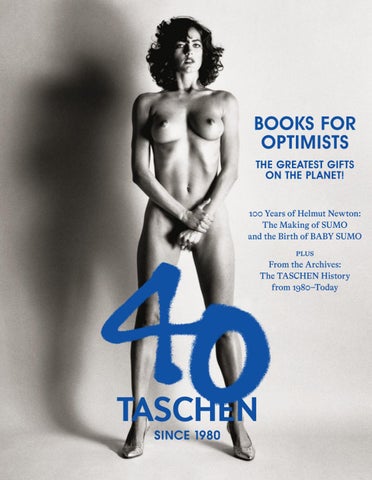
From the Archives
David Hockney, 2020
1980s Comic beginnings... ...for the young Benedikt Taschen: 18 years + 25 square meters = the first incarnation of TASCHEN COMICS! After years of collecting, he sets up his own store in Cologne, Germany, selling a huge selection of new and rare collector’s comics.
1980
18-year-old Benedikt Taschen at his first comic book store in Cologne.
Surreal success! Magritte saves the day (and the company). Penniless Benedikt borrows money wherever he can to buy 40,000 copies of a Magritte book printed in English. The gamble pays off: within a few days the entire stock sells out at the revolutionary retail price of 9.95 Deutschmarks.
1985 DALÍ by Conroy Maddox. The first two original TASCHEN books: Dalí and Picasso.
1980
1982
SALLY FORTH by Wallace Wood. The very first TASCHEN COMICS publication. He started his career as an EC Comics artist (40 years later: see our new XL The History of EC Comics book).
RAY BANANA by Ted Benoit.
1984
1985
MAGRITTE. IDEAS AND IMAGES.
PICASSO by Ingo F. Walther.
Invitation to the opening of the first store: “Germany’s largest specialist shop for comics and adjacent fields offers several thousand new publications from twelve countries around the world.” 1980.
A three-story store in Cologne becomes the new home of TASCHEN COMICS, 1982.
5
1989 1986 THE MAGIC MIRROR OF M.C. ESCHER
1988
1989
CONTEMPORARY ART
ARCHITECTURE OF THE TWENTIETH CENTURY
1987 ANTONI GAUDÍ. The first title in the Big Art Series.
The TASCHEN-mobile hits Europe— if you can’t get the books to the booksellers, bring the booksellers to the books (and keep them locked in the van until they seal their order!), 1986.
VAN GOGH. THE COMPLETE PAINTINGS. Marking the centenary of the painter’s death. “A magical book that says it all.” —La Provence
1985
“I don’t want a Taschenbuch... ...I want a book by TASCHEN!” A poster features Benedikt’s daughter Marlene (“Taschenbuch” means “paperback” in German).
1990s
June and Helmut Newton outside of TASCHEN’s headquarters, Cologne, 1999.
1990
Karl Lagerfeld celebrates the first book of his photographs at TASCHEN’s new headquarters in Cologne.
1990 GEORG BASELITZ
1991 STARCK
1991
1991
KIPPENBERGER
PICASSO
BAUHAUS
“the definitive introduction to the scope and range of Picasso’s work.”—The Times
“...finally a book that brings a breath of fresh air to the lifeless literature on Bauhaus.” —domus
1990
Georg Baselitz, Cologne, 1990.
Martin Kippenberger, Cologne, 1991. Philippe Starck, Cologne, 1990s.
1992 JEFF KOONS
1993 SOUTINE. CATALOGUE RAISONNÉ
1991 JEAN PROUVÉ
1994 DALÍ. THE COMPLETE PAINTINGS
1992
“Bound to become the standard reference work...” —Le Figaro
TOM OF FINLAND
William Claxton, Sunset Marquis Hotel, Hollywood, 1998.
Wolfgang Tillmans, Taschen residence, Cologne, 1997.
1999
Julius Shulman at his studio in the Hollywood Hills. “If buildings were people, those in Julius Shulman’s photographs would be Grace Kelly: classically elegant, intriguingly remote.” —ARTnews
Offended Jaybird veterans recently stormed the TASCHEN headquarters on Sunset Boulevard protesting the publication of TASCHEN’s bargain-priced LUTHER BIBLE. Coinciding with the release of their new TASCHEN book, NAKED AS A JAYBIRD, agitated nudist leader Mr. Edvin (“Ed”) Paas verbally attacked Lutheran elder Reverend Beaver: “We will not tolerate this unbalanced situation. There is no way our book can compete with our Christian brethren’s manuscript. Give us more color, more pages and a more competitive price.” Gathering at the rear entrance of Musso & Frank restaurant on Hollywood Boulevard, where the joyous Lutherans were celebrating their publication v ictory, the naked protesters verbally clashed with the Lutheran congregation claiming unfair price dumping. The wild-eyed naked Jaybird leader, proudly displaying his vintage ’70s “Jaybird seeks Jaygirl” placard, was heard screaming: “It’s all that bastard Taschen’s fault, let’s go get him!” “Wait a minute,” the Reverend replied. “We love our publication … but I agree, that porno-pushing publisher needs a lesson. Let’s go kick his ass!” The naked protesters and the Protestants marched hand in hand to the Crossroads of the World, where they staged their protest at the TASCHEN offices. An instant traffic jam ensued on the famous boulevard. Publisher Benedikt Taschen, warned of their approach by his sidekick Faulpelz, calmly observed the mob from his second-story office. Responding to their p rotests, Mr. Taschen invited the leaders of the heated parties up for coffee. The publisher offered them a deal they couldn’t refuse. “Qualified customers in the Bay Area and the Bible Belt will receive both titles for the price of one. I hope that this will encourage and promote a better understanding of your ideals.” And with a wink and a smile, Mr. Taschen declared, “That took 20 minutes. Everything is possible if you‘ve just got a certain amount of charm. Pussy, Protestants and Picasso—TASCHEN loves them all.”
1999 Albert Oehlen at the Chemosphere House, Hollywood.
1995
1994
CHRISTO AND JEANNE-CLAUDE WRAPPED REICHSTAG, BERLIN, 1971-1995. One of the first signed and limited editions.
PARIS INTERIORS
1995 ELMER BATTERS. FROM THE TIP OF THE TOES TO THE TOP OF THE HOSE
1994 ALBERT OEHLEN
1994
ERIC KROLL’S FETISH GIRLS
1995
WHAT GREAT PAINTINGS SAY by Rose-Marie and Rainer Hagen.
Frans Lanting, Bill Claxton, and Julius Shulman at the Chemosphere House, 1999.
Jorge Pardo, Chemosphere House, 1999.
17
1997
1999
FRANS LANTING. EYE TO EYE
1998 JULIUS SHULMAN. ARCHITECTURE AND ITS PHOTOGRAPHY
HELMUT NEWTON. SUMO
1999 1997 THE ART OF ERIC STANTON
ART AT THE TURN OF THE MILLENNIUM
“...the biggest bound volume produced in the 20th century: 460 pages, m easuring two and a half feet tall by one and a half feet wide, and weighing 66 pounds.” —Vanity Fair
© Alice Springs / Maconochie Photography
H.R. Giger, Zurich, late 1990s.
Benedikt Taschen, Billy Wilder, and Helmut Newton at the Chemosphere House in Hollywood, 1999. Photo by Alice Springs.
18
TASCHEN MAGAZINE
Š Alice Springs / Maconochie Photography
1999
Helmut Newton with the very first copy of SUMO in the courtyard of the TASCHEN HQ, Cologne. Photo by Alice Springs.
GOAT — knockout! Jeff Koons and Will Smith celebrating the launch of GOAT (The Greatest of All Time), 2003. A tribute to Muhammad Ali at the Miami Beach Convention Center, the historic site of Ali’s 1964 triumph over Sonny Liston.
2000s
2007
Vanessa del Rio Queen of ’70s porn takes the throne at the TASCHEN New York store’s launch of Fifty Years of Slightly Slutty Behavior.
2001 2000 NEUTRA. COMPLETE WORKS
ALBERTUS SEBA. CABINET OF NATURAL CURIOSITIES
2003 GOAT. A TRIBUTE TO MUHAMMAD ALI “This is not a book. This is a monument on paper, the most megalomaniacal book in the history of civilization, the biggest, heaviest, most radiant thing ever printed— Ali’s last victory.” —Der Spiegel WILDER’S 2001 BILLY SOME LIKE IT HOT
2002 THE LUTHER BIBLE
Howard Bingham, Ali’s best friend and principal photographer of GOAT, along with Neil Leifer, at his house in Los Angeles, 2002.
Rem Koolhaas, Cologne, 2001. 23
2003
2004
LEONARDO DA VINCI. THE COMPLETE PAINTINGS AND DRAWINGS
JAZZ LIFE by William Claxton and Joachim E. Berendt. The legendary photographic journey documenting the jazz scene of 1960s America.
“There’s no legal way of approaching Leonardo’s work more closely.” —The Financial Times
2004
2005
ANDO. COMPLETE WORKS
THE CURSE OF LONO by Hunter S. Thompson and Ralph Steadman.
CASE STUDY HOUSES. THE COMPLETE CSH PROGRAM 1945–1966
2002
Nobuyoshi Araki, Tokyo, 2003.
Zaha Hadid, London, 2006. Photo by Jason Schmidt. 26
TASCHEN MAGAZINE
2006 Christo and Jeanne-Claude at the TASCHEN Store New York.
2005 RENZO PIANO
2007 VANESSA DEL RIO
2006 DAVID LACHAPELLE. ARTISTS & PROSTITUTES
2006 PETER BEARD
2005 THE STANLEY KUBRICK ARCHIVES
Yumiko and Tadao Ando at the TASCHEN Store Beverly Hills, 2015.
Peggy Moffitt, David LaChapelle, Crystal Harris, and Hugh Hefner, TASCHEN office, Los Angeles, 2009.
2012
1,000 TASCHEN titles and counting Window display at Walther König’s legendary Cologne bookshop with an eclectic selection from the TASCHEN archive.
1986
2009
2004
1997
2008
2004
2011
1993
1997
1990
2010
1980
1998
1995
2009
1994
2000
2005
1984
2007
1997
1997
1998
2008
2001
2008
1996
2002 2011
1986
1986
1998
1991
1999
1995
1984
1994
2000
1987
2005
2009
1990
2010
1995
1988
2001
2010 2008
2002 2003
1997
Photo © Verena Günther
1991
11
2008
2010
1997
1991
2006
1984
2011
2005
1999
2004
2000
2010
2003
1988
2007
2000
2011
2008
1985
1990
2012
1998
1991
2011
2002
1995
1996
1999
1995
1995
2001
1989
2009
1982
1994
1994
2000
2003
2010
1997
1991
1986
2011
1992
2003
2001
2001 2009
2010
1998
2005
2001
2007
2002
2012 1991
2003
2012
2008 THE CIRCUS
2007 THE BIG BOOK OF BREASTS
2008 CHRISTOPHER WOOL
2009 NORMAN MAILER. MOONFIRE “The greatest book I have ever seen. The photography is unparalleled . . . more than just a book, it is an experience.” —American Photo
2009 LOS ANGELES: PORTRAIT OF A CITY
Dennis Hopper, Hollywood, 2009.
Terry Richardson and Benedikt Taschen, New York, 2010. Photographed by Terry Richardson.
2013 Keith Richards signing The Rolling Stones SUMO, Philadelphia.
David Hockney at the TASCHEN stand at Frankfurt Book Fair, 2016.
2010s
2019
SebastiĂŁo Salgado at the launch of Gold at Fotografiska Stockholm.
2011 KOOLHAAS/OBRIST. PROJECT JAPAN. METABOLISM TALKS
2011 FRÉDÉRIC CHAUBIN. CCCP. COSMIC COMMUNIST CONSTRUCTIONS PHOTOGRAPHED
2012 MARC NEWSON. WORKS
2010
2012
75 YEARS OF DC COMICS. THE ART OF MODERN MYTHMAKING
THE JAMES BOND ARCHIVES
Shigeru Ban in his studio, Tokyo, 2003.
Marc Newson at the TASCHEN Store Beverly Hills, 2012. 37
2017
Beverly Hills Mad Men Celebrating television genius at the launch of TASCHEN’s extensive two-volume record of Mad Men: Jessica Paré, executive producer/ director Scott Hornbacher, Kiernan Shipka, January Jones, creator Matthew Weiner, c ostume designer Janie Bryant, Christina Hendricks, and Jon Hamm, TASCHEN Store Beverly Hills.
2013 GENESIS. SEBASTIÃO SALGADO
THE ROLLING STONES. SUMO Authorized and signed by Mick Jagger, Keith Richards, Charlie Watts, and Ronnie Wood.
“My love letter to the planet.”
2013
2014
NATIONAL GEOGRAPHIC: AROUND THE WORLD IN 125 YEARS
2014 ANNIE LEIBOVITZ. SUMO
2014 AI WEIWEI
Claudia Schiffer and Mario Testino at the launch of Rio de Janeiro, Paris, 2009.
Valentino, Gwyneth Paltrow, Giancarlo Giammetti, and Udo Kier at the Chemosphere House, Hollywood, 2009.
40
TASCHEN MAGAZINE
2014
Annie Leibovitz with her SUMO at the Chemosphere House, Hollywood.
Today’s value
$ 22,500 (1,500%)
$ 12,500 (192%)
$ 2,000
$ 1,500
(667%)
$ 4,500
$ 4,500
(375%)
(450%)
(257%)
$ 24,000 (480%)
$ 3,00
(429%)
1999
2005
2006
2006
2007
2007
2008
2008
Ed. of 10.000
Ed. of 1.000
Ed. of 2.500
Ed. of 1.000
Art Ed. of 100
Art Ed. of 125
Ed. of 1.500
Ed. of 1.000
$ 1,500
$ 300
$ 1,750
$ 400
$ 6,500
$ 5,000
$ 1,000
$ 700
$ 20,000 (400%)
“TASCHEN books are almost designed to be collectible. It’s very common for a TASCHEN book to gain value almost instantly.”
$ 4,000 (571%)
Richard David, Abebooks, the world’s most popular platform for antiquarian books
$ 4,500 (450%)
$ 14,000
$ 2,500
(778%)
(500%)
00
$ 8,500
)
(340%)
$ 3,000 (300%)
$ 3,000 (429%)
2008
2009
2009
2010
2011
2012
2015
2016
Art Ed. of 100
Ed. of 1,000
Art Ed. of 300
Ed. of 1,500
Art Ed. of 125
Art Ed. of 250
Ed. of 1,772
Art Ed. of 250
$ 1,800
$ 700
$ 1,000
$ 500
$ 2,500
$ 1,000
$ 700
$ 5,000
2019
The McCartneys Mary, Paul, and Stella McCartney with Ringo Starr and Barbara Bach at the London launch of Linda McCartney’s The Polaroid Diaries.
2016 NAOMI Artwork by Allan Jones.
2018
THE STAR WARS ARCHIVES 1977–1983
2015 MICK ROCK. THE RISE OF DAVID BOWIE, 1972–1973 JAMES BALDWIN. STEVE SCHAPIRO. THE FIRE NEXT TIME
2015 ANDY WARHOL. POLAROIDS 1958–1987
“A beacon in dark times 50 years on.” —The Independent
2017
Stan Lee at his home with Benedikt Taschen, seeing the first copy of The Stan Lee Story after ten years in the making, Hollywood, 2018.
Rocky. The Complete Films launch with Sylvester Stallone at the TASCHEN Store Beverly Hills, 2019. 45
2016
Naomi Campbell with Lenny Kravitz and Dave Chappelle at the Chemosphere House, Hollywood.
2018 DAVID BAILEY. SUMO
2018 REMBRANDT. THE COMPLETE PAINTINGS
2019 JAPANESE WOODBLOCK PRINTS
2018 MURALS OF TIBET. SUMO by Thomas Laird. The treasures of Tibetan heritage, signed by His Holiness the Dalai Lama. “A significant contribution not just to Asian art, but to the humanities.”—The Metropolitan Museum of Art.
Lynn Goldsmith and Patti Smith at the TASCHEN Store Beverly Hills, 2019.
48
TASCHEN MAGAZINE
David Bailey at his SUMO launch, Claridge’s London, 2019.
His Holiness the 14th Dalai Lama (left) and Benedikt Taschen with the first edition of Murals of Tibet in Dharamsala.
2018
2016
Pope Francis Marlene Taschen presents Sebastião Salgado’s Genesis in St. Peter’s Square, Rome.
How a TASCHEN Book Is Made Behind the scenes of our production process and the challenges of creating some of the biggest books in the world.
During the binding process, the book block is pressed several times at different stages. The sewing of the book block is a semi-automatic process. For oversized books, the quality of a machine-sewn book block is superior to one that is hand-sewn. This one-of-a-kind machine can sew signatures measuring up to 70 cm (27.5 in.) in height. Mauro Loce, director of the bindery, presents the final art edition of Ferrari, which comes with a bookstand designed by Marc Newson.
The leather application on the case is done by hand. The socalled Oxford hollow is added to strengthen the spine. Finishing touch: the iconic Cavallino emblem is applied to the book’s cover.
The signatures (sheets of paper printed and folded) of the books are gathered manually.
A TASCHEN Tour The staircase at the TASCHEN headquarters in Cologne with works by Martin Kippenberger and Jeff Koons.
The 19th-century mansion in Cologne has been TASCHEN’s headquarters since 1990.
Door handle at the main entrance: Donald’s head cast in bronze from the first comic store in 1980.
The canteen: floor by Albert Oehlen and paintings by Martin Kippenberger.
Beverly Hills: TASCHEN’s first store in the U.S., designed by Philippe Starck with artworks by Albert Oehlen.
Milan: bookshelves by Marc Newson and floor by Jonas Wood.
Springfield: TASCHEN store in The Simpsons’ 2012 episode “The Day the Earth Stood Cool.”
The Simpsons TM and © 2012 Twentieth Century Fox Film Corporation. All Rights Reserved.
At the Claridge’s in London.
Martin Kippenberger, Cologne, 1991.
Meet the Artist TASCHEN has a longstanding tradition of book signings with a chance to add a personal touch to your books.
Araki, Paris, 2005.
Wolfgang Tillmans, London, 2013.
Renzo Piano, Paris, 2018.
61
Beatriz Milhazes, Miami, 2017.
Christo, London, 2018.
David LaChapelle, Milan, 2017.
Peter Beard, Paris, 2006.
62 
TASCHEN MAGAZINE
Peter Lindbergh, Berlin, 2016.
Tadao Ando, Los Angeles, 2012.
Naomi Campbell, London, 2016.
63
Walton Ford, Copenhagen, 2010.
INSANE! OUR GREATES HITS...
ST
HARDCOVER 512 PAGES
SHOWN HERE IN ORIGINAL SIZE
...FOR 25Â BUCKS A POP!
wolfgang tillmans Q&A
Eyes of Our Time Greifbar 61, 2017.
Wolfgang Tillmans installing the Concorde Installation at TASCHEN headquarters, Cologne, c. 1997.
In 1995 you published your first book with TASCHEN. How did your collaboration with TASCHEN start? That was in Cologne in 1993, when the city was the center of the German art scene. I had my first solo exhibition with Daniel Buchholz in the back room of a small antique shop he ran with his father. Burkhard Riemschneider, who was TASCHEN editor at that time, was one of the first people to buy a print from the exhibition. At a dinner in Daniel’s apartment, I asked Burkhard if he could imagine doing a book with me. A few months later, he brought Angelika Muthesius, then TASCHEN’s chief editor, to the gallery, and she fell in love with some of my photographs. In the meantime, I had started making a dummy made of color copies. It was finished by Christmas 1993, and I showed it to Angelika and Benedikt. Some friends of mine said that it was much too early to publish a big book at the age of 25, but I knew: this work has to be published. Thank God Benedikt thought the same way. Your first book, Wolfgang Tillmans (1995), was an instant success. Was that due to the zeitgeist? That term is sometimes used in a derogatory way, but it is actually a beautiful word: “the spirit of the time.” My book’s success was born out of a misunderstanding—people took it as a documentary record of the time, when instead I had compiled it equally of pictures that were staged and those taken as they were found. I was less concerned with depicting reality in a traditional way and instead created a fiction of possible lives and situations and social interactions, which were in themselves authentic to the spirit of the time. That gave the images power—people could identify with them—and their draw seems to not have waned ever since. Afterwards you made three more books with TASCHEN: Burg (1998), truth study center (2005) and Neue Welt (2012). What do they represent to you and how do they reflect your artistic development? I see my books with TASCHEN as equivalent to “albums” in pop music terms. They are the record of a longer stretch of time and personal development. They all share my desire to speak about what it feels like to be alive in the here and now. I want to make books that can be read and entered into by different people in different countries through their own eyes, allowing them to make connections to their own lives. These connections might not happen in every single image but if a reader gets a sense of “I know how that smells” or “I have an idea what that feels like” then I’m most happy. Because that is what art can do best: create a sense of solidarity amongst people. You have explained what connects these books, but how do they differ? The first book was born out of a knowing innocence, looking at life around me—the passion of being independent. Burg chronicles me enjoying the freedom of exploring artistic genres like still life and landscape whilst also living through a period of great love, sadness and loss. truth study center I completed seven years after Burg in 73
a very different world. I faced the outward disorder with a desire to order my photographs according to genres and types. My scope opened wider to include architecture as well as abstract pictures made without a camera, whilst still reserving a central focus for the human portrait and images of the body, including the sexual body. Another seven years later I published Neue Welt, which was a new beginning, a real challenge to myself. I wanted to look at the world in an even wider scope, traveling five continents and using for the first time a digital camera. I employed new layout techniques and embarked on making a new record of the visible world by embracing fragments of it that I found on the way. Books are an important part of your artistic expression. What do books mean to your practice? Photographs are wonderful in the way they are equally suited to sit on a wall as they are to be placed on a printed page. The portability and easy access of a book—especially a TASCHEN book—allows it to meet you in unexpected moments in your life. Books have a special tactile quality, the way they feel to the touch, and they have an intriguing smell! Taken all together these books seem to be a photographic document that attempts to document the world, however, it is rather a feeling that is described/depicted/illustrated. What did it feel like to you to bring all of them together and update them in this special year 2020? I most of all wanted to keep the integrity of each of the books, but also felt welcome to add an element of “remix” to them. Sometimes I inserted images from back in the time, and sometimes I confronted a new picture with some from 20 years ago, like for example a portrait from 2018 of Neneh Cherry, whose music I listened to a lot in 1993. Recent years up to 2020 are also represented, making the book a complete journey to right now.
“I see my books with TASCHEN as equivalent to ‘albums’ in pop music terms. They are the record of a longer stretch of time and personal development. They all share my desire to speak about what it feels like to be alive in the here and now.” Wolfgang Tillmans
WOLFGANG TILLMANS. FOUR BOOKS 40TH ANNIVERSARY EDITION 512 pages $ 25
What inspires you? This is a tough one, and I’m sure that’s why you ask it. Looking at the way things are, at how they appear from different angles, inspires me. To be open to being surprised, without fear—and making peace with that—inspires me. And of course being together with others, friends and lovers. What does TASCHEN mean to you? I truly respect TASCHEN’s respect for history. TASCHEN books as a whole build a memory of human exploration and that is truly important in our times. What’s your favorite TASCHEN book and why? Elmer Batters’ book of foot and leg fetishism impressed me deeply, as it was a perfect illustration of “form follows function.” The Leonardo da Vinci catalogue raisonné remains a permanent source of reference. Anders (Brighton Arcimboldo), 2005. 74
TASCHEN MAGAZINE
Courtesy Galerie Buchholz, Berlin, Maureen Paley, London, David Zwirner, New York
AI WEIWEI Wearable Art
Limited Edition Bags and Scarves by Ai Weiwei
All images courtesy of Ai Weiwei studio.
CATS AND DOGS
ZODIAC
AI WEIWEI. THE CHINA BAG Edition of 2,500 26.1 × 18.8 in. $ 500
Papercutting is a traditional Chinese art going back 2,000 years. The colored, intricately cut papers are used as a story-telling medium in festivities, for prayers, and as everyday decoration.
HAIRCUT
CITIZENS’ INVESTIGATION
CATS AND DOGS
AI WEIWEI. THE SILK SCARF Edition of 2,500 35.4 × 35.4 in. $ 300
The bags and scarves take their motifs from papercuts created by Ai Weiwei as part of his Papercut Portfolio, published by TASCHEN in 2019.
Reach Out and Touch Me
In 1981 Anton Corbijn first formally photographed synth teen idols Depeche Mode in London and Basildon, Essex, for an NME cover; in the foreground the smirking, blurred singer Dave Gahan, the rest of the band standing behind him smiling in sharp focus. According to Corbijn, the band was, at the time, “too poppy” for his taste. Fast-forward five years and Depeche Mode were transforming their sound and looking towards something more edgy and brooding. Corbijn came on board to do one video and became the band’s de facto creative director, and since 1986 he has crafted all their photography, most of the videos, album graphics, and set designs. Depeche Mode. Anton Corbijn is a detailed illustrated history of how Corbijn’s timeless visuals and epic but honest aesthetic have helped cement Depeche Mode’s reputation as the biggest cult band in the world. This Collector’s Edition features over 500 photographs from Corbijn’s extensive archives, some never seen before, including formal and informal portraits from places such as Madrid, Hamburg, the California desert, Prague and Marrakech (many taken during the making of iconic videos such as “Enjoy the Silence” and “Personal Jesus”); a multitude of off-the-cuff, candid images; and stunning live shots from all their tours since 1988. In addition to the photographs, there are sketches and designs for stage sets and album covers, Corbijn’s handwritten captions throughout the book, placing the reader right in the middle of the shoot, and an extended interview with the Dutch master. Created with the full collaboration of the band, who also share some insights on working with Corbijn, Depeche Mode. Anton Corbijn trumpets how one man’s original and unforgettable visuals helped shape the band’s enduring popularity. Reflecting on his expanded role in Depeche, Corbijn recalls in the book’s introduction: “A lot of it came down to me, and I wanted it to be right for them. I wanted to think for them. To be great for them.” This book is a testament to the depth and breadth of that greatness, a celebration of one of the most creative and enduring collaborations in rock history.
En route to LA 1988. Randers, Denmark 1987. 84
TASCHEN MAGAZINE
All photos © 2020 Anton Corbijn
DEPECHE MODE Anton Corbijn’s official illustrated history
Art Edition No. 1–100 SOFAD, London, 1992 Print signed by Anton Corbijn image: 15 × 15 in. sheet: 23.4 × 16.5 in. $ 1,800 86
TASCHEN MAGAZINE
Art Edition No. 101–200 SOTU, New York, 2008 Print signed by Anton Corbijn image: 15 × 15 in. sheet: 23.4 × 16.5 in. $ 1,800 87
“Anton was able to give the DM sound, that we were beginning to create, a visual identity.” Dave Gahan
88
TASCHEN MAGAZINE
Opposite: Randers, Denmark 1987. Madrid, 1992.
XXL DEPECHE MODE. ANTON CORBIJN Hardcover in clamshell box Collector’s Edition (No. 201–1,986), signed by Anton Corbijn; and Dave Gahan, Martin Gore and Andrew “Fletch” Fletcher. 512 pages $ 900 Creative director for Depeche Mode since 1986, Anton Corbijn’s timeless aesthetics have cemented the band’s reputation as effortlessly cool and cutting edge. With over 500 photographs from Corbijn’s personal archives, many never seen before, as well as stage set designs, sketches, album covers, and tour books, this volume visually amplifies the impact of Depeche Mode’s “fourth member.” Also available as two Art Editions of 100 copies each (No. 1–200), with a print signed by Anton Corbijn (see previous spread). 89
THE HISTORY OF EC COMICS The world’s most notorious comics
Calling All EC FanAddicts!
“ They were to me what Grimms’ fairy tales were to children in the 19th century.” Joe Hill
Johnny Craig Christmas cover of The Vault of Horror No. 35, 1954. Al Feldstein and Bill Gaines in the EC office, late 1950, with a rack of their latest comic books. 92
TASCHEN MAGAZINE
In 1947, Bill gaines inherited EC Comics from his legendary father M. C. Gaines, who was responsible for midwifing the birth of the comic book as we know it during his tenure at All-American Comics, bringing the likes of Wonder Woman and Green Lantern to the world. Over the next eight years, Bill Gaines—along with Al Feldstein, H arvey Kurtzman, and Wally Wood and others—would reinvent the very notion of the comic book with titles like Tales from the Crypt, Crime SuspenStories, Weird Science, and MAD. EC delighted in publishing gory, morbid horror and crime comics that had snap, ironic endings—but they also pioneered the first trueto-life war comics, the first “real” science-fiction stories, and tales about such then-taboo subjects as racism, bigotry, vigilantism, drug addiction, and police corruption. Too good to last, they were eventually caught up by various 1950s guardians of morality, who were convinced that EC’s often over-the-top content was causing juvenile delinquency. TASCHEN presents the full, fascinating story of this fabled company, written and expertly curated by EC-authority Grant Geissman. Even the most die-hard EC Fan-Addicts will find something new within these pages, with the Gaines family archives providing more than 100 rarities that have never seen print. Many of the cover images are reproduced from Gaines File Copies, which are widely regarded as the best surviving copies of the EC Comics. Gathering more than 1,000 illustrations that include the rarest and most notorious covers, interior pages, photos, vintage original artwork, and some of the most celebrated stories ever to be printed in four colors for a dime, this is the ultimate EC Comics compendium and a must-have for any comics enthusiast or pop culture historian.
if you’re a pop culture aficionado, you may already be familiar with Tales from the Crypt, the American television series that aired on HBO from 1989 to 1996. You may also remember Weird Science, the 1985 John Hughes feature film starring Kelly LeBrock and Anthony Michael Hall. And you almost certainly know MAD, the long-running humor magazine that has become an American institution. But generally only true pop culture cognoscenti know that each of these properties started out as full-color, 10-cent comic books, published by a small, scrappy company called EC Comics. So why should there be a gigantic, weighty tome in celebration of these comics? Put simply, because this lesser-known company had an enormous impact on American pop culture, managing to be both commercially successful as well as boldly innovative. At its creative peak in the 1950s, the EC line of comics included horror, crime, science-fiction, war, and humor titles. The list of writers and artists who contributed to—and produced some of their best work for—EC reads like a “who’s who” of mid-20th-century comic books, including Al Feldstein, Harvey Kurtzman, Johnny Craig, Jack Davis, Graham Ingels, Wallace Wood, Joe Orlando, Reed Crandall, Al Williamson, Bernie Krigstein, and Frank Frazetta. To hard-core EC fans—known as “EC Fan-Addicts” (who are, indeed, fanatics!)—these were simply the best comic books ever published. Counted among EC’s fans are some disparate pop culture luminaries, including novelists Stephen King and R. L. Stine, filmmakers George Lucas, Steven Spielberg, and George Romero, Underground Comix cartoonist Robert Crumb, Monty Python member/visionary director Terry Gilliam, and musician Jerry Garcia, all of whom point to EC as an important inspiration.
This amazingly influential company had some rather unlikely beginnings—dating back to the 1930s, to the actual genesis of the comics industry. This tale, like any good tale, has twists and turns, ups and downs, heroes and villains, thrills and chills, and even something like a Tales from the Crypt–style rise from the dead (but without the ghoulish retribution). So how did EC comics ascend from their humble beginnings to become some of the most celebrated—and most reviled—comic books of all time? Read on, if you dare! —Grant Geissman
“…remembered by generations of fans as an early pinnacle in art and story-telling, even as they were driven off the newsstands by the advent of the censorious comic code authority.”
Only the first printing of 5,000 copies comes with a numbered sticker.
“EC’s gruesome, fantastical and slapstick chromosomes course through the films of Joe Dante and George Lucas, of Steven Spielberg and Quentin Tarantino, and the novels of Stephen King.”
XXL
All Images copyright: TM & © William M. Gaines Agent, Inc.
THE HISTORY OF EC COMICS Grant Geissman 592 pages $ 200 Famous First Edition: First printing of 5,000 numbered copies
Johnny Craig Splash page from “Touch and Go!,” adapted from the classic Ray Bradbury story (Crime SuspenS tories No. 17, 1953).
Peter Beard A visionary artist who used photography, drawing, and collage to document a vanishing world
PETER BEARD 1938 — 2020
Artist, diarist, collector, and writer Peter Beard has fashioned his life into a work of art; the illustrated diaries he kept from a young age evolved into a serious career as an artist and earned him a central position in the international art world. He collaborated with Francis Bacon and Salvador Dalí, he made diaries with Andy Warhol, worked on books with scientists like Dr. Norman Borlaug, Dr. Richard Laws, and Alistair Graham, and toured with Truman Capote, Terry Southern, and the Rolling Stones— all of whom are brought to life, literally and figuratively, in his work. He delved into the world of fashion for its beautiful women, taking Vogue stars like Veruschka to Africa and bringing new ones back to the U.S. with him. After spending time in Kenya and striking up a friendship with the author Isak Dinesen (Karen Blixen) in the early 1960s, Beard bought 50 acres next to her farm with the stipulation that he would film and write about the land and its flora and fauna. He witnessed the dawn of Kenya’s population explosion, which challenged finite resources and stressed animal populations—including the starving elephants of Tsavo dying by the tens of thousands in a wasteland of eaten trees. So he documented what he saw—with diaries, photographs, and collages. He went against the wind in publishing unique and sometimes shocking books of these works, including The End of the Game. The corpses were laid bare; the facts carefully recorded, sometimes in type and often by hand. Beard uses his photographs as a canvas onto which he superimposes multi-layered contact sheets, ephemera, found objects, newspaper clippings that are elaborately embellished with meticulous handwriting, old-master inspired drawings, and often swaths of animal blood used as paint. In 2006, TASCHEN first published the book that has come to define his oeuvre, signed by the artist and published in two volumes. It sold out instantly and became a highly sought-after collector’s item. Now it is available in one large-format volume, along with a fresh new edition of his landmark publication on Africa’s wildlife crisis, The End of the Game.
XL PETER BEARD 770 pages $ 150 Also available: THE END OF THE GAME 292 pages $ 100
Previous spread: Reflections on Natural History, Moite Bay, Lake Rudolf, 1965/2004. Self-portrait, 1975. Opposite: Veruschka Rhino Roping in Darajani, 1964/2003. 100
TASCHEN MAGAZINE
© Peter Beard, Courtesy Peter Beard Studio, www.peterbeard.com
Walter Chandoha Dogs From the world’s most beloved pet photographer
© The Estate of Walter Chandoha.
Man’s Best Friend
Bulldogs, Long Island, New York, 1952. Walter Chandoha in his studio in New Jersey with his rescue dog, 1975.
“ Walking the supermarket pet-food aisle in the 1960s was like attending a Chandoha gallery opening; almost every brand used his work on its packaging at one point.”
Also available: CATS 296 pages $ 50
WALTER CHANDOHA. DOGS 296 pages $ 50 Walter Chandoha’s legacy as the 20th century’s greatest pet photographer lives on in this sequel to his critically acclaimed Cats. Featuring over 60 breeds, photographed in a variety of styles and locations, the book includes color studio and environmental portraits, black-and-white street scenes, dogs roaming free in the countryside, and vintage dog shows. 103
Walton Ford Pancha Tantra The painter’s sinister wildlife scenes in an updated edition
Walton and the Beasts
At first glance, Walton Ford’s life-size beastial tableaux recall the prints of 19th-century illustrators John James Audubon and Edward Lear. A closer look reveals a complex and disturbingly anthropomorphic universe, full of symbols and allusions to the “operatic” quality of traditional natural history. In this stunning but sinister visual world, beasts and birds are not mere aesthetic objects but dynamic actors in allegorical struggles. In dazzling watercolor, the images impress as much for their impeccable realism as they do for their complex narratives.
Silent film star Gloria Swanson, thrown to the lions in Male and Female, 1919.
Ars Gratia Artis 2017, watercolor, gouache, and ink on paper.
Ars Gratia Artis
This time I had to lie on the floor and remain absolutely still. I would ruin the scene if I couldn’t control my breathing. My back was bare to the waist. I could hear a lion’s claws scratching the floor as the trainer led him in on a leash. Then I could hear another trainer whisper to Mr. De Mille, who came and knelt beside me. “I must ask you something for your own safety,” he whispered. “You’re not menstruating, are you?” “No,” I replied very softly. He stood up and said to the trainer, “We can proceed. Everything’s fine.”
106
TASCHEN MAGAZINE
Then I could hear the lion breathing near me. They put a piece of canvas on my back to keep the lion’s manicured claws from making the slightest scratch. Then they brought the lion up to me and put his paw on the canvas. Ever so slowly they pulled the canvas aside until I could feel his paw on my skin. Every hair on my head was standing on end. I could hear the camera grinding and then the crack of the trainer’s whip. Every cell in my body quivered when the animal roared. His hot breath seemed to go up and down my spine. For an instant I opened my eyes a slit. Without raising my head, I saw lines of people ringing the set, motionless absolutely silent. Among them, in his uniform, his eyes popping almost out
of his head, was Daddy. His mouth hung open with horror at the sight of his one and only child with a man holding a gun beside her and a roaring lion standing over her. It was our first glimpse of each other in five years. When the scene was over, I could tell that Mr. De Mille was ecstatic. He said we would not reshoot it. He could tell it was perfect. He said if I had any energy left, he would like me to get into the moleskin evening gown so that he could redo one or two closeups. Then the shooting would be finished./ ——— From 1920s film star Gloria Swanson’s autobiography SWANSON ON SWANSON, Pocket Books, 1981. 107
108 
TASCHEN MAGAZINE
All images © Walton Ford, Photo on this page by Alyssa Robb for Wingate Studio
Walton Ford checking an early proof of the art edition Granary at Wingate Studio in New Hampshire. The six plate aquatint etching, Granary, depicts crimson-capped Acorn Woodpeckers guarding their cache of acorns as the Hollywood Hills— and the famed Stahl House—are threatened by wildfire.
XL WALTON FORD. PANCHA TANTRA 424 pages $ 80 This updated edition of Pancha Tantra is the most comprehensive survey of Ford’s oeuvre to date, with 40 new works, more than 120 additional pages, and a new essay by the artist. Also available as an Art Edition No. 1–100 Leatherbound, in slipcase With the six plate aquatint etching Granary, image: 12 × 9 in. sheet: 18.5 × 14 in. printed on Rives BFK paper Signed and numbered by Walton Ford $ 9,500 109
CABINET OF CURIOSITIES  Hidden treasures, exquisite beauty, and dreams of universal knowledge
Wunderkammer of the World
Photos Š Massimo Listri
Opposite: Rock crystal, malachite, amethyst, coral, and a very rare Seychelles nut that functions as the cup of a drinking vessel. Augsburg Arts Cabinet, Uppsala Universitet, Sweden.
Various specimens, including reptiles and amphibians, collection of shells and various kinds of crabs, corals, and gorgonians. Cabinet d’histoire naturelle de Clément Lafaille, Muséum d’Histoire Naturelle de La Rochelle.
The Wunderkammer, or “cabinet of curiosities,” saw collectors gathering objects from many strands of artistic, scientific, and intellectual endeavor, in an ambitious attempt to encompass all of humankind’s knowledge in a single room. From the Grand Duke Francesco I de’ Medici and Holy Roman Emperor Rudolf II to Archduke Ferdinand II of Habsburg, these aristocratic virtuosos acquired, selected, and displayed the objects in real-life catalogues that represented the entire world—spanning architecture, interior design, painting, sculpture, gemology, geology, botany, biology and taxonomy, astrology, alchemy, anthropology, ethnography, and history. Marvel at the unicorn horns (narwhal tusks), gems, rare coral growths, Murano glasswork, paintings and peculiar mechanical automata. Browse through illustrations of exotic and mythical creatures and discover the famed “Coburg ivories,” an astounding collection
of crafted artifacts. These collections are nothing short of a journey through time, from the Renaissance and Age of Discovery, the Mannerist and Baroque periods, up to the present day. Although many of these cabinets of curiosities no longer exist, others have been meticulously reconstructed, and new ones born. These marvelous cabinets of curiosities can now be explored by all in this XXL collection. To realize this mammoth undertaking, Massimo Listri traveled to seven European countries over several decades; the result is a set of gorgeous photographs, an authoritative yet accessible introduction, and detailed commentary on each of the 19 chambers highlighting the most remarkable items in each collection. Discover how these timeless treasures both describe and defined civilization, the modern concept of the museum, and our very knowledge of the universe.
113
XXL MASSIMO LISTRI. CABINET OF CURIOSITIES 356 pages $ 150
“Dive into a world of carved amber, magical coral and stuffed mermaids.”
Also available:
XXL MASSIMO LISTRI. THE WORLD’S MOST BEAUTIFUL LIBRARIES 560 pages $ 200
“Prepare to be transported to heaven on earth.”
114
TASCHEN MAGAZINE
Ornamental polyhedron; spheres with polyhedra; polyhedra with stars and cubes; Ivory, c. 1600. Coburg Ivories, Tesoro dei Granduchi, Florence.
Peter Lindbergh  An intimate personal statement by Lindbergh about his work
UNTOLD
STORIES
In memory of Peter Lindbergh by Wim Wenders What were Peter’s greatest talents? Asking that question, I’m not talking about photography, that goes without saying, that was his craft, his profession, finally his art, for which Peter Lindbergh became world famous. But… where did all that come from? It wasn’t just “there” as a stroke of genius, it had a source in his life. I include all of you who knew Peter and worked with him in my question, so you can all answer it for yourself: “What were his greatest gifts?” I try to define what comes to my mind. I sometimes watched him work, on beaches in Normandy, in the streets of New York, 118
TASCHEN MAGAZINE
in industrial ruins in Berlin or on rooftops in LA, and what strikes me most in my memory now, Peter, is how much you were always laughing, and how that joy came from a soul entirely living in the moment, immersed in a constant joyful present. And everybody on the set was totally involved in your world.
Previous: Sasha Pivovarova, Steffy Argelich, Kirsten Owen & Guinevere van Seenus, Brooklyn, 2015. Peter Lindbergh and Wim Wenders. Photo by Stefan Rappo. Kara Young Duisburg, 1984.
The recording instrument for that magical present tense was your camera, Peter, and it wasn’t measuring time in seconds, or fractions of seconds, but in exposures, and it went incredibly fast sometimes, click-click-click-click-click-click-click and sometimes more hesitantly, click —— click ... With your camera you were generating and shaping a present tense. Fully being there in every moment, that is already a huge accomplishment, but taking others along with you into that time zone, and stretching those moments, not only for yourself, but for those around you to some kind of tiny joyful eternities, that is an incredible gift! You had it in you to make that carelessness contagious and include others in that lightness of being. That was the bliss in which your photography blossomed and in which the most impossible things became possible. By pulling others into this state, you gave them the rare chance to let go and free themselves of that net that life so often throws over us and makes us become actors of ourselves. In the bliss of your look and in front of your camera, people weren’t just beautiful, not just supermodels, not just icons, but women (and sometimes men) in all their glory of freedom, of equality, of sister- and brotherhood and thus, yes, of a different beauty. Nobody else, it seems to me, had that liberating gift, could control at the same time a whole machinery of electricians, of wardrobe and make-up artists, grips and prop men and make it all look like the easiest thing in the world. Inside that magic presence you created little pockets of solitude in which you could also be alone with a person, just you, the other, and your camera, in the now, in that joyful experience of the sheer moment. But that was not all. Your other great gift, Peter, was your generous friendship. You were such a good friend! Yes, that is an art, too! More than ever! You were a good friend to many of us here, made so many of us feel that you were happy to see us, and that was never an act, never phony, never just a show. You gave us all the most heart-felt unique “Peter hugs,” and to feel your big solid body in those embraces was a unique experience, because we physically realized how giving, sharing, and ... kind you were. 119
All images Š Peter Lindbergh Foundation
Let me say this word again, because it has become so rare today and almost lost: you were such a kind man, Peter! Your kindness and generosity were genuine, they were your favorite state of being. All of that was condensed in that wide awake pair of eyes behind those almost invisible glasses over that big smile shining through that stubble on your face. Those eyes were always sparkling with joy, and when our gaze met them, that joyfulness jumped over and started to work in us. We’re all not strangers to such joy, to such kindness, to such knowledge of the present tense, we have it in us, but we have mostly forgotten it. It is the child we all carry in us, but you preserved it, Peter, you kept it alive and intact. You hadn’t lost the ability to draw from that well of childhood. That was the open source in your art and in your life. Just remembering this child shining through your eyes will always bring a smile onto our faces. One of the last times I saw you, Peter, was early in the morning. I tip-toed through your studio to leave the house, and there you were, lying on your sofa, sleeping, all dressed, with your open computer resting on your stomach. I had left you, late the night before, in your studio when you had shown me some series of photographs you had taken recently and that you were fond of. Those were pictures of Peter Handke, and you were so glad about your encounter, and the other series was a photo session with that wise rebel child Greta Thunberg. You also enthusiastically described how you met her. And then we said good night, and I knew you still had long and lonely hours in front of you. That was the reverse angle of your joyful shooting sessions: those long nights of going through thousands of raw photographs and selecting quietly, seriously, painstakingly, fully concentrated, alone.
XL PETER LINDBERGH. UNTOLD STORIES 320 pages $ 80
Also available:
XL PETER LINDBERGH. ON FASHION PHOTOGRAPHY 472 pages $ 70
XL PETER LINDBERGH. DIOR Two volumes in slipcase 520 pages $ 200
Those eyes remain closed now that saw and loved so many of us here and that gave all of us so much light and lightness. These eyes taught millions to see beauty not only as a product of fashion, but as our innermost human propensity for freedom, kindness, a sense of identity, and joy and for the right of inhabiting the child in us. We’re all grateful that you were and are and always will be in our lives, Peter. Church of Saint-Sulpice, Paris, September 2019
Querelle Jansen Paris, 2012. 121
Library of Esoterica Astrology and Tarot From ancient knowledge to modern-day practice
A Date with Destiny The Library of Esoterica explores how centuries of artists have given form to mysticism, translating the arcane and the obscure into enduring, visionary works of art. Each subject is showcased through both modern and archival imagery culled from private collectors, libraries, and museums around the globe. The result forms an inclusive visual history, a study of our primal pull to dream and nightmare, and the creative ways we strive to connect to the divine.
“This book reminds us of our eternal and universal search for meaning, purpose, and the divine.� itsnicethat.com
Previous: Paul Rumsey Astrologers, 2020. Pamela Colman Smith The Wheel of Fortune from the Rider-WaiteSmith Tarot, 1910.
Paul Rumsey at Chappel Galleries Essex UK (previous) / © U.S. Games Systems / © A. A. Khan & Michael Eaton / Cover Julia Turk
Opposite: Michael Eaton & A. A. Khan Strength, The Black Power Tarot, 2015.
124
TASCHEN MAGAZINE
LIBRARY OF ESOTERICA. TAROT Jessica Hundley 520 pages $ 40
To explore the Tarot is to explore ourselves, to be reminded of the universality of our longing for meaning, for purpose and for a connection to the divine. This 600-year-old tradition reflects not only a history of seekers, but our journey of artistic expression and the ways we communicate our collective human story. For many in the West, Tarot exists in the shadow place of our cultural consciousness, a metaphysical tradition assigned to the dusty glass cabinets of the arcane. Its history, long and obscure, has been passed down through secret writing, oral tradition, and the scholarly tomes of philosophers and sages. Hundreds of years and hundreds of creative hands—mystics and artists often working in collaboration—have transformed what was essentially a parlor game into a source of divination and system of self-exploration, as each new generation has sought to evolve the form and reinterpret the medium.
Author Jessica Hundley traces this fascinating history in Tarot, the debut volume in TASCHEN’s Library of Esoterica series. The book explores the symbolic meaning behind more than 500 cards and works of original art, two thirds of which have never been published outside of the decks themselves. It’s the first ever visual compendium of its kind, spanning from Medieval to modern, and artfully arranged according to the sequencing of the 78 cards of the Major and Minor Arcana. It explores the powerful influence of Tarot as muse to artists like Salvador Dalí and Niki de Saint Phalle and includes the decks of nearly 100 diverse contemporary artists from around the world, all of whom have embraced the medium for its capacity to push cultural identity forward. Rounding out the volume are excerpts from thinkers such as Éliphas Lévi, Carl Jung, and Joseph Campbell; a foreword by artist Penny Slinger; a guide to reading the cards by Johannes Fiebig; and an essay on oracle decks by Marcella Kroll. 125
LIBRARY OF ESOTERICA. ASTROLOGY Andrea Richards, Jessica Hundley (ed.) 520 pages $ 40
Vladimir Manzhos Waone The Magus, 2012–14.
William Law The True Principles of All Things from The Works of Jacob Behmen, Vol. 3, by Dionysius Andreas Freher, 1764.
From the beginning of human history, individuals across cultures and belief systems have looked to the sky for meaning. The movement of celestial bodies and their relation to our human lives has been the central tenant of astrology for thousands of years. The practice has both inspired reverence and worship, and deepened our understanding of ourselves and the world around us. While modern-day horoscopes may be the most familiar form of astrological knowledge, their lineage reaches back to ancient Mesopotamia. As author Andrea Richards recounts in Astrology, the second volume in TASCHEN’s Library of Esoterica series, astronomy and astrology were once sister sciences: the King’s Chamber of the Great Pyramid at Giza was built to align with constellations, Persian scholars oversaw some of the first observatories, and even Galileo cast horoscopes for the Medicis. But with the Enlightenment and the birth of exact science, the practice moved to places where mystery was still 126
TASCHEN MAGAZINE
permitted, inspiring literature, art, and psychology, and influenced artists and thinkers such as Goethe, Byron, and Blake. Later movements like the Theosophists and the New Agers, would thrust the practice into the mainstream. Edited by Jessica Hundley, this vibrant visual history of W estern astrology is the first ever compendium of its kind, exploring the symbolic meaning behind more than 400 images, from Egyptian temples and illuminated manuscripts to contemporary art from across the globe. Works by artists from Alphonese Mucha and Hilma af Klint to A rpita Singh and Manzel Bowman are sequenced to mirror the spin of the planets and the wheel of the zodiac. With a foreword by legendary astrologer Susan Miller and wisdom from new interviews with astrologers like Robert Hand, Jessica Lanyadoo, and Mecca Woods, Astrology celebrates the stars and their mysterious influence on our everyday lives.
127
Manzhos Waone (Ex Interesni Kazki) / Embassy of the Free Mind
TATTOO 1730s–1970s Henk Schiffmacher’s Private Collection A personal history of tattooing
Flash Back: A Life in Tattoos by Henk Schiffmacher the magpie of tattoo collecting There has always been a part of me that’s like a magpie, the bird that makes off with anything that shines. In the old European sagas, they were known to steal jewelry and put it in their nests. When I was a kid, I had little collections of Neolithic stones, and flints, and arrowheads, and other treasures like birds’ eggs and dead birds. I would take the wings off the birds and dry their skulls, and display all of it on nails on my wall. I would make endless drawings and hang those up too. I pilfered things from my dad’s old trunks from his time as a Dutch marine in Indonesia. I put a sign on bedroom door, “My Museum.” I wanted to bring the world outside in. I knew I was not going to stay in this little village for long. My father was a butcher, and he would send me and my five brothers and two sisters out to deliver meat scraps to the Dutch farmers who were really poor back then. I would step off my bicycle into the snow and step into these ancient farmhouses. The people still dressed in their traditional clothing. As soon as I had a camera, I went back and took pictures of these people with my father. He discovered photography with me, and we started taking photographs together. My father was not an easy man. He was troubled by his experiences in World War II and the Indonesian War of Independence, and was haunted his whole life by the death of one of his brothers who’d been a resistance fighter against the Nazis. His big love was history. I could get a little bit of this love if we talked history, so I learned to ask questions to get him to talk. My father and his six brothers would tell a lot of stories. As a child, I would stay up late listening to them from behind the sofa. All of this developed my eye and my ear, and my appreciation for people’s personal stories, and their pain. 128
TASCHEN MAGAZINE
Previous: George “Captain” Costentenus, c. 1880. Born in Albania, he was the first to get entirely tattooed for show. He claimed to have been tattooed by Mongols. His Burmese tattoos were the work of a skilled nonWestern artist whose identity we don’t know. Henk and Louise Schiffmacher in their tattoo studio in Amsterdam, Schiffmacher and Veldhoen Tattooing. Photograph by Tino Konino.
An album of original tattoo designs by unidentified British tattoo artist, c.1918–20s. This kind of album was a tattooer’s bread and butter. It would have been used as a table book you could take on the road. Given the dress code back then, the private part of your body was much bigger than it is now. And inside this large private zone, they would put very private tattoos like these. These were private jokes.
130
TASCHEN MAGAZINE
My life has always been a life in pictures. I grew up in the Catholic Church surrounded by pictures of saints and sinners. I was an altar boy, and the path inside the church to the Crucifixion was like a comic book for illiterate people. I hated the strictness of the Church, but I loved the images and the stories, like the Crucifixion, the Stigmata of St. Francis, medieval martyr pictures, and later the work of H ieronymus Bosch and Albrecht Dürer. I was dyslexic, so I would very much think in pictures rather than words. The only book we had in the house was Gustave Doré’s illustrated bible, La Grande Bible de Tours. I would sit and look at the fantastic etchings for hours. That was my world. My father was a butcher; my grandfather was a butcher. We weren’t “book people,” but I loved books. It took an enormous effort at the beginning, but by twelve, I was reading anything I could find. In Catholic school, nuns were my first teachers. For art, they would give each of us a piece of paper. Paper was expensive, and you knew you weren’t going to get another one, so you filled the whole paper, edge to edge. Our drawings always ended up very baroque. That’s still how I draw. The church priests started asking me to draw things for them, but pretty soon, I was too hot to handle and left school. I wasn’t interested in a life of Heaven and Hell and nothing in between. People would tell me, “Act normal. Normal is crazy enough.”
But that was not my thing. Because of my difficulties in school, I had something to prove. I very much felt the urge to fight back against the world, and my growing knowledge of history and my drawings were my protection. I had to fight for a while internally to turn this frustration around, but it was this agitation that made me curious. It made me a little curious kid for life. birds of paradise When I was off the leash and went into the world, I had two skills: loving history and drawing. When I first started hanging out in the tattoo world in the early 1970s, it was the early days of what people now call the renaissance of Western tattooing. I was fascinated by the whole underground world that was starting to bubble up onto the streets of Amsterdam. I was really into Diane Arbus, and I had an urge to take pictures of the people we in Holland call “birds of paradise.” Sometimes they were drunks. Sometimes they were sailors, sometimes they were just hardworking people—I was interested in anyone who had a story to tell. To me, it was the tattoos that told way more about the person than anything else. I thought it was an incredibly honest thing to do. These people weren’t often able to communicate very well, but nonetheless, had made this effort to make sure that their message
was clear. I understood that. Tattooing fascinated me because it was about the power of images. It’s a simple language, a very primitive form of communication. We all know the cross, the anchor, the heart. They are simple, but they tell you something about the person in a very direct way. I have a piece of skin in formaldehyde that is one hundred and fifty years old. The guy is gone and forgotten, but his tattoo still communicates with me every day. giving your body to it Through my friendship with Tattoo Peter and other tattoo artists I met in his shop in Amsterdam starting in 1974, I became pen pals with tattoo artists around the world. They would send me their drawings, and I would send them my photographs. That was the beginning of the collection. Slowly my collection started to grow, and I started tattooing, which felt really natural because of my love of drawing. Back then, if you wanted to learn to tattoo, you got tattooed. You gave your body to it. You used your own body to learn, and you stole with your eyes. People were really secretive back then. Everybody held their cards close to their chests, but it was still all about personal relationships, and with only about four hundred artists worldwide, you had to travel. When I started traveling, I would meet all these different people, 131
Right: Woodblock print of tattooed Kabuki hero Danshichi Kurobei, 1840. In the decades after Kuniyoshi’s smash-hit woodblock prints illustrating the sixteenth-century novel Shuihuzhuan (Water Margin) were released in 1827–1830, the market was flooded with action scenes of warriors, inspiring large-scale Japanese tattooing, which continues to this day.
Below: Māori woman with chin moko and feather from the prized huia bird, c. 1900s. They say tattooing started in New Zealand when the women cut themselves mourning their dead and then rubbed themselves with soot.
Opposite: Original album of tattoo designs by George Burchett, c. 1910s. You can see the heavy influence of Japanese tattooing in this album in the dragons, birds, and snakes. The extraordinary artistry of these images shows Burchett’s prodigious talent.
whether in Morocco, or Borneo, or Japan, and our whole conversations would be on pieces of paper. These pictographic conversations were an international language I felt immediately comfortable with. a living history For many of us in the tattoo world, collecting tattoo artifacts has been the only way we have ever been part of art history. Just like the earliest cave drawings, the primitive markings of the earliest tattoos link us to the human need to express ourselves in the face of brutal realities, whether as medicine or for religious reasons or to remind us where we came from. This is the beginning of an artistic instinct. Tattoos are the poor man’s Rembrandt, and everyone who is tattooed is part of an art history that has been under the radar for a long time. That’s the magical thing about it. We don’t really need it. You can’t eat the damn thing. But we really, really need to express ourselves. It is a very strange type of food, but it’s essential, and tattoo artists have known this all along. This whole collection is a monument to the old world of tattooing that I fell in love with when I first started out. Whether it’s a dragon in the old Japanese style, or a tattoo of Florence Nightingale, or “Homeward Bound” on a sailor during World War II, the images—as well as the tattooed people—have their own histories. My own journey in tattooing is made up of all these other people’s personal histories too, and this book is a testament to this. It’s a house of cards built on the backs of hundreds of other artists, but it won’t fall too easily because it’s been inked on skin. Just like Greek myths, or Roman architecture, or fairy tales, tattoos are sources of endless fascination and inspiration. I hope these images and stories will inspire others to keep this history alive.
132
TASCHEN MAGAZINE
All images courtesy of Collection of Henk Schiffmacher / Schiffmacher Tattoo Heritage.
“This book is so badass, loaded with fantastic shit from the history of tattooing that I’ve collected over 40 years. There’s a lot of stuff in it that’s never been seen before. This has been a serious labor of love.” Henk Schiffmacher
Tommy Stephens tattooed by Bert Grimm, c. 1940s. This chest piece is one of my favorite Bert Grimm tattoos. This is what great tattooing looks like. He was a master and absolutely knew what he was doing.
XL TATTOO 1730s–1970s. HENK SCHIFFMACHER’S PRIVATE COLLECTION OF THE ART AND ITS MAKERS Noel Daniel (ed.) 440 pages $ 175 Famous First Edition: First printing of 10,000 numbered copies Legendary tattoo artist, historian, and beloved raconteur Henk Schiffmacher takes us through 180 years of tattoos from Japan and New Zealand to the Bowery. This oversized, personal exploration of tattoo art gathers 800+ images from Schiffmacher’s renowned collection of ephemera—including extremely rare flash sheets from giants in early tattooing, original drawings, and photographs— into one unprecedented collection. 135
fantasy art Meet the genre’s biggest heroes: Frank Frazetta, Philippe Druillet, Boris Vallejo
Myth, Muscle and Sexy Maidens by Dian Hanson
136
TASCHEN MAGAZINE
138
TASCHEN MAGAZINE
Left: Courtesy of Heritage Auctions. © 2020 Marvel
the origins of fantasy art trace to folklore, fairy tales, religious allegory and mythology, and probably back to the cave, where early humans huddled in fear of unexplainable events, inspiring the invention of gods and monsters. No subsequent science has erased our species’ yearning for all-powerful heroes to vanquish the monster under the bed, or our satisfaction in watching the battle from the safety of our duvets. Some conflate fantasy with sci-fi, but sci-fi, based on science, turns on the possible, on mastering the universe through human technology, while fantasy fashions dream worlds that can never be, a creative step beyond. A spaceship, no matter how improbable, is sci-fi; a winged dragon is fantasy. Fantasy art as we know it today evolved from England’s Golden Age of Children’s Literature, launched in the 1860s with “toy” books of fairy tales, featuring imaginative painted covers. Their immediate popularity led to more fantasy fiction with illustrated chapter openers, and finally, in 1902, to Beatrix Potter’s The Tale of Peter Rabbit, the first children’s book illustrated throughout. While fantasy was considered too infantile for adults, art world evolution was chipping away at the barrier. The sinuous nature-inspired cult of art nouveau, encompassing craft and architecture as well as art, had undeniable fantasy elements. It was realism on steroids, a sensually overgrown garden of earthly delights, without the ironic horror of Bosch’s infamous masterwork. Many fantasy artists cite art nouveau as an early inspiration, though surrealism, following in 1920, is the most direct precursor of the genre. Like fantasy art, surrealism is grounded in recognizable people, places and things, altered in an
attempt to “resolve the previously contradictory conditions of dream and reality into an absolute reality, a super-reality,� as Andre Breton defined it in 1924. Unlike surrealism, however, contemporary fantasy art was born of commerce, introduced in 1923 with Weird Tales magazine, an American pulp title featuring short fiction wrapped in luridly painted covers. The first artists were veteran magazine illustrators with no particular specialty, quickly replaced by those crafting a new genre of fantasy art for adults, combining menace, in the form of monsters, with sex, as damsels in distress, and heroes, to slay the first and save the second. The great fantasy writers Robert E. Howard, H. P. Lovecraft, Ray Bradbury, Arthur C. Clarke, Frank Herbert and others got their start in Weird Tales and its imitators, while every artist in this book owes his or her career to J. Allen St. John, Margaret Brundage, Virgil Finlay, Hannes Bok and fellow fantasy art pioneers who granted us permission to remain imaginative for life.
Previous: Moebius Arzak, le rocher, 2015 @ Moebius Production.
Norman Saunders Cover painting for Marvel Science Stories, 1939.
Greg Hildebrandt Aladdin 1984, for Favorite Fairy Tales.
Philippe Druillet
He was born in the city of Toulouse on June 28, 1944, to Fascist parents about to flee, and named after Philippe Henriot, a collaborator known as the “French Goebbels.” The first doctor to examine the child was arch-nihilist author Louis-Ferdinand Céline. The family lived in Spain until Druillet’s father died in 1952. Back in France, the creative child took inspiration from Gustave Doré and Gustave Moreau. He became a photo grapher and French correspondent for Famous Monsters of Filmland magazine. After meeting his first wife, Nicole, he began to draw in earnest, producing what would become his most famous character, Lone Sloane, in 1966. In 1969, Druillet began working with Pilote, the s eminal bande dessinée magazine. Saturday nights at Druillet’s home became a kind of salon for the cutting edge of French comic artists and writers. In December 1974 four of these visionaries, Jean-Pierre Dionnet, Moebius, Druillet, and financier Bernard Farkas, released Métal Hurlant magazine to showcase this new breed of comic artists. “It was a period of madness,” said Druillet. Nicole’s death by cancer the following year sent Druillet deep into depression, addiction, and work. He produced the classic La Nuit—a tale in poison red and toxic green of a dying Earth ravaged by mad bikers—to address his demons. In 1979, Druillet remarried and, though still pursued by depression, his resumé in the following decades reflected how Métal Hurlant helped carve out a wider space in European culture for comic artists. He created editioned prints, sets and storyboards for a sci-fi adaptation of a Wagner opera, sculptures, furniture, jewelry, lighters and perfume bottles, designed logos and advertising campaigns, and began, in 1981, to draw his most ambitious literary adaptation to date: Gustave Flaubert’s Salammbô as space opera. Even more surprising, Druillet then adapted his adaptation into a video game that—at least visually—did it justice (Salammbô: Battle for Carthage, Cryo Interactive, 2003). It is in that new medium that Druillet’s influence on our visual world can be most firmly, if belatedly, felt. Most gamers are now familiar with cities of batwing and bone and with squared and howling mouths set in slit-eyed barbaric slab-sided orc heads that trace their lineage back to the rigid Technicolor mouthfuls of anguish and defiance in Druillet’s most distinctive faces. —Zak Smith
Philippe Druillet in his Paris studio, c. 1995. Photo by Gilles Rousset. Opposite: Philippe Druillet Petite femme de la nuit, 1978. 140
TASCHEN MAGAZINE
Frank Frazetta
Frank Frazetta is the unquestioned god of fantasy art, a master of muscle and menace, of fleshy fair maidens and lurking dark forces. And as if talent and imagination weren’t enough, the guy had movie star looks, personality, and charm. He was born Frank Frazzetta (he dropped a z) in Brooklyn in 1928, and enrolled in the Brooklyn Academy of Fine Arts, at a cost of $8 a month, in 1936. At 15 he found work with Bernard Baily Studio, and by 1948, just 20 years old, Frazetta was a fully established artist, drawing Western, mystery, historical, and fantasy comics for multiple publishers. In his spare time, he played baseball, and was famously scouted by the New York Giants for their farm team. In late 1962 fellow artist Roy Krenkel found him a job with Ace Books, doing covers and spot illustrations for a series of Edgar Rice Burroughs novels—mostly Tarzan. This is where his fantasy work began, and he immediately picked up similar commissions for Lancer Books, Canaveral Press and Fawcett Publications. The book covers led to 32 memorable covers for Warren Publishing’s Creepy, Eerie, and Vampirella magazines, including the defining first cover for the latter. And then came Conan. Up until 1966 all of Frazetta’s work was done “for hire,” which allowed publishers to keep his originals. This changed when Lancer Books commissioned covers for the first comprehensive paperback series of Conan. Frazetta agreed only on condition he retain the rights to his originals, then created eight stunning career-making covers. From then on Frazetta was the first name in fantasy art, for movie posters, book covers, album covers for Molly Hatchet and Nazareth, for multiple monographs, and for the Ralph Bakshi film Fire and Ice in 1982. By 1990 Frazetta was refusing most book cover, magazine, and poster work in favor of original painting commissions, but his health was failing. It took years to diagnose hyperthyroidism, which led to the first of many strokes in 1995. The strokes numbed his right hand, so he taught himself to paint with his left and soldiered on. When his wife Ellie died in July 2009 Frank lost interest in life. He died less than a year later, on May 10, 2010. Two months after Frazetta’s death Kirk Hammett of Metallica paid the Frazetta heirs $ 1 million for Conan the Adventurer, finally breaking up the eight Conan paintings that crowned the god of fantasy art. —Dian Hanson
Opposite: Frank Frazetta Moon Maid for the cover of the 1974 Ace Books edition of Edgar Rice Burroughs’ The Moon Maid. Frank Frazetta in his Brooklyn studio, 1966. 143
Boris Vallejo
No matter the alleged subject—fantasy, science fiction, erotica, comics, or even the occasional comedy commission—Boris Vallejo’s real subject is always the body. These bodies do a thousand things in his work: wield weapons, embrace demons, stand dazzled or defiant before mythical creatures, recline against rocks and trees, ride flying dragons and unicorns past richly colored planets and clouds, twist, wrestle, emerge from massive eggs and flowers, curl beneath black leather or butterfly wings, and sinuously crawl across landscapes and each other—while remaining perfectly lit, heroically posed, intrepid, stoic—bodies. Born in 1941, the son of a prominent lawyer in Lima, Peru, Vallejo found his first illustration job and first bodybuilding magazine in 1957, at age 16. After a two-year detour into medical school—which left him with an even greater knowledge of anatomy—Vallejo arrived in New York in 1964, carrying little more than his violin, $80, and some samples of his work. Soon he was doing covers for Warren and Marvel magazines like Eerie, Dracula Lives!, Tales of the Zombie, and Savage Sword of Conan, developing his trademark style. In 1975 he shifted from magazines to book covers, including an entire series featuring his childhood hero, Tarzan. Vallejo’s talent for richly rendering human (and reptilian) flesh—complete with tan lines and all the gradations of tone—elevated his work above a hoard of pretenders. “Students ask us what colors we use for skin tones,” (the “we” here includes Vallejo’s second wife, Julie Bell) “and really there is no such thing. When we paint skin tones we practically use the whole palette we have available. Normally I have on my palette anywhere between 18 to 24 colors.” In 1980 Vallejo began publishing a new calendar each year and taking movie poster commissions for fantasy films including Barbarian Queen and Deathstalker, while for National Lampoon he ironically referenced his own style for their Vacation and European Vacation posters. He generally uses live models for reference, and in 1989 he invited a fellow bodybuilder to model at his studio. She was a painter, too. They fell in love, and after their marriage in 1994 Boris Vallejo and Julie Bell became known as the “First Couple of Fantasy Art.” Today, at age 79, Vallejo still gets up every day eager to get in the studio. As long as the commissions keep coming, he continues to work, precisely, confidently continuing his celebration of the human body in action. —Zak Smith
Boris Vallejo in his studio, Allentown, Pennsylvania. Photo by Julie Bell. Opposite: Boris Vallejo Nubian Warrior, 1978. 144
TASCHEN MAGAZINE
XXL MASTERPIECES OF FANTASY ART Dian Hanson 532 pages $ 200 Famous First Edition: First printing of 7,500 numbered copies Featuring Julie Bell, Philippe Druillet, Frank Frazetta, H. R. Giger, The Brothers Hildebrandt, Jeffrey Catherine Jones, Rodney Matthews, Moebius, Rowena Morrill, Sanjulian, Boris Vallejo, Michael Whelan, plus 99 more. This monster-sized tome features original paintings, contextualized by preparatory sketches, sculptures, calendars, magazines, and paperback books for an immersive dive into this dynamic, fanciful genre.
“It was likely the first art you really enjoyed, discovered on a comic book, paperback or record cover. You’d almost feel the blood vessels expanding in your brain as you absorbed the rich colors, the alien landscape, the idealized human figures.” Dian Hanson
The Star Wars Archives 1999–2005 Volume two of the definitive exploration of the Star Wars galaxy
May the Force Be With You
“Something like Star Wars is at least 10 times as much work as any other movie because of the breadth of ideas that have to be put into creating an entire world at all levels—from cultural to physical, it’s very difficult.” George Lucas
The Phantom Menace (1999) A pneumatic ramp is used to enhance Ray Park’s (Darth Maul) dramatic leap in a remarkable display of acrobatics as Rob Inch (doubling as Qui-Gon Jinn) swings his lightsaber.
Attack of the Clones (2002) Jango Fett (Temuera Morrison) in full bounty hunter costume. The Phantom Menace (1999) George Lucas directing Jake Lloyd in Tunisia. Opposite: Attack of the Clones (2002) Filming Christopher Lee (as Sith Lord Count Dooku) astride his speeder bike, a wind machine swishing his cloak. As digital technology progressed the filmmakers realized that they only needed to make the parts of the set that the actors interacted with.
All photos: TM & © 2020 Lucasfilm Ltd.
From the moment Star Wars burst onto the screen in 1977, audiences have been in equal parts fascinated and appalled by the half-man/half-machine hybrid Darth Vader. In 1999, creator George Lucas began the story of how Anakin Skywalker grew up to train as a Jedi under Obi-Wan Kenobi, found love with the Queen of Naboo, Padmé Amidala, before turning to the dark side of his nature and becoming more machine than man. After driving the development of nascent digital technology, George Lucas perceived how he could create new creatures and new worlds on a grander scale than ever before. He created the first digital blockbuster, and met fierce resistance when he pushed for widespread digital cameras, sets, characters, and projection—all of which are now used throughout the industry. He essentially popularized the modern way of making movies. Made with the full cooperation of George Lucas and Lucasfilm, this second volume covers the making of the prequel trilogy—Episode I The Phantom Menance, Episode II Attack of the Clones, and Episode III Revenge of the Sith—and features exclusive interviews with Lucas and his collaborators. The book is profusely illustrated with script pages, production documents, concept art, storyboards, on-set photography, stills, and posters.
150
TASCHEN MAGAZINE
XXL THE STAR WARS ARCHIVES. EPISODES I–III 1999–2005 Paul Duncan 600 pages $ 200 Famous First Edition: First printing of 10,000 numbered copies Made in close collaboration with George Lucas and Lucasfilm, this second volume covers the making of the prequel trilogy: Episode I The Phantom Menace, Episode II Attack of the Clones, and Episode III Revenge of the Sith. The XXL tome continues our visual trip through the Star Wars galaxy with an exclusive interview with Lucas, script pages, concept art, on-set photography, and more.
Also available:
XXL THE STAR WARS ARCHIVES. EPISODES IV–VI 1977–1983 604 pages $ 200
Revenge of the Sith (2005) Chief model maker Michael Lynch works on the 1:90-scale Utapau wall, which measures 34 feet wide by 16 feet tall.
BIG Formgiving The Bjarke Ingels Group reflects on their oeuvre through time
© Rasmus Hjortshøj
Future Perfect
Aarhus Ø, Denmark, 2019.
BIG. FORMGIVING 736 pages $ 50 Bjarke Ingels Group breaks down their work across time in this ambitious multidisciplinary undertaking. Formgiving explores the evolution of intelligence, communication, migration, and how architecture and design can literally give form to the future.
Also available: YES IS MORE 400 pages $ 30 BIG. HOT TO COLD 712 pages $ 50
david hockney A signed and numbered artist’s book by David Hockney, My Window follows the course of seasons through the window of Hockney’s Yorkshire home in 120 iPhone and iPad drawings
Window to the World 156
TASCHEN MAGAZINE
my window describes flowers and the sunrise in Bridlington, East Yorkshire. I started on the iPhone in 2009 (twenty o’nine). There was great advantage in this medium because it’s backlit and I could draw in the dark. I didn’t ever have to get out of bed. Everything I needed was on the iPhone. From about April to August when the sun is in the north, if I didn’t pull the curtains or lower the venetian blind down, the sun would wake me up —at about 4:30 am on 21st June. I would never have thought to do a sunrise without the iPhone. My friend John would put different flowers there every two or three days. I drew on the iPhone with my thumb, but when the iPad came out in 2010 I immediately got one from California, probably the first one in Bridlington. Ever since I’ve used the iPad, as I could draw with a stylus and get more details in.
“If you would like to be given a bouquet by Hockney, here is your chance.”
Previous: David Hockney, Los Angeles, 2020. Photo by Mark Mahaney. Above: Sketch by David Hockney of his bedroom. Left: Hockney with a copy of My Window, in his Hollywood Hills studio, 2019. Opposite: No. 955 10th July, 2011 iPad drawing. 158
TASCHEN MAGAZINE
For the works of David Hockney: © 2020 David Hockney
—david hockney, 17th August 2019
BABY
SUMO DAVID HOCKNEY. MY WINDOW Hardcover in clamshell box Collector’s Edition No. 1,001–2,000, signed by David Hockney 248 pages $ 2,000 In this artist’s book of 120 iPhone and iPad drawings, David Hockney follows the course of the seasons through the window of his Yorkshire home. Each image depicts a fleeting moment—from the colorful sunrise and lilac morning sky to nighttime impressions, snow-covered branches and the arrival of spring. Printed in large format, this is a highly perceptive and poetic body of work. Art Edition No. 501–750 (see opposite page) with a 8-color inkjet print of the iPad drawing ‘No. 610’, 23rd December 2010, image: 17.3 × 12.9 in. sheet: 22 × 17 in. printed on cotton-fiber archival paper Signed by David Hockney $ 12,000
161
Her Majesty The public and private life of the world’s most famous monarch
Meet the Queen
Yousuf Karsh, 1951. David Bailey, 2014.
“A stunning photographic compendium covering every detail of the Queen’s remarkable life.”
XL
Left: © Camera Press/ Yousuf Karsh / Right: © David Bailey
HER MAJESTY. A PHOTOGRAPHIC HISTORY 1926—TODAY. UPDATED EDITION Reuel Golden, Christopher Warwick 368 pages $ 70
Photo by Amanda Demme
naomi campbell The one and only The best of Naomi in an updated two-volume portfolio
A New Decade by Naomi Campbell
2020 marks the start of a whole new decade for me. And I tell you what, I’m looking forward to it. I’m ready to embrace my fifties. I still like working. Isn’t that awful? The last year alone has been great fun, just in terms of the people I’ve been working with. Shooting with Campbell Addy for the Guardian was a big highlight, as was working with Jamie Hawkesworth on British Vogue. I want to work with all these kids. And reuniting with Juergen Teller again, after all these years, it’s been a blast. Generally, I believe in going with the flow, even if it takes me in directions I never would have thought. Like social media. I never thought I’d be doing any of it—Instagram, Twitter, YouTube. I was so intimidated. But now I enjoy sharing bits of my life with followers. It’s for them, the fans, after all, that I’m glad to be bringing out a second, more affordable, edition of this book. They’re the ones who have grown up with me, who have watched and lived with me. Without them, who knows where I’d be? As for diversity in fashion, I get asked about it all the time and it’s as critical as ever. The other day, for example, I was accused of being a hypocrite because I didn’t want to take part in an all-black show. I’ve been pushing for balanced inclusion my entire career. What kind of message would it send, if I took part in a show that excludes white models? That would make me a hypocrite. Of course, it’s historic to see my friend Edward Enninful be appointed Editor-in-Chief of British Vogue, and Tyler Mitchell become the first black photographer to shoot the cover of American Vogue—I am happy for them both—but at the same time, it shouldn’t even be an
issue. We desperately need more diversity behind the scenes at fashion companies, if only to avoid the need for emergency advisory panels after every new scandal. And while we have more diversity at fashion shows and in magazines, let’s see what happens in advertising; will models of color get the same contracts and fees as white girls, or be subject to one-off deals and campaigns that only last a season or two? Then, with Africa, it’s kind of crazy that in 2020, I still have to go and talk to brands and try to convince them that they are missing out. So many companies call themselves global operations, when they have no presence in a continent made up of 54 countries. I’ve been involved in Africa for decades, but recently it’s become a bigger focus. I realised that was my purpose after granddad, Nelson Mandela, died. Now I’m trying to shine a light on Africa, to connect African designers and models with the global community, through co-producing Arise Fashion Week in Lagos and headlining events such as the 2019 Forbes Africa’s Leading Women Summit in Durban. I want to give back. It really is as simple as that. I can’t do it all, but I can do my part, and I want to. Looking back through my career, I feel proud to have achieved so much. I’ve been in the spotlight since I was a teenager. There was no guidebook; I’ve made mistakes and learnt from them. Thankfully, I’m still being given opportunities to do great work and there’s a lot more I’d like to achieve. God willing, I will. That’s why I continue to be so enthusiastic and energized about the future. To be honest, I hope that’s how I always feel. “Retire” isn’t a word I ever want to use. “Chill out” maybe, but “retire” never. 165
166 
TASCHEN MAGAZINE
“She’s a black Bardot, an African Marilyn, the Josephine Baker of the Nineties. Half kitten, half tigress, sexy and innocent, a flowerchild in a career woman’s body.”
XL NAOMI. UPDATED EDITION 2 volumes in a box 910 pages $ 150 An intimate encounter with a cultural icon and a dazzling journey through fashion’s greatest moments. Jam-packed with unforgettable shoots, magazine covers, and video stills, as well as an exclusive text by Naomi.
167
Shaken, Not Stirred
No Time to Die Š 2020 Danjaq, LLC and Metro-Goldwyn-Mayer Studios Inc. All Rights Reserved.
The James Bond Archives Behind the scenes of the legendary film series starring the British secret agent
“The only Bond book you’ll ever need.”
XXL THE JAMES BOND ARCHIVES. “NO TIME TO DIE” EDITION 648 pages $ 200
James Bond (Daniel Craig) and Madeleine Swann (Léa Seydoux) in No Time To Die.
ULTIMATE Collector Cars The stories behind 100 of the world’s most coveted automobiles
Dreamwheeling
Alfa Romeo 8C 2900B MM Spider, 1938.
This double volume is the unrivaled collector car anthology. It curates 100Â of the most exquisite, remarkable, and desirable cars of all time.
Mercedes-Benz SSK, 1929.
Pages 170–171: Michael Furman / Previous: Peter Harholdt / Darin Schnabel, courtesy RM Sotheby’s / Tim Scott, Fluid Images
Ferrari 250 Testa Rossa, 1957.
McLaren F1 LM, 1995.
1900–10s Mercedes-Simplex 40 hp Marmon Wasp Mercer Type 35 R Raceabout Rolls-Royce 40/50 HP Silver Ghost “London-to-Edinburgh” Tourer Stutz Model A Bear Cat Bugatti Type 18 Mercedes Grand Prix Race Car 1920s Alfa Romeo G1 Spider Corsa Bugatti Type 35 Mercedes-Benz SSK Bentley 4½-liter Supercharged Single-seater Bentley 4½-liter Supercharged Team Car Tourer 1930s Bugatti Type 41 Royale Binder Coupé de Ville Alfa Romeo 8C 2300 Monza Duesenberg Model SJ Weymann “Fishtail” Speedster Auburn Twelve Custom Speedster Alfa Romeo Tipo B P3 Mercedes-Benz W 25 Duesenberg Model SJ Convertible Coupe by Walker-LaGrande Rolls-Royce Phantom I Jonckheere Coupé Lagonda LG45R Rapide Bugatti Type 57G “Tank” Bugatti Type 57SC Atlantic
Lamborghini Miura P400 SVJ, 1971.
Talbot-Lago T150-C SS “Goutte d’Eau” by Figoni et Falaschi Delahaye 135 Competition Court Torpedo Roadster by Figoni et Falaschi Mercedes-Benz 540 K Spezial-Roadster BMW 328 Mille Miglia “Bügelfalte Alfa Romeo 8C 2900B MM Spider Delahaye Type 165 Alfa Romeo 8C 2900B Lungo Spider Porsche Type 64 1950s Ferrari 340 America Barchetta Cunningham C-4R Roadster Ferrari 250 Europa Jaguar C-Type Works Lightweight Bentley R-Type Continental Fiat 8V Supersonic Mercedes-Benz W 196 R Streamliner Mercedes-Benz W 196 R Mercedes-Benz 300 SLR “Uhlenhaut Coupé” Mercedes-Benz 300 SL Alloy Gullwing Coupé Porsche 550 Spyder Jaguar D-Type Ferrari 290 MM Maserati 450S Prototype Maserati A6G/2000 Berlinetta Zagato Aston Martin DBR1 Jaguar XK-SS Ferrari 335 S Ferrari 250 Testa Rossa
BMW 507 Series II Ferrari 410 Superamerica Series III Ferrari 250 GT LWB California Spider Competizione 1960s Ferrari 250 GT SWB Alloy Berlinetta Competizione Maserati Tipo 61 “Birdcage” Aston Martin DB4 GT Zagato Ferrari 250 GTO Shelby 260 Cobra Jaguar E-Type Lightweight Low Drag Coupé Aston Martin DP215 Mercedes-Benz 300 SL Roadster Porsche 904/6 Carrera GTS Ferrari 250 LM Shelby Cobra Daytona Coupe Ferrari 275 GTB/C Speciale Aston Martin DB5 Convertible Shelby Mustang GT350 Paxton Prototype Shelby 427 Cobra S/C Jaguar XJ13 Ferrari 365 P Berlinetta Speciale Ford GT40 Mark II Ferrari 330 P4 Ferrari 275 GTS/4 NART Spider Alfa Romeo 33 Stradale Chevrolet Corvette Sting Ray L88 Coupe Chevrolet Camaro ZL1 COPO Ferrari 365 GTB/4 Competizione Prototype
1970–90s Porsche 917K Plymouth Hemi Barracuda Lamborghini Miura P400 SVJ Lamborghini Countach LP 400 “Periscopio” Ferrari 288 GTO Porsche 959 Sport Porsche 911 Carrera RS 3.8 Ferrari F40 LM McLaren F1 LM Porsche 911 GT1 Evo Mercedes-Benz AMG CLK GTR 2000s Ferrari Enzo Ferrari Porsche Carrera GT Maserati MC12 Aston Martin One-77 Bugatti Veyron 16.4 Grand Sport Vitesse “Le Ciel Californien” Porsche 918 Spyder Weissach Package McLaren P1 LM Lamborghini Centenario Roadster Ferrari LaFerrari Aperta Bugatti Divo Aston Martin Valkyrie McLaren Speedtail
Ferrari 250 Europa, 1953.
Previous: Courtesy Kidston SA / Dirk de Jager, courtesy RM Sotheby’s
Settling for nothing less than the very best of the best, and presenting each model with stunning imagery taken by the world’s leading car photographers alongside rare archival treasures.
XL ULTIMATE COLLECTOR CARS Charlotte & Peter Fiell Two volumes in slipcase, 904 pages $ 250 Famous First Edition: First printing of 10,000 numbered copies The definitive anthology of collector cars: A true connoisseur’s volume, it curates 100 of the most coveted and spectacular cars of all time, from the landmark 1903 Mercedes-Simplex 40 hp to the radically designed 2020 McLaren Speedtail. With a foreword by Rob Myers, and interviews with Frederick Simeone, The Duke of Richmond and Gordon, Sandra Button, John Collins, and Shelby Myers. 179
HELMUT NEWTON The BABY SUMO Edition
Helmut Newton checks a printing sheet during Frankfurt Book Fair, 1999.
The Making of Helmut Newton’s
SUMO
Photo: Š Alice Springs / Maconochie Photography
Helmut Newton signing the pages which were subsequently bound into SUMO. Monte Carlo, 1999. Photo by Alice Springs.
Over a period of two years, Helmut Newton and Benedikt Taschen exchanged letters, faxes, and phone calls to define details of the SUMO production. At some point, not amused by the prospect of having to sign the entire print run of 10,000 copies, Newton tried to wrestle out of the agreement, suggesting to “maybe sign a few dozen” printing sheets.
183
suite at the Sunset Marquis Hotel, Hollywood, 1997. Photo by Helmut Newton.
Helmut Newton, Benedikt Taschen and auctioneer Simon de Pury after the auction of SUMO copy number one, signed by over 100 celebrities portrayed in
the book. At 620,000 deutschmarks it made the world record price for a book published in the 20th century, Berlin, 2000. Photo by Alice Springs. © The Helmut Newton Estate / Maconochie Photography; © Alice Springs / Maconochie Photography
Benedikt Taschen with the handmade dummy of SUMO when first presenting his idea of producing a gigantic book to stunned Helmut and June Newton in his
184
TASCHEN MAGAZINE
185
At 620,000 Deutschmarks SUMO made the world record price for a book published in the 20th century
“ That book was an outrageous idea—totally crazy!” Helmut Newton
Exhibition view from Helmut Newton SUMO at the Helmut Newton Foundation, Berlin, 2009. Photo by Gerhard Kassner.
SUMO: A Landmark Revisited by Philippe Garner
Karl Lagerfeld, Paris 1992. Rue Aubriot, Yves Saint Laurent, French Vogue, Paris 1975. 188
TASCHEN MAGAZINE
Helmut always demonstrated a healthy disdain for easy or predictable solutions. SUMO—a bold and, certainly within the traditions of photography, an unprecedented publishing venture—was an irresistible project. The idea of a spectacular compendium of images, reproduced to exceptional page size and to state-of-the-art origination and printing standards, emerged from an open, exploratory dialogue between photographer and publisher. Helmut liked to probe possibilities, ever eager to rethink the ways in which he could develop and extend the all-important interface between his work and his audience. The magazine page had been the constant on which he had built his career; from the mid-1970s, books and exhibitions offered further opportunities, allowing him to exploit more extended picture sequences and significant changes of print scale. Here, with the physically commanding SUMO, weighing in—boxed and shrink-wrapped—at 35.4 kilos, Helmut created, at the close of the 20th century, a landmark book that would stand head and shoulders above anything that had been attempted conceptually or technically before. SUMO, complete with its bespoke lectern, set an ambitious new standard—a book with the dimension of a private exhibition. SUMO might also be interpreted as a triumph of another order, with a very particular political and cultural significance that made it a singularly emotive and gratifying achievement. For here was a forceful statement, implicit rather than baldly stated—and all the stronger for that— confirming the authority of an unusually gifted individual’s perspective and emphatically marking his determination to engage an audience on his terms—in short, a statement about freedom of expression. Helmut ranks among the foremost figurative artists of his era. A social commentator of exceptional insight, his was a distinct and surprising sensibility—perverse, with a sharp and insistent curiosity, perfectly leavened by wry humour. Helmut’s talent was uniquely personal and he had the ability to turn into a valuable creative resource everything that he experienced, including the turmoil of those formative years in which brutal and traumatic political realities disrupted all that had been agreeable and stable in his life. An at-first reluctant exile, he adapted imaginatively to his itinerant destiny. Helmut developed a finely calibrated sensitivity to the atmosphere of place and to everything he observed— notably to the subtleties of social codes and rituals and to the visual language of seduction and of style. He took inspiration from his nostalgic fondness for the evocative symbols of old Europe, the Europe of his youth; and he embraced with fascination the vulgar New Babylons of the U.S., particularly Los Angeles. As he matured, he learned to use that matchless eye and twisted perception to create a body of work that is to its age as significant a document as are, for instance, the satirical caricatures of William Hogarth to the excesses of 18th-century Britain, the drawings of Honoré Daumier to the social nuances of French life in the mid-19th century or the savage visual dissections of George Grosz to the decadence of that very Berlin into which Helmut was born.
189
Villa d’Este, Lake Como, Italy 1975. 190
TASCHEN MAGAZINE
191
192 
TASCHEN MAGAZINE
To the question: “What people do you like to photograph?” my answer is: “Those I love, those I admire and those I hate.”
Photos pp. 188–193: Helmut Newton © The Helmut Newton Estate / Maconochie Photography
Helmut Newton
Helmut truly found his form once he settled in Paris. There, he defined for himself a creative role within a chic high Bohemia, the milieu of interlinked friends and professional associates in the worlds of fashion, the media and the arts that was the stimulating crucible for his work. In his rue Aubriot studio in the 1970s, he stored his Kodachrome transparencies in small cabinets labelled “Fashion”, “Erotic subjects” and “Portraits mondains”; but of course his genius was to wilfully blur these distinctions, building a multilayered social portrait in which subtle allusions and telling undercurrents lent every picture intrigue and reverberation. Helmut travelled widely, but always carried with him the precious and poignant memories of his native Germany; and these feelings drew him back with increasing r egularity to the country and culture that had shaped him. There was an irresistible logic in the fact that the four issues of Helmut Newton’s Illustrated that he produced between 1985 and 1995 should take their inspiration from then-new photo-illustrated journals that had inspired him in the 1930s. Germany could boast a long and significant tradition in the story of publishing, since the flowering of printing in the pioneering era of Johannes Gutenberg; and Helmut had, at first hand, witnessed its tragic corollary with the repression and the book burning of the Nazis. This observation calls to mind Helmut’s cool-headed response some years ago to the report that a lecture he had been invited to deliver to a university audience would be disrupted by a group of students planning to throw raw meat at this speaker, whose work they were only prepared to perceive through the prism of their own rigid prejudices. Helmut’s judicious opening remarks situated him immediately as one who was lucky to have escaped the increasingly vicious purges of the late 1930s and who had surely earned the right to freedom of artistic expression—and the right, as a working photographer, to challenge and to provoke. The student anger was defused and by the end of his talk all were ready to offer up their resounding applause for an artist with the courage and tenacity to pursue his creative instinct to the full and who, through his witty, sophisticated and confrontational images, was determined to throw down the gauntlet against the mediocre, the safe and the superficial. SUMO, appropriately published in Germany, has made its memorable statement as a piece of photo-book history.
Elizabeth Taylor, Vanity Fair, Los Angeles 1989. Debra Winger, Los Angeles 1983. 193
Philippe Starck Q&A The French creator on democratic designs and intelligent structures
Reach for the Essential
194
TASCHEN MAGAZINE
How did you meet Benedikt? How did your collaboration with TASCHEN start? I can’t remember how or when I met Benedikt Taschen, because the meeting seems anecdotal and meaningless compared to the person. Before everything, that person was an extraordinary voice, a voice that raised the dead, a voice from beyond the grave, a voice that made women from all continents fall. The dream voice. A voice so deep that sometimes we couldn’t hear, as there was only bass and infrabass. I didn’t want to make books. Actually, it’s been 12 years since our last book—it’s my fault I am unable to finish the one in progress, which shows my degree of urgency. I used to find coffee table books—these big, heavy, expensive art books—quite anti-democratic. For me, they were social representations that no one really browsed through, only displayed to show we have wealth, culture, and a sturdy coffee table (well designed by a famous creator) that can support them. When I discovered by chance TASCHEN Editions, I also discovered that their prices were exactly in line with my work on democratic design. I thought that with these prices, TASCHEN books were actually like TV at that time: going everywhere, reaching everyone, with no social discrimination. That is the reason why, on the day we met, I signed with him. He still is the only one I have signed with. It must be said that Benedikt is an incredibly special person and an incredibly loyal friend. When you’re friends with Benedikt, it’s for life. What I like about Benedikt is that he is a man of very few words. He listens. Each “non-answer” is a deep acquiescence: not out of courtesy or disinterest, he simply agrees. And we always agree. W hat was the inspiration / impulse for the SUMO bookstand? I don’t precisely remember the inspiration that reigned over the creation of the SUMO bookstand. But when I see it now, I understand that I wanted to create a useful object that would show an extremely intelligent foldable structure. That, I didn’t design; I am not that clever. It is a structure that already existed among ancient Egyptians. It is without doubt the most intelligent foldable structure ever made. I was not interested in creating a beautiful object, but in showing this intelligence. What was the design process? The design process is always the same: reach for the essential with the minimum of energy, the minimum of matter, and try to prove more than the simple function of the object.
Besides your very own book and the design of the bookstand, you created the architecture for the first TASCHEN stores (Paris 2000, Miami, Beverly Hills, New York, London...). The first store, in Paris, took a radical new approach to presenting books; what was your idea? My idea was extremely simple: TASCHEN books are not expensive but accessible to all, from all social classes. Thus, paradoxically, I wanted the time of purchase to feel like a privileged, exceptional moment. I wanted the boutiques to be artistic, even luxurious. I couldn’t stand the idea of selling these wonderful books on plywood panels. I wanted to subconsciously give an added value to the purchase of these books, especially since they are almost always gifts. How do you describe the collaboration with Benedikt? My collaboration with B is that of old friends. Even if we don’t see each other often, we have always shared the same thought form: the best for everyone with a touch of folly, excess, poetry, fantasy and above all an enormous and permanent laughter. When B laughs, which happens rarely but deeply, window glass splinters and foundations tremble. Your book with TASCHEN was a huge success. What did it mean to you? Did the book reveal / illustrate anything new about your work? I didn’t know my book with TASCHEN was an important success. I am very happy about it because I spend 10 hours per day creating Christmas gifts for everyone, and I am pleased when gifts are appreciated. My books are not meant to show how handsome I am (that would be a failure); to show how talented I am (that would also be a failure); to show how genius I am (that, I am definitely not). They are meant to show that the sky isn’t the limit; that imagination is the greatest power; that we have the duty to invent always with the highest vision, rigor, and honesty; that everyone can do it, as creativity isn’t genetic or of divine order but it is a will, a choice of life: to dedicate one’s life, to only exist to the benefit of the dream. What does TASCHEN mean to you? What does TASCHEN stand for? TASCHEN is a fantastic educational tool. Almost everyone can have access to almost every existing form of culture. With such editorial quality, TASCHEN should be reimbursed by the Social Security. What’s your favorite TASCHEN book? All of them, as each complements the others. Each book gives a facet of humanity, so they’re all interesting to me.
How did you approach the BABY SUMO edition? I can only like the new BABY SUMO because it connects with my obsession with democratic design, democratic production: being smaller, I suppose, it will cost less. All that is beautiful and less expensive is a mark of respect to people who don’t want to or can’t spend their money on an object that is great yet secondary to survival.
Philippe Starck working on the design of the stainless steel SUMO table in his studio, Paris, 1998. 195
BABY SUMO, the ultimate collectible: Published in a limited edition of 10,000 numbered copies, it is exactly half the size of the famous 1999 original. Created on the occasion of Helmut Newton’s 100th birthday and TASCHEN’s 40th anniversary.
HELMUT NEWTON. BABY SUMO Edited and revised by June Newton Edition of 10,000 numbered copies 29.2 in. (height of book on stand) 464 pages $ 1,500 BABY SUMO comes with a bookstand designed by Philippe Starck, including a pedestal and a booklet documenting the making of this legendary publication.
NEIL LEIFER The indubitable champion of boxing photography
XL LEIFER, BOXING. 60 YEARS OF FIGHTS AND FIGHTERS Hardcover in slipcase Collector’s Edition of 1,000 numbered copies, signed by Neil Leifer 424 pages $ 1,000
Neil Leifer Boxing
Tyson Fury vs. Deontay Wilder II: MGM Grand, Las Vegas, 2020.
60 Years of Fights and Fighters
© Authentic Brands Group
Neil Leifer has shot almost every important boxing match for the last 60 years, from the first Patterson-Johansson fight in 1959 right through to the 2020 Wilder-Fury rematch.
202
TASCHEN MAGAZINE
Dick Tiger vs. Roger Rouse: Las Vegas Convention Center, 1967. Mike Tyson vs. Trevor Berbick: Las Vegas Hilton, 1986.
Neil Leifer took his first important boxing photo from a five-dollar seat at Yankee Stadium. The year was 1959 and Leifer, aged 16, captured Floyd Patterson versus Ingemar Johansson in the ring in the center of the stadium, dramatically floodlit and surrounded by mesmerized crowds. The picture was granular, shot from a distance with a $ 75 Yashica-Mat, “a poor man’s Rolleiflex,” but it had the unmistakable Leifer touch—powerful, nuanced, and adept at finding openings others would never see. From that shot on, Leifer was in love with photographing boxing. One year later, he covered the Patterson-Johansson rematch, where Floyd Patterson regained the title. In 1961, as a credentialed shooter for Sports Illustrated working alongside idols Hy Peskin and John Zimmerman, he shot their Miami Rubber Match—and one of his photographs was featured as the magazine’s cover. By the age of 25, he had created the most enduring images of Muhammad Ali, setting the spectacular tone for both his and Ali’s careers. His 1965 and 1966 photographs of a triumphant Ali standing over Sonny Liston and a bird’s-eye view of a knocked-out Cleveland Williams are considered two of the greatest sports photographs of all time.
The indubitable champion of the boxing photography genre, Leifer has since shot almost every important fight of the last 60 years. He was ringside at the “Rumble in the Jungle,” the “Thrilla in Manila,” and “The Clash on the Dunes.” He saw the first matchup between Joe Frazier and Ali, both undefeated heavyweight champions, and Floyd Mayweather raining dollar bills on Conor McGregor at the press tour for their 2017 fight. Nobody has seen the sport and its spectacle through more revealing eyes, from black-and-white images of the old Madison Square Garden to pay-per-view Las Vegas pyrotechnics. In 2014, Leifer became the only photographer ever to be inducted into the International Boxing Hall of Fame. With hundreds of his finest photographs, an introduction assembled from the best boxing columns of the era by famed journalist Gay Talese, and incisive captions from sports writer Gabriel Schechter, detailing the pageantry, personalities, and action inside the ring, Leifer, Boxing. 60 Years of Fights and Fighters is the culmination of Leifer’s unprecedented achievement, his lasting legacy to the sport he loves.
203
Neil Leifer (left) with Muhammad Ali at LIFE magazine’s New York studio, 1966.
Neil Leifer
ALI INVENTS THE DOUBLE-CLUTCH SHUFFLE, 1966
Edition of 40 two panels, each 31.5 × 65 in. signed by Neil Leifer $ 8,000
Ten classic photographs, each in an edition of 40 signed Dye-sublimation prints on ChromaLuxe aluminum panels, ready to hang.
Ten legendary moments from Leifer’s lens
ALI VS. PATTERSON I, 1965
ALI VICTORIOUS, ALI VS. LISTON II, 1965
Powerful, nuanced, and adept at finding openings others would never see: the unmistakable Leifer touch!
CLAY VS. LISTON I, 1964
ALI VS. FOSTER, 1972
Edition of 40 39.4 × 39.4 in. signed by Neil Leifer $ 4,000
Mario Testino Ciao! The photographer’s love letter to Italy
Ode to Italy Napoli, 1997.
Venezia, Roma, Napoli, Firenze. This is Italy: by the sea and on the streets, from Torino to Montepulciano, discover an intimate portrait of the Italy that Mario Testino knows and loves. An homage to Italy’s people, art, food, and fashion.
XL MARIO TESTINO. CIAO. OMAGGIO ALL’ITALIA 254 pages $ 80
J. C. Volkamer Citrus Fruits An 18th-century ode to the citrus fruit
Celestial Citrus
Have you ever thought of citrus fruits as celestial bodies, angelically suspended in the sky? Perhaps not, but J. C. Volkamer (1644–1720) did—commissioning an extravagant and breathtaking series of large-sized copperplates representing citrons, lemons, and bitter oranges in surreal scenes of majesty and wonder. Ordering plants by post mostly from Italy, G ermany, North Africa, and even the Cape of Good Hope, the Nuremberg merchant Volkamer was a devotee of the fragrant and exotic citrus at a time when such fruits were still largely unknown north of the Alps. His garden came to contain a wide variety of specimens, and he became so obsessed with the fruits that he commissioned a team of artists and copperplate engravers to create 256 plates of 170 varieties of citrus fruits, many depicted in life size, published in a two-volume treatise. The first volume appeared in 1708, with the impressively lengthy title The Nuremberg Hesperides, or Thorough Description of the Noble Citron, Lemon and Bitter Orange Fruits: How They may be P roperly Planted, Cultivated, Tended and Raised in This and Neighbouring Regions. In both volumes, Volkamer draws on years of hands-on experience to present a far-reaching account of citrus and how to tend to them—from a meticulous walk-through of how to construct temporary orangeries, glasshouses, and hothouses for growing pineapples to commentary on each fruit variety, including its size, shape, color, scent, tree or shrub, leaves, and country of origin. In each plate, Volkamer pays tribute to the verdant landscapes of Northern Italy, his native Nuremberg, and other sites that captured his imagination. From Genovese sea views to the Schönbrunn Palace, each locale is depicted in the same obsessive detail as the fruit that overhangs it. We witness branches heavy with grapefruits arch across a sun-bathed yard in Bologna and marvel at a huge pineapple plant sprouting from a South American town. The result is at once a fantastical line-up of botanical beauty and a highly poetic tour through the lush gardens and places where these fruits grew. Few colored sets of Volkamer’s work are still in existence today. This publication draws on the two recently discovered hand-colored volumes in the city of Fürth’s municipal archive in Schloss Burgfarrnbach. This reprint also includes 56 newly discovered unpublished illustrations that Volkamer intended to gather in a third volume.
XXL J. C. VOLKAMER. THE BOOK OF CITRUS FRUITS Iris Lauterbach 384 pages $ 175 Famous First Edition: First printing of 5,000 numbered copies 211
Previous: Personification of Aegle, one of the Hesperides. Citron Cedro grosso Bondolotto Nuremberg.
Bitter orange Pompelmus Nuremberg.
Citron Cedro a Zucheta Verona — The Odoli Garden. All images © Fürth, Schloss Burgfarrnbach, Stadtarchiv und Stadtmuseum
Lemon and lime Lumia da Gallicia River Brenta Vecchia — Villa Contarini al Ponte.
Julian SCHNabel This Limited Edition presents the entire scope of the artist’s oeuvre in XXL format alongside essays on every facet of his work
Life on the Big Canvas Wildly immersive and often larger than life, Julian Schnabel’s works speak to us directly: in paintings created on everyday objects such as broken plates, market stall covers, or boxing ring floors, in sculptures that carry the paintings into space, or in movies on artists and other heroes unbowed by any turns of fate.
I barely knew him and then or the migration of the Duck-Billed Platypus to Australia By Laurie Anderson
218 
TASCHEN MAGAZINE
Now It’s early June and the world is shredding. We’re on the phone talking about the latest murder by police, of Rayshard Brooks in Atlanta, and all the Black Lives Matter marches and rallies around the country and the world. Julian sends me a layout for some work he’s putting together about crime, including a text about van Gogh, “The Man Suicided by Society” by Antonin Artaud, with an image of Julian’s first plate painting, The Patients and the Doctors. We ask each other: What can we do? It’s June 2020 and New York City is still closed because of the coronavirus pandemic. Many of the stores and restaurants in our neighborhood are boarded up. Lots of people are still masked and the future of the city veers almost daily from guardedly positive to dire. I’m finding it hard to write this short story about my friend. I keep getting overwhelmed by the emergencies that continue to unfurl. Is it the pandemic that makes me see life as if from a great distance, a panorama of lost places and long gone people? The phone rings and it’s Julian and he’s reading a section from his script “In the Hand of Dante.” The pandemic is going on but Julian is writing, revising scripts, painting. “I miss Shooter, l haven’t seen him for months,” he says and sends me a video of his six-year-old son Shooter slowly falling asleep as he reads to him on FaceTime. This summer a new blind big girl painting no longer has a purple streak over her eyes. This time around she has no eyes. There’s just a long scar across her face where her eyes would be. I saw the new blind girl painting a few days ago at his outdoor studio in Montauk that he built when he moved out there. It’s a painting not only about the blindness of white people but the lack of any eyes at all.
The old days I must have run into Julian around the time he was doing the Whitney Independent Study Program with Ron Clark and Yvonne Rainer. I remember the circles of folding chairs and people sitting on windowsills and intense discussions about politics, the meaning of pure ideas like “the edge.” Julian had just arrived from Texas and was the only painter in the program who didn’t seem bothered by the notion that painting was dead. He was just rediscovering New York and the rest of his education started at 1 a.m. every night at Mickey Ruskin’s bar Max’s Kansas City, an artists bar where through his first and best friend in New York, Bob Williamson, young Julian was introduced to a world of New York artists with a capital A. In those days there he met Robert Smithson, Richard Serra, Willem de Kooning, Blinky Palermo, Brice Marden, Neil Williams, Larry Poons, and John Chamberlain, to list a few. We were in different worlds, I was recovering from minimal sculpture at the time. We swirled around each other, in and out of scenes of mutual friends—Gordon Matta-Clark and Susan Ensley, Dickie Landry, at the Leo Castelli and Sonnabend galleries,
“I want my life to be in my work, crushed into my painting like a pressed car. If it’s not, my work is just some stuff.” Julian Schnabel
Untitled (The Sky of Illimitableness), 2015.
Previous: Large Girl with No Eyes, 2001 (detail). 219
Number 1 (Van Gogh, Self-portrait with bandaged ear, Willem), 2018.
XXL JULIAN SCHNABEL Hans Werner Holzwarth, Louise Kugelberg (eds.) Hardcover in clamshell box Collector’s Edition No. 136–1,135, signed by Julian Schnabel 570 pages $ 1,000 This oversized limited-edition book, made in close collaboration with the artist, offers the most generous opportunity to experience Schnabel’s art outside of seeing it in person. Art Edition No. 1–135 Please check our website.
at 420 West Broadway, Trisha Brown, Phil Glass, John Chamberlain, Vito Acconci, and Malcolm Morley. It was the late ’70s and New York, like now, was dark and mysterious. In SoHo we lived in abandoned buildings—the future was uncertain. Artists, however, were beginning to think big. Very big. It seemed like everybody I knew was making an opera. You’d walk down West Broadway and see other artists, always dressed in work boots and painters clothes: “How’s your opera going?” “Good, how’s yours?” Not many of us actually made operas although we called them that anyway. Julian was one of the artists at that moment who was inventing a whole new scale, his own iconography, wild imagery, and an energy that was blasting off. At that moment he wasn’t showing in a gallery and very few people had seen his work. Our paths crossed now and then but it wasn’t until about twenty-five years later, when my husband Lou Reed and I moved to the West Village across the street from Julian, that he and I became real friends. Lou and I had moved to Julian’s street in 1998 and felt lost in the looming space we’d found to live, formerly a women’s prison. Lou, who had really good design ideas, had chosen lots of unusual lamps. He asked for Julian’s advice. Julian brought over a mast that became a stair railing, Moroccan doors that formed a balcony and created a bedroom, turning the living room into a Shakespearean courtyard, and several thick sets of two-storey red velvet curtains that opened onto the silent Hudson River. Living across the street from Julian has made the West Village feel like home. Now that I’ve been away for months in isolation I think about how much I love walking home at night in New York and seeing bright lights shining up in the huge rose-colored Palazzo Chupi. I remember seeing Julian’s model of the new building made from stacked-up cardboard boxes. As the building materialized with its balconies, arcades, crenellated arches—a fanciful fairytale—it kept its feeling of a child’s idea of a Venetian palace. The neighbors were poised to hate it until they realized it wasn’t another monster condo—the kind that were beginning to wedge their ways into the neighbor- hood—but was instead some kind of painting, some kind of vision, that was also a building. Now it’s a treasured landmark. Julian could look down from the balcony and wave to Lou practicing Tai Chi on our roof. “Come by and see the new paintings,” says Julian and every time I stop by there’s something new to see. Sometimes there are enormous red drawings on the floor, sometimes new roses on fractured plates. Next time I stop by there’s an installation of van Gogh plate paintings; in some Willem Dafoe is van Gogh, and in others van Gogh is van Gogh : : :
Julian Schnabel in his 23rd Street studio with The Mutant King, New York 1981. Photo by Hans Namuth. Courtesy Julian Schnabel Archive. 220
TASCHEN MAGAZINE
Last Attempt at Attracting Butterflies, 1994.
“I see paintings everywhere.” Julian Schnabel 221
ANDY WARHOL Love, Sex, & Desire: Drawings 1950–1962
Book of Desire
Well before Andy Warhol’s rise to the pinnacle of Pop Art, he created and exhibited seductive drawings celebrating male beauty. Andy Warhol Love, Sex, & Desire: Drawings 1950–1962 features over three hundred drawings rendered primarily in ink on paper portraying young men, many of them nude, some sexually charged, and occasionally adorned with whimsical black hearts and delightful embellishments. They lounge or preen, proud of or even bored by their beauty, while the artist sketches them, rapt. They rarely engage with their keen observer, and likewise Warhol’s focus is on their form, their erotic qualities, and unbridled sexuality. If his subjects are content to revel in their attractiveness, so too is Warhol. His confident hand illustrates a multitude of colorful characters, yet also reveals much about this enigmatic artist. Warhol was already a booming commercial i llustrator when he exhibited studies from this body of work at the Bodley Gallery on New York’s Upper East Side in 1956.He mistakenly saw these illustrations as his way of breaking into the New York art scene, underestimating the pervading homophobia of the time. While he never saw through his plan to publish the drawings as a monograph, he did produce more than a thousand elegant, seemingly effortless drawings from life. This volume finally brings his project to fruition by gathering his most striking images, published here for the first time in a comprehensive book and chosen by the Andy Warhol Foundation for the Visual Arts. Edited and featuring an introduction by the F oundation’s Michael Dayton Hermann, and essays by Warhol biographer Blake Gopnik and art critic Drew Zeiba. The inclusion of poems by James Baldwin, Thom Gunn, Harold Norse, Essex Hemphill and Allen Ginsberg create moments of introspection, which expand on the themes and moods present in the drawings. In style, the drawings evoke the sketches of Jean Cocteau and even Matisse: highly distilled and sure of line, yet loose. The sly voyeurism, meanwhile, is entirely Warhol’s own, and even the most risqué drawings contain a kind of droll humor—a sense of ironic detachment—that would become a Warhol trademark. His confident hand illustrates a multitude of colorful characters, yet also r eveals much about this enigmatic artist.
Opposite: Untitled (Unknown Male), c. 1958. Black ballpoint and ink stamped on manila paper with watercolor. Andy Warhol, c. 1957. Photographer unknown. Chromogenic color print. 223
“Throughout the 1950s, Warhol was one of a tiny handful of artists who insisted on building their art around issues of gay identity.”
Untitled (Reclining Male), 1955-57. Black ballpoint on blue laid sketchbook paper.
Untitled (Feet with Campbell’s Soup Can), c. 1960. Black ballpoint on white paper.
ANDY WARHOL. LOVE, SEX, AND DESIRE. DRAWINGS 1950–1962 Michael Dayton Hermann (ed.) 392 pages $ 100 Famous First Edition: First printing of 7,500 numbered copies
224
TASCHEN MAGAZINE
Opposite: Untitled (Dusty Cook), c. 1954. Ink and Dr. Martin’s Aniline Dye on Strathmore paper.
225
© The Andy Warhol Foundation for the Visual Arts, Inc.
Rembrandt’s full oeuvre in two XXL volumes
“With these books, you have brought Rembrandt into the 21st century.” David Hockney
XXL REMBRANDT. THE COMPLETE DRAWINGS AND ETCHINGS 756 pages $ 200
NEW EDITION
NEW EDITION
NEW EDITION
BOSCH. THE COMPLETE WORKS $ 70
VELÁZQUEZ. THE COMPLETE WORKS $ 70
WHAT GREAT PAINTINGS SAY. 100 MASTERPIECES IN DETAIL $ 70
REMBRANDT. THE COMPLETE PAINTINGS $ 200
PIETER BRUEGEL. THE COMPLETE WORKS $ 200
CARAVAGGIO. THE COMPLETE WORKS $ 70 NEW EDITION
GUSTAV KLIMT. THE COMPLETE PAINTINGS $ 70
EGON SCHIELE. THE COMPLETE PAINTINGS $ 200
VERMEER. THE COMPLETE WORKS $ 70 227
50th Anniversary Print Editions signed by Buzz Aldrin
FEW LEFT APOLLO 11. ‘SOLAR WIND COMPOSITION EXPERIMENT’ Edition of 75 copies $ 4,500 New price 2021: $ 6,000
Six classic photographs of the historic Apollo 11 mission to the moon. Dye-sublimation prints on ChromaLuxe aluminum panels, ready to hang.
ANDY WARHOL. SEVEN ILLUSTRATED BOOKS $ 200
CHRISTO AND JEANNE-CLAUDE $ 200
JEAN-MICHEL BASQUIAT $ 200
THE NASA ARCHIVES. 60 YEARS IN SPACE $ 150
NORMAN MAILER. MOONFIRE 50TH ANNIVERSARY EDITION $ 50
KAY NIELSEN’S A THOUSAND AND ONE NIGHTS $ 300
NEW EDITION
LEONARDO. THE COMPLETE PAINTINGS AND DRAWINGS $ 50
NEW EDITION
NEW EDITION
VAN GOGH. THE COMPLETE PAINTINGS $ 50
DALÍ. THE PAINTINGS $ 50 229
NEW EDITION
THE HISTORY OF GRAPHIC DESIGN. TWO VOLUMES $ 80 each
TOM OF FINLAND XXL $ 80
SURFING. 1778–TODAY $ 80
DALÍ. TAROT $ 60
THE STAN LEE STORY $ 200
DALÍ. LES DÎNERS DE GALA $ 60 NEW EDITION
WALT DISNEY’S MICKEY MOUSE. THE ULTIMATE HISTORY $ 200 230
TASCHEN MAGAZINE
THE ULTIMATE SNEAKER BOOK $ 50
INFORMATION GRAPHICS $ 50
The definitive, illustrated history produced in collaboration with the band
THE ROLLING STONES. UPDATED EDITION 466 pages $ 80
“This book isn’t just rock’n’roll, it’s a rollercoaster through fifty years of memory lane!” KEITH RICHARDS
The history of the adidas shoe, from its beginnings until today
XL THE ADIDAS ARCHIVE The Footwear Collection 644 pages $ 150
NEW EDITION
ANDO. COMPLETE WORKS $ 60
ENTRYWAYS OF MILAN $ 70
ARCHITECTURE IN THE 20TH CENTURY $ 70 NEW EDITION
JULIA WATSON. LO—TEK, DESIGN BY RADICAL INDIGENISM $ 50
BAUHAUS. CENTENARY EDITION $ 50
CONTEMPORARY HOUSES $ 70
NEW EDITION
REM KOOLHAAS. ELEMENTS OF ARCHITECTURE $ 125
ZAHA HADID. COMPLETE WORKS $ 60
REM KOOLHAAS. COUNTRYSIDE, A REPORT $ 25 233
JAPANESE WOODBLOCK PRINTS $ 200
NICCOLINI. THE HOUSES AND MONUMENTS OF POMPEII $ 200
HIROSHIGE. ONE HUNDRED FAMOUS VIEWS OF EDO $ 40 NEW EDITION
VON MARTIUS. THE BOOK OF PALMS $ 70
REDOUTÉ. THE BOOK OF FLOWERS $ 70
SEBA. CABINET OF NATURAL CURIOSITIES $ 70 NEW EDITION
THE ART AND SCIENCE OF ERNST HAECKEL $ 200
FASHION HISTORY FROM THE 18TH TO THE 20TH CENTURY $ 70
NEW EDITION
FASHION DESIGNERS A–Z, UPDATED 2020 EDITION $ 80 234
TASCHEN MAGAZINE
Annie Leibovitz SUMO
FEW LEFT ANNIE LEIBOVITZ. SUMO Edition of 9,000 copies $ 3,000 New price 2021: $ 3,500 Edition of 1,000 copies with print Keith Haring $ 5,000 New price 2021: $ 6,000
David Bailey SUMO
DAVID BAILEY. SUMO Edition of 2,700 copies $ 3,000 Edition of 75 copies each with print Jean Shrimpton $ 12,500 Andy Warhol $ 12,500
WARHOL ON BASQUIAT $ 60
JAMES BALDWIN. STEVE SCHAPIRO. THE FIRE NEXT TIME $ 50
REN HANG $ 50
WILLIAM CLAXTON. JAZZLIFE $ 80
DAVID LACHAPELLE. GOOD NEWS $ 70
LINDA MCCARTNEY. THE POLAROID DIARIES $ 50
ANDY WARHOL. POLAROIDS $ 60
HELMUT NEWTON. POLAROIDS $ 60
NEW EDITION
MICK ROCK. THE RISE OF DAVID BOWIE $ 40
237
NEW EDITION
NEW EDITION
GREAT ESCAPES YOGA $ 60
GREAT ESCAPES ITALY $ 60
GREAT ESCAPES MEDITERRANEAN $ 60
SEBASTIÃO SALGADO. GENESIS $ 80
THE BOOK OF SYMBOLS $ 40
STEVE MCCURRY. ANIMALS $ 60
NEW EDITION
THE NEW YORK TIMES EXPLORER. 100 TRIPS AROUND THE WORLD $ 40 238
TASCHEN MAGAZINE
NEW EDITION
THE NEW YORK TIMES 36 HOURS. EUROPE $ 40
NEW EDITION
THE NEW YORK TIMES 36 HOURS. WORLD. 150 CITIES $ 40
Murals of Tibet SUMO
THOMAS LAIRD. MURALS OF TIBET $ 12,000
Edition of 918 copies signed by His Holiness the 14th Dalai Lama
Marc Newson’s Monument to Ferrari
“TASCHEN has turned the book as collectible sculptural object from avant-garde oddity into luxury commodity.”
FERRARI Edition of 1,697 copies $ 6,000
David Hockney SUMO
Photo by Matthias Vriens
DAVID HOCKNEY. SUMO Edition of 9,000 copies $ 3,000 New price 2021: $ 3,500
BABY SUMOÂ, welcome to the world!
The Ultimate Collectible: precisely half the size of the legendary original.