Reverentially Peering into the Past, Boldly Focusing on the Future
I steer my bark with hope in the head, leaving fear astern. My hopes, indeed, sometimes fail; but never oftener than the foreboding of the gloomy.
“ “
—Thomas Jefferson to John Adams
Bari and I love our house. Designed by architect John W. Floore in 1951, it has bold Mid-Century Modern lines, never-ending windows with views of the mighty oaks and surrounding greenery, and a solid slab foundation. It’s perched atop a hill, which on the West Fort Worth prairie passes as a mountain. Over the decades, its angled semi-flat roof has protected our five kids and us from every kind of Texas weather you can imagine.
Our home is overflowing with treasured memories: the frames of the kids’ bedroom doors are marked with Sharpie lines made over the course of twenty-plus years measuring their ever-elevating heights. Our expansive backyard has served as a venue for innumerable pickup games in football, soccer, golf, swimming, and baseball, featuring our kids and hundreds of their friends. It has hosted dozens of seemingly “Lord of the Flies”-themed birthday parties. Wildlife refuge, archery range, Nerf-gun battlefield, and M*A*S*H unit: It has done it all. As Robert Earl Keen says, “Ain’t nothin’ better than your own backyard.”
We love our house. We believe it to be the finest home in all the land.
And—now that our youngest has graduated from college, and we can take a step back and breathe—we can acknowledge that our home’s 1951-era electrical system (should the lights flicker when you turn on a blow dryer?) and plumbing systems need updating. The ancient gas space heaters embedded in the bathroom walls, while quaint, probably need to be relocated to a museum or asbestosremediation facility. The green-linoleum vintage countertops of the kitchen, which have provided the launching pad for
tens of thousands of our meals, deserve retirement. And the kitchen cabinets are woefully inadequate for our expanding regimen of anti-aging supplements.
The kids’ dorm-like bedrooms, which are distant echoes of their now grown (and in a couple of cases married) former inhabitants, are bedecked with trophies, dubious artwork, and school yearbooks. They should now be repurposed as guest bedrooms and, thrillingly, as a nursery for the eagerly anticipated sleepovers of our first grandchild (ETA fall 2026!).
We are therefore approaching the upcoming renovation with deep reverence for the design, character, and living history of this place, which is so very special to our family. While looking back is not unimportant, it is the forward gaze and the hopeful knowledge of fantastic future days and memories yet to be made that propel us onward.
Similarly, I have a deep love for another “home” of mine—The Tarrant County Bar Association. Standing on a strong foundation, led by legal lions from the past, the Bar has served our lawyers, judges, and the broader Tarrant County community extraordinarily well for more than a century. And while there exists a valid argument that if it ain’t broke, don’t fix it, we, too, must adapt to new technologies and direct our focus forward—to the horizon.
And now—as we prepare to enter our 122nd year as an organization, led by the irrepressible Kayla Dailey and her crack staff of elite operators—it is appropriate to take a step back and breathe. Evaluate where we’ve been, where we are, and where we want to go.
To stand on the shoulders of the giants of the past, as we surely are, is simply not enough. Blessed with this lofty JULY/AUGUST 2026 ▪ THE VERDICT 5
perch, we must continuously reach heavenward as we aspire to honor their legacy through solidifying our base, pruning and retooling where necessary, and introducing bold new initiatives that mirror the needs of our current constituencies.
The ideas below (and many more) will be vetted and either approved, modified, or jettisoned when our Board convenes at our inaugural Board Leadership Summit in July:
• Providing civics education to the youth of Tarrant County.
• Renewing our commitments to veterans and to community service.
• Promoting, fearlessly—during this 250th year since the signing of our Declaration of Independence—the Rule of Law and the Independence of our Judiciary.
• Reaffirming the oath we all took as lawyers to support the Constitutions of the United States and of the great State of Texas.
• Expanding engagement opportunities for members. Lawyering can be lonely. There are true, lifelong friendships waiting to be formed within this hospitable organization.
• Touring our neighbor … with the new Texas A&M Law School building opening this fall.
• Experiencing a new venue for Bench Bar under the leadership of Judge Wilkinson.
• Reflecting on our mission and vision as we continue to plot a strategic path forward.
A crucial first step in this process will be to listen to our membership. To our judiciary. To those who are not yet members. And to our community at large. About what we’re doing right. What can be improved. And what should be mothballed. In that vein, we are preparing to launch The TCBA Listening Tour. We will be sending targeted ambassadors among the membership and the Tarrant County community this summer and fall to ask questions of many of you. And listen carefully to your responses.
So, grab a hammer, strap on a tool belt, and join me in achieving this modest proposal:
That—together—we make the TCBA the Best Bar Association in the United States of America. g
The Tarrant County legal community is full of mentors! Do you have someone who has made an impact on your legal career that you’d like to shout out in The Verdict?
JUL 1–14
JUL 9
JUL 9
JUL 16
JUL 17
JUL 21
JUL 22
JUL 23
JUL 29
EVENT CATEGORIES
TCBA and CTL Back to School Drive
LegalLine Remote | 5–7 p.m
CLE Membership Luncheon City Club | 12–1 p.m.
Center for Transforming Lives Backpack Assembly Center for Transforming Lives 11:30 a.m.–1 p.m.
Texas Lawyers for Texas Veterans Clinic Fort Worth VA | 1–4:30 p.m.
Tax & Estate Planning Section Cannon Teleconference City Club | 12–1:30 p.m.
Court Staff Seminar Series – Part Two TCBA | 12–4 p.m.
LegalLine
Section Orientation
TCBA | 12 p.m.–1 p.m.
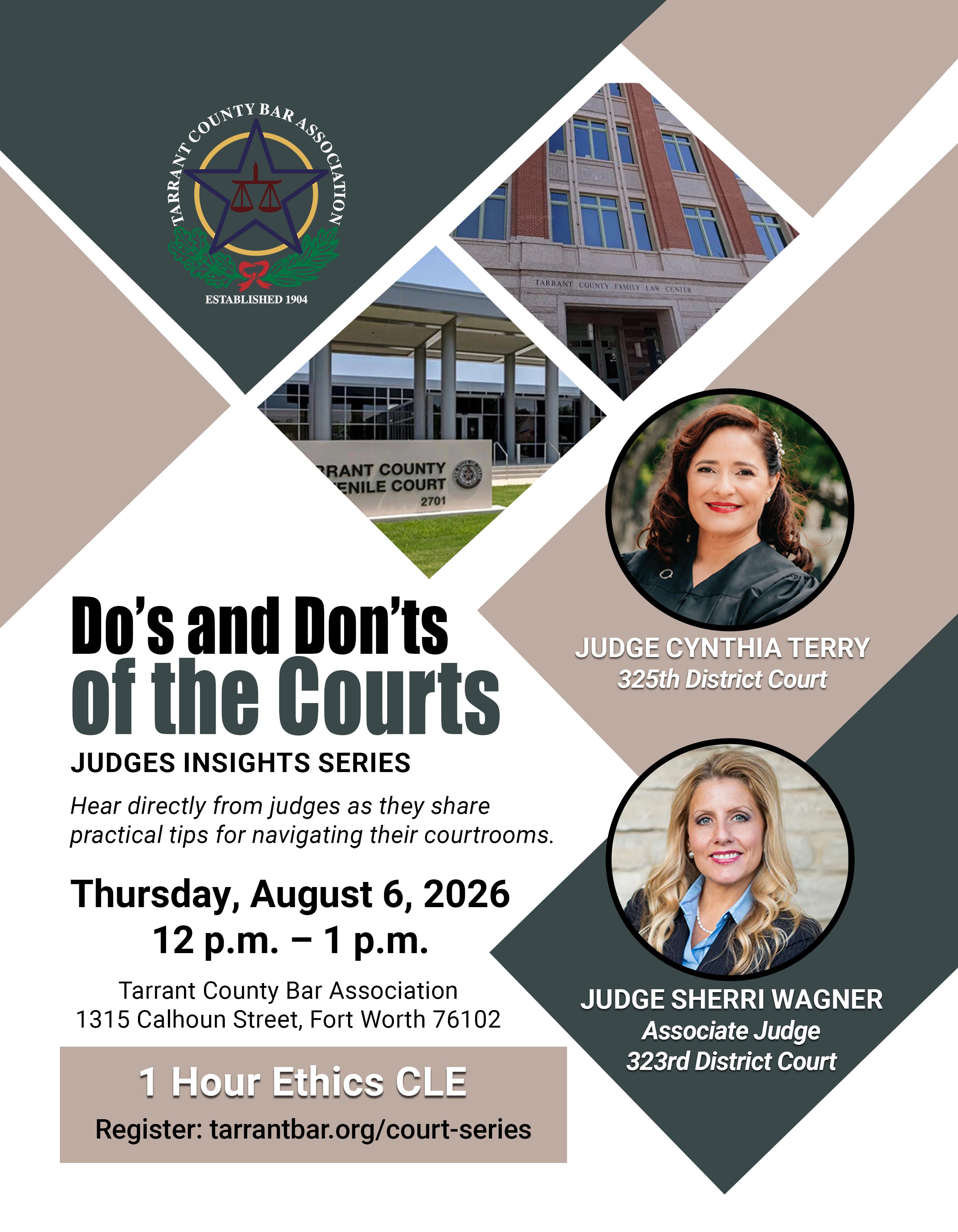
Do’s & Don’ts of the Court TCBA | 12–1 p.m.
Magic Shred TCBA Parking Lot | 11 a.m–1 p.m.
Mahon Inn of Court – Meet & Greet Fort Worth Club | 5:30 p.m.–6:30 p.m.
Section Orientation
LegalLine Remote | 5 – 7 p.m. AUG 3 AUG 6 AUG 7 AUG 11 AUG 12 AUG 13 AUG 13 AUG 14 AUG 18 AUG 19 AUG 21 AUG 27
TCBA | 12 p.m.–1 p.m.
LegalLine Remote | 5–7 p.m.
Firm Ambassador Social Top Golf Fort Worth | 6–7 p.m.
The Legal Lunch Series TCBA | 11:30 a.m–1:30 p.m.
Tax & Estate Planning Section Cannon Teleconference City Club | 12–1:30 p.m.
Blackstone Winners Luncheon City Club | 12–1p.m.
1L Welcome Lunch TCBA | 11:30 a.m. – 1:30 p.m.
YLA SNAPSHOT
OJOHN EASTER
OLA CAMPBELL
2025–2026 TCYLA President
2024–2025 TCYLA President
Building Knowledge and Connection Through TCYLA
ne of the greatest strengths of our legal community
we have seen that spirit on full display through several outstanding events.
“The Discoverability of AI Prompts,” examining one of the newest and most practical issues facing lawyers as artificial intelligence becomes a larger part of everyday practice. The presentation sparked thoughtful discussion about technology, ethics, and litigation strategy.
Rule of Civil Procedure 166a—What’s New with Summary Judgment,” providing attendees with practical guidance on recent developments affecting one of the most important procedural tools available to Texas litigators. We are grateful to each of these presenters for sharing their time and expertise with our members.
TCBA Solo and Small Firm Section in June for a joint happy hour at Maple Branch Craft Brewery. We hope to continue partnering with other organizations and TCBA sections throughout the year to create additional opportunities for lawyers across all practice areas and experience levels to get to know one another.
to hear from you. If you have a CLE topic you are passionate
about, we encourage you to reach out. Our best programs have come from attorneys willing to share practical knowledge that benefits lawyers at every stage of their careers. Likewise, if your firm or organization is interested in co-hosting a happy hour or networking event with TCYLA, we would welcome
Whether you are a brand-new attorney, a seasoned practitioner, or somewhere in between, there is a place for you in TCYLA. Attend a CLE, stop by a happy hour, volunteer alongside us, or simply introduce yourself to our members. The relationships formed through our local bar often become the mentors, referral sources, opposing counsel, and friends
We look forward to seeing you at an upcoming event and hope you’ll join us as we continue building an engaged,
Members of the 2026–2027
100 Club
*List Reflected Below is as of June 12, 2026
Adams, Lynch & Loftin, P.C
Albert, Neely & Kuhlmann, LLP
Anderson, Cummings & Drawhorn
Anderson & Riddle, LLP
Baker Monroe Huston, PLLC
Barlow Garsek & Simon, LLP
Blaies & Hightower, L.L.P.
Bonds Ellis Eppich Schafer Jones, LLP
Bourland, Wall & Wenzel, P.C.
Brackett & Ellis, P.C.
Brown, Proctor, Peck & Piwetz, LLP
Bruner & Bruner, PC
City of Fort Worth – City Attorney’s Office
Cook Children’s Health Care System
– Legal Department
Curnutt & Hafer, LLP
Decker Jones, P.C.
Dismuke & Waters, P.C.
Factor, Campbell & Baker
Freeman Mills PC
Friedman, Suder & Cooke, P.C.
Gardner Smith & Vaughan, PLLC
Griffith, Jay, & Michel, LLP
Harris, Finley & Bogle, P.C.
Harrison Steck, P.C.
Haynes and Boone, LLP
Holland Johns & Penny LLP
Jackson Walker LLP
Kelly Hart & Hallman LLP
KoonsFuller, P.C.
Killen & Dennis, PC
Law Offices of Paup, Shutt & Associates, P.C.
Linebarger Goggan Blair & Sampson, LLP
Lively & Associates, PLLC
McDonald Sanders, P.C.
Munsch Hardt Kopf & Harr, P.C.
Naman, Howell, Smith & Lee, PLLC
Nelson Bumgardner Conroy PC
Noteboom – The Law Firm
Padfield & Stout, LLP
Patterson Law Group
Pham Harrison, LLP
Phelps Dunbar LLP
Pope, Hardwicke, Christie, Schell, Kelly & Taplett, L.L.P.
To be eligible for the 100 Club, any law firm, government agency, law school, or corporate legal department with four or more members must attain 100% TCBA membership compliance for the 2026–2027 bar year. This qualifies them for the “100 Club.” The firms/ organizations listed above have already paid their membership dues and qualify for 100 Club membership
for the new bar year. Any firm/organization that qualifies in the future will have its name published in every issue of the The Verdict for this bar year. TCBA takes pride in the participation of these law firms and other groups. The new bar year began on July 1. If you have not paid your renewal invoice, please contact Tiffany Myles at tiffany@tarrantbar.org. g
KAYLA DAILEY
EXECUTIVE DIRECTOR A Message from the A Statewide Recognition of Service and Excellence
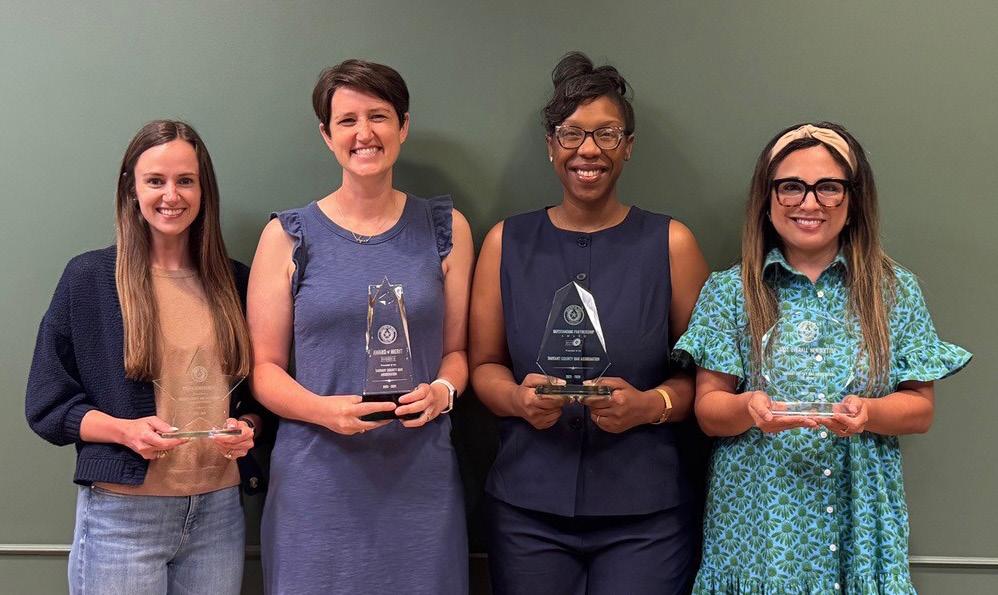
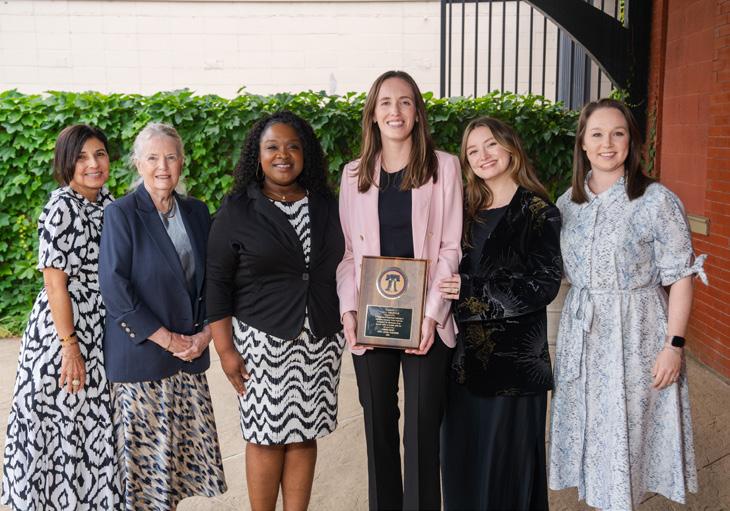
The Tarrant County Bar Association is proud to announce that we were recognized with four statewide awards at the State Bar of Texas Annual Meeting in Houston. These honors reflect the dedication of our volunteers, Board of Directors, members, and staff, all working together to advance our mission and serve the community.
While each award recognizes a specific program or initiative, together they tell a larger story about who we are as an organization. From community service and pro bono efforts to member communications and overall organizational excellence, these awards represent the collective work of countless individuals who generously give their time, talent, and energy to the TCBA.
Award of Merit
For the fourth consecutive year, the TCBA received the Award of Merit, the highest honor awarded to a local bar association in our division.
This award recognizes the overall strength of the organization and highlights the breadth and quality of programs, services, and initiatives offered throughout the year. Receiving this recognition for four straight years is a remarkable accomplishment and reflects the sustained commitment of our volunteers, board members, committee leaders, and staff.
The Award of Merit belongs to every member who volunteers for a project, serves on a committee, attends an event, mentors a young lawyer, participates in community service efforts, or supports the work of the Association. It is a recognition of the culture of engagement and service that makes the TCBA such a special organization.
Outstanding Partnership Award
The TCBA also received the Outstanding Partnership Award for its collaboration with the Center for Transforming Lives through the efforts of our Community Service Committee.
Led by Membership Director Tiffany Myles and Community Service Committee Chair Spencer Mainka, this partnership focused on supporting families and individuals served by Center for Transforming Lives through several impactful service initiatives. Throughout the year, volunteers participated in an Angel Tree program, collected professional clothing to help individuals prepare for employment opportunities, and organized a feminine hygiene products drive to provide essential items to those in need.
These projects demonstrate the power of lawyers and legal professionals coming together to make a meaningful difference beyond the practice of law. We are honored that this partnership was recognized at the state level and grateful to everyone who contributed their time and resources to these efforts.
Star of Achievement
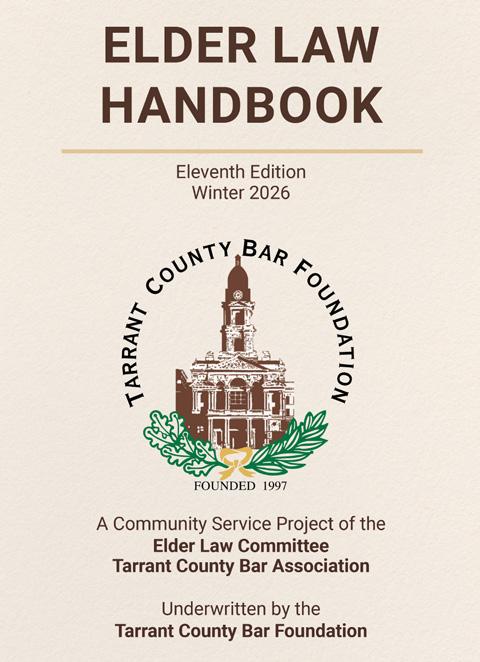
The TCBA was also honored with the Star of Achievement for the Elder Law Handbook.
Led by Pro Bono Program Director Sarah Hoffman, the Elder Law Handbook underwent a comprehensive revision and expansion to provide older adults and their families with practical, accessible information on a wide range of legal
issues. The project required the collaboration of numerous volunteer attorneys who generously shared their expertise to ensure the handbook remains a valuable resource for our community.
A special recognition is owed to Don Buckman, whose contributions were instrumental to the success of the project. Don dedicated countless hours to reviewing and revising the handbook with a singular goal in mind: making it more accessible and understandable for the individuals and families who rely on it. His thoughtful edits, attention to detail, and commitment to public service helped transform the handbook from a legal resource into a practical guide that can be used and understood by the broader community.
The result is a publication that helps empower individuals to better understand and navigate important legal matters, furthering the TCBA’s commitment to public service and access to justice.
Best Publication
Rounding out the Annual Meeting, the TCBA received the Best Publication Award for The Verdict
This recognition celebrates the successful transformation of the TCBA’s member publication into something more engaging, substantive, and reflective of the legal community we serve.
The rebranding effort was championed by Board members Tiffany Burks and Nikki Chriesman-Green, who helped envision a publication that would move beyond a traditional association newsletter and become a publication members genuinely look forward to reading. Under the leadership
of Communications Director Elizabeth Banda, that vision became a reality.
Throughout the year, countless Board members, Section leaders, Brown Bag speakers, and other contributors shared their expertise and experiences through articles that strengthened the publication’s legal content and expanded its reach. New features such as Jury Verdicts, Life Outside the Fort, and other member-focused stories helped create a publication that informs, connects, and celebrates our legal community.
The result is a publication that is more than a source of Association news—it’s a reflection of the people, accomplishments, and ideas that make the TCBA special. We are honored that those efforts were recognized with the Best Publication Award.
A Moment to Celebrate
Receiving these awards on behalf of the TCBA was an incredible honor, but what makes them truly meaningful is what they represent. Each award reflects the dedication of volunteers who give their time, board members who provide leadership, staff who work tirelessly behind the scenes, and members who continually step forward to serve our profession and our community.
These accomplishments are the result of countless individuals working together toward a common purpose: strengthening the legal profession, serving the public, and making a positive impact throughout Tarrant County.
Awards may bear the Association’s name, but they belong to the people who make the TCBA such a special organization. Thank you for helping us continue a tradition of service, professionalism, and excellence. g
LAWYERS ON THE MOVE & IN THE NEWS
If you are a TCBA member and would like to place a free announcement in The Verdict, please submit your information by email to Elizabeth Banda, Communications Director, at elizabeth@tarrantbar.org.
L to R: Sarah Hoffman, Kayla Dailey, Tiffany Myles, and Elizabeth Banda. TCBA received four statewide awards at the State Bar of Texas Annual Meeting in Houston.
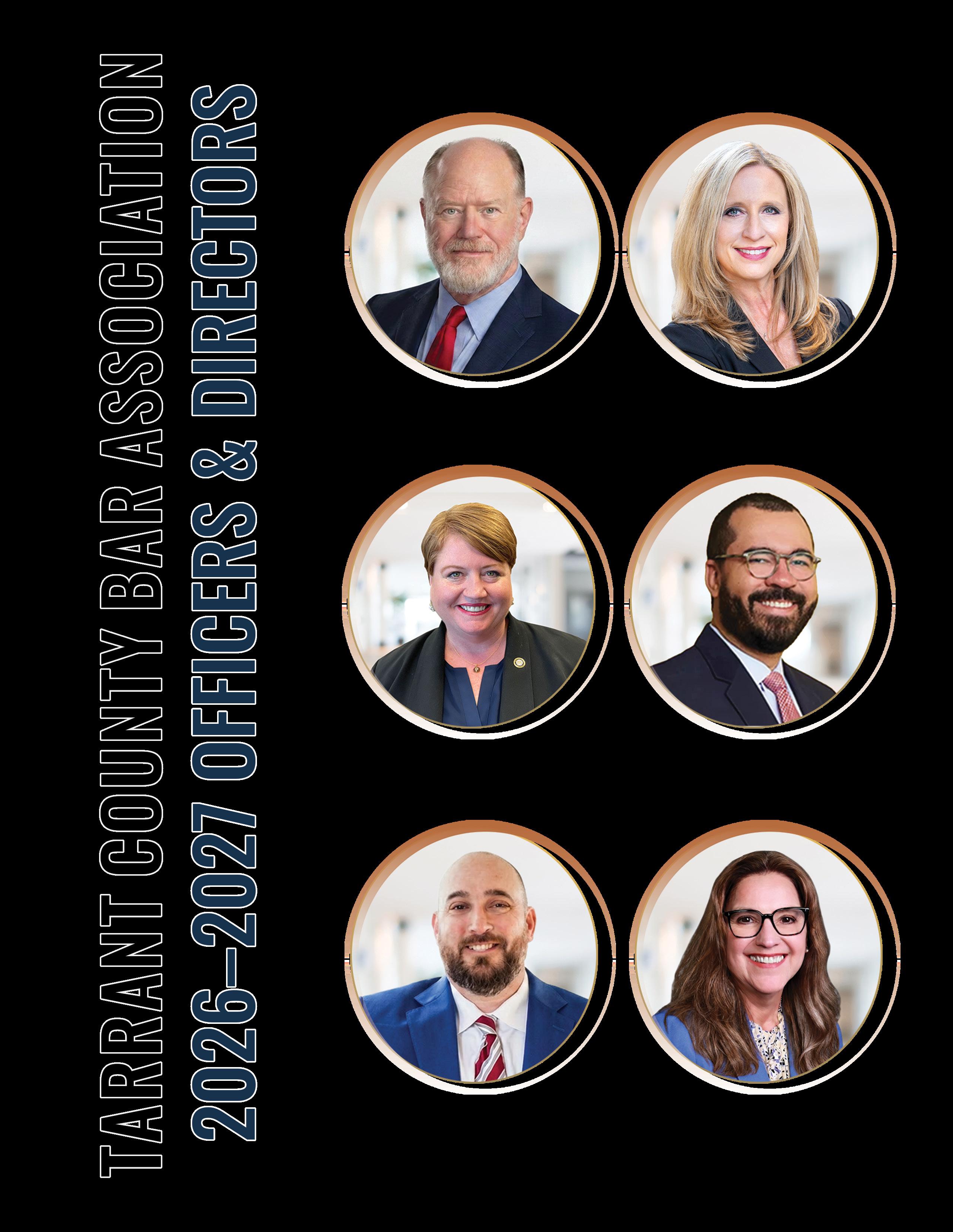
PRESIDENT
John Brookman
PRESIDENT-ELECT
Caroline Harrison
Leslie Hunt (Term ends 2027)
Smith (Term ends 2027)
APPOINTED DIRECTOR
Wade Barrow 2026–2027
APPOINTED DIRECTOR
Norma Bazán 2026–2027
Dwayne
VICE PRESIDENT
VICE PRESIDENT
SECRETARY-TREASURER
DIRECTOR
Joe Cleveland
Joe Cleveland
Mollee Westfall
Heidi Angel (Term ends 2027)
DIRECTOR
Amy Allen (Term ends 2028)
DIRECTOR
Trey Loftin (Term ends 2028)
DIRECTOR
Karon Rowden (Term ends 2028)
APPOINTED DIRECTOR
Nikki Chriesman-Green 2026–2027
TCYLA PRESIDENT
Marylynn Smitherman 2026–2027
IMMEDIATE PAST PRESIDENT
Marvina Robinson
Buyer Beware: Title & Survey Review in Real Estate Transactions
By James Griffis Harris, Finley & Bogle, P.C. | jgriffis@hfblaw.com
2025–2026
Real Estate Section Chair
Introduction
Imagine being a buyer who intends to purchase a tract of land with plans to construct a new office building, only to discover after closing that a utility easement bisects the proposed building site and prevents construction in the easement area. The easement was disclosed in the title commitment and shown on the survey, but no one reviewed these carefully before closing. The buyer faces significant loss and reaches out to an attorney for the first time post-closing hoping for a solution, but no helpful solution is available.
While buyers often carefully inspect the physical condition of property to avoid the risk of discovering defects after closing, they frequently pay less attention to their title commitment or survey. Surprisingly, many buyers wait to review their title commitment and survey until after closing—usually after a costly dispute has arisen. Such disputes can often be avoided through a careful pre-closing review of the title commitment and survey by experienced counsel.
An experienced real estate attorney is familiar with the title and survey review process and can identify risks, recommend solutions, and help buyers avoid costly mistakes. Below are some basic concepts to keep in mind when reviewing a title commitment and survey and examples to underscore the importance of a thorough review prior to purchasing real estate.
The Title Commitment and Survey
The title commitment is exactly what it sounds like—a title company’s commitment to issue a title policy. The title commitment is issued by a title company shortly after the real estate contract is executed, while a title policy is generally issued after closing. Schedules A, B, and C of the title commitment must be reviewed closely prior to closing.
Schedule A contains information about the transaction, including the proposed insured, policy type and amount, type of interest insured, record title holder, and legal description of the property. Buyers should review Schedule A carefully to confirm its accuracy. In particular, the seller named in the purchase contract should match the record title owner listed in Schedule A, and the legal description should be consistent with the survey. If the property benefits from an appurtenant easement (such as an access easement), counsel should request that the easement be insured in addition to the property being purchased.
Schedule B lists exceptions to title (i.e., items that will not be insured when the title policy is issued). Common examples of Schedule B exceptions are easements, leases, rights of first refusal, restrictive covenants, and mechanic’s liens against the property. These exceptions, and any documents accompanying them, should be carefully reviewed to assess risk.
If a Schedule B exception is problematic, a buyer may require the seller to cure it, request its removal from the title commitment, seek an endorsement to the title policy, or pursue other curative measures. For example, if an oil and gas lease appears as a Schedule B exception, the buyer may request a surface use waiver from the mineral owner and/or the operator to prevent the property’s surface from being used for mineral development activities. If a surface use waiver cannot be obtained, the title company may issue T-19.1 and/or T-19.2/.3 endorsements instead.
Some Schedule B exceptions are incapable of being cured prior to closing and may force a buyer to walk away from the transaction. As an example, a restrictive covenant prohibiting the sale of alcohol on the property would obviously be detrimental to a buyer intending to operate a bar. If the restriction cannot be removed or otherwise adequately addressed, the buyer may have no practical choice but to terminate the transaction.
Schedule C generally identifies items that must be satisfied before the title policy is issued, such as liens and judgments affecting the property or seller. Buyers often receive the title commitment early in the transaction and postpone reviewing it until shortly before closing. If, for example, Schedule C requires a judgment to be released, and the buyer does not become aware of the requirement until the eve of closing, there may be insufficient time to obtain the release, if one is obtainable at all. This can jeopardize closing and result in unintended consequences for the buyer, such as loss of financing or liability for breach of contract.
Survey review goes hand in hand with the review of the title commitment. The survey helps illustrate Schedule B exceptions by depicting exceptions that can be located on the property, like easements, setback lines, and encroachments. Buyers should carefully review the survey together with the title commitment to determine whether any Schedule B exceptions could interfere with their intended use of the property. Early review can help avert significant heartache post-closing. This may have helped the unsuspecting office developer described above avoid significant loss.
Conclusion
Pre-closing review of a title commitment and survey is an essential part of assessing risk in real estate transactions. An ounce of prevention is worth a pound of cure, and a careful pre-closing review of a title commitment and survey can help facilitate smoother closings, avoid future disputes or costly mistakes, protect the value of the property, and make the property more attractive to future buyers, lenders, or investors. g
LAWYER REFERRAL & INFORMATION SERVICE
The Lawyer Referral & Information Service (LRIS) is a service of the Tarrant County Bar Association that benefits both TCBA member attorneys and the public.
Congratulations to the attorneys who earned the highest lawyer fees through LRIS during the 2025–2026 Bar Year!
Reporting Period: July 2025–June 2026
1st PLACE
2nd PLACE 3rd PLACE
Approved by the American Bar Association, LRIS allows member attorneys to receive client referrals and build their business, while helping callers quickly find an attorney in the area of law they need.
The program is intended to help individuals who are able to pay normal attorney fees but have difficulty finding legal representation due to lack of experience with the legal system, lack of information about needed services, or fear of costs. Membership costs range from $150 to $200 annually.
Why Join LRIS?
Each year, attorneys like Jonathan, Andrew, and Greg demonstrate just how impactful the program can be — both professionally and financially.
• Maximize Your Earnings: Like Jonathan, Andrew, and Greg, you can earn substantial rewards by offering quality referrals.
• Grow Your Practice: Connect with clients in need of your expertise and grow your client base.
• Build Your Reputation: Build valuable relationships and be recognized for your exceptional service.
For more details about joining LRIS, please visit www.tarrantbar.org/JoinLRIS or email us at lris@tarrantbar.org.
Top Ten Jury and Bench Trial Tips from “thirtysomething” Years of Practice
By Lynn Waller Kelly The Blum Firm, P.C. | lkelly@theblumfirm.com
One of my LinkedIn contacts who is a former federal prosecutor asked me for my top trial tips. He has instituted a formal de-brief meeting with his entire team immediately after any trial, which I think is a splendid idea.
Since 1989, I’ve been in the courtroom in various roles: state prosecutor, insurance defense attorney, probate judge, and now back to attorney advocate in estate litigation and guardianship cases. I’ve not yet perfected my courtroom practice, but I’ve learned many things along the way by trial and error:
1. Prepare as thoroughly as possible. With experience, you’ll be able to prepare more efficiently and effectively— particularly if you’re repeating similar types of hearings or trials in a defined practice area.
2. Keep information/documents you may need to refer to in court organized in a way that makes sense to you so they can be located quickly. Have paper copies of key documents in case electronics or Wi-Fi connectivity fails.
3. Make sure you have prepared orders in advance to make it easy for the court to grant the relief you are requesting in real time. For example, an order for a motion in limine, an order granting motion for summary judgment, an order of dismissal.
4. Keep two running lists during the trial or hearing: First, if applicable, an “elements” checklist. If you’re fortunate enough to have a second chair or an assistant of any kind in the courtroom, task them with checking off your elements. In jury selection, enlist another person to assist you in observing the reactions and facial expressions of potential jurors. With a large group, it’s impossible for one person to catch it all. Second, during your trial keep a running list of points to address in closing or concluding argument.
5. Don’t be so glued to your script that you fail to pay attention to the actual content of what’s being said in the courtroom. Also, watch for clues from body language of witnesses, jurors, the judge, and even other courtroom personnel. If you make eye contact, what happens? If necessary, adjust your pre-planned agenda!
6. Concentrate on displaying a professional demeanor before you enter the courtroom. Many times when I was an associate judge, parties and their attorneys would openly discuss their case when I was in the elevator, not realizing I was the judge they were about to appear before. Worse yet, several attorneys failed to get a solid grip on the door to the hallway in front of the courtroom, accidentally slamming the door in my face!
7. What you wear is important. Projecting competence and professionalism through your clothing can give you an advantage. At a minimum, an attorney should not wear something that is distracting. When I first worked at the Dallas County District Attorney’s Office in the early 90’s, women weren’t allowed to wear pants. In subsequent years, pants were allowed but only matching “pantsuits!” Today the choices are almost overwhelming, especially for women attorneys, but in my opinion the best approach is to err on the side of being conservative. For a jury trial heavy practice, consultation with a professional wardrobe consultant may be worth the investment. There are even studies regarding which colors are best perceived by potential jurors, and a consultant with experience in this area can guide your investment in purchasing classic pieces.
8. There will be surprises at almost every hearing and without fail at every trial. Some of these you can learn from; some are simply anomalies. More experience will yield more confidence. Carry on!
9. After the trial, consider asking the judge and other courtroom personnel for feedback. Having been an associate probate judge for six years in a very high volume court in an urban jurisdiction, I can vouch that in this setting very few attorneys ask for feedback from court personnel. Seeking input about opportunities for improvement may not always be fruitful, but many judges and other court personnel welcome the chance to be helpful.
10. One final tip: keep a detailed log of your trials, especially jury trials. Include names of opposing law firms and individual counsel. I failed to do this and have found it impossible to recreate. g
TEXAS LAWYERS FOR TEXAS VETERANS
By Sarah Hall Hoffman, Pro Bono Programs Director
TARRANT COUNTY CHAPTER
Thank You to Our Recent Volunteers!
Looking for ways you can support TLTV but unable to volunteer?
CONSIDER SPONSORING A REMOTE OR IN-PERSON CLINIC!
Contact sarah@tarrantbar.org for more details.
July 17, 2026
August 21, 2026
Clinics are from 1 p.m.– 4 p.m.
Veterans Affairs Outpatient Facility 2201 SE Loop 820, Fort Worth, TX 76119
Interested in volunteering? Email sarah@tarrantbar.org .
Alexis Allen Ryan Damiano
TARRANT COUNTY BAR ASSOCIATION SECTIONS
The Tarrant County Bar Association has fifteen (15) sections consisting of members with similar professional interests. Each section holds an average of four meetings per year and elects its own officers. Section meetings provide opportunities for networking, collaboration, and specialized continuing legal education. For information about section activities, please contact tracy@tarrantbar.org.
Spotlighting members practicing law beyond Fort Worth
Q: Where do you live and practice in Tarrant County, and what do you love most about your community?
Well, I practice in Grand Prairie, and Grand Prairie is located in four different counties, largely in Dallas County, but a good bit of our population is also in Tarrant County. I lived in Tarrant County for probably about 20 years, so I’m very familiar with the Tarrant County area. What I love about Tarrant County and practicing in Tarrant County is the sense of community. Everyone’s always willing to help out and assist everyone else. It’s always been a place where you feel a sense of community and belonging. Nobody is really an outsider. I moved to the DFW area back in 1999 and then moved here permanently in 2001. I’ve been here for a while, and it has always felt like home to me. When I first moved here, I lived in Tarrant County. I lived in Tarrant County from probably 2001 to 2020.
GRAND PRAIRIE, TEXAS
A Q&A with TCBA Member
Mel McGinnis
Q: Where are you originally from?
I’m originally from Louisiana. I went to law school at LSU, and I moved here in 1999, but I wasn’t here full time because I was still in law school. When I finished law school in 2001, I moved to Arlington, which was actually the first place I lived in Tarrant County. I’ve lived in quite a few places, including North Richland Hills, Arlington, Mansfield, and the Grand Prairie side of Tarrant County for probably about seven and a half years.
Q: What inspired you to become a lawyer and what keeps you motivated in the work today?
I’ve just always been a person who likes to help others. I grew up in a small town in Louisiana, and it was an underserved, underdeveloped town. A lot of people there didn’t really understand the legal process and how things work, so I always felt like I could help with that. If I became an attorney and got that part of the education, I could help and assist those people who really weren’t familiar with the legal process and had a hard time navigating it. So that’s part of the reason I was inspired to go to law school.
And of course, I’m a big Thurgood Marshall fan, so I wanted my moments in the courtroom and fighting for the rights of people. What I enjoy most now is that I do a lot of economic development, and I really enjoy seeing areas go from pretty much nothing to places where people love to come, work, live, and play. In Texas, it’s one of those things that just happens on a regular basis. There’s so much development. There’s so much construction. There are so many opportunities to create spaces for people to live and enjoy. I really enjoy that about the DFW area, just because there’s so much development going on. I really just enjoy creating spaces for people to live and enjoy their lives. That’s really enticing to me.
Q: If you weren’t a lawyer, what do you think you’d be doing instead?
Oh, I’d be doing interior design. I love it.
I love creating spaces for people to live or creating spaces for people to just enjoy in their home. Having a home that you can really enjoy, that’s visually pleasing and aesthetically pleasing, I love doing that. I love designing spaces and creating that kind of thing. When I retire, I’ll probably do that. I will only take maybe one client every six months because I don’t want to have a job doing interior design.
I love creating things. I’m a creative at heart. I would say I’m a creative who just happens to be a lawyer.
“I’m a creative who just happens to be a lawyer.”
Q: Who has been a mentor or a major influence in your legal career?
In my legal career, a couple of people have been a major influence. When I worked for the City of Fort Worth, Marcia Wise was one of the deputy city attorneys at the time. She really taught me a lot about how to deal with people and how to navigate working for cities because it’s different when you work for a city. You have a lot to deal with, including the politics. It’s a very delicate situation to navigate. I see Marcia from time to time through the Women Attorneys Section. I have not been as involved the last two years because when I switched jobs, I had a huge learning curve, but I was heavily involved in the Women in Law Luncheon for about five years before that.
She was a really good mentor for me in that space in terms of attorneys who work in this area. I’ve also had some really good male mentors as well. He passed away last year, but Art Pertile was a giant in municipal law and was always so helpful to me. Whenever I had questions, I could call Art, and he would help me. He would say, “Hey, here’s what you have to do. These are the things you need to look for. Think about this.
Have you thought about that?” Art was a former city attorney of Waco and was well known throughout the state in the world of municipal law. I think those two have had a really big influence on my legal career, both because Marcia was a female leader at a time when there weren’t many female deputy city attorneys or city attorneys, and because I was able to model parts of my career after theirs and learn from them.
Q: What is a fun or surprising fact that most people don’t know about you?
I’ve only been thinking about this recently because, unfortunately, Peabo Bryson recently passed away. At my high school graduation, I sang “A Whole New World” with two other classmates. We sang the whole song at our graduation ceremony, and not a lot of people know that. I also did a lot of spoken word events between 2018 and 2020, before COVID changed so many things. I’m a poet at heart, and spoken word is something I particularly enjoy. g
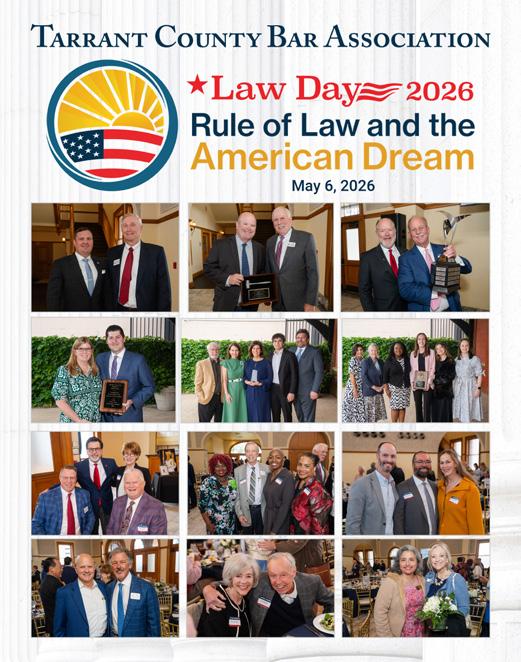
May 6, 2026
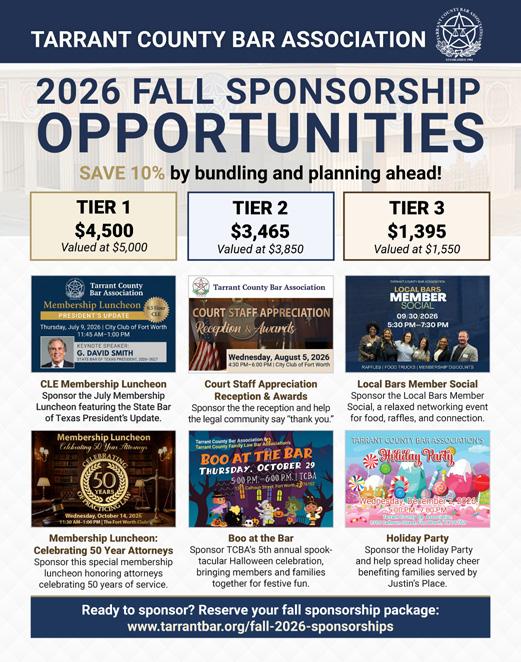
CLE Membership Luncheon
Sponsor the July Membership Luncheon featuring the State Bar of Texas President’s Update.
Membership Luncheon: Celebrating 50 Year Attorneys
Sponsor this special membership luncheon honoring attorneys celebrating 50 years of service.
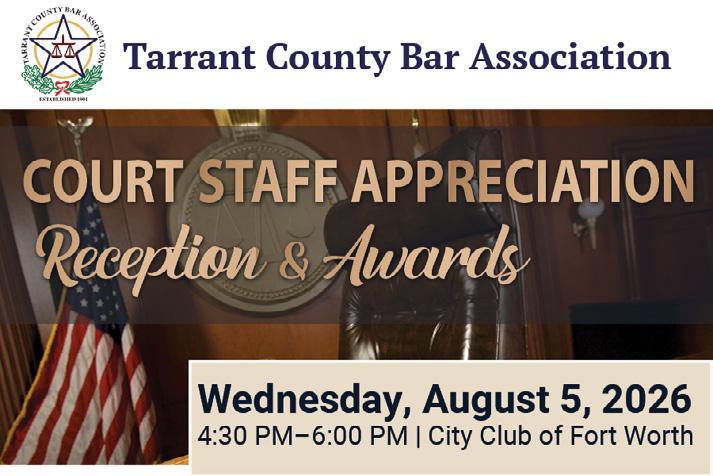
Court Staff Appreciation Reception & Awards
Sponsor the the reception and help the legal community say “thank you.”
Boo at the Bar
Sponsor TCBA’s 5th annual spooktacular Halloween celebration, bringing members and families together for festive fun.
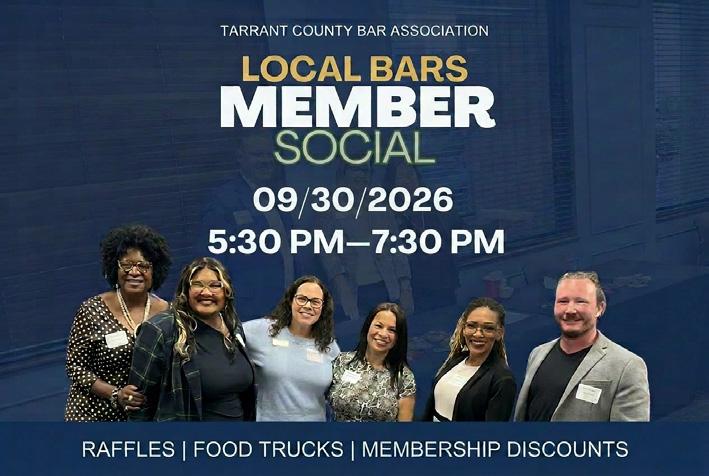
Local Bars Member Social
Sponsor the Local Bars Member Social, a relaxed networking event for food, raffles, and connection.
Holiday Party
Sponsor the Holiday Party and help spread holiday cheer benefiting families served by Justin’s Place.
Ready to sponsor? Reserve your fall sponsorship package: www.tarrantbar.org/fall-2026-sponsorships
FALL 2026 PACKAGE COMPARISON
Package prices reflect a 10% bundled sponsorship discount.
TIER BENEFITS
Includes three 1/2-page ads in The Verdict, recognition at each sponsored event, and sponsor publicity on TCBA’s website, in The Verdict, and on TCBA’s social media.
Includes two 1/2-page ads and one 1/4-page ad in The Verdict, recognition at each sponsored event, and sponsor publicity on TCBA’s website, in The Verdict, and on TCBA’s social media.
Includes two 1/4-page ads in The Verdict, recognition at each sponsored event, and sponsor publicity on TCBA’s website, in The Verdict, and on TCBA’s social media.
LegalLine
Amy Allen
Nick Bettinger
Robert Blankenship
Sara Correa
Ndidi Gbulie
Stephen Gaylord
Dustin G. Hoffman
Merrit Klapperich
Angelia Megahan
Lisa Ramirez
Arin Schall
BRITTANI
ROLLEN | Tarrant County Bar Foundation Chair
A Message from the The Tarrant County Bar Foundation Needs Your Support FOUNDATION A Message from the
Iam deeply honored to serve as the 2026 Chair of the Tarrant County Bar Foundation. When I reflect on what drew me to this role, the answer is simple: a commitment to giving back to our community and ensuring that access to legal services is not a privilege reserved for those who can afford it, but a right extended to all who need it.
The Tarrant County Bar Foundation was formed in 1997 under the leadership of its first Chair, Thos. H. Law, alongside an inaugural board that included Sam Rosen, Kathy Lanford, Brian Newby, Albon Head, Dee Kelly, Steve Maxwell, Chuck Noteboom, and David Seidler. Now entering our 29th year, the Foundation has grown into one of the most impactful legal service organizations in our region, and I am humbled to follow in the footsteps of so many extraordinary leaders who have guided this institution.
The numbers tell a powerful story. Over the past nearly three decades, the TCBF has awarded more than $500,000 in grants to over 30 organizations dedicated to serving our community. Recipients have included Methodist Justice Ministry, the Eldon B. Mahon Inn of Court, L. Clifford Davis Legal Foundation, Pathfinders, Guardianship Services, and many others doing critical work. The Foundation currently awards approximately $30,000 per year in grants, with the application deadline closing every April 15.
But grants are only part of the picture. The TCBF has served more than 3,935 veterans through the Texas Lawyers for Texas Veterans–Tarrant County Chapter since its inception. In recent years alone, our volunteers have staffed free legal clinics throughout Tarrant County, distributed hundreds of award-winning Elder Law Handbooks, dedicated countless hours to the LegalLine program fielding calls from community members in need of guidance, served dozens of individuals through the People’s Law School, provided free legal representation to low-income individuals in family law and estate planning matters, and assisted guests facing homelessness at the True Worth Place Legal Resource Center. These programs change lives—and they exist because lawyers in this county choose to give their time and their resources.
For me, this work is personal. I have spent my career in law understanding the immense power that legal knowledge carries. The law shapes every aspect of a person’s life—from
their family, to their home, to their livelihood. Yet too many members of our community face legal challenges without any access to counsel, often because they simply cannot afford it.
The TCBF bridges that gap. It stands in the space between need and service, and it does so because of the generosity and dedication of Tarrant County’s legal community.
That is why I serve as Chair—because I believe that as lawyers, we bear a particular responsibility to the communities we live and practice in. We have the training, the resources, and the professional obligation to ensure that justice is not merely aspirational but accessible. Every time a veteran receives guidance on a benefits claim, every time a low-income family gets representation in a custody matter, every time a person experiencing homelessness learns their rights, the TCBF fulfills its founding purpose.
As we look ahead to this year, I am excited to share one of my primary goals: revitalizing the Mahon Lecture Series in connection with Texas A&M School of Law. The lecture series, named in honor of the Honorable Eldon B. Mahon, has a storied tradition in our legal community. I believe that by partnering with Texas A&M School of Law, we can bring renewed energy and relevance to the series, creating programming that not only honors Judge Mahon's legacy of service and scholarship but also engages the next generation of lawyers in the mission of pro bono work and community service. It is an opportunity to connect our established legal community with the students and emerging practitioners who will carry this work forward.
Of course, none of what the TCBF accomplishes would be possible without its Fellows—numbering over 750—and the generous contributions from individual lawyers and law firms across our community. The Foundation is also supported by grants from organizations such as the Texas Access to Justice Foundation and the Fort Worth Foundation. I intend to continue the important work of my predecessors in growing the Foundation’s endowment fund, because the larger that fund becomes, the more we can do for the organizations and programs that serve those in need.
I also want to echo a call to action. If you are not already involved in one of the TCBF's programs, I encourage you to
Continued on page 33
A TCBA Member Poll
We asked TCBA members: “Which legal movie or TV show gets the profession the most right?”
WINNING VOTES
MY COUSIN VINNY
Leslie Barrows
Aulstin Gardiner
Amy Hennessee
Bill Larimer
Joshua Lewellyn
OTHER TOP PICKS
12 Angry Men
Larry Cotten
Better Call Saul
Amy Allen Donald MacQueen Scott Lindsey
The Lincoln Lawyer
Sion Alford Jasmine Avery
HONORABLE MENTIONS
A Civil Action
Wes Myers
A Time to Kill
Alex Briggs
Bosch
Natalie Tofflemoyer
The D.A. 1971–1972
Judge Don Pierson
Legally Blonde
Wendy Hart
Perry Mason Wade Barrow
Skip Reynolds II
The Wire
Mary Thornton Witness for the Prosecution
Judge Bob McCoy
None of them
Paige Anders Lewiecki
The Rainmaker
WHY MEMBERS CHOSE IT
Honestly, Better Call Saul is probably the most realistic portrayal of the legal profession ever put on screen — and it’s not particularly close. What sets it apart is that it actually cares about the unglamorous parts: building a practice from scratch, the grind of public defense work, the enormous gap between a solo street lawyer and a white-shoe firm. And Jimmy’s whole arc is basically a slow-motion bar ethics violation — watching a genuinely talented guy talk himself into one small compromise after another until he’s someone completely different. Lawyers love it for a reason.
—Amy Allen
A Time to Kill for its witness examinations, expert impeachment, motion practice, and most of all, the suspense of waiting on the verdict after you have done all you can, and after months of preparation, left your case in the hands of someone else to decide who wins.
—Alex Briggs
Legally Blonde. Sometimes we underestimate opposing counsel based on appearance or demeanor and as attorneys we often fly by the seat of our pants!
—Wendy Hart
To Kill a Mockingbird because it shows the ethical standards we should all strive towards.
—Jackie Robinson
None of them. But I wish I could say whatever I want as long as I say “withdrawn” afterwards like they do on Law & Order SVU.
—Paige Anders Lewiecki
THANK YOU
to everyone who cast your vote!
Jury Duty returns in our next issue with a brand-new question. Be on the lookout!
New Members of the TCBA:
ATTORNEYS
Owen Anderson
John Barber
Bailee Barton
Wayne Basist
John Behan
Lori Blair
Joshua Blann
Elizabeth Borders
Alexander Briggs
Madeline Brinkley
Erik Cabrera-Zamora
Lisa Callaghan
Sean Carmichael
Tom Carr
Andrea Casanova
Mary Chang
Bradlyn Cole
David Copeland
Carys Davies
Richard DeBerry
Cydni D’Elia
Benjamin Dockery
Christopher Doyle
MacKenzie Dunnehoo
Kiera Dwyer
David Fink
Christopher Flanagan
Kayla Harrington
Sydney Harty
Brenda Hasenzahl
J. Hernandez
J. Hogan
Paul Honrales
Ashley Judd
Jacob Kalinke
Honest Kapic
William Kennedy
Andrew Kerns
Ashley Kirk
William Klaess
Jenna Lusk
Timothy Malone
Jaclyn Marsh
Micah Mays
Jordan Miner
William Morrison
June Moynihan
Madison Nagra
Ifunanya Ngadi
Ky Nguyen
Robert Notari
Ben Parsons
Anissa Patel
Jacob Pelley
Malissa Perkins
LAWYERS ON THE MOVE &
in the News
Doug Clayton Elected Chair of Junior Achievement of the Chisholm Trail Board
Doug Clayton, a partner at Cantey Hanger LLP, has been elected Chair of the Board of Directors of Junior Achievement of the Chisholm Trail.
Clayton has served on the board since 2016 and previously served as Vice Chair of the Governance Committee. He is Chair of Cantey Hanger’s Business Transactions Practice Group, where his practice focuses on mergers and acquisitions, corporate finance, securities offerings, SEC compliance, and other business transactions. Junior Achievement of the Chisholm Trail is a nonprofit organization dedicated to helping students develop career readiness, financial literacy, and entrepreneurship skills. g
Gary Nickelson Named to Fort Worth Inc.’s 500 Most Influential People List
Gary L. Nickelson, a partner at Goranson Bain Ausley, has been named to Fort Worth Inc. magazine’s 500 Most Influential People of 2026 list.
Nickelson has practiced family law exclusively for more than 50 years, including high-net-worth divorce, complex property division, business valuation disputes, and matters involving closely held businesses. Throughout his career, he has served in numerous leadership roles within the Texas family law community and the State Bar of Texas. His recent recognitions include Best Lawyers 2025 Family Law “Lawyer of the Year” in Dallas/Fort Worth, Fort Worth Magazine Top Attorney, and the 2024 Texas Bar Foundation Dan Rugeley Price Memorial Award. g
2026–2027
New Member Breakfast Sponsor All TCBA members get 10% off!
MEET OUR INAUGURAL AMBASSADORS
We are proud to recognize the first group of TCBA Ambassadors who will help connect, engage, and welcome new members into our Bar community.
• Brook Bell
• Lisa Boyd
• Lauren Braly
• Kristie Gray
• Roland Johnson
• Wayne Long
• Jessica Miller
• Meagan Minchew
• Tonya Minton
• Natalie Moran
• Hannah Orand
• James Osteen
• Adam Simmons
• James Stouffer
MEMBERSHIP REPORT
By Tiffany Myles, Membership Director
A Year of Service, Connection, and Growth
As I reflect on this past Bar year, I am filled with gratitude for the dedication and generosity of our members. After stepping away on maternity leave in February and returning in May, I was inspired to see that our organization had remained actively engaged in serving both our profession and the greater community.
Throughout the year, our members consistently came together to support families in Fort Worth through our partnership with the Center for Transforming Lives. Whether through donations of clothing, hygiene products, or financial contributions, our members demonstrated a commitment to service that reflects the very best of our profession.
As we close out this Bar year, we can proudly look back on a year marked by meaningful service, strengthened partnerships, and a shared commitment to making a positive impact in our community.
Looking ahead to the new bar year, I encourage each of our members to help us grow by
inviting a non-member to attend a bar event, CLE, or social gathering. Tarrant County is home to nearly 6,000 active attorneys, yet many have not experienced the professional connections, leadership opportunities, and sense of community our bar provides. As of 2025, there were 5,986 active attorneys in Tarrant County alone. We have an incredible opportunity to expand our reach and ensure that more attorneys feel welcomed and engaged within our organization.
My hope for the coming year is that we continue building a bar association where every attorney in Tarrant County feels they have a place to connect, learn, serve, and belong. Together, we can strengthen our profession and continue making a difference both within the legal community and throughout Fort Worth.
Thank you for your continued support, involvement, and commitment to our mission. I look forward to another successful year ahead. g
Laura Rua
Ian Ruiz
Candace Sandifer
Krystal Santana
Brittany Shipp
Marcus Smith
Matthew Stringer
Thomas Swafford
Miguel Taboada
Matthew Tautfest
Cammie Taylor
Melissa Waggoner
Delaine Ward
Bret Weatherford
Alexander Yow
JUDICIARY
Hon. Raquel Brown
Hon. David Green
LEGAL STAFF
Alexandra Dean
Dhara Tipler
ASSOCIATES
Jeff Sanford
Miles Schneider
Steven Yeager
LAW STUDENTS
Dulcie Rogers Summers
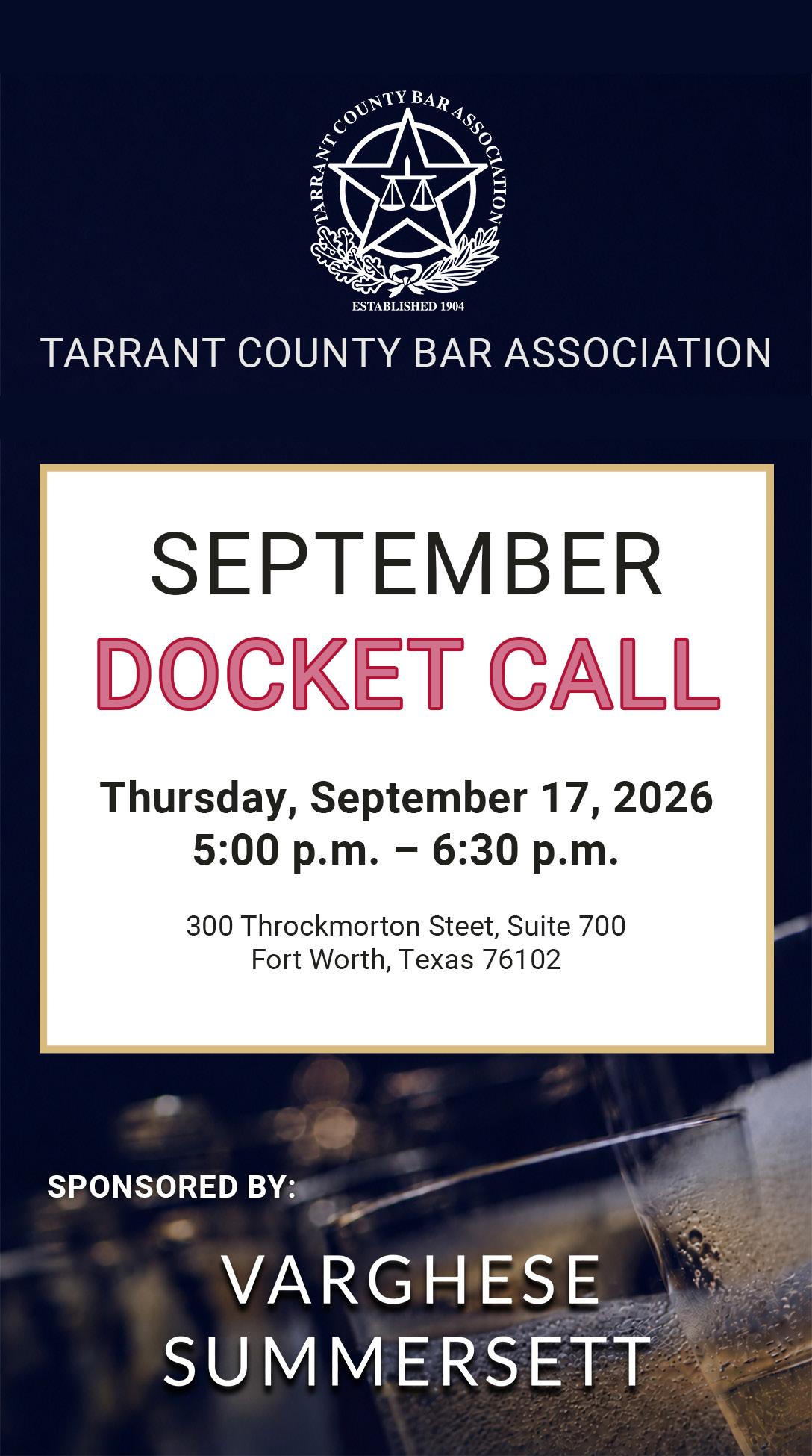
Thank You to Our June Docket Call Sponsor
Meet the New TCBA Office Manager : Arizbe Oviedo
Q: Where are you from?
I was born and raised in Fort Worth and have spent my entire life here, attending school from elementary through college in the area. Fort Worth has always been home to me, and I really value being part of the community I grew up in.
Q: Can you tell us a little about your family?
I have two children; my daughter is 14 and enjoys playing volleyball and shopping, and my son is 12 and loves soccer and video games. We stay pretty active with their sports and activities, which keeps life busy but fun. In my free time, I also enjoy traveling and exploring new places to eat with family and friends.
Q: What do you like to do in your spare time?
Most of my spare time is spent supporting my kids in their activities—cheering them on at games, practices, and competitions, and being their personal chauffeur in between. When I’m not on the sidelines, I enjoy hosting dinner parties and game nights with family and friends.
Q: What made you want to join the TCBA?
I was looking for an opportunity that would allow me to
continue using my background in the legal field while also providing the flexibility I need as a parent. From the moment I met the staff at TCBA, I immediately felt welcomed and at home. It was clear that it was a supportive and collaborative environment, which made my decision an easy one.
Q: What has been your favorite part of the job so far?
My favorite part has been the opportunity to help connect the community with valuable legal resources and to support the planning and execution of events both on- and off-site. I also really enjoy working alongside former court staff and being part of a team that is so knowledgeable and dedicated to serving the legal community.
Q: What’s one interesting or unexpected fact about you?
I’m always on the lookout for my next travel adventure or great restaurant find, and at home, I love hosting themed dinner parties and game nights—any opportunity to bring people together and make memories. g
Questions or need assistance with attorney ID badges or room rentals? Arizbe is here to help!
TCBA Supports Legal Clinics in Collaboration with the Down Syndrome Partnership of North Texas
By Heidi M. Angel
Jackson Walker LLP, Partner | hangel@jw.com 2025–2027 TCBA Board of Directors
Thanks to a generous grant from the Texas Bar Foundation, the Down Syndrome Partnership of North Texas (the “DSPNT”) held a will-signing clinic at the TCBA offices on May 12 as part of a series of events designed to support families of individuals with Down syndrome in engaging in the important process of establishing a will, trust, legal guardianship, and alternatives to guardianship. Participants attended at least one of several educational sessions offered on the topics of estate planning, special needs planning, guardianship, and supported decision-making. After attending an educational session, participants were able to apply for legal services based on their particular need, and each participant was matched with an attorney who provided pro bono or low bono legal services on a sliding scale. Guardianship cases are ongoing and another wills clinic and a Supported DecisionMaking Agreement clinic are being planned for the fall.
DSPNT has been serving families in North Texas (Tarrant, Johnson, Hood, Parker, and Wise counties) since 1995 with programs supporting families and individuals with Down syndrome through all stages of life—from diagnosis through adulthood. DSPNT supports individuals with Down syndrome in achieving the universally desired goals of self-fulfillment, pride in one’s achievements, inclusion in the community, and reaching one’s fullest potential through social and educational activities. The legal services provided through the Texas Bar Foundation grant further the DSPNT’s mission of providing support to individuals with Down syndrome and their families through awareness and engagement, advocacy and outreach, education, and the exchange of ideas and experiences.
Continued from page 27
consider volunteering even a small amount of your time. It takes both funding and volunteers to make these programs work. Whether it is staffing a legal clinic, mentoring a law student, or contributing to the grant fund, every effort matters.
I have a fantastic Board of Directors this year who are committed to rolling up their sleeves and ensuring that the Foundation’s programs and grants not only continue but expand. I am grateful for their dedication, and I am grateful for the support of every lawyer in Tarrant County who believes, as I do, that our profession carries a duty to serve.
Thank you for your continued support of the Tarrant County Bar Foundation. I look forward to a year of meaningful impact, renewed traditions, and deepened commitment to access to justice for all members of our community. g
Thanks to the TCBA and to the following attorneys and law firms who have generously participated in this effort:
• Robert J. Blankenship
• Annie Counts
• Angela Harvey
• Lynn Kelly
• Amy M. Lorenz
• Jennifer Lovelace
• Monique Lopez-Hinkley
• Lisa Ramirez
• Anna Rose St. Martin
• Monika J. Worsley
• Alexis Allen Law
• The Blum Firm, P.C.
• Dismuke & Waters
• Jackson Walker, LLP
• Kelly Hart & Hallman LLP
• Law Office of Angela Harvey
• Lovelace Law, P.C.
• Worsley Law PLLC
About the Texas Bar Foundation
Since its inception in 1965, the Texas Bar Foundation has awarded more than $30 million in grants to law-related programs. Supported by members of the State Bar of Texas, the Texas Bar Foundation is the nation’s largest charitablyfunded bar foundation. g
Snippets
Civil and Criminal
by Judge Bob McCoy g County Criminal Court No. 3
Mustangs: America’s wild horses. All they have is where they stand.
ASK JUDGE BOB
Judge Bob, does the Texas Constitution address freedom of worship?
Yes, Freedom of Worship—all men have a natural and indefeasible right to worship Almighty God according to the dictates of their own consciences. No man shall be compelled to attend, erect or support any place of worship, or to maintain any ministry against his consent. No human authority ought to, in any case whatever, to control or interfere with the rights of conscience in matters of religion, and no preference shall ever be given by law to any religious society or mode of worship. But it shall be the duty of the Legislature to pass such laws as may be necessary to protect equally every religious denomination in the peaceable enjoyment of its own mode of public worship.
S. Methodist Univ. v S. Cent. Juris. Conf., 716 S.W.3d 475 (Tex. 2025). Tex. Const. art. I, § 6
THE PACK’S MONTHLY PARAPROSDAKIAN
(a figure of speech in which the latter part of a sentence or phrase is surprising or unexpected; frequently humorous)
A boiled egg is hard to beat.
Abigail, Mary, and Martha Elijah
THE PACK’S QUOTE OF THE MONTH
Asthma doesn’t seem to bother me any more unless I’m around cigars or dogs. The thing that would bother me most would be a dog smoking a cigar.
— Steven Allen
THE Editor's NOTES FROM THE FARM
Your riding was great, but your falling off was terrible.
CRIMINAL ITEMS OF INTEREST
1. Physical Restraints
“The law has long forbidden routine use of visible shackles during the guilt phase; it permits a State to shackle a criminal defendant only in the presence of a special need.”
“The Fifth and Fourteenth Amendments prohibit the use of physical restraints visible to the jury absent a trial court determination, in the exercise of its discretion, that they are justified by a state interest specific to a particular trial.”
Coreas Machado v. State, 703 S.W.3d 435 (Tex. App.—Dallas 2024).
2. Expert Witness
A trial judge must make three separate inquiries before admitting expert testimony: “(1) the witness qualifies as an expert by reason of his knowledge, skill, experience, training, or education; (2) the subject matter of the testimony is an appropriate one for expert testimony; and (3) admitting the expert testimony will actually assist the fact-finder in deciding the case.”
Gonzalez v. State, 703 S.W.3d 466 (Tex. App.—Eastland 2024).
3. Competency
A trial court employs a two-step procedure for making competency determinations: (1) an informal inquiry; and (2) a formal competency trial. The trial court must conduct an informal inquiry upon any “suggestion” from any credible source that the defendant may be incompetent. If the trial court determines at the informal inquiry stage that there is “some evidence from any source that would support a finding that the defendant may be incompetent to stand trial,” it must then proceed to the second step—order that the defendant submit to a psychiatric or psychological competency examination and, except for certain exceptions, later hold a formal competency trial.
Royal v. State, 703 S.W.3d 895 (Tex. App.—Eastland 2024).
4. Search Warrant
Probable cause to support a search warrant is present when, under the totality of circumstances, there is at least a “fair probability” or “substantial chance” (it need not be “more likely than not”) that evidence of an offense will be found at the location that law enforcement seeks to search.
Wells v. State, 714 S.W.3d 614 (Tex. Crim. App. 2025).
Judge Carey Walker, County Criminal Court No. 2
5. Element of an Offense
An “‘element of offense’ means: (A) the forbidden conduct; (B) the required culpability; (C) any required result; and (D) the negation of any exception to the offense.”
Tucker v. State, 706 S.W.3d 379 (Tex. App.—Austin 2024).
6. Admissibility of Evidence
To determine whether evidence is admissible in the face of a Rule 403 objection, the trial court must conduct a balancing test. This test requires the court to balance (1) the evidence’s inherent probative force and (2) the proponent’s need for that evidence against the evidence’s tendency (3) to suggest a decision on an improper basis or (4) to confuse or distract the jury from the main issues, (5) the possibility that a jury that is ill-equipped to evaluate the evidence’s probative force would give it undue weight, and (6) the likelihood that the evidence’s presentation will consume an inordinate amount of time or merely repeat evidence already admitted.
Hance v. State, 714 S.W.3d 775 (Tex. App.—Fort Worth 2025).
7. Article 39.14 CCP
The baseline inquiries for determining a violation under Article 39.14 are: (1) whether the State failed to disclose evidence that was not work product or otherwise privileged; (2) whether the withheld evidence was favorable to the defendant; and (3) whether the evidence was material.
Poor v. State, 715 S.W.3d 15 (Tex. App.—Eastland 2024).
CIVIL ITEMS OF INTEREST
1. Oil and Gas Rights
“The mineral estate is called ‘dominant’ and the surface estate ‘servient,’ not because the mineral estate is in some sense superior, but because it receives the benefit of the implied right of use of the surface estate.” Id. The mineral owner’s right in this regard extends not only to the surface of the land but also to the use of those portions of the subsurface retained by the surface estate.
Myers-Woodward, LLC v Underground Servs., 716 S.W.3d 461 (Tex. 2025).
2. Church Doctrine
“Courts must be careful not to intrude upon internal matters of the church governance.” S. Methodist Univ. v S. Cent. Juris. Conf., 716 S.W.3d 475 (Tex. 2025).
3.
Contract
As a general rule, only parties to a contract can sue to enforce it, but an exception applies to a nonparty who qualifies as a third-party beneficiary of the contract. The right to sue is available only to the third party to whom the contract expressly grants contractual rights. S. Methodist Univ. v S. Cent. Juris. Conf., 716 S.W.3d 475 (Tex. 2025).
4. No Squinting
In interpreting mineral leases, as with other contracts, we will not squint to discover requirements that the parties themselves chose not to write into the memorialization of their bargain. Cromwell v Anadarko E&P Onshore, LLC, 716 S.W.3d 515 (Tex. 2025).
5. Working Interest
“A working interest is the right to share in well production, subject to the costs of exploration and development.” Cromwell v Anadarko E&P Onshore, LLC, 716 S.W.3d 515 (Tex. 2025).
6.
Intentional Nuisance
A “defendant may be held liable…based on proof that he intentionally created or maintained” a nuisance. A “nuisance” is a “condition that substantially interferes with the use and enjoyment of land by causing unreasonable discomfort or annoyance to persons of ordinary sensibilities attempting to use and enjoy it.”
In re Oncor Elec. Delivery Co. LLC, 716 S.W.3d 525 (Tex. 2025).
7. Old Soil
A common-law term like “writ of mandamus,” when transplanted into the statutory law, “brings the old soil with it.”
Paxton v American Oversight, 716 S.W.3d 535 (Tex. 2025).
8.
Writ of Mandamus
This Court often issues the writ of mandamus — or does so provisionally — to compel a lower court to perform a duty that is “simply ministerial and involves no judicial discretion.” Lloyd v Brinck, 35 Tex. 1, 10 (1871). But the writ’s historical uses extend beyond supervision of lower courts and include the possibility that writs of mandamus may be issued against officials in other branches of government, in appropriate cases where the issuing court is lawfully authorized to do so.
Paxton v American Oversight, 716 S.W.3d 535 (Tex. 2025).
QUOTE OF THE MONTH
When you are 20 years old, you worry about what everyone thinks about you.
When you are 40, you don’t care what everyone thinks about you. And when you are 60, you realize no one was thinking about you anyway.
— Winston Churchill
LAWYER’S QUOTE OF THE MONTH
One with the law is a majority.
— Calvin Coolidge
HISTORICAL QUOTE OF THE MONTH
After Germanic leader Arminius destroyed three Roman legions in the Battle of Teutoburg Forest, another Germanic leader offered Emperor Tiberius to poison Arminius. The Emperor responded, “It is not by secret treachery but openly and by arms that the people of Rome avenge themselves on their enemies.”
— Tacitus g
By Kayla Dailey TCBA Executive Director
Bench Bar, Reimagined
For more than 30 years, the Bench Bar Conference has been one of the TCBA’s most cherished traditions—a place where judges and attorneys step away from their daily demands to learn together, reconnect with colleagues, and strengthen the relationships that make our legal community unique.
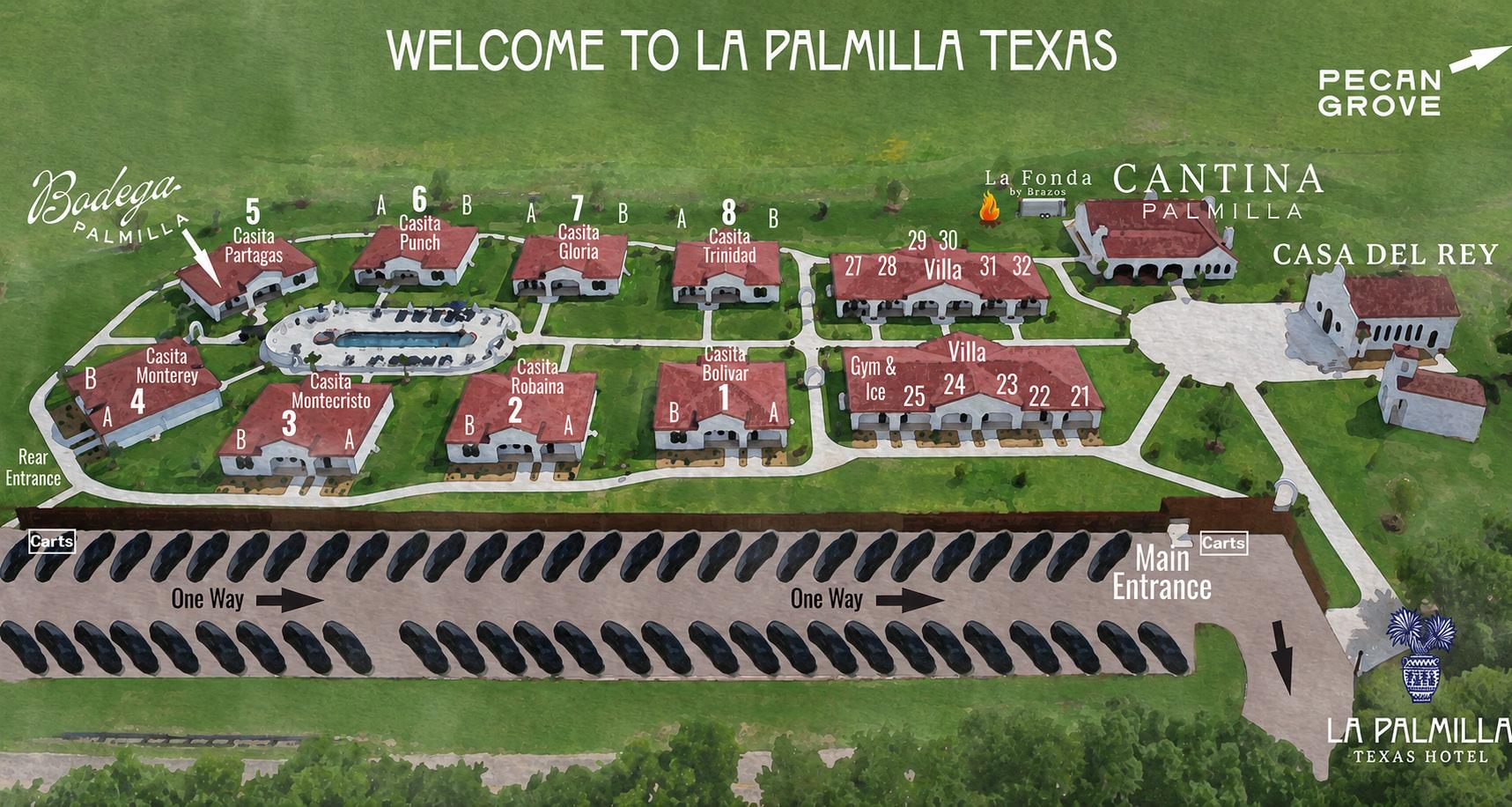
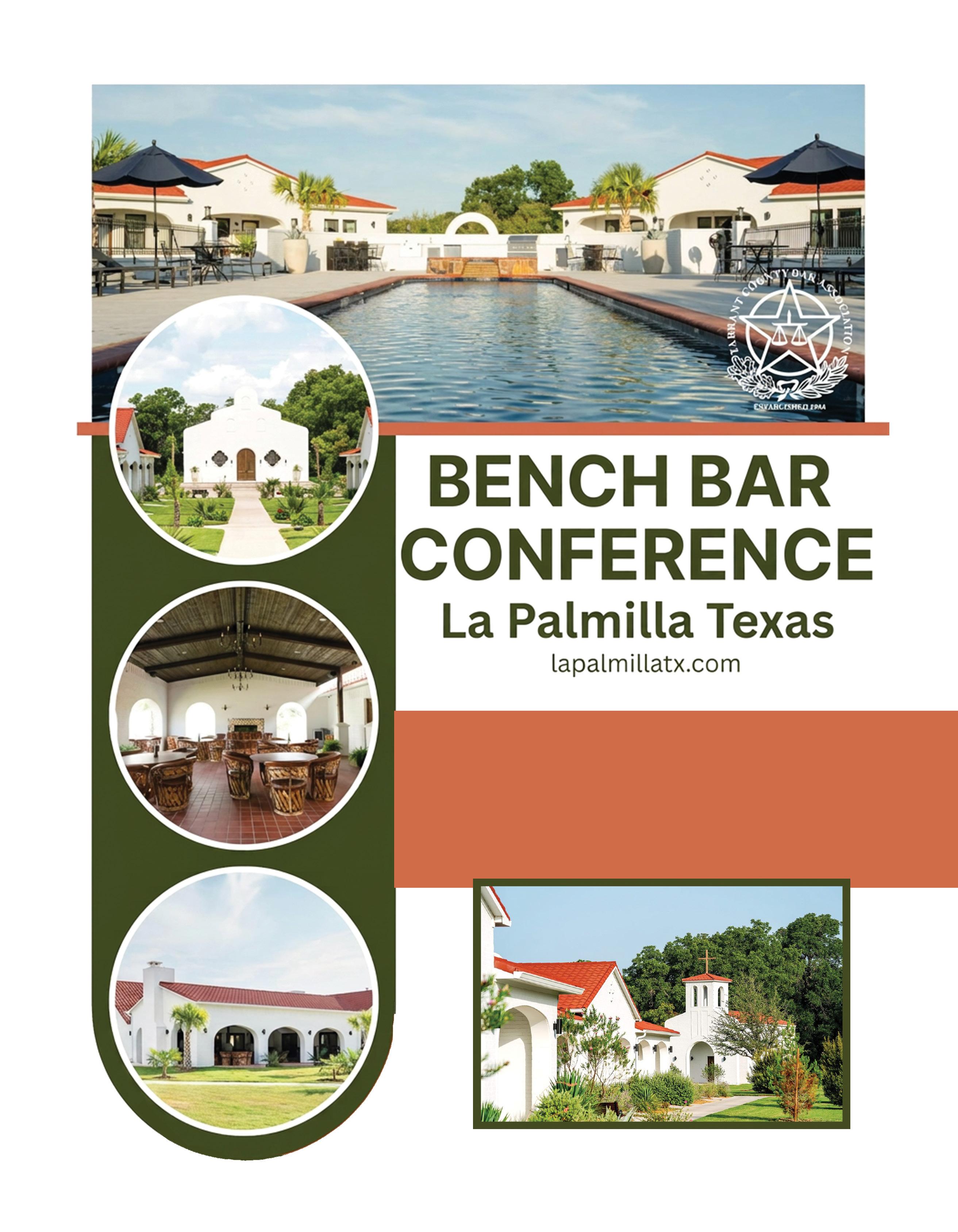
In 2027, we’re taking that experience in a new direction. From April 16–18, 2027, the TCBA will gather at La Palmilla Texas in Glen Rose. This is not a traditional hotel conference center with ballrooms and endless meeting rooms. Instead, La Palmilla offers something different: a retreat atmosphere designed for conversation, community, and connection. Think destination resort—but without the destination travel.
We’ve reserved the entire property exclusively for the TCBA, creating an experience that feels intentionally removed from the pace and pressures of everyday practice. Our CLE programming will be held in the beautiful Cantina Palmilla and the Casa Del Rey Chapel, distinctive spaces that encourage engagement and conversation rather than simply sitting through another conference in another conference room.
Accommodations are equally unique. Attendees will stay in thoughtfully designed casitas, each featuring a private bedroom and bathroom. Many of the casitas also include shared living spaces and kitchens, creating natural opportunities to gather with colleagues, continue discussions after sessions,
and enjoy the camaraderie that has always defined Bench Bar.
Beyond the educational programming, La Palmilla offers plenty of ways to recharge and connect. The property features a pool and hot tub, pickleball court, fitness center, beautiful pecan grove, and nearby river access. And because Bench Bar is about more than CLE, we’re exploring ways to incorporate some of the area’s unique attractions into the weekend, with possibilities including Squaw Valley Golf Course, Fossil Rim Wildlife Center, and Dinosaur Valley State Park.
One of the things that makes Bench Bar 2027 so special is its intentionally intimate setting. With just 32 rooms and 49 beds available on-site, the experience will feel less like a large conference and more like a private retreat shared with colleagues and friends. We’ve also arranged discounted overflow accommodations at a nearby hotel, but if you’ve already pictured yourself enjoying morning coffee on a casita patio or an evening conversation by the pool, mark your calendars now—registration opens in January, and we expect on-site rooms to go quickly.
The heart of Bench Bar remains the same. You’ll still find the exceptional CLE, meaningful conversations, and relationships that have made this conference special for decades. The setting, however, is something entirely new. Your favorite programming. A completely new atmosphere. g
Five Considerations for Effectively Valuing Intellectual Property
By Robert Allen Whitley Penn, LLP | robert.allen@whitleypenn.com
In the modern economy, a company’s most valuable assets may not show up on a standard balance sheet. Intangible assets/intellectual property (IP), such as customer lists, internally developed technology, or trade names/marks, may drive the operations and profits of a business but be “hidden assets.” Whether the context is a potential transaction, a licensing arrangement, litigation, or tax planning, a solid IP valuation is based on a few core considerations:
1. What is the purpose or intended use of the valuation?
The approaches, methodologies, and assumptions in an IP valuation may depend on the purpose or intended use of the valuation. For example, a potential sale transaction might call for a valuation from a “most likely buyer” perspective. This could call for differing assumptions as compared to a fair market value analysis based on the notion of a “hypothetical willing buyer and seller.” Is the IP to be valued as a standalone asset or in the context of a business enterprise? The answer could impact the choice of methodologies or inputs. Clarity on the purpose and intended use can avoid missteps or misunderstanding in the valuation process.
2. Is the IP defensible?
The value of IP could vary materially based on the defensibility of the asset. Is the IP properly registered? How long will it remain viable? For patents and trademarks in particular, scope of protection and enforceability can materially affect value.
3. How does the IP actually create value?
Effective valuations are grounded in the real economics of the IP. Understanding how the subject IP generates revenue, reduces costs, or produces some other type of economic benefit is crucial. Does the IP stand on its own as a revenuegenerating product? Is the asset a contributory asset that must be combined with other assets to create value? Does a brand allow a company to charge a premium price for its products or services? Clear attribution is critical, particularly when applying income-based methods.
4. Which approach or method is best?
Use of the cost, market, and income approaches often comes down to the facts and circumstances of the subject asset and the situation. Development-stage or pre-revenue IP may be best valued under a cost approach, while mature, revenuegenerating IP may be best analyzed with an income or market
approach. Market data can provide a solid basis of support, but establishing true comparability may be a challenge. Use of multiple methods can provide a basis for comparison, but only if the methods are appropriate and well-executed.
5. Are the assumptions and inputs reasonable and supportable?
The choice of appropriate methodology may not mean much if the methodology has flawed or unsupported inputs and assumptions. Forecasts, estimated useful lives, and risk are critical underlying factors that can lead to an unreliable valuation result. Reasonable and supportable assumptions are key to a reasonable and supportable valuation result.
In practice, IP valuation requires as much qualitative analysis as it does quantitative analysis. Turning valuation into a black-box exercise may be efficient, but the result may not make sense and/or hold up in the face of review and scrutiny. The best results come when the analysis and resulting value make sense in light of the story and the reasonably expected economics. g
By Tracy Card, CLE Director TCBA Sections Liaison
Looking Ahead to a New Bar Year
Welcome to the New Bar Year! I would like to thank you all for your participation in your sections and for everyone’s hard work. We are once again in full swing for the new Bar Year, so watch your calendars for some exciting events! If you are looking for more ways to get involved with the Association, let me encourage you to get involved with your sections. We are also working on filling board positions, so if you are interested in helping, please let me know by emailing tracy@tarrantbar.org. g
MENTOR MONDAY SEMINAR SERIES
In Conversation with... Joe Cleveland
Brackett & Ellis, P.C. and 2026–2027 TCBA Vice President
Q: You’ve spent more than 30 years practicing complex commercial and intellectual property litigation. What initially drew you into this area of law and what has kept you engaged in it over the years?
I began my career as a law clerk for Judge Eldon B. Mahon at the United States District Court. During my time there, Judge Mahon occasionally handled intellectual property cases. When I later entered private practice, I continued working on intellectual property matters, and that area of my practice has grown significantly over the past 30 years.
I believe this growth is largely due to my active involvement in both the Intellectual Property Section of the Tarrant County Bar Association and the Intellectual Property Section of the State Bar of Texas, where I eventually served as chair. Through this involvement, I developed strong relationships with intellectual property attorneys across Texas.
As a result of working closely with these attorneys, I began receiving an increasing number of referrals from colleagues within the intellectual property field and related practice areas.
Q: What advice would you give to lawyers who want to develop deep expertise in a particular area of practice?
I recommend developing a relationship with a strong mentor who practices in this area. The United States Patent and Trademark Office also offers internship opportunities that can help newer attorneys better understand how the Office operates.
Additionally, attending high-quality continuing legal education programs—particularly those offered by the Intellectual Property Section of the State Bar of Texas—is an excellent way to build knowledge in this area. If possible, I would also suggest observing an intellectual property trial,
as it provides valuable, practical insight into how these cases are handled in court.
Q: What qualities do you believe are most important in earning the trust and respect of clients, courts, and colleagues?
I follow the Golden Rule—treat others as you would like to be treated. Always approach others with respect and professionalism. Honor your commitments, whether it is what you have agreed to do or not to do. At all times, communicate with the court and opposing counsel with candor, respect, and professionalism.
Q: Why is it important for lawyers to contribute to shaping the profession beyond their individual cases?
I believe it is important for lawyers to play an active role in shaping the laws of our state and country. Lawyers are trained to carefully draft and analyze language, whether in contracts, legal arguments, or proposed legislation. Our state benefits when skilled attorneys contribute to developing laws that help resolve disputes in a fair and even-handed manner.
Lawyers are uniquely qualified to serve society in this way, and I believe every lawyer has a responsibility to contribute. The Texas Lawyer’s Creed, for example, encourages participation in pro bono work. When you take on a meaningful cause, you will often find many other lawyers willing to join you in that effort.
For these reasons, I strongly encourage every lawyer to find ways—large or small—to help improve our legal system.
Q: What separates truly effective advocates from the rest?
Effective advocates are, first and foremost, honest and straightforward with the court. They present the facts and the law clearly, without minimizing or overstating them.
They also tell their client’s story in a compelling way, using analogies and storytelling techniques to help the judge or jury understand the evidence and reach an informed decision. In the end, effective advocacy combines candor with a persuasive, well-structured presentation that aligns with the facts and the law.
Q: Were there mentors who played an important role in your career development, and how have those
experiences influenced the way you mentor younger lawyers today?
I’ve been fortunate to benefit from excellent mentors throughout my career, including Judge Mahon, Ted Mack, Richard Gately, and many other respected attorneys in our legal community. Early in a lawyer’s career, it is important to learn from experienced practitioners and understand how the law is practiced in our legal community.
As you become more seasoned, however, I believe it is equally important to give back by mentoring others and fostering the same sense of guidance and support that you received along the way.
Q: What would you be doing if you weren’t a lawyer?
I’m honestly not sure. I truly enjoy practicing law—the challenges it brings, the camaraderie among the bar and the judiciary, and the opportunity to help solve people’s problems. It’s something I find deeply rewarding, so I can’t easily imagine doing anything else. g
Joe spoke during May’s Mentor Monday Seminar, an interactive, informative session moderated by Steve Laird. Watch the recorded session and earn 1 hour of free ethics CLE at www.tarrantbar.org/cle-mentor-monday-cleveland.
Why 18-Wheeler Cases are Different
By Seth McCloskey Law Offices of Laird & McCloskey | mccloskey@texlawyers.com
Board of Directors
Atractor-trailer can weigh up to 80,000 pounds fully loaded — roughly 20 times the weight of an average passenger car. When a big rig crashes, the consequences are rarely minor — and often catastrophic. Yet many injury lawyers approach a trucking case the same way they would a routine fender-bender, soft-tissue injury case. That is a costly mistake — and one which may embroil an unwitting attorney in legal malpractice. Commercial trucking cases are legally, factually, and strategically different from ordinary carcrash cases, and understanding why can mean the difference between adequate representation and inadequate compensation for your client.
It’s Usually a System Failure, Not Just a Bad Driver:
The first thing to understand is that most serious trucking crashes are not caused by a single moment of inattention. They are the product of a system failure — a chain of bad decisions, ignored warnings, and unmet legal obligations stretching from the driver’s seat all the way up to the boardroom.
The trucking industry is one of the most heavily regulated industries in America, and for good reason. Commercial motor vehicles (CMVs) travel millions of miles each year on roads shared with passenger vehicles, cyclists, and pedestrians. In 83% of fatalities involving 18-wheelers, it is the occupants of the passenger vehicle — not the truck — who die. The federal government recognized long ago that the potential for catastrophic harm demanded strict rules. The result is a dense body of law known as the Federal Motor Carrier Safety Regulations (FMCSRs), found at Title 49 of the Code of Federal Regulations (C.F.R.), Parts 350–399.
Despite this regulatory framework, the trucking industry has a troubling track record of non-compliance. In practice, federal oversight is often reactive rather than proactive and enforcement tends to follow crashes rather than prevent them. The gap between the rules on paper and the practices on the road is where serious injuries occur, and where significant cases are built.
The Web of Potentially Responsible Parties:
One of the biggest differences between a trucking case and a standard car-crash case is the number of entities that may share legal responsibility. A typical trucking incident can involve:
The driver, who may have violated hours-of-service rules, operated with a disqualifying medical condition, or used a handheld electronic device, among other factors.
The motor carrier (trucking company) , which may have negligently hired, trained, supervised, or retained the driver, or may have failed to maintain the vehicle or provide a safe route for travel.
The chameleon carrier, which may be a motor carrier with a new, different, USDOT number but operated by and through a former company with the same owners, drivers, and vehicles. Chameleon carriers are often high-risk, dangerous motor carriers who are attempting to evade safety enforcement by hiding behind a new name and number.
The broker or logistics company, which arranged the shipment and may bear liability for negligent brokering under federal regulations and common law, which includes negligent selection of the motor carrier.
The double broker, which obtained the shipment from either the original broker or shipper as a motor carrier or broker, and then re-brokered the load to a different, less safe, unknown, or unvetted motor carrier for transport.
The shipper, which loaded the cargo and may be responsible if improperly secured freight caused or contributed to the crash.
Vehicle owners and manufacturers, who may bear responsibility for mechanical defects.
Insurance adds another critical layer. Motor carriers operating in interstate commerce are required to maintain minimum coverage and, in most cases, a federally mandated endorsement known as the MCS-90, which ensures that a judgment against the carrier can be collected even if coverage disputes arise. An unfamiliar or unqualified injury attorney may not understand the various layers of coverage and applicable sureties that protect the motoring public. Understanding these insurance structures — primary coverage, excess layers, self-insured retentions (SIRs), and endorsements — is essential from day one.
The Federal Regulations:
While the FMCSRs make up approximately 690 pages of safety laws, the regulations are truly designed to protect the motoring public, not to simply punish a negligent driver and company for making a singular mistake. The FMCSRs define in precise detail what motor carriers and their drivers must do — and must not do. When a carrier or driver falls short, those regulations become the standard of care in litigation. Some of the most important provisions for CMV injury
cases include:
49 C.F.R. § 390.13 — Prohibits a motor carrier from aiding, abetting, or encouraging any driver to violate the FMCSRs. A carrier cannot pressure a driver to push through fatigue or skip an inspection, and if it does, it bears direct regulatory exposure.
49 C.F.R. § 391.11 — Sets minimum qualifications for every commercial driver. A carrier may not require or permit an unqualified driver to operate a CMV. Qualification requirements include age, valid CDL, medical certification, and the ability to safely drive the vehicle.
49 C.F.R. § 391.23 — Requires the motor carrier to investigate every driver applicant’s background, including contacting all prior employers for whom the applicant drove a CMV within the preceding three years, and obtaining the applicant’s driving record from every state in which the driver held a license during the same period.
49 C.F.R. § 391.25 — Requires motor carriers to conduct an annual review of each driver’s driving record to identify any disqualifying violations.
49 C.F.R. §§ 391.41–391.45 — Require that all CMV drivers be medically certified by a licensed examiner on the FMCSA’s National Registry of Certified Medical Examiners. A driver who is not medically qualified may not legally operate a CMV.
49 C.F.R. § 392.3 — Prohibits a motor carrier from permitting an ill or fatigued driver to operate a CMV. This regulation directly targets the widespread problem of drowsy driving in the industry.
49 C.F.R. §§ 392.80 and 392.82 — Prohibit the use of handheld mobile telephones and texting while operating a CMV.
49 C.F.R. §§ 392.7 and 396.1–396.19 — Require motor carriers to systematically inspect, repair, and maintain every CMV in their fleet. A carrier that knows of a mechanical defect and puts the truck on the road anyway has violated federal law — and likely multiple common-law duties.
Hours of Service: The Math Doesn’t Lie
Fatigued driving is one of the deadliest problems in commercial trucking. To combat it, federal law strictly limits how long a driver can operate before resting. Under 49 C.F.R. § 395.3, a property-carrying CMV driver may drive a maximum of 11 hours within a 14-hour window after coming on duty, and may not drive at all after 60 hours on duty in 7 consecutive days (or 70 hours in 8 consecutive days).
When a carrier’s records show a driver logged, for example, 60,000 miles in 60 days, the math reveals the fraud. Traveling 1,000 miles per day at legally permitted speeds, limited to 11 driving hours in any 14-hour period, and subject to mandatory 34-hour restart requirements under § 395.3(c), the numbers simply do not add up. In some cases I’ve had, driver applicants have claimed to drive 30,000 miles in a single month — an impossible feat if abiding by safety regulations.
Yet often these applicants are still hired, thus demonstrating the corporate liability for negligent hiring and training. Miles driven versus hours logged is one of the most powerful analytical tools in a trucking plaintiff’s arsenal.
Since December 2017, most CMV drivers have been required by 49 C.F.R. Part 395, Subpart B to use an Electronic Logging Device (ELD) — a (supposedly) tamper-resistant device that automatically records driving time, engine hours, and vehicle location. ELD data is often more reliable than paper logs, but it is not infallible, and contrary to popular marketing assertions (and the trucking industry as a whole), ELDs can and are sometimes manipulated (e.g., the driver unplugs the device and replugs it in when he arrives at his destination).
Drive Qualification Files: The Hiring Record That Doesn’t Lie Either
Under 49 C.F.R. § 391.51, every motor carrier must maintain a Driver Qualification File (DQF) for each driver it employs. The DQF must contain the driver’s employment application, motor vehicle records, road test results, medical certificates, and documentation of annual driving record reviews. These files must be preserved for the duration of employment and for three years after the driver leaves the company.
In litigation, the DQF is often the first smoking gun. A DQF riddled with prior accidents, moving violations, and unanswered red flags — combined with proof that the motor carrier never acted on them — is powerful evidence of negligent hiring, negligent retention, and institutional indifference to safety.
Spoliation and Preservation of Evidence Issues:
It is often said that trucking cases are won or lost in the first 72 hours after a crash. Modern commercial trucks generate enormous amounts of electronically stored information, and much of it is automatically overwritten unless a preservation demand is served immediately. In fact, some data actually disappears the moment the engine is started back up and the CMV begins to move post-collision. Key data sources include:
Engine Control Module (ECM) and Event Data Recorder (EDR): Capture vehicle speed, throttle position, brake application, and other critical data in the seconds before impact.
GPS and telematics data: From systems like Qualcomm, Omnitracs, or Lytx, which log location, speed, and driver behavior on a rolling basis.
Dashcam and outward-facing video: From systems like SmartDrive or Verizon Connect, which may capture the crash itself or the driver’s conduct in the minutes leading up to it. Unfortunately, oftentimes I see drivers intentionally covering the inward-facing cameras with a sun visor or paper, thus obstructing the inward view at the time of the crash.
Onboard messaging and dispatch communications: Which can reveal pressure from the carrier on the driver to push through fatigue, delay, or unsafe road conditions.
A comprehensive spoliation letter must be sent to all JULY/AUGUST 2026
potentially responsible parties — the carrier, driver, broker, and shipper — within days of the crash, demanding preservation of all of this data as well as the physical truck and trailer. Waiting too long means the evidence disappears, sometimes permanently.
Common Law Claims: Layering the Theory of Recovery
The FMCSR violations do not stand alone. They establish the standard of care and help prove it was breached. The underlying common-law causes of action give the plaintiff the vehicle for recovery. Against the driver, the claim is typically negligence. Against the motor carrier, the claims include respondeat superior (employer liability for the driver’s conduct), negligent hiring, negligent training, negligent supervision, and negligent retention. Against brokers, shippers, and logistics companies, negligent selection, negligent entrustment, negligent loading, and negligent routing may apply.
The layering of sources is critical in trial preparation. A carrier’s own safety manual, internal policies, CDL training materials, the applicable FMCSR provisions, the Commercial Driver’s License (CDL) Handbook, and industry defensive driving standards can all be used together to establish a standard of care that is indisputable, provable, and fair — and then to show precisely how the defendant fell short of it and should be held responsible for the catastrophic injuries that occurred.
What the Verdicts Tell Us:
Corporate misconduct in trucking cases does not go unnoticed by Texas juries. The industry calls these outcomes “nuclear verdicts.” But in my opinion, a nuclear verdict requires a nuclear failure first. These results did not come from runaway juries acting irrationally. They came from carriers whose systemic failures were documented, provable, and, ultimately, indefensible.
This Is Not a Car Crash Case:
When a commercial truck crashes, a trained plaintiff’s lawyer should not ask, “What did the driver do wrong?” They should ask, “What did the entire system do wrong?” The answer — revealed through electronic data, qualification files, hoursof-service records, maintenance logs, broker contracts, and dispatch communications — is often: quite a lot.
The FMCSRs give injured Texans a powerful, federally mandated standard of care. Add to this the training and resources available to trucking outfits (like the Commercial Motor Vehicle Driver’s Handbook, etc.), and the standard of care framework becomes clear. The obligation to know that standard, enforce it, and hold carriers accountable for violating it belongs to the lawyers who represent the people in the passenger vehicles — the ones who make up the vast majority of the fatalities and are defenseless against an 80,000-pound
Bankruptcy and Collections Issues for Landlords and Tenants
By Sam Johndroe Johndroe Law, PLLC | sam@johndroelaw.com
Bankruptcy and collections issues often arise in landlord/ tenant relationships, with various rights and remedies available to commercial and residential landlords and tenants across Texas. Tenants often get behind on rent or may owe other amounts, such as for late fees or property damage. Landlords often want to collect these amounts and may occasionally use improper means of collection. Sometimes amounts owed are disputed. Sometimes, whether any amount at all is owed is disputed, such as when there is a dispute over whether a tenant had a legal right to terminate his or her lease. Tenants who get behind on their bills sometimes file bankruptcy, which creates difficulties for landlords seeking to evict.
The eviction process itself can provide opportunities for landlords to collect delinquent rent. Under Senate Bill 38, which went into effect for eviction cases filed starting in January of this year, landlords now have the option to send a “notice to pay or vacate” rather than an unconditional notice to vacate. In some cases, a “notice to pay or vacate” is now required. This can provide an opportunity for landlords to collect—and an incentive for tenants to bring their delinquencies current to avoid eviction.
Moreover, residential tenants appealing eviction judgments from justice courts to county courts at law must pay rent into the court registry, from which the landlord can withdraw. This provides an opportunity for landlords to collect a portion of what they are owed.
While eviction lawsuits are highly expedited and limited in scope under Texas law and a landlord cannot obtain general relief in an eviction suit, a judgment for delinquent rent accruing through the eviction trial is available (in addition to possession of the property, attorney’s fees, and court costs).
Landlords seeking to collect additional amounts can file separate lawsuits for breach of contract and any other appropriate causes of action, which can be prosecuted concurrently with eviction suits, after an eviction suit, or in lieu of an eviction suit. Oftentimes, these lawsuits can be resolved quickly and efficiently with a default judgment or motion for summary judgment (a motion for summary judgment is not applicable if filed in the justice of the peace court; in these courts, a different “motion for summary disposition” may be available).
Many apartment complexes and larger property management companies will also use third-party debt collection agencies to attempt to collect from tenants. Sometimes they will use these agencies without first filing suit or obtaining
a judgment. Other times, a landlord will obtain an eviction judgment, but a debt collection agency may nonetheless be used to attempt to collect not just this amount, but also a larger amount that may be owed. Attempting to collect a larger amount than that awarded in an eviction judgment is not always improper as the relief available in eviction judgments is very limited and these judgments do not necessarily reflect all that is legitimately owed.
Aside from evictions and other means, commercial landlords also have the option to exercise statutory lockout remedies under Chapter 93 of the Texas Property Code. While some terms can be modified in a lease, the statutory commercial lockout procedure generally requires commercial landlords to provide a new key to tenants who get caught up— providing another opportunity for landlords to collect and an incentive for tenants to correct delinquencies. Particularly in the commercial context, landlords may also have options to exercise statutory or contractual landlord’s liens.
Judgments in eviction, breach-of-contract, or other litigation can be abstracted and pursued with writs of garnishment, writs of execution, receiverships, turnover orders, postjudgment discovery, and other means typically available to judgment creditors. Many tenants are judgment proof, but receiverships in particular may be useful to some landlords seeking to collect.
Bankruptcies also commonly complicate landlord/tenant relationships. Tenants often file bankruptcy to delay evictions, with co-debtor stays often also being an issue. There are some exceptions and limitations to the automatic stay’s applicability, particularly for repeat bankruptcy filers. And landlords can seek relief from the stay to be able to proceed with evictions and/or adequate protection. Moreover, landlords with tenants who are delinquent in the payment of rent or other amounts are creditors who can file proofs of claim in bankruptcies.
Sometimes disputes arise over whether collection is appropriate. Tenants may have a number of claims when landlords make improper collection efforts. I often see tenants terminate their leases and vacate early—for all kinds of different reasons. Sometimes tenants may have reasonable reasons for vacating, but may still not have the legal right to be released from their lease. Other tenants do have a statutory right to terminate their leases. For example, residential tenants can terminate their leases due to habitability issues after going through a strict procedure, including giving notice and an opportunity to repair.
The landlord may say the tenant had no such right to terminate, accelerate rent, and send the amount to a collection
agency. In these cases, if termination was legally allowed, a tenant may have claims for violations of state or federal debt collection or other laws, and/or may seek declaratory judgments or other relief.
Even when a tenant did not have a legal right to terminate, legitimate disputes can still arise with accelerated rent or rent that became due after the tenant vacated. Even when tenants vacate and stop paying rent without any kind of legal excuse, Texas law requires that landlords mitigate their damages by attempting to find replacement tenants (and not “double dipping” when they do). In other cases, attempting to collect rent through the end of the lease can be improper.
Security deposits can be a valuable tool to protect landlords from delinquent rent and property damage. However, they must be properly handled and accounted for. Texas law is generally landlord-friendly, but much more tenant-friendly when it comes to deposits. Statutory claims are available to both residential and commercial tenants who feel their deposits were not properly returned or itemized. Landlords must comply with strict procedures for accounting for deposits
when not fully returned. Deposits cannot be used for normal wear and tear. Improper retention or accounting can lead to treble damages and other relief for the tenant.
This is only a brief overview of some of the bankruptcy and collections-related issues that arise in landlord/tenant relationships. If you have any questions, please feel free to email me at sam@johndroelaw.com. g
Sam spoke during May’s Brown Bag Seminar Series: Collections.
Watch the recorded session and earn 3 hours at www.tarrantbar.org/ brown-bag-collections-2026.
Section CLEs
Bankruptcy Law Section
Topic: “Top Ten Trial Tips from the Fort Worth Bankruptcy Bench”
Speakers: Judge Edward L. Morris, United States Bankruptcy Court for the Northern District of Texas
Judge Mark X. Mullin, United States Bankruptcy Court for the Northern District of Texas
CLE: 1 hour (Free for Section Members | $20 Non-Section Rate)
Construction Law Section
Topic: “Truth or Tech – Navigating AI Generated Evidence in the Courtroom”
Speaker: Beth Silverman, ArcherHall
CLE: 1 hour (Free for Section Members | $20 Non-Section Rate)
Energy Law Section
Topic: “From Pipelines to Powerlines – Opportunities and Obstacles for Energy in the Rapid Growth of Data Centers”
Speaker: Mark Doré, The Doré Law Firm, LLC
CLE: 1 hour (Free for Section Members | $20 Non-Section Rate)
Fort Worth Business & Estate Section
Topic: “Income Tax Saving Ideas: Become a Hero to Your Client”
Speaker: John R. Hunter, The Blum Firm
CLE: 1 hour (Free for Section Members | $20 Non-Section Rate)
Mentor Monday Seminar Series with Steven C. Laird
Guest Speaker: Judge Pat Gallagher, 96th District Court 1 hour Ethics (FREE for TCBA Members)
Guest Speaker: Lu Pham, Pham Harrison, LLP 1 hour Ethics (FREE for TCBA Members)
Guest Speaker: Major Brandon Reese, USMC 1 hour Ethics (FREE for TCBA Members)
Connecting Top Employers with Premier Professionals.
EMPLOYERS: Find Your Next Great Hires
• PLACE your job in front of our highly qualified members
• SEARCH our resume database of qualified candidates
• MANAGE jobs and applicant activity right on our site
• LIMIT applicants only to those who are qualified
• FILL your jobs more quickly with great talent
PROFESSIONALS: Keep Your Career on the Move
• POST a resume or anonymous career profile that leads employers to you
• SEARCH and apply to hundreds of new jobs on the spot by using robust filters
• SET UP efficient job alerts to deliver the latest jobs right to your inbox
• ACCESS career resources, job searching tips and tools tarrantbar.careerwebsite.com
Contact TCBA Career Center 's customer service department at clientserv@communitybrands.com for more information.
Civil District Court Jury Trial Verdicts
April 2026–May 2026
4/1/2026–5/31/2026 sorted by judgment date.*
*Does not include cases designated as “on appeal” with the Clerk’s Office as of 6/15/2026.
HELEN COLLIE V. DEONDRICK WILLIAMS, PURITY OILFIELD SERVICES LLC, AND OMNI ENERGY SERVICES CORP.
342-356670-24
Hon. R.H. Wallace Jr. (342nd District Court)
Trial: March 2–3, 2026
Judgment: April 6, 2026
Attorney – Plaintiff(s): V. Paige Eldridge
Attorney – Defendant(s):
John M. Pease and Jonathan M. Spigel
Summary:
Plaintiff sued following a motor vehicle collision involving a tractor-trailer operated by Defendant Deondrick Williams in the course and scope of his employment with Purity Oilfield Services LLC.
Plaintiff alleged Defendant made an unsafe lane change and struck her vehicle, causing personal injuries and property damage.
The jury found that both Plaintiff and Defendant were negligent and assigned 50% responsibility to each. The jury awarded damages for medical expenses, physical impairment, pain and mental anguish, and property damage. The court entered judgment awarding Plaintiff $55,000 in damages, plus prejudgment interest and court costs.
JUAN LOPEZ-RENTERIA V. EDWARD ELIAS AMAYA
048-357506-24
Hon. Chris Taylor (48th District Court)
Trial: March 9–10, 2026
Judgment: April 10, 2026
Attorney – Plaintiff(s): Ramon Eduardo Gonzalez and James Trujillo
Attorney – Defendant(s): Sable Beard Summary:
Plaintiff asserted a motor vehicle negligence claim arising from a rearend collision. The jury unanimously found Defendant negligent and determined that Defendant’s negligence proximately caused the occurrence.
The jury awarded Plaintiff $20,200, consisting of $3,000 for past physical pain and suffering and $17,200 for past medical expenses, while awarding no future damages. Judgment was entered in favor of Plaintiff.
DOROTHY GATEWOOD AND LIDDY WILBURN V. SUSAN THOMPSON
236-352334-24
Hon. H. Dustin Fillmore III (236th District Court)
Trial: April 13–14, 2026
Judgment: April 14, 2026
Attorney – Plaintiff(s): Tesha L. Williams
Attorney – Defendant(s): Jonathan E. Cheatham
Summary:
Plaintiffs asserted negligence claims arising from a motor vehicle collision at the intersection of the I-183 service road and Southwest Boulevard. Plaintiffs alleged Defendant failed to yield the right of way and ran a red light, causing the collision and resulting injuries. The jury found that neither Defendant nor Plaintiff Dorothy Gatewood was negligent. The court entered a take-nothing judgment in favor of Defendant and taxed court costs against Plaintiff.
DE’JA ORVISS V. DONNA GIETL 153-342746-23
Hon. Susan McCoy (153rd District Court)
Trial: February 9, 2026
Judgment: April 20, 2026
Attorneys – Plaintiff(s): Scott H. Richard
Attorneys – Defendant(s): Michael D. Gorman and Tiffany Mir
Summary:
Plaintiff asserted a motor vehicle negligence claim arising from a parking lot collision in Arlington. The jury found Plaintiff negligent and found that Defendant was not negligent. The court entered a take-nothing judgment in favor of Defendant and taxed court costs against Plaintiff.
REBA GUTHRIE V. DANIEL WILLENBORG
348-360003-24
Hon. Megan Fahey (348th District Court)
Trial: April 20–21, 2026
Judgment: April 22, 2026
Attorneys – Plaintiff(s): Jackson Morrison and William Pate
Attorneys – Defendant(s):
R. Bruce Moon and Kyle L. Smith
Summary:
Plaintiff asserted negligence and gross negligence claims arising from a motor vehicle collision in Arlington, alleging Defendant rearended her vehicle while she was stopped at a stop sign and then left the scene before returning. In an 11–1 verdict, the jury found that Defendant’s negligence did not proximately cause the occurrence in question. The court entered a take-nothing judgment in favor of Defendant and taxed court costs against Plaintiff.
ROSA DELICA HERNANDEZ V. GLORIA PAYNE TENNISON
342-362548-25
Hon. R.H. Wallace Jr. (342nd District Court)
Trial: April 27–28, 2026
Judgment: April 29, 2026
Attorney – Plaintiff(s): Landon D. Haas
Attorneys – Defendant(s): Kathy Kassabian Reid
Summary:
Plaintiff asserted a motor vehicle negligence claim arising from a collision in Hurst, alleging Defendant ran a red light and struck Plaintiff’s vehicle. In a 10–2 verdict, the jury found Defendant negligent and found that Plaintiff was not negligent. The jury awarded Plaintiff $73,219 in damages for pain, mental anguish, impairment, and medical expenses. Judgment was entered in favor of Plaintiff, together with prejudgment interest, court costs, and post-judgment interest.
MARIA GUADALUPE
ELISEA V. KOBY TAYLOR
342-363507-25
Hon. Kimberly Fitzpatrick (342nd District Court)
Trial: April 29, 2026
Judgment: April 30, 2026
Attorney – Plaintiff(s): Zachary D. Herbert
Attorneys – Defendant(s): T. Cass Keramidas
Summary:
Plaintiff brought a motor vehicle negligence claim arising from a rear-end collision on Interstate 35 in Tarrant County. The jury returned a unanimous verdict awarding Plaintiff $10,000 in damages, consisting of $7,500 for past medical expenses, $1,250 for past physical pain and mental anguish, and $1,250 for past physical impairment. The court entered judgment in favor of Plaintiff for $12,373.25, including prejudgment interest and court costs.
BINSWANGER ENTERPRISES, LLC V. ELITE CUSTOM GLASS, LLC, LOUIE, LLC, JEFFREY EMERSON, JUSTIN BEALL, AND
ANTONY TEMPLE
141-358810-24
Hon. John P. Chupp (141st District Court)
Trial: April 6–22, 2026
Judgment: May 22, 2026
Attorneys – Plaintiff(s):
Sara Hollan Chelette, Michael Hurst, Gloria Jones-Walker, and Mary Nix
Attorneys – Defendant(s): Jason Freeman and Micah Miller
Summary:
Plaintiff, a commercial and residential glass company, asserted claims arising from the alleged misuse of confidential information, solicitation of employees, breaches of confidentiality and employee nonsolicitation agreements, and related business torts following the formation of a competing glass company. The jury unanimously found in favor of Plaintiff on claims against Defendants Jeffrey Emerson, Justin Beall, Antony Temple, Elite Custom Glass, LLC, and Louie, LLC. The court entered judgment awarding Plaintiff $469,674.29 in damages, jointly and severally against Defendants, together with $1,520,000 in attorneys’ fees, prejudgment interest, costs, and permanent injunctive relief.
DATHARIAN POTTER V. MARIA-GUADALUPE
MARTINEZ
017-363614-25
Hon. Melody Wilkinson (17th District Court)
Trial: May 19–20, 2026
Order: May 27, 2026
Attorneys – Plaintiff(s):
Dustin Brown
Attorneys – Defendant(s): Michael A. Smith Summary:
Plaintiff asserted a motor ve-
hicle negligence claim arising from a collision on Interstate 35 in Tarrant County, alleging Defendant struck Plaintiff's vehicle from behind and pushed it into a retaining wall. In an 11–1 verdict, the jury found that Plaintiff was negligent and found that Defendant was not negligent. The court entered a takenothing judgment in favor of Defendant and taxed court costs against Plaintiff.
ROBERT MORGAN V. KEONTAE WILLIAMS, MARTIN MARIETTA FLEET MANAGEMENT, LLC, MARTIN MARIETTA SOUTHWEST READYMIX, INC., MARTIN MARIETTA MATERIALS, INC., MARTIN MARIETTA TEXAS READY-MIX, LLC, TXI OPERATIONS, LLC, AND TEXAS INDUSTRIES TRUST 342-357475-24
Hon. R.H. Wallace Jr. (342nd District Court)
Trial: April 6–9, 2026
Judgment: May 28, 2026
Attorneys – Plaintiff(s): Brennan Clay
Attorneys – Defendant(s): Mark E. Stradley Summary:
Plaintiff asserted negligence claims arising from a motor vehicle collision involving a tractor-trailer operated by Defendant Keontae Williams in the course and scope of his employment with Martin Marietta. Plaintiff alleged Defendant failed to maintain a safe following distance and collided with the rear of Plaintiff's vehicle. The jury found Defendant negligent and awarded Plaintiff $110,281.39 in damages for medical expenses, physical pain, and
mental anguish. The court entered judgment in favor of Plaintiff, awarding damages, prejudgment interest, and court costs.
DAVID MICHAEL VAUGHN V. BAMWESIGE FRED KISUULI, JOSHUA PORRO, AND THERESA LORRAINE ARRINGTON A/K/A T.L. SPENCERARRINGTON 017-355045-243
Hon. Melody Wilkinson (17th District Court) Trial: May 5–13, 2026
Judgment: May 29, 2026
Attorney – Plaintiff(s):
Brian W. Butcher and Trey Harlin
Attorney – Defendant(s): Christopher T. Colby, Kelly M. Crain, and Laura S. Spangler Summary:
Plaintiff asserted negligence and gross negligence claims arising from a multi-vehicle incident on Highway 121. Plaintiff alleged that after exiting his vehicle near a disabled vehicle stopped in a travel lane, he was struck by another vehicle and suffered catastrophic injuries, including the loss of both legs. In an 11–1 verdict, the jury found that Plaintiff, Bamwesige Fred Kisuuli, and Theresa Arrington each contributed to causing Plaintiff's injuries and apportioned responsibility 14% to Plaintiff, 16% to Kisuuli, and 70% to Arrington. The jury awarded Plaintiff $39 million in damages. After reducing the award based on Plaintiff's percentage of responsibility, the court entered judgment for Plaintiff in the amount of $35,707,332.41, including prejudgment interest. g
Tarrant County Bar Association 1315 Calhoun Street
Fort Worth, TX 76102-6504 ADDRESS
If any of your contact information is incorrect, please submit the corrected information to the TCBA office at 817.338.4092, or email admin@tarrantbar.org
Member Benefits Vendor List
Limit 5 standard size boxes per member. Register: tarrantbar.org/magic-shred Friday, August 7, 2026 11:00 a.m. – 1:00 p.m. | TCBA Parking Lot
8am™ LawPay offers TCBA members a secure, compliant payment solution for accepting client payments by card or eCheck. For a limited time, new users can pay no monthly fee for one year. Terms apply. Visit lawpay.com to claim the offer.
AMO Office Supply guarantees the lowest prices on office supplies for TCBA members, with next-day delivery and free shipping. Call 800.420.6421.
TCBA members may take advantage of discounts provided by the following vendors: Let us celebrate this
in the
of The
! To ensure recognition, please verify that the retiree is a current TCBA member.
Submit your recognition: www.tarrantbar.org/retirement-recognition Printed on Paper with 10% Recycled Fiber
EVERNET Consulting provides IT support, practice management solutions, website development, marketing, social media management, online reviews, and client outreach for law firms nationwide. TCBA members receive a discount. Visit evernetco.com/lp/tarrant-county-form/.
Falcon Document Solutions delivers fast, reliable process service, scanning, printing, copying, e-discovery, litigation displays, and trial boards. Available 24/7 at 817.870.0330 or falcondocs.com. TCBA members receive discounted rates.
Fort Worth JSB Co., Inc. offers a 10% TCBA member discount on business cards, letterhead, envelopes, brochures, flyers, and more. Call 817.577.0572 for a quote.
Fort Worth Zoo offers discounted tickets for TCBA members—$20 adult, $16 child/senior. Contact Tracy Card at tracy@tarrantbar.org or 817.338.4092.
Martinizing Cleaners offers TCBA members and employees 15% off dry cleaning and laundry services, plus a $25 gift card toward their first service. Home and office pickup and delivery available. Visit martinizing.com or contact Anne-Marie Koppy at A.Koppy@Martinizing.net or 469.254.5433.
Thomson Reuters offers TCBA members 15% off new Westlaw subscriptions or upgrades, including Westlaw Edge. Contact Ben Galloway at Ben.Galloway@TR.com.
For IT Help:
Juris Fabrilis provides members with discounted rates on web-based tools to assist in managing their law practices. For more information, call 817.481.1573 ext. 101.
For Shredding and Document Disposal:
Magic Shred offers TCBA members 10% off secure, on-site document shredding services. TCBA also hosts four free member shredding events each year, where members may bring up to five boxes. Call 940.783.6580 for details. g